
A complete issue · 32 pages · 1921
Judge — February 19, 1921
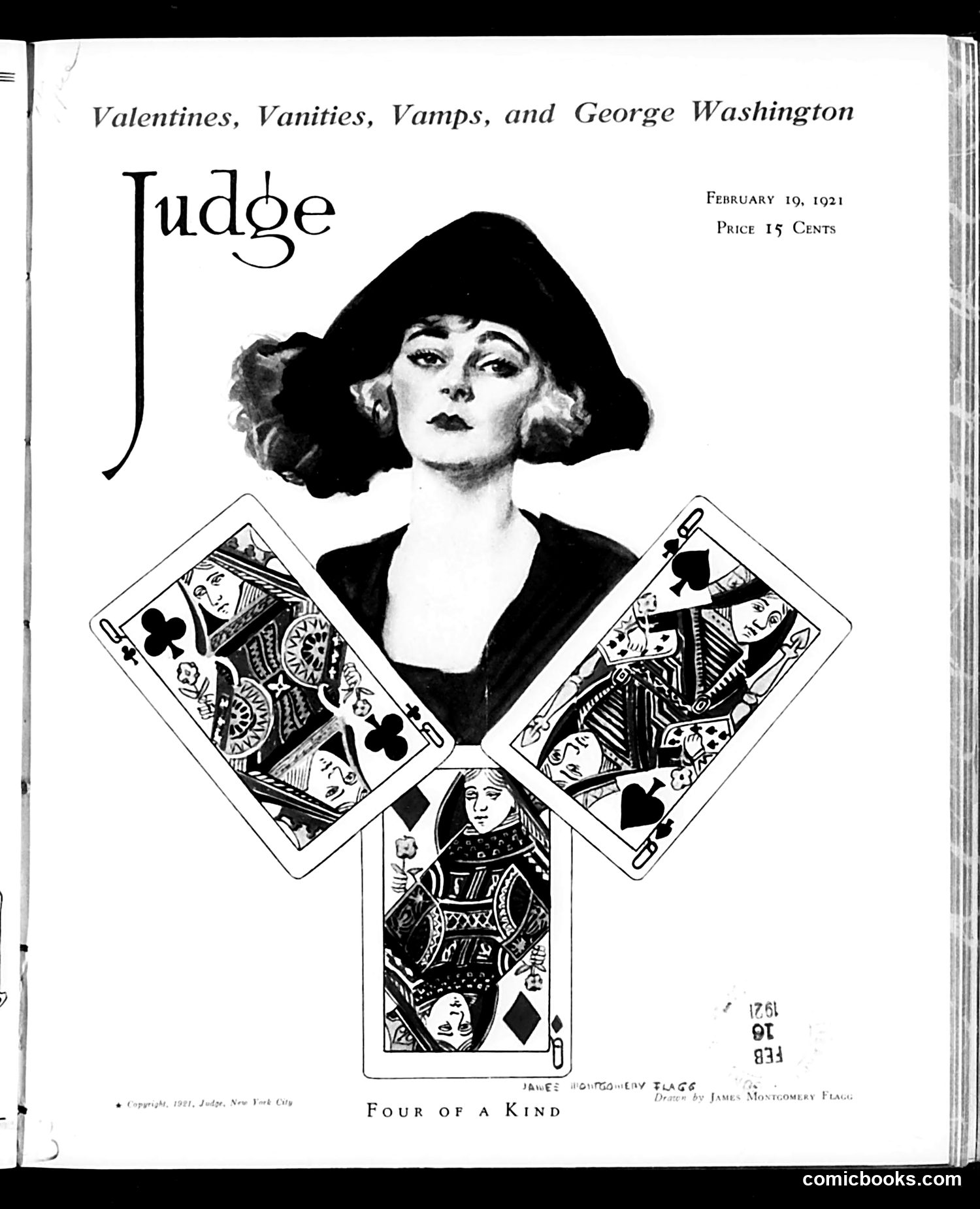
This Judge magazine cover from February 19, 1921 features artwork by James Montgomery Flagg titled "Four of a Kind." The image shows a stylish woman with 1920s bob haircut positioned above three playing cards—the Queen of Clubs, King of Spades, and Queen of Diamonds. The phrase "Four of a Kind" is a poker reference, suggesting the woman represents a fourth card in a winning hand. The satirical joke likely comments on the "New Woman" of the Jazz Age—the flapper figure with her modern appearance and independence. By comparing her to a playing card, the cartoon humorously suggests she's part of a winning combination, possibly mocking both women's changing social roles and the gambling/vice culture associated with Prohibition-era America (1920-1933).
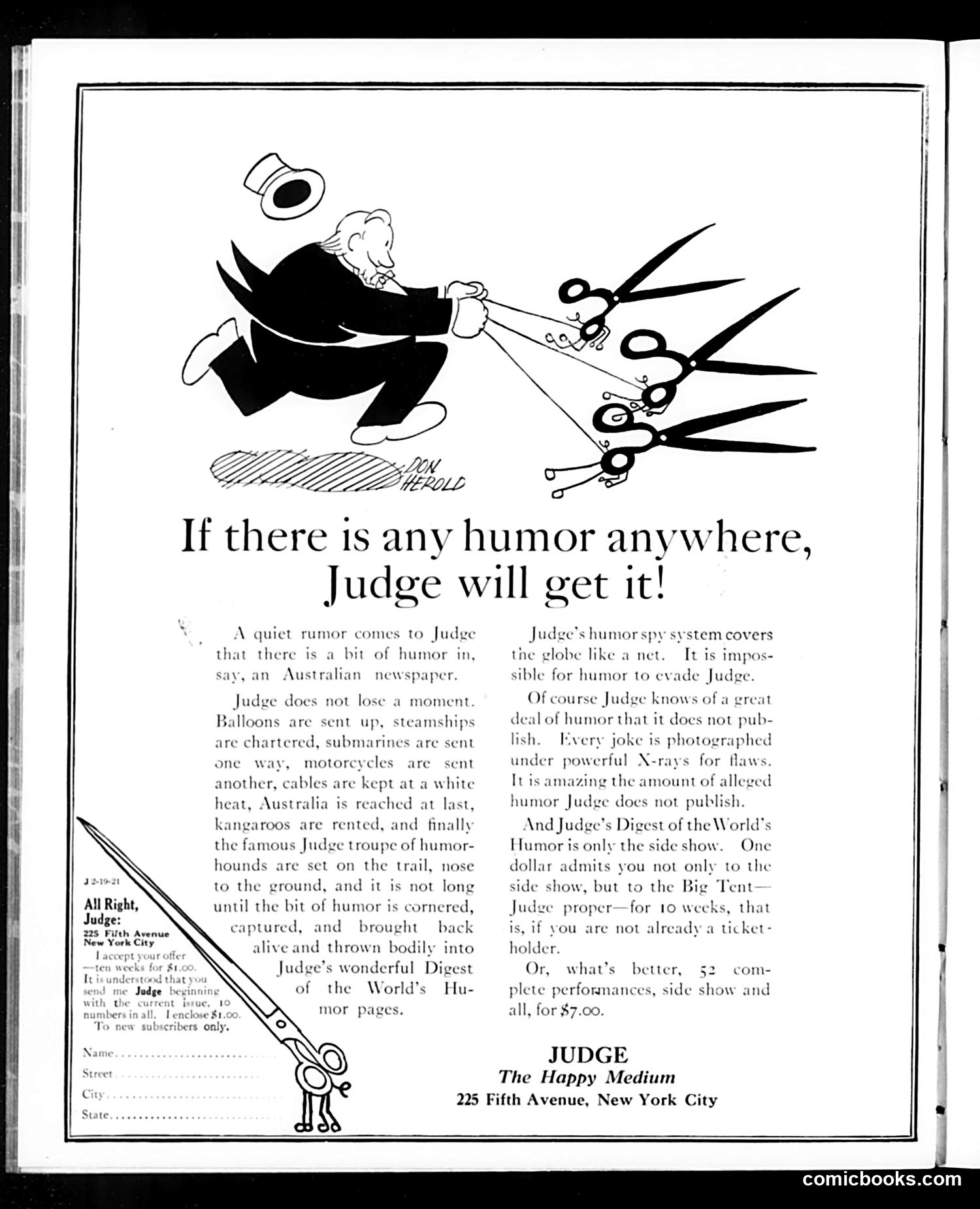
This page is primarily **advertising for Judge magazine itself** rather than political satire. The main cartoon shows a man in formal attire juggling multiple large scissors, with his top hat flying off—a visual metaphor for Judge's ability to "cut through" humor and satire wherever it exists. The accompanying text humorously claims Judge has a global "humor spy system" that catches jokes before other publications, using absurd examples (kangaroos rented in Australia, submarines sent one way) to mock its own editorial pretensions. The page includes a subscription offer ($1.00) and promotes "Judge's Digest of the World's Humor" as a side show to the main publication. It's essentially self-promotional content disguised as humorous editorial patter—common in early 20th-century magazine advertising.
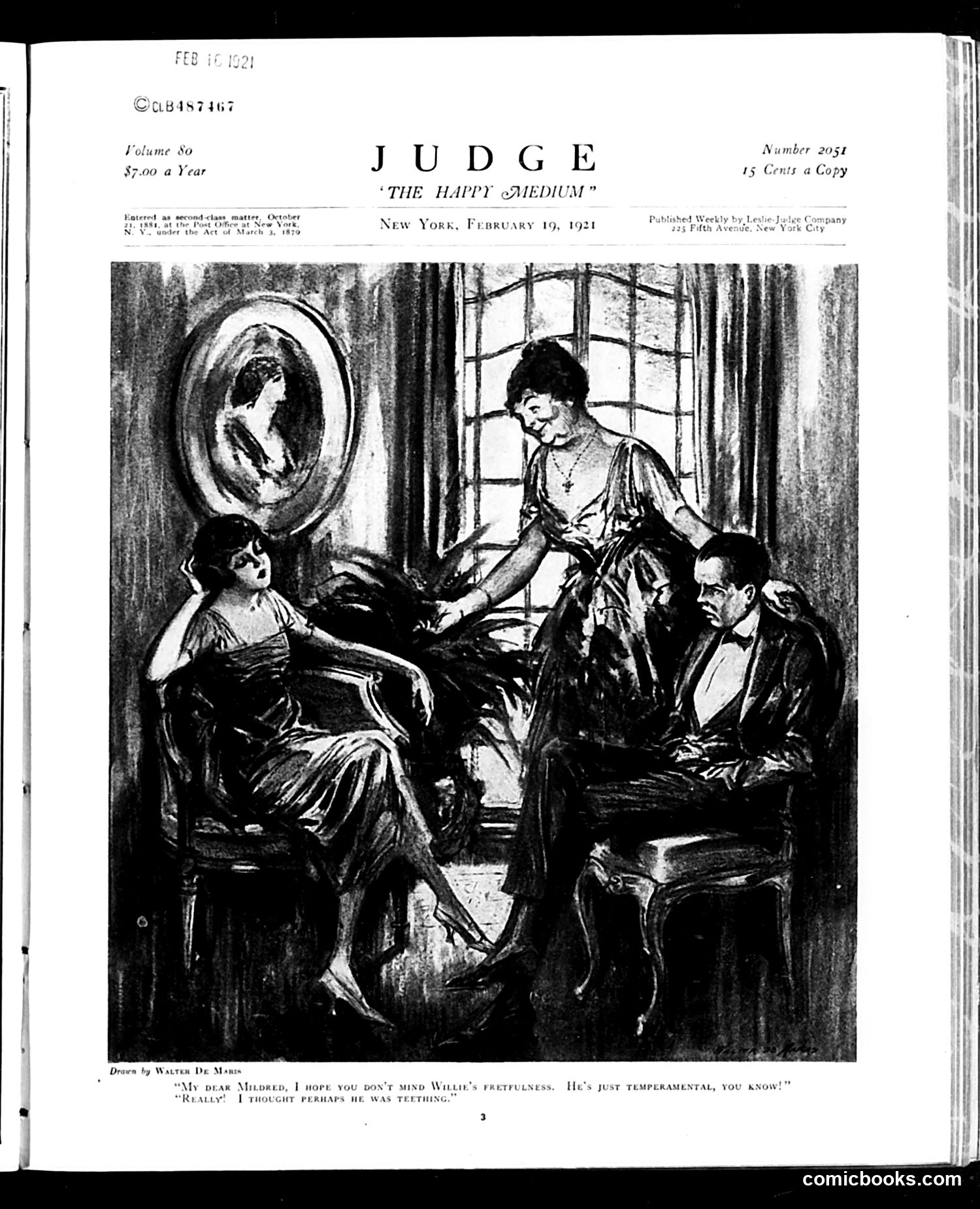
This illustration by Walter De Maris depicts a domestic scene addressing infant behavior. The caption references "Willie's fretfulness" and "teething," suggesting the cartoon satirizes contemporary parenting anxieties about babies. The scene shows a woman (likely the mother or nanny) with three adults gathered around an infant, appearing to discuss or diagnose the child's behavior. The ornate mirror and formal furnishings indicate an upper-class household. The satire appears to target either: (1) over-medicalization of child-rearing in the 1920s, or (2) the tendency of well-to-do families to summon multiple advisors for minor infant issues rather than using common sense. The caption's tone suggests gentle mockery of excessive concern about normal developmental phases like teething.
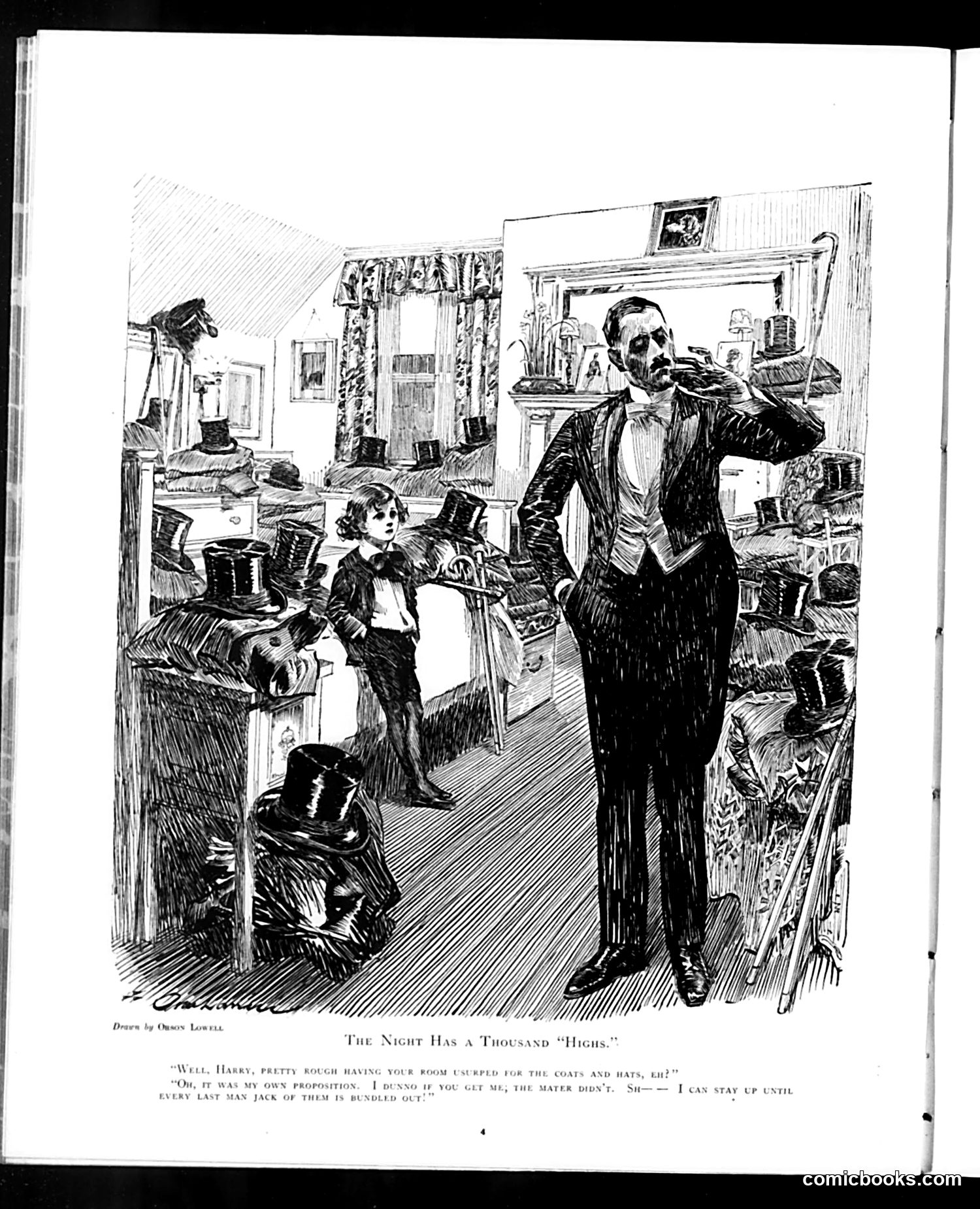
This illustration by Orson Lowell depicts a domestic scene addressing class anxiety and servant management in what appears to be late 19th or early 20th-century America. A well-dressed man confronts a young male servant about disorder in the household—coats and hats scattered everywhere. The gentleman sarcastically accuses the servant (Harry) of treating the room as his own domain, warning that "every last man jack of them is bundled out" if the master doesn't receive better service. The servant attempts explanation while appearing contrite. The satire targets the friction between employers and domestic workers during an era of rigid class hierarchy, mocking both the employer's imperious tone and the servant's defensive posture. The title's reference to "highs" likely suggests the chaotic state of the room.
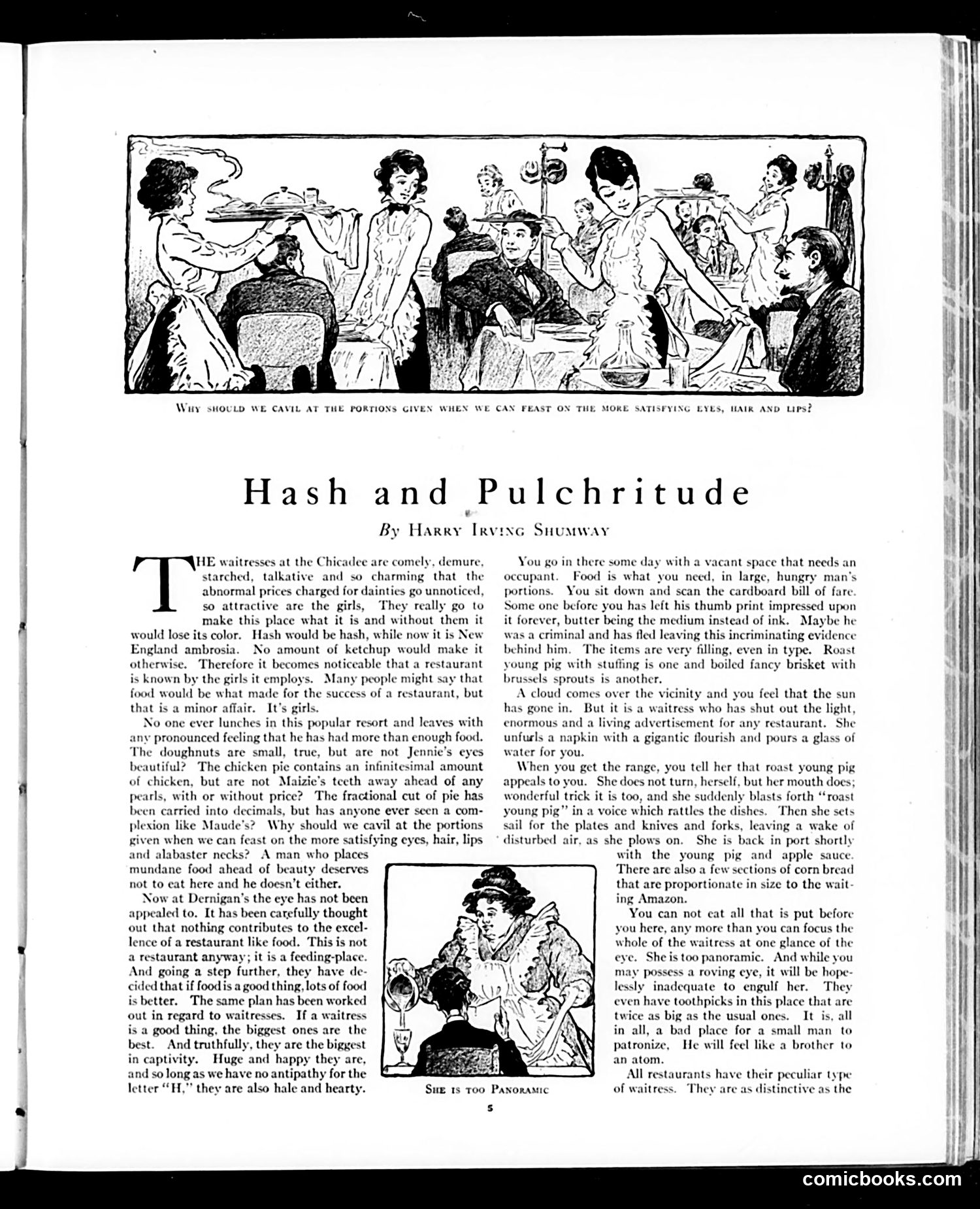
This article satirizes the contrast between poor food quality and attractive waitress service at restaurants, particularly the Chicalee. The author argues that while diners endure mediocre "hash" (cheap food), they're compensated by the visual appeal ("pulchritude") of the waitresses. The top illustration shows a lively restaurant scene with well-dressed patrons and attentive female servers. The accompanying text humorously critiques how restaurants—especially Dernigans—succeed not through culinary excellence but through employing attractive waitresses who distract customers from bad food. The piece mocks both the restaurant industry's strategy and male patrons' willingness to accept poor meals in exchange for aesthetic distraction, presenting this as a commentary on gender roles and consumer culture in early 20th-century dining establishments.
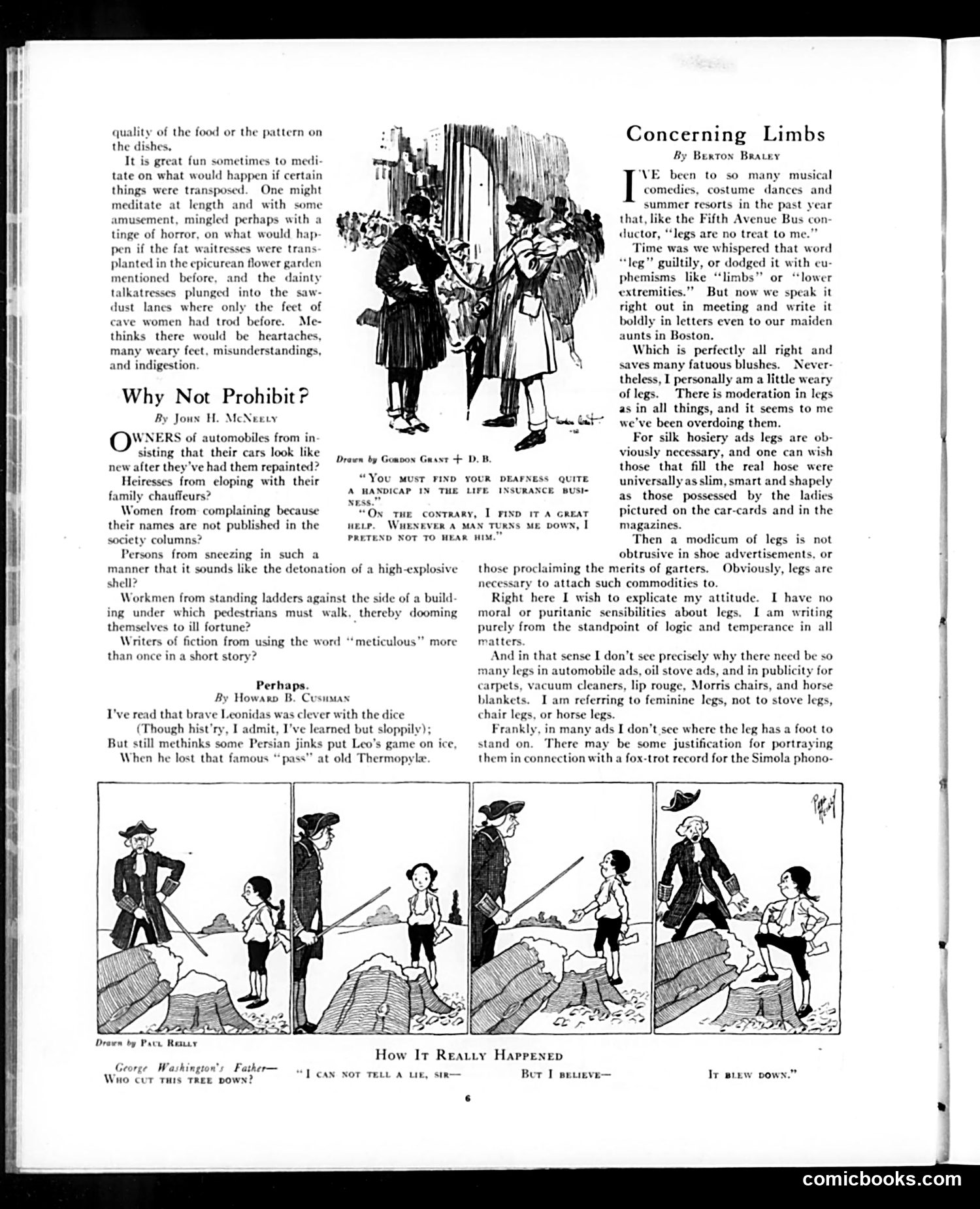
This page contains three separate articles and cartoons satirizing different topics: 1. **"Concerning Limbs"** by Bayard Bailey critiques excessive display of women's legs in advertisements and entertainment, arguing for moderation rather than prohibition. 2. **"Why Not Prohibit?"** by John H. McNeely uses absurdist humor, listing ridiculous things that could be "prohibited" (like car horns, heiresses eloping, workers on ladders), satirizing the era's prohibition movement by showing how arbitrary such bans would be. 3. **"How It Really Happened"** is a four-panel cartoon by Paul Henley about George Washington cutting down a cherry tree—the famous apocryphal story—humorously suggesting the real events differed from the legend, ending with "It blew down." The page reflects 1920s social debates around women's fashion, regulatory overreach, and American folklore.
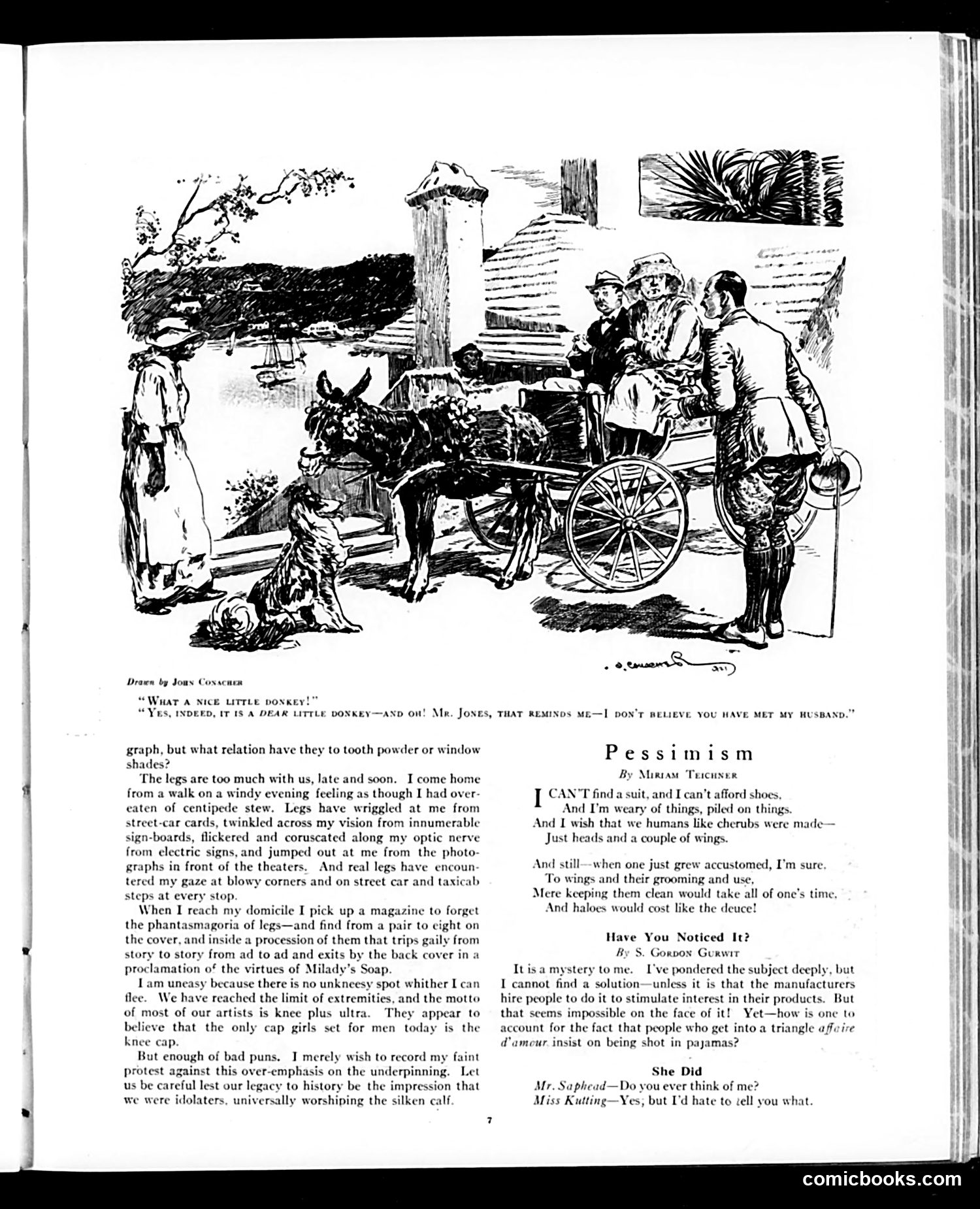
**The Cartoon:** Drawn by John Conecher, this depicts a social comedy scenario. A woman shows a man a donkey, then uses it as a conversation starter to introduce her husband—implying the husband is being compared (unfavorably) to the animal. The humor relies on the wife's backhanded insult, suggesting her spouse is as appealing or intelligent as a donkey. **The Articles:** The page contains three brief satirical pieces mocking early 20th-century social trends and attitudes: 1. A complaint about the overuse of female legs in advertising and illustration—legs appearing everywhere from streetcars to theater photos to magazine covers—the author finds this obsessive focus tiresome. 2. A poem about pessimism: the speaker wishes humans were made like cherubs (just heads and wings) to avoid life's material burdens, then realizes even wings would require maintenance. 3. A joke about the mystery of why people involved in scandals insist on being photographed in pajamas. These represent typical *Judge* humor: social observation mixed with light cynicism about modern advertising, fashion, and behavior.
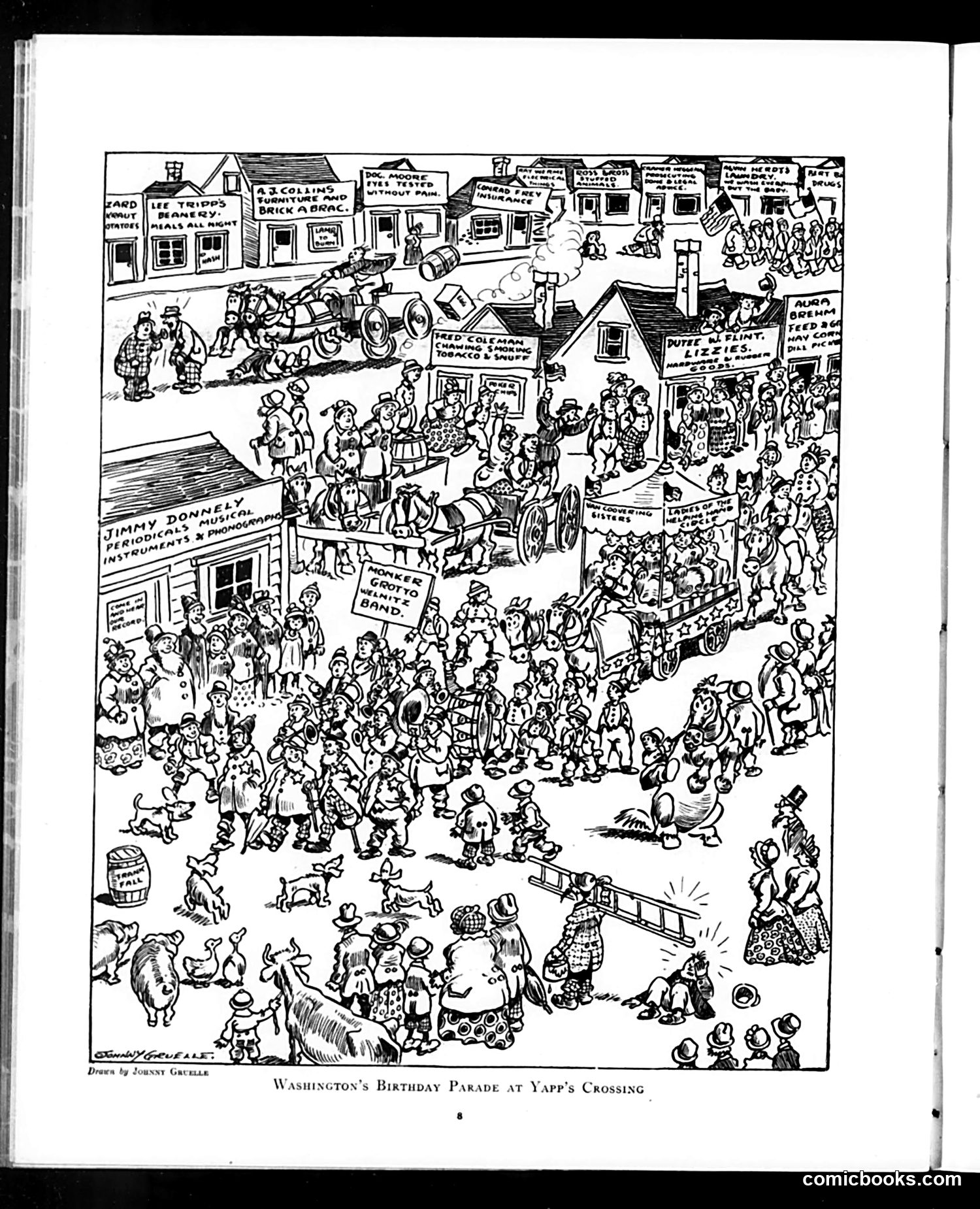
This is a single satirical cartoon depicting a chaotic small-town parade celebrating George Washington's birthday. The drawing is crowded with numerous figures, animals, and hastily-made floats and signs, creating comedic disorder. The satire targets small-town America's earnest but haphazard attempts at civic celebration. Visible shop signs reference local businesses (Lee Tripps, Colains furniture, Dr. Moore's insurance), suggesting this is meant as gentle mockery of provincial American towns trying to organize patriotic events with limited resources and considerable confusion. The abundance of people, animals, and competing activities—rather than an orderly, dignified parade—emphasizes the rustic, disorganized nature of the proceedings. This reflects Judge magazine's urban perspective finding humor in rural or small-town American life and its well-intentioned but somewhat chaotic civic culture.
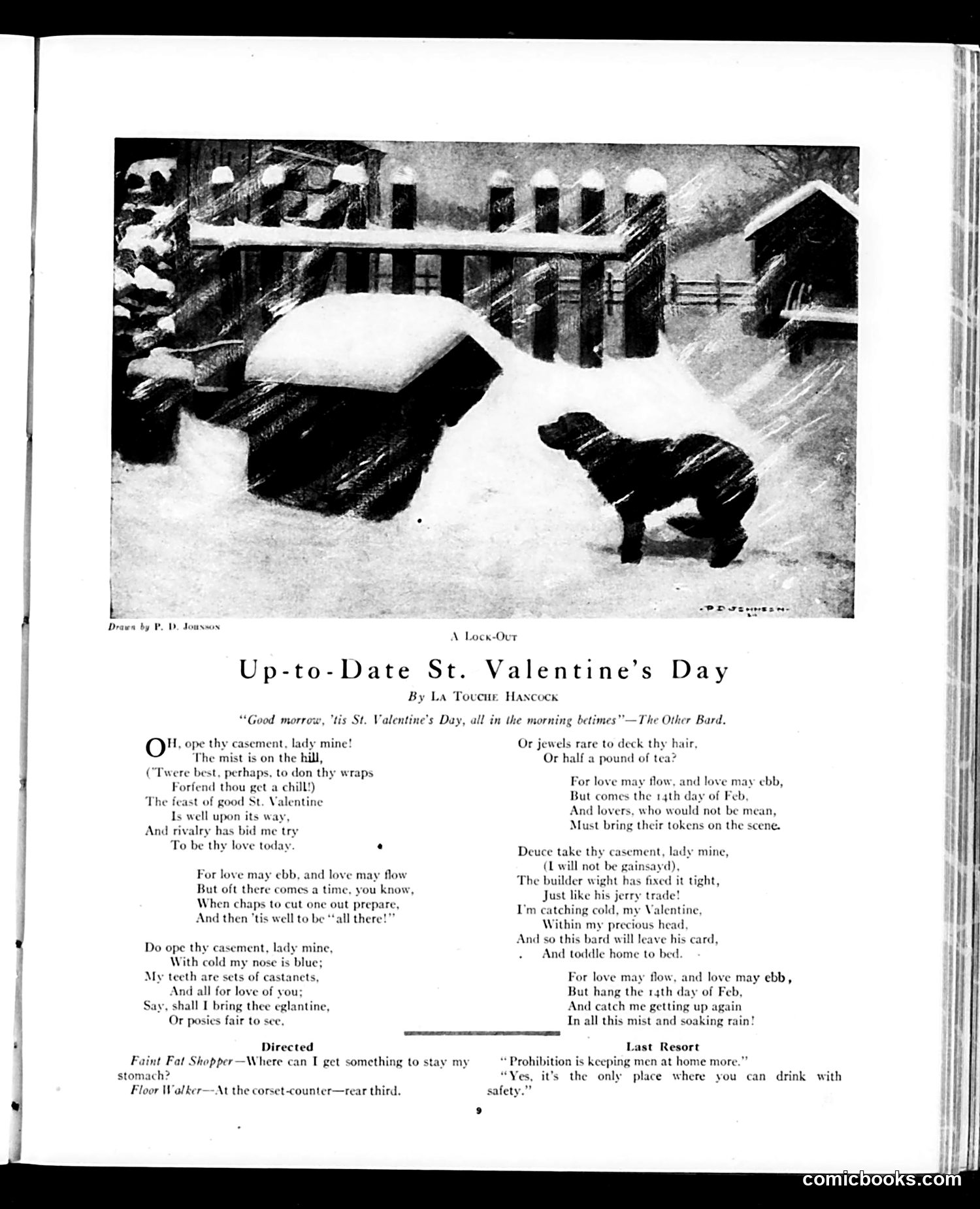
This is a humorous poem satirizing modern Valentine's Day customs, presented as a parody of Shakespeare's *Hamlet* ("Good morrow, 'tis St. Valentine's Day"). The joke contrasts romantic tradition with practical reality: a suitor attempts the classic gesture of serenading his love beneath her window, but modern inconveniences—cold weather, a stuck window, the builder's poor craftsmanship—make the romantic gesture ridiculous and uncomfortable. Rather than offering flowers or jewelry, the poem humorously suggests practical gifts like tea. The accompanying cartoon "A Lock-Out" visually reinforces this: a figure bundled against snow appears to give up the courtship attempt entirely, abandoning romance for warmth and comfort. The small joke below about a "Faint Fat Shopper" puns on corsets (which restrict the waist/stomach), implying one must visit the corset counter to "drink" anything—likely a Prohibition-era reference to hidden alcohol.
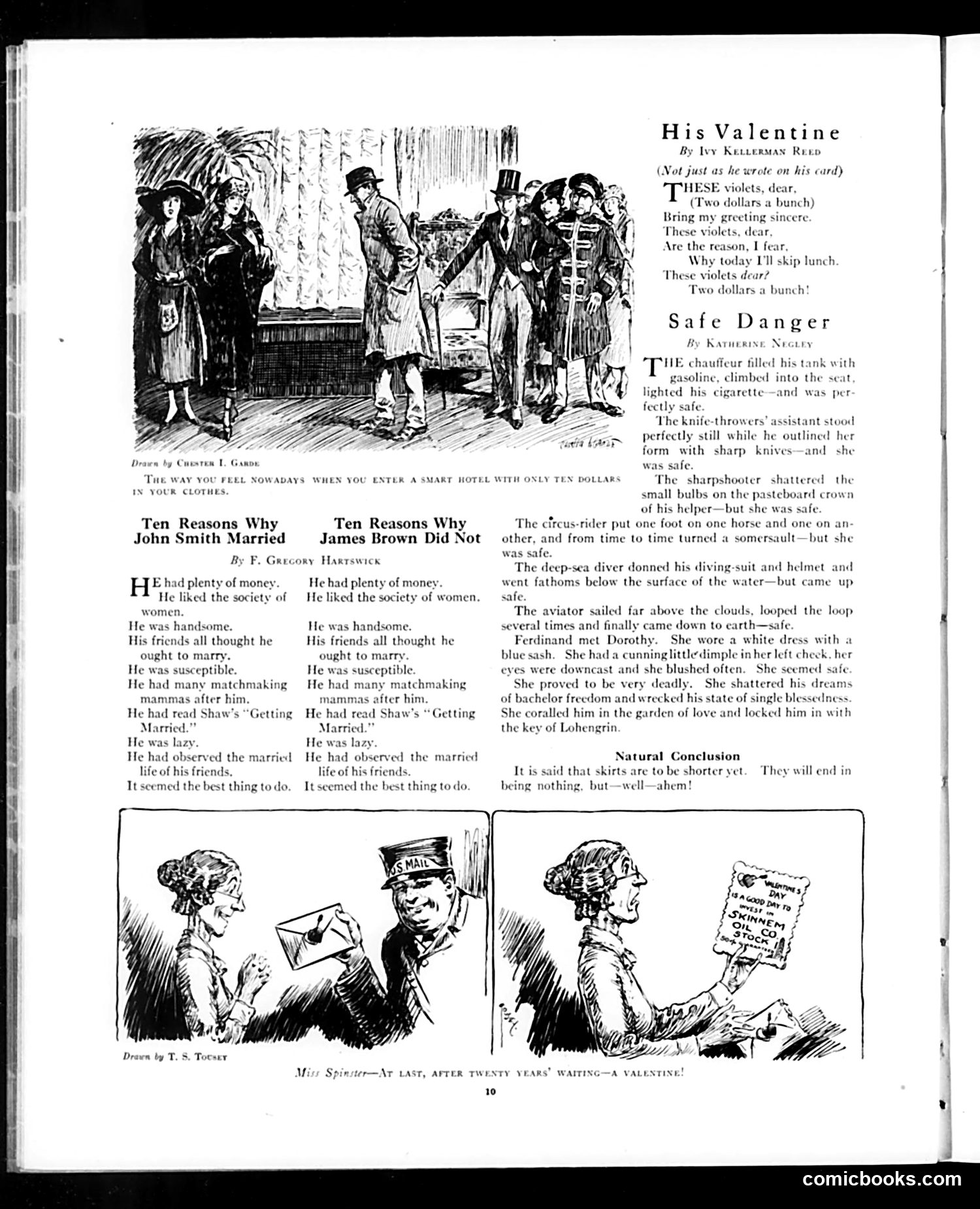
This page contains several short humorous pieces satirizing early 20th-century social conventions: **"His Valentine"** mocks romantic gestures by revealing the mundane reality: a man buys two-dollar violets to impress his Valentine, but the expense forces him to skip lunch—undercutting the sentiment with economic hardship. **"Ten Reasons Why"** presents parallel lists for John Smith marrying versus James Brown *not* marrying, with identical reasons listed for both outcomes. The satire suggests marriage decisions are arbitrary; the same facts justify opposite choices depending on perspective. **"Safe Danger"** uses ironic reversal: genuinely dangerous activities (knife-throwing, diving, aviation) are called "safe" because professionals control them, while meeting an ordinary woman in a white dress proves "deadly"—trapping a man in marriage. This reflects anxiety about women's power in romantic contexts. **Bottom cartoon** shows "Miss Spinster" finally receiving a Valentine after 20 years of waiting—satirizing prolonged single life and desperation.
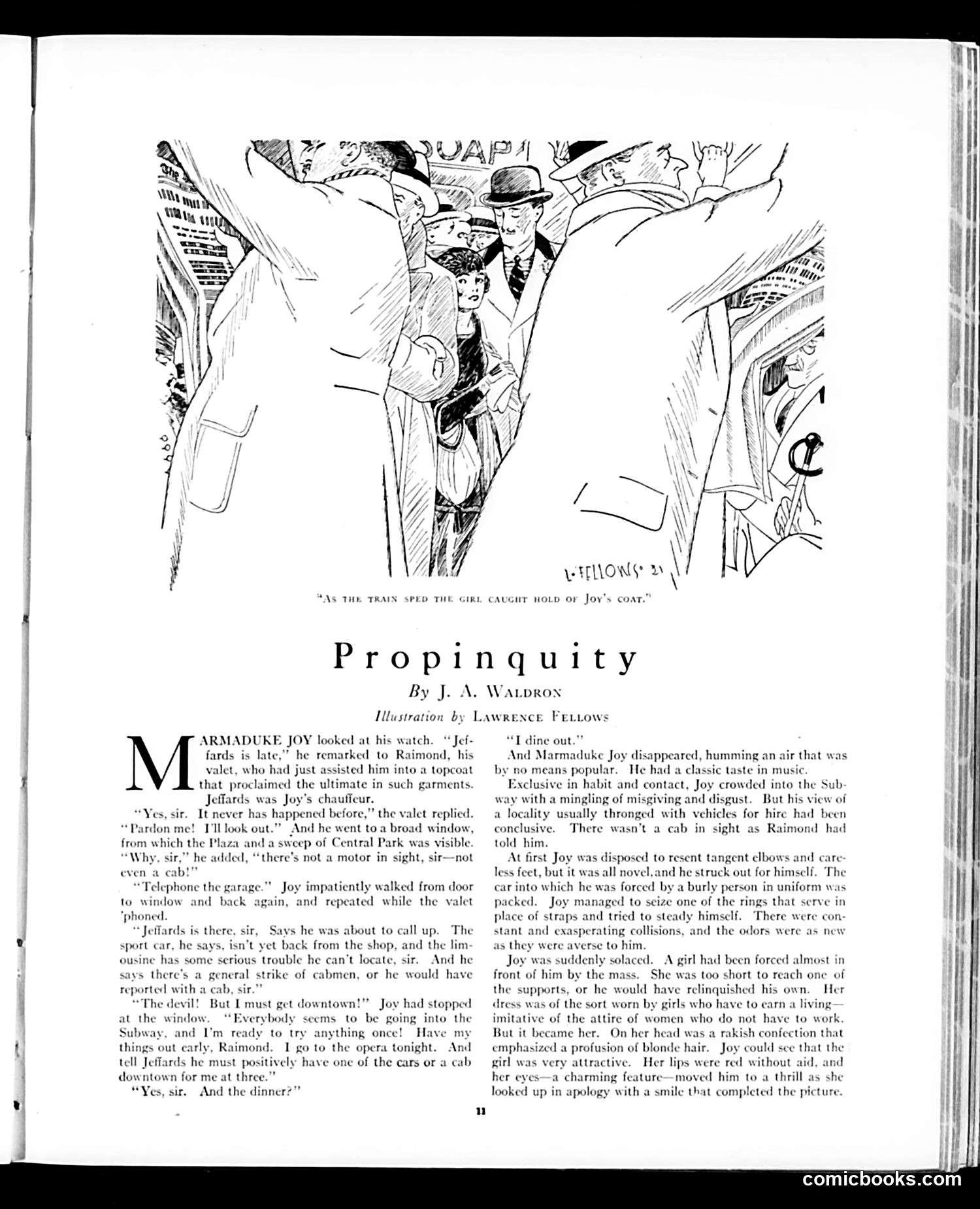
This page presents the opening of a short story titled "Propinquity" (meaning nearness or proximity) by J.A. Waldron, illustrated by Lawrence Fellows. The narrative follows Marmaduke Joy, a wealthy Manhattan gentleman who cannot access his usual transportation—cars are in the shop, and a cab strike has immobilized the city. Forced to use the subway for the first time, Joy finds himself packed into a crowded train car where he encounters an attractive working-class young woman with blonde hair and red lips. The illustration at top shows the comedic moment when the train's movement causes the woman to stumble backward and grab Joy's coat for balance. The story's title hints at the plot: their forced physical proximity in the crowded subway will spark romantic connection between characters from different social classes. This reflects a common early-20th-century American literary trope—that chance encounters between wealthy and working-class people could overcome class barriers through attraction.
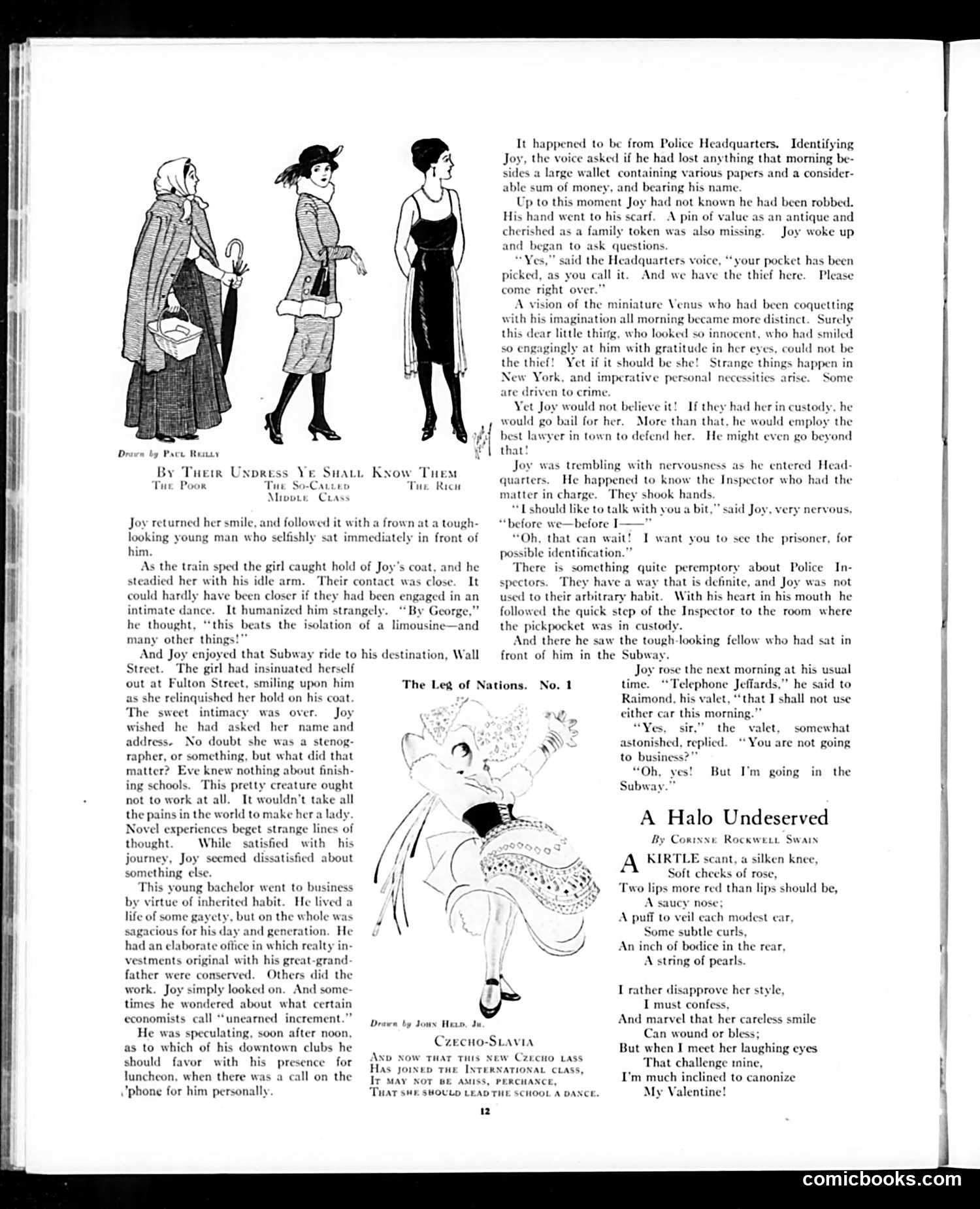
This page presents a serialized romantic story rather than a political cartoon. The narrative follows "Joy," a wealthy young man who meets an attractive woman on the subway, only to discover she's a pickpocket who stole his wallet and family heirloom pin. The satire targets **class distinctions and moral hypocrisy** in early 20th-century America. Joy's internal conflict—nearly willing to defend a criminal because she's beautiful and seemingly innocent—mocks the privileged male's disconnect from reality. The story suggests that desperate circumstances ("imperative personal necessities") drive people to crime, yet Joy's solution is superficial: bail money and lawyers rather than understanding systemic poverty. The three illustration captions ("By Their Undress Ye Shall Know Them") explicitly mock class markers through fashion, contrasting poor, middle-class, and wealthy women's appearances. The page also includes unrelated content: "A Halo Undeserved" (a poem about an idealized woman) and "Czecho-Slovakia" (likely referencing post-WWI Eastern European politics).
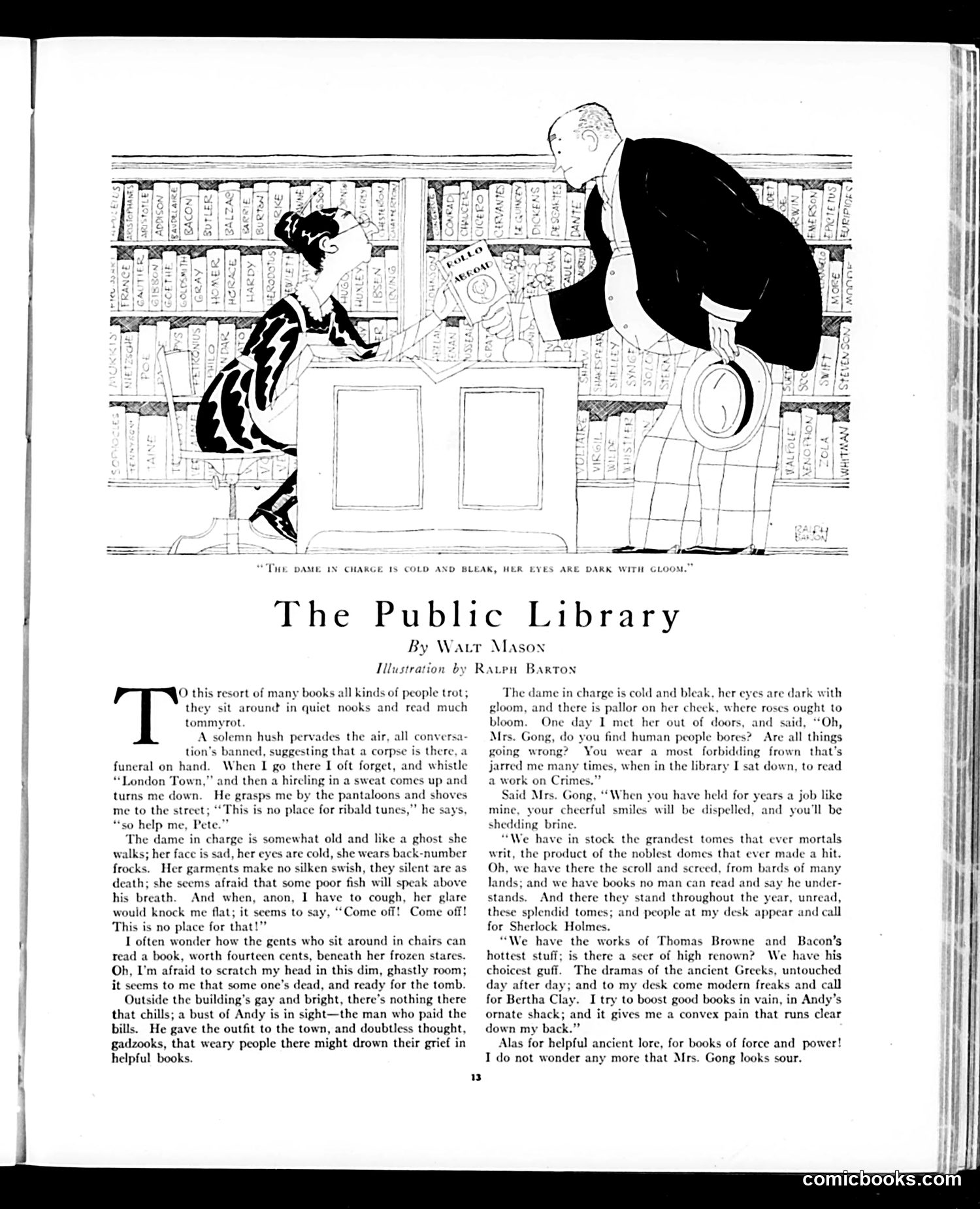
This humorous poem satirizes both public library culture and the librarian's thankless job. The illustration shows a stern, disapproving female librarian (Mrs. Gong) confronting a patron in a library filled with books. The satire works on two levels: First, it mocks library patrons—people who sit quietly reading "tommyrot" (nonsense), who read cheap popular fiction like Bertha Clay novels instead of serious literature, and who generally annoy the librarian. Second, it sympathizes with Mrs. Gong's frustration: despite the library's excellent collection of classical works (Thomas Browne, Bacon, Greek dramas), patrons ignore them in favor of lowbrow mysteries and romance. The poem's message is gently ironic: the librarian's sourness is justified because people waste access to great literature. The public library, meant as a democratic institution for cultural elevation, instead serves those seeking mere entertainment.
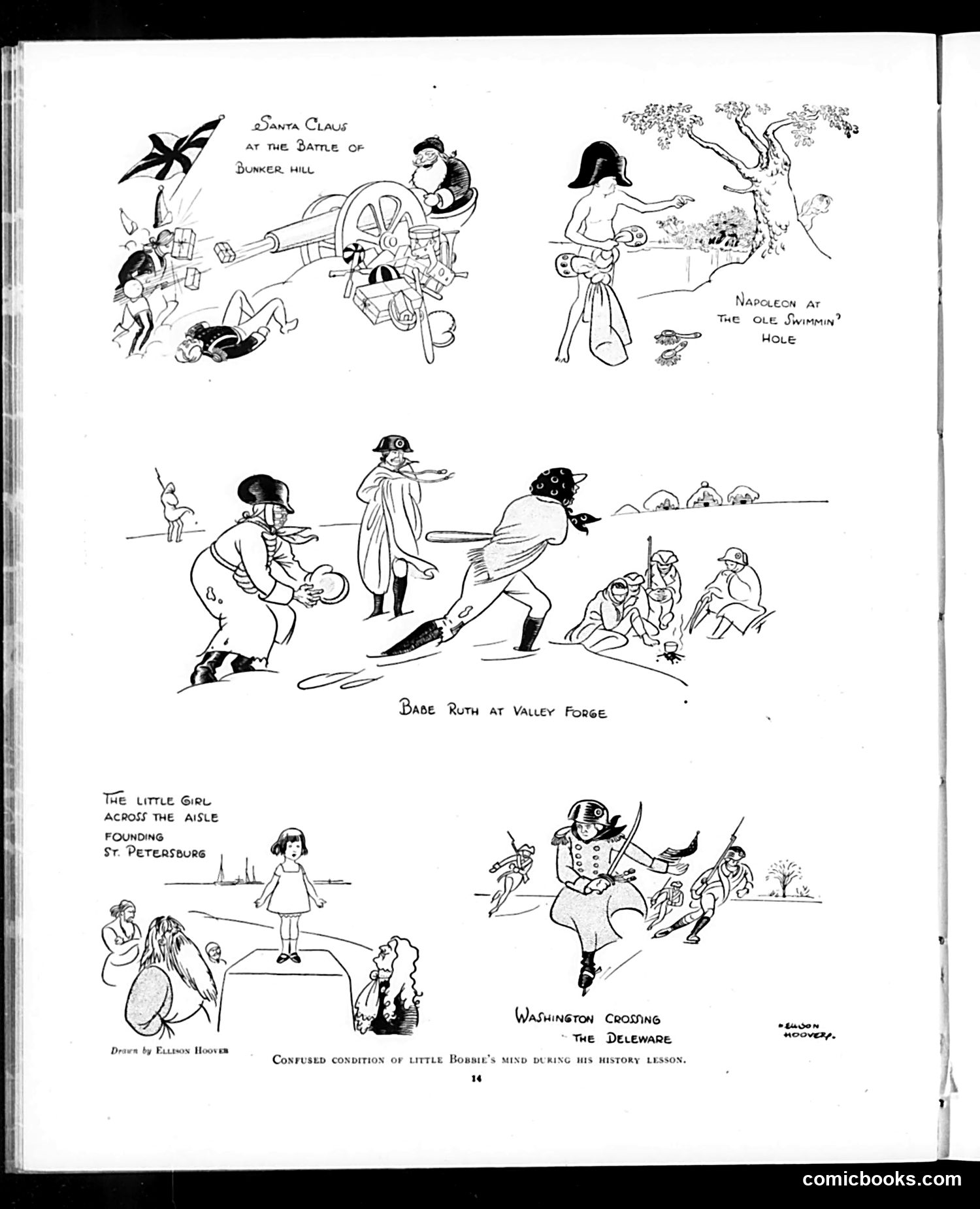
This page presents historical figures reimagined in absurd, anachronistic scenarios—a common Judge magazine satirical approach. The cartoons mock a schoolchild's confused understanding of American history by placing famous figures in ridiculous situations: **"Santa Claus at the Battle of Bunker Hill"** depicts Santa operating a cannon, conflating Christmas mythology with Revolutionary War history. **"Napoleon at the Ole Swimmin' Hole"** shows Napoleon in casual swimming attire, undermining his military gravitas. **"Babe Ruth at Valley Forge"** places the baseball legend among starving soldiers. **"Washington Crossing the Delaware"** features a sailor in absurd poses. The caption explains this represents "confused condition of little Bobbie's mind during his history lesson"—the satire targets how children jumble historical facts with popular culture and contemporary figures. The artist (Ellison Hoover) uses visual absurdity to comment on either poor history education or childhood confusion about temporal distinctions. The overall joke: history becomes nonsensical when mixed with unrelated famous personalities.
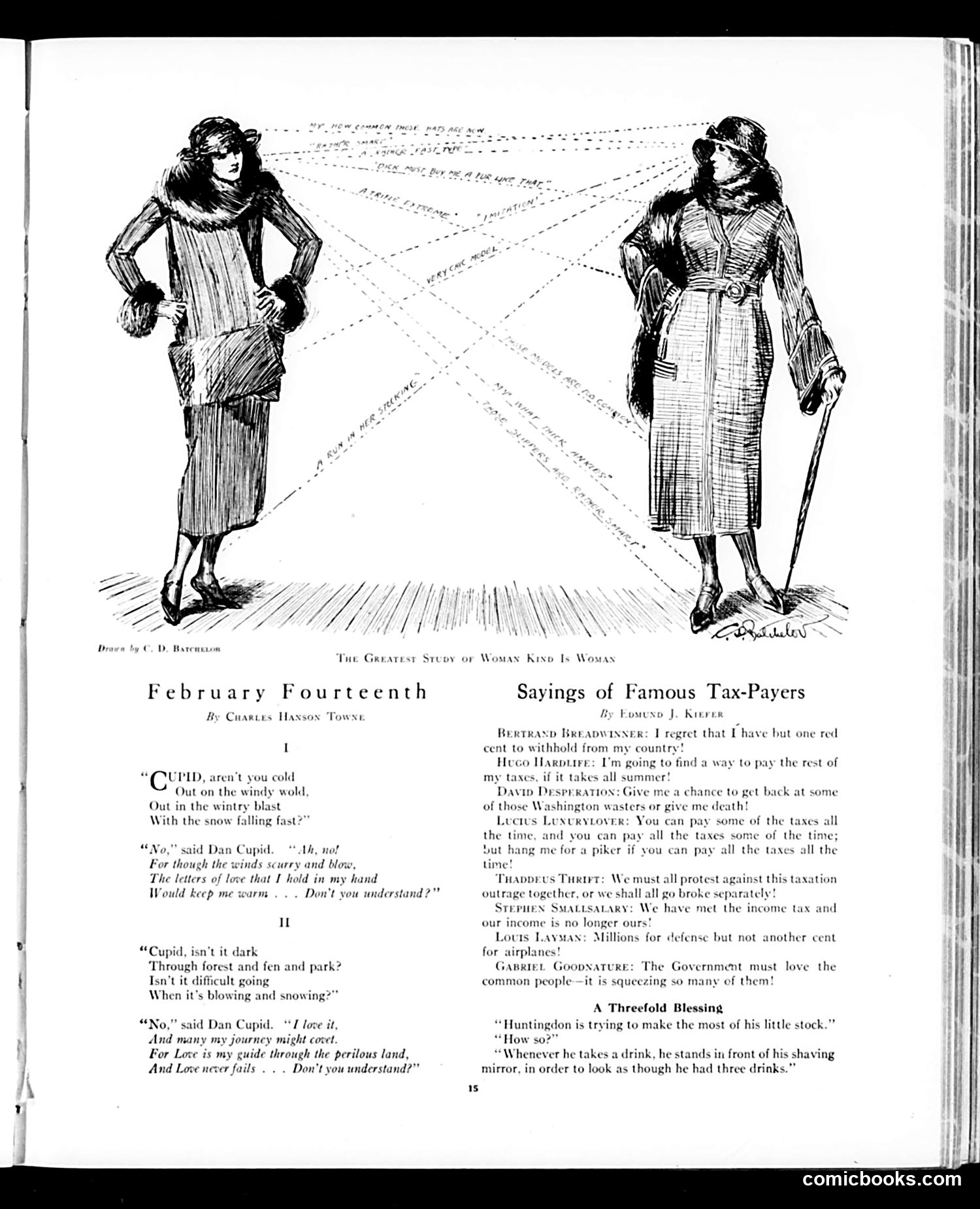
This Judge magazine page contains two distinct satirical pieces from Valentine's Day (February 14th). **Top illustration**: "The Greatest Study of Woman Kind Is Woman" depicts two women exchanging evaluative glances, suggesting female rivalry or judgment of one another—a commentary on women's social dynamics. **Left section**: A Cupid poem by Charles Hanson Towne romantically defends love's power to sustain one through hardship, using Victorian sentimental language. **Right section**: "Sayings of Famous Tax-Payers" is the page's political satire. Named wealthy and middle-class figures express frustration with income taxation (likely the recently-implemented 1913 federal income tax). The quotes range from mock patriotism ("one red cent") to desperate evasion tactics, satirizing tax avoidance attitudes across social classes. The final joke about "Huntingdon" mocks someone making meager resources appear more abundant through deception. The satire targets both the wealthy resenting taxation and ordinary citizens struggling with tax burden—critiquing universal resistance to paying for government services.
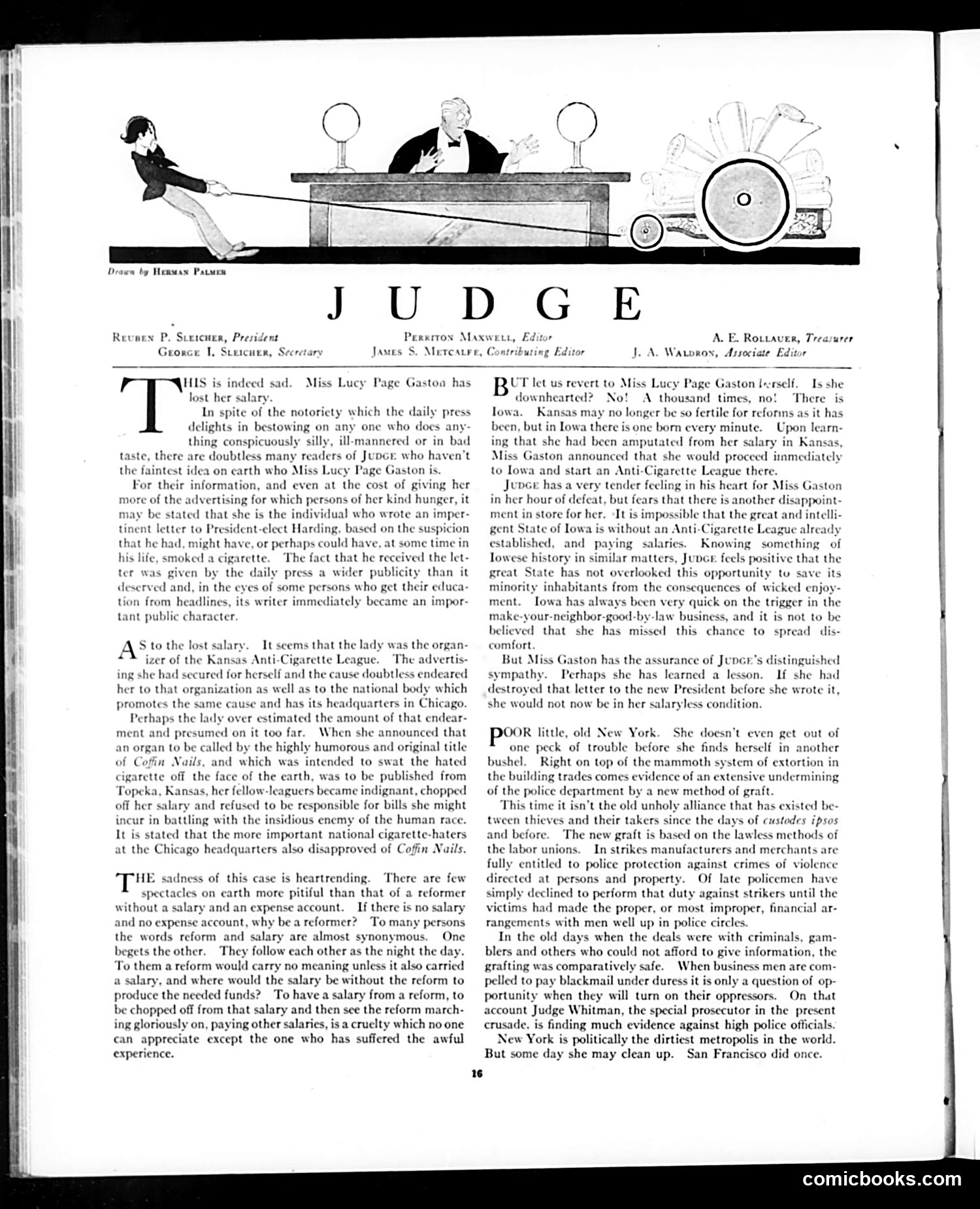
This editorial cartoon and accompanying article satirize Lucy Page Gaston, a prominent anti-cigarette crusader who lost her salary from the Kansas Anti-Cigarette League after launching an overly ambitious publication called *Coffin Nails*. **The satire's target:** Judge mocks reformers motivated primarily by salary rather than genuine conviction. The magazine suggests Gaston wrote an impertinent letter to President-elect Harding accusing him of smoking, generating publicity for herself rather than the cause. **The joke:** When Kansas anti-cigarette leaders cut her funding, Gaston immediately announced plans to start an identical league in Iowa—implying she pursues salaries through reform causes rather than meaningful social change. Judge sardonically suggests Iowa likely already has such an organization, predicting her next inevitable failure. **The cartoon** (top) depicts Gaston as a small figure being pulled toward a large machine—symbolizing how reform organizations exploit and discard activists once their usefulness expires.
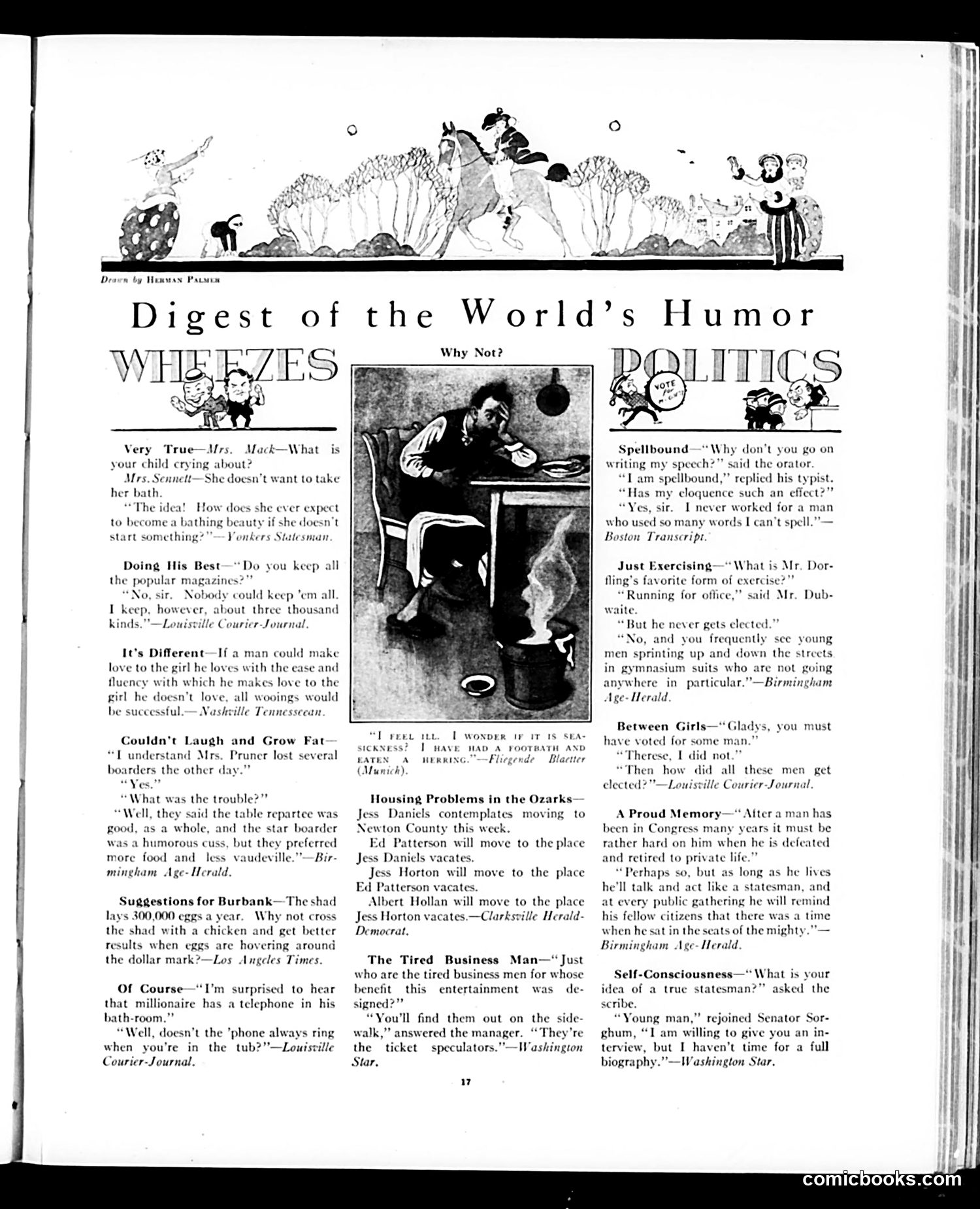
This page collects brief humorous anecdotes from various newspapers, organized under thematic sections (Wheezes, Politics, Why Not?). The jokes reflect early-20th-century American life and attitudes. The **center cartoon** depicts a man at a desk, apparently ill, with text suggesting he ate seafood. The humor relies on physical comedy about digestive distress. The **political section** includes jokes about politicians' vanity and incompetence: a defeated congressman still acts important; a senator (Senator Sorghum) refuses a full interview; business candidates run unsuccessfully for office; and speculators (rather than actual attendees) comprise entertainment audiences. Other jokes satirize contemporary concerns: bathing beauties, expensive eggs during inflation, magazine collecting, courtship difficulty, and housing shortages in rural areas (the Ozarks section shows circular job-switching). The overall tone is gentle mockery of everyday frustrations—spousal dynamics, professional pretension, and romantic awkwardness—rather than sharp political critique.
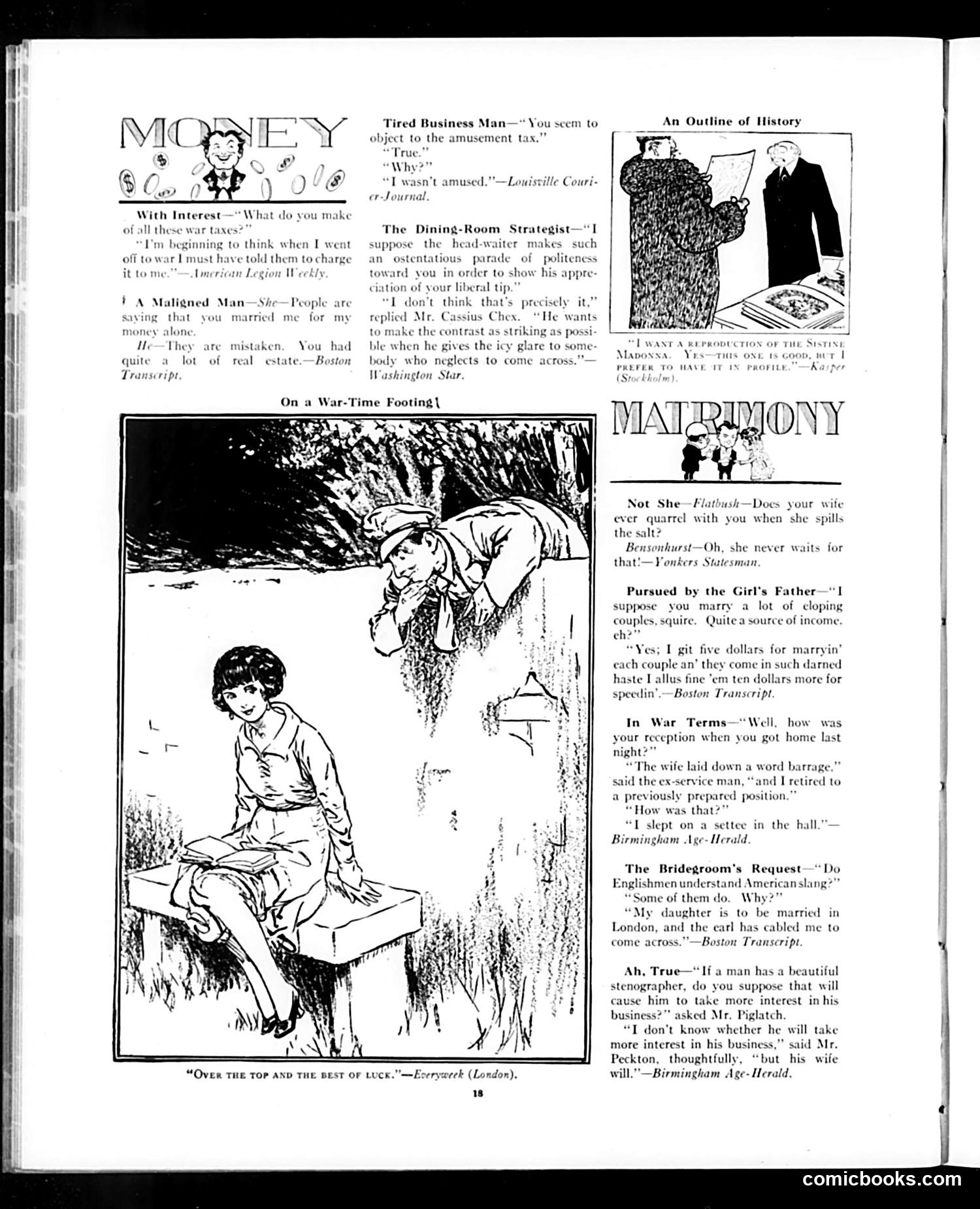
This page collects brief humorous anecdotes satirizing **wartime American life and social pretense** during WWI era. **Key themes:** - **War taxation**: Jokes mock both unpopular new taxes and hypocrisy (the "amusement tax" on entertainment deemed unamusing). - **Class anxiety**: Multiple jokes target social climbing and money-consciousness—marriages for wealth, tipping rituals, eloping couples as business opportunity. The era's economic strain surfaces repeatedly. - **Domestic power dynamics**: Several jokes depict wives as domineering, using wartime language ("word barrage," "prepared position") to humorously describe marital conflict and male retreat. - **The illustration** (captioned "Over the Top and the Best of Luck") depicts a woman climbing a hill or trench, evoking WWI's grueling "over the top" charges, though applied here to civilian life. The overall tone mocks American materialism, social pretense, and gender relations while using war terminology as comedic framework—reflecting how thoroughly wartime had saturated public discourse and anxieties.
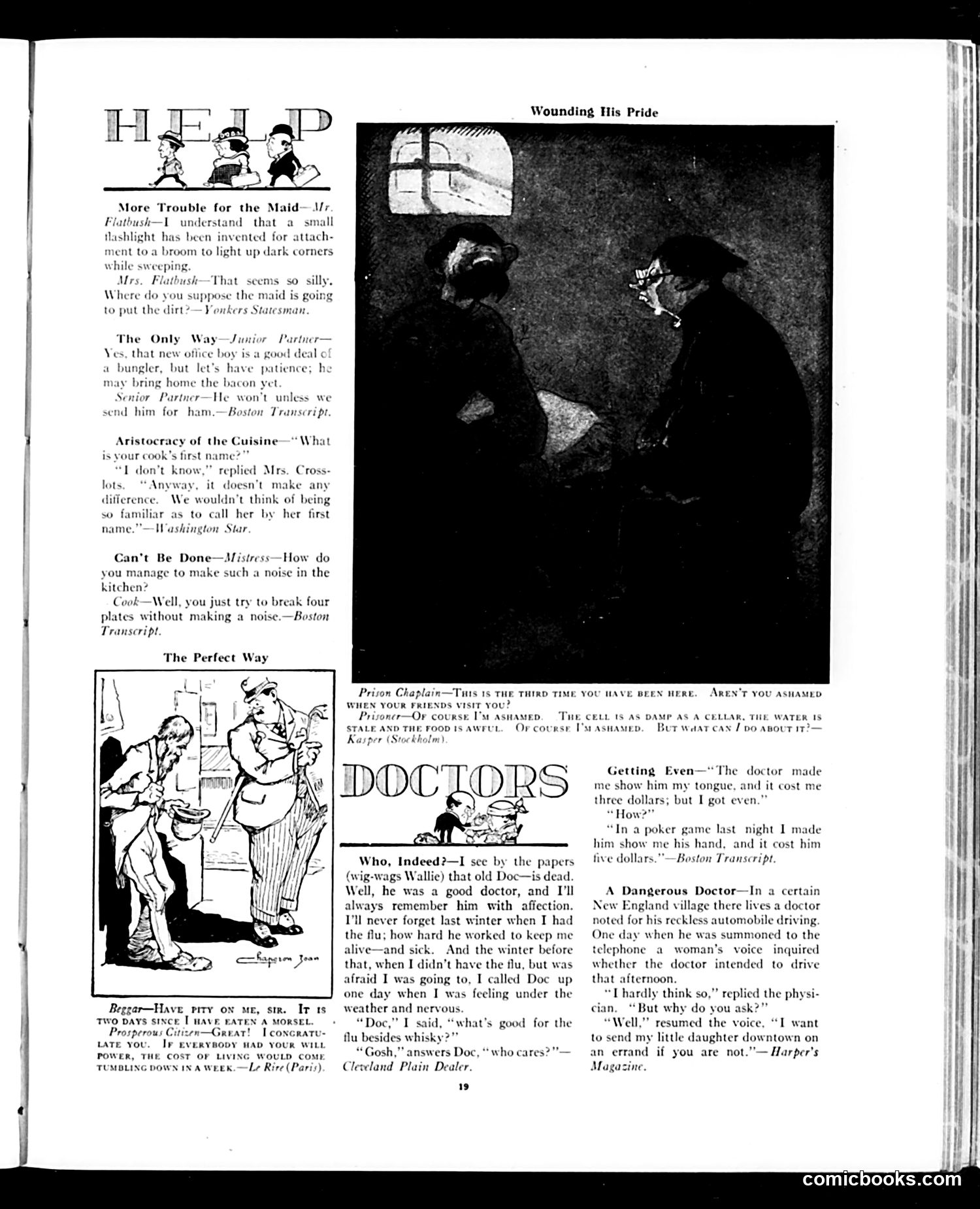
This page from the satirical magazine *Judge* contains multiple brief humorous anecdotes mocking domestic servants, workers, and professionals of the early 20th century. The cartoons and jokes target: - **Maids**: Their supposed stupidity and laziness (the flashlight joke implies a maid would simply dump dirt rather than sweep it properly) - **Office boys**: Portrayed as incompetent "bungler[s]" - **Servants**: Depicted as presumptuous for expecting familiarity with employers - **Doctors**: Shown as indifferent to patient welfare ("who cares?") and reckless drivers The satirical point consistently ridicules the working class and service workers through gentle mockery of their perceived incompetence and impropriety. The "Prison Chaplain" cartoon depicts a prisoner complaining about cell conditions—the chaplain's helpless response suggests resignation to institutional indifference. These pieces reflect early-20th-century middle-class attitudes: servants were expected to be deferential, obedient, and competent; when they failed, they became subjects of ridicule rather than sympathy.
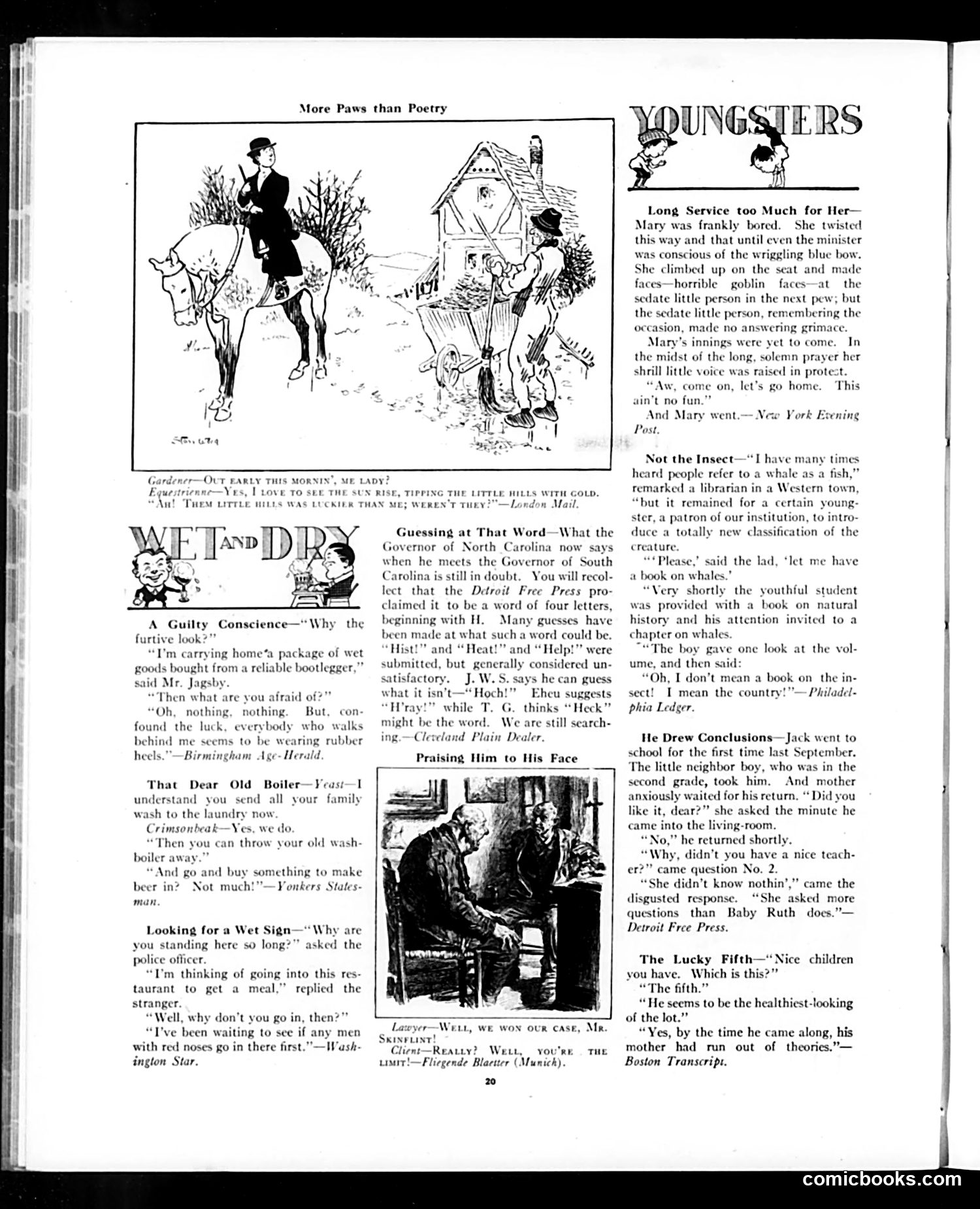
This page from Judge magazine contains several brief humorous anecdotes satirizing Prohibition-era America and social anxieties. The top cartoon depicts a man on horseback nervously approaching a house, captioned with dialogue about carrying "wet goods" (illegal alcohol) from a bootlegger while fearing people following him—mocking both bootlegging and paranoia during Prohibition. Other jokes target: - **Prohibition enforcement**: A man avoiding a restaurant until he sees "men with red noses" enter first, suggesting drinkers can be identified by appearance - **North/South relations**: A cryptic reference to what Governors of North and South Carolina would say meeting each other (implying a mild insult beginning with "H") - **Child behavior and parenting**: Including a bored child disrupting church services and a schoolboy's disappointing first day The page reflects 1920s American concerns: illegal alcohol distribution, regional tensions, evolving parenting theories, and social propriety. The humor derives from recognizable contemporary anxieties rather than specific current events.
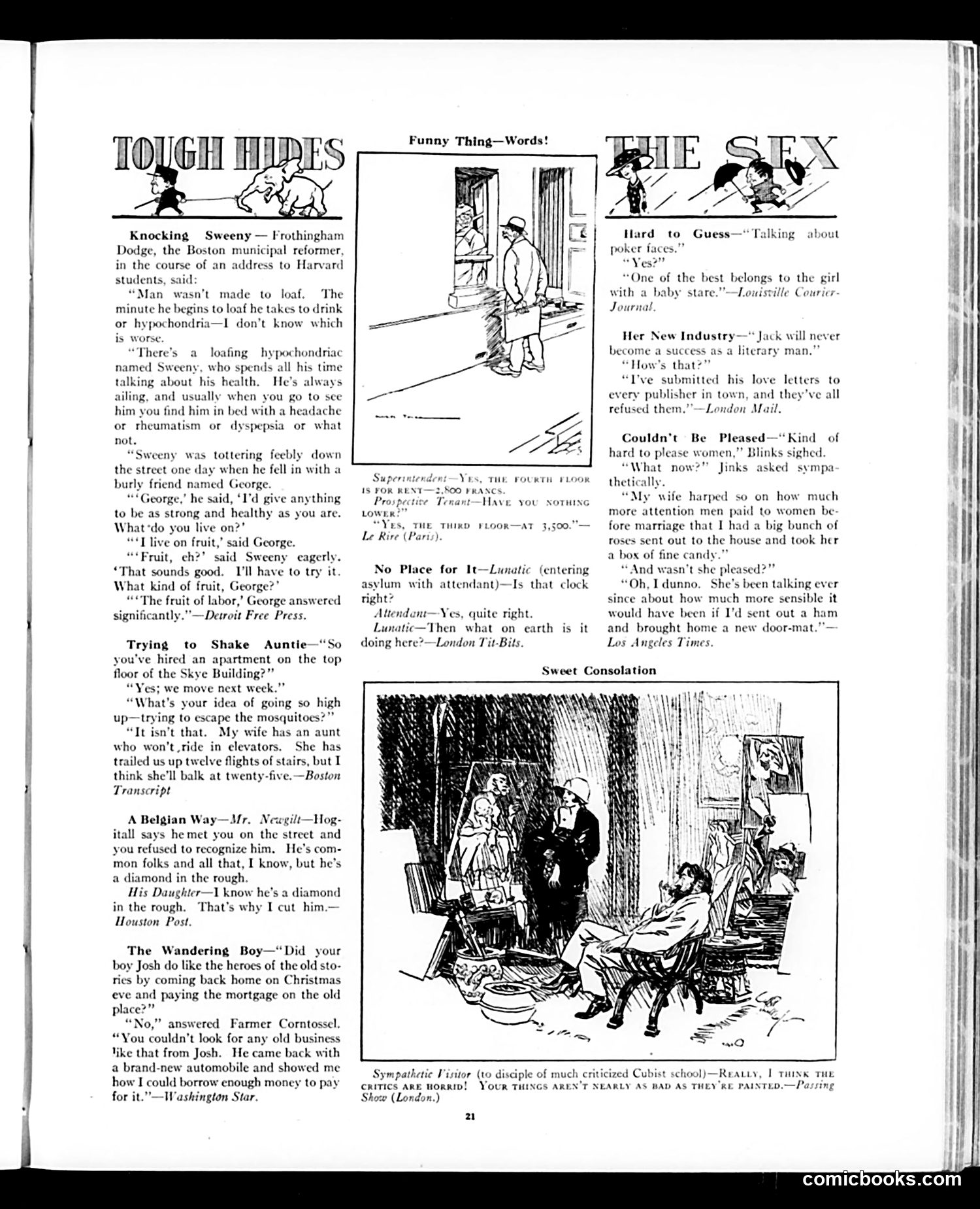
This page contains theater criticism rather than a traditional political cartoon. The header illustration shows a judge presiding over theatrical matters, setting the tone for reviewing Broadway productions. The text critiques two plays: Clare Kummer's "Rollo's Wild Oat" (which mocks Shakespeare) and "John Hawthorne" (produced by The Theatre Guild). The author argues that while Kummer's commercial comedy is frivolous but entertaining, The Theatre Guild's artistic pretensions produce genuinely bad drama. The satire targets the tension between **commercial theater** (represented by Kummer and the character Mr. Stein, a Jewish theater manager) and **highbrow artistic theater** (The Theatre Guild). The critic suggests both approaches have merit—commercial theater needn't apologize for ephemeral fun, while artistic theater shouldn't excuse poor execution in the name of avant-garde realism. The piece also mocks audiences for their passive tolerance of bad productions.
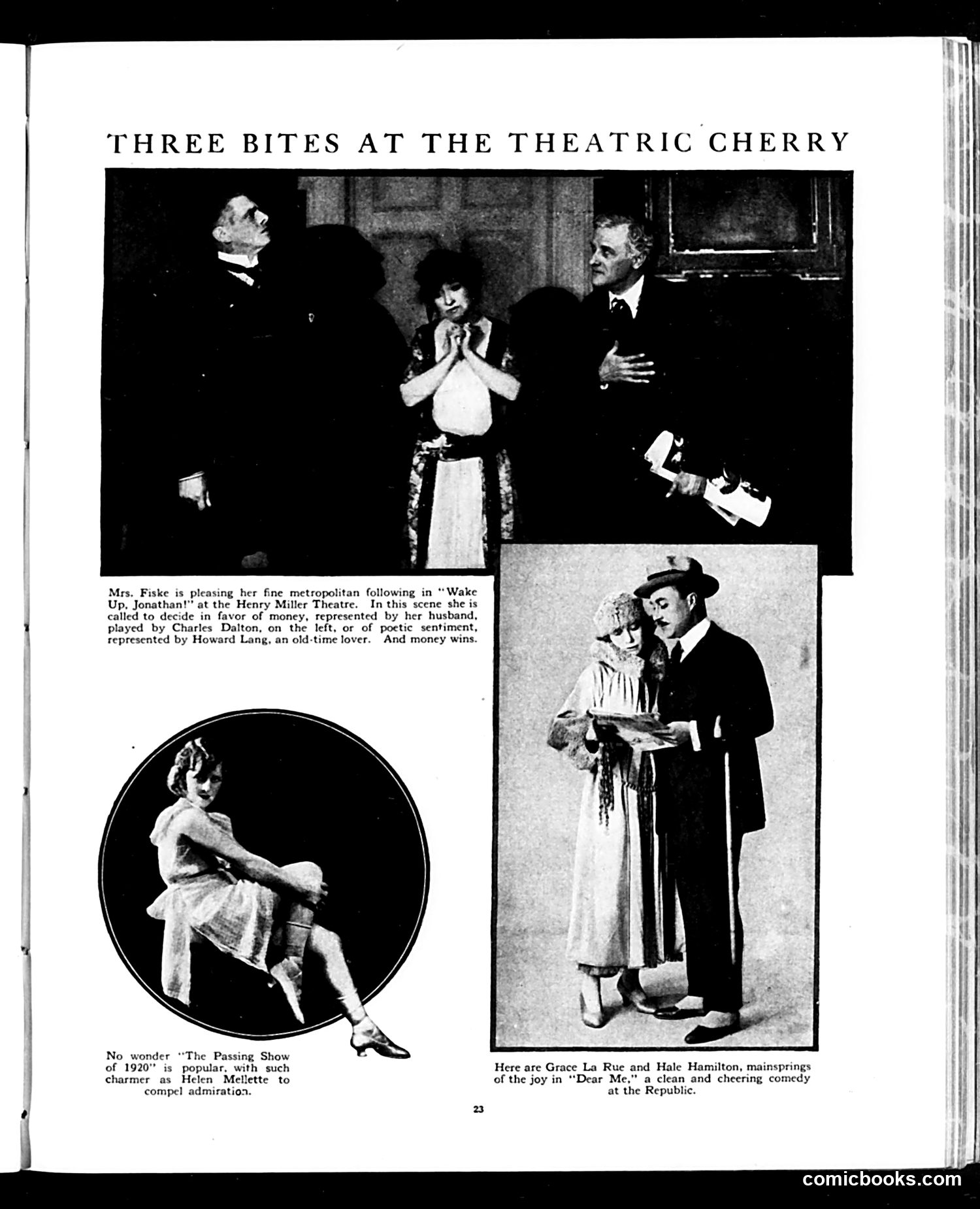
This page from Judge magazine reviews three Broadway productions circa 1920. It's not satirical but rather entertainment coverage featuring theatrical scenes. The top image shows a scene from "Wake Up, Jonathan!" at the Henry Miller Theatre, where actress Mrs. Fiske must choose between money (represented by her husband, played by Charles Dalton) and romantic sentiment (represented by Howard Lang, described as "an old-time lover"). The joke is that money wins—a commentary on practical materialism over romance. Below are two other productions: "The Passing Show of 1920" featuring Helen Mellette, and "Dear Me" at the Republic with Grace La Rue and Hale Hamilton. These are straightforward theater reviews praising the performers and plays as popular, charming entertainment. The page represents Judge's coverage of contemporary Broadway hits for its metropolitan readership.
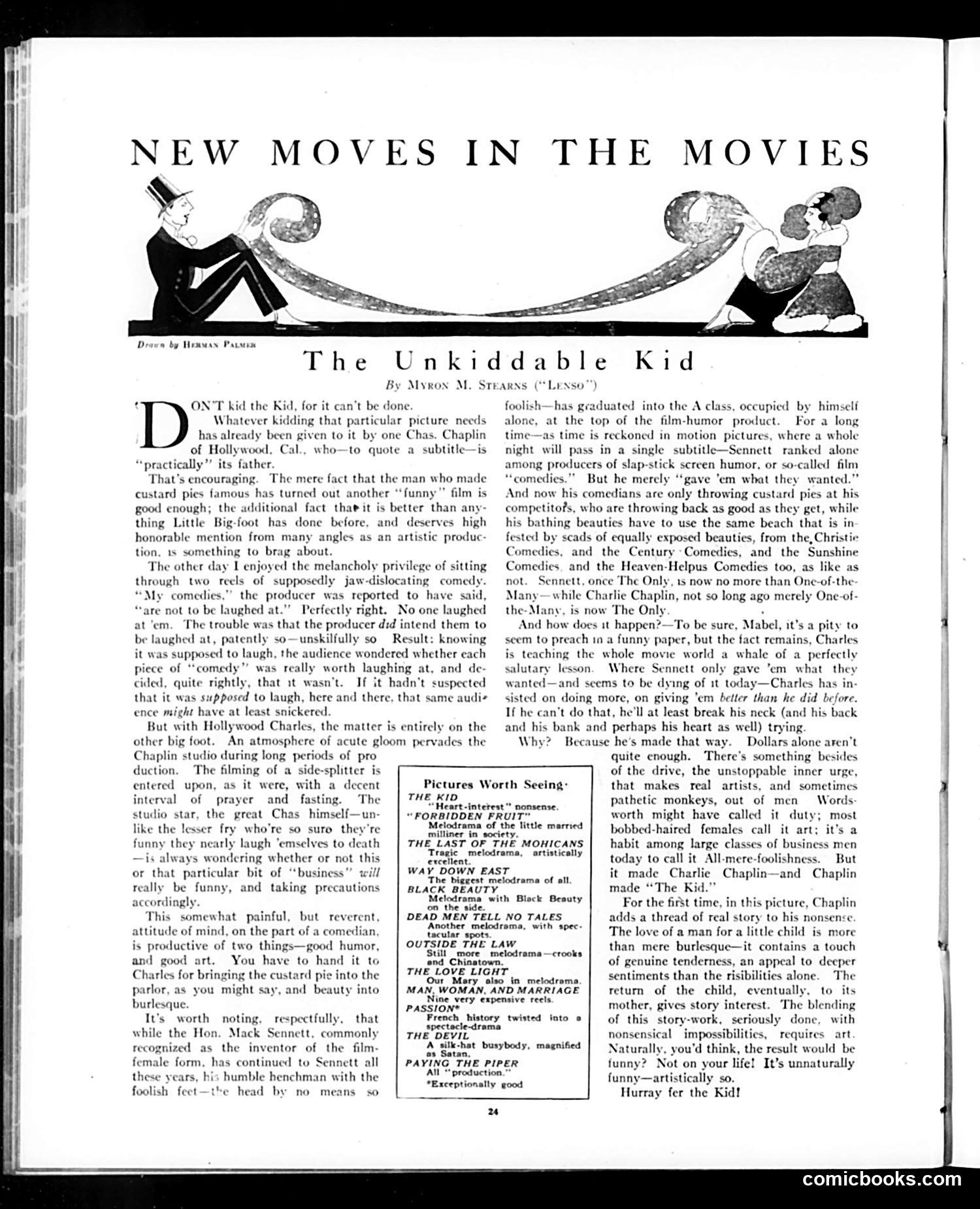
This page discusses Charlie Chaplin's film "The Kid," analyzing how Chaplin successfully introduced genuine pathos and emotional depth to comedies—a daring move in an era when audiences expected pure slapstick humor. The cartoon at top, drawn by Herman Peixotto, shows a man in a top hat and a child balanced on opposite ends of a plank, illustrating the film's central dynamic: the relationship between Chaplin's character and the child actor. The article argues that Chaplin elevated film comedy by combining humor with sincere sentiment, doing what other comedians like Mabel Normand and Mack Sennett hadn't attempted. The piece criticizes competitors' shallow comedies while praising Chaplin's artistic ambition and emotional authenticity.
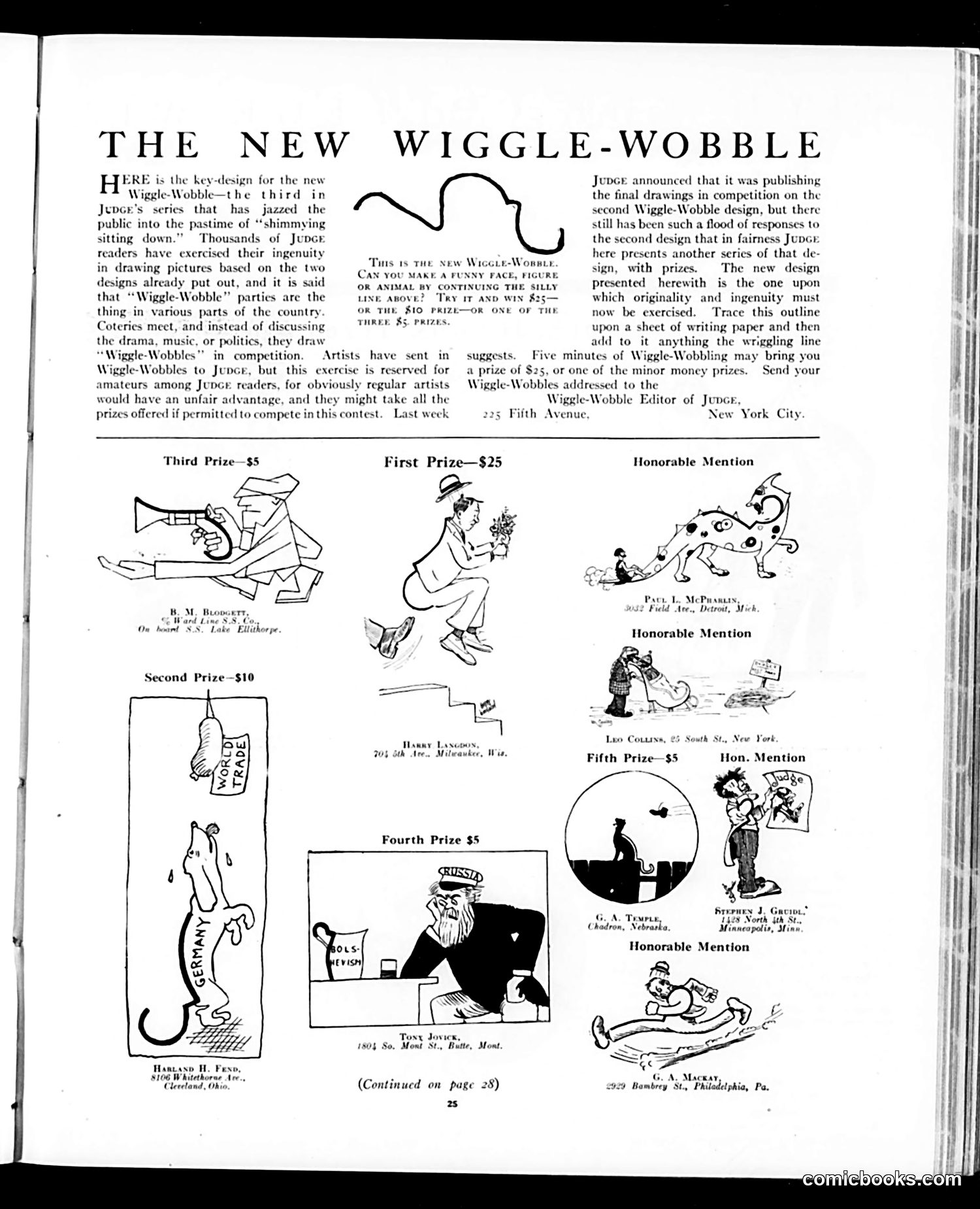
This page announces *Judge* magazine's drawing competition inviting amateur readers to complete a deliberately silly line drawing by adding their own creative extensions to make it form a humorous face, figure, or animal. The contest was extremely popular—so much so that *Judge* was printing winning entries in successive weeks. The magazine emphasizes that this contest is reserved for amateur readers specifically, as professional artists would have "unfair advantage." The "Wiggle-Wobble" refers to a 1920s fad where people held "Wiggle-Wobble parties" to draw these pictures together instead of discussing serious topics like drama, music, or politics—suggesting contemporary frivolousness about world affairs during this era. Prizes range from $25 down to $5, with honorable mentions also awarded. The page displays the third-through-fifth prize winners and several honorable mentions, showing completed entries from various American cities.
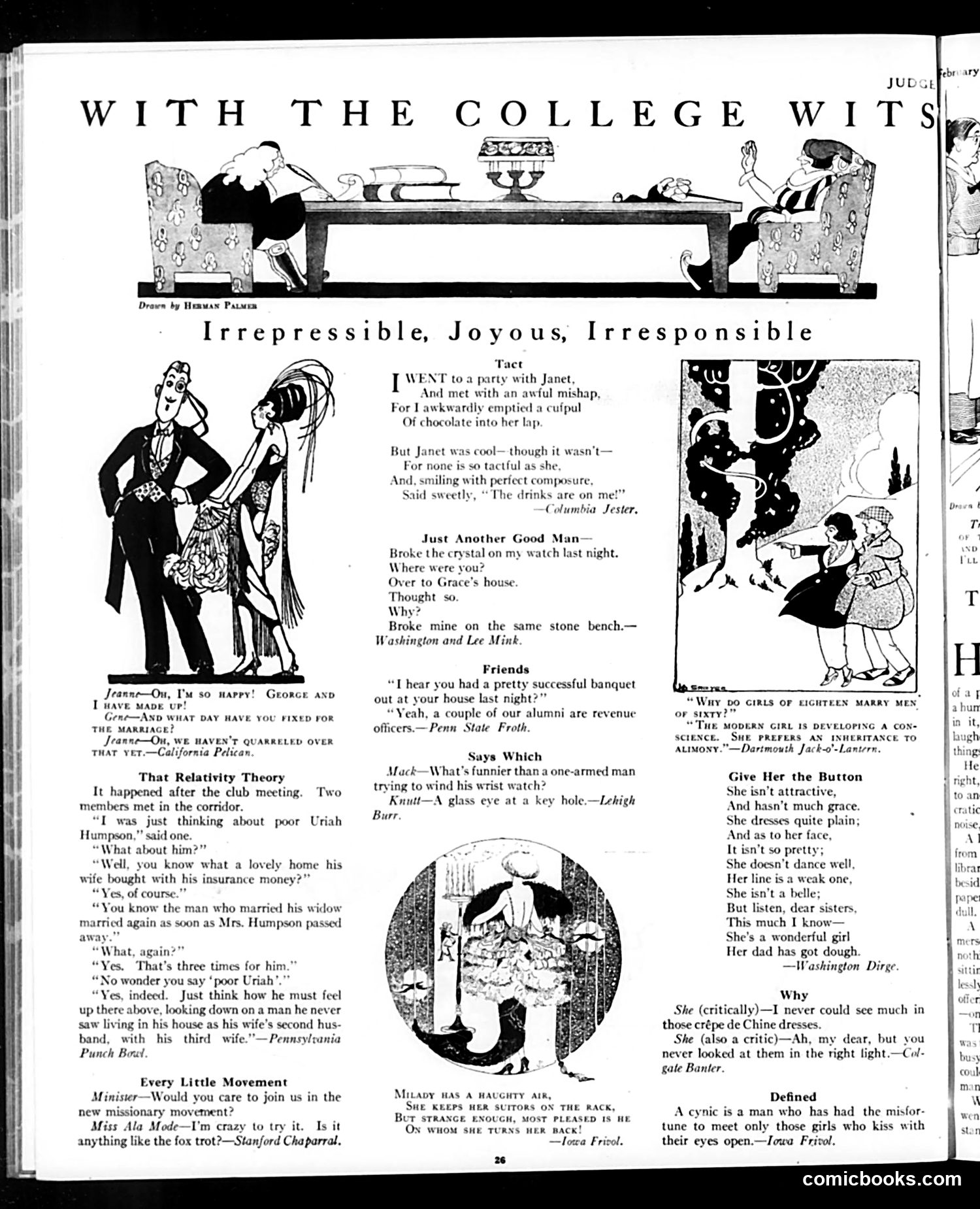
This is a humor page from Judge magazine collecting jokes and comic observations, primarily from college publications. The content satirizes early 20th-century courtship, marriage, and gender dynamics. **Key themes:** The opening cartoon depicts a couple at a table—likely commenting on the impulsive, carefree nature of modern youth romance (the title "Irrepressible, Joyous, Irresponsible"). The jokes mock: - **Marriage pragmatism**: A woman planning her wedding only after a quarrel occurs; men marrying widows for financial gain - **Gender stereotypes**: Women pursuing "missionary movements" if they resemble dancing crazes; girls valuing wealth ("her dad has got dough") over appearance or character - **Dating conventions**: Male anxiety about female behavior; criticism of women's fashion choices **The satire targets** the shallow materialism and social climbing of the era's young people, particularly women's perceived focus on financial security and status rather than genuine compatibility. The repeated emphasis on wealth ("insurance money," inheritance, dough) suggests anxiety about women's economic motivations in marriage. The page reflects 1920s-era college humor—lighthearted but tinged with misogyny typical of that period's publications.
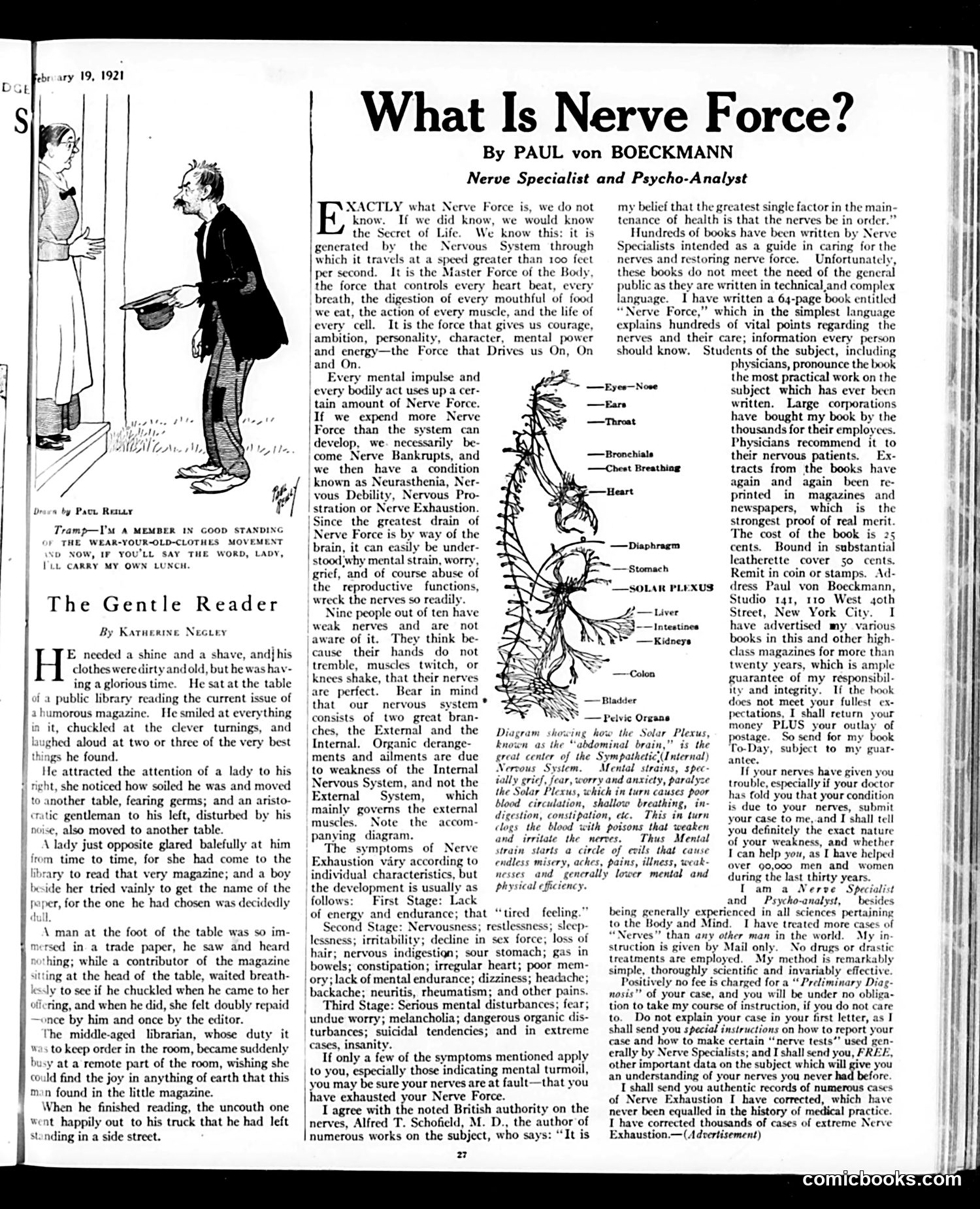
**"The Gentle Reader"** cartoon satirizes class prejudice in public spaces. A shabby but cheerful tramp enjoys a humorous magazine in a library, while surrounding patrons—a fastidious lady, an aristocrat, and a snobbish woman—react with disgust or avoidance. Only a working-class boy and a magazine contributor pay him genuine attention. The joke critiques how people judge worth by appearance rather than character. The tramp's opening line references the "wear-your-old-clothes movement," likely a 1920s wartime conservation effort, allowing him to claim respectability while mocking pretentious attitudes. **"What Is Nerve Force?"** is a pseudo-medical advertorial (advertisement disguised as editorial content) by Paul von Boeckmann, a "Nerve Specialist and Psycho-Analyst." It promotes his 64-page book about treating "Neurasthenia" and "Nerve Exhaustion"—vague 1920s diagnoses often applied to fatigue or anxiety. The anatomical diagram and pseudo-scientific language lend false authority to what was likely a commercial health guide targeting anxious readers.
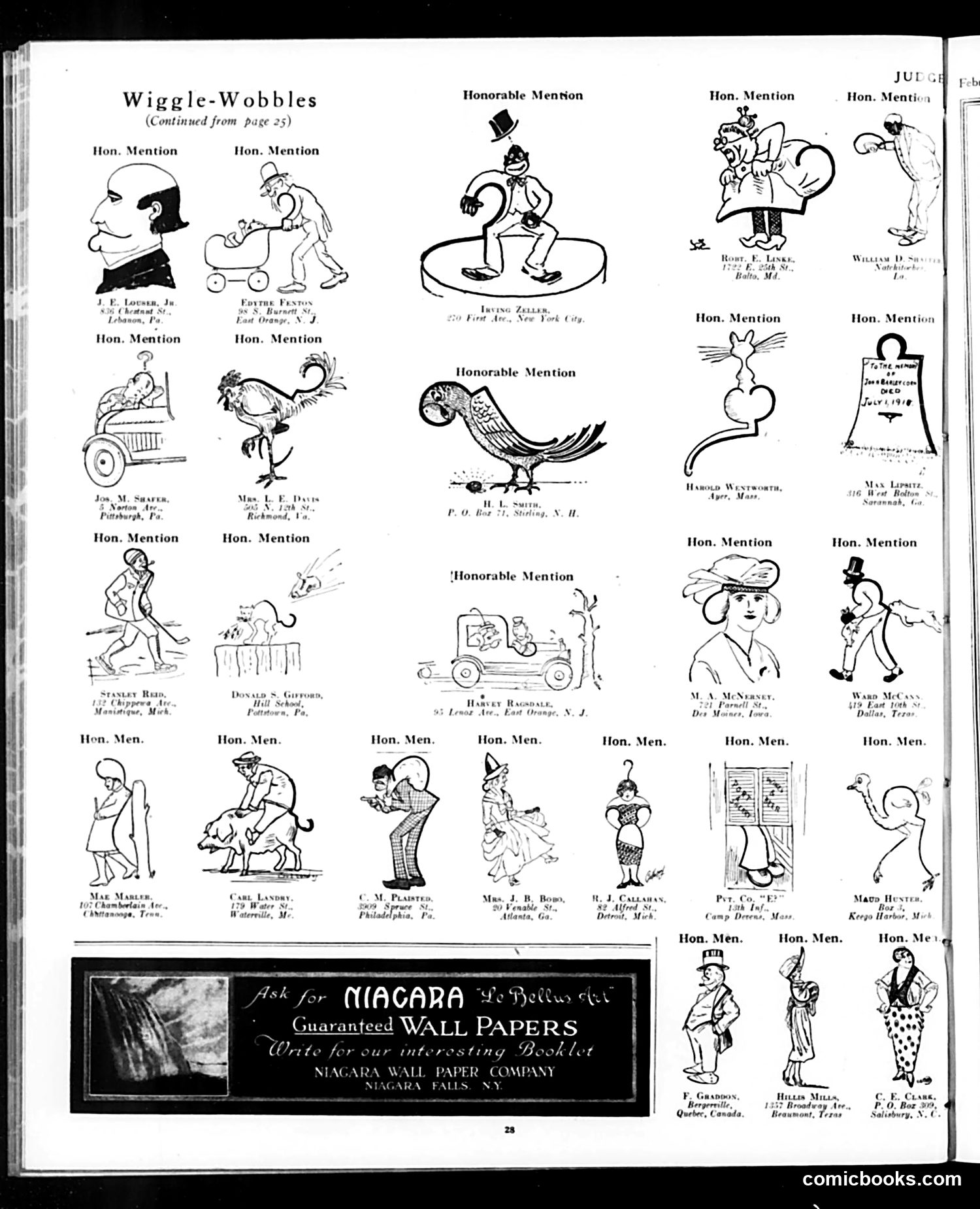
This page displays "Wiggle-Wobbles"—a cartoon competition section from *Judge* magazine featuring humorous character sketches submitted by readers. Each small cartoon depicts an exaggerated figure in a comedic pose or situation, labeled with the artist's name and address. The cartoons appear to be lighthearted, simple gag drawings showing everyday characters—a woman with a baby carriage, someone driving, figures in various silly poses—typical of early 20th-century humor publications. The "Hon. Mention" designations indicate these were finalist submissions that didn't win top prizes but were notable enough for publication. The page also includes a Niagara Wall Paper Company advertisement at the bottom, typical of magazine monetization of this era. The overall content represents amateur/reader-submitted cartooning rather than professional political satire—essentially an early form of crowdsourced humorous illustration.
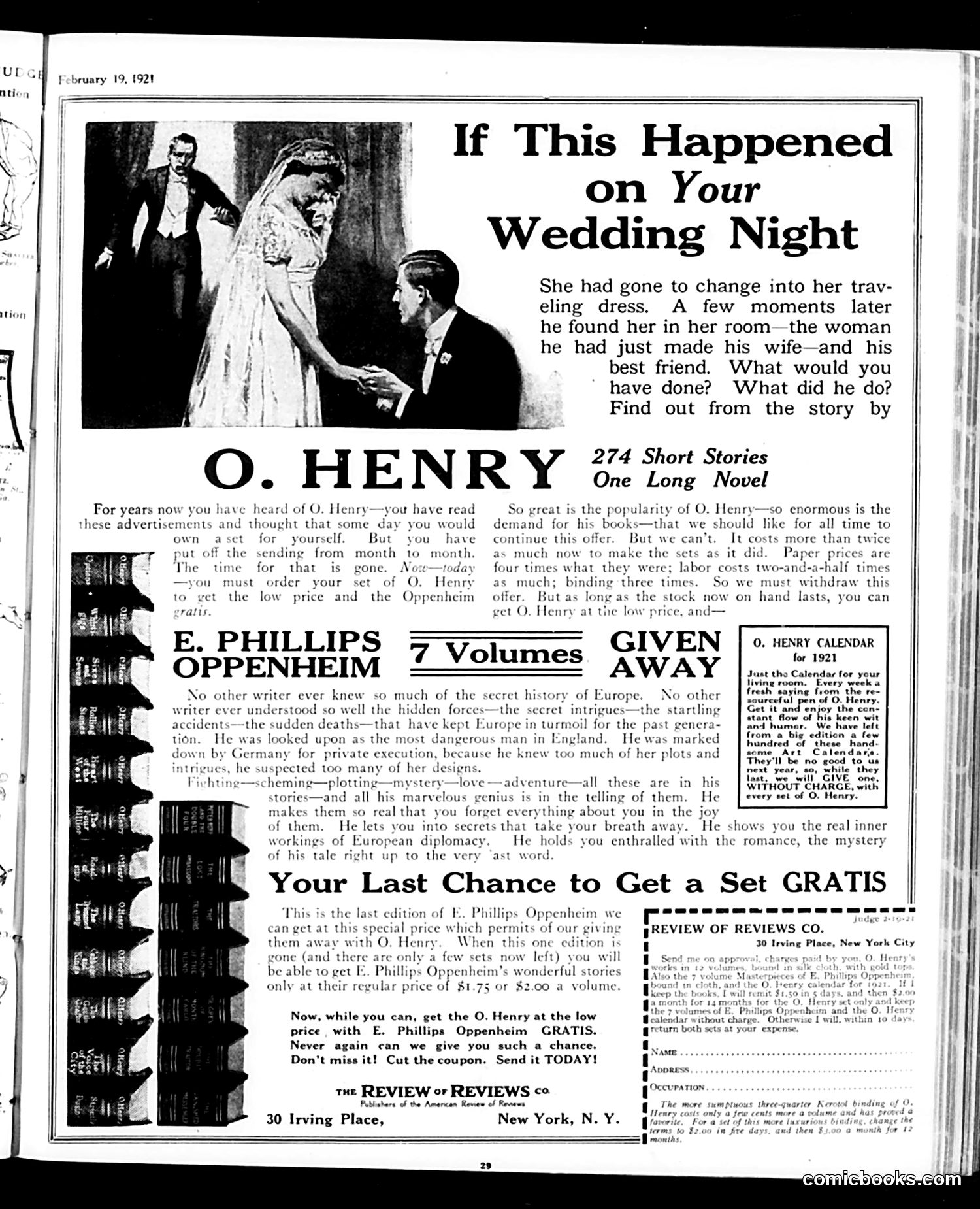
This is primarily a **book advertisement**, not political satire. The page promotes O. Henry's collected works bundled with E. Phillips Oppenheim novels through the Review of Reviews Company (February 19, 1921). The small illustration at top depicts a dramatic domestic scene—a newlywed discovering his wife with his best friend—meant to intrigue readers about O. Henry's short story collections, known for unexpected twists and moral dilemmas. The teaser "What would you have done?" invites readers to purchase the books to learn the story's resolution. The main text emphasizes Oppenheim as a spy novelist who understood European "secret history" and diplomatic intrigue, likely appealing to post-WWI readers fascinated by espionage and international conflict. The "gratis" offer is time-limited: buy the O. Henry set at reduced price, receive the Oppenheim volumes free—but only while stock lasts. A bonus O. Henry calendar sweetens the deal. This is aggressive 1920s direct-mail marketing, not satire.
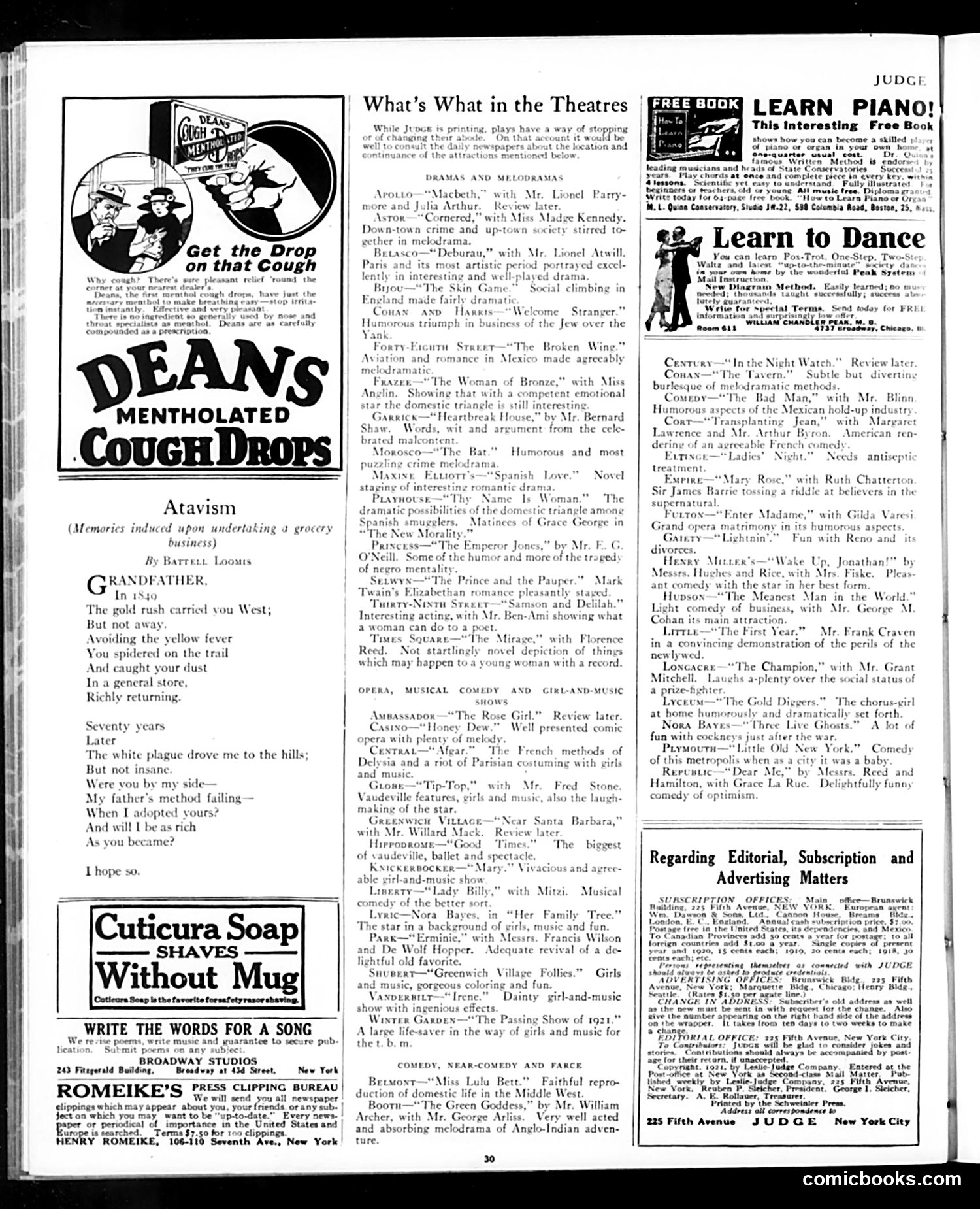
This page's main literary content is a poem titled "Atavism" by Bartel Loomis, subtitled "Memories induced upon undertaking a grocery business." The poem reflects on family history and inherited traits across generations. The speaker's grandfather struck it rich during the 1849 California Gold Rush, then returned wealthy. Seventy years later, the speaker—suffering from tuberculosis (the "white plague")—retreats to the hills seeking recovery, just as his grandfather once did during a yellow fever outbreak. The satire is gentle: the poem ironically contrasts the grandfather's successful financial outcome with the speaker's uncertain prospects, despite mimicking his ancestor's method of geographic escape. The title "Atavism" (reversion to ancestral traits) suggests the speaker is unconsciously repeating family patterns, hoping for similar prosperity but acknowledging he may not achieve it. The rest of the page contains theatre reviews, advertisements (Cuticura Soap, Deans Mentholated Cough Drops), and business listings typical of Judge magazine's format.
This is an advertisement for *Film Fun*, a humor magazine, disguised as editorial content. It describes "Funday"—the monthly publication day—as a household event that brings joy to an entire American family. The text references silent film stars **Constance Talmadge** and **Doris May** (popular actresses of the 1920s), and **Harold Lloyd** (famous silent comedian), indicating this is from the silent film era. The satire is gentle: the ad claims *Film Fun* is so entertaining it temporarily liberates housewives from "gray monotony" of domestic labor, makes fashion-conscious sisters linger over celebrity photos, excites brothers wanting to discuss movies, and even makes dignified fathers revert to childlike giddiness. The joke is that a magazine about cinema becomes a cultural event uniting the family—a clever marketing pitch positioning *Film Fun* as essential household entertainment. The ad costs twenty cents.
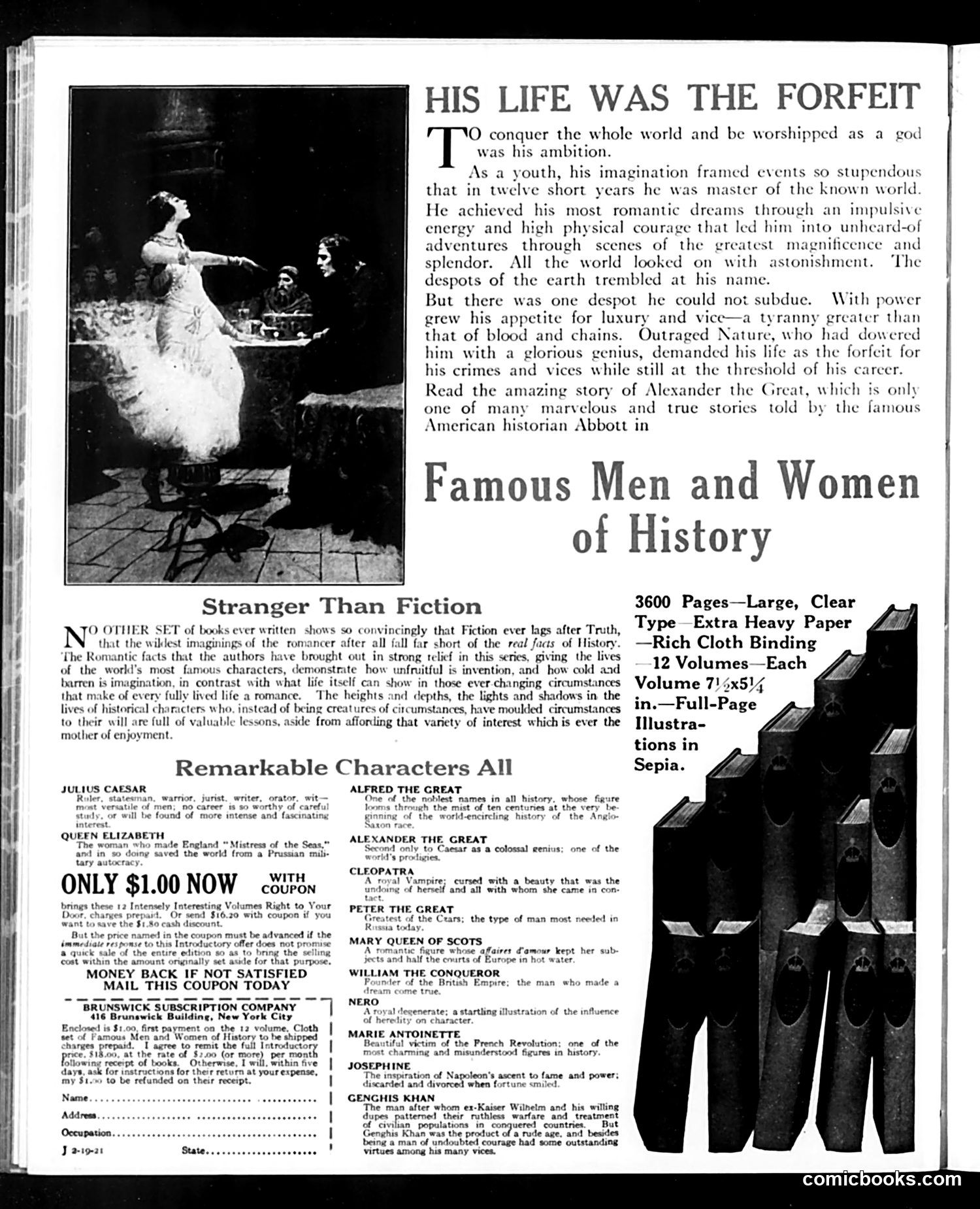
This is primarily **advertising copy**, not a political cartoon. The page promotes a 12-volume encyclopedia titled "Famous Men and Women of History" by American historian Abbott. The advertisement uses dramatic narrative about **Alexander the Great** as its hook—describing his ambition to conquer the world, his physical courage, but ultimately his moral downfall through vice and luxury ("Nature...demanded his life as the forfeit for his crimes and vices"). The pitch argues these historical biographies are more compelling than fiction because they contain "real facts of History." The text emphasizes that actual historical figures prove more dramatic than invented characters. The "Remarkable Characters All" section lists subjects covered: Julius Caesar, Queen Elizabeth, Alfred the Great, Cleopatra, Peter the Great, Mary Queen of Scots, William the Conqueror, Nero, Marie Antoinette, Josephine, and Genghis Khan—a standard historical pantheon of the era. The coupon at bottom offers the set for $1.00 initially, then monthly installments, with a money-back guarantee.