
Judge, 1921-02-19 · page 19 of 32
Judge — February 19, 1921 — page 19: what you’re looking at
What you’re looking at
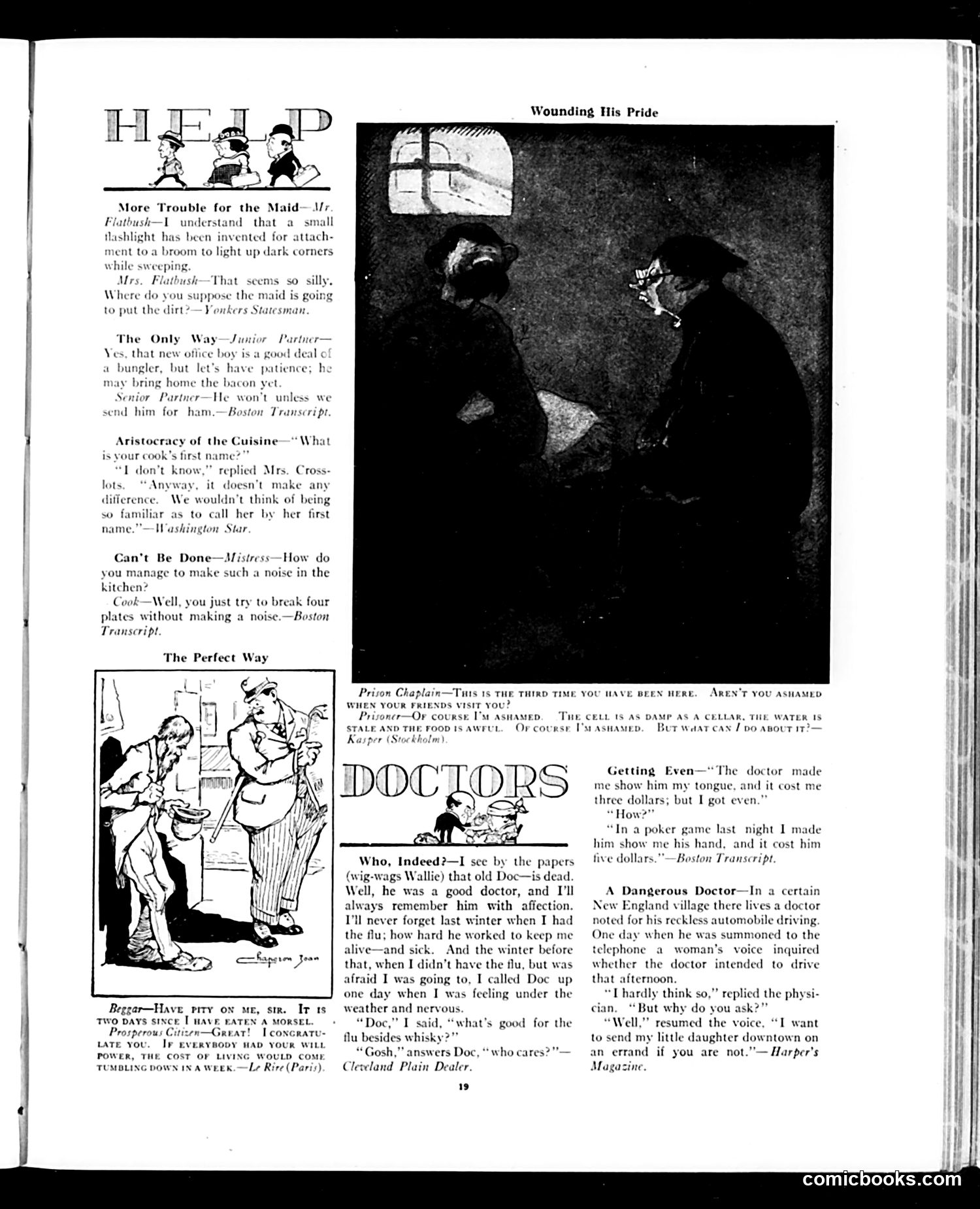
This page from the satirical magazine *Judge* contains multiple brief humorous anecdotes mocking domestic servants, workers, and professionals of the early 20th century. The cartoons and jokes target: - **Maids**: Their supposed stupidity and laziness (the flashlight joke implies a maid would simply dump dirt rather than sweep it properly) - **Office boys**: Portrayed as incompetent "bungler[s]" - **Servants**: Depicted as presumptuous for expecting familiarity with employers - **Doctors**: Shown as indifferent to patient welfare ("who cares?") and reckless drivers The satirical point consistently ridicules the working class and service workers through gentle mockery of their perceived incompetence and impropriety. The "Prison Chaplain" cartoon depicts a prisoner complaining about cell conditions—the chaplain's helpless response suggests resignation to institutional indifference. These pieces reflect early-20th-century middle-class attitudes: servants were expected to be deferential, obedient, and competent; when they failed, they became subjects of ridicule rather than sympathy.
📄 Transcribed text from this page (OCR, searchable)
Machine-transcribed from the original scan — historical spelling and the odd misread are preserved.
} More Trouble for the Maid— l/r Flathush—L understand that a Hashlight has been invented for attach- nt toa broom to light up dark corners while sweeping. Mrs. F That se Where do you suppose the maid is goi Yonkers Statesman. small s so silly. to put the dirt? The Only Way—Jinior Partier— Ves, that new office boy is a good deal « abu may bring home the bacon yet He won't unless we Boston Transcript. ler, but let’s have patience; nior Partner do him for ham Aristocracy of the Cuisine—" What is your cook's first name?” don’t know,” replied Mrs. Cross: rts. “Anyway, it doesn’t make any ditierence. We wouldn’t think of being so familiar as to call her by her first name.” —Washington Star Can't Be Done—Mistress—How do you manage to make such a noise in the kitchen? Cook—Well, you just try to break four plates without making a noise.—Boston Transcript The Perfect Way Beggar—Have prry ox str, str. It ts Two Days since [ WAVE EATEN A MORSEL. Prosperous Citizen—Great! [concratu- LATE You. IF EVERYBODY HAD YOUR WILL POWER, THE COST OF LIVING WoULD cor TUMBLING DOWN IN A WEEK. —L¢ Rire (Paris) Woundi: Prison Chap HIS 18 THE THIRD TIME WHEN YOUR FRIENDS Visit you? Prisonerp—Or course I'm asnasen. T STALE AND THE Foop Is awret. Or coursr Kasper (Stockholm) Who, Indeed?—I see by the papers (wig-wags Wallie) that old Doc—is dead. Well, he was a good doctor, and I'll always remember him with affection. I'll never forget last winter when I had the flu; how hard he worked to keep me alive—and sick. And the winter before that, when I didn’t have the flu, but was afraid I was going to, I called Doc up one day when I was feeling under the weather and nervous “Doe,” I said, “what's good for the flu besides whisky? “Gosh,” answers Doc, * who cares? "’— Cleveland Plain Dealer. ng His Pride You HAVE BEEN HERE. AREN'T You ASHAMED © CELL 18 AS DAMP AS A CELLAR, THE WATER IS Varasnamen. Bur waat can / po anovut it? — le Getting Even—“The doctor 1 me show him my tongue, and it cost me three dollars; but I got even.” “How?” “In a poker game last night 1 made him show me his hand, and it cost him five dollars. Boston Transcript A Dangerous Doctor—In a certain New England village there lives a doctor noted for his reckless automobile driving. One day when he was summoned to the telephone a woman’s voice inquired whether the doctor intended to drive that afternoon. “Thardly think so,” replied the physi- cian. “But why do you ask?” “Well,” resumed the voice, “I want to send my little daughter downtown on an errand if you are not.”— Harper's Magazine. comicbooks.com