
Judge, 1921-02-19 · page 22 of 32
Judge — February 19, 1921 — page 22: what you’re looking at
What you’re looking at
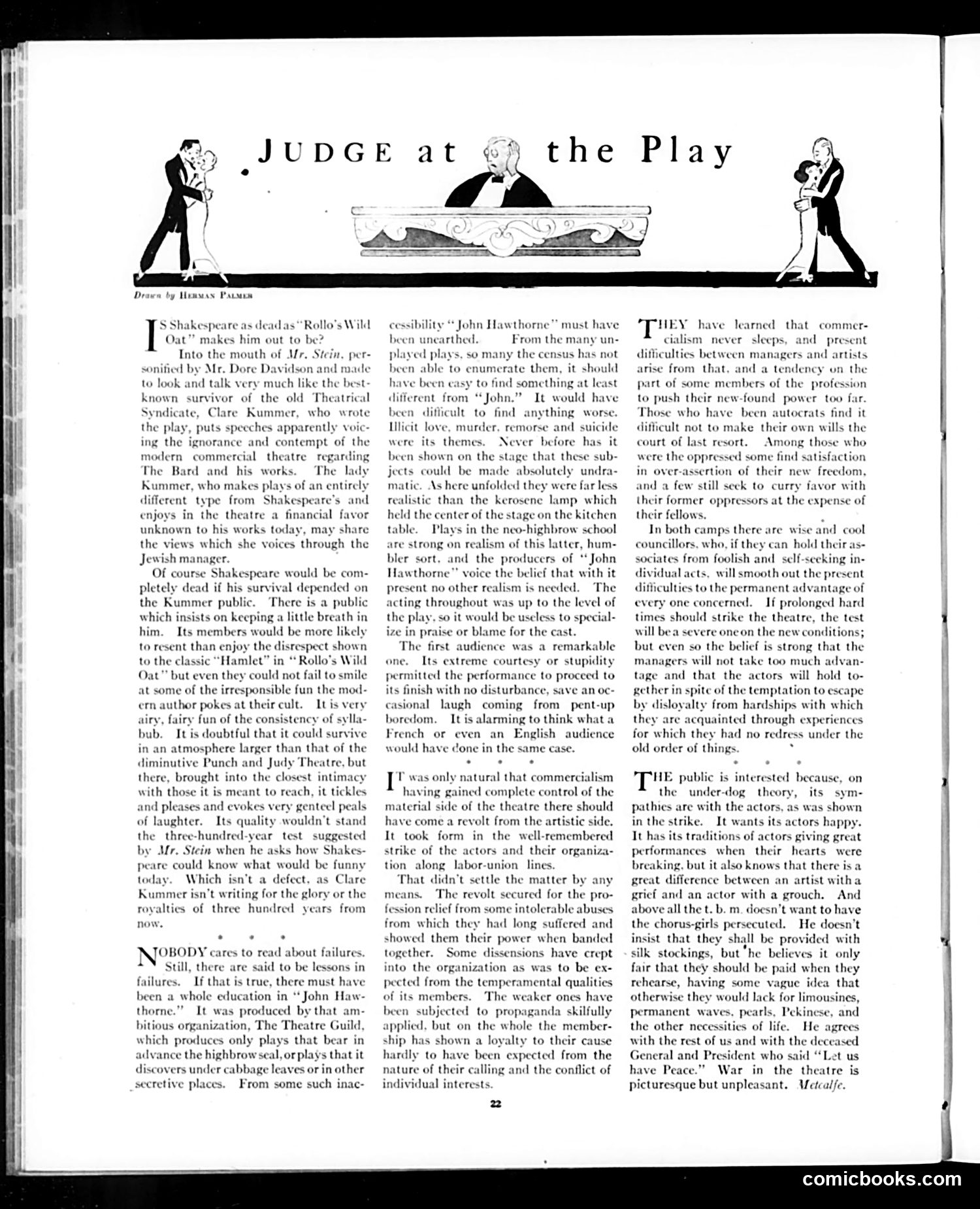
This page contains theater criticism rather than a traditional political cartoon. The header illustration shows a judge presiding over theatrical matters, setting the tone for reviewing Broadway productions. The text critiques two plays: Clare Kummer's "Rollo's Wild Oat" (which mocks Shakespeare) and "John Hawthorne" (produced by The Theatre Guild). The author argues that while Kummer's commercial comedy is frivolous but entertaining, The Theatre Guild's artistic pretensions produce genuinely bad drama. The satire targets the tension between **commercial theater** (represented by Kummer and the character Mr. Stein, a Jewish theater manager) and **highbrow artistic theater** (The Theatre Guild). The critic suggests both approaches have merit—commercial theater needn't apologize for ephemeral fun, while artistic theater shouldn't excuse poor execution in the name of avant-garde realism. The piece also mocks audiences for their passive tolerance of bad productions.
📄 Transcribed text from this page (OCR, searchable)
Machine-transcribed from the original scan — historical spelling and the odd misread are preserved.
Drawn by Wemsax Patio S Shakespeare as deadas“Rollo’s Wild Oat” makes him out to be? Into the mouth of Mr. Stein, per- sonified by Mr. Dore Davidson and made to look and talk very much like the best- known survivor of the old Theatrical Syndicate, Clare Kummer, who wrote the play, puts speeches apparently voic- ing the ignorance and contempt of the modern commercial theatre regarding The Bard and his works. The lady Kummer, who makes plays of an entirely different type from Shakespeare’s and enjoys in the theatre a financial favor unknown to his works today, may share the views which she voices through the Jewish manager. Of course Shakespeare would be com- pletely dead if his survival depended on the Kummer public. There is a public which insists on keeping a little breath in him. Its members would be more likely to resent than enjoy the disrespect shown to the classic “Hamlet” in ** Rollo’s Wild Oat” but even they could not fail to smile at some of the irresponsible fun the mod- ern author pokes at their cult. Lt is very airy, fairy fun of the consistency of sylla- bub. It is doubtful that it could survive in an atmosphere larger than that of the diminutive Punch and Judy Theatre, but there, brought into the closest intimacy with those it is meant to reach, it tickles and pleases and evokes very genteel peals of laughter. Its quality wouldn't stand the three-hundred-year test suggested by Mr. Stein when he asks how Shakes- peare could know what would be funny today. Which isn’t a defect, as Cla Kummer isn’t writing for the glory or the royalties of three hundred years from now. JOBODY cares to read about failures. Still, there are said to be lessons in failures. If that is true, there must have been a whole education in “John Haw- thorne.”” It was produced by that am- bitious organization, The Theatre Guild, which produces only plays that bear in advance the highbrow seal, or plays that it discovers under cabbage leaves or in other secretive places. From some such inac- cessibility “ John Hawthorne” must have been unearthed. From the many un- played plays. so many the census has not been able to enumerate them, it should have been easy to find something at least different from “John.” It would have been diflicult to. find anything worse. Illicit love, murder, remorse and suicide were its themes. Never before has it been shown on the stage that these sub- jects could be made absolutely undra- matic. As here unfolded they were far less realistic than the kerosene lamp which held the center of the stage on the kitchen table. Plays in the neo-highbrow school are strong on realism of this latter, hum- bler sort, and the producers of “John Hawthorne” voice the belief that with it present no other realism is needed. The acting throughout was up to the level of the play, so it would be useless to special- ize in praise or blame for the cast. The first audience was a remarkable one. Its extreme courtesy or stupidity permitted the performance to proceed to its finish with no disturbance, save an oc- nal laugh coming from pent-up boredom. It is alarming to think what a French or even an English audience would have cone in the same case. T was only natural that commercialism having gained complete control of the material side of the theatre there should have come a revolt from the artistic side. It took form in the well-remembered strike of the actors and their organiza- tion along labor-union lines. That didn’t settle the matter t means. The revolt secured for the pr fession relief from some intolerable abuses from which they had long suffered and showed them their power when banded together. Some dissensions have crept into the organization as was to be ex- pected from the temperamental qualities of its members. The weaker ones have been subjected to propaganda skilfully applied, but on the whole the member- ship has shown a loyalty to their cause hardly to have been expected from the nature of their calling and the conflict of individual interests. any MEY have learned that commer- cialism never sleeps, and present difficulties between managers and artists arise from that, and a tendency on the art of some members of the pr to push their new-found power too far. Those who have been autocrats find it dificult not to make their own wills the court of last resort. Among those who were the oppressed some find satisfaction fession in over-assertion of their new freedom, and a few still seck to curry favor with their former oppressors at the expense of their fellows. . In both camps there are wise and cool councillors, who, if they can hold their as- sociates from foolish and _ self-secking in- dividual acts, will smooth out the present difficulties to the permanent advantage of every one concerned. If prolonged hard times should strike the theatre, the test will bea severe oncon the new conditions; but even so the belief is strong that the managers will not take too much advan- tage and that the actors will hold to- gether in spite of the temptation to escape by disloyalty from hardships with which they are acquainted through experiences for which they had no redress under the old order of things. . THE public is interested because, on the under-dog theory, its sym- pathics are with the actors, as was shown in the strike. It wants its actors happy. It has its traditions of actors giving great performances when their hearts were breaking, but it also knows that there is a great difference between an artist witha grief and an actor with a grouch. And above all the t. b. m. doesn’t want to have the chorus-girls persecuted. He doesn’t insist that they shall be provided with silk stockings, but ‘he believes it only fair that they should be paid when they rehearse, having some vague idea that otherwise they would lack for limousines, permanent waves. pearls, Pekinese, and the other necessities of life. He agrees with the rest of us and with the deceased General and President who said “Let us have Peace.” War in the theatre is picturesque but unpleasant. Vetcalfe. comicbooks.com