
Judge, 1921-02-19 · page 18 of 32
Judge — February 19, 1921 — page 18: what you’re looking at
What you’re looking at
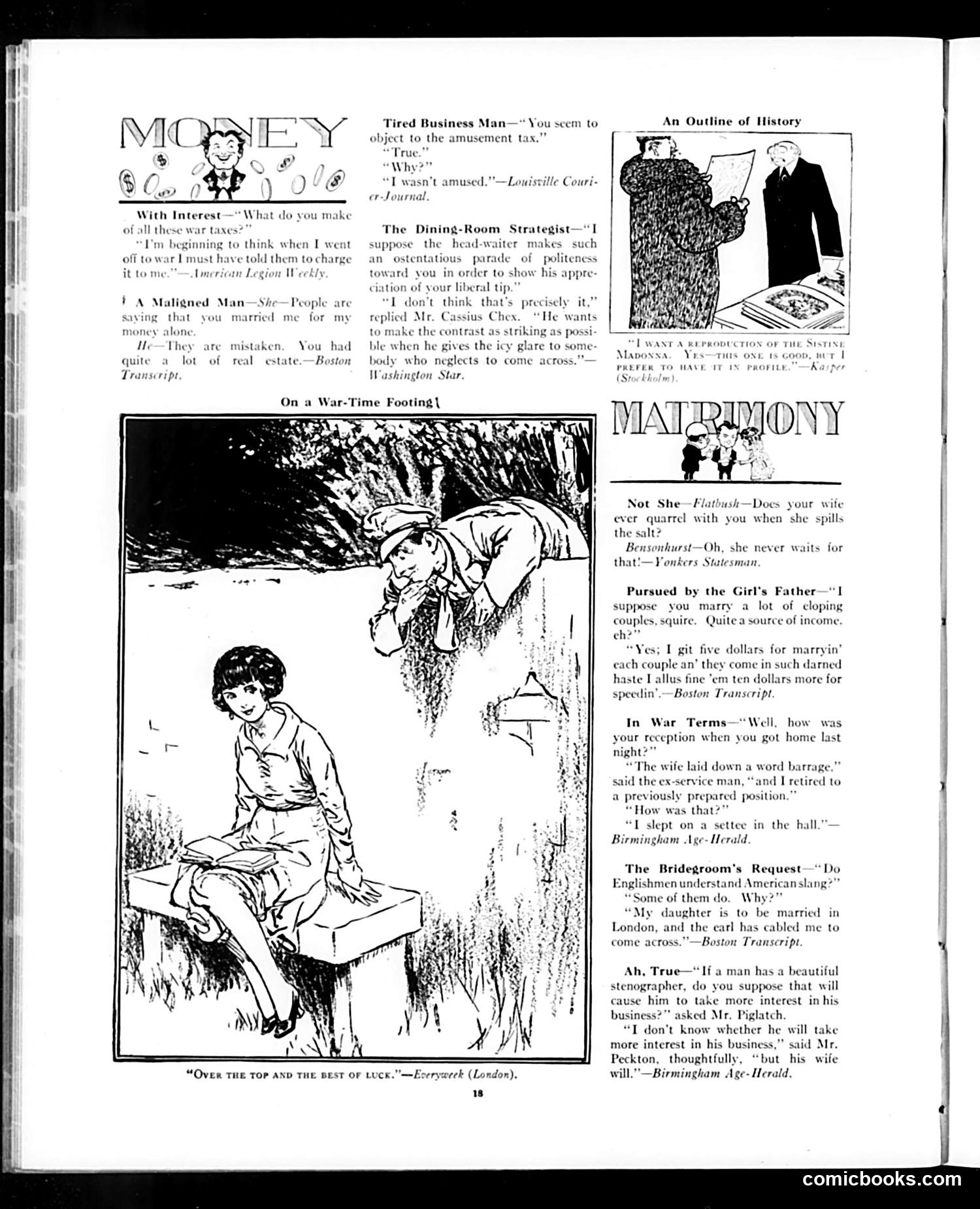
This page collects brief humorous anecdotes satirizing **wartime American life and social pretense** during WWI era. **Key themes:** - **War taxation**: Jokes mock both unpopular new taxes and hypocrisy (the "amusement tax" on entertainment deemed unamusing). - **Class anxiety**: Multiple jokes target social climbing and money-consciousness—marriages for wealth, tipping rituals, eloping couples as business opportunity. The era's economic strain surfaces repeatedly. - **Domestic power dynamics**: Several jokes depict wives as domineering, using wartime language ("word barrage," "prepared position") to humorously describe marital conflict and male retreat. - **The illustration** (captioned "Over the Top and the Best of Luck") depicts a woman climbing a hill or trench, evoking WWI's grueling "over the top" charges, though applied here to civilian life. The overall tone mocks American materialism, social pretense, and gender relations while using war terminology as comedic framework—reflecting how thoroughly wartime had saturated public discourse and anxieties.
📄 Transcribed text from this page (OCR, searchable)
Machine-transcribed from the original scan — historical spelling and the odd misread are preserved.
Tired Business in—* You seem to object to the amusement tax.” True.” “Why?” “T wasn’t amused.”"—Louisville Couri- er-Journal. With Interest" What do you make of all these war taxes?” The Dining-Room Strategist—“I “I'm beginning to think when I went — suppose the head-waiter makes such them tocharge an. ostentatious parade of politeness Ve toward you in order to show his appre- f your liberal tip.” ink that's precisely it, jus Chex. “He wants off to war I must have to! it to me.”"—.Emerican Le ciat 1 A Maligned Man—She—People are I ing that you married me for my — replied Mr. C money alone to make the contrast as striking as possi He—They are mistaken. You had — ble when he gives the icy glare to quite a lot of real estate.—Boston body who neglects to come across.”"— Transcript Washington Star. say ANT A REPR Mapvoxsxa. Yrs—titts one ts Goon. PREFER TO HAVE IT IN PROFILE MAT RIONY _ FR On a War-Time Footing\ =u es x Not She—Flathush—Does your wiie ever quarrel with you when ‘she spills the salt? Bensonhurst—Oh, she never waits for that!— Yonkers Statesman. Pursued by the Girl's Father—"I suppose you marry a lot of cloping ] couples, squire. Quite a source of income. eh?" “Yes; I git five dollars for marryin’ cach couple an’ they come in such darned haste I allus fine ’em ten dollars more for speedin’.—Boston Transcript. In War Terms—“Well, how was your reception when you got home last night?” “The wife laid down a word barrage,” said the ex-service man, “and I retired to a previously prepared position.” “How was that?” “I slept on a settee in the hall.”"— Birmingham Age-Herald. a The Bridegroom's Request—" Do Englishmen understand Americanslang?” Some of them do. Why?” “My daughter is to be married in London, and the earl has cabled me to come across.” —Boston Transcript Ah, True—*If a man has a beautiful stenographer, do you suppose that will cause him to take more interest in his business?” asked Mr. Piglatch. “I don’t know whether he will take more interest in his business,” said Mr. Peckton, thoughtfully, “but his wife will.”"—Birmingham Age- Herald, Everyweek (London), 18 “Over THE TOP AND THE BEST OF LUCK.” comicbooks.com