
A complete issue · 32 pages · 1921
Judge — February 12, 1921
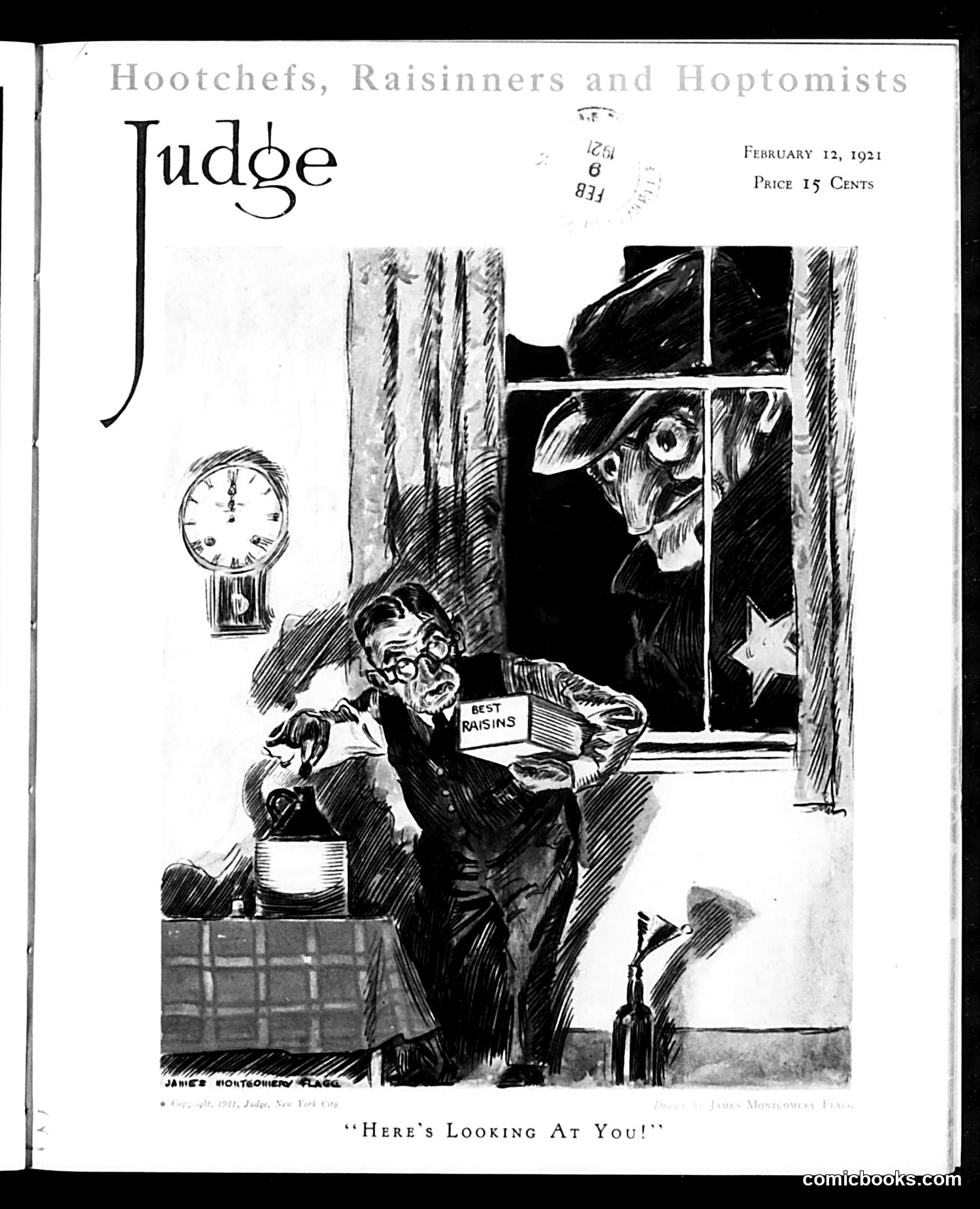
This Judge magazine cover from February 12, 1921 depicts a figure labeled "BEST RAISINS" looking out a window at what appears to be a well-dressed man or judge outside. The cartoon's title suggests a confrontational moment or challenge. The specific context remains unclear without additional information about 1921 events. However, the "Best Raisins" label suggests this may reference the California raisin industry or a related agricultural/commercial matter. The figure at the window appears skeptical or aggressive—possibly representing a regulatory or judicial authority—while the indoor figure holds or displays raisins for inspection or judgment. The exact satirical target and political/social reference cannot be definitively determined from the image alone.
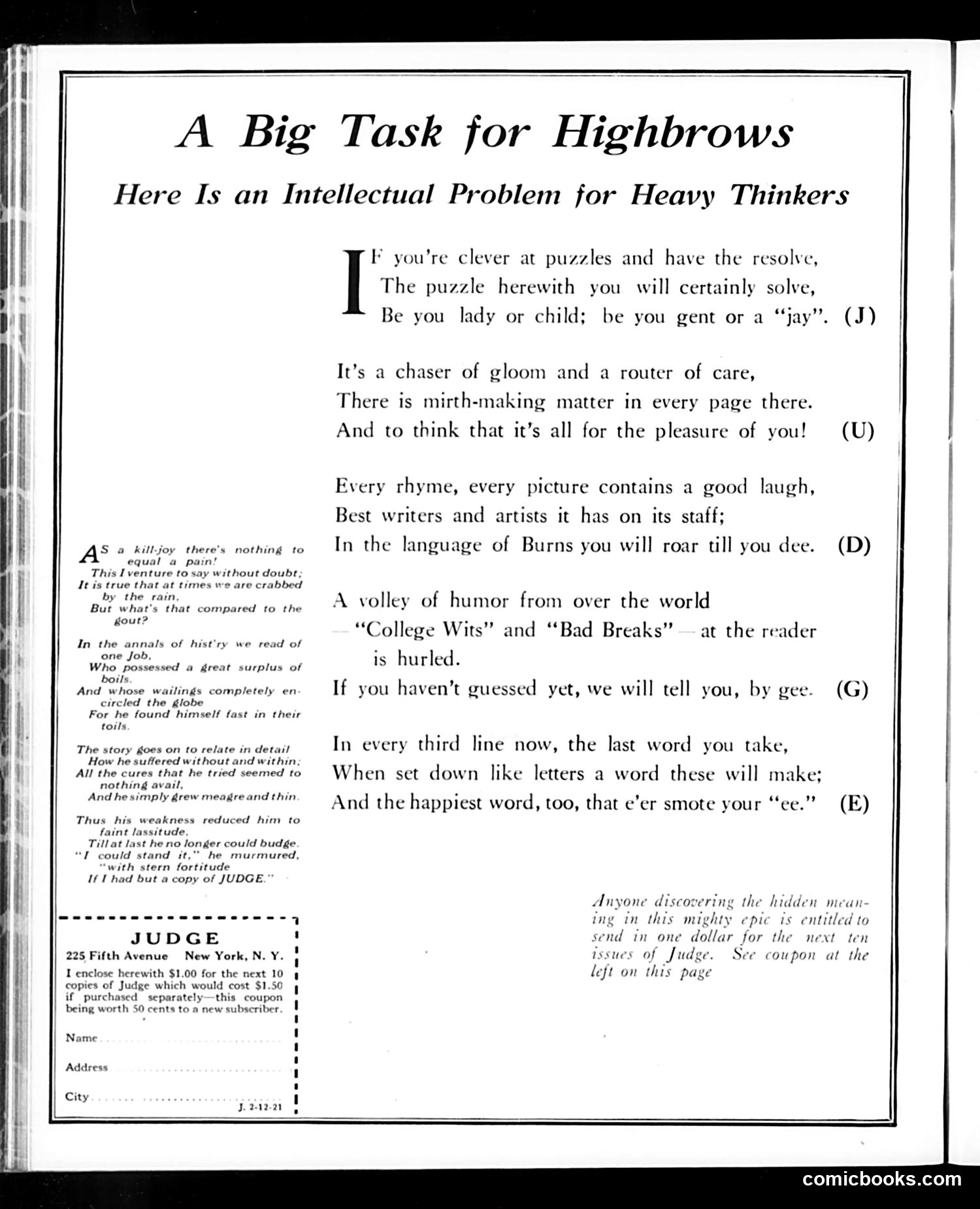
This page is primarily **advertising and wordplay puzzle content** rather than political satire. The main feature is an acrostic puzzle where the last letters of each line spell out a hidden message (letters marked J, U, D, G, E visible in the text). The poem describes Judge magazine's content—humor, illustrations, and literary pieces—and invites readers to solve the puzzle. The sidebar includes a subscription offer: $1.00 for ten future copies of Judge (normally $1.50 if purchased separately). The "intellectual problem for heavy thinkers" is simply a word puzzle game, not political commentary. This represents Judge's self-promotional advertising strategy targeting educated readers.
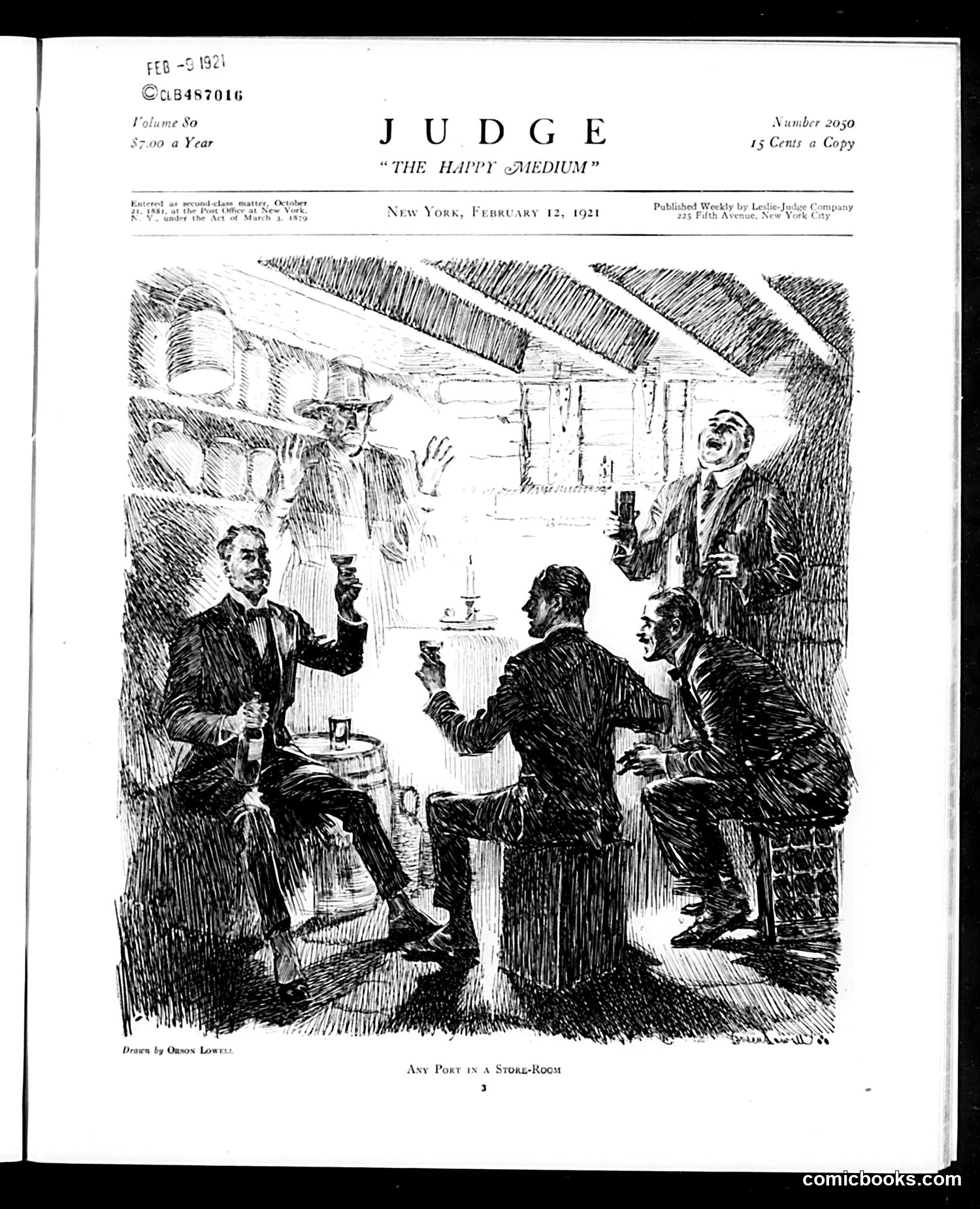
This February 1921 cartoon depicts five men in formal attire toasting in what appears to be a storage room or cellar. The title's pun references Prohibition, which had just begun (January 1920), making alcohol illegal. "Any port in a storm" becomes "any port in a stork-room"—likely alluding to both drinking venues and the need to find alternative places to consume alcohol during Prohibition's enforcement. The men appear to be wealthy or well-connected individuals finding illicit ways to drink despite the new law. The cartoon satirizes how Prohibition, intended to eliminate drinking, actually drove consumption underground into speakeasies and private locations. The joke targets the hypocrisy of those with means who circumvent the law while ordinary citizens face stricter enforcement.
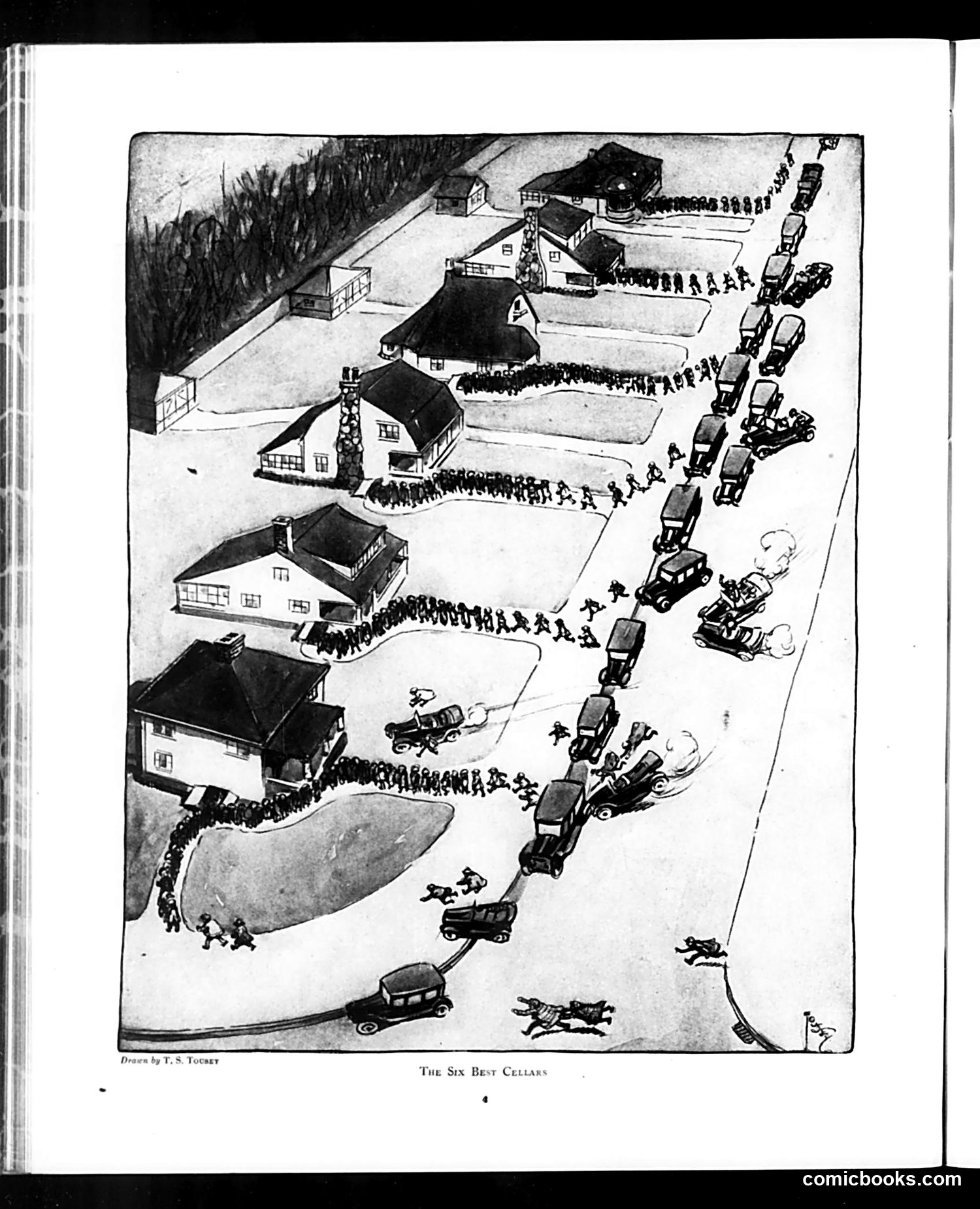
This cartoon satirizes Prohibition-era wine smuggling and bootlegging. The illustration depicts six residential houses arranged on a snowy hillside, each with lines of people queuing outside—appearing to represent illegal alcohol distribution points or speakeasies disguised as homes. Vehicles (likely delivery trucks) are positioned along a winding path, seemingly transporting contraband liquor between the "cellars" (basements where alcohol was illegally stored and sold). The satire mocks how widespread bootlegging operations became during Prohibition (1920-1933), with ordinary houses serving as fronts for illegal alcohol sales. The organized, almost commercial scale shown here—with multiple simultaneous operations and steady customer flow—suggests the cartoon critiques both the absurdity of Prohibition enforcement and the thriving black market it created.
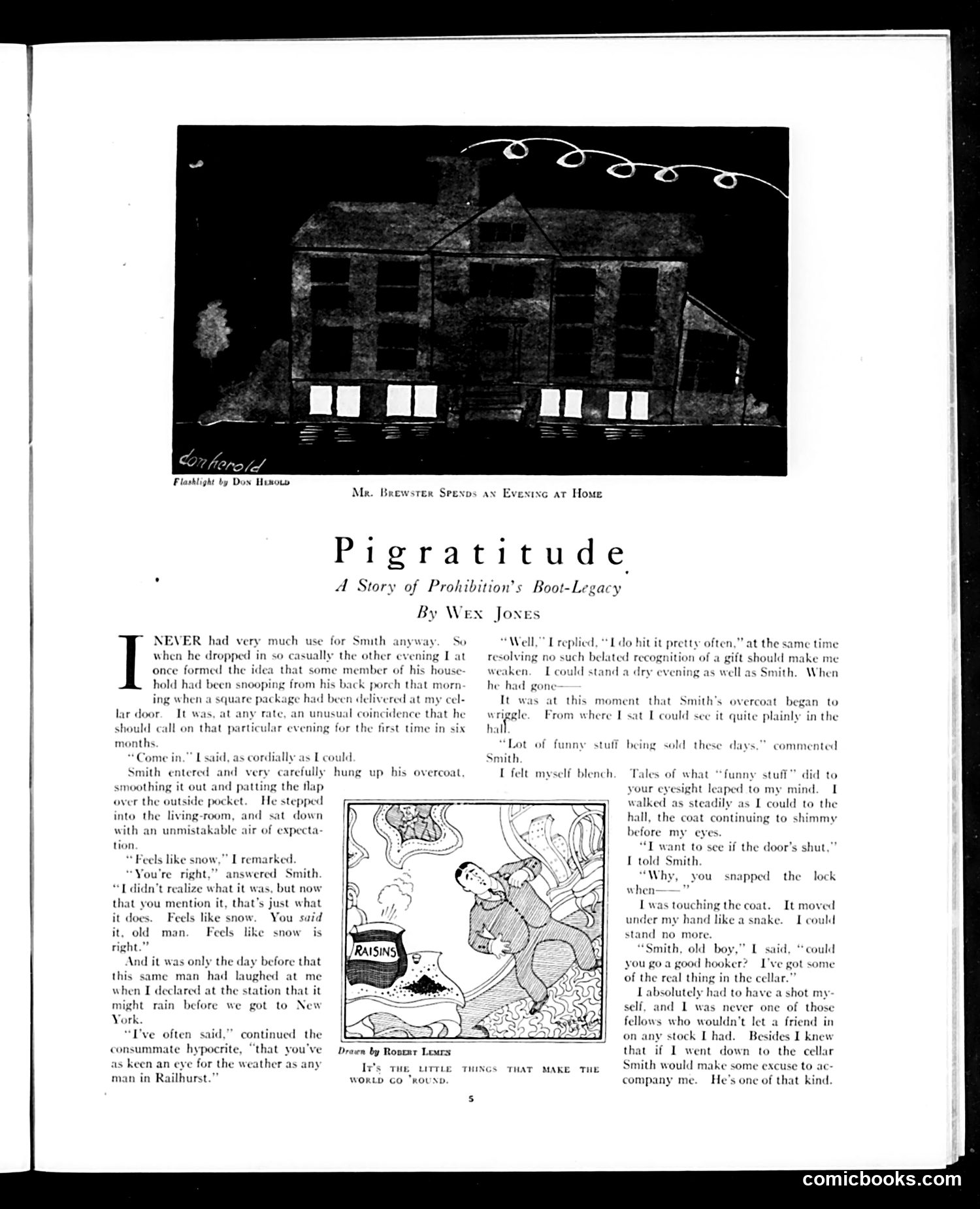
This page from *Judge* magazine presents a short story by Wex Jones about Prohibition's unintended consequences. The narrative describes a visitor's encounter with "Smith," who has illegally obtained alcohol ("funny stuff") during the dry era. The story uses humor to critique Prohibition by depicting ordinary people resorting to bootlegging and black-market dealings to obtain liquor. The illustration by Robert Leach shows a domestic scene involving what appears to be contraband alcohol (marked "RAISINS"—likely code for illegal liquor). The title "Pigratitude" puns on ingratitude, suggesting ironic commentary on how Prohibition-era "boot-legacy" created moral compromises among respectable citizens who broke the law to drink.
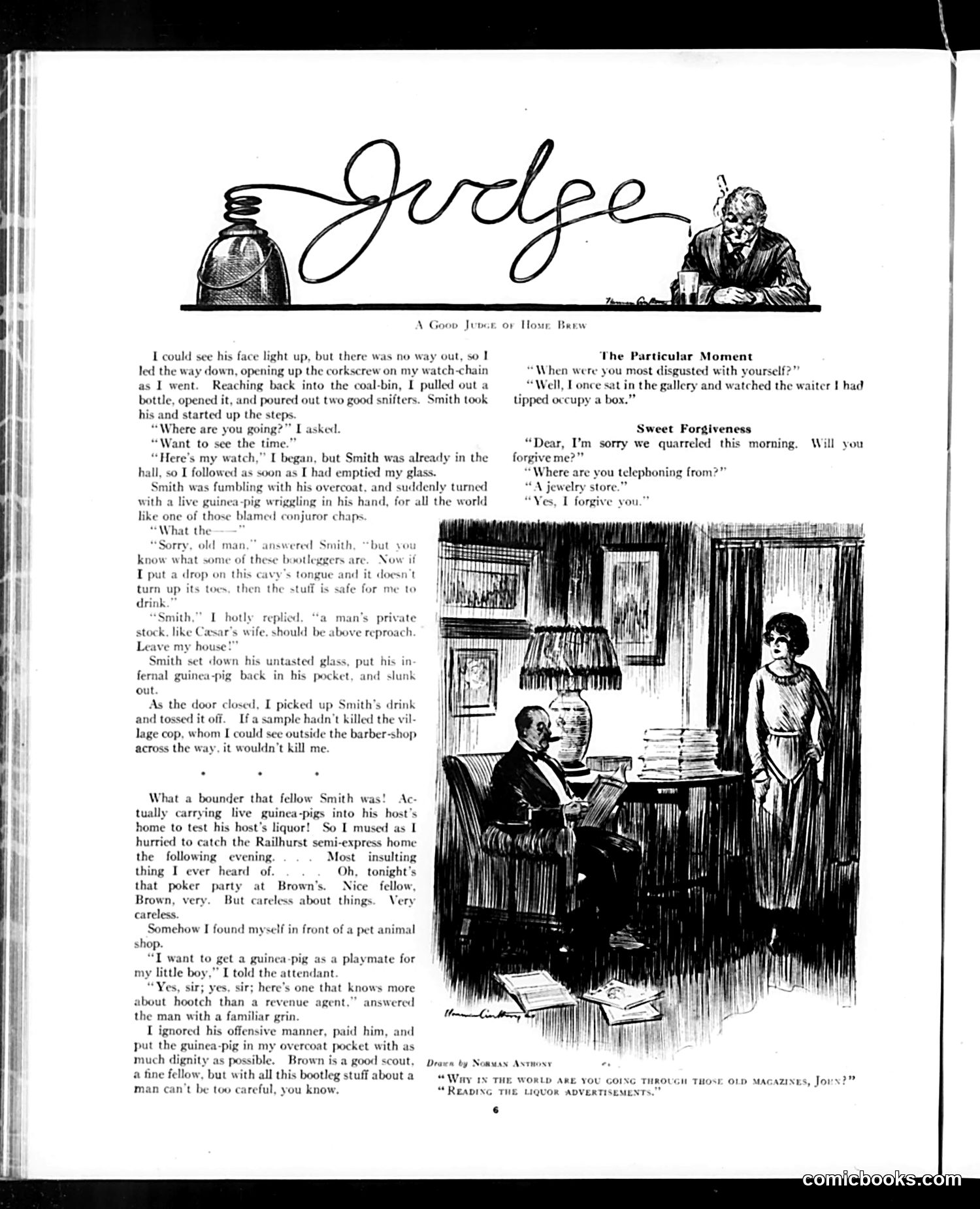
This page contains a humorous short story titled "A Good Judge of Home Brew" rather than political satire. The narrative describes a character named Smith who visits someone's home carrying a live guinea pig in his pocket. The story satirizes Smith's thoughtlessness as a guest—he's described as a "bounder" (a rude, disreputable person) for this bizarre behavior. The accompanying illustration depicts a domestic scene where Smith sits reading while a woman stands nearby, presumably discovering his inappropriate guest. The humor targets **social etiquette violations and poor behavior among men**. The caption at bottom, mentioning "old magazines" and "liquor advertisements," suggests this is satirizing common household guest misbehavior of the era—the guinea pig being an absurdly specific example of inconsiderate conduct.
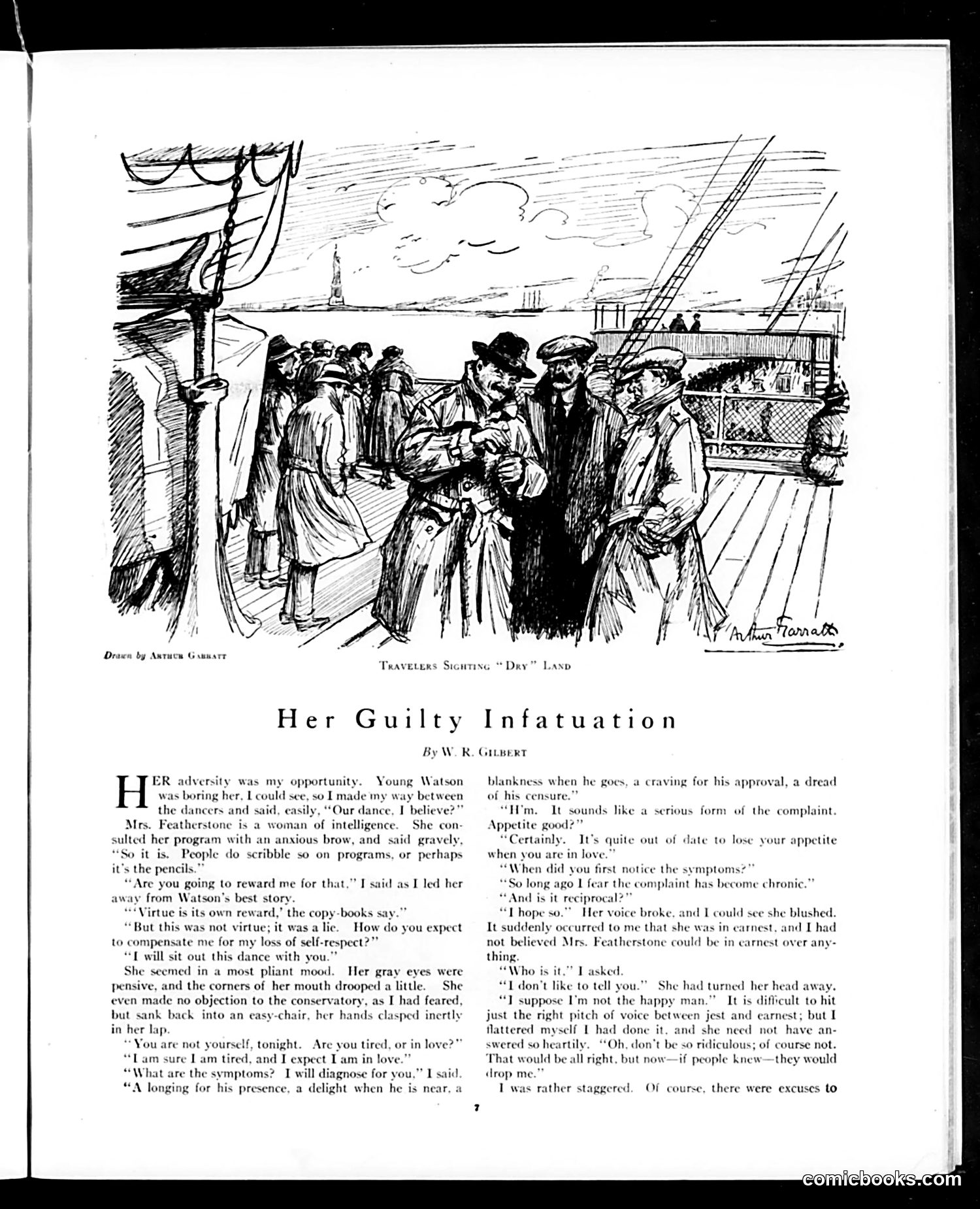
This story-and-cartoon page satirizes early 20th-century social hypocrisy around romance and reputation. The narrator, a manipulative man, interrupts young Watson's boring conversation to dance with the intelligent Mrs. Featherstone. Through flattery and false modesty, he learns she's fallen in love—but she refuses to name her admirer because, if discovered, society would ostracize her. The satire targets the absurd social double standard: a woman experiencing genuine romantic feelings faces social ruin merely from admission, while the man's dishonest scheming (lying about his dance card, feigning concern) carries no consequence. The ship-deck illustration suggests travelers observing respectable society's surface while its hypocrisy operates beneath. The story mocks Victorian-era rigid morality that punished women's authentic emotions while rewarding male manipulation.
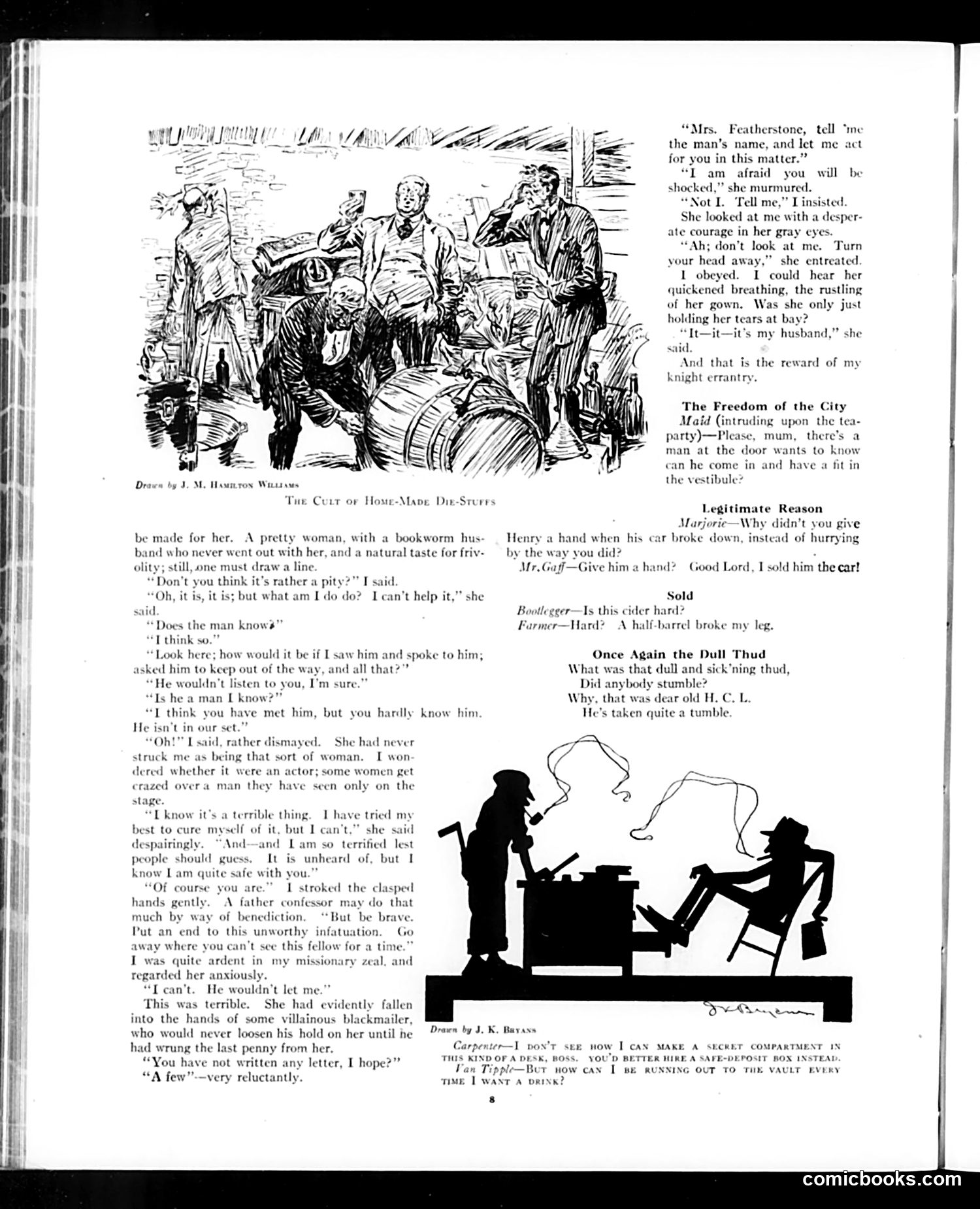
This page contains multiple satirical pieces typical of early 20th-century American humor: **Main Story ("The Cult of Home-Made Dill-Stuffs"):** A woman confesses to a male narrator that she's infatuated with a man outside her social circle, hinting at blackmail. The narrator believes she's trapped by a villain—only to learn the "man" is her own husband. The joke mocks Victorian melodrama and marital indifference: the woman's desperate infatuation is actually longing for her bookish, stay-at-home husband's attention. **Bottom Cartoons:** Quick jokes about class and commerce—a carpenter debates desk security with his boss; working-class characters discuss whether cider is "hard" (alcoholic); crude humor about someone stumbling. The overall satire targets genteel pretense and unhappy marriages among the leisure class, contrasting them with working-class practicality. The humor relies on readers' familiarity with Victorian romance tropes and period class anxieties.
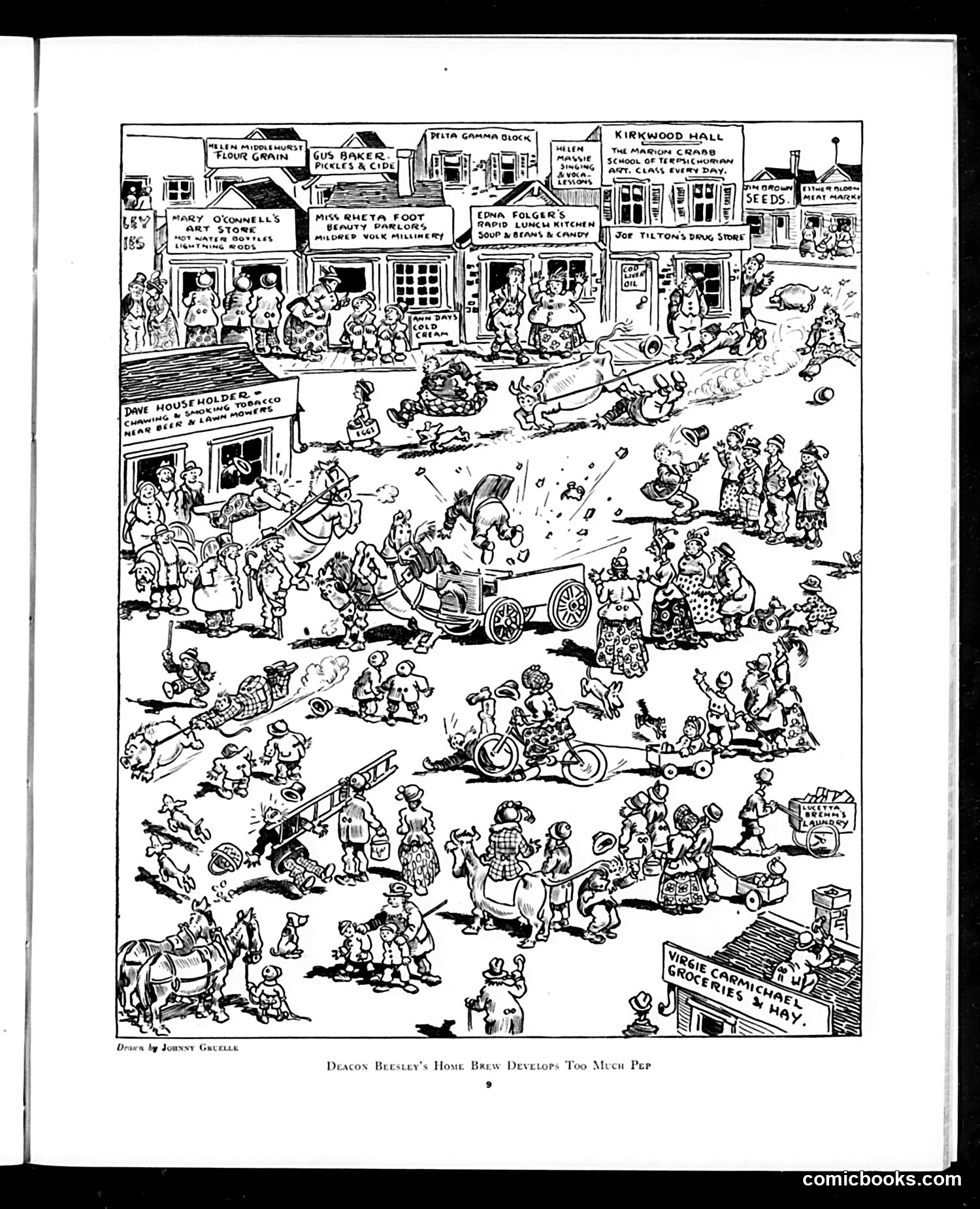
This Judge cartoon satirizes Prohibition-era home brewing. The title references "Deacon Beesley," suggesting a respectable community figure engaged in illegal alcohol production. The crowded street scene depicts chaos—children and adults running wild, vehicles colliding, people sprawling about—presumably caused by homemade beer that's dangerously potent or unstable. The joke targets the hypocrisy of Prohibition: ostensibly pious citizens (a "deacon") secretly brewing alcohol, which becomes so volatile it creates public mayhem. The detailed storefronts and community setting emphasize how widespread and disruptive this underground activity was. The cartoon mocks both the irony of prohibition enforcement and the real dangers of amateur alcohol production during the 1920s-30s era.
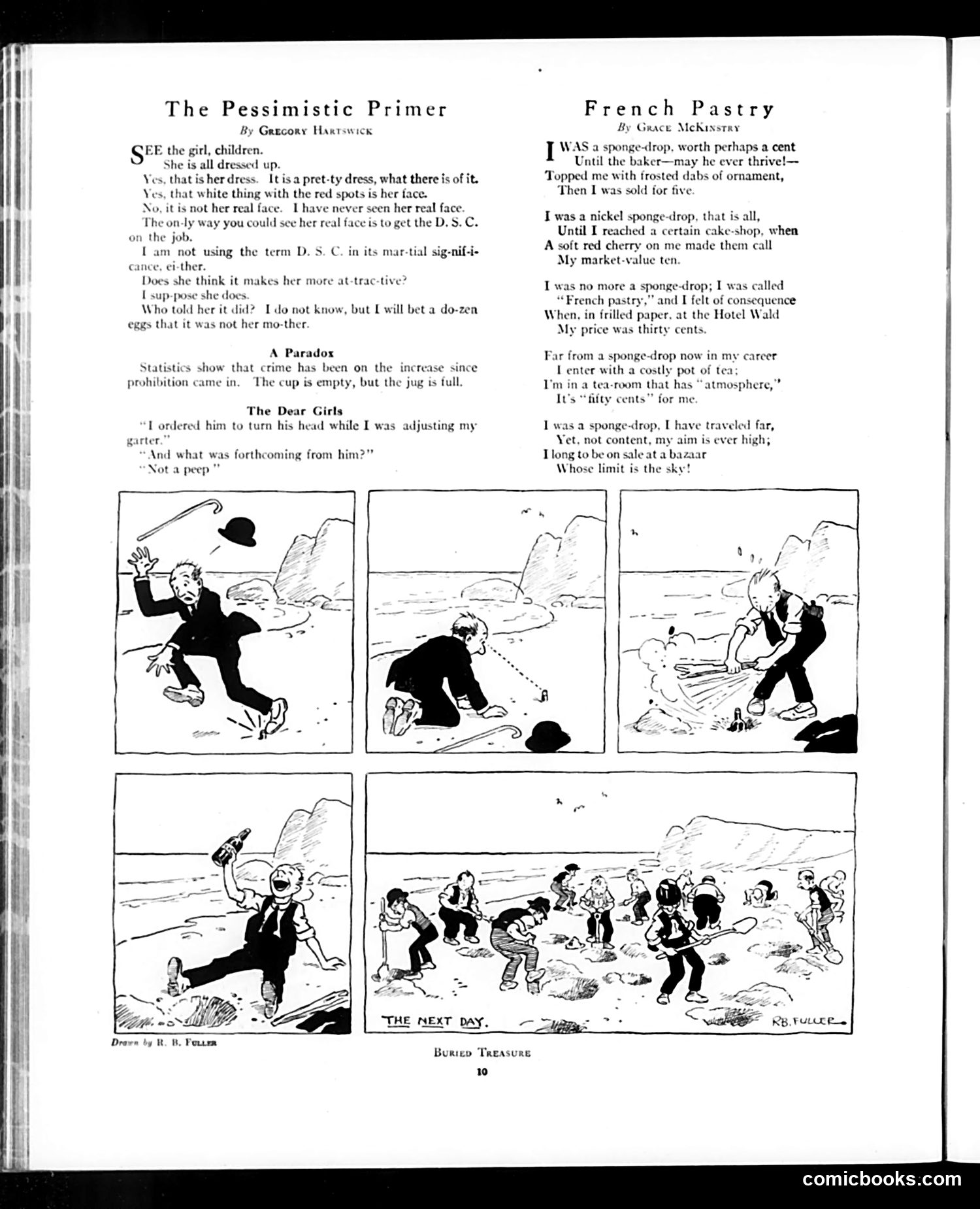
This page contains three distinct satirical pieces from an American satirical magazine: **"The Pessimistic Primer"** mocks women's heavy makeup use, presenting it as a primer lesson for children. The joke is that a girl's face is so caked with cosmetics that her "real face" is invisible—you'd need the D.S.C. (likely "Detective Service" or similar authority) to find it. The satire critiques excessive makeup as deceptive artifice. **"A Paradox"** is a brief joke about Prohibition: crime increased after alcohol bans began, yet the liquor jug remains full—suggesting bootleggers and illegal drinking thrived under the law. **"The Dear Girls"** presents a humorous double entendre: a woman orders a man to look away while adjusting her garter (a suggestive undergarment), yet he responds with complete indifference ("Not a peep"). The **"Buried Treasure"** comic strip (illustrated by R.B. Fuller) shows a man finding and digging up treasure, which the next day attracts crowds of diggers—implying widespread imitation or theft.
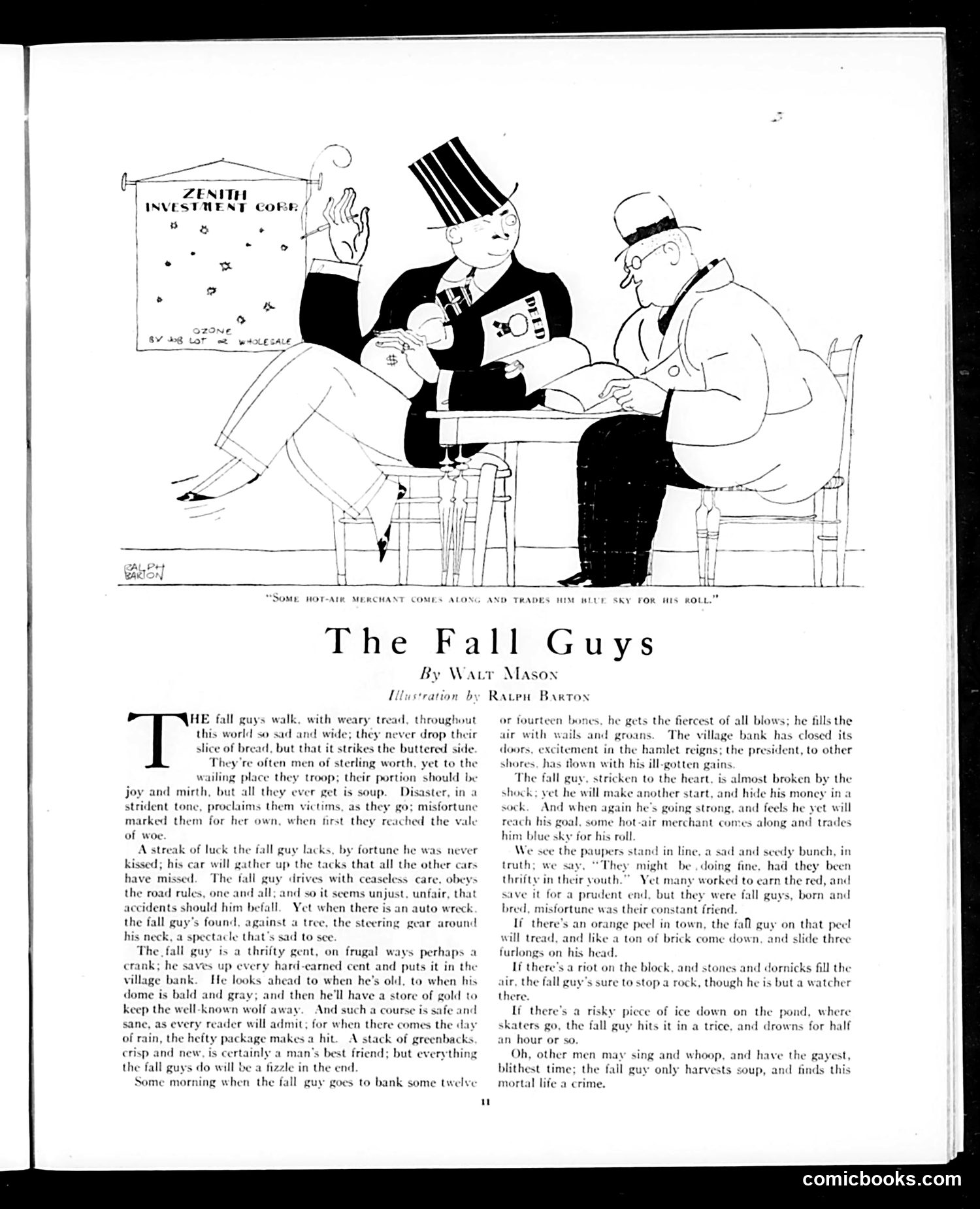
This is a satirical story (not a political cartoon) by Walt Mason about perpetually unlucky people—"fall guys"—who experience constant misfortune despite virtue and hard work. The illustration shows three men in an office examining a "Zenith Investment Corp." chart. The caption references a "hot-air merchant" trading the fall guy "blue sky for his roll"—a reference to worthless stock schemes and investment fraud that were common during the early 20th century. Mason's piece satirizes both bad luck and the economic system that exploits the working poor. Fall guys are described as hardworking, thrifty, and rule-following, yet they suffer car accidents, bank closures (where managers abscond with deposits), swindles by con-artist merchants, and everyday mishaps. The satire suggests that virtue alone cannot protect ordinary people from systematic exploitation and random catastrophe—a critique of unchecked capitalism and the precariousness of working-class life.
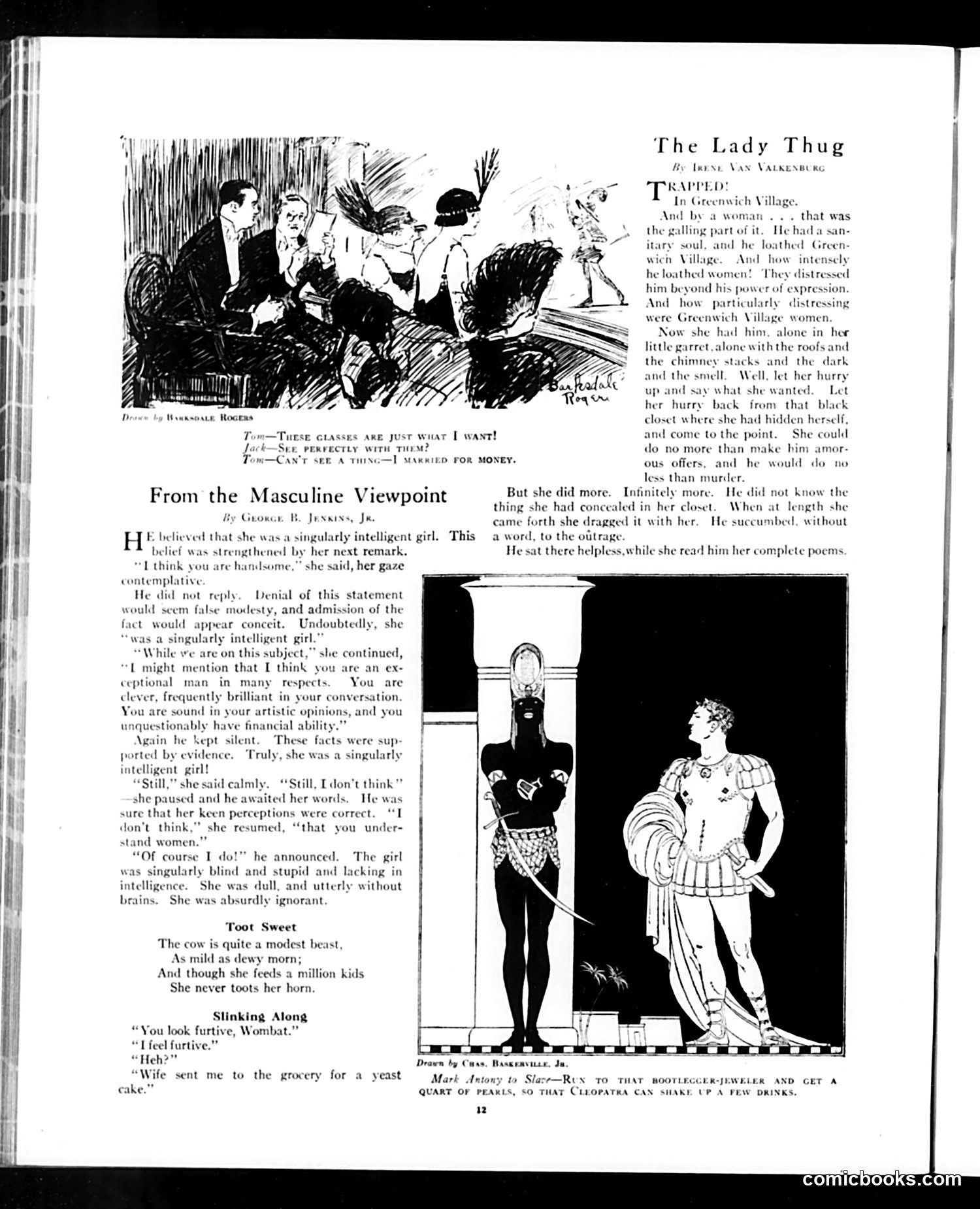
This page contains two satirical stories mocking 1920s bohemian and gender dynamics. **"The Lady Thug"** satirizes a Greenwich Village intellectual who prides himself on understanding women while being utterly oblivious. The "thug" is a woman who traps him and forces him to listen to her poetry—presented as a form of assault worse than violence. The joke targets both the pretentious male intellectual (who contradicts himself, calling her intelligent then stupid) and the ambitious female poet, suggesting her creative work is literally a weapon/violation. **"From the Masculine Viewpoint"** more directly mocks male vanity. A woman flatters a man's intelligence, appearance, and opinions, then undercuts him by saying he "doesn't understand women"—exposing his self-satisfaction as baseless. The humor relies on period stereotypes: bohemian pretension, the "new woman" as threatening, and mutual incomprehension between sexes. The illustration shows a glamorous woman confronting an apparently important man, reinforcing the role-reversal premise that women possess surprising power.
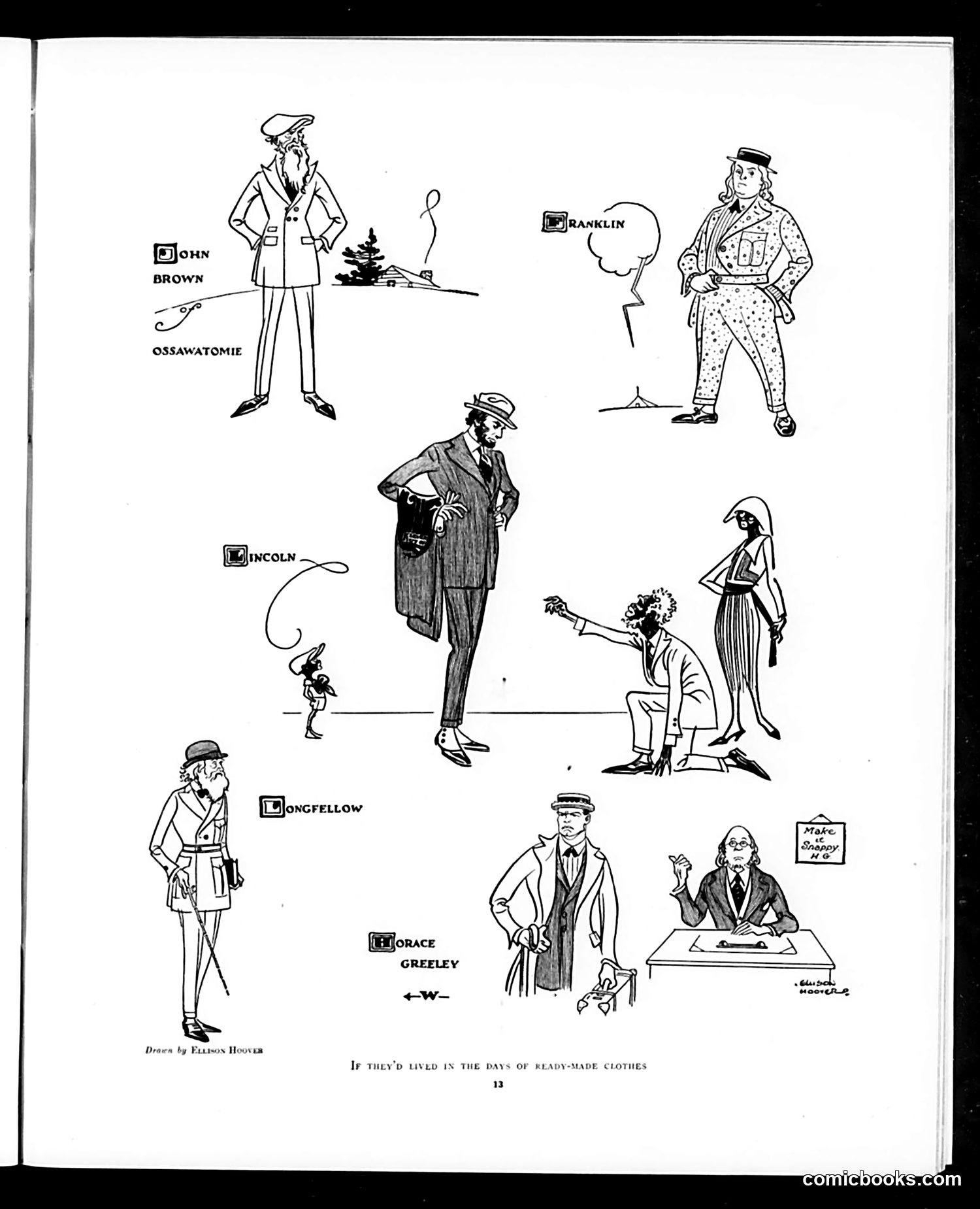
This satirical illustration presents famous historical figures as they might appear if dressed in ready-made clothes of the era. The caption reads "If they'd lived in the days of ready-made clothes." The cartoon caricatures include John Brown (Ossawatomie), Lincoln, Franklin, Horace Greeley, and others—all depicted in contemporary late-19th-century attire. The satire appears to mock the idea that these serious historical figures, reimagined in modern ready-made fashion, would lose their dignified gravitas. By placing them in ordinary contemporary clothing rather than formal or period dress, the cartoon suggests that ready-made garments lack the distinction of custom tailoring, reducing even great men to ordinary appearance. This likely critiques both ready-made clothing as inferior and comments on how material presentation affects perception of importance.
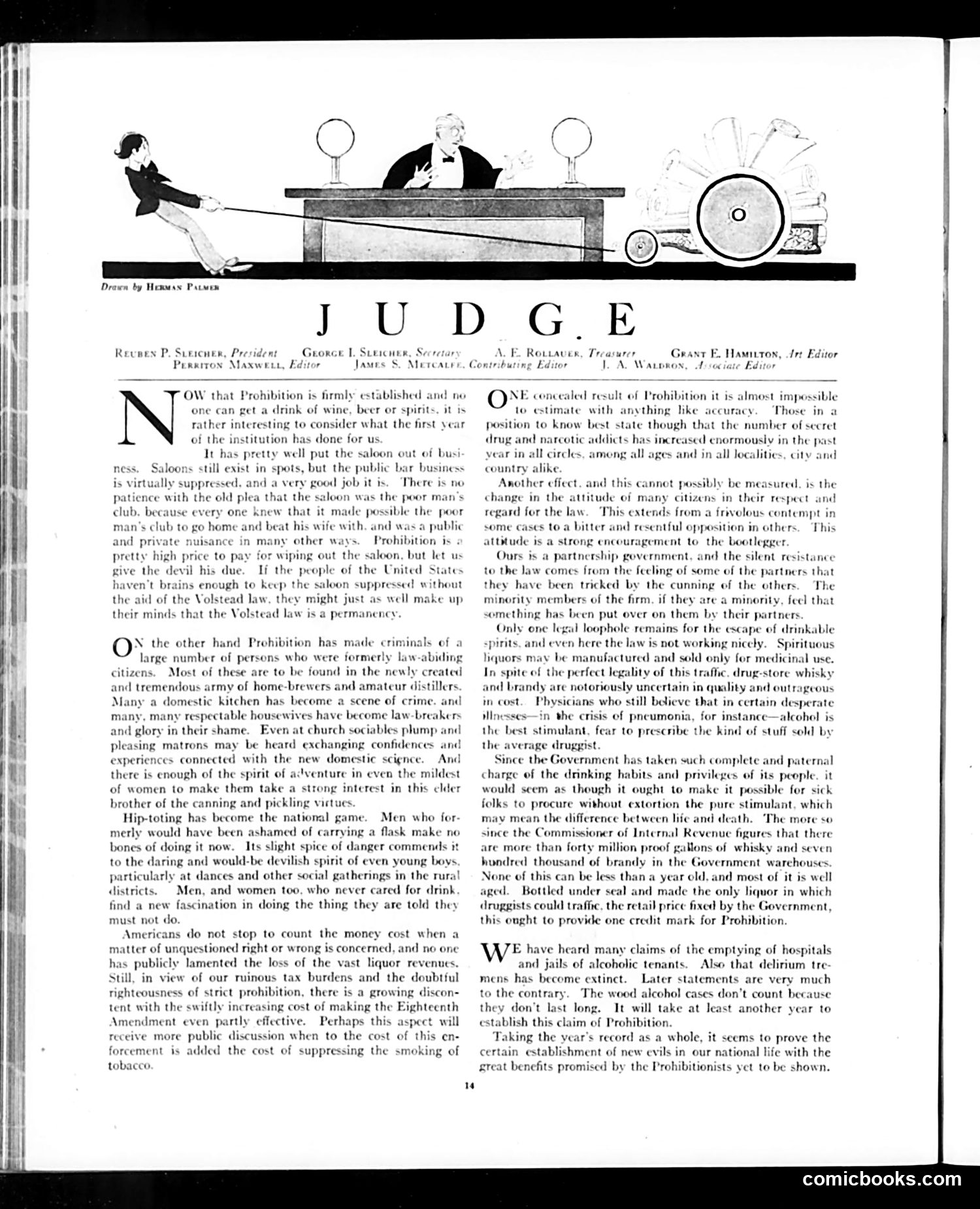
The cartoon's header illustration depicts a man being pulled backward by a rope attached to a large wheel labeled "Judge"—a visual metaphor for the magazine's satirical commentary on Prohibition. The accompanying articles (drawn by Hemans Palmer) discuss Prohibition's first-year effects, adopting a skeptical, tongue-in-cheek tone. The authors acknowledge Prohibition's stated goal—closing saloons—but catalog unintended consequences: the creation of home brewers and amateur distillers, widespread flask-carrying ("hip-toting"), and increased drug addiction. They note that Prohibition has paradoxically made lawbreakers of respectable citizens and eroded respect for law itself. The satire cuts both ways: mocking both Prohibition's failures and Americans' hypocrisy in flouting it. The final sentence hints at future criticism by sardonically suggesting tobacco prohibition might follow—implying the enforcement costs of Prohibition are becoming untenable.
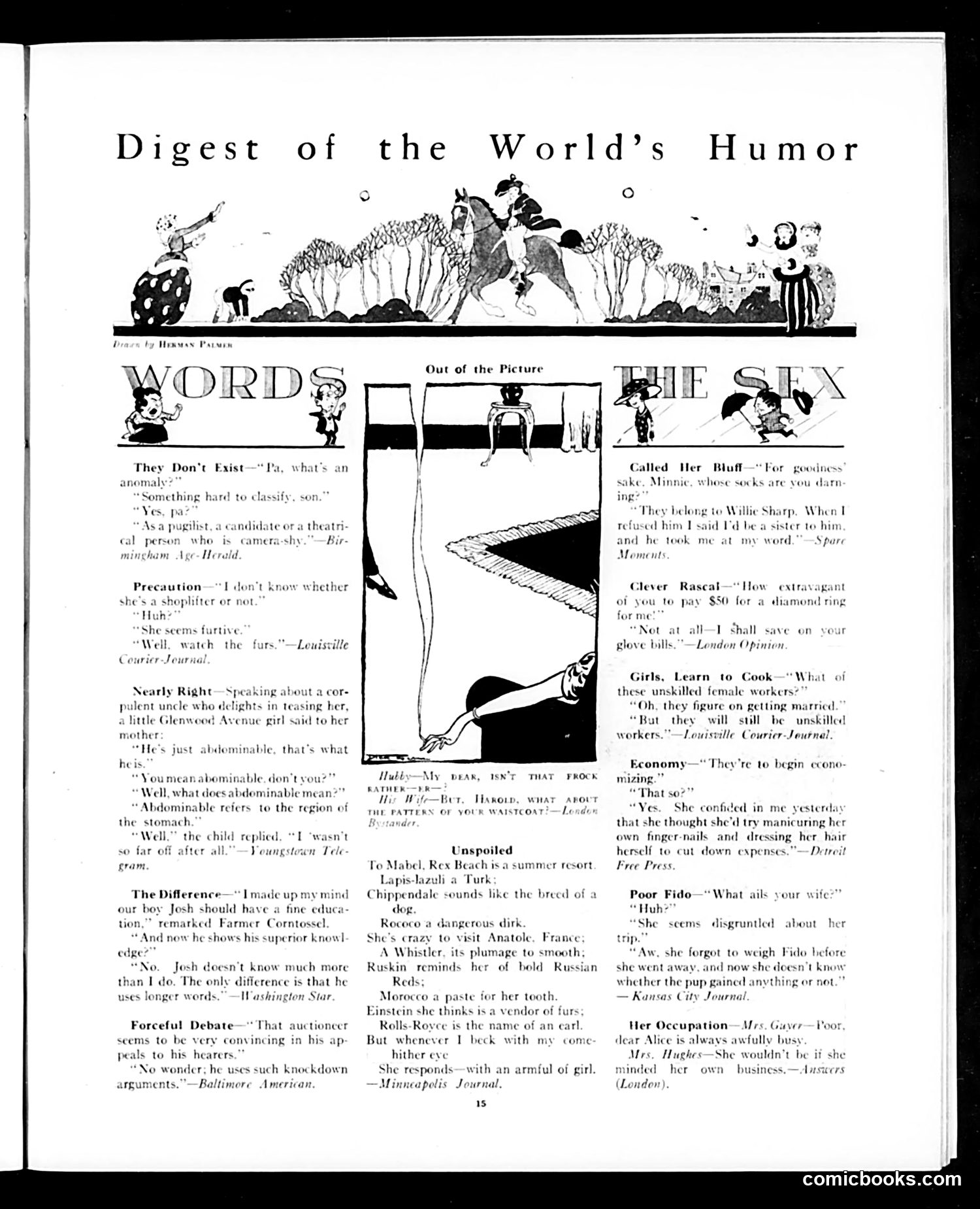
This is a humor digest page featuring short jokes and witticisms organized under headings like "Words," "Out of the Picture," and "The Sex." The content is early 20th-century domestic and social comedy typical of Judge magazine. The jokes target recognizable contemporary figures and situations: a camera-shy theatrical candidate, middle-class parenting anxieties, a farmer's son acquiring pretentious vocabulary, and marital dynamics. Several jokes mock women's knowledge—an "unspoiled" woman confuses cultural references (Rolls-Royce for an earl, Einstein for a furrier), while others joke about women's occupations, housekeeping incompetence, and marriage prospects. The humor reflects period assumptions: women are vain, ignorant of culture, primarily marriage-focused, and their "work" (cooking, manicuring) is temporary until they wed. The cartoons accompanying these jokes use simple line drawings to visualize the scenarios. The overall tone is lighthearted rather than mean-spirited, though the gender stereotypes are pronounced by modern standards.
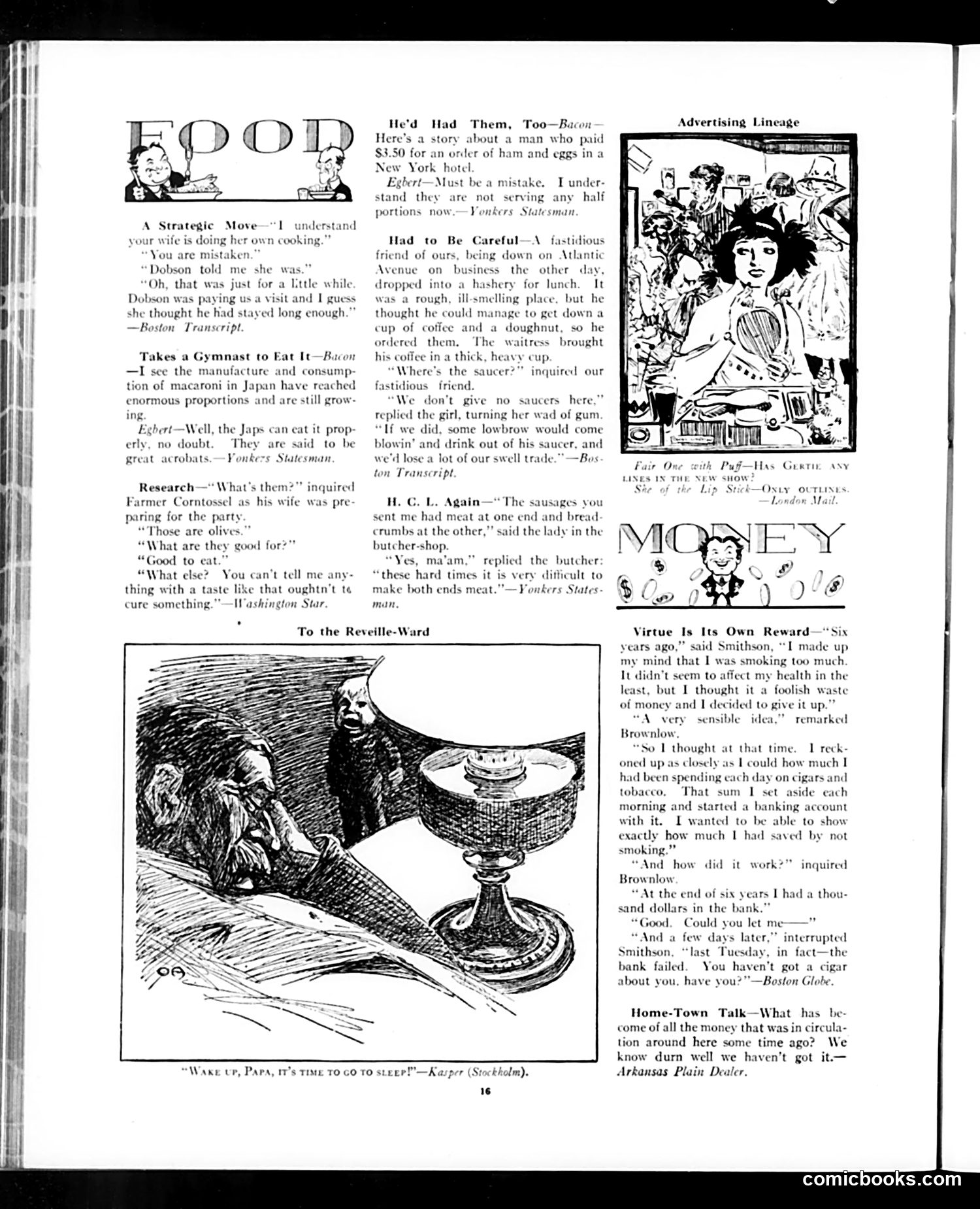
This page contains several brief humorous anecdotes typical of early-20th-century American satirical journalism, plus one illustration. The jokes target common social situations and economic concerns of the era: **"A Strategic Move"** satirizes marital dynamics—a wife stops cooking when a guest (Dobson) visits, implying she wants him to leave. **"Takes a Gymnast to Eat It"** jokes about Japanese acrobatic skill, stereotyping Japanese people as naturally flexible enough to eat macaroni "properly." **"Had to Be Careful"** mocks poor restaurant quality during economically difficult times (the "H.C.L." references likely mean "High Cost of Living"), with waitresses serving coffee without saucers to prevent "lowbrows" from drinking from them. **The illustration** shows a figure sleeping, captioned "Wake up, Papa, it's time to go to sleep!"—a joke about working-class exhaustion. **"Virtue Is Its Own Reward"** ironically describes a man who saved money by quitting smoking, only to lose it all when his bank failed—commentary on economic instability and ironic misfortune during uncertain times.
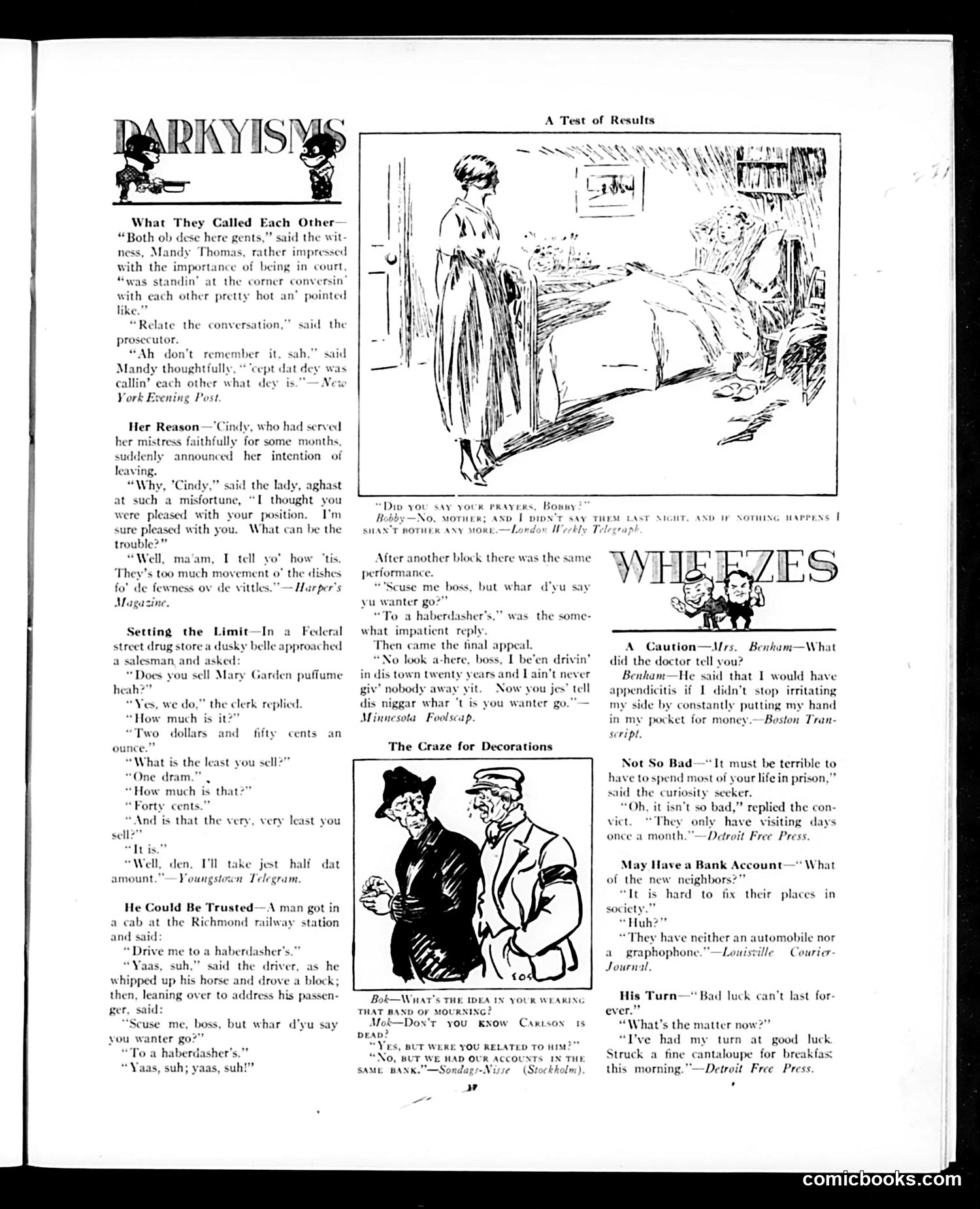
This page from *Judge* magazine collects racist humor stereotyping African Americans through dialect and servile characterizations typical of early 20th-century American satire. The main cartoons ridicule Black speakers for mangled English ("fo' de fewness ov de vittles," "yaas, suh"). One depicts a cab driver repeatedly asking passengers their destination—suggesting stupidity or dishonesty. Another shows two men in mourning bands, joking that they wear them not from family death but because "we had our accounts in the same bank"—implying financial deception. A sketch titled "A Test of Results" shows a child refusing prayer because "nothing happens," mocking both childhood logic and religious faith. The page represents *Judge*'s editorial voice: mocking working-class and immigrant populations alongside racial caricatures. These "witticisms" relied on audience familiarity with minstrelsy stereotypes—now recognized as deeply offensive but then considered mainstream American humor in elite publications.
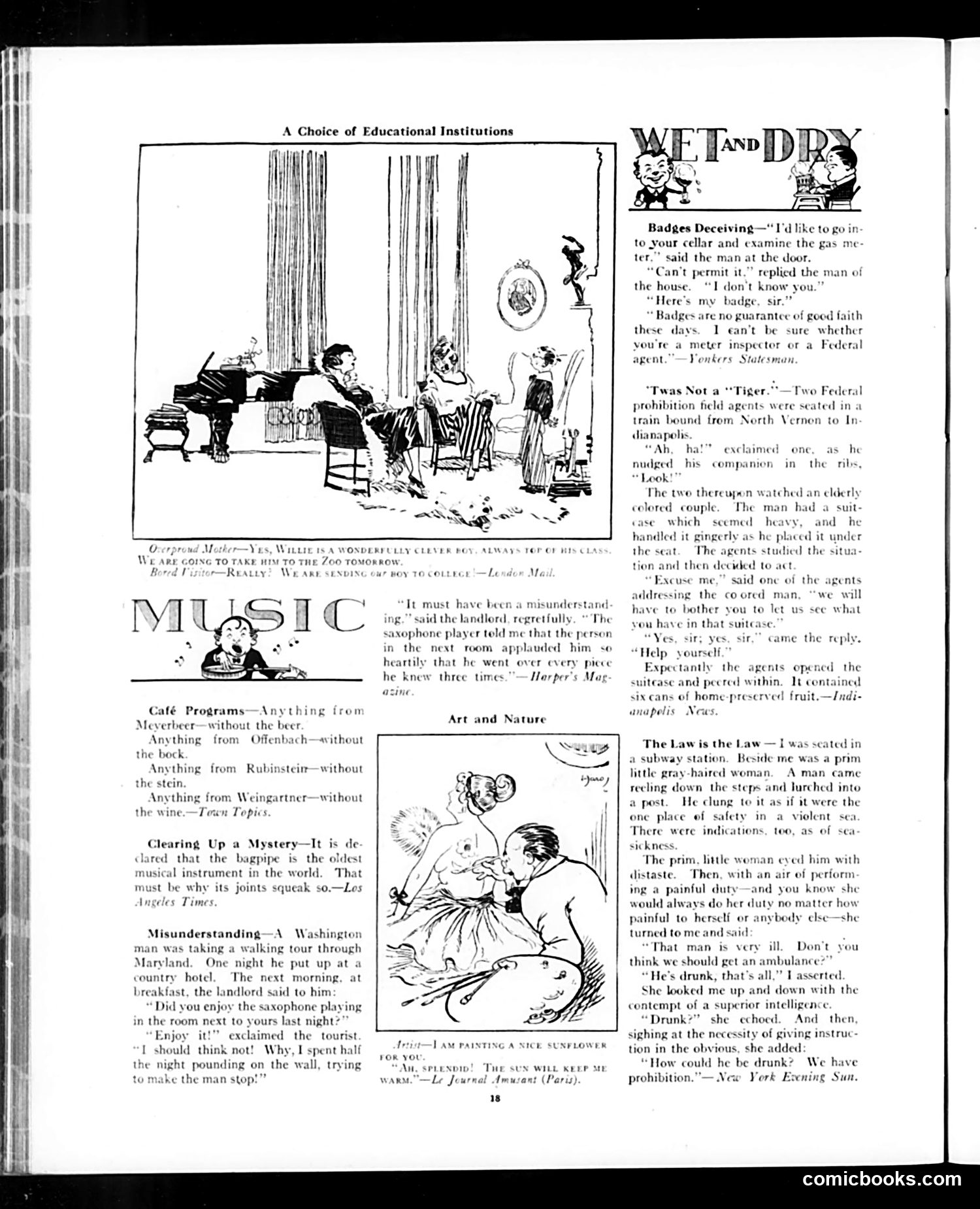
This page from Judge (a satirical weekly) contains multiple short humor pieces mocking American life circa Prohibition era. The top cartoon satirizes parents' educational choices, showing a father claiming he'll take his "wonderfully clever boy" to the zoo—implying the child needs animal-level education rather than college. "Badges Deceiving" jokes about post-Prohibition distrust: a homeowner refuses a meter inspector entry because government badges no longer guarantee legitimacy (playing on Prohibition enforcement corruption and federal agent abuses). "'Twas Not a Tiger" mocks overzealous Prohibition agents who conduct an invasive search of an elderly Black couple's suitcase, expecting illegal alcohol but finding only canned fruit—satirizing the heavy-handed enforcement and racial profiling common during Prohibition. "The Law is the Law" features a prim woman insisting a visibly intoxicated man on subway steps cannot be drunk because "we have prohibition"—sharp satire of Prohibition's obvious failure and the gap between law and reality. The scattered music and art anecdotes are lighthearted filler typical of the era's humor magazines.
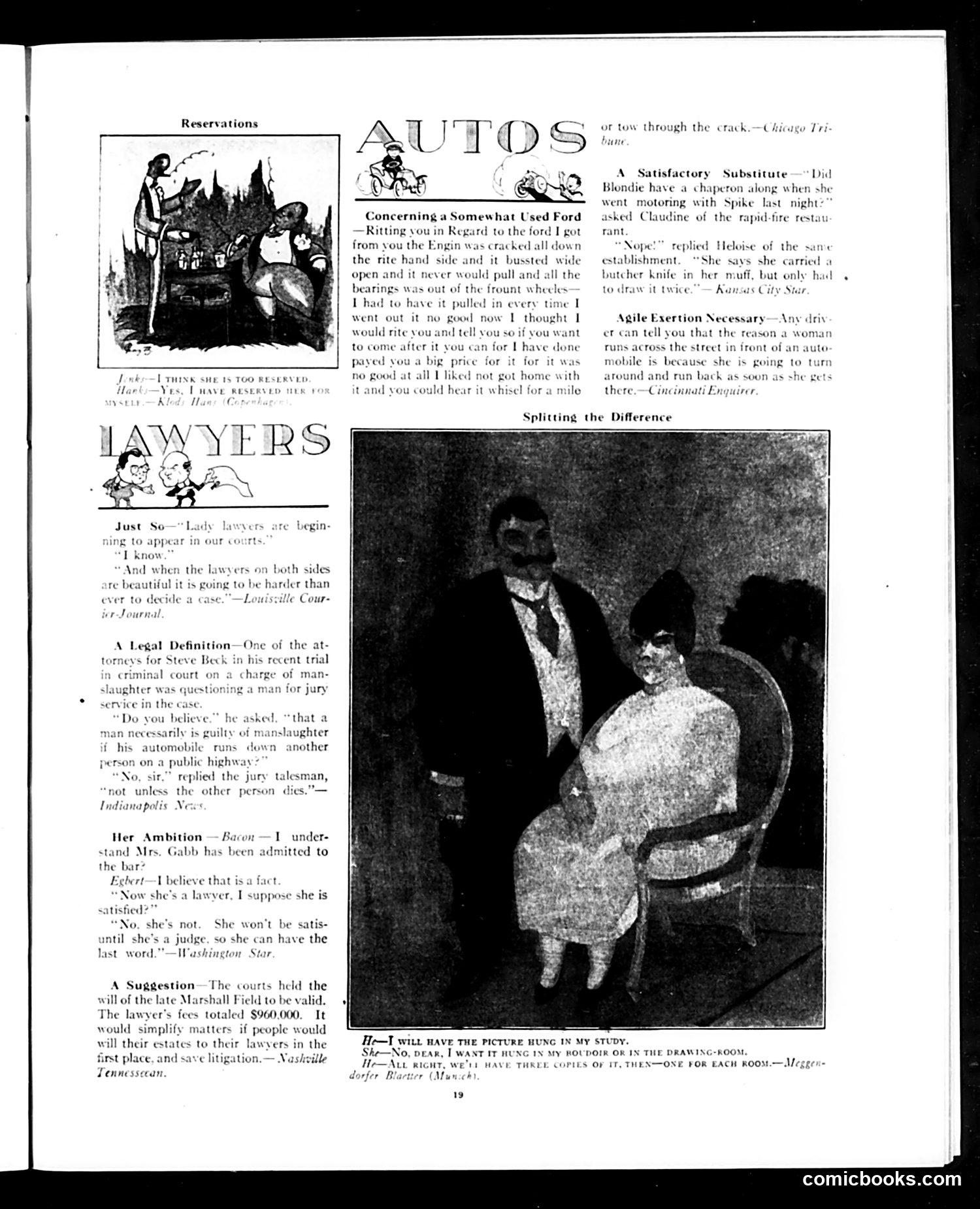
This page contains multiple brief satirical items typical of early 20th-century American humor magazines: **"Reservations"** shows a couple in a car; the joke concerns a woman's "reserved" demeanor—likely about sexual prudishness or emotional coldness in courtship. **"Autos"** section includes anecdotes mocking automotive culture and gender relations: a man complains about a defective Ford he purchased; another item jokes that a woman doesn't need a chaperon while motoring because she carries a knife for protection. **"Lawyers"** section satirizes the legal profession and women entering it, including a quip that Mrs. Gabb won't be satisfied as a lawyer until she becomes a judge "so she can have the last word"—mocking women's alleged argumentativeness. **"Splitting the Difference"** (the photograph) shows a domestic dispute where a husband proposes purchasing three copies of a picture so each spouse can hang it in their preferred room—satirizing marital compromise and female domestic authority. The humor reflects period anxieties about women's changing roles and automotive technology's social impact.
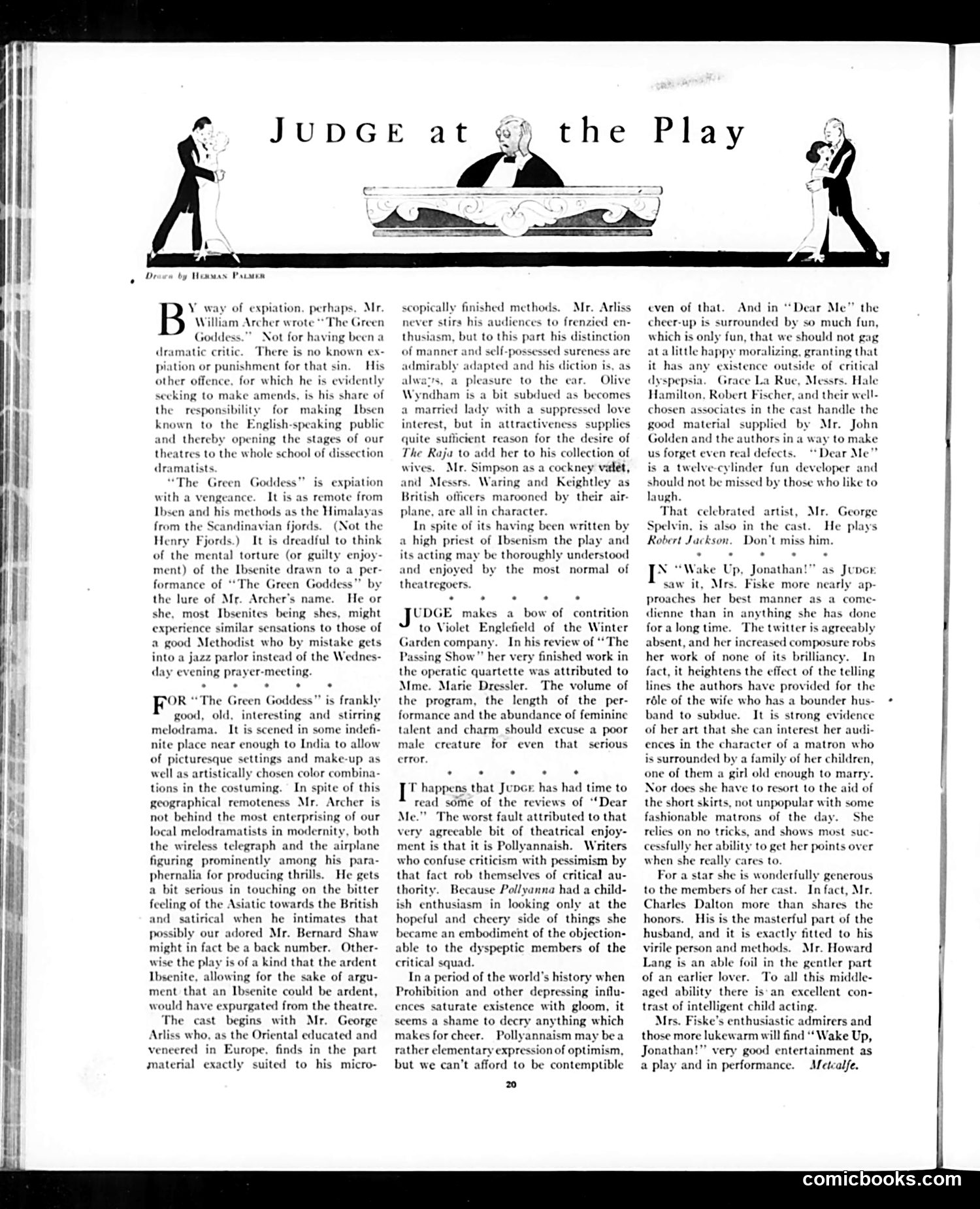
This is a theater criticism column reviewing contemporary Broadway productions. The header illustration shows a judge presiding over theatrical matters, establishing the satirical tone. The main review critiques William Archer's play "The Green Goddess," performed by acclaimed actor George Arliss. The satire centers on Archer's contradiction: as a dramatic critic, he championed Henrik Ibsen and serious, analytical drama to English audiences, yet wrote a conventional melodrama with exotic settings, wireless telegraphs, and airplanes—precisely the entertainment an Ibsenite would despise. The columnist mocks Ibsen devotees as humorless purists, comparing their suffering at this play to "a good Methodist who by mistake gets into a jazz parlor." The piece praises Arliss's refined performance and supporting cast while defending the play's entertainment value against intellectual pretension—essentially defending fun theater against snobbish criticism. A secondary note apologizes for misattributing an actress's performance to Marie Dressler.
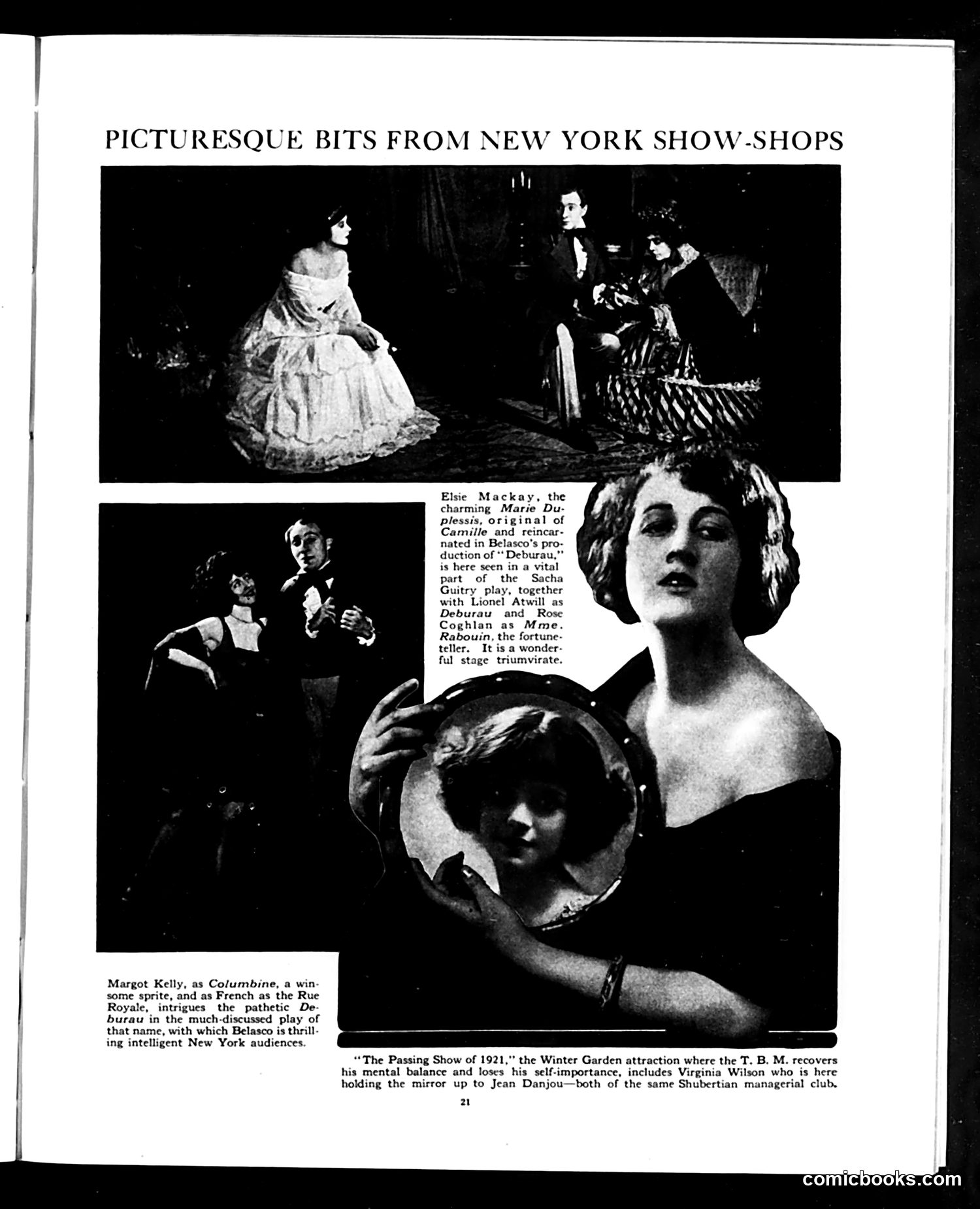
This page showcases theatrical productions from New York's 1921 stage season. The content is not satirical but rather entertainment journalism—photographs and captions describing Broadway shows. Featured are scenes from: - A production of "Deburau" (a Sacha Guitry play directed by David Belasco), featuring actors Elsie Mackay, Lionel Atwill, and Rose Coghlan - "The Passing Show of 1921" at the Winter Garden, featuring Virginia Wilson and Jean Danjou The text emphasizes the prestige of these productions and their talented casts. References to "T.B.M." and "Shubertian managerial club" appear to reference theater management figures, though specific identities are unclear. The page functions as celebrity promotion rather than political or social satire—typical Judge magazine theater coverage from the era.
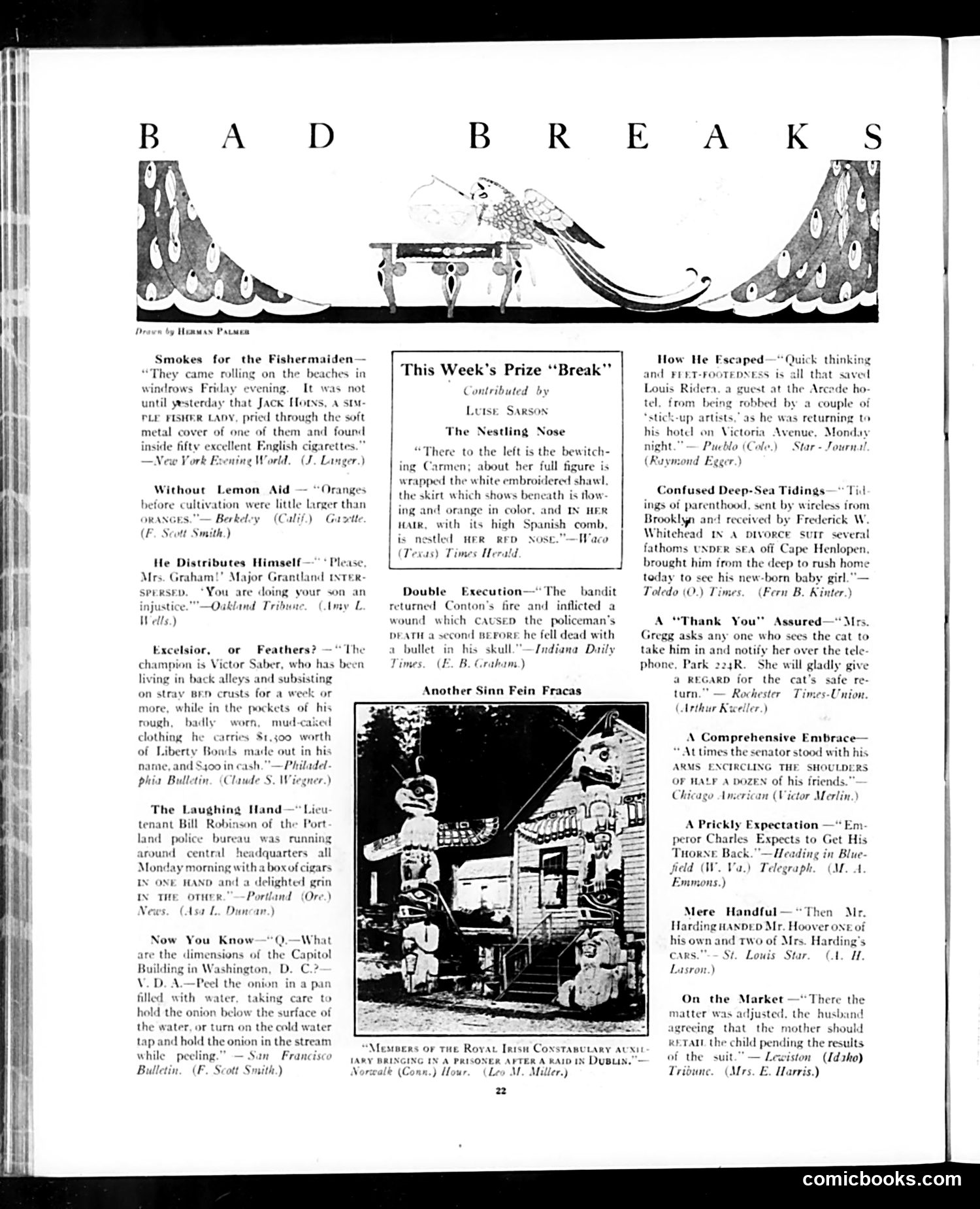
This is a humor page from Judge featuring short, satirical "breaks" — absurd news items highlighting logical contradictions or ironic situations in newspaper reporting. The cartoon at top, by Herman Palmer, shows a bird at a table labeled "BAD BREAKS," visually introducing the concept. The items mock newspaper writers for overlooking obvious absurdities: a fisherman finding expensive cigarettes in seaweed; a poor man carrying $1,700 in Liberty Bonds; someone explaining onion-peeling instead of answering a factual question about the Capitol Building. The page also includes the week's winning submitted "break" by Luise Sarson, poking fun at overwrought description (a woman with a prominent red nose described romantically as "nestling"). The lower image shows Irish constabulary making an arrest, captioned with another break about confused parenthood notification via wireless. The humor derives from Judge's regular feature: reprinting real newspaper passages that contain glaring logical errors or funny juxtapositions, inviting readers to spot similar "breaks" in their local papers.
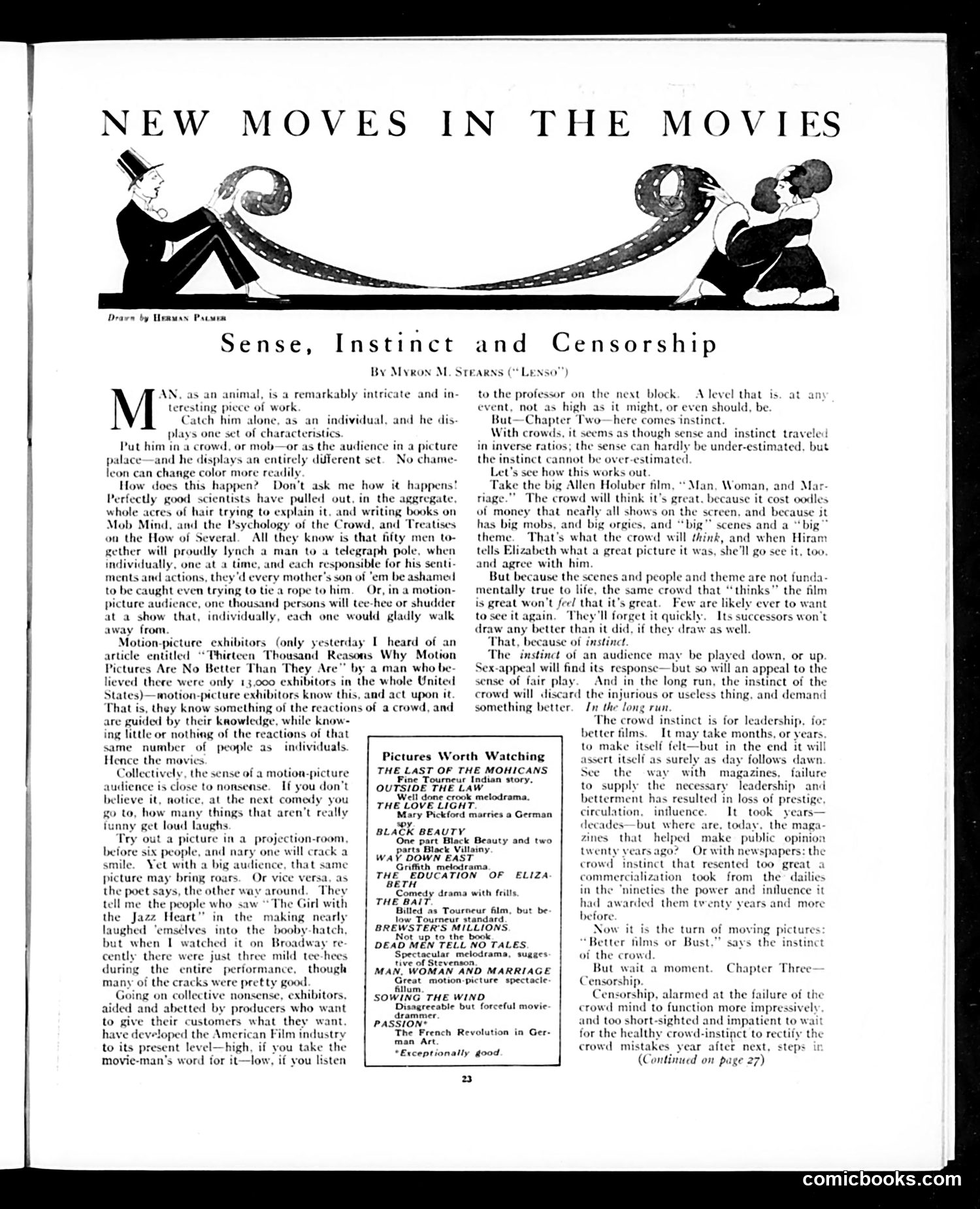
This article by Myron M. Stearns ("Lenso") examines how movie audiences behave differently in crowds versus as individuals. The top illustration shows silhouetted figures at opposite ends pulling a film strip, visually representing the tension between collective and individual responses. Stearns argues that while individual moviegoers possess "sense," crowds operate on "instinct." He illustrates this with Allen Holuber's film *Man, Woman, and Marriage*—a big-budget production with expensive sets and crowds that audiences will collectively praise, yet individually forget because the content lacks authenticity. The satire targets both producers (who exploit crowd psychology through spectacle) and audiences (whose collective judgment differs from their individual judgment). Stearns suggests that while short-term crowd instinct can be manipulated, long-term audience instinct—their genuine sense of quality—ultimately determines a film's lasting success. The article advocates for films grounded in truth over mere spectacle, challenging Hollywood's reliance on crowd psychology over artistic merit.
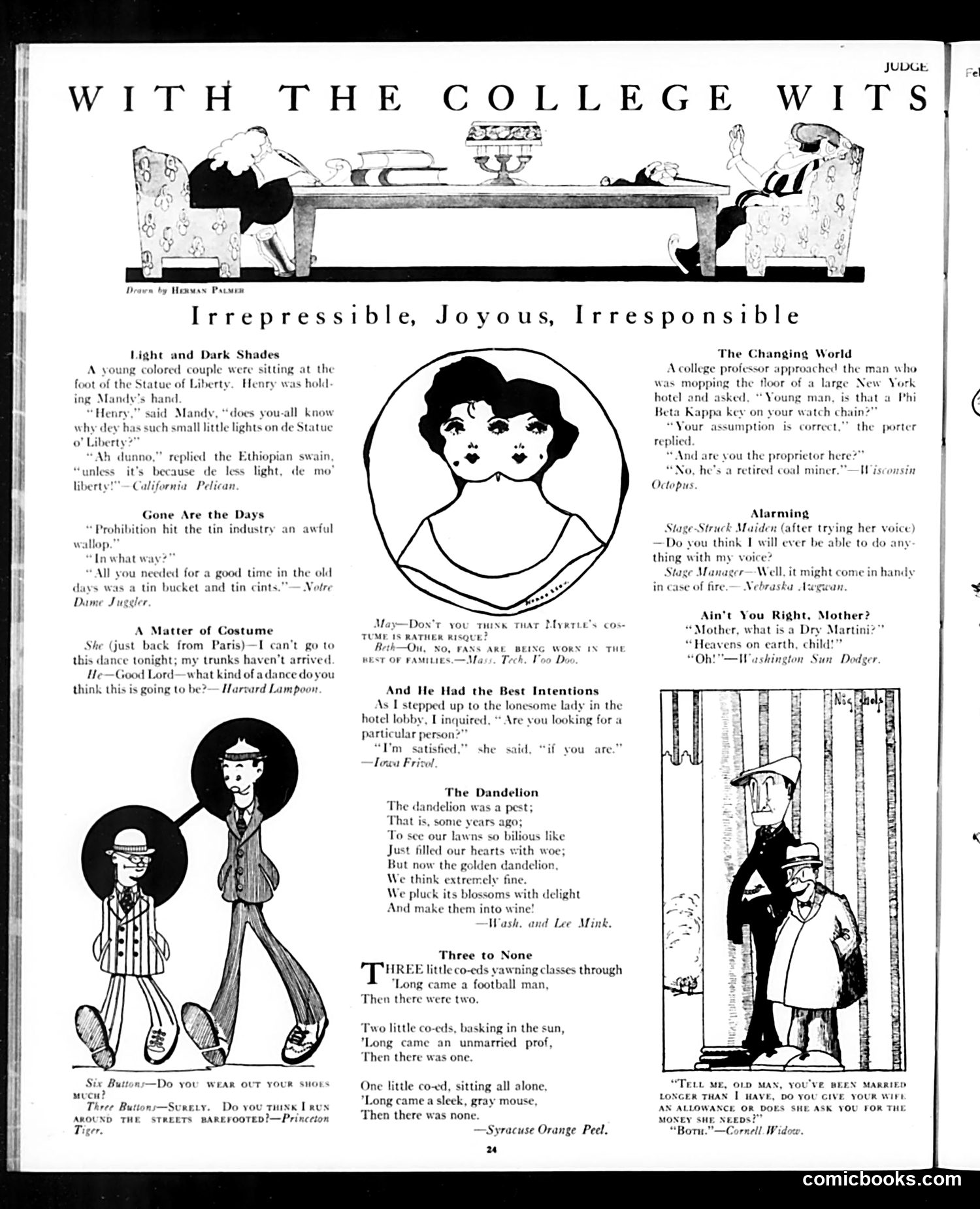
This Judge magazine page contains humorous social commentary typical of early 20th-century American satire: **"Light and Dark Shades"** mocks racial stereotypes, depicting African American characters using exaggerated dialect to discuss the Statue of Liberty's lights—a cheap joke about intelligence. **"The Changing World"** satirizes class mobility and credential inflation: a college-educated porter wearing a Phi Beta Kappa key challenges assumptions about education and social status. **"A Matter of Costume"** jokes about post-WWI social changes and modern fashion from Paris—commentary on evolving morality and women's clothing. **"Three to None"** uses dark humor about college women: co-eds disappear one-by-one when encountering men (football players, professors), implying romantic/sexual conquest. The final "none" suggests tragedy or pregnancy. Other items mock changing gender roles, women's ambitions, and Prohibition-era attitudes. The overall tone reflects 1920s anxieties about modernization, education, and shifting social hierarchies, delivered through period humor that relies heavily on stereotypes and coded social commentary.
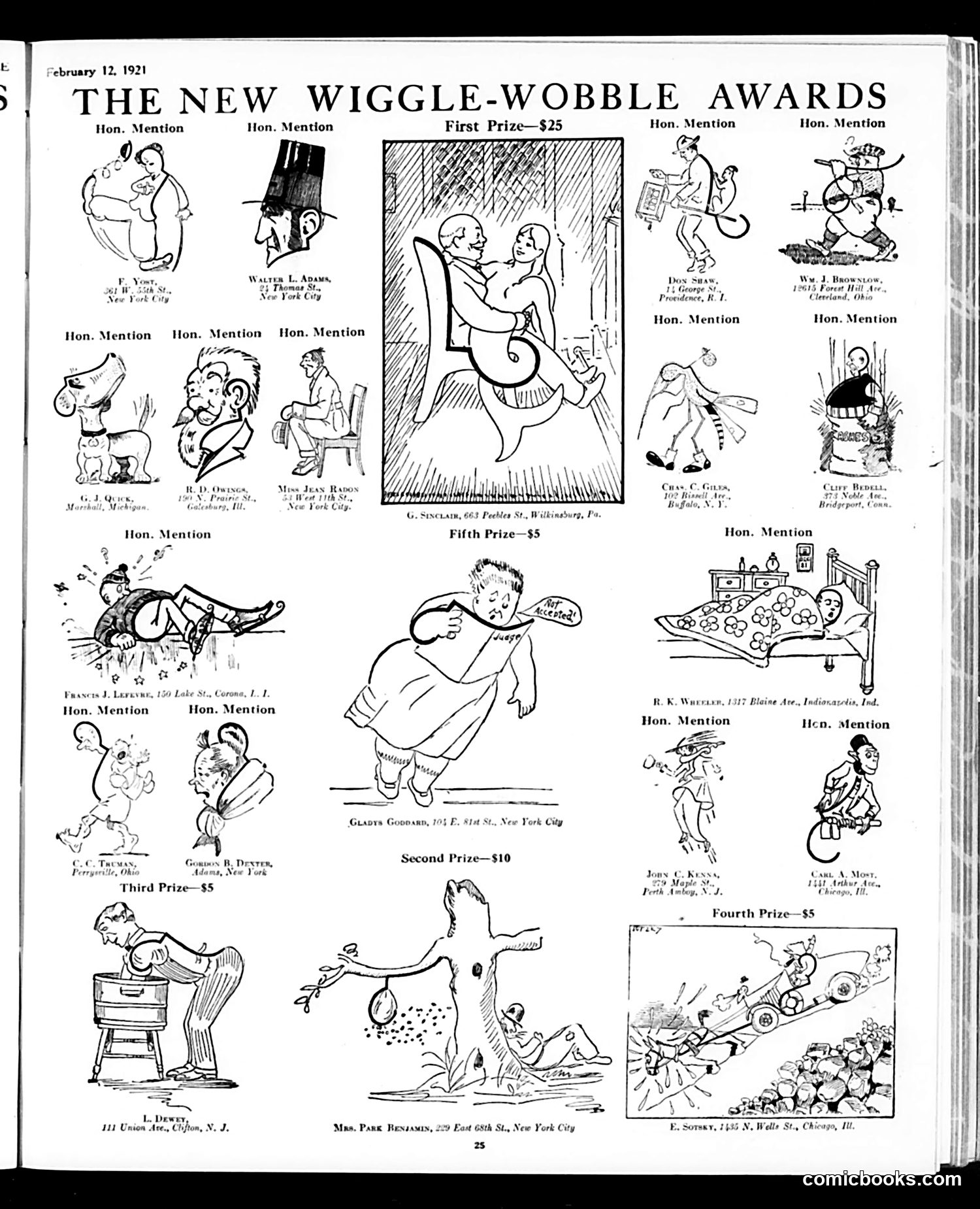
This page presents a humorous drawing contest celebrating the "Wiggle-Wobble"—likely referencing the popular 1920s dance craze featuring exaggerated body movements. Judge magazine solicited comic illustrations of people performing this fashionable dance, awarding prizes ($25 for first place down to $5 for lower positions). The cartoons depict figures in various states of energetic, undignified gyration—people twisting, jumping, and contorting themselves in comically exaggerated ways. The style mocks both the dance itself and its enthusiastic practitioners, portraying the Wiggle-Wobble as ridiculous and undignified. This reflects Jazz Age satire: Judge, a conservative publication, frequently ridiculed modern youth culture and contemporary dance trends as vulgar and morally questionable. The contest format allows readers to submit their own parodies, making fun of what many considered a scandalous departure from proper dancing.
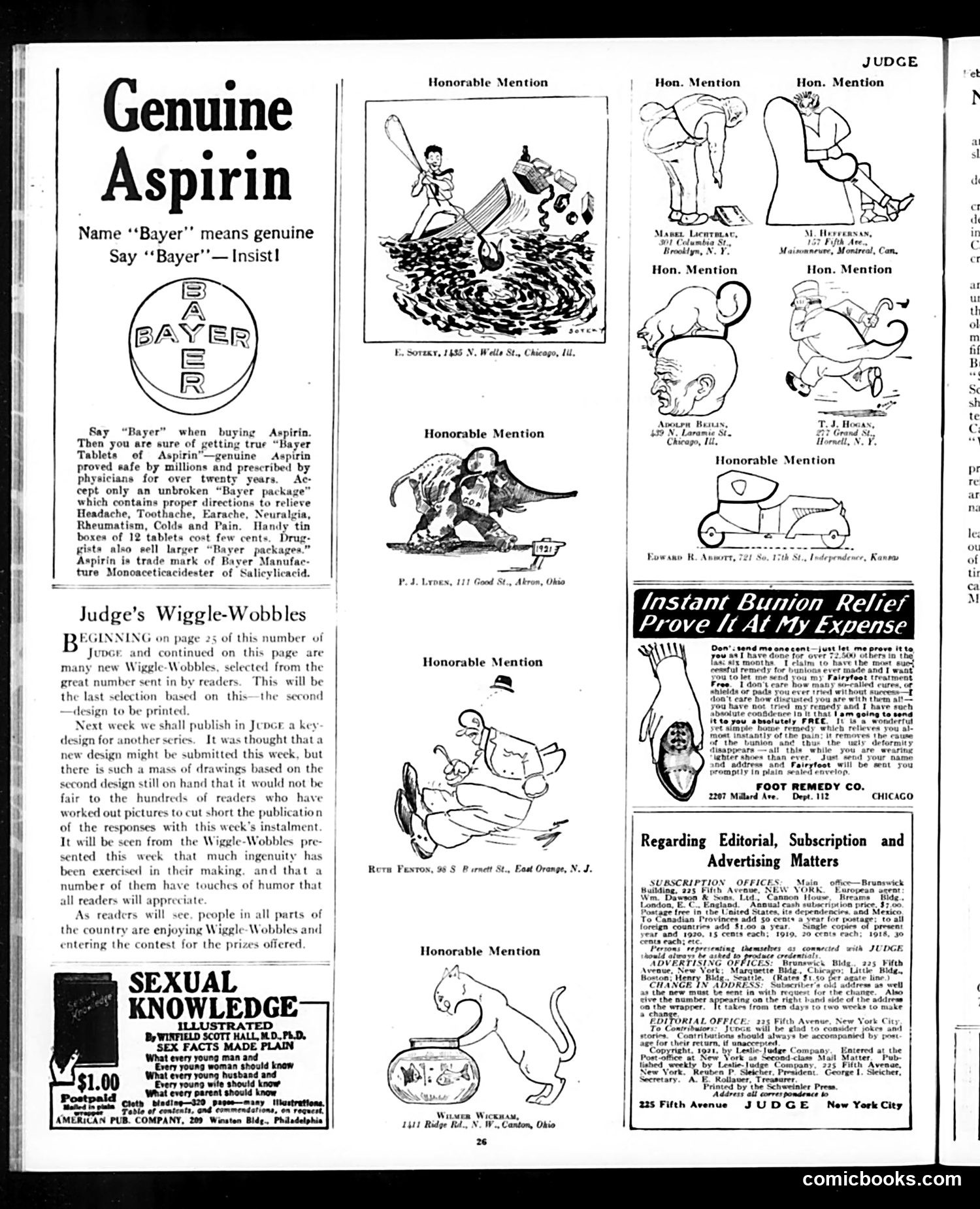
This page is primarily **advertising and administrative content** with minimal satirical cartoons. The main editorial feature is "Judge's Wiggle-Wobbles"—a reader-submission contest where contributors transform a provided template design into creative drawings. The text explains that this week presents the second batch of selected entries from hundreds of submissions, with winners receiving "Honorable Mention" credit. The cartoons shown are these fan submissions, each credited to different readers nationwide. The bulk of the page contains advertisements (Bayer Aspirin, Fairyfeet bunion remedy, and a book on sexual knowledge) alongside subscription and administrative information for Judge magazine. There is **no apparent political satire** on this page—it's a content-filler issue mixing reader engagement with ads and housekeeping details. The "Wiggle-Wobbles" were Judge's equivalent of modern contest drawings or coloring-book challenges for reader participation.
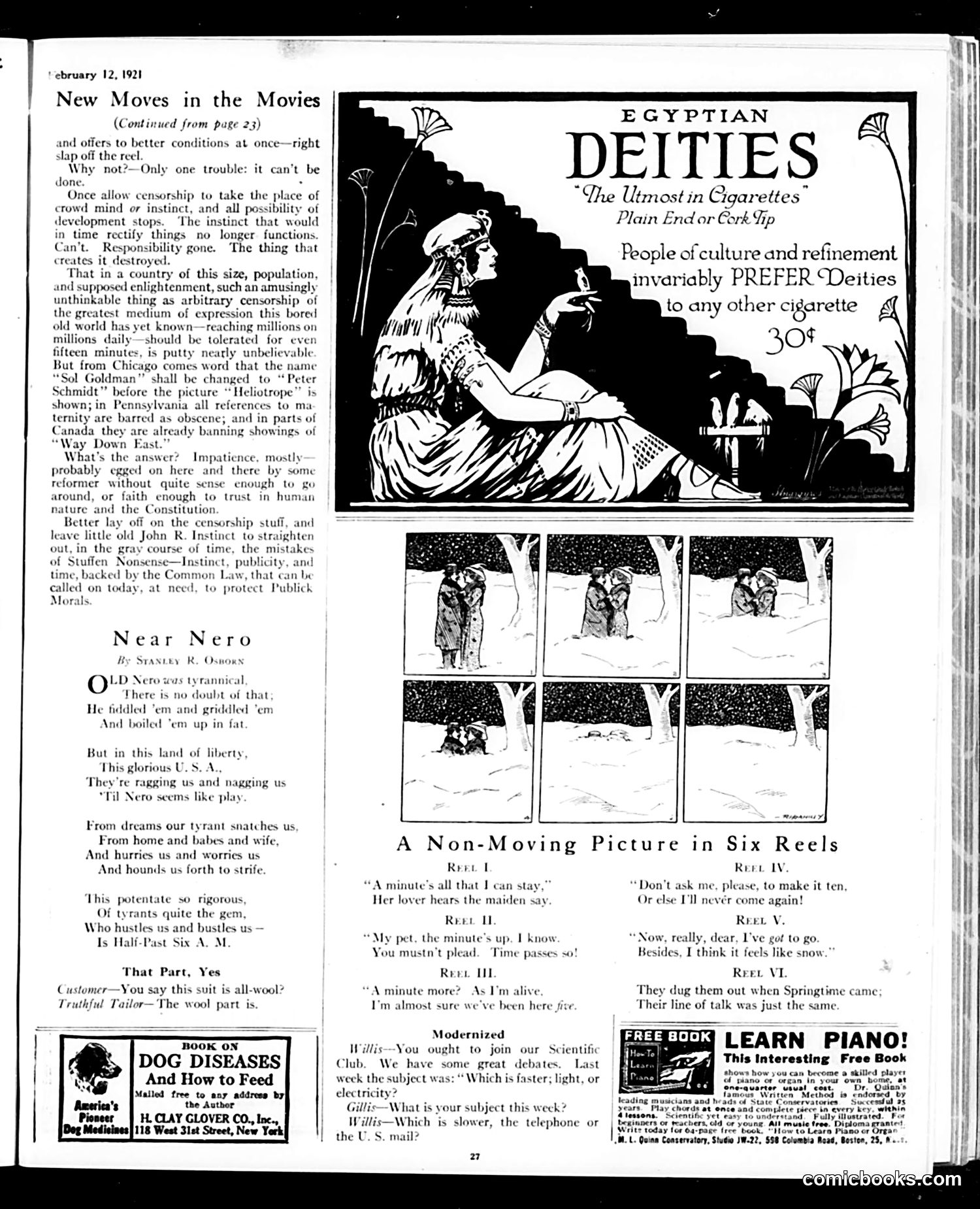
This February 1921 *Judge* page contains film industry commentary and light humor pieces rather than political cartoons. **"New Moves in the Movies"** argues against film censorship, citing specific cases: the renaming of actor "Goldman" to "Schmidt" in *Heliotrope*, Pennsylvania banning references to "maternity," and Canada censoring *Way Down East*. The author criticizes arbitrary censorship as destructive to artistic expression and constitutional rights, appealing instead to "instinct" and "common law." **"Near Nero"** satirizes early-morning work schedules, comparing the tyranny of 6 a.m. wake-ups to Emperor Nero's brutality—suggesting American workers face comparable oppression in their daily grind. **"That Part, Yes"** is a brief joke about a deceptive tailor claiming a suit is "all-wool" when only the wool portion is. **"A Non-Moving Picture in Six Reels"** humorously depicts a couple's repeated, unchanging conversation during a brief visit—suggesting monotony despite changing circumstances. The page is largely advertisements, including cigarettes and piano lessons.
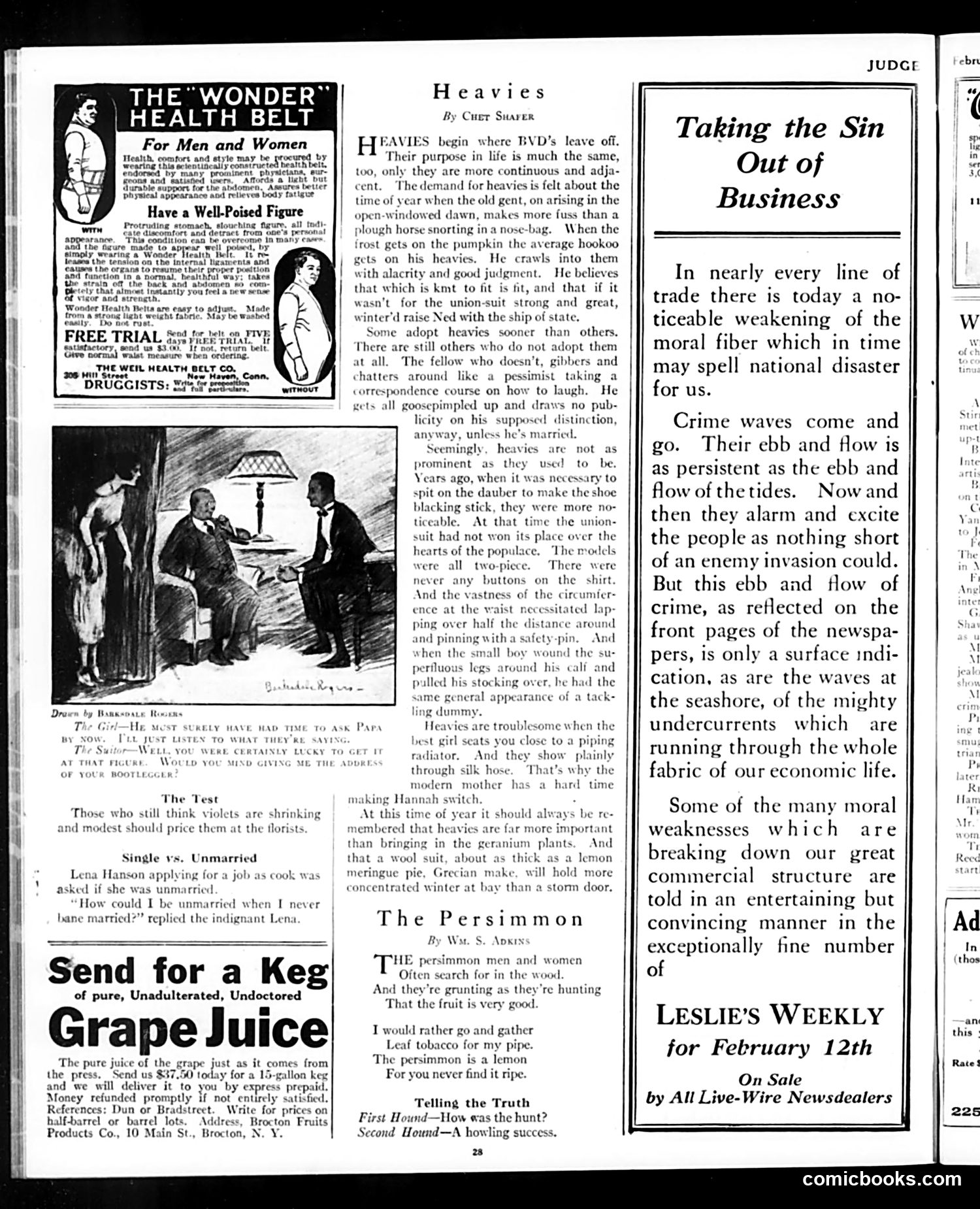
This page combines advertisements, humor pieces, and social commentary typical of Judge magazine's satirical format. **The Main Content:** The largest piece, "Heavies" by Chet Shafer, is a humorous essay about thermal underwear (union suits). It's a lighthearted commentary on seasonal clothing, describing how men reluctantly don heavy underwear when winter arrives. The satire gently mocks both the underwear itself and male vanity—men claim their "heavies" are essential to national stability while secretly worrying about their appearance. **Supporting Materials:** - Small humor pieces mock semantic absurdities ("Single vs. Unmarried") and modest flower prices - An editorial titled "Taking the Sin Out of Business" expresses concern about declining moral standards in commerce - "The Persimmon" poem humorously contrasts fruit-hunting with tobacco preference - Period advertisements for health belts and grape juice occupy the margins **Context:** This represents early 20th-century American humor focused on everyday domesticity, seasonal rituals, and mild social criticism rather than sharp political satire.
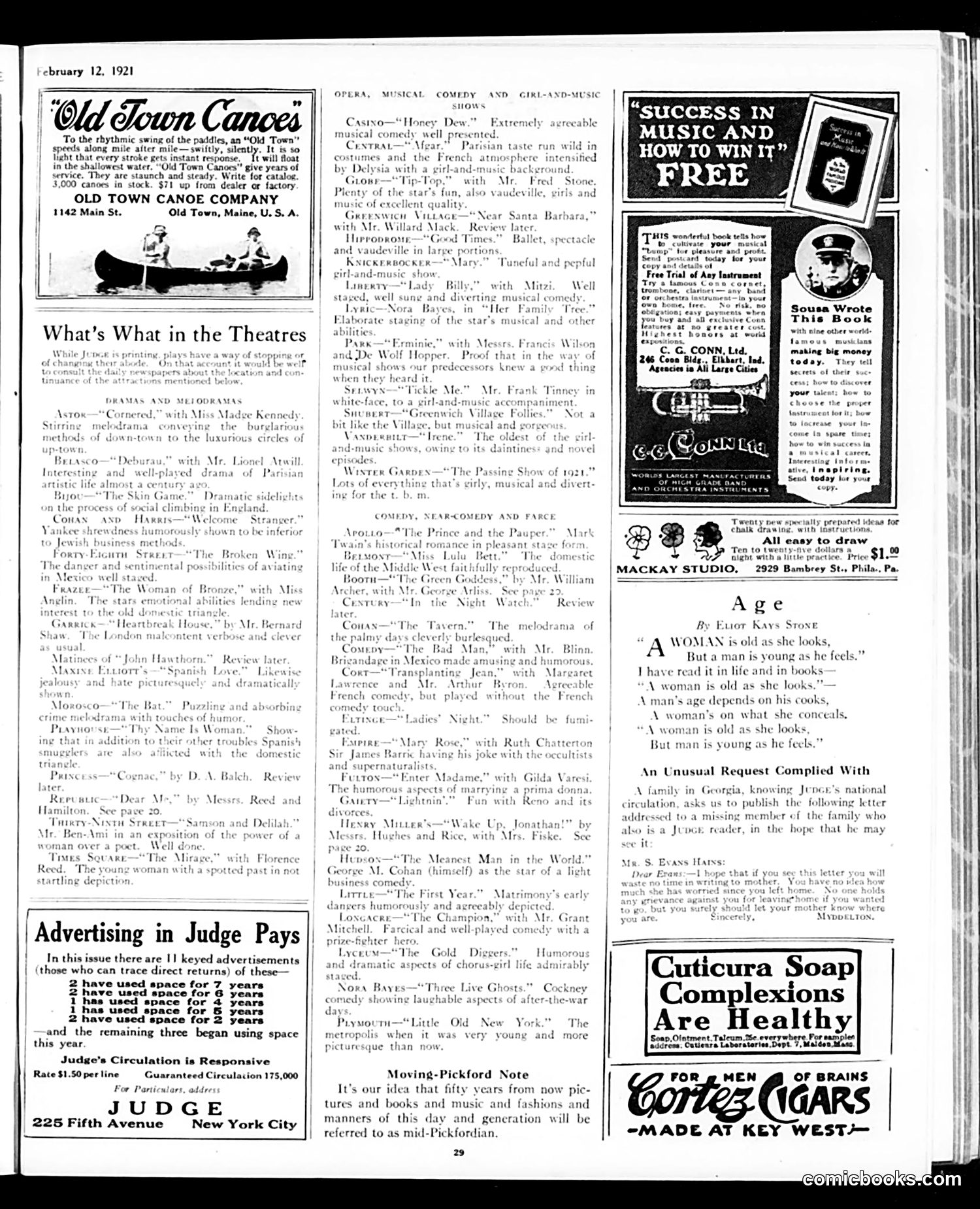
This page is primarily **advertising and theater reviews**, not political satire. The dominant content is a full-page canoe advertisement (top left) and extensive theater listings—standard for Judge's entertainment coverage. Notable theater advertisements appear throughout. The only substantive editorial content is a brief poem titled **"Age"** by Elinor Kays Stone, which plays with gender stereotypes: "A woman is old as she looks / But a man is young as he feels." This mild social commentary suggests women's value is tied to appearance while men's remains tied to vitality—reflecting 1920s gender attitudes. A **moving-picture note** references Mary Pickford's cultural dominance, suggesting her influence on fashion and manners is so pervasive that the era may become known as "mid-Pickfordian"—acknowledging the film star's outsized cultural impact. The remaining space is filled with period advertisements (soap, cigars, books) typical of early 1920s magazines. This is not a satirical or political page, but rather a commercial and entertainment-focused one.
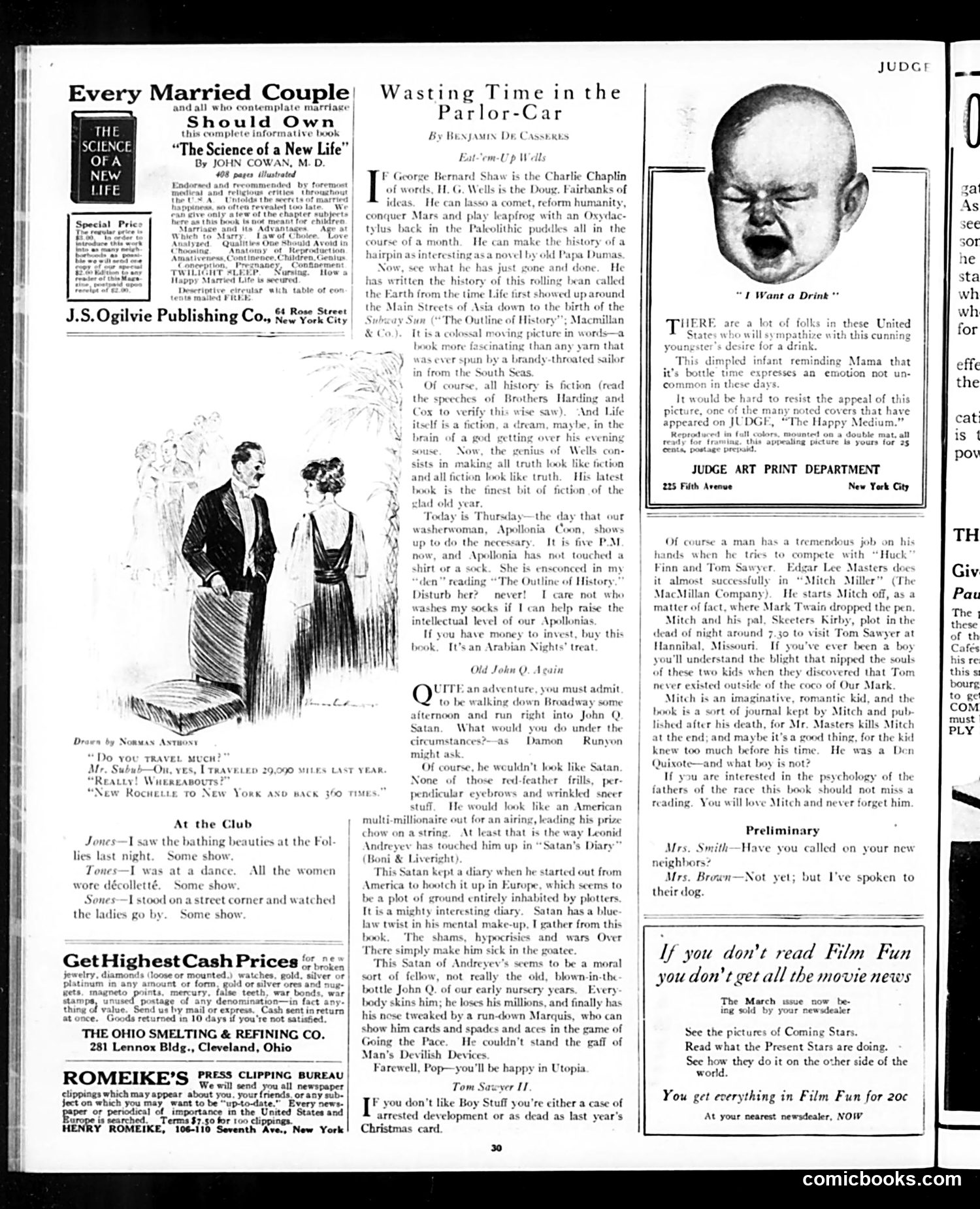
This page combines advertisements with literary commentary typical of Judge magazine's satirical approach. The main article, "Wasting Time in the Parlor-Car" by Benjamin De Casseres, discusses George Bernard Shaw's prolific output, comparing him to Charlie Chaplin and Douglas Fairbanks. The author uses Shaw as a vehicle for commenting on contemporary intellectualism—noting that Shaw makes everything seem like fiction while making fiction seem true. The piece then pivots to discussing Satan as a character in a new book by Andreyev, satirizing how even the devil becomes "a moral sort of fellow" in modern literature, losing his traditional evil nature. The accompanying illustration (by Norman Anthony) shows a couple in a railroad parlor car—a common setting for flirtation or conversation in early 20th-century travel. The surrounding advertisements target married couples and those seeking "culture," reflecting Judge's audience of educated, middle-class readers. The overall tone mocks both intellectual pretension and contemporary entertainment trends.
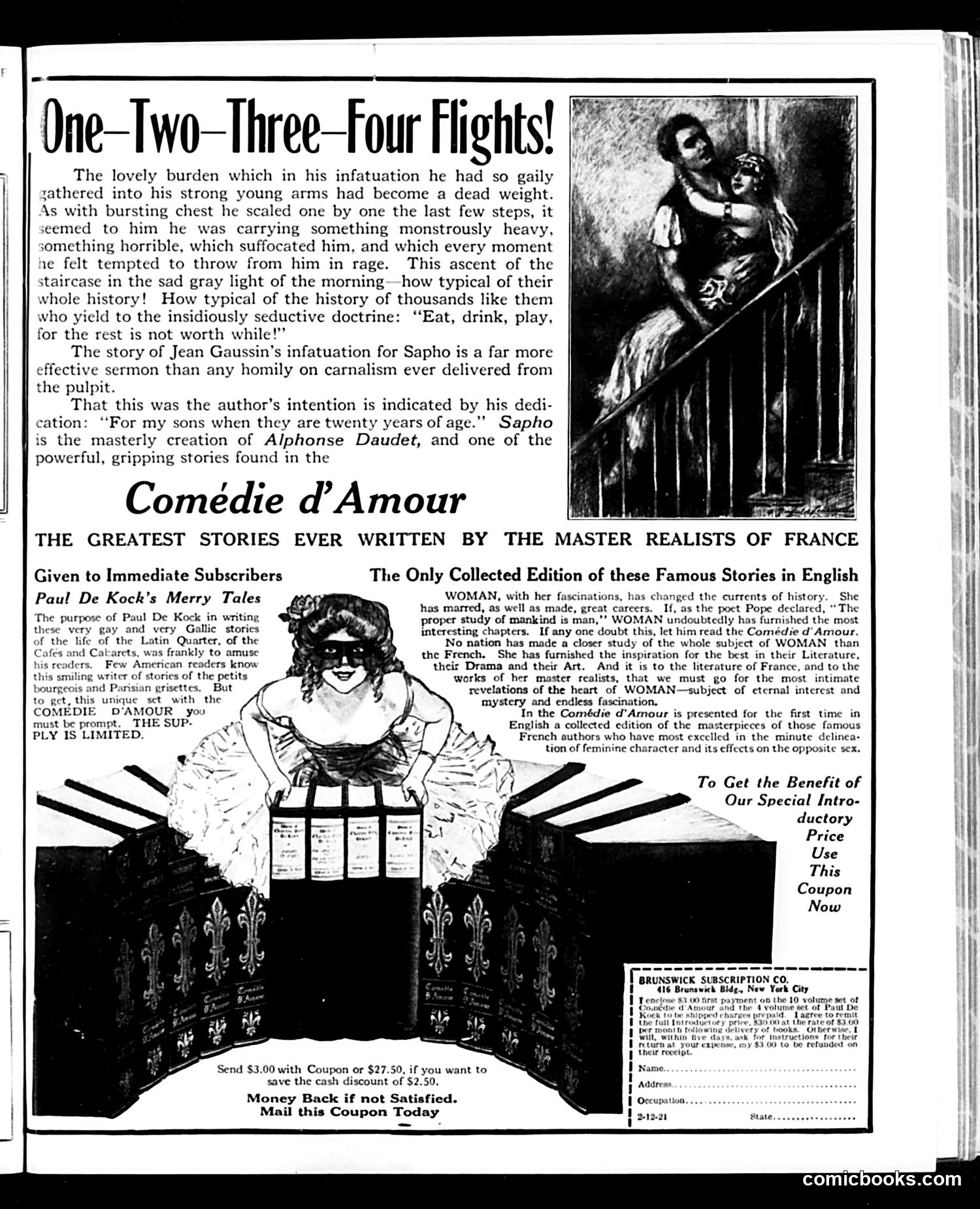
This page advertises a subscription to *Comédie d'Amour*, a collected English edition of French realist literature featuring works by Alphonse Daudet and Paul de Kock. The main illustration depicts a man climbing stairs while carrying a woman—a literal visualization of the burden of romantic entanglement referenced in the text above. The satire targets the "eat, drink, play" philosophy of hedonistic romance. The ascending staircase symbolizes the exhausting, inescapable nature of infatuation. The passage suggests the male protagonist initially found the woman lovely but now experiences her as crushing weight—a commentary on how romantic indulgence becomes oppressive. The advertisement frames these French stories as moral instruction ("effective sermon") for young men about carnality's consequences, despite their titillating subject matter. This creates ironic tension: the publisher markets sophisticated French literature about women and desire while morally justifying it as cautionary tales for sons "when they are twenty years of age."
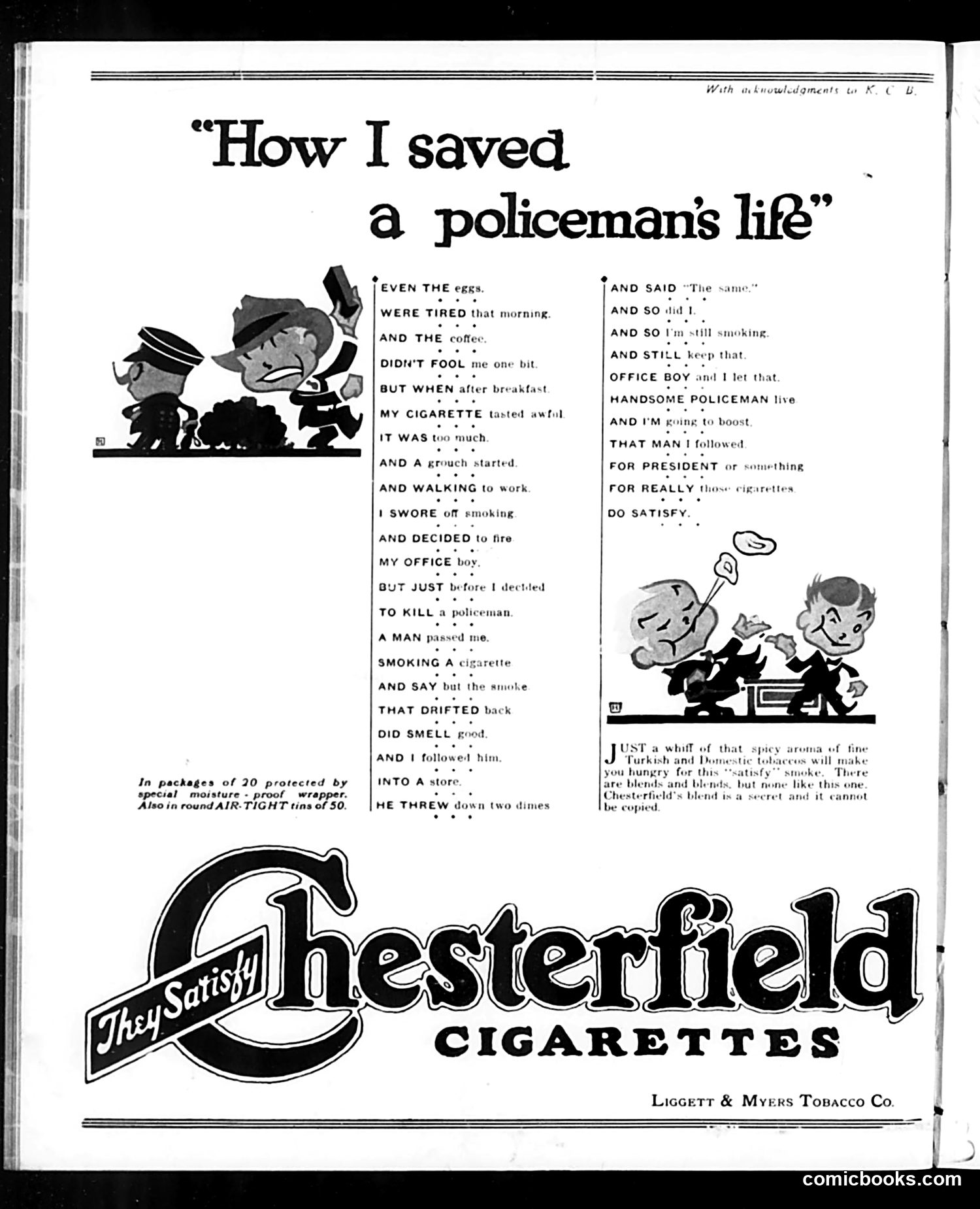
This is primarily a **cigarette advertisement disguised as comic narrative**, not political satire. The "story" follows a man's morning: tired from breakfast, he swears off smoking and decides to fire his office boy. But then a stranger's cigarette smoke entices him, he follows the man into a store, and buys Chesterfields instead—framed as having "saved a policeman's life" (by not firing the boy, presumably). The humor is absurdist and self-aware: the narrative's title makes an exaggerated, nonsensical claim about the cigarettes' virtue. The cartoon figures are unnamed everyman characters—no specific political figures are caricatured here. The advertisement's core message: Chesterfield cigarettes are so appealing their aroma alone can redirect your worst impulses. The accompanying text emphasizes the cigarettes' "secret blend" as superior to competitors. This reflects **early 20th-century advertising techniques** that used humor and manufactured narrative to create brand loyalty through entertainment rather than product claims.