
Judge, 1921-02-12 · page 23 of 32
Judge — February 12, 1921 — page 23: what you’re looking at
What you’re looking at
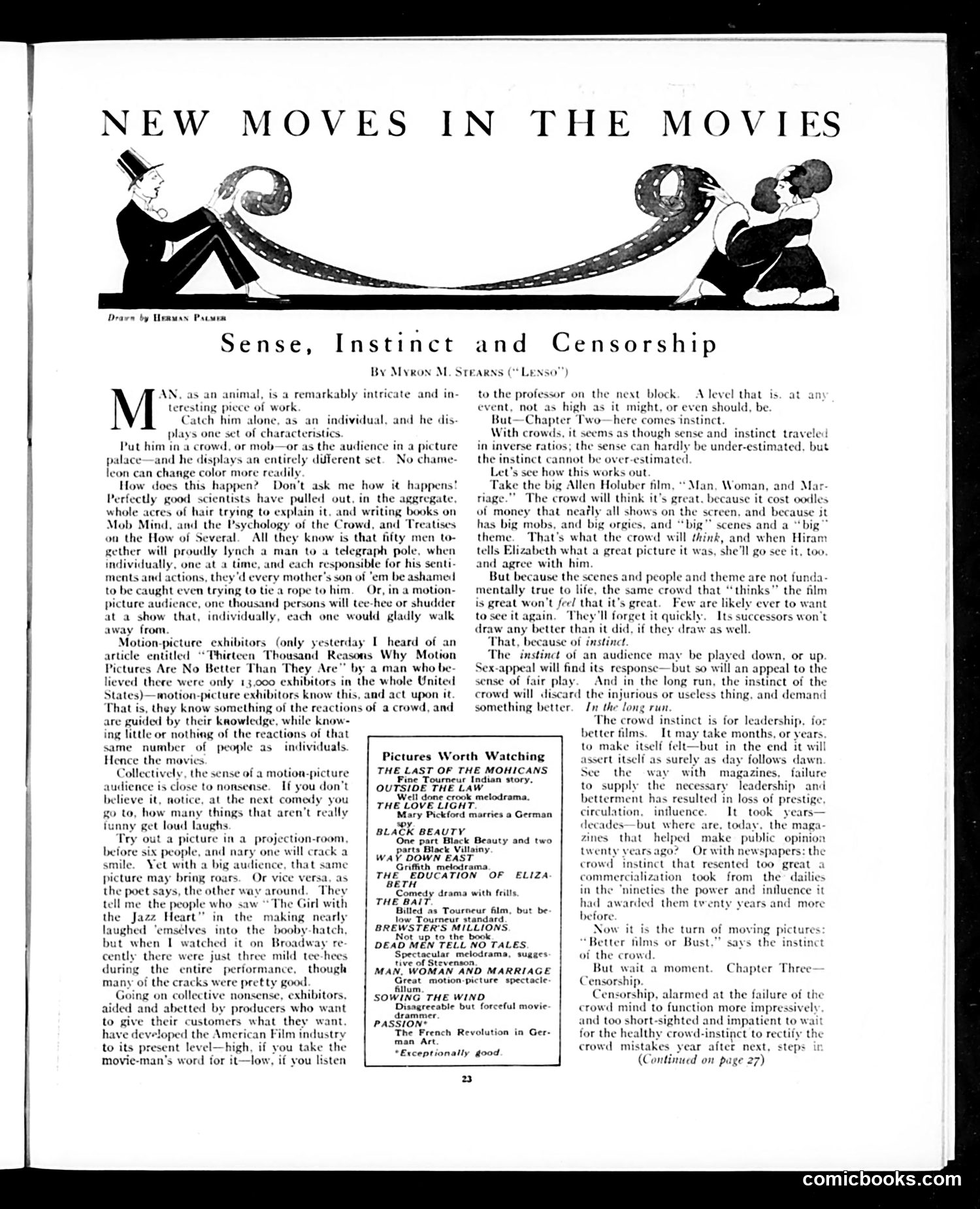
This article by Myron M. Stearns ("Lenso") examines how movie audiences behave differently in crowds versus as individuals. The top illustration shows silhouetted figures at opposite ends pulling a film strip, visually representing the tension between collective and individual responses. Stearns argues that while individual moviegoers possess "sense," crowds operate on "instinct." He illustrates this with Allen Holuber's film *Man, Woman, and Marriage*—a big-budget production with expensive sets and crowds that audiences will collectively praise, yet individually forget because the content lacks authenticity. The satire targets both producers (who exploit crowd psychology through spectacle) and audiences (whose collective judgment differs from their individual judgment). Stearns suggests that while short-term crowd instinct can be manipulated, long-term audience instinct—their genuine sense of quality—ultimately determines a film's lasting success. The article advocates for films grounded in truth over mere spectacle, challenging Hollywood's reliance on crowd psychology over artistic merit.
📄 Transcribed text from this page (OCR, searchable)
Machine-transcribed from the original scan — historical spelling and the odd misread are preserved.
NEW MOVES IN THE MOVIES Draws by Hemwan Prewem Sense, Instinct By Myron M. Ste AN, as an animal, is a remarkably intricate and in- teresting piece of work Catch him alone, as an individual, and he dis: plays one set of characteristics. Put him in a crowd, or mob—or as the audience in a picture palace—and he displays an entirely different set. No chame- leon can change color more readily How does this happen? Don’t ask me how it happens! Perfectly good scientists have pulled out, in the aggregate, whole acres of hair trying to explain it. and writing books on Mob Mind, and the Psychology of the Crowd, and Treatises oa the How of Several. All they know is that fifty men to- gether will proudly lynch a man to a telegraph pole, when individually, one at a time, and each responsible for his senti- ments and actions, they'd every mother’s son of ‘em be ashamed to be caught even trying lo tie a rope to him. Or, in a motion- picture audience, one thousand persons will tee-hee or shudder at a show that, individually, each one would gladly walk away from. Motion-picture exhibitors (only yesterday I heard of an article entitled “Thirteen Thousand Reasons Why Motion Pictures Are No Better Than They Are” by a man who be lieved there were only 13,000 exhibitors in the whole United States)—motion-picture exhibitors know this, and act upon it That is, they know something of the reactions of a crowd, and are guided by their kaowledge, while know- ing little or nothing of the reactions of that and Censorship ARNS (“LENSO") to the professor on the next block, A level that is. at an, event, not as high as it might, or even should, be. But—Chapter Two—here comes instinct. With crowds, it seems as though sense and instinct traveled in inverse ratios; the sense can hardly be under-estimated. but the instinct cannot be over-estimated, Let’s sce how this works out Take the big Allen Holuber film, * Man, Woman, and Mar riage."’ The crowd will think it’s great. because it cost oodles of money that neafly all shows on the screen, and because it has big mobs, and big orgies, and “big” scenes and a “big” theme. That's what the crowd will think, and when Hiram tells Elizabeth what a great picture it was, she'll go sce it, too. and agree with him But because the scenes and people and theme are not funda- mentally true to life, the same crowd that “thinks” the film is great won't feel that it’s great. Few are likely ever to want to see itagain. They'll forget it quickly. Its successors won't draw any better than it did, if they draw as well. That, because of instinct. The instinct of an audience may be played down, or up. Sex-appeal will find its response—but so will an appeal to the sense of fair play. And in the long run, the instinct of the crowd will discard the injurious or useless thing, and demand something better. Jn the long run. The crowd instinct is for leadership, for better films. It may take months, or years to make itself felt—but in the end it will same number of people as individuals. Hence the movies Collectively, the sense of a motion-picture audience is close to nonsense. If you don’t believe it, notice, at the next comedy you go to, how many things that aren't really tunny get loud laughs. Try out a picture in a projection-room, before six people, and nary one will crack a smile. Yet with a big audience, that same picture may bring roars. Or vice versa, as the poet says, the other way around. They tell me the people who saw “The Girl with the Jazz Heart” in the making nearly laughed ‘emsélves into the booby-hatch but when I watched it on Broadway re cently there were just three mild tee-hees during the entire performance, though many of the cracks were pretty good Going on collective nonsense, exhibitors, aided and abetted by producers who want to give their customers what they want have developed the American Film industry present level—high, if you take the -man’s word for it—low, if you listen Pictures Worth Watching THE LAST OF THE MOHICANS Fine Tourneur Indian story. OUTSIDE THE LAW ‘Well done crook melodrama, THE LOVE LIGHT. Mary Pickford marries a German spy. BLACK BEAUTY One part Black Beauty and two parts Black Villainy. WAY DOWN EAST Griffith melodrama, THE EDUCATION OF ELIZA BETH Comedy drama with frills, THE BAIT. Billed as Tourneur film, but be low Tourneur standard BREWSTER’S MILLIONS, Not up to the book DEAD MEN TELL NO TALES. Spectacular melodrama, sugges tive of Stevenson MAN, WOMAN AND MARRIAGE Great motion-picture spectacle fillum SOWING THE WIND Disagrecable but forceful movie drammer PASSION* The French Revolution in Ger- man Art *Exceptionally good assert itself as surely as day follows dawn. See the way with magazines, failure to supply the necessary leadership and betterment has resulted in loss of prestige. circulation, influence. It took years— decades—but where are, today, the maga- zines that helped make public opinion twenty vearsago? Or with newspapers: the crowd instinct that resented too great commercialization took from the dailies in the ‘nineties the power and influence it had awarded them twenty years and more before. Now it is the turn of moving pictures “Better films or Bust,” says the instinct i the crowd. But wait a moment. Censorship. Censorship, alarmed at the failure of the crowd mind to function more impressively and too short-sighted and impatient to wait for the healthy crowd-instinct to rectify the crowd mistakes year aftet next, steps (Continued on page 27) hapter Three comicbooks.com