
Judge, 1921-02-12 · page 7 of 32
Judge — February 12, 1921 — page 7: what you’re looking at
What you’re looking at
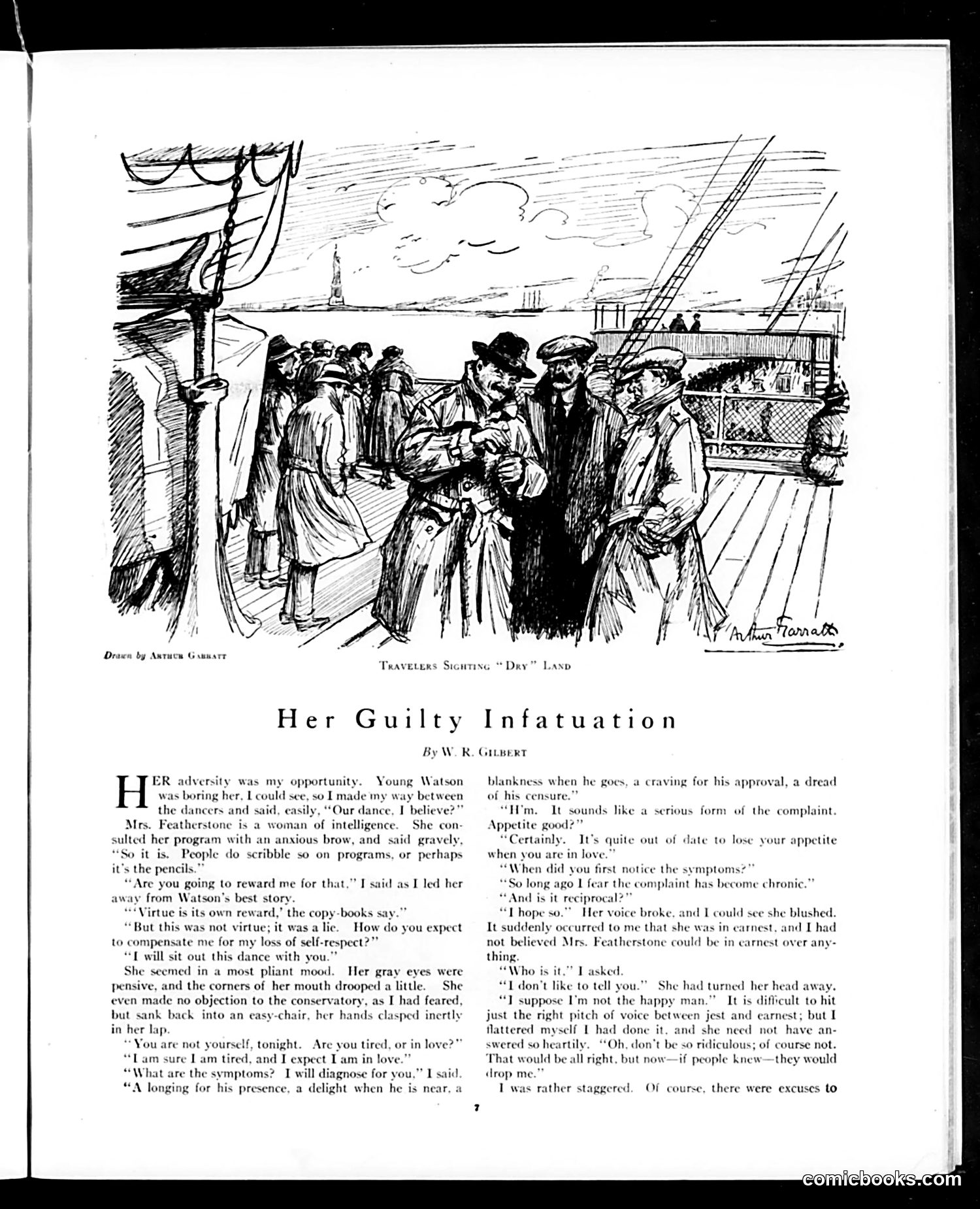
This story-and-cartoon page satirizes early 20th-century social hypocrisy around romance and reputation. The narrator, a manipulative man, interrupts young Watson's boring conversation to dance with the intelligent Mrs. Featherstone. Through flattery and false modesty, he learns she's fallen in love—but she refuses to name her admirer because, if discovered, society would ostracize her. The satire targets the absurd social double standard: a woman experiencing genuine romantic feelings faces social ruin merely from admission, while the man's dishonest scheming (lying about his dance card, feigning concern) carries no consequence. The ship-deck illustration suggests travelers observing respectable society's surface while its hypocrisy operates beneath. The story mocks Victorian-era rigid morality that punished women's authentic emotions while rewarding male manipulation.
📄 Transcribed text from this page (OCR, searchable)
Machine-transcribed from the original scan — historical spelling and the odd misread are preserved.
Drawe by Axruce G unser Traveters Sicumxe * Dry” Laxp Her Guilty Infatuation By WR. Gitnert ER adversity was my opportunity. Young Watson H was boring her, Lcould see, so T made my way between the dancers and said, easily, “Our dance, I believe?” Mrs. Featherstone is a woman of intelligence. She con- sulted her program with an anxious brow, and said gravely, “So it is. People do scribble so on programs, or perhaps it’s the pencils.” “Are you going to reward me for that,” I said as I led her av from Watson’s best story ‘Virtue is its own reward,’ the copy-books say.”” But this was not virtue; it was a lic. How do you expect mpensate me for my loss of self-respect?” [ will sit out this dance with you.” She seemed in a most pliant mood. Her gray eyes were pensive, and the corners of her mouth drooped a little. She even made no objection to the conservatory, as I had feared, but sank back into an easy-chair, her hands clasped inertly in her lap. “You are not yourself, tonight. Are you tired, or in love?” “Lam sure Iam tired, and I expect I am in love.” “What are the symptoms? I will diagnose for you,” I said a delight when he is near, a blankness when he goes, a craving for his approval, a dread of his censure.” “Hm. It sounds like a serious form of the complaint. Appetite good?” “Certainly. It’s quite out of date to lose your appetite when you are in love, When did you first notice the symptoms?"" lon, 0 1 fear the complaint has become chronic.” And is it reciprocal?” “LT hope so.” Her voice broke, and L could see she blushed. It suddenly occurred to me that she was in carnest, and [had not believed Mrs. Featherstone could be in carnest over any- thing “Who is it.” 1 asked. “T don’t like to tell you.” She had turned her head away. “T suppose I'm not the happy man.” It is difficult to hit just the right pitch of voice between jest and earnest; but I flattered myself 1 had done it, and she need not have an- swered so heartily, ‘Oh, don’t be so ridiculous; of course not. That would be all right, but now—if people knew—they would drop me.” I was rather staggered. Of course, there were excuscs to