
Judge, 1921-02-12 · page 20 of 32
Judge — February 12, 1921 — page 20: what you’re looking at
What you’re looking at
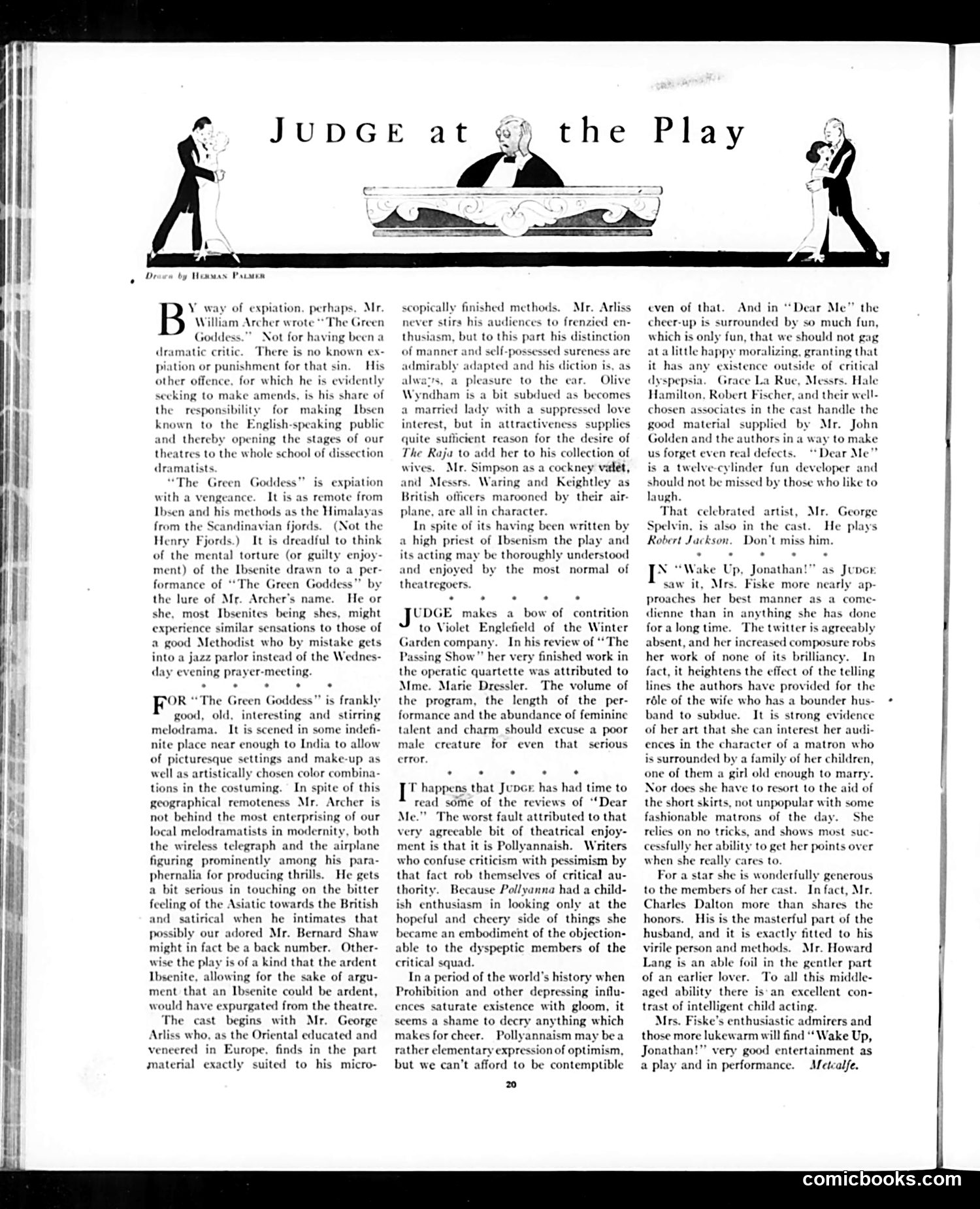
This is a theater criticism column reviewing contemporary Broadway productions. The header illustration shows a judge presiding over theatrical matters, establishing the satirical tone. The main review critiques William Archer's play "The Green Goddess," performed by acclaimed actor George Arliss. The satire centers on Archer's contradiction: as a dramatic critic, he championed Henrik Ibsen and serious, analytical drama to English audiences, yet wrote a conventional melodrama with exotic settings, wireless telegraphs, and airplanes—precisely the entertainment an Ibsenite would despise. The columnist mocks Ibsen devotees as humorless purists, comparing their suffering at this play to "a good Methodist who by mistake gets into a jazz parlor." The piece praises Arliss's refined performance and supporting cast while defending the play's entertainment value against intellectual pretension—essentially defending fun theater against snobbish criticism. A secondary note apologizes for misattributing an actress's performance to Marie Dressler.
📄 Transcribed text from this page (OCR, searchable)
Machine-transcribed from the original scan — historical spelling and the odd misread are preserved.
“ JUDGE at Deven by Wewas Porton Y way of expiation, perhaps, Mr William Archer wrote * The Green Goddess.” Not for having been a dramatic critic. There is no known ex- tion or punishment for that sin. His for which he is evidently other offence, secking to make amends, is his share of the responsibility for making Ibsen known to the English-speaking public and thereby opening the stages of our theatres to the whole school of dissection dramatists. “The Green Goddess” is expiation with a vengeance. It is as remote from Ibsen and his methods as the Himalayas from the Scandinavian fjords. (Not the Henry Fjords.) It is dreadful to think of the mental torture (or guilty enjoy- ment) of the Ibsenite drawn to a per- formance of ‘The Green Goddess” by the lure of Mr. Archer's name. He or she, most Ibsenites being shes, might experience similar sensations to those of a good Methodist who by mistake gets into a jazz parlor instead of the Wednes- day evening prayer-meeting. ‘OR “The Green Jess” is frankly good, old, interesting and stirring melodrama. It is scened in some indefi- nite place near enough to India to allow of picturesque settings and make-up as well as artistically chosen color combina- tions in the costuming. In spite of this geographical remoteness Mr. Archer is not behind the most enterprising of our local melodramatists in modernity, both the wireless telegraph and the airplane figuring prominently among his para- phernalia for producing thrills. He gets a bit serious in touching on the bitter feeling of the Asiatic towards the British and satirical when he intimates that possibly our adored Mr. Bernard Shaw might in fact be a back number. Other- wise the play is of a kind that the ardent Ibsenite, allowing for the sake of argu- ment that an Ibsenite could be ardent, would have expurgated from the theatre. The cast begins with Mr. George Arliss who, as the Oriental educated and veneered in Europe, finds in the part material exactly suited to his micro- ei) the scopically finished methods. Mr. Arliss never stirs his audiences to frenzied en- thusiasm, but to this part his distinction of manner and self-possessed sureness are admirably adapted and his diction is, as alwazs, a pleasure to the ear. Olive Wyndham is a bit subdued as becomes a married lady with a suppressed love interest, but in attractiveness supplies quite sufficient reason for the desire of The Raja to add her to his collection of wives. Mr. Simpson as a cockney valet, and Messrs. Waring and Keightley as British officers marooned by their air- plane, are all in character. In spite of its having been written by a high priest of Ibsenism the play and its acting may be thoroughly understood and enjoyed by the most normal of theatregoers. une makes bow of contrition to Violet Englefield of the Winter Garden company. In his review of “The Passing Show" her very finished work in the operatic quartette was attributed to Mme. Marie Dressler. The volume of the program, the length of the per- formance and the abundance of feminine talent and charm should excuse a poor male creature for even that serious error. [happens that Juoce: has had time to id some of the reviews of ‘Dear The worst fault attributed to that very agreeable bit of theatrical enjoy- ment is that it is Pollyannaish. Writers who confuse criticism with pessimism by that fact rob themselves of critical au- thority. Because Pollyanna had a child- ish enthusiasm in looking only at the hopeful and cheery side of things she became an embodiment of the objection- able to the dyspeptic members of the critical squad. In a period of the world’s history when Prohibition and other depressing influ- ences saturate existence with gloom, it scems a shame to decry anything which makes for cheer. Pollyannaism may be a rather elementary expression of optimism, but we can’t afford to be contemptible 20 re Me Play even of that. And in “Dear Me” the cheer-up is surrounded by so much fun, which is only fun, that we should not gag ata little happy moralizing, granting that it has any existence outside of critical dyspepsia. Grace La Rue, Messrs. Hale Hamilton, Robert Fischer, and their well- chosen associates in the cast handle the good material supplied by Mr. John Golden and the authors in a way to make us forget even real defects. “Dear Me” is a twelve-cylinder fun developer and should not be missed by those who like to laugh. That celebrated artist, Mr. George Spelvin, is also in the cast. He plays Robert Jackson. Don’t miss him. JX “Wake Up, Jonathan!” as June saw it, Mrs. Fiske more nearly ap- proaches her best manner as a come- dienne than in anything she has done fora longtime. The twitter is agreeably absent, and her increased composure robs her work of none of its brilliancy. In fact, it heightens the effect of the telling lines the authors have provided for the réle of the wife who has a bounder hus- band to subdue. It is strong evidence of her art that she can interest her audi- ences in the character of a matron who is surrounded by a family of her children, one of them a girl old enough to marry. Nor does she have to resort to the aid of the short skirts, not unpopular with some fashionable matrons of the day. She relies on no tricks, and shows most suc- cessfully her ability to get her points over when she really cares to. For a star she is wonderfully generous to the members of her cast. In fact, Mr. Charles Dalton more than shares the honors. His is the masterful part of the husband, and it is exactly fitted to his virile person and methods. Mr. Howard Lang is an able foil in the gentler part of an earlier lov To all this middle- aged ability there is'an excellent con- trast of intelligent child acting. Mrs. Fiske’s enthusiastic admirers and those more lukewarm will find “‘ Wake Up, Jonathan!” very good entertainment as a play and in performance. Metcalfe. comicbooks.com —