
A complete issue · 32 pages · 1920
Judge — October 2, 1920
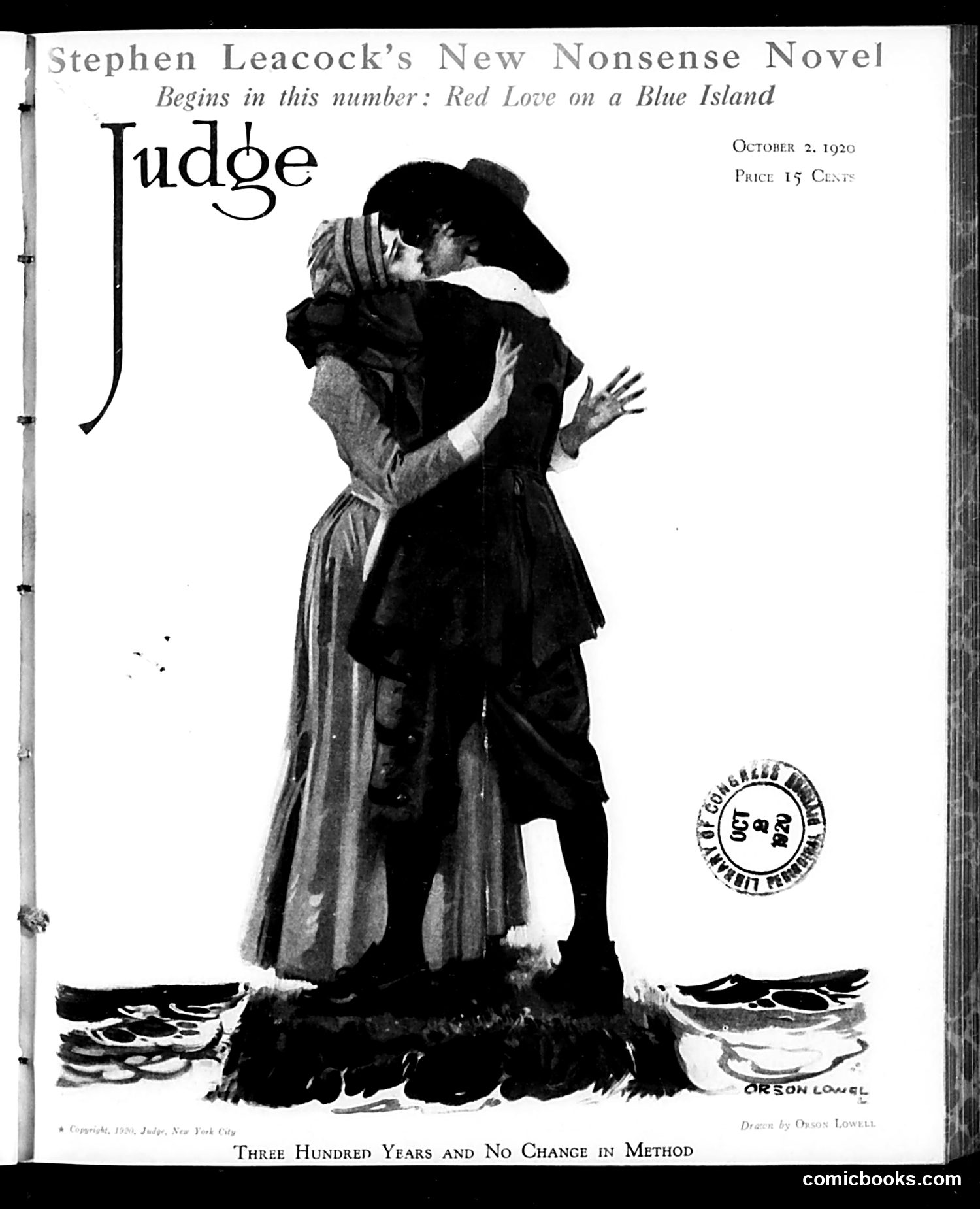
This is the cover of **Judge**, a satirical American magazine from October 1920, priced at 15 cents. The main illustration shows a couple in an embrace on what appears to be a rocky shore, drawn by Orson Lowell. The caption reads "Three Hundred Years and No Change in Method," suggesting commentary on unchanging romantic or courtship practices despite the passage of time. The cover advertises Stephen Leacock's serialized nonsense novel "Red Love on a Blue Island," indicating the magazine featured literary fiction alongside satire. The library stamp visible suggests institutional archiving. Without additional context from inside pages, the specific satirical targets remain unclear, though the title suggests commentary on timeless human behaviors or social conventions.
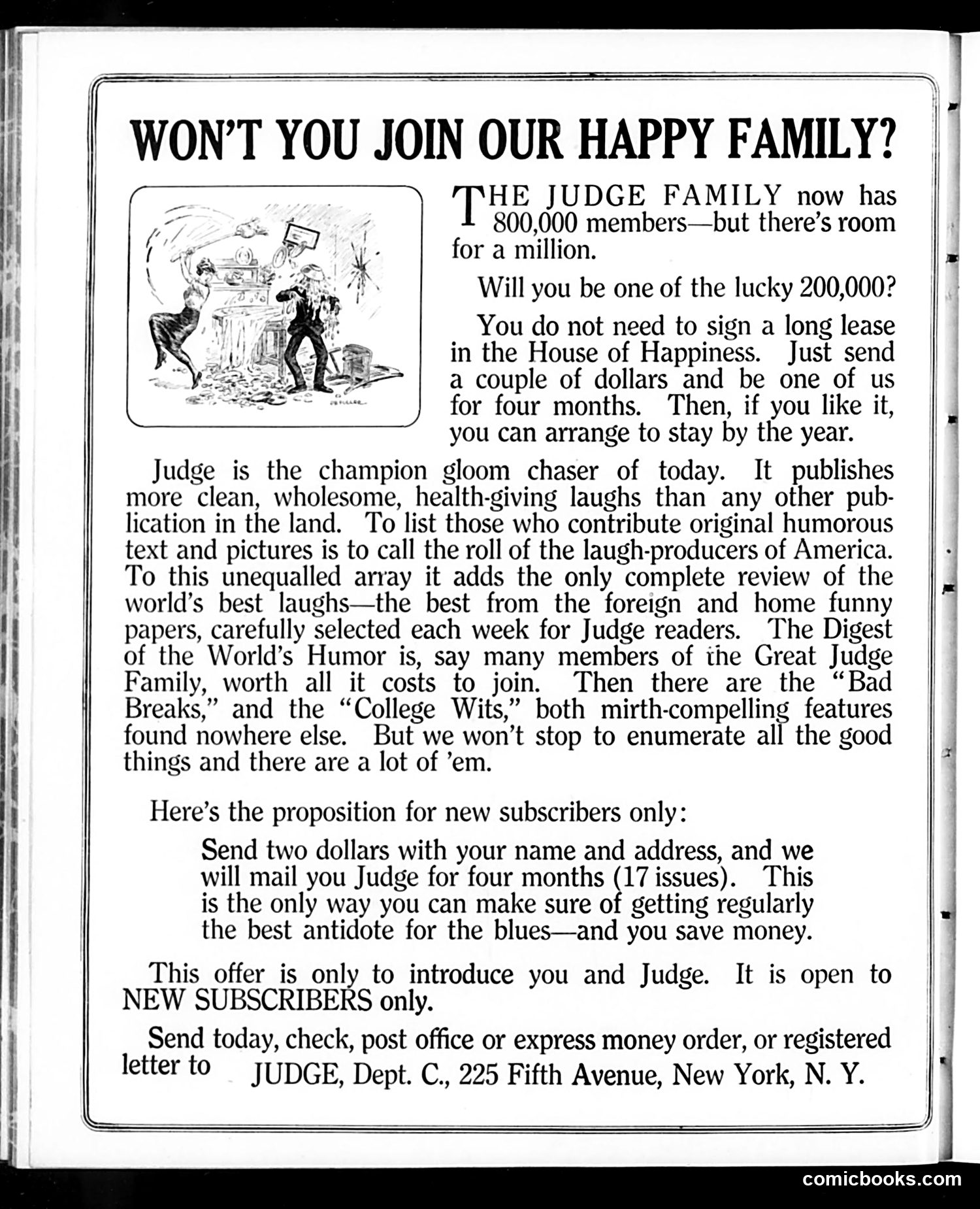
This page is primarily a **subscription advertisement** for Judge magazine itself, not political commentary. The small cartoon in the upper left shows a couple in formal attire appearing to dance or celebrate amid scattered money and luxurious furnishings—illustrating the magazine's purpose: providing humor and entertainment. The ad emphasizes Judge's content: original humorous contributions, a "Digest of the World's Humor" featuring international jokes, and regular features like "Bad Breaks" and "College Wits." It positions Judge as America's premier humor publication. The "Happy Family" metaphor frames readers as joining an exclusive 800,000-member community. The offer—two dollars for four months—was marketed exclusively to new subscribers as an introductory rate. The address (225 Fifth Avenue, New York) indicates Judge's Manhattan headquarters.
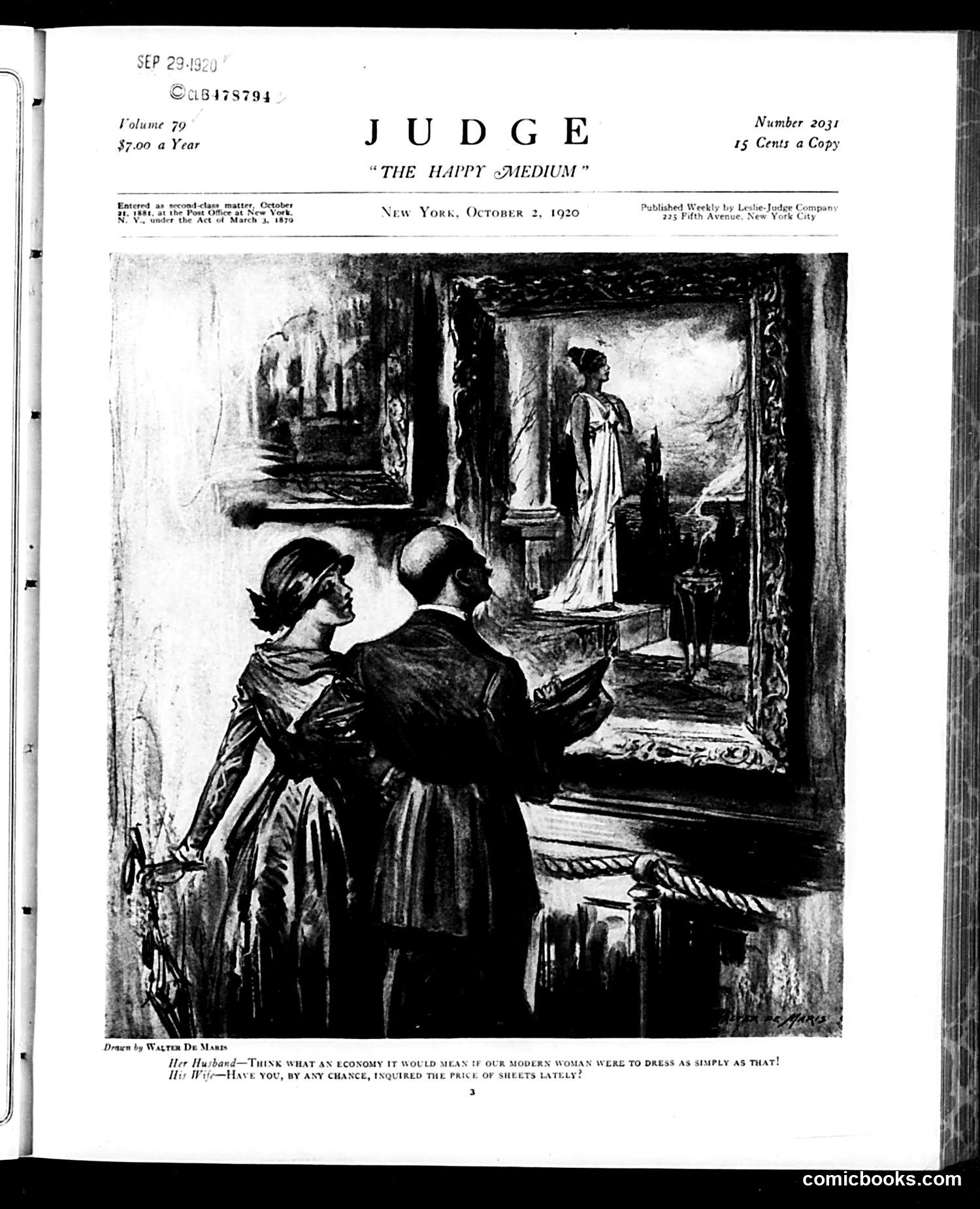
This cartoon by Warren De Vilss depicts a couple viewing a woman's dress in what appears to be a shop window or display. The satire addresses women's fashion economy during the early 1920s. The husband's comment—"Think what an economy it would mean if our modern woman were to dress as simply as that!"—sarcastically references the minimal clothing worn by the classical female figure displayed. His wife's response about the "price of sheets" suggests the joke: dressing in simple draped garments (like classical togas) would be cheaper than buying the expensive fabric required for modern fashionable dresses. This reflects post-WWI anxieties about women's changing roles, rising costs of living, and evolving fashion standards that required substantial fabric and expenditure.
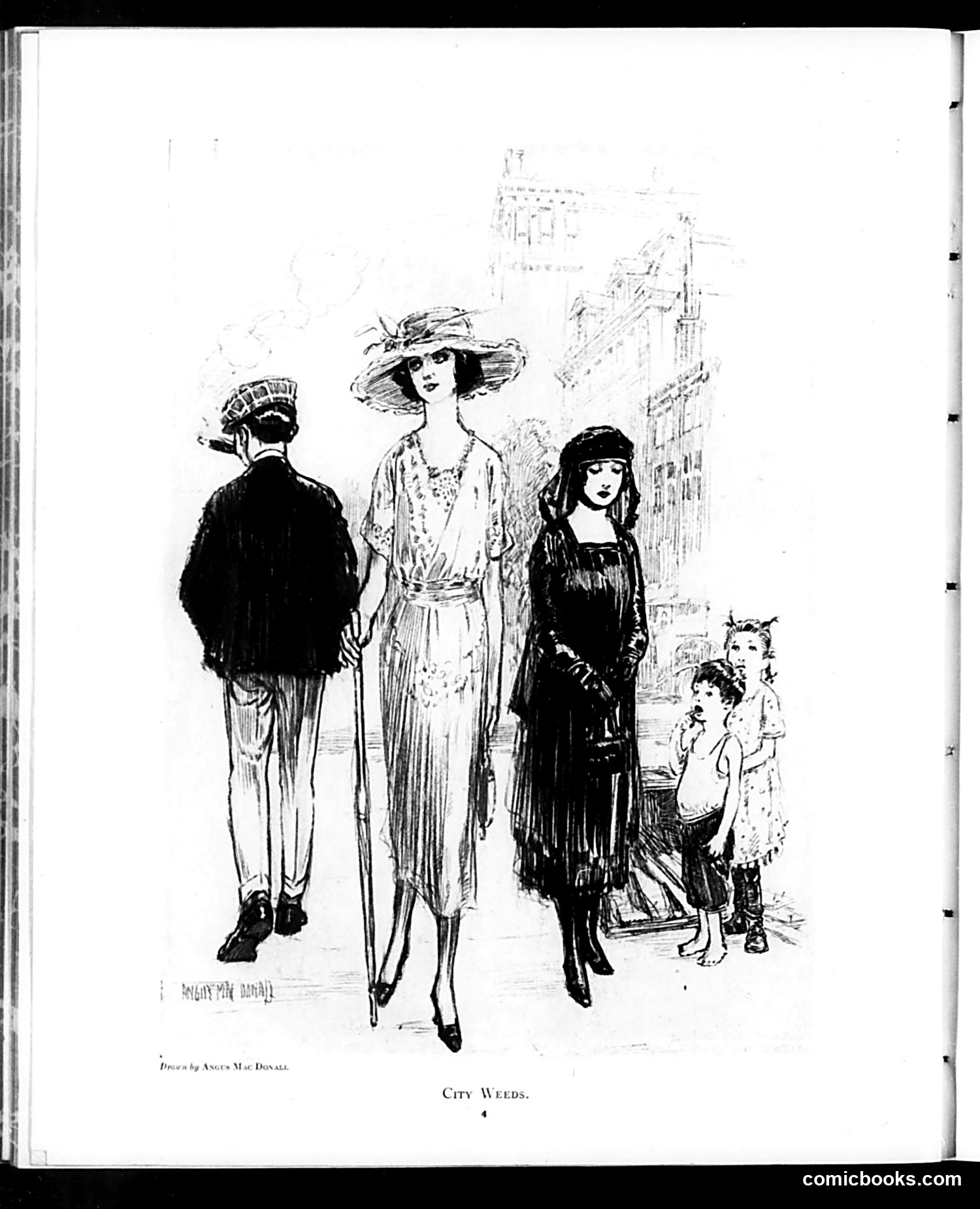
This illustration by Angus MacDonald satirizes urban social problems through the metaphor of weeds. The image depicts a fashionably dressed woman with two children of notably different appearances walking through a city street. The satire likely critiques the contrast between wealth and poverty in cities—the well-dressed adult represents prosperity or respectability, while the ragged children represent urban poverty and neglect. The title "City Weeds" suggests these impoverished children are undesirable growths in the urban landscape, similar to weeds in a garden. This reflects early 20th-century concerns about urban poverty, child welfare, and social inequality that were frequent subjects in Judge magazine's satirical commentary.
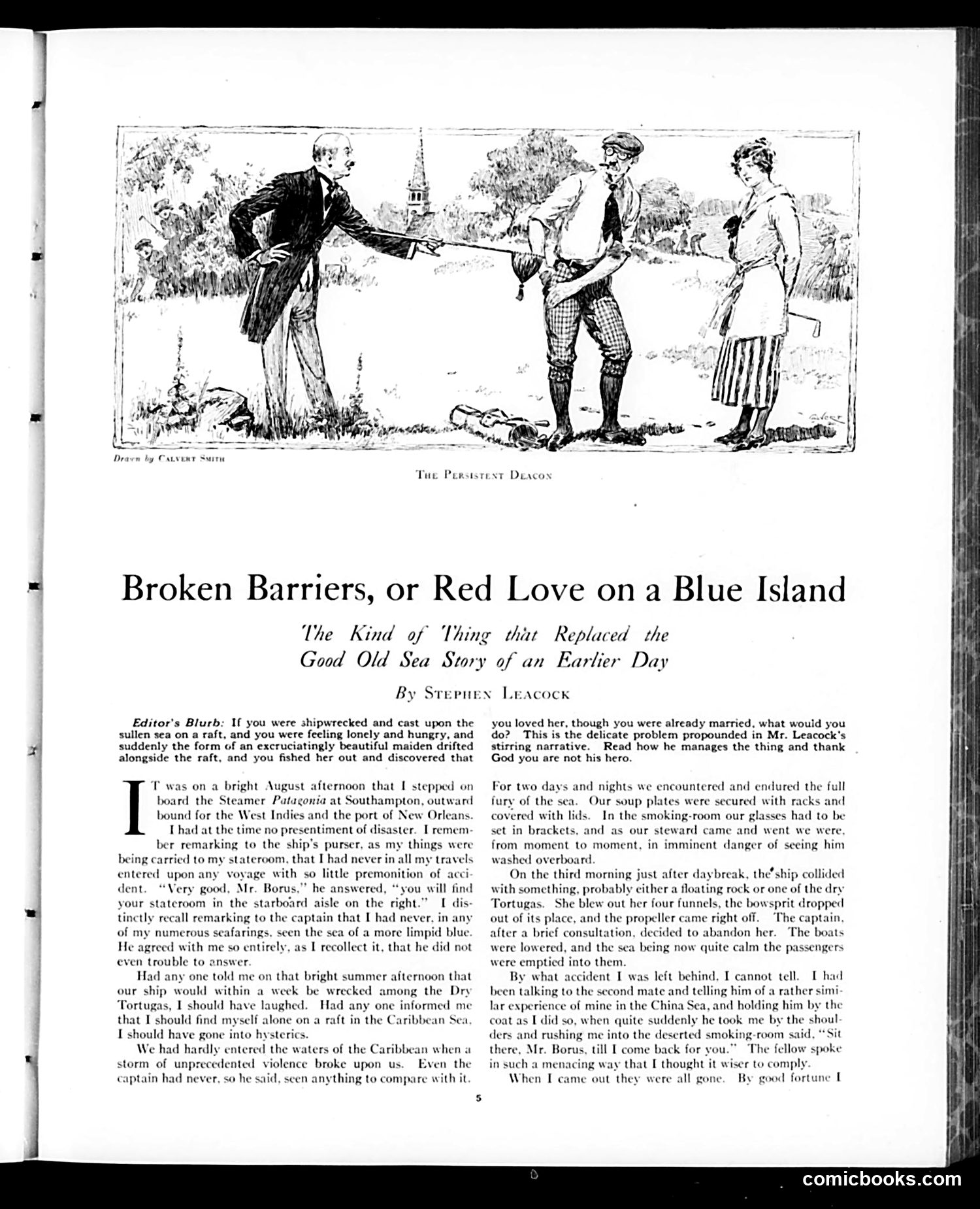
The cartoon depicts a social scenario rather than political satire. It shows a clergyman ("deacon") persistently courting a young woman while a man (possibly her fiancé or suitor) and another woman observe. The deacon extends his hand toward the couple despite their clear disinterest. The humor lies in the title's irony: the "persistent deacon" ignores social boundaries and the woman's obvious unavailability, continuing his unwanted advances regardless. This satirizes hypocritical clergy who publicly preach morality while privately behaving inappropriately—a common Victorian-era critique of religious figures. The accompanying story "Broken Barriers, or Red Love on a Blue Island" by Stephen Leacock addresses similar themes of social transgression and unexpected romantic entanglements, particularly shipboard encounters that override normal social conventions.
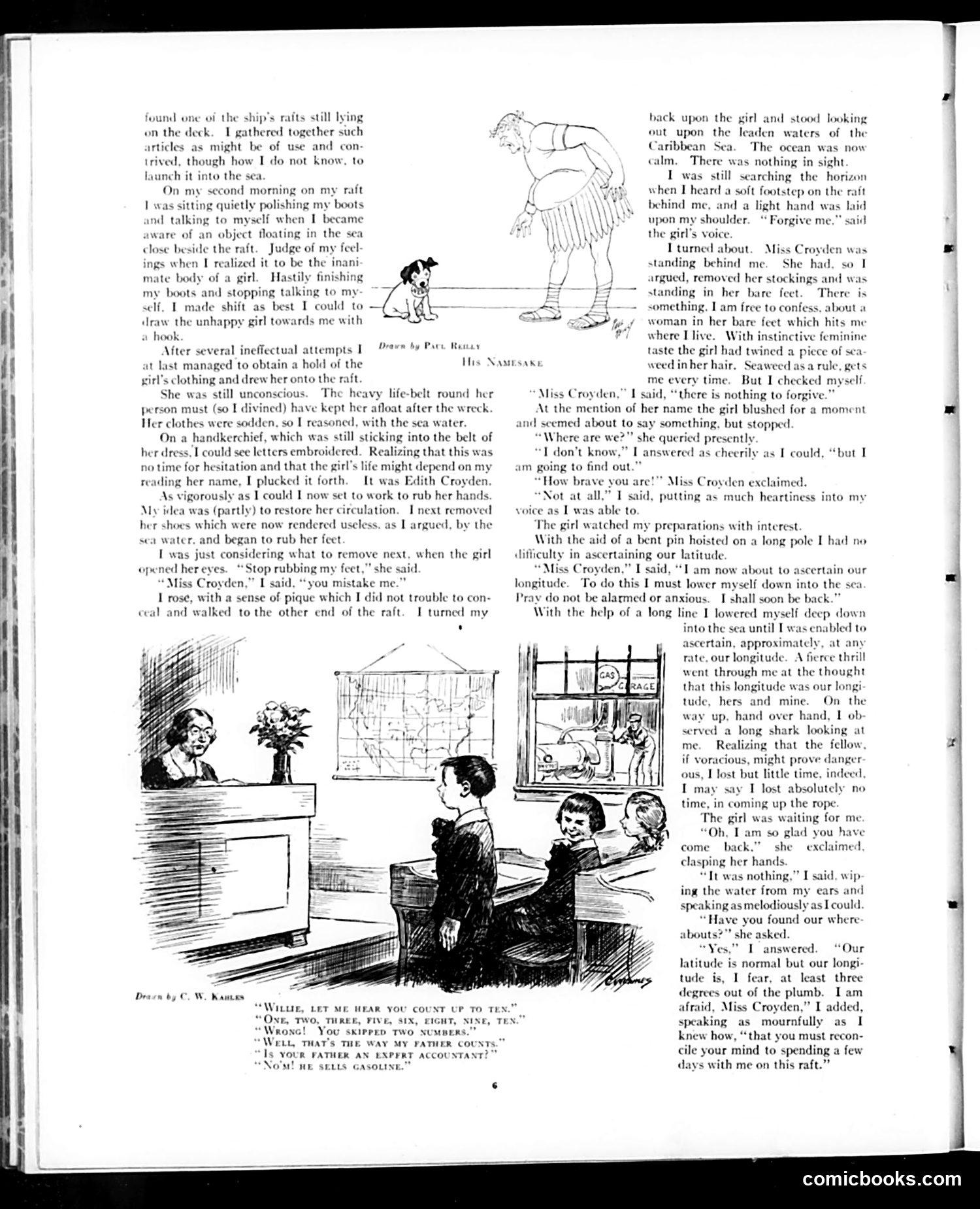
This page contains a serialized adventure story illustrated with pen-and-ink drawings, not political satire. The narrative describes a shipwreck rescue involving a girl named Miss Croyden, whom the narrator finds floating in the sea and brings aboard a raft. The lower cartoon, captioned "Willie, let me hear you count up to ten," appears to be a domestic humor piece about a father teaching his son to count, with a punchline about the father being "an expert accountant" who "sells gasoline"—likely satirizing either dubious business practices or wartime gasoline rationing/profiteering. The page is primarily literary entertainment rather than political commentary.
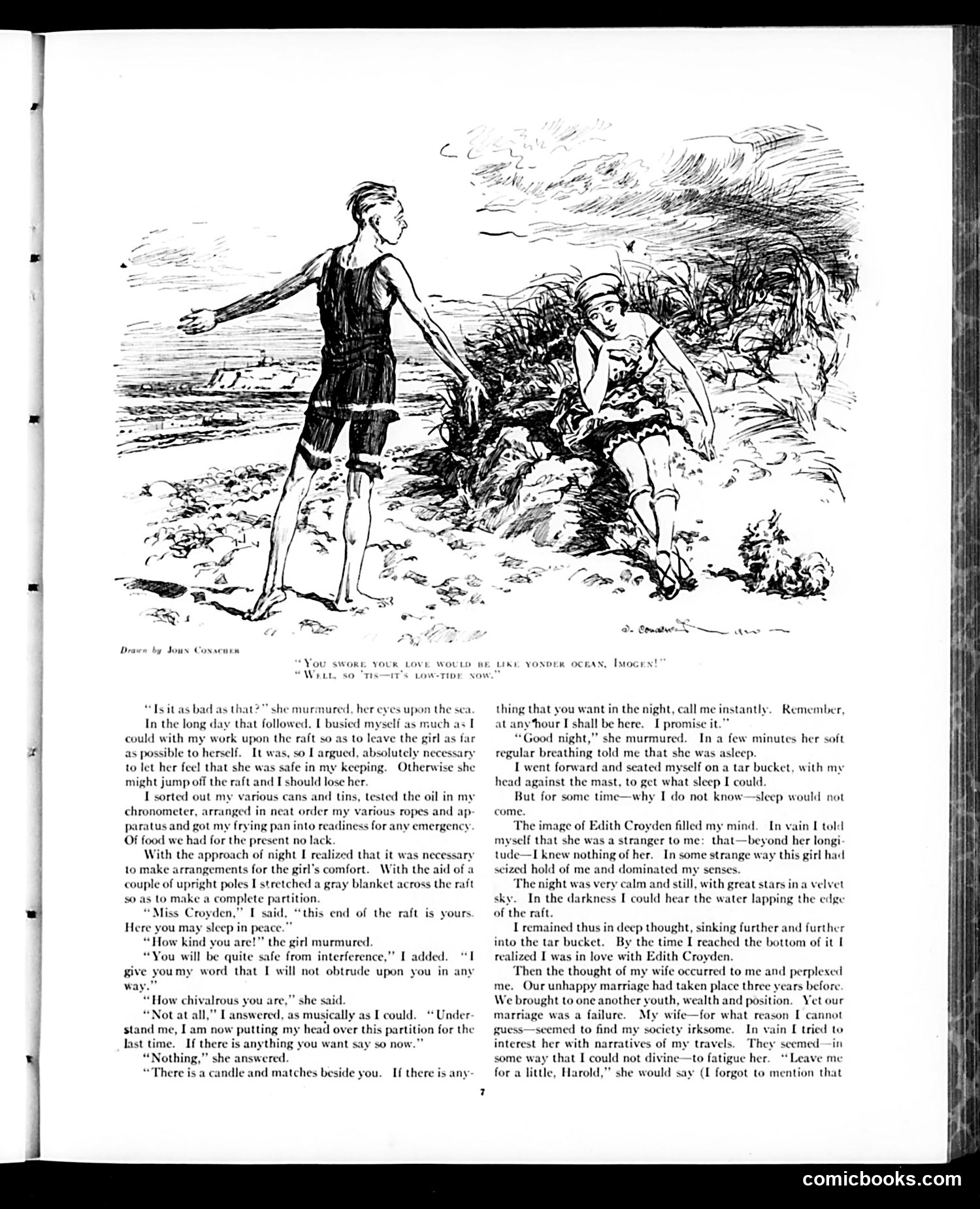
This page contains a romantic fiction narrative rather than political satire or editorial cartooning. The illustration by John Cosgrove depicts a scene from what appears to be an adventure novel serialized in Judge magazine. The story concerns a narrator (Harold) and a woman named Edith Croyden stranded on a raft at sea. The cartoon caption captures dialogue about their romantic feelings—she claims her love would be "like yonder ocean," he replies it's "low-tide now" (suggesting diminished ardor, likely due to his marriage). The text reveals the narrator's internal conflict: he's falling in love with the mysterious Edith despite being unhappily married for three years. His wife finds him tiresome and wants solitude from him. This represents **serialized romantic fiction**—common Judge content alongside satire. The appeal lay in melodramatic adventure and emotional entanglement rather than political commentary. For modern readers, this shows how magazines like Judge mixed humor with serialized storytelling to maintain readership.
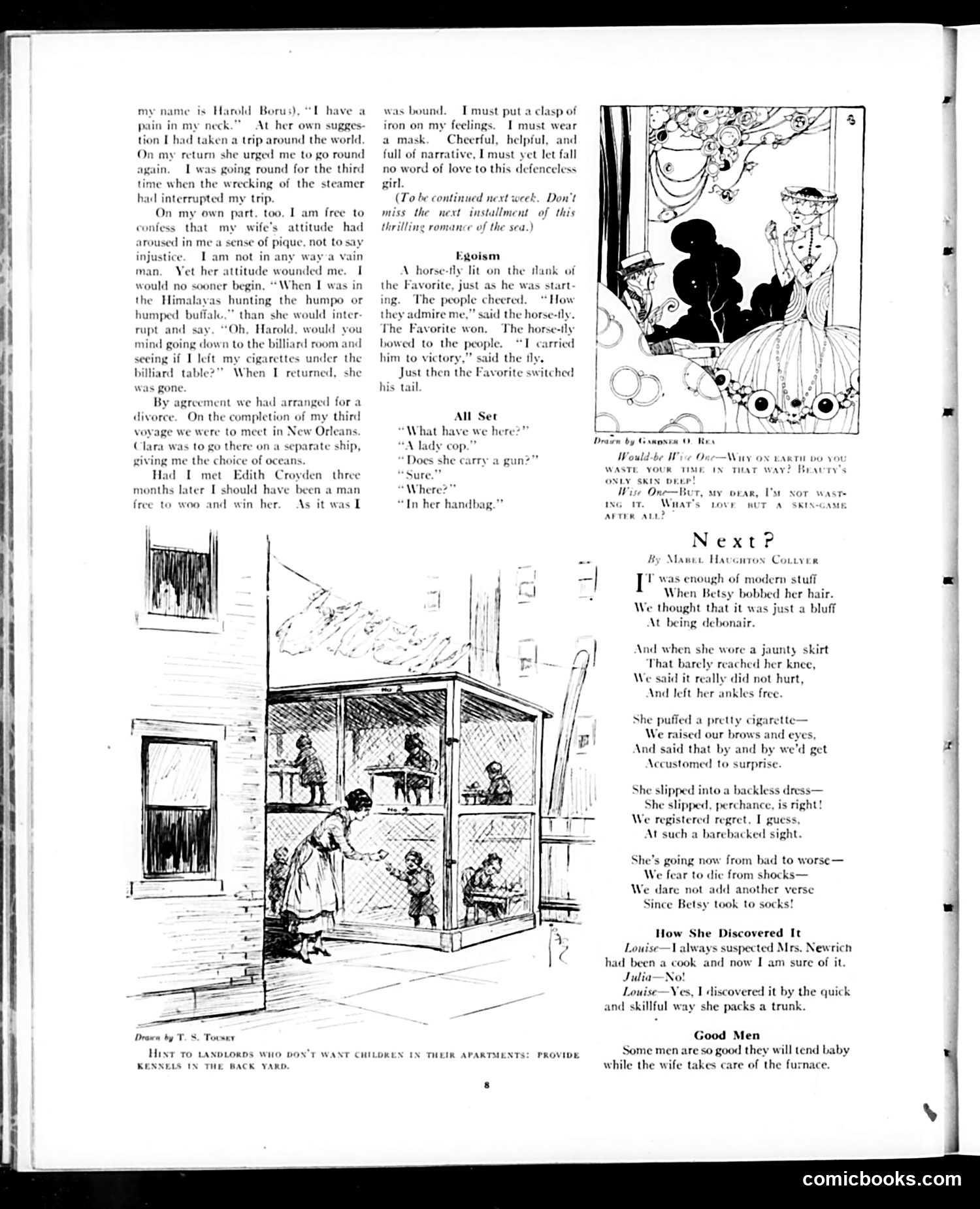
This page contains multiple satirical pieces reflecting early 20th-century social anxieties: **Main Story (serialized romance):** A man named Harold Borus describes his predicament—he's divorcing his dismissive wife Clara but meets an appealing woman (Edith Croyden) before the divorce finalizes, forcing him to suppress his feelings. The satire mocks marital discord and masculine frustration. **"Egoism" fable:** A horse-fly believes it won a race, not the horse. This mocks vanity and unearned credit-taking. **"Next?" poem:** Satirizes modern young women's rapidly changing behavior—bobbed hair, short skirts, cigarettes, backless dresses, and now *socks*. Each innovation shocked society; the humor lies in cataloging escalating "outrages" to female modesty, implying constant moral panic over women's liberation. **Social humor:** Includes jokes about landlords banning children, feminine vanity vs. love, and a "new money" woman's cooking past revealed through trunk-packing skills. The overall tone reflects conservative anxiety about modernizing social norms, particularly women's increasing independence and fashion choices.
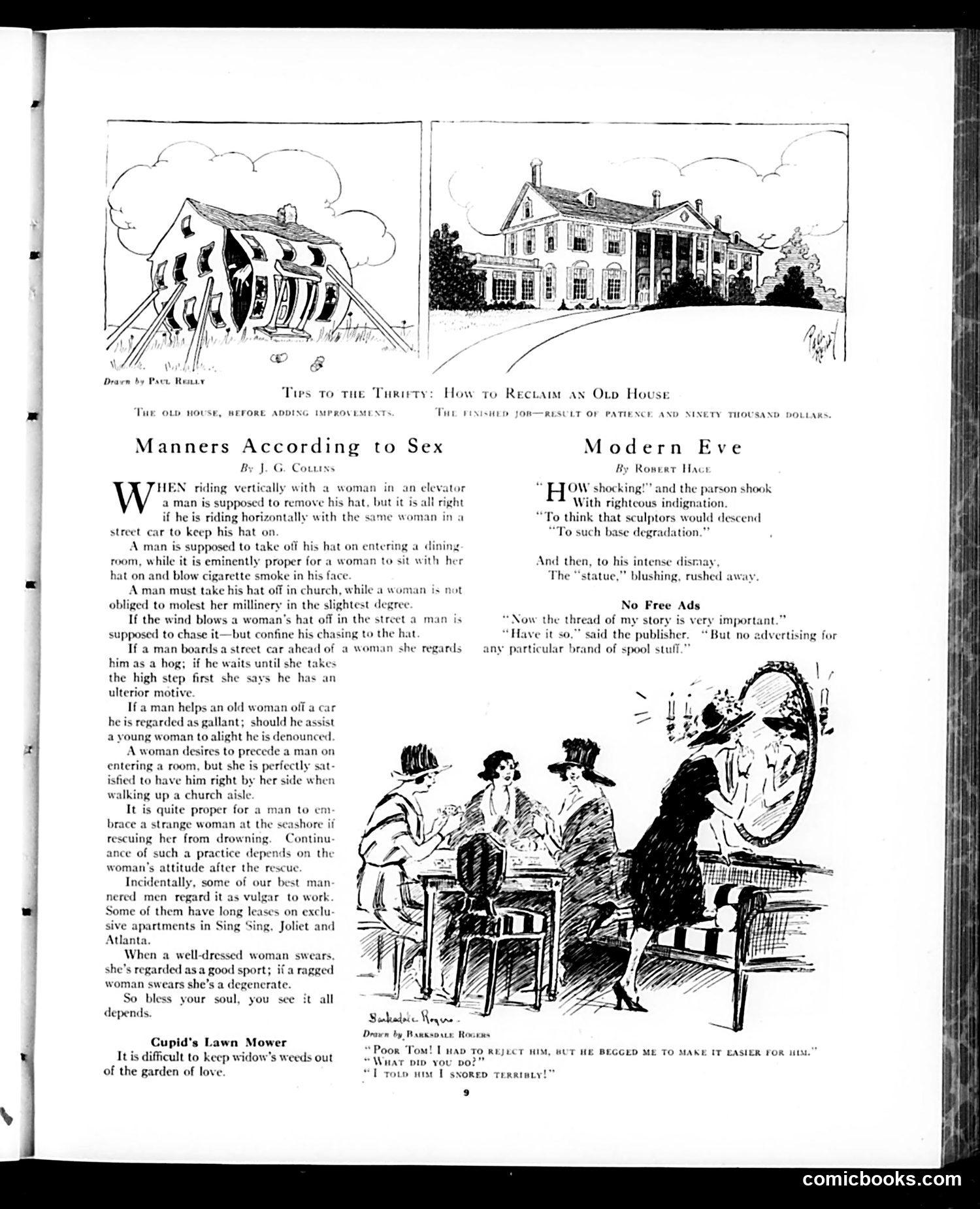
This page contains three satirical pieces typical of early 20th-century Judge magazine humor: **"Manners According to Sex"** by J.G. Coutts mocks the contradictory social rules governing men's and women's behavior. The satire highlights the absurdity of etiquette standards: men must remove hats in certain situations but not others; helping women can be viewed as either gallant or suspicious depending on the woman's age; women can wear hats indoors while men cannot. The closing line—"So bless your soul, you see it all depends"—underscores the arbitrary, hypocritical nature of these gendered conventions. **"Modern Eve"** by Robert Hacé depicts a man shocked by a nude female statue, regarding it as degrading to sculptors. The humor lies in the statue's personification and "modest" escape, satirizing prudish attitudes toward art and the female form. **"No Free Ads"** presents a brief dialogue about advertising copy, likely an in-joke about publishing practices. The two house sketches at top illustrate a restoration article. The overall page satirizes social pretension and contradictory moral standards of the era.
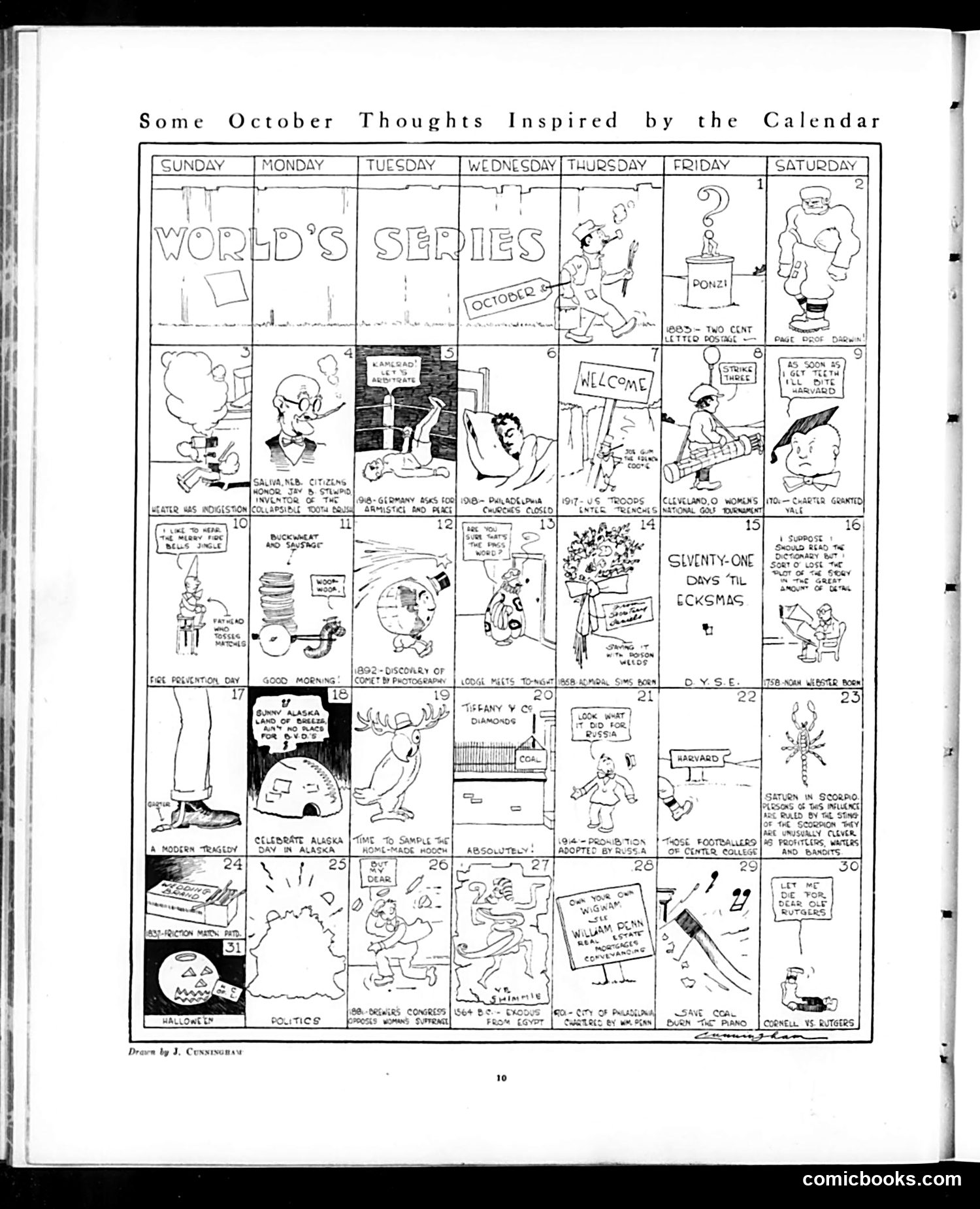
This is a calendar-based comic strip by J. Cunningham running through October, with each day featuring a brief gag or topical reference. The humor relies on October events and occasions. Visible references include: - **World Series** (early October baseball championship) - **Columbus Day** (October 12) - **Halloween** (October 31) — shown with jack-o'-lantern imagery - **Election Day** implications ("Politics") - **Tiffany & Co. diamonds** (commercial reference) - Various seasonal/autumn themes The strip uses simple line drawings and puns tied to the calendar date. Most jokes appear to be light domestic or seasonal humor rather than pointed political satire, though one panel references "Cleveland" and "Women's National Golf Tournament," suggesting contemporary events from when this was published. Without clearer image resolution for all panels, specific details of some gags remain unclear, but the overall concept is straightforward daily humor keyed to October's calendar.
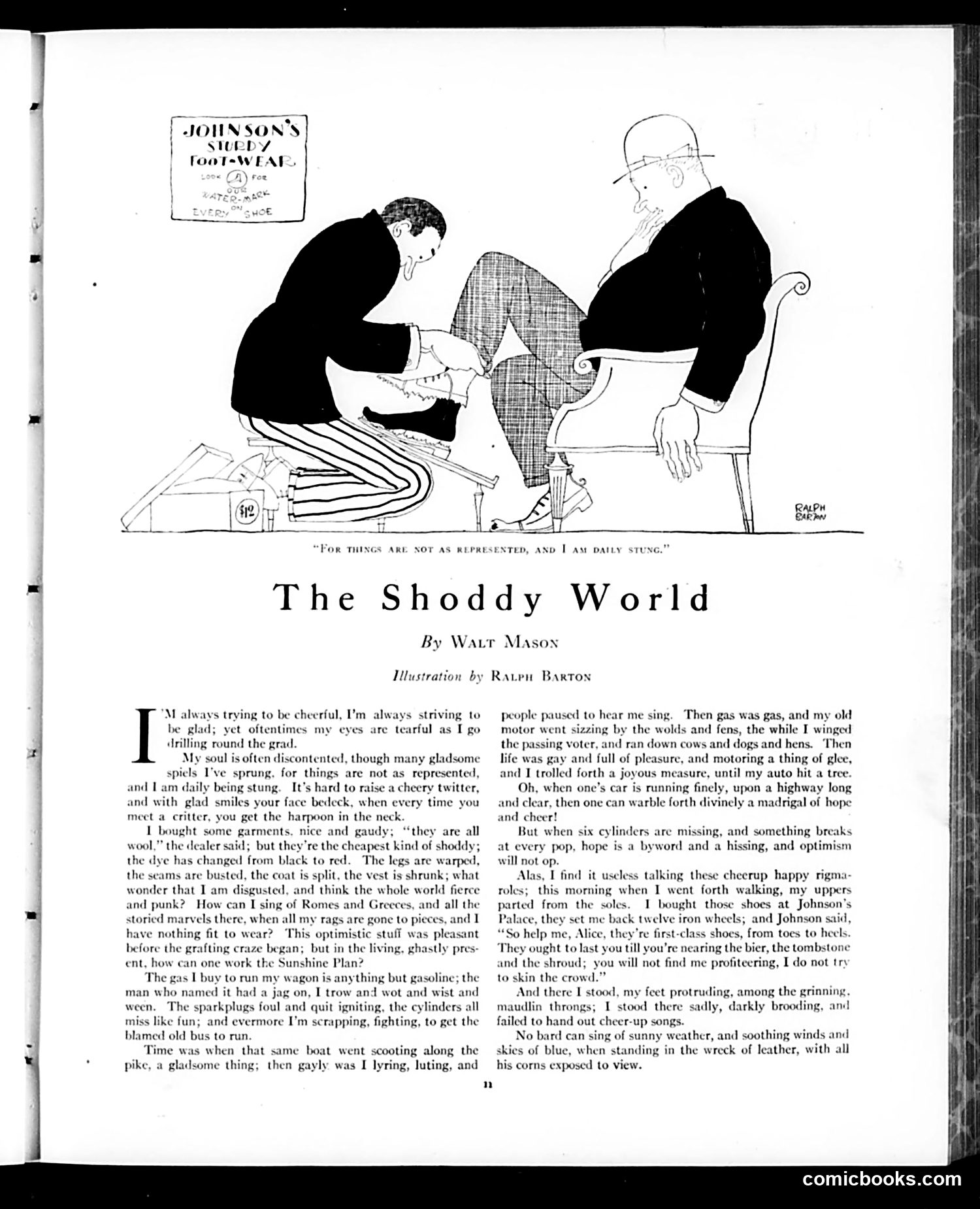
This page satirizes consumer fraud and defective merchandise in early 20th-century America. The cartoon illustrates the article's theme: a man being fitted with shoes at "Johnson's Sturdy Foot-Wear" while complaining to a companion about being "daily stung." Walt Mason's essay laments buying inferior goods marketed as quality—garments labeled "all wool" that are cheap shoddy, automobile fuel that isn't genuine gasoline, and shoes from "Johnson's Palace" that fall apart despite the seller's promises. The repeated refrain "things are not as represented" captures the core complaint. The satire targets both manufacturers and retailers who profit through deception, selling defective products at premium prices. The narrator's inability to maintain optimism while literally and figuratively falling apart—shoes splitting, clothes warping, cars breaking down—underscores how consumer fraud undermines everyday life and one's cheerfulness. The "Sunshine Plan" reference suggests mocking the contemporary positive-thinking movement as useless when facing real material problems.
This page from Judge magazine contains two distinct pieces of satirical commentary: **"Owen Wister: Matchmaker"** mocks international diplomacy post-WWI. The author uses marriage/divorce metaphors to critique various nations' political maneuvering—Germany courting Russia, Britain and France in alliance, etc. The piece specifically celebrates novelist Owen Wister's argument (from his book "A Straight Deal") that America and Britain should unite against their common enemies rather than fight each other, referencing historical grievances dating back to the American Revolution ("the little affair at Lexington"). **"Pete Among the Philistines"** reviews Claude C. Washburn's novel "Order," praising its protagonist Pete as a romantic rebel who disrupts an uptight, rule-bound small town (Marville). The satire celebrates nonconformity and spontaneity over rigid social order—Pete's chaotic influence makes townspeople wish for more freedom ("we'll be almost human!"). Both pieces advocate for breaking stuffy conventions, whether diplomatic rigidity or small-town conformity.
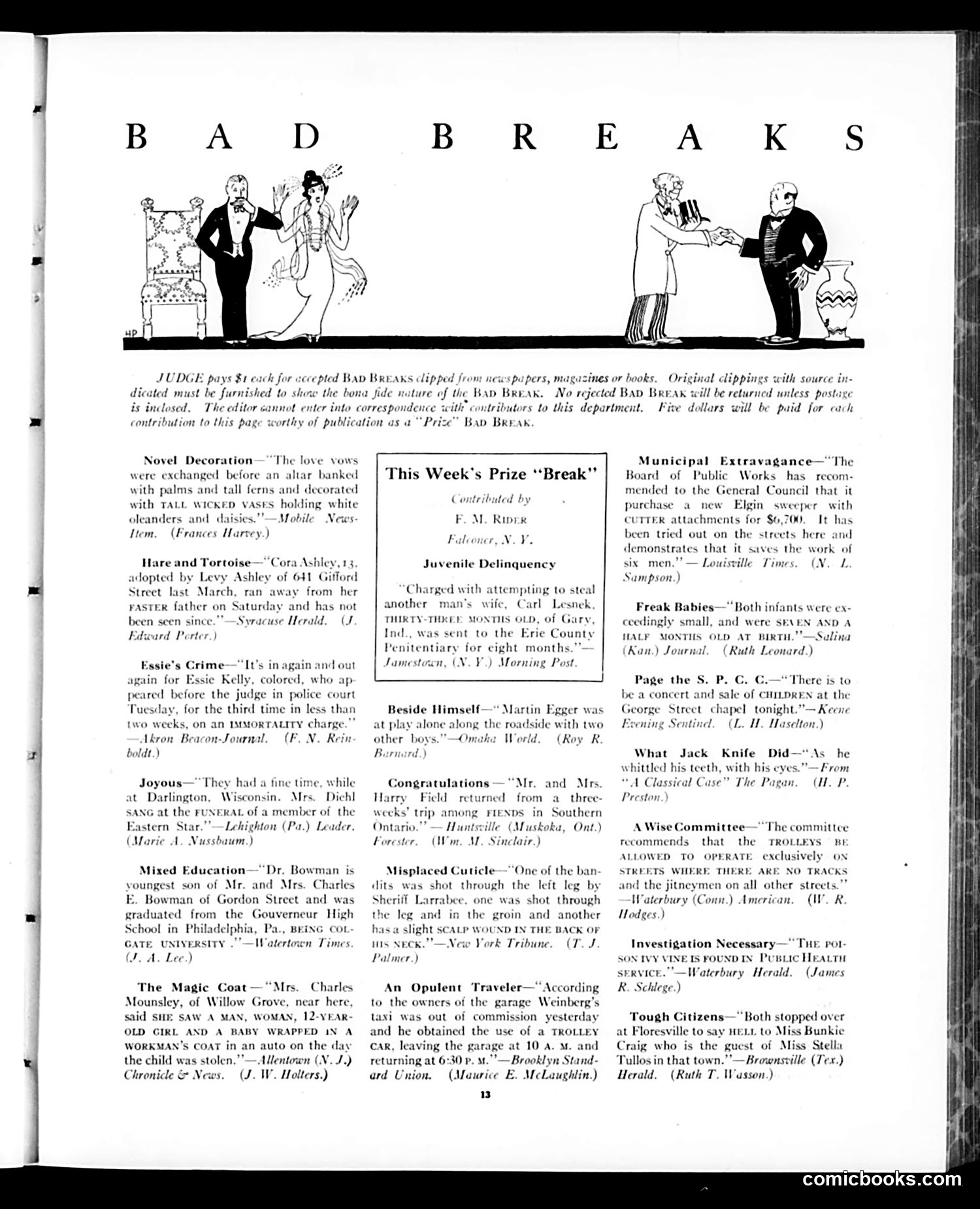
This page from *Judge* magazine is a compilation of unintentional newspaper humor—real clippings containing awkward phrasing or accidental double entendres. Judge paid $1 for each accepted submission. The cartoon at the top illustrates the concept: editors and publishers discover embarrassing errors in print. The "Bad Breaks" themselves are absurdist newspaper excerpts where garbled wording creates unintended comic meanings. For example: - "Cora Ashley...ran away from her **faster** father" (likely "foster") - A child was "**wrapped in a workman's coat**" (suggesting kidnapping humor) - Congratulating someone for a trip where people sang "at the **funeral**" - A man charged with attempting to steal another's wife when **33 months old** The humor relies on readers spotting how careless editing or typographical errors made respectable newspapers sound ridiculous or scandalous. It's satire of journalistic sloppiness—a recurring feature mocking poor editorial oversight.
This is primarily a **text-heavy editorial** rather than a cartoon page, reflecting post-WWI American sentiment circa 1919-1920. **Main Arguments:** The editors celebrate economic recovery after wartime government control, particularly regarding railroads. They credit deregulation for restored business activity and claim labor-management disputes have been resolved fairly. **Social/Political Context:** The piece criticizes **unionized labor**, specifically targeting radical and foreign-born union elements. It references the **Brooklyn Rapid Transit strike**, where unions allegedly violated contracts and bylaws under pressure from "strong-armed" radical members. **The Satire's Point:** Judge presents an optimistic, pro-business narrative: Germany's threat is dismissed as fiction, inflation is "weakening," and the real problem is militant labor organizing—not capital interests. The editors frame radical unionists as un-American and criminal while portraying management as reasonable. **For Modern Readers:** This reflects the "Red Scare" era's anti-labor, anti-radical sentiment, blaming immigrant and radical elements rather than examining legitimate worker grievances or structural economic issues.
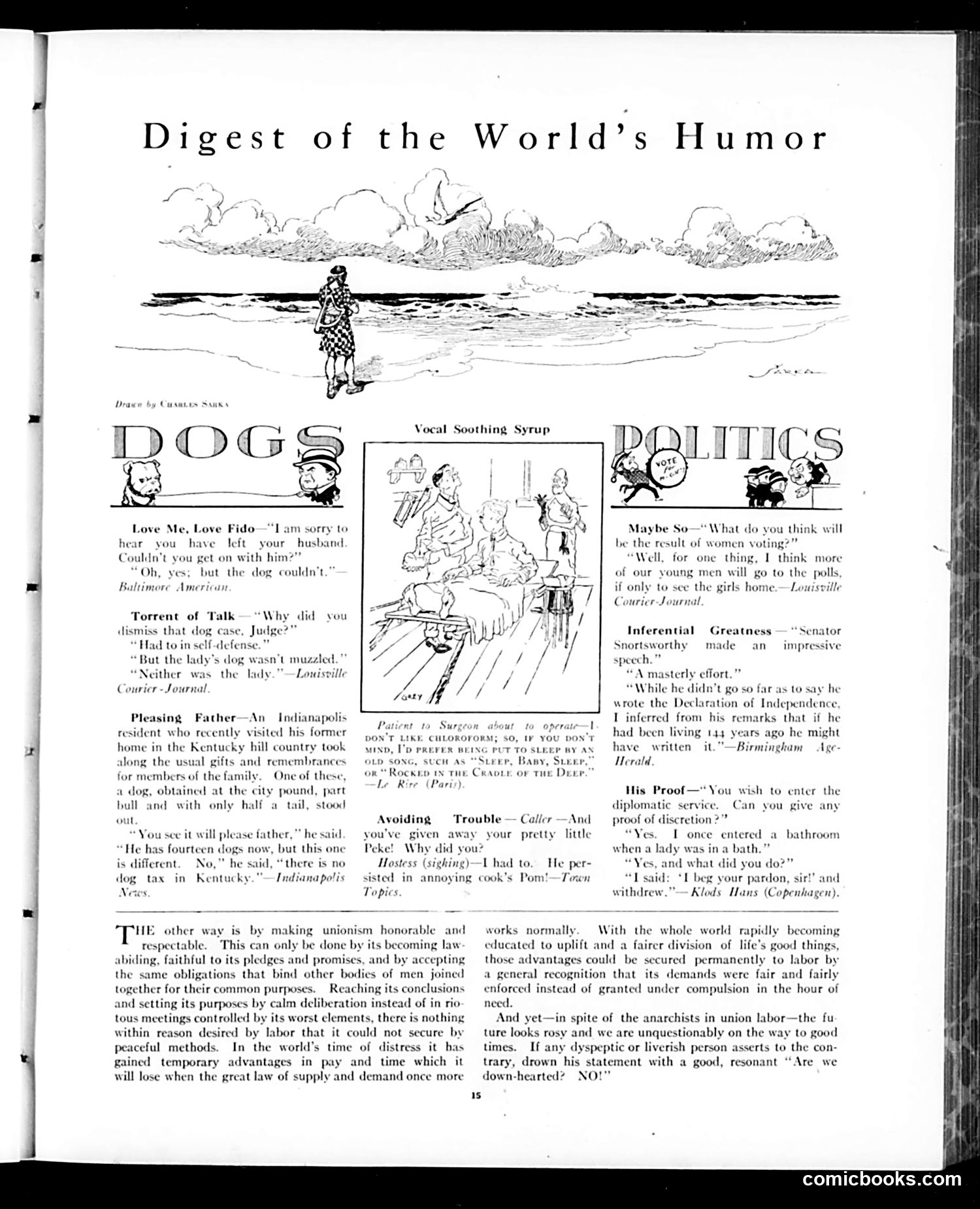
This page collects brief humorous anecdotes and jokes arranged around a central illustration of a woman at the beach. The humor targets social conventions of the era: **The jokes** play on marital discord ("Love Me, Love Fido"), legal absurdity (a dog case dismissed because the *lady* wasn't muzzled), and gender dynamics (women voting will increase male poll attendance solely to escort girls home). **The central cartoon** depicts advice about avoiding "chloroform"—likely a sleeping aid—with the caption suggesting if you don't wish to sleep by it, avoid it entirely, a play on Victorian prudishness about such substances. **The longer essay** at bottom advocates for labor unionization becoming "respectable" through peaceful, lawful methods rather than "riotous meetings." It reflects early 20th-century debates over labor rights versus anarchist/radical union tactics. Overall, the page reflects Judge's satirical approach: mocking Victorian social pretensions, gender relations, and contemporary labor politics through short, punchy comedy.
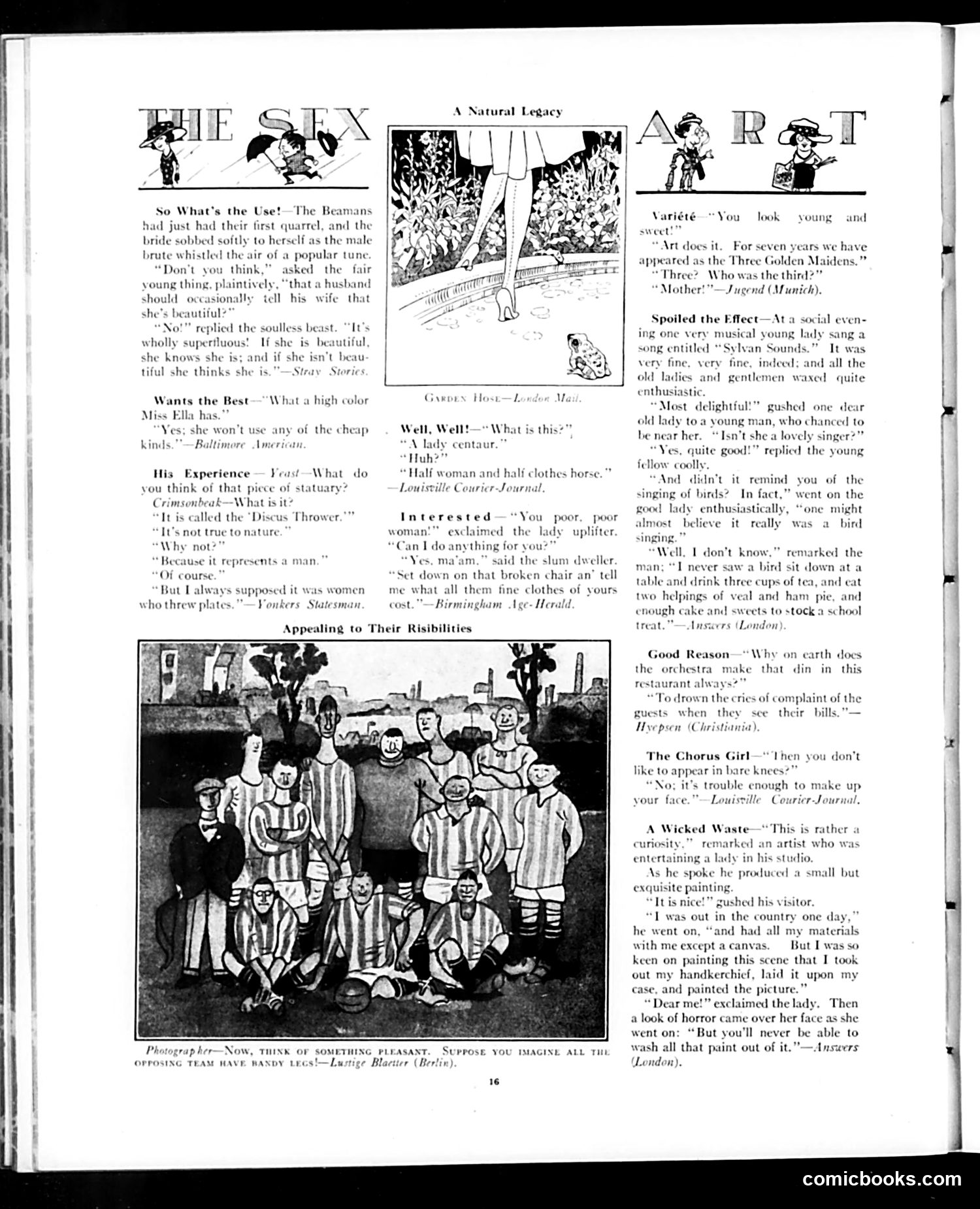
This page from *Judge* magazine presents multiple brief satirical anecdotes mocking gender relations and social pretenses of the era. **Main themes:** The opening strips ridicule newlywed dynamics—a husband's dismissal of compliments to his wife, a woman's materialistic standards for suitors, and the gap between artistic ideals and reality (a statue titled "The Dishes Thrower" that "isn't true to nature"). **The central photograph** shows a sports team, captioned to humorously suggest the opposing team has "brandy legs"—a crude joke about athletic performance or drunkenness. **Other anecdotes** mock: a society woman's affected singing compared to a bird eating pie, a "slum dweller" wanting fine clothes, an artist painting with a handkerchief instead of canvas, and a lady horrified at the impracticality of his work. **Overall satire:** These pieces lampoon pretension, materialism, gender stereotypes, and the gap between artistic/social ideals and messy human reality—typical *Judge* fare mocking American society's affectations and hypocrisies.
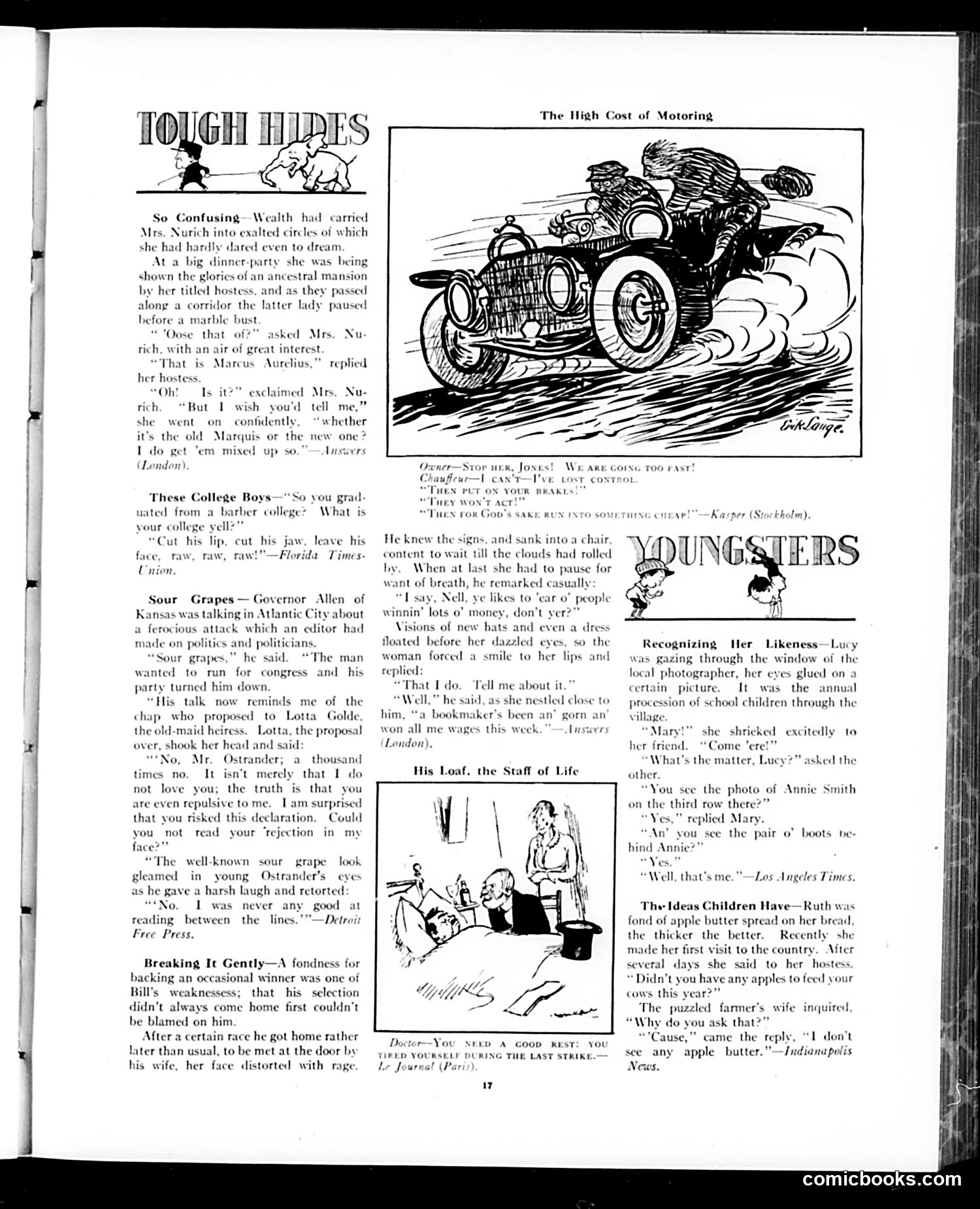
This page from the satirical magazine Judge contains several humor pieces mocking social pretension and marital dynamics of the early 20th century. **"So Confusing"** ridicules nouveau-riche Mrs. Nurich's ignorance: she mistakes the classical bust of Marcus Aurelius for a contemporary nobleman, revealing her unfamiliarity with high culture despite entering wealthy circles. **"These College Boys"** and **"Sour Grapes"** are brief jokes about disappointment and social rejection. **"The High Cost of Motoring"** (top cartoon) satirizes early automobile dangers—the driver has lost brake control, suggesting cars are unreliable and perilous, a timely concern when automobiles were still novel and mechanically unreliable. **"His Loaf, the Staff of Life"** depicts a doctor recommending rest to an exhausted man. **"Recognizing Her Likeness"** and **"The Ideas Children Have"** are gentle anecdotes about children's misunderstandings and innocent mistakes. The overall theme emphasizes class anxieties, marital friction, and the disorienting modernity of new technology like motorcars.
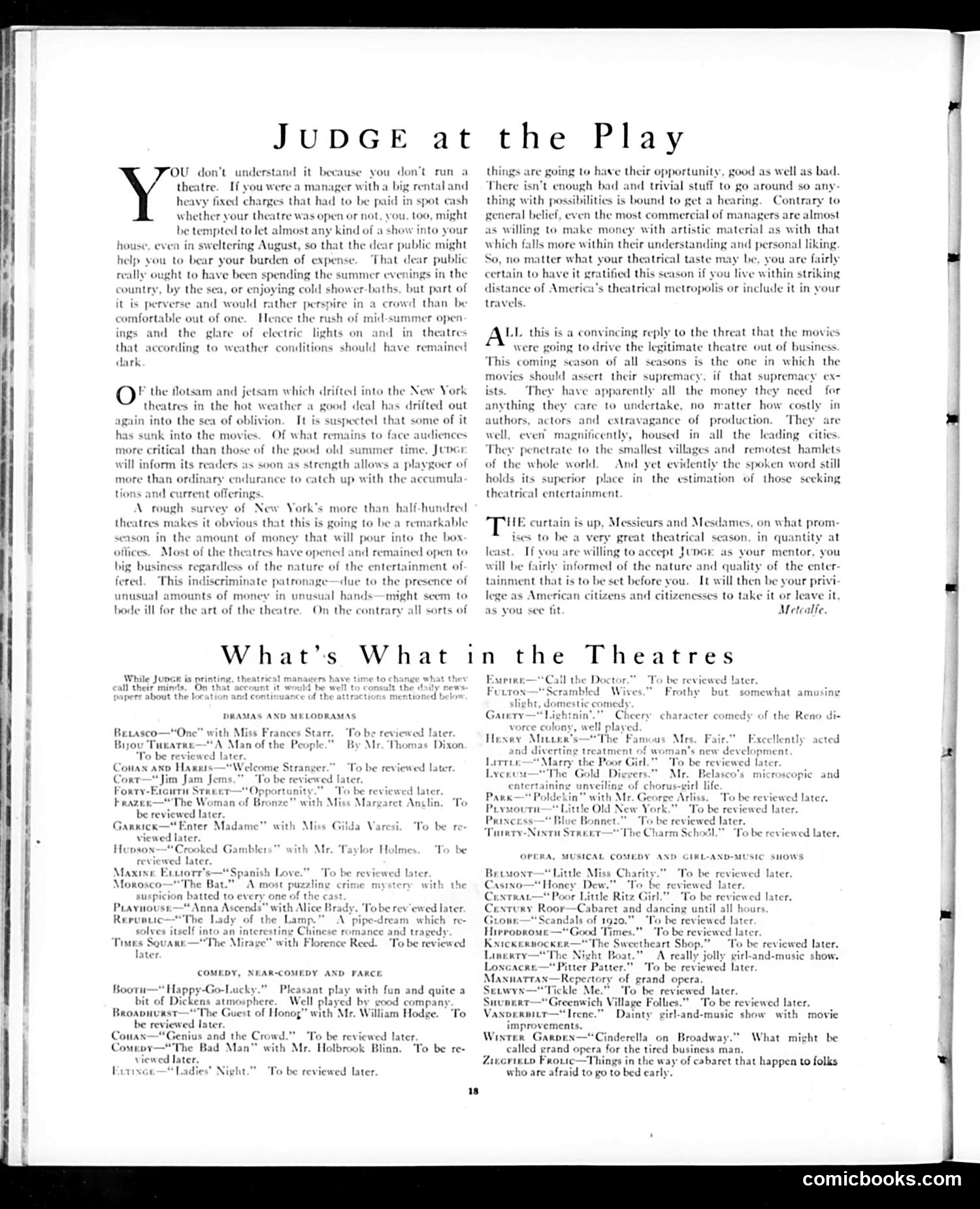
This article is an editorial defending theatrical managers against criticism for putting on mediocre shows during hot summer months. The author argues that theater owners, burdened by heavy fixed costs, must fill seats regardless of production quality—even if audiences should logically prefer the countryside or cool showers. The piece addresses a contemporary anxiety: **movies were threatening live theater's dominance**. The author notes that bad summer theater productions "drift into the movies," and claims (unconvincingly) that despite this competition, the coming season will be "remarkable" because even marginal theatrical material gets staged. The accompanying theater listings occupy the lower half, cataloging current Broadway offerings across categories (dramas, comedies, musicals) to be reviewed. The satire's target: theater managers' economic desperation during off-season months, their willingness to present anything profitable, and the implicit weakness of live theater facing cinema's challenge—all masked by reassuring rhetoric about artistic opportunity.
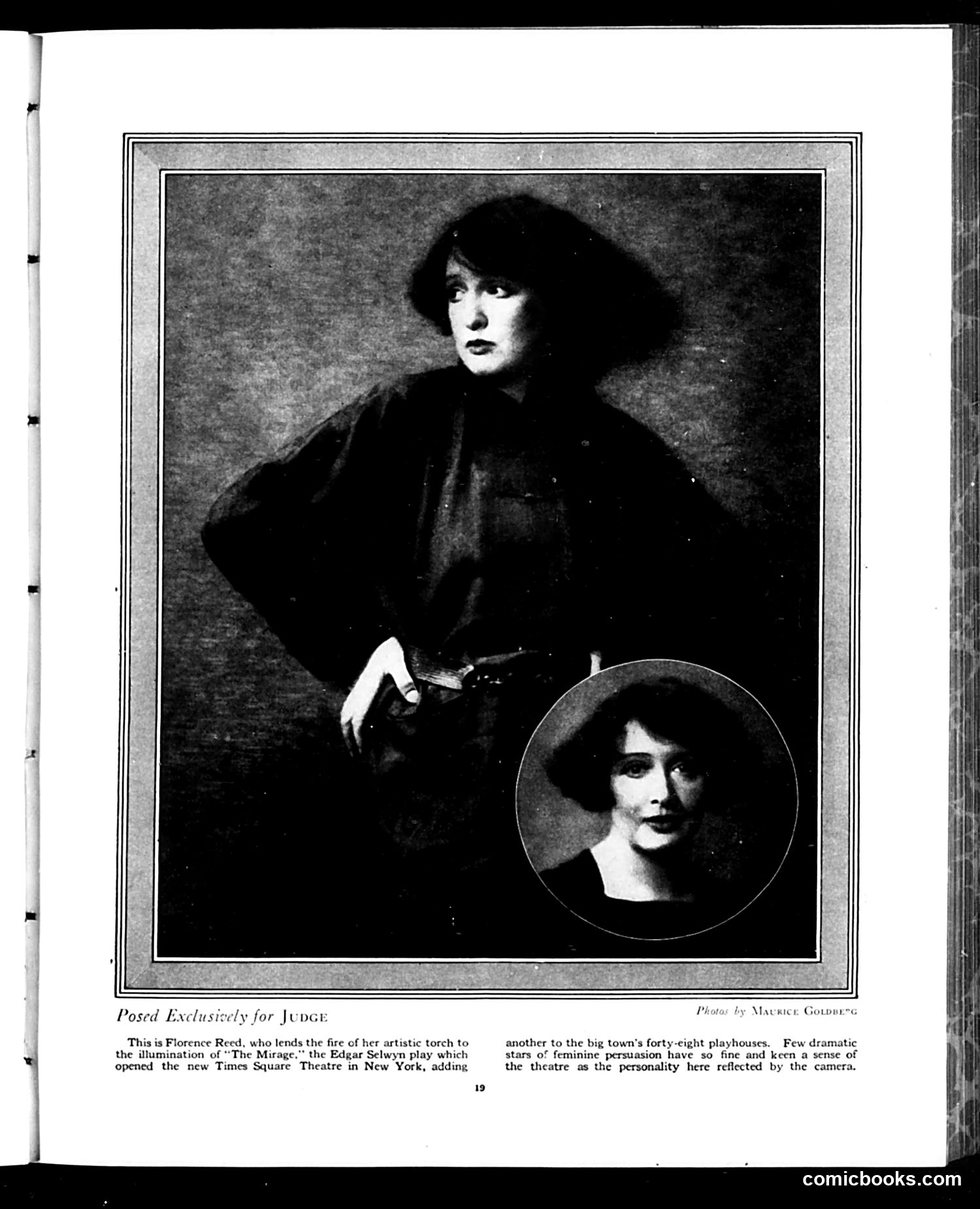
This is a theatrical photograph rather than a political cartoon. It features Florence Reed, a dramatic actress, posed for *Judge* magazine to promote her starring role in "The Mirage," an Edgar Selwyn play that opened the new Times Square Theatre in New York. The accompanying text praises Reed's artistic talent and her ability to illuminate theatrical productions, suggesting she was a notable stage performer of the era. The inset circular portrait offers a closer view of her face. The piece celebrates her as one of the few dramatic actresses with refined sensibility and strong understanding of theatrical personality—essentially promotional content celebrating a Broadway star, not satirical commentary.
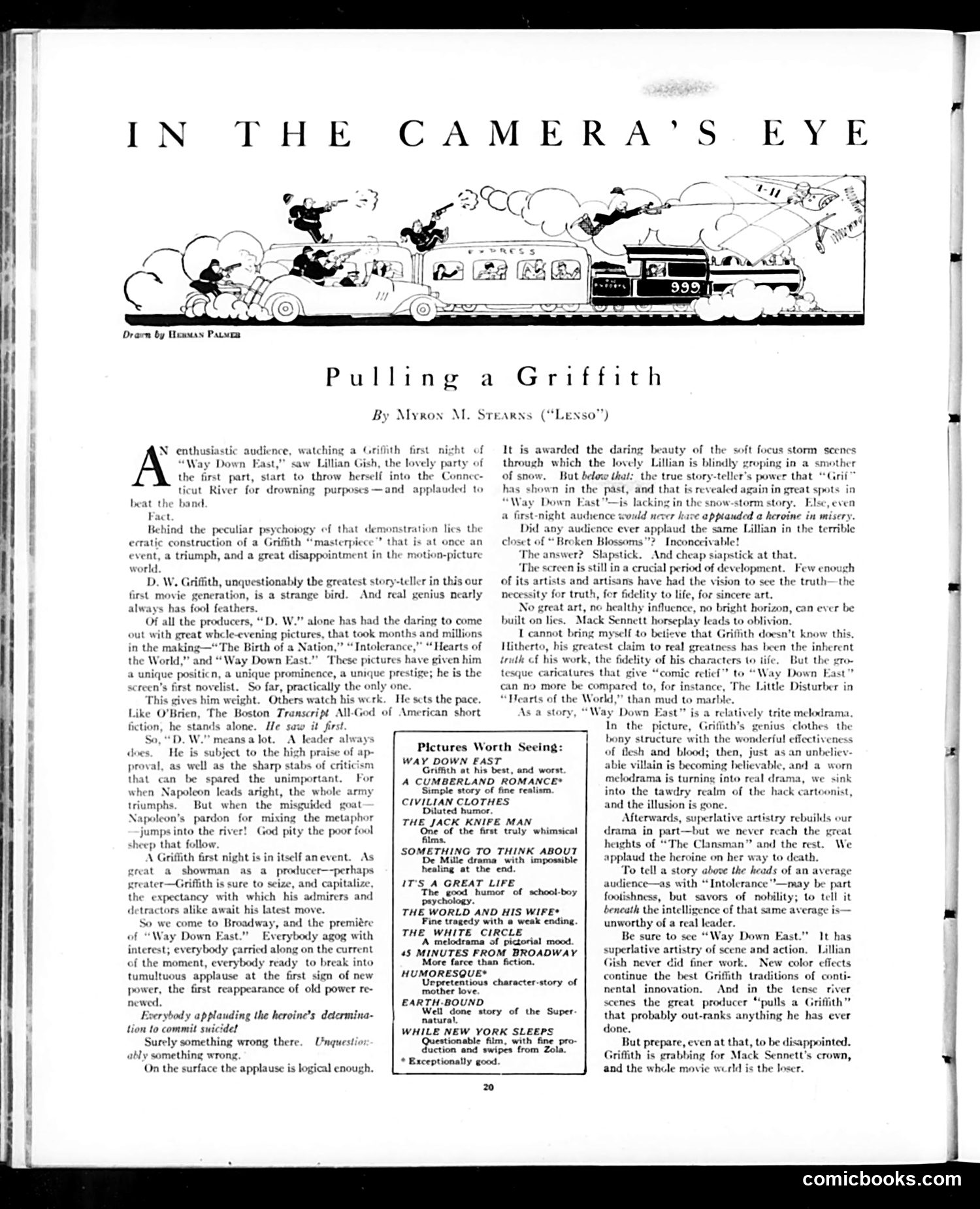
This article critiques director D.W. Griffith's film *Way Down East*, which premiered with a famous scene of actress Lillian Gish threatened with suicide (jumping into an icy river). The satire targets the incongruity between what audiences *should* feel and what they actually applaud. **The Point:** At the premiere, the audience enthusiastically applauded Gish's character's suicide attempt—a morally problematic response. The author argues this reveals a fundamental flaw in Griffith's storytelling: he manipulates audiences into celebrating destructive behavior through technical spectacle (soft-focus cinematography, dramatic staging) rather than genuine emotional truth. **The Satire:** Griffith, positioned as cinema's greatest "novelist," is simultaneously mocked for his erratic genius—compared to a brilliant but foolish military leader. The applause for suicide becomes the damning proof that his artistry serves mere sensation over substance, revealing the audience (and by extension, Griffith) as morally confused. The piece represents early film criticism wrestling with cinema's power to emotionally manipulate viewers.
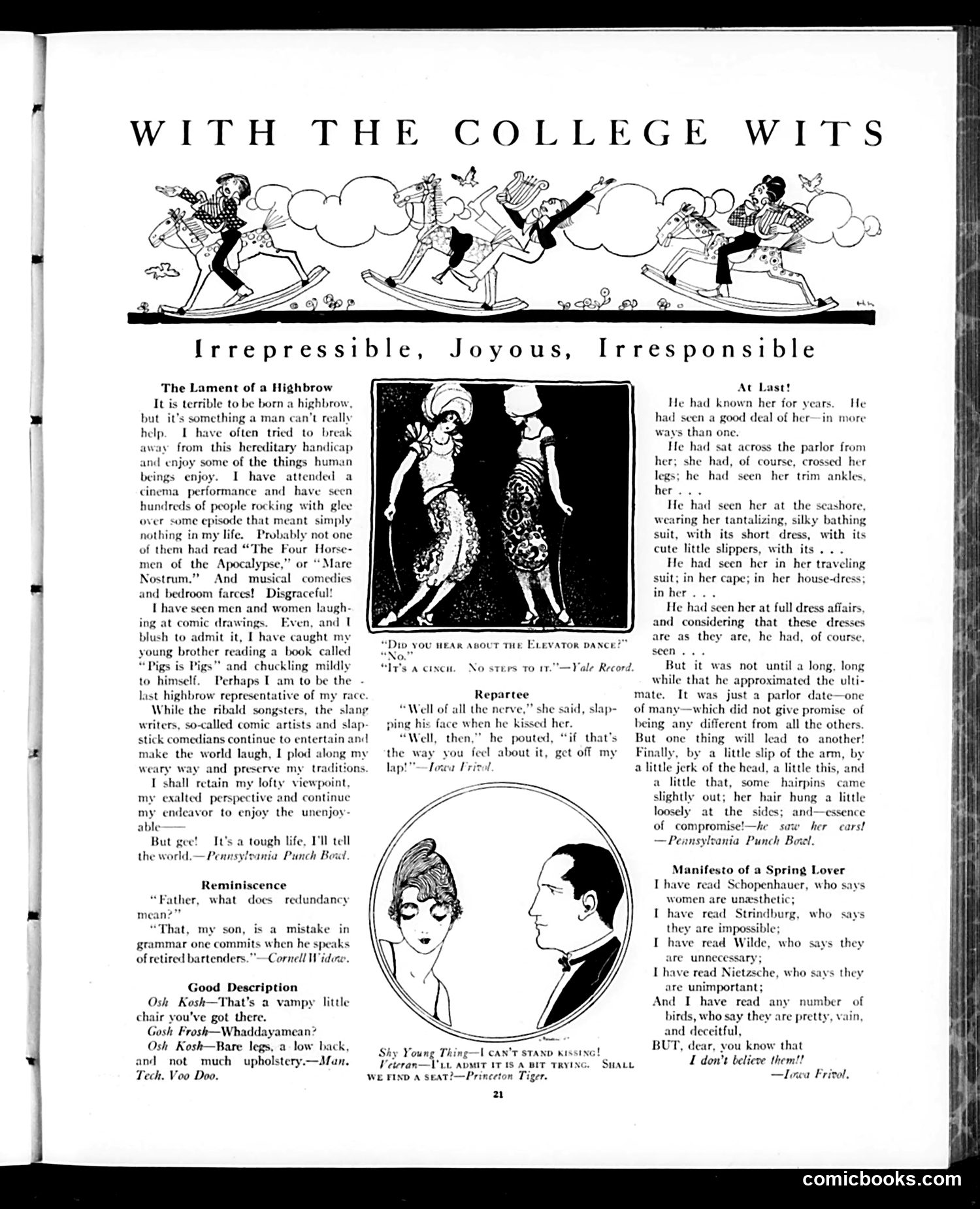
This page collects humorous college-themed content mocking intellectual pretension and courtship customs of the 1920s era. **"The Lament of a Highbrow"** satirizes educated snobs who disdain popular entertainment (cinema, comic strips, musical comedies) that ordinary people enjoy, yet feel trapped by their own superior tastes. The writer admits to being "the last highbrow representative of my race"—a self-aware joke about elitist alienation. **"At Last!"** uses extended innuendo to describe a young man's gradual intimate progress with a woman over years, climaxing when he finally sees her ears with her hair slightly loose—a risqué joke for the era about achieving physical closeness. The shorter pieces mock campus dating rituals: the "Elevator Dance" (unclear reference), complaints about physical discomfort from revealing fashions ("Osh Kosh" chair joke), and the contrast between philosophical arguments against women (Schopenhauer, Nietzsche, Wilde) and romantic desire. The tone throughout is lighthearted mockery of both highbrow pretension and youthful romantic fumbling.
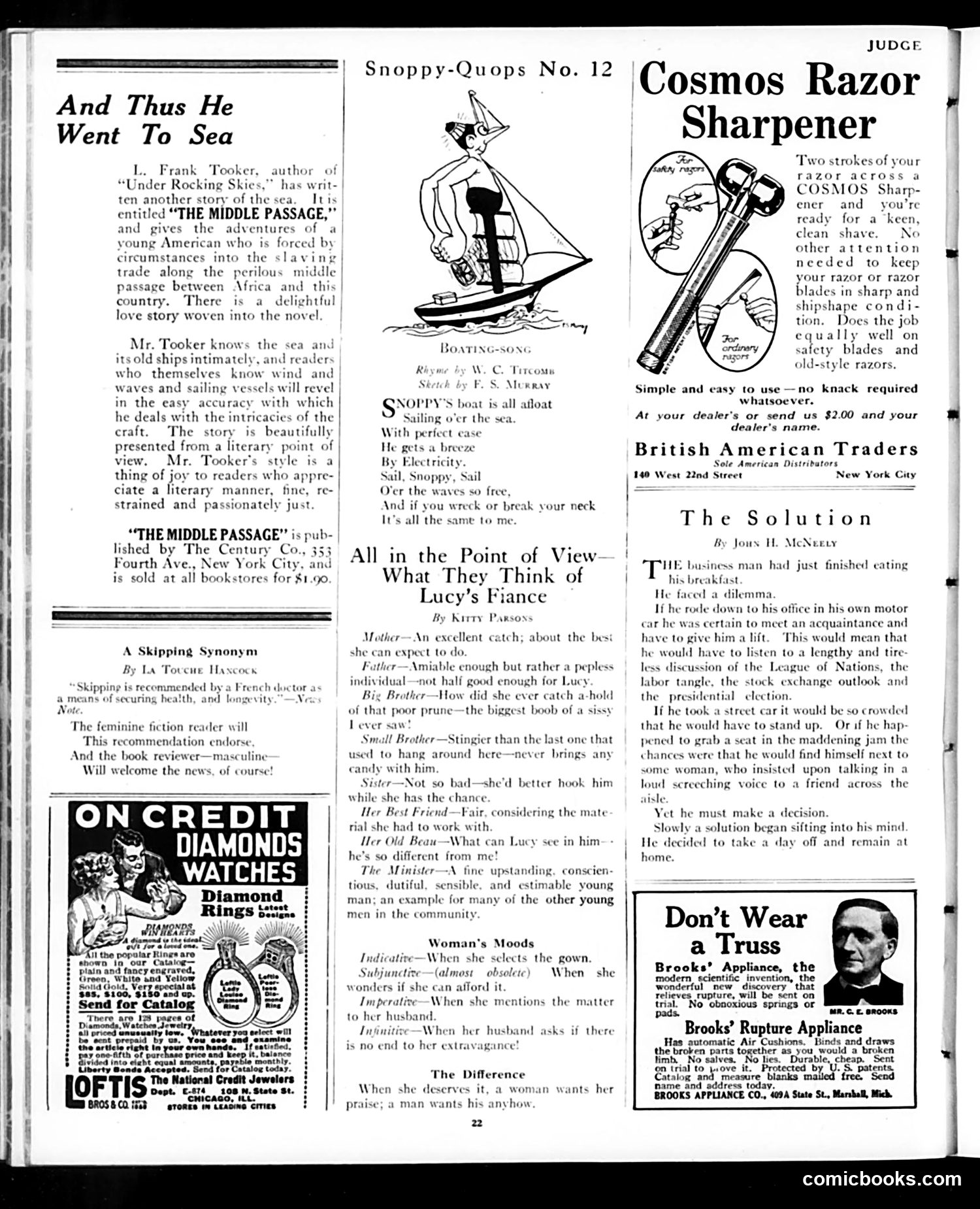
This page is primarily **advertising and light humor** rather than political satire. The "Snoppy-Quops" cartoon depicts a whimsical character sailing a boat powered by electricity rather than wind—a joke about modern technology replacing traditional methods. The accompanying verse is lighthearted nonsense. The "Woman's Moods" section uses grammatical terminology (indicative, subjunctive, imperative) as a framework for spoofing female behavior around shopping and spending—a common early-20th-century trope portraying women as indecisive about purchases but demanding with husbands about expenses. "All in the Point of View" satirizes how different family members judge Lucy's fiancé through their own prejudices and interests (mother sees status, brother sees stinginess, clergy sees moral virtue). The advertisements dominate: diamond jewelry on credit, a razor sharpener, and appliances—typical consumer goods marketing of the era. The page reflects Judge's dual purpose as both satirical commentary and commercial vehicle for the advertising-dependent magazine industry.
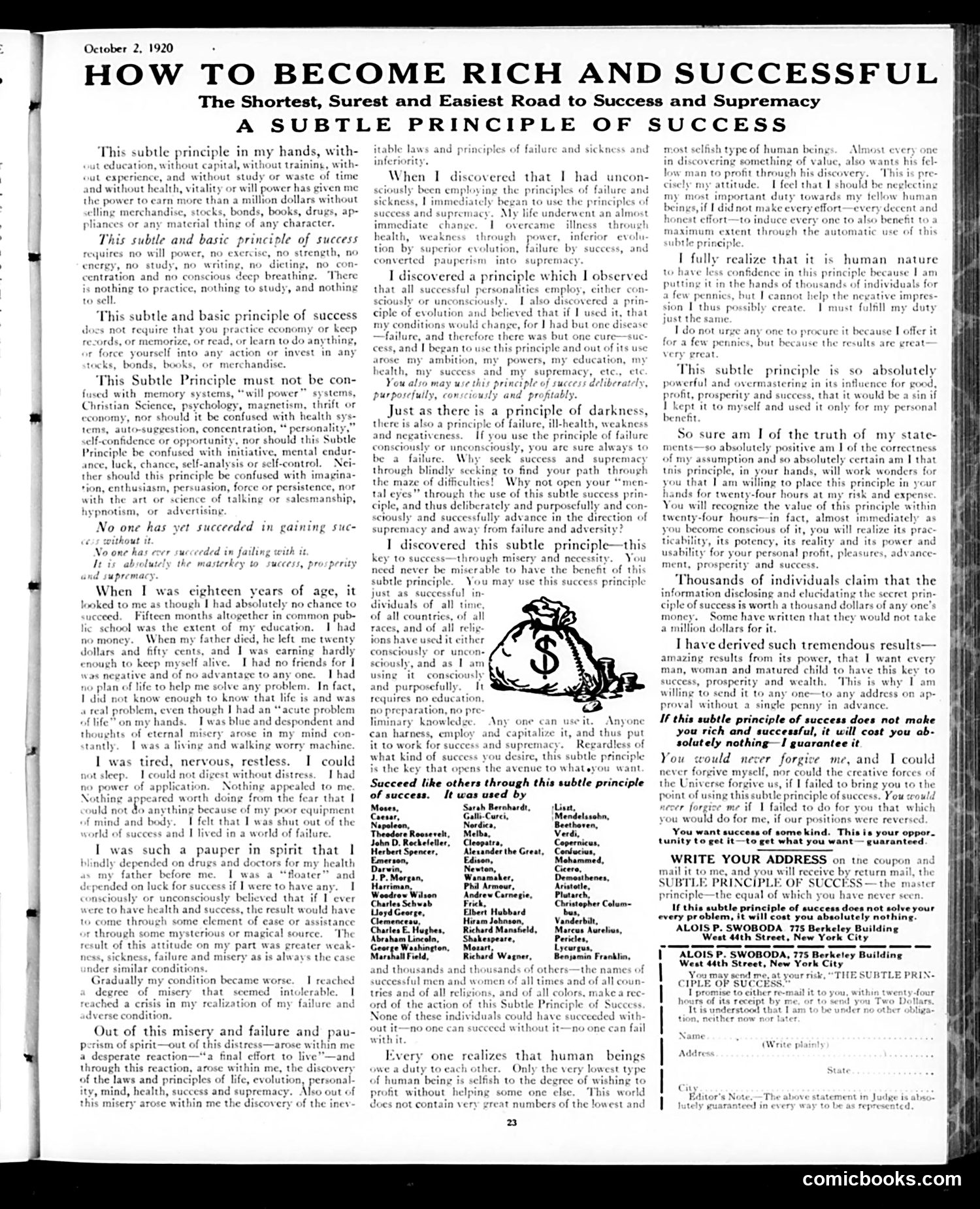
This appears to be **satirical self-help parody**. The advertisement mocks the explosion of mail-order success manuals and prosperity schemes that flooded America in the early 20th century. The humor lies in the **contradiction between promises and delivery**: the author repeatedly claims his "subtle principle" requires absolutely no effort, study, practice, money, health, or intelligence—yet simultaneously insists it made him wealthy. The text circles back obsessively to what the principle *isn't* (work, willpower, education, concentration) without ever clearly stating what it *is*. The money-bag illustration reinforces the joke: this is essentially a pitch for nothing disguised as everything. **Context**: Post-WWI America saw an explosion of dubious "success literature." Judge satirizes how these con-artists marketed impossible claims to desperate people seeking quick wealth without effort—a timeless American con that remains relevant today. The solicitation at bottom requests readers mail in for "the master principle"—completing the satire by mimicking actual fraudulent mail schemes.
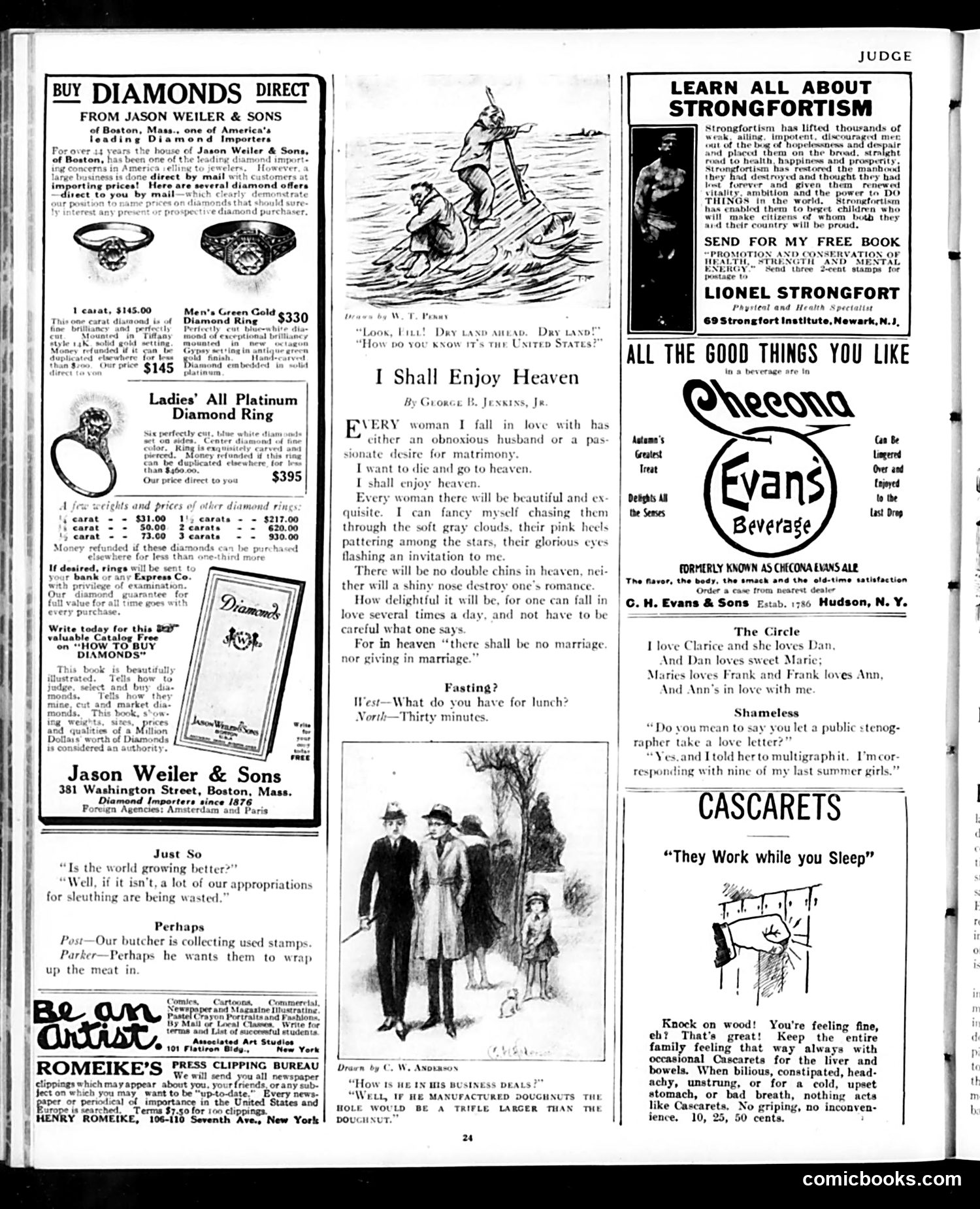
This page is primarily **advertising and light humor** rather than political satire. The content includes: **Main Cartoons:** Two small illustrated jokes appear—one showing figures in water (artist: W.F. Posey), another depicting businessmen (artist: C.W. Anderson). These illustrate brief written gags about "dry land" and manufacturing doughnuts, typical of Judge's gentle, topical humor. **Literary Content:** A poem titled "I Shall Enjoy Heaven" by George B. Jenkins, Jr., satirizes women's romantic fantasies about the afterlife—a common turn-of-the-century literary trope mocking female sentimentality. **Dominant Feature:** The page is overwhelmingly filled with **advertisements**—for diamonds, Chicora beverage, Cascarets laxative, and various services. This reflects Judge's business model as a commercial publication. **Historical Context:** The ads reveal period concerns: diamond purchasing by mail, "Strongfortism" (a bodybuilding/self-improvement trend), and laxatives (common ailments of the era). The overall tone is lighthearted rather than incisive political commentary.
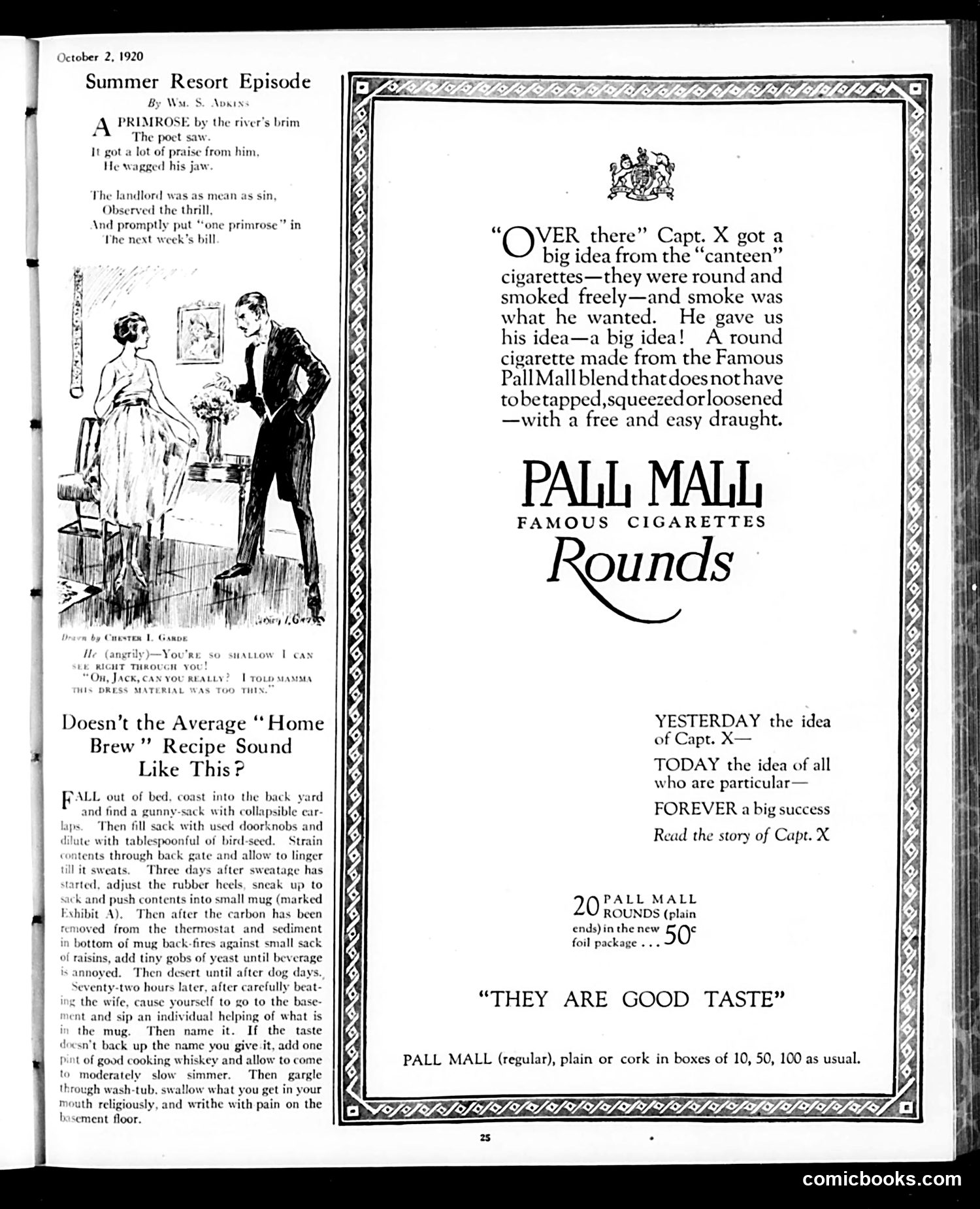
This page mixes satirical humor with advertising during Prohibition (1920-1933). The "Summer Resort Episode" cartoon depicts a flirtation between a man and woman at a resort, with a crude joke about the woman's "shallow" nature—typical period humor about gender dynamics. The main satirical piece, "Doesn't the Average 'Home Brew' Recipe Sound Like This?", mocks Prohibition-era home alcohol production. It presents an absurd, deliberately disgusting "recipe" involving doorknobs, bird-seed, and thermostat carbon—satirizing the dangerous and crude bootleg liquor many Americans were making illegally during the alcohol ban. The rest is advertising for Pall Mall cigarettes, promoting their new round "Rounds" product. The cigarette ads capitalize on the Prohibition context; with alcohol banned, cigarette companies aggressively marketed their products as legal alternatives. The ads emphasize the cigarettes' ease of use and quality, appealing to consumers seeking accessible pleasures.
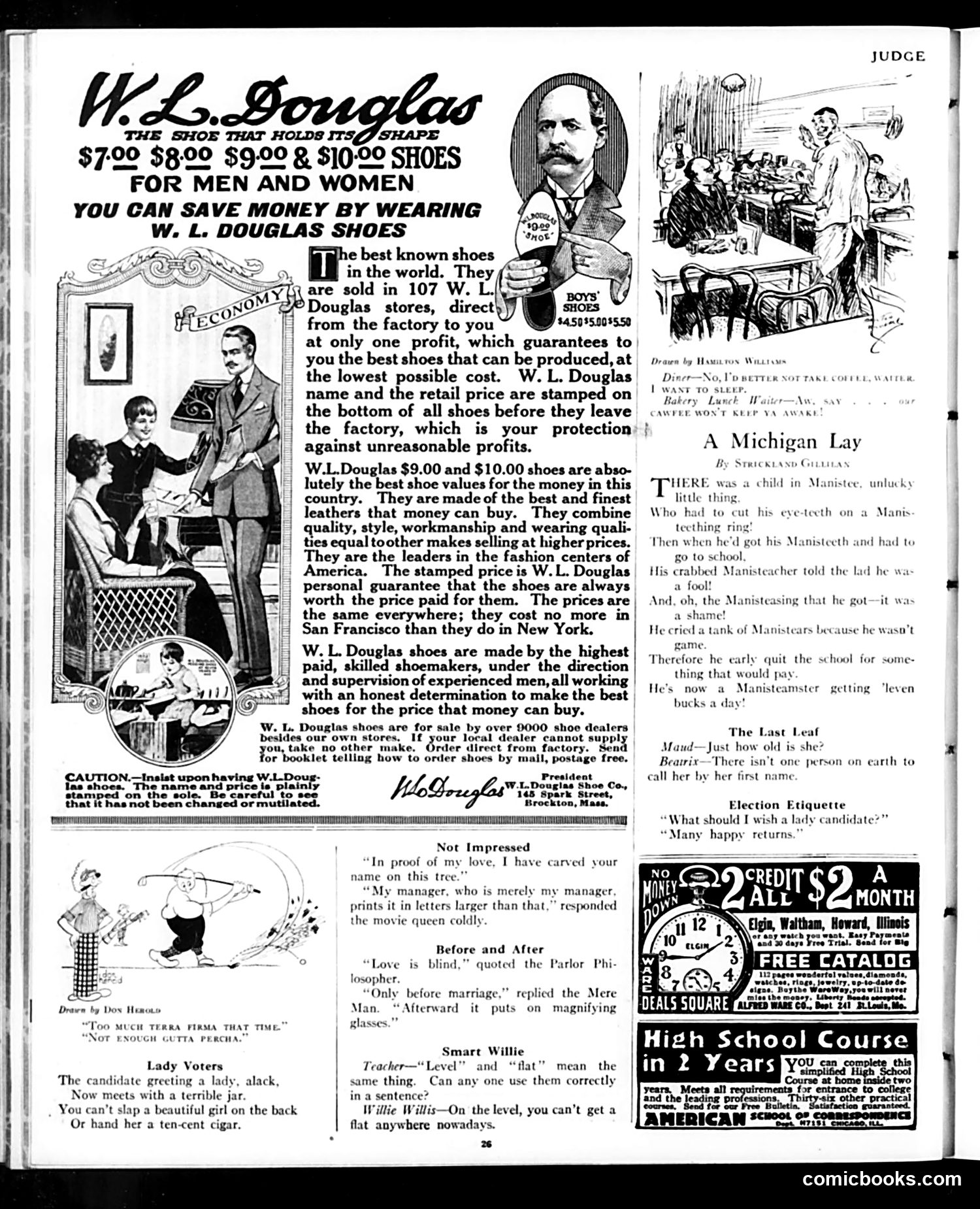
This page is primarily a **W.L. Douglas shoe advertisement** with several small humorous sidebar comics. **The Main Ad:** Promotes W.L. Douglas shoes ($7-$10 range) emphasizing value and factory-direct pricing that undercuts middlemen profits. The ad features a well-dressed man with two children, appealing to middle-class consumers concerned about getting honest value. **The Small Comics:** - **"Not Impressed"**: A movie actress dismisses her manager's romantic gesture—satire of celebrity vanity and theatrical affectation. - **"Before and After"**: A joke about marriage destroying romance through literal magnification—common domestic humor of the era. - **"Smart Willie"**: A student's witty non-answer about "flat" and "level" meaning rent prices won't rise—typical "clever schoolboy" humor. - **"Michigan Lay"**: Regional wordplay about a Manistee, Michigan boy who's unlucky (cutting teeth, called a fool, mocked), quits school, and becomes a teamster earning "eleven bucks a day." - **"Lady Voters"**: Brief joke about election etiquette toward female political candidates—reflecting early 20th-century confusion over women's new voting rights.
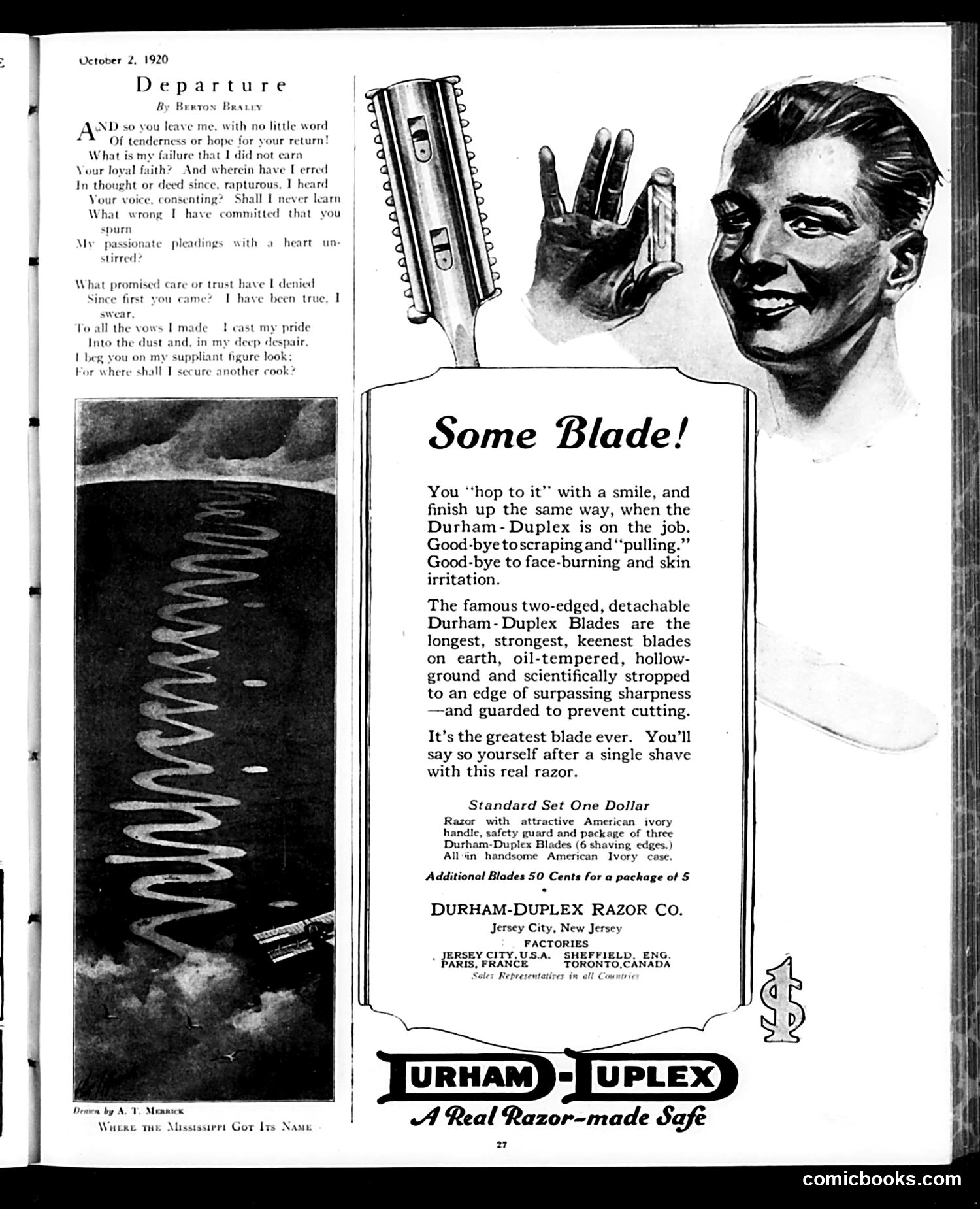
This page combines a poem with a razor advertisement. The poem "Departure" depicts a man pleading with a woman to stay, claiming he's been faithful and devoted—but the punchline reveals he's actually begging his cook not to leave him ("For where shall I secure another cook?"). The satire mocks domestic dependency: a man's theatrical romantic language masks his real concern—losing household staff. It's a commentary on male entitlement and the help crisis of the post-WWI era, when domestic servants were increasingly scarce and demanding better wages. The adjacent Durham-Duplex razor advertisement is unrelated thematically, promoting safety razors with detachable blades at one dollar—a standard commercial appeal to efficiency and comfort. The cartoon on the left (titled "Where the Mississippi Got Its Name") remains unclear without better image resolution, though the spring/coil imagery suggests industrial or engineering humor.
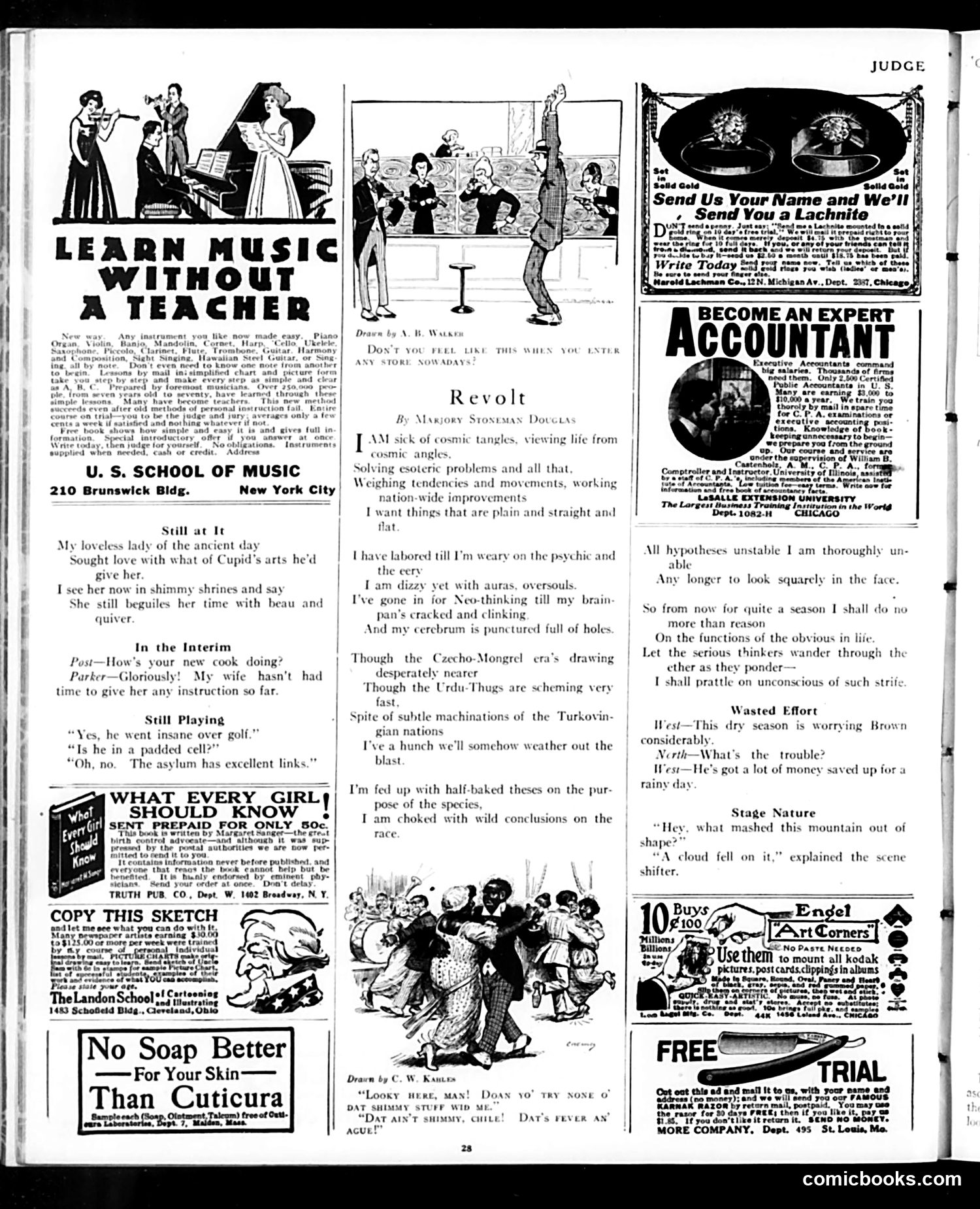
This is primarily an **advertising page** with one substantial literary contribution. The main content is a poem titled "Revolt" by Marjory Stoneman Douglas, expressing post-World War I disillusionment. The speaker rejects abstract intellectualism—"cosmic tangles," psychic theories, "Neo-thinking"—and yearns for simple, direct experience instead. References to "Czecho-Mongrel era," "Urdu-Thugs," and "Turkavingian nations" appear to be satirical inventions mocking the era's obsession with geopolitical complexity following WWI. The page features several cartoons and humor pieces (with racial dialect humor typical of the period) alongside period advertisements for music lessons, accounting courses, and consumer products. The visual cartoon at page bottom depicts a domestic scene with exaggerated dialect, common to Judge's style of the era. The satire's point: post-war intellectual exhaustion—a modern reader should understand this as reflecting genuine cultural fatigue with the complexities that emerged after 1918.
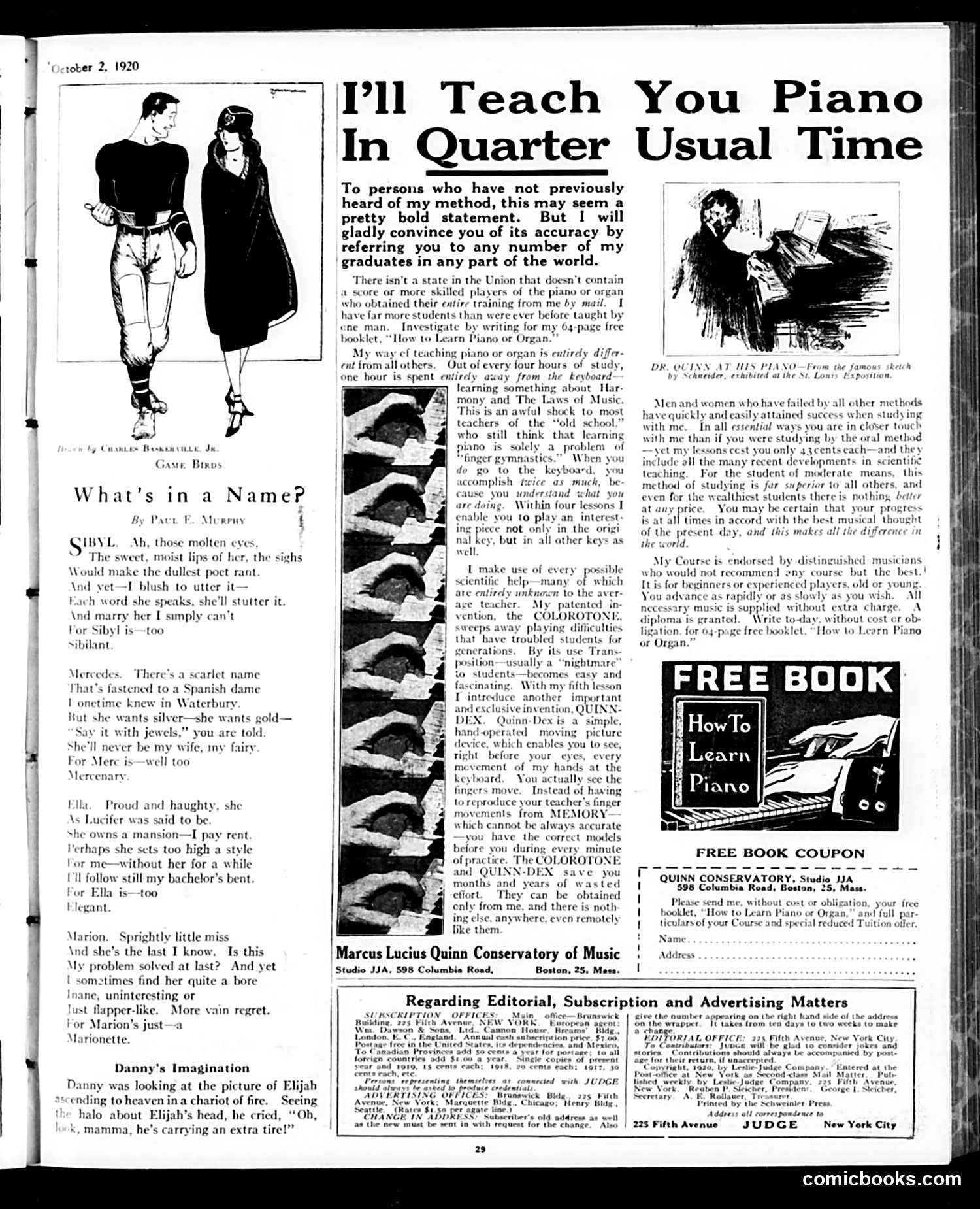
This page contains two distinct pieces of content: **"What's in a Name?" (poem by Paul F. Murphy):** A light satirical poem playing on women's names to mock their personalities. Each stanza uses a woman's name to create a pun about her character flaw—Sibyl is "sibilant" (lisps), Mercedes is "mercenary" (greedy), Ella is "elegant" (snobbish), and Marion is a "marionette" (puppet-like). The humor relies on wordplay targeting stereotypical female flaws, typical of 1920s magazine humor. **"Danny's Imagination":** A brief joke about a boy misinterpreting a biblical illustration, confusing Elijah's halo in a chariot of fire with his mother carrying "an extra tire" (spare car tire). This plays on children's misunderstandings of religious imagery. The remainder is advertising for Marcus Lucius Quinn's piano correspondence course, claiming to teach piano in "quarter usual time" using patented inventions (Colorotone and Quinn-Dex). This appears to be genuine advertising rather than satire.
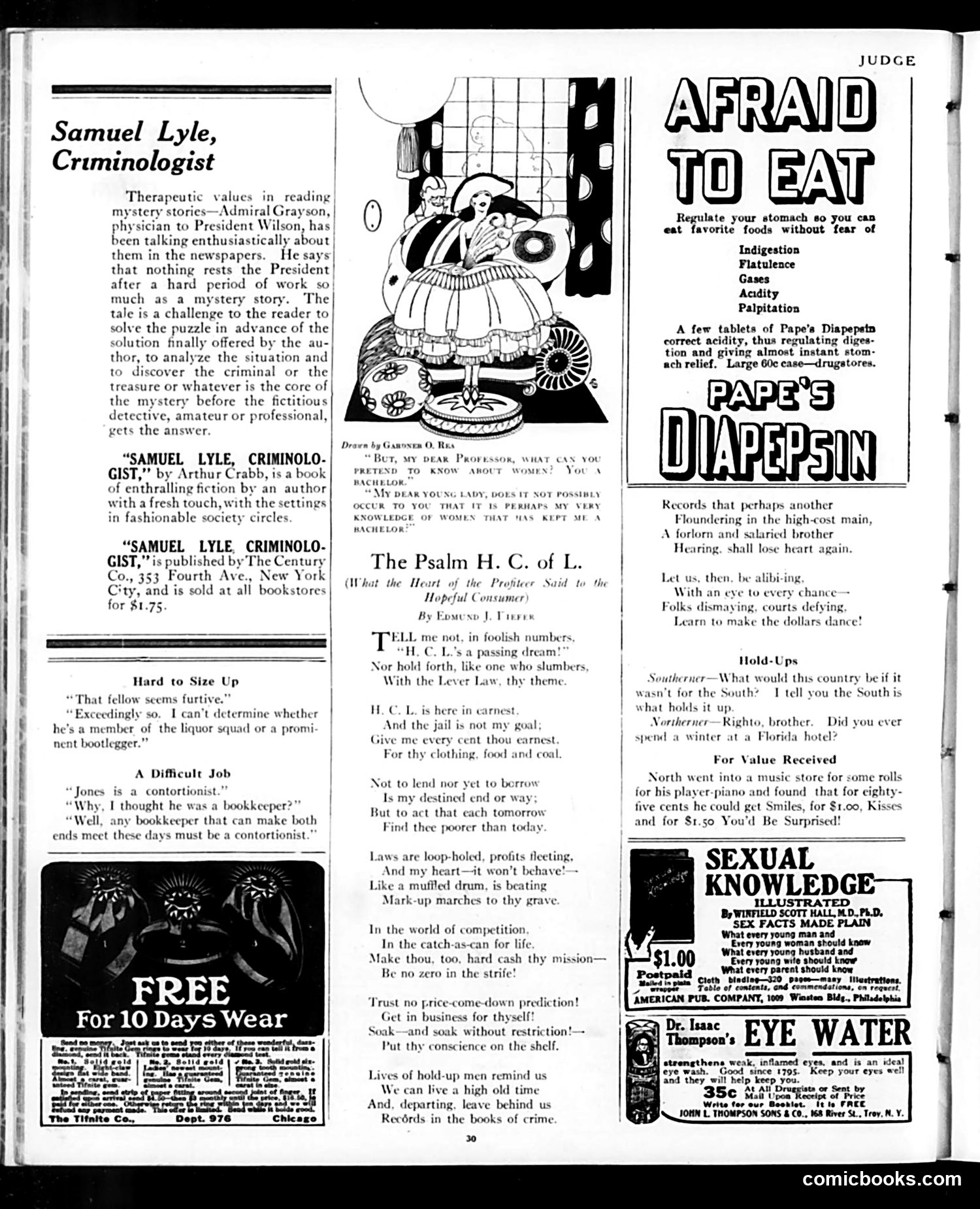
This page from *Judge* satirizes several aspects of 1920s American life: **Upper content** promotes Arthur Crabb's mystery novel "Samuel Lyle, Criminologist," noting that President Wilson's physician recommended mystery stories as relaxation. **Three brief jokes** mock Prohibition-era confusion (liquor agents vs. bootleggers), bookkeeping during inflation, and gender dynamics. **"The Psalm H.C. of L."** is the page's main satire. "H.C. of L." refers to the "High Cost of Living"—a major 1920s economic complaint. The poem sardonically celebrates profiteering: "Make thou, too, hard cash thy mission" and "Put thy conscience on the shelf." It mocks speculators and price-gougers exploiting consumers struggling with inflation and wartime economic disruption. **Advertisements** for digestive aids, sexual knowledge guides, and eye water represent typical period patent medicines marketed to address modern anxieties. The satire targets post-WWI economic inequality and the morality of those profiting from others' hardship during difficult times.
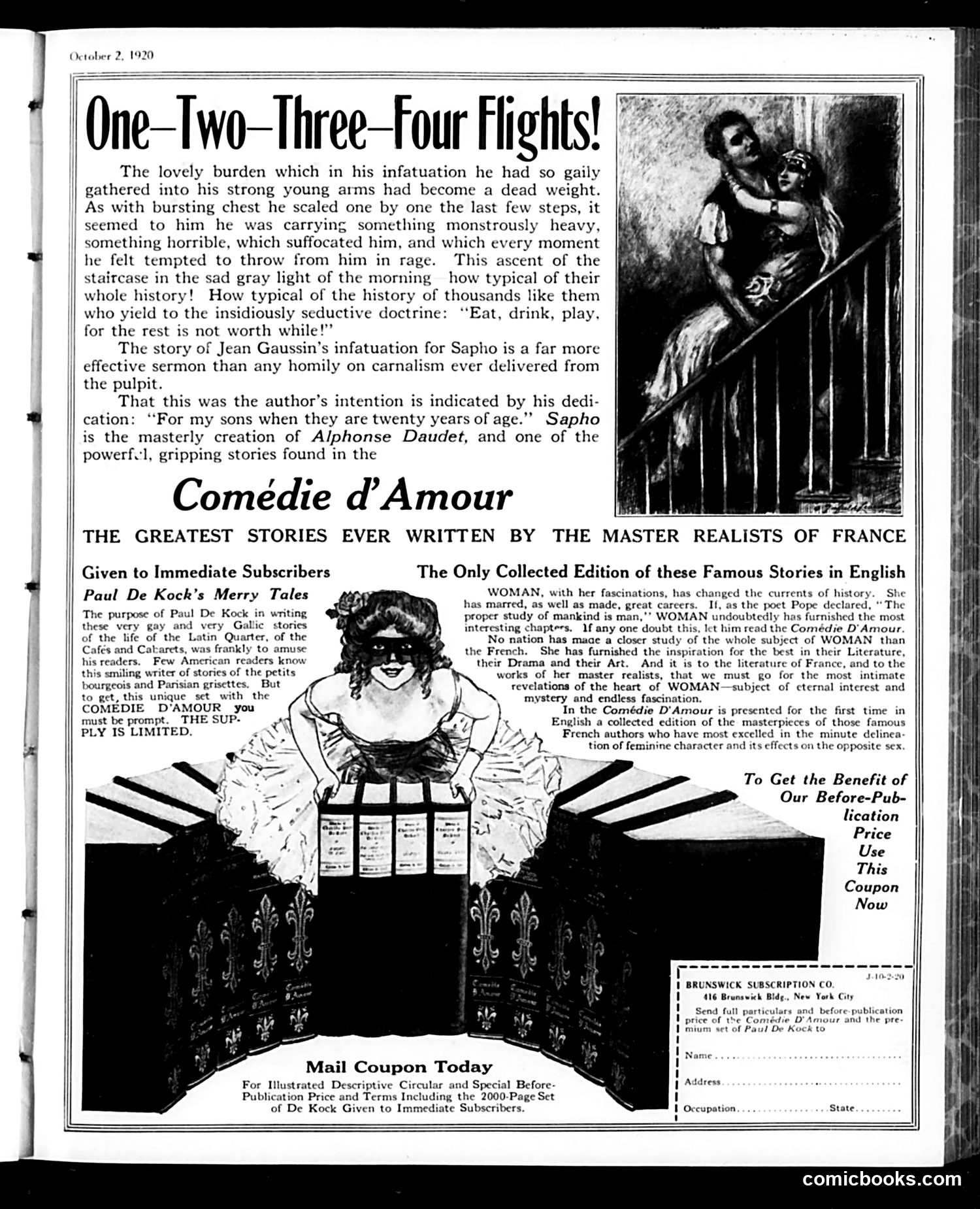
This page is primarily **advertising**, not satire. It promotes a subscription collection called *Comédie d'Amour*, featuring French realist literature. The illustrated narrative at top depicts a young man climbing stairs while carrying a woman—a scene from Alphonse Daudet's novel *Sapho*. The text frames this as a moral cautionary tale about the dangers of yielding to hedonistic philosophy ("Eat, drink, play, for the rest is not worth while"). The weight he carries symbolizes the burden of infatuation and sensual indulgence. The advertisement positions this collection as high-minded literature—stories by "master realists of France" that reveal truths about human nature, particularly feminine character. The promotional copy emphasizes that these are serious works of artistic merit, not mere entertainment, despite their focus on romantic entanglement and desire. The coupon at bottom invites immediate subscription at a "before-publication price," creating urgency through limited supply claims.
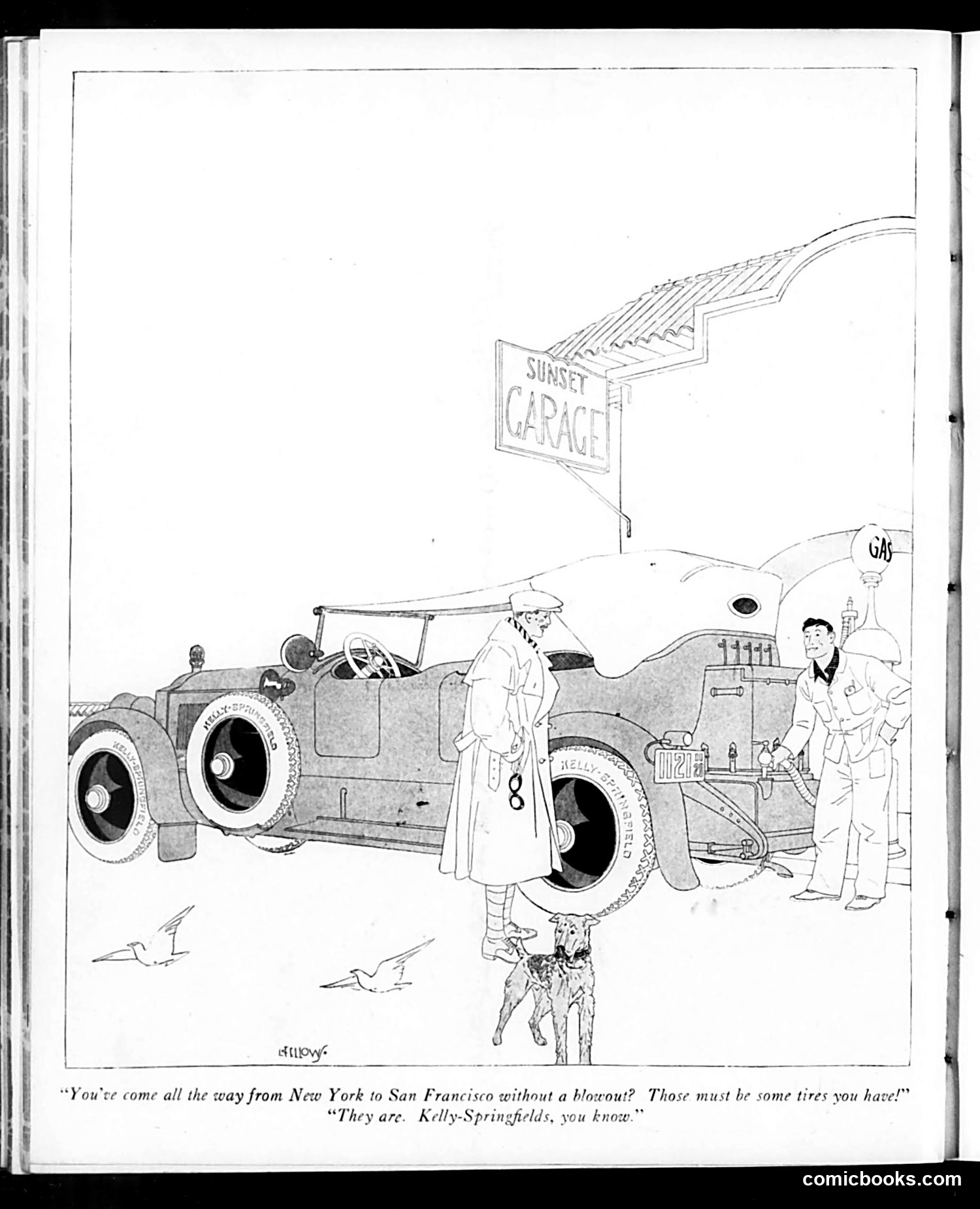
This is an advertisement disguised as a cartoon joke. Two men meet at a "Sunset Garage" with their automobiles. One expresses amazement that the other has driven from New York to San Francisco without experiencing a "blowout" (tire failure)—a common problem for early automobiles with fragile tires. The punchline reveals the advertiser's product: Kelly-Springfield tires, presented as so reliable they can withstand a cross-country journey without failure. This was a genuine selling point in the early automotive era when tire durability was a significant concern for drivers. The cartoon employs a subtle advertising technique, embedding the brand endorsement within what appears to be a humorous scenario rather than direct promotion.