
Judge, 1920-10-02 · page 14 of 32
Judge — October 2, 1920 — page 14: what you’re looking at
What you’re looking at
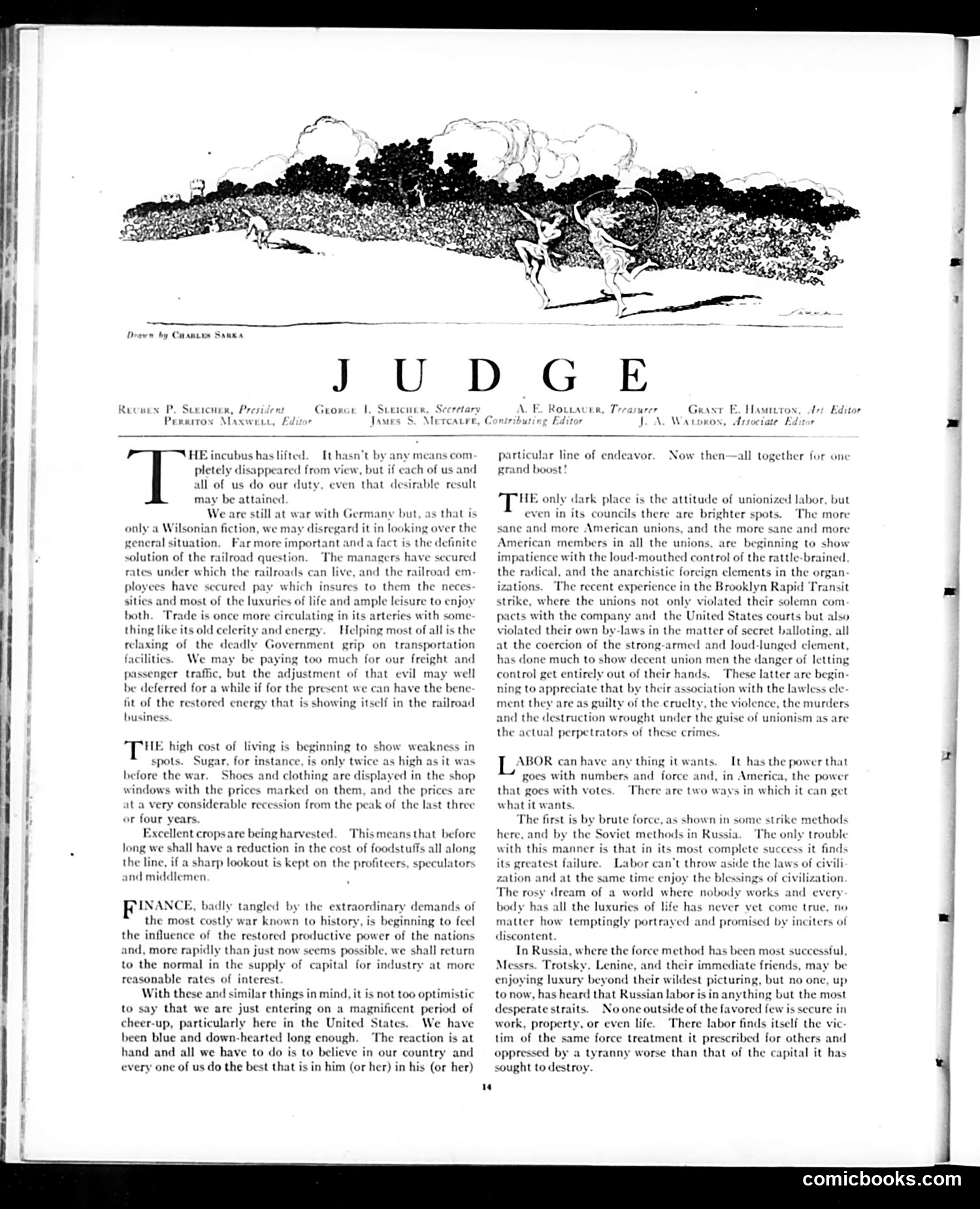
This is primarily a **text-heavy editorial** rather than a cartoon page, reflecting post-WWI American sentiment circa 1919-1920. **Main Arguments:** The editors celebrate economic recovery after wartime government control, particularly regarding railroads. They credit deregulation for restored business activity and claim labor-management disputes have been resolved fairly. **Social/Political Context:** The piece criticizes **unionized labor**, specifically targeting radical and foreign-born union elements. It references the **Brooklyn Rapid Transit strike**, where unions allegedly violated contracts and bylaws under pressure from "strong-armed" radical members. **The Satire's Point:** Judge presents an optimistic, pro-business narrative: Germany's threat is dismissed as fiction, inflation is "weakening," and the real problem is militant labor organizing—not capital interests. The editors frame radical unionists as un-American and criminal while portraying management as reasonable. **For Modern Readers:** This reflects the "Red Scare" era's anti-labor, anti-radical sentiment, blaming immigrant and radical elements rather than examining legitimate worker grievances or structural economic issues.
📄 Transcribed text from this page (OCR, searchable)
Machine-transcribed from the original scan — historical spelling and the odd misread are preserved.
JUDGE Recvoes P. Suercner, President Georce L. Stercnen, Secretary Perairon Maxwett, Editor HE incubus has lifted. It hasn't by any means com pletely disappeared from view, but if each of us and all of us do our duty, even that desirable result may be attained. We are still at war with Germany but, as that is only a Wilsonian fiction, we may disregard it in looking over the general situation. r more important and a fact is the definite solution of the railroad question. The managers have secured rates under which the railroads can live, and the railroad em- ployees have secured pay which insures to them the neces sities and most of the luxuries of life and ample leisure to enjoy both. Trade is once more circulating in its arteries with some thing like its old celerity and energy. Helping most of all is the relaxing of the deadly Government grip on transportation facilities. We may be paying too much for our freight and passenger traffic, but the adjustment of that evil may well be deferred for a while if for the present we can have the bene fit of the restored energy that is showing itself in the railroad business. Tee high cost of living is beginning to show weakness in spots. Sugar, for instance, is only twice as high as it was before the war. Shoes and clothing are displayed in the sh windows with the prices marked on them, and the prices are ita very considerable recession from the peak of the last three or four years Excellent cropsare being harvested. Thismeans that before long we shall have a reduction in the cost of foodstuffs all along the line, if a sharp lookout is kept on the profiteers, speculators ilemen and mic INANCE, badly tangled by the extraordinary demands of the most costly war known to history, is beginning to feel the influence of the restored productive power of the nations and, more rapidly than just now seems possible, we shall return to the normal in the supply of capital for industry at more reasonable rates of interest With these and similar things in mind, it is not too optimistic to say that we are just entering on a magnificent period of cheer-up, particularly here in the United States. We have been blue and down-hearted long enough. ‘The reaction is at hand and all we have to do is to believe in our country and every one of us do the best that is in him (or her) in his (or her) James S. Metcatre, C “4 A. FE. Rottaver, Treasurer ant E. Hasuvton, dee Editor niributing Editor J. A. Wanpron, Assoctate Editor particular line of endeavor. Now then—all together for on grand boost! “THE only dark place is the attitude of unionized labor, but even in its councils there are brighter spots. The more sane and more American unions, and the more sane and more American members in all the unions, are beginning to show impatience with the loud-mouthed control of the rattle-brained the radical, and the anarchistic forcign elements in the organ izations. The recent experience in the Brooklyn Rapid Transit strike, where the unions not only violated their solemn com pacts with the company and the United States courts but also violated their own by-laws in the matter of secret balloting, all at the coercion of the strong-armed and Joud-lunged element, has done much to show decent union men the danger of letting control get entirely out of their hands. These latter are begin ning to appreciate that by their association with the lawless ele ment they are as guilty of the cruelty, the violence, the murders and the destruction wrought under the guise of unionism as are the actual perpetrators of these crimes. ABOR can have any thing it wants. It has the power that goes with numbers and force and, in America, the power that goes with votes. There are two ways in which it can get what it wants. The first is by brute force, as shown in some strike methods here, and by the Soviet methods in Russia. The only trouble with this manner is that in its most complete success it finds its greatest failure. Labor can’t throw aside the laws of civili zation and at the same time enjoy the blessings of civilization The rosy dream of a world where nobody works and every fe has never vet come true, no body has all the luxuries of matter how temptingly portrayed and promised by inciters of discontent In Russia, where the force method has been most successful Messrs. Trotsky, Lenine, and their immediate friends, may be enjoying luxury beyond their wildest picturing, but no one, up to now, has heard that Russian labor is in anything but the most desperate straits. No one outside of the favored few is secure in work, property, or even life. There labor finds itself the vic- tim of the same force treatment it prescribed for others and oppressed by a tyranny worse than that of the capital it has sought to destroy. a comicbooks.com