
A complete issue · 36 pages · 1920
Judge — April 10, 1920
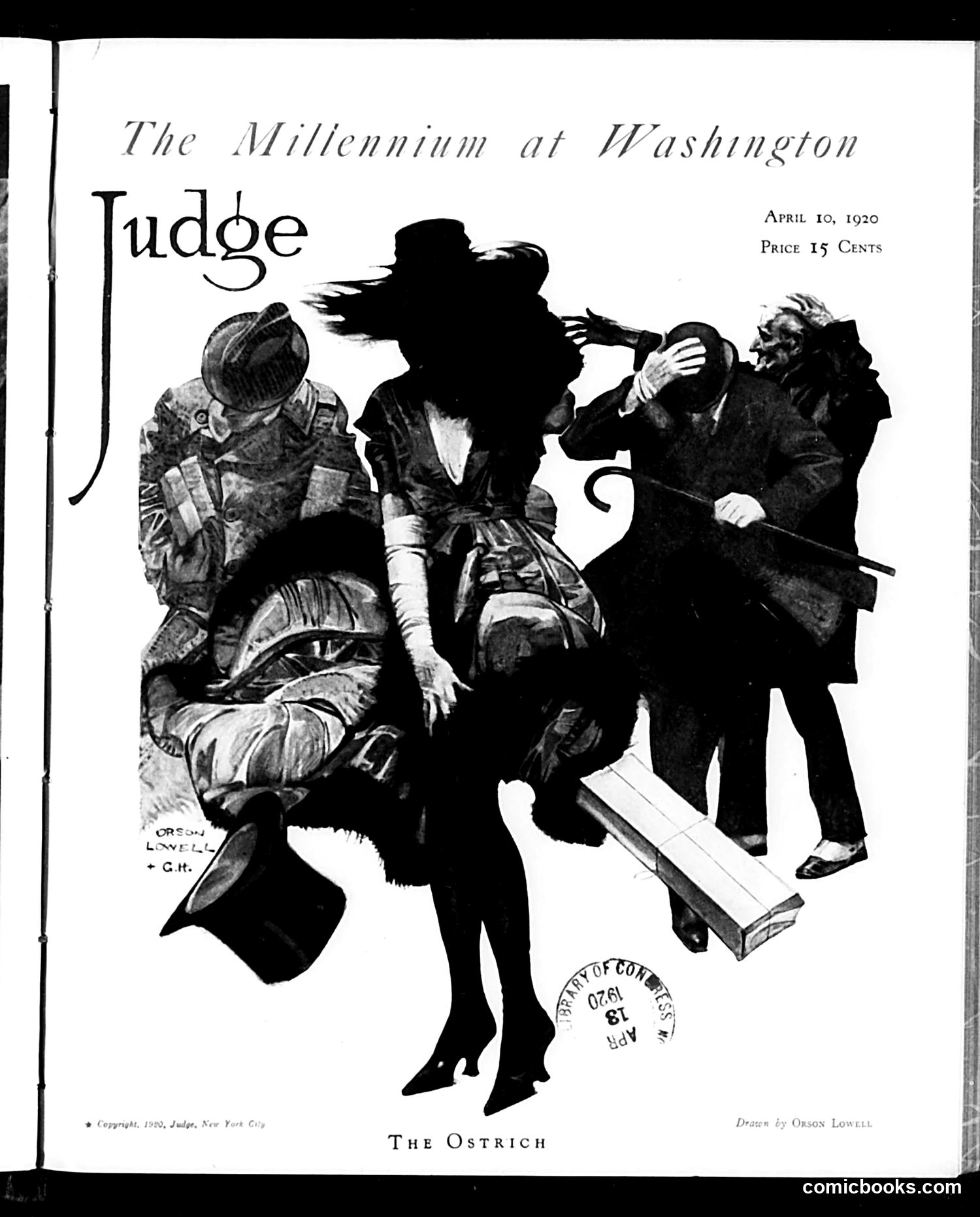
This political cartoon depicts a woman (center) being attacked or confronted by four men in formal dress. The title "The Ostrich" suggests the woman represents someone ignoring reality—a common metaphor from the false belief that ostriches bury their heads in sand. The cartoon likely references debates over women's roles or rights circa 1920, possibly related to Prohibition (passed January 1920) or women's suffrage (ratified August 1920). The aggressive male figures appear to represent opposing political or social forces confronting a female-embodied principle or policy position. The artist is credited as Orson Lowell. Without additional context, the specific political figures or events remain unclear, though the satire clearly criticizes either the woman's avoidance of a problem or her opposition to these men's agenda.
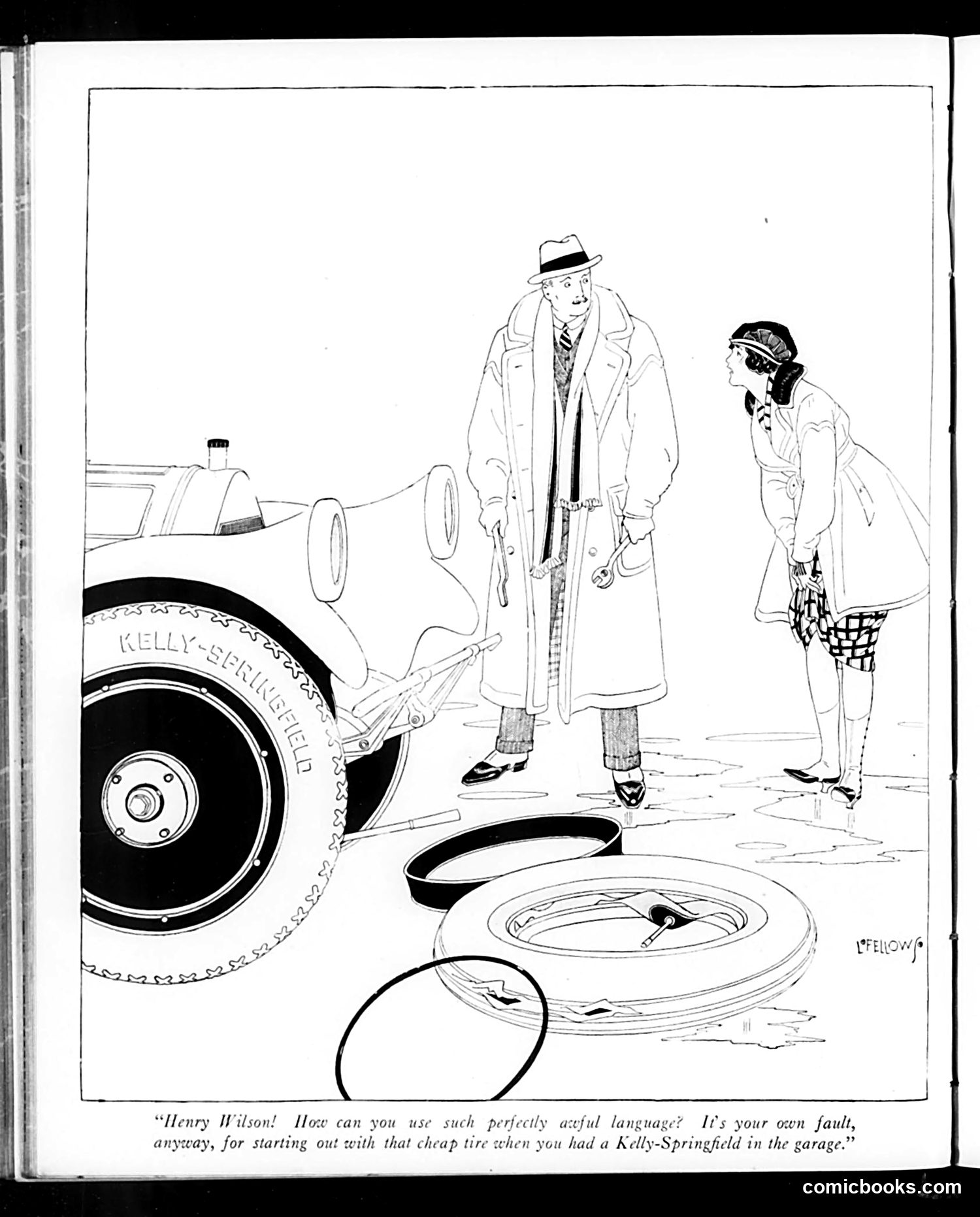
This cartoon satirizes a man named Henry Wilson for using profanity while changing a car tire. The woman (likely his wife) scolds him, noting it's ironic that he's cursing despite owning a Kelly-Springfield tire—implying these were reliable, quality tires that shouldn't cause frustration. The joke relies on early 20th-century social attitudes: gentlemen weren't supposed to swear in front of ladies, yet automotive maintenance apparently tested even respectable men's composure. The cartoon advertises Kelly-Springfield tires indirectly by suggesting their reliability should prevent such outbursts. This reflects both period gender norms (women as moral arbiters) and the novelty of automobiles as temperament-testing machines for the average driver.
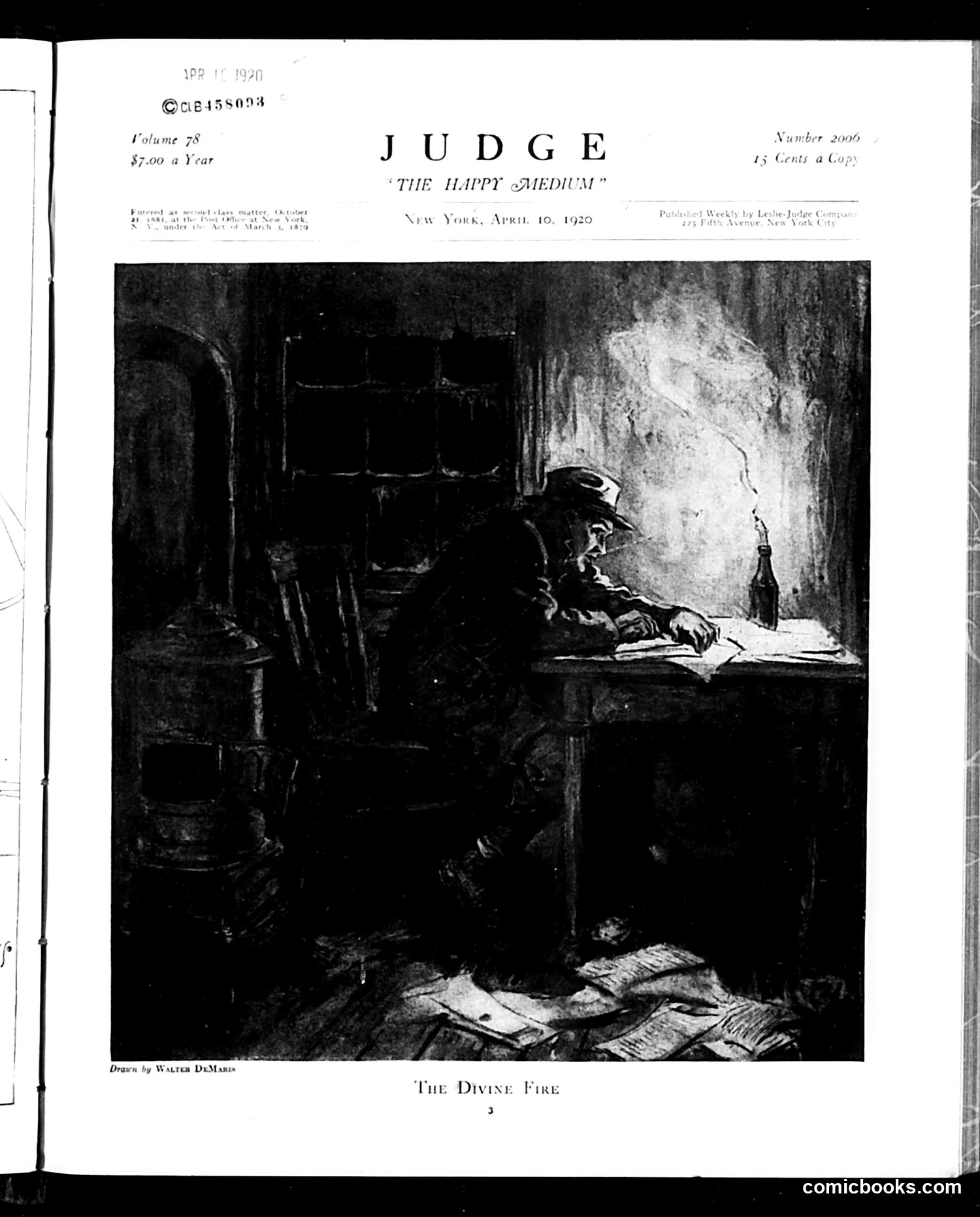
This illustration by Walter DeMaris depicts a solitary figure hunched over a desk by candlelight in a sparse, dimly-lit room, surrounded by scattered papers and a bottle. The title "The Divine Fire" sarcastically references artistic inspiration or creative genius. The cartoon appears to criticize impoverished or struggling writers/artists of the era—those pursuing their craft under difficult conditions with minimal resources. The "divine fire" of creative inspiration is undercut by the harsh reality of poverty: bare walls, meager lighting, and apparent desperation. This likely comments on the romanticization of the starving artist versus the actual hardship such figures endured in post-WWI America, offering social commentary on economic inequality and the cost of artistic ambition.
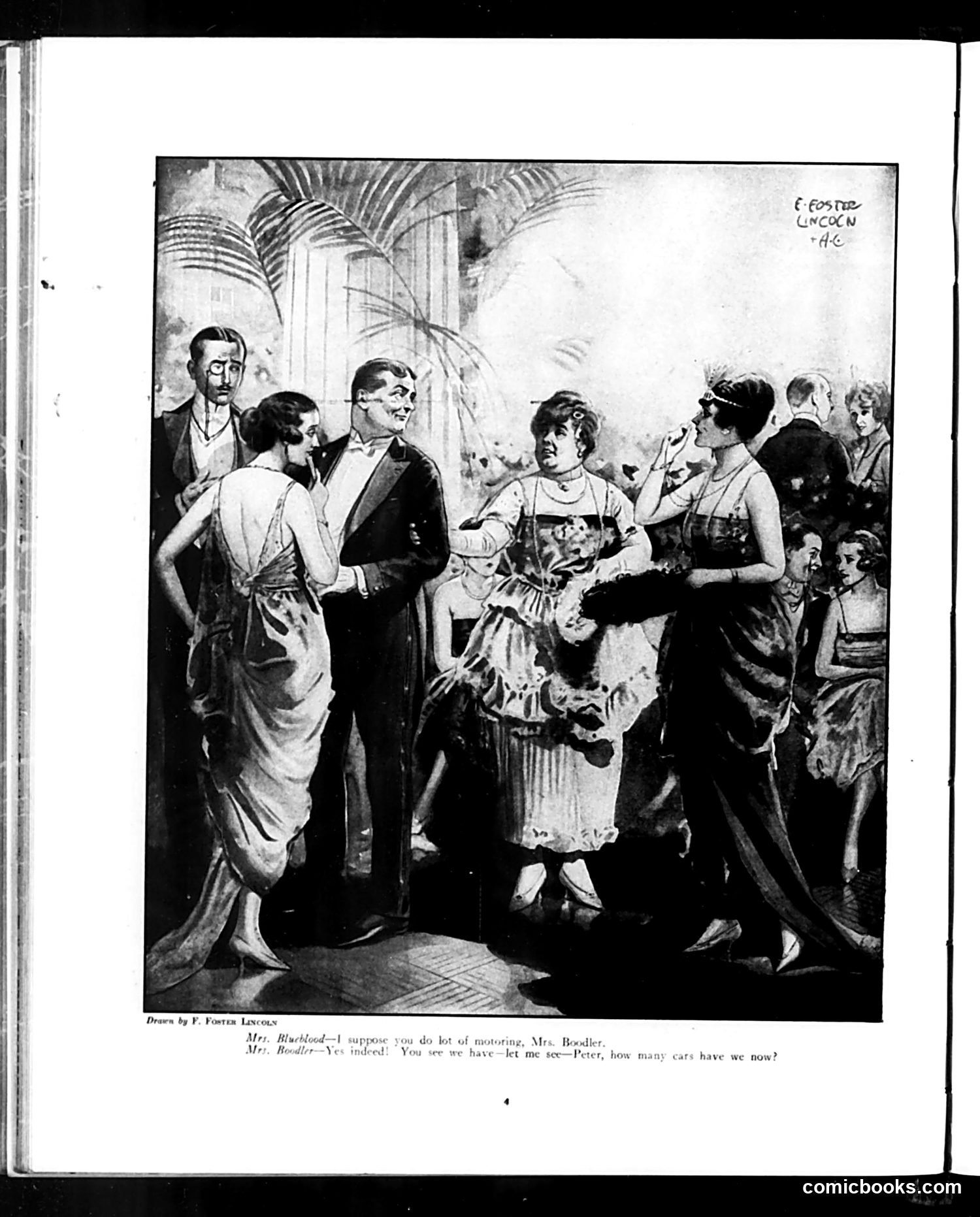
**The Cartoon:** This drawing by F. Foister Lincoln depicts an elegant social gathering, likely at a wealthy home (note the ornate architecture with palm plants and columns). **The Joke:** Mrs. Blackwood addresses Mrs. Bowdler with concern about "motoring" (early automobile driving). Mrs. Bowdler responds that they've "let me see—Peter, how many cars have we now?"—suggesting she's lost count of their automobile collection. **The Satire:** The humor targets wealthy society women's casual extravagance during the early automobile era. The joke mocks both their obsession with motor cars as status symbols and their obliviousness to their own excessive consumption—they can't even keep track of how many vehicles they own. It's satire of the nouveau riche and their conspicuous display of wealth.
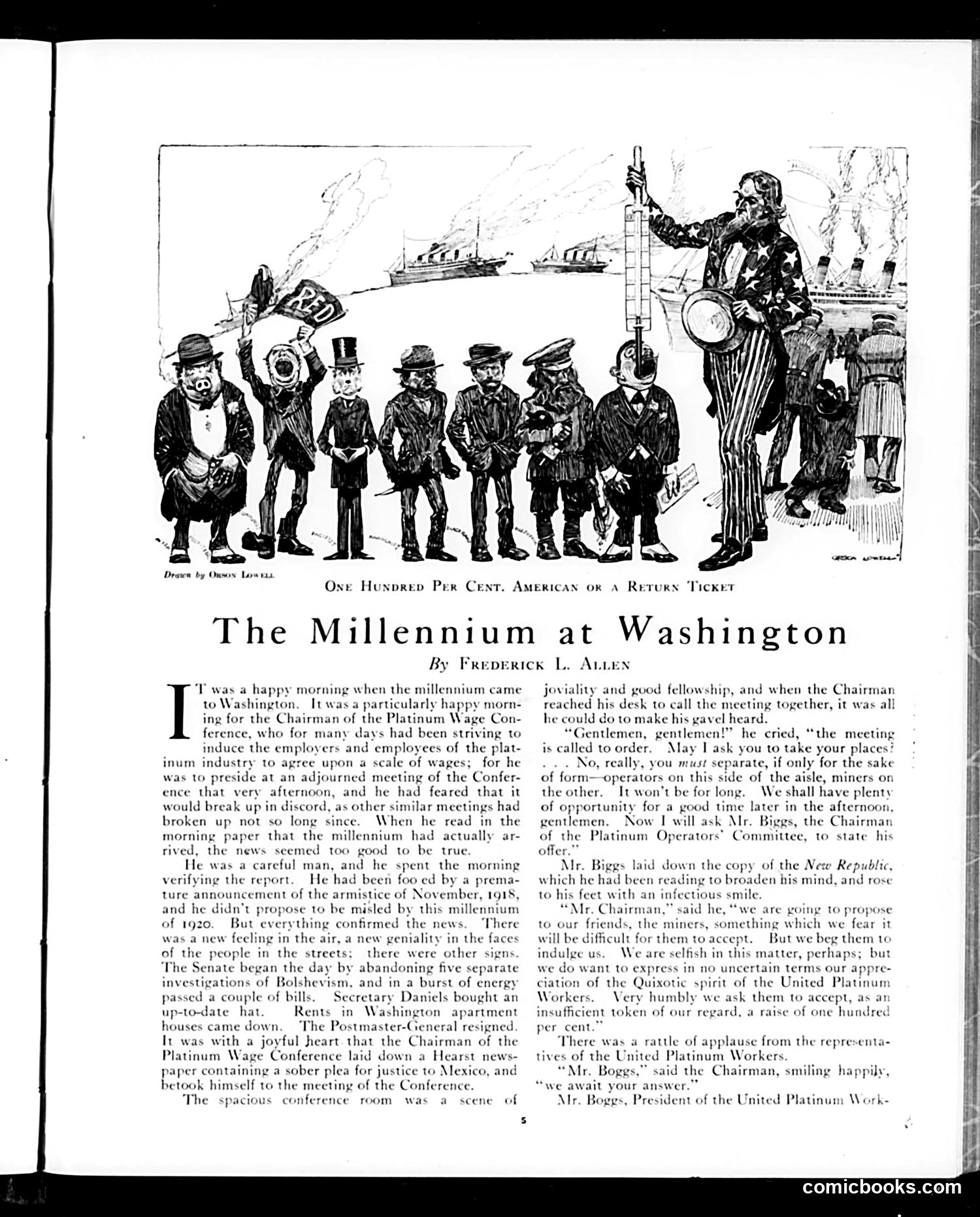
This satirical cartoon depicts a Platinum Wage Conference meeting where labor representatives—shown as caricatured working-class figures—seek a 100% wage increase ("return ticket"). The tall figure on the right, identified as Mr. Boggs of the United Platinum Workers, presents their demands while the Conference Chairman attempts to manage the meeting. The satire mocks both sides: the workers' apparently unrealistic wage demands and the employers' condescending dismissal of labor concerns. The "millennium" reference suggests the impossibility of workers achieving such gains. The cartoon satirizes the growing labor-management tensions of the early 20th century, presenting wage negotiations as absurdly theatrical rather than serious economic debate.
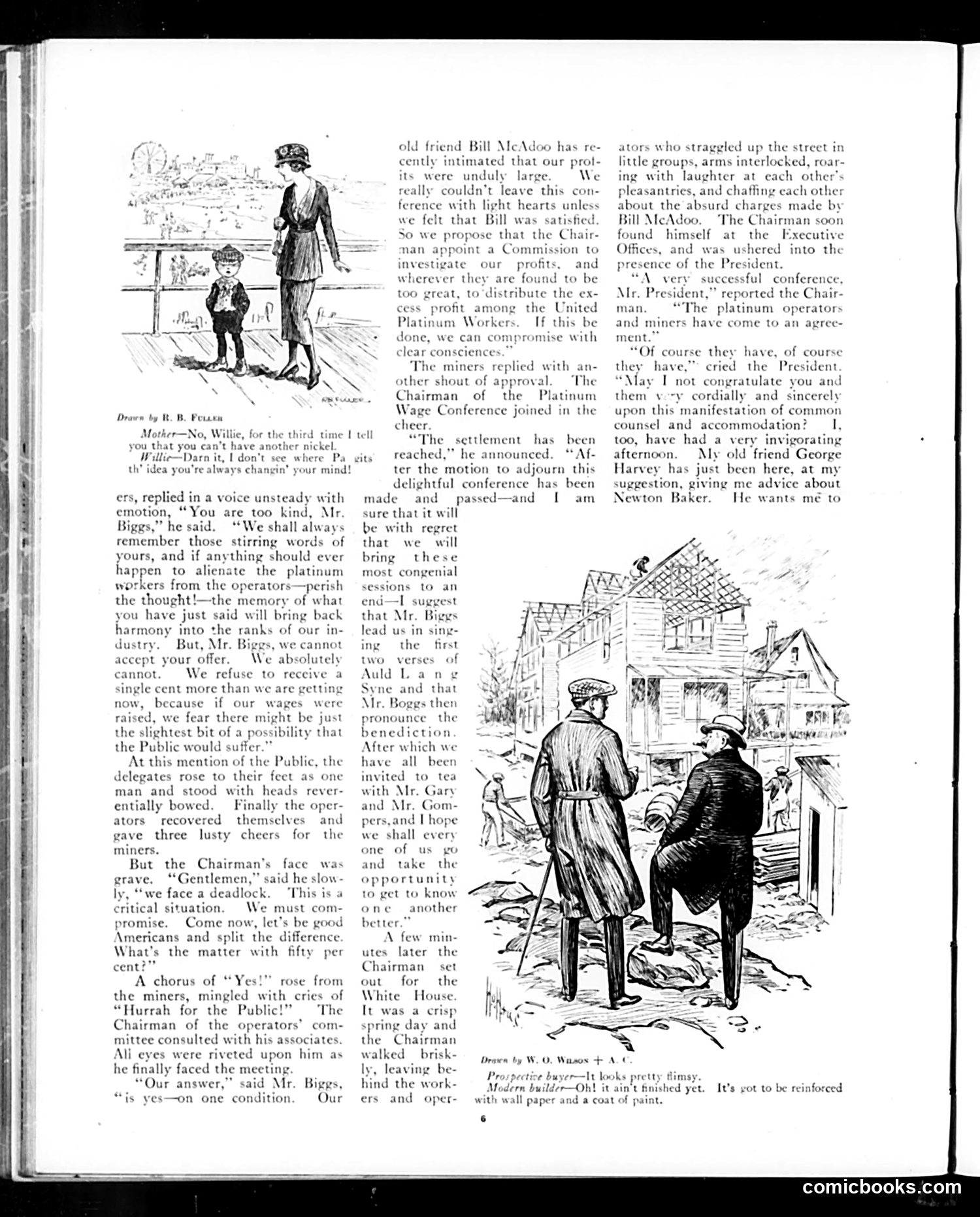
This page satirizes a conference between platinum miners and operators. The narrative describes a tense deadlock where miners, represented by Mr. Biggs, reject a wage offer "because if our wages were raised or fear there might be just the slightest bit of a possibility that the Public might suffer." The satire targets the operators' claim that wage increases would harm the public—a common argument against labor demands. The miners' response exposes this logic as absurd self-sacrifice. The cartoon illustrations show workers and operators in confrontational stances, emphasizing class tension. The piece mocks both sides' posturing while highlighting how operators used "public welfare" rhetoric to justify refusing higher wages, a recurring tension in early 20th-century labor disputes.
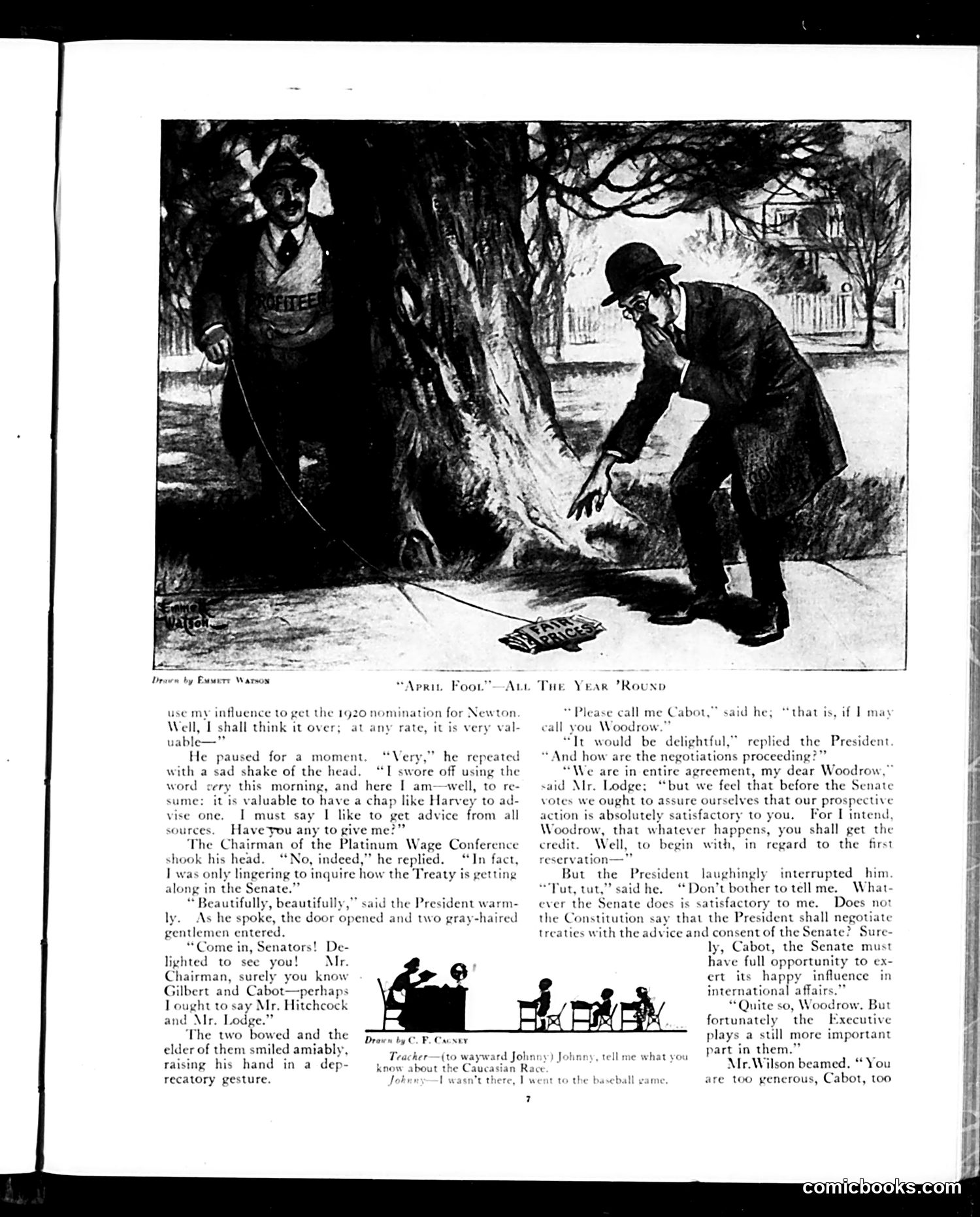
This 1920 Judge cartoon satirizes President Woodrow Wilson's handling of the League of Nations treaty ratification. The two visiting senators are **Henry Cabot Lodge** and **Gilbert Hitchcock**, key figures in the Senate's treaty debate. The satire targets Wilson's apparent passivity: Lodge and Hitchcock arrive ostensibly to consult him on Senate reservations to the treaty, but Wilson insists the Senate has full authority and that he's satisfied with whatever they decide. This is ironic, since historically Wilson *opposed* Lodge's reservations and fought hard against them. The cartoon mocks Wilson's diffident stance as political theater—he's so eager to appear cooperative that he's surrendering executive authority. The "April Fool" title suggests the entire exchange is foolish performance. The smaller panel with the "Teacher" makes an unrelated joke about the Caucasus Race (likely referencing baseball).
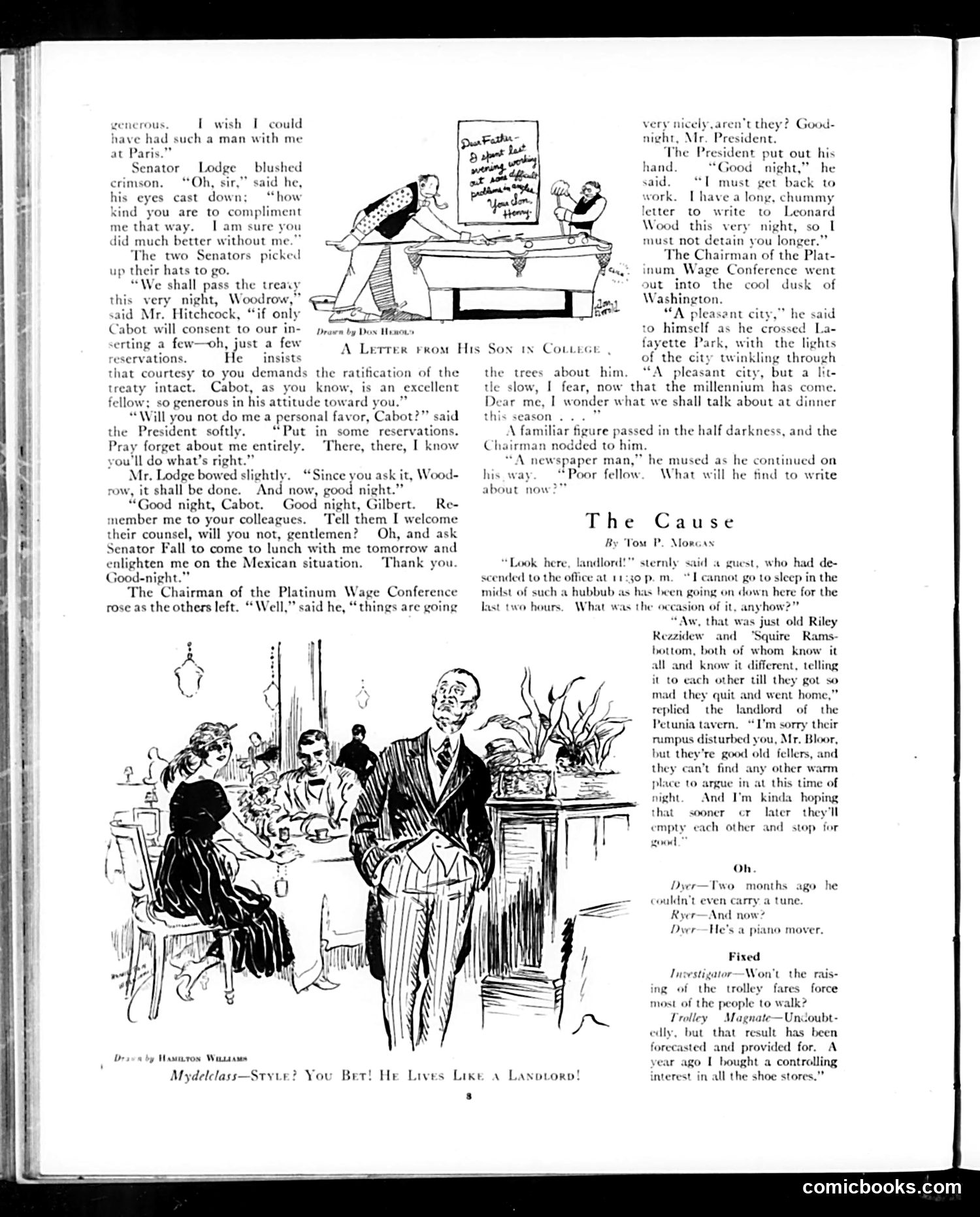
This page satirizes President Woodrow Wilson's diplomacy regarding the League of Nations treaty. The top narrative shows Wilson manipulating Senator Henry Cabot Lodge into accepting treaty reservations by appeals to vanity and personal favor—Wilson asks Lodge to add reservations "as a personal favor," reversing his stated opposition to them. The satire mocks Wilson's indirect persuasion tactics and suggests his principles are flexible. The secondary cartoons use shorter jokes to mock contemporary figures and situations: a landlord story about quarrelsome guests, and jokes about piano movers and trolley fare increases. These appear designed as filler humor rather than political commentary. The artwork credits indicate Hamilton Williams as illustrator. The page satirizes political compromise and the gap between public principles and private negotiation during the contentious League of Nations debate of the Wilson era.
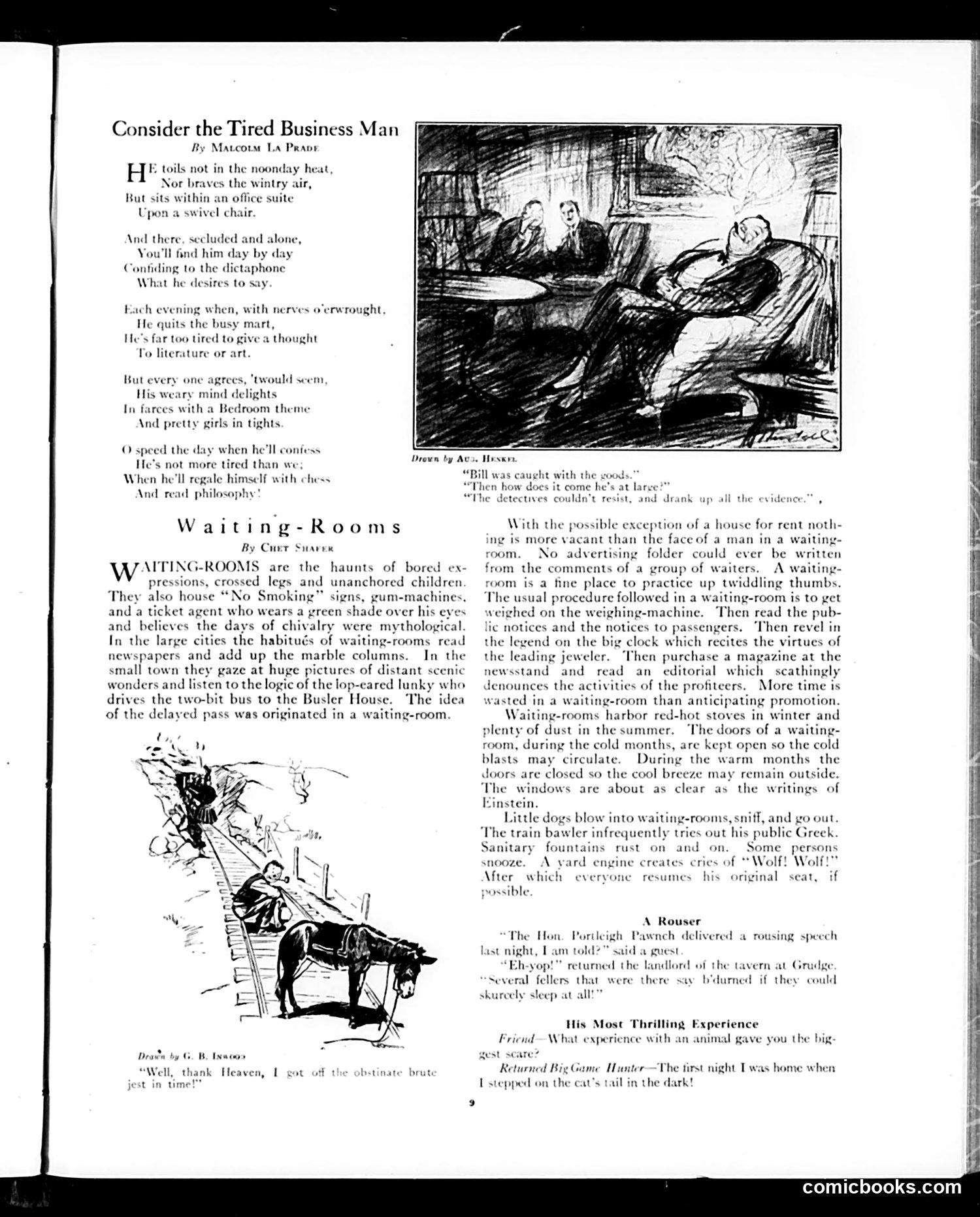
This *Judge* magazine page satirizes early 20th-century American urban life. "The Tired Business Man" mocks the office worker who claims exhaustion prevents him from intellectual pursuits, yet enjoys frivolous entertainment (bedroom farces, pretty girls). The satire suggests hypocrisy: he's not genuinely tired, just mentally lazy. "Waiting-Rooms" humorously catalogs the misery of train station waiting areas—boredom, poor ventilation, malfunctioning amenities, and absurd activities (reading jeweler advertisements, weighing oneself). The recurring joke is that waiting-rooms waste time through their own poor design and tedious environment. The cartoon illustrations accompany these sketches with visual gags: a man escaping a mule, a detective story snippet about evading arrest. The final anecdote—a "big game hunter" frightened by stepping on a cat's tail—is pure slapstick humor deflating masculine bravado. Together, these pieces gently mock modern urban American society's tedium and pretense.
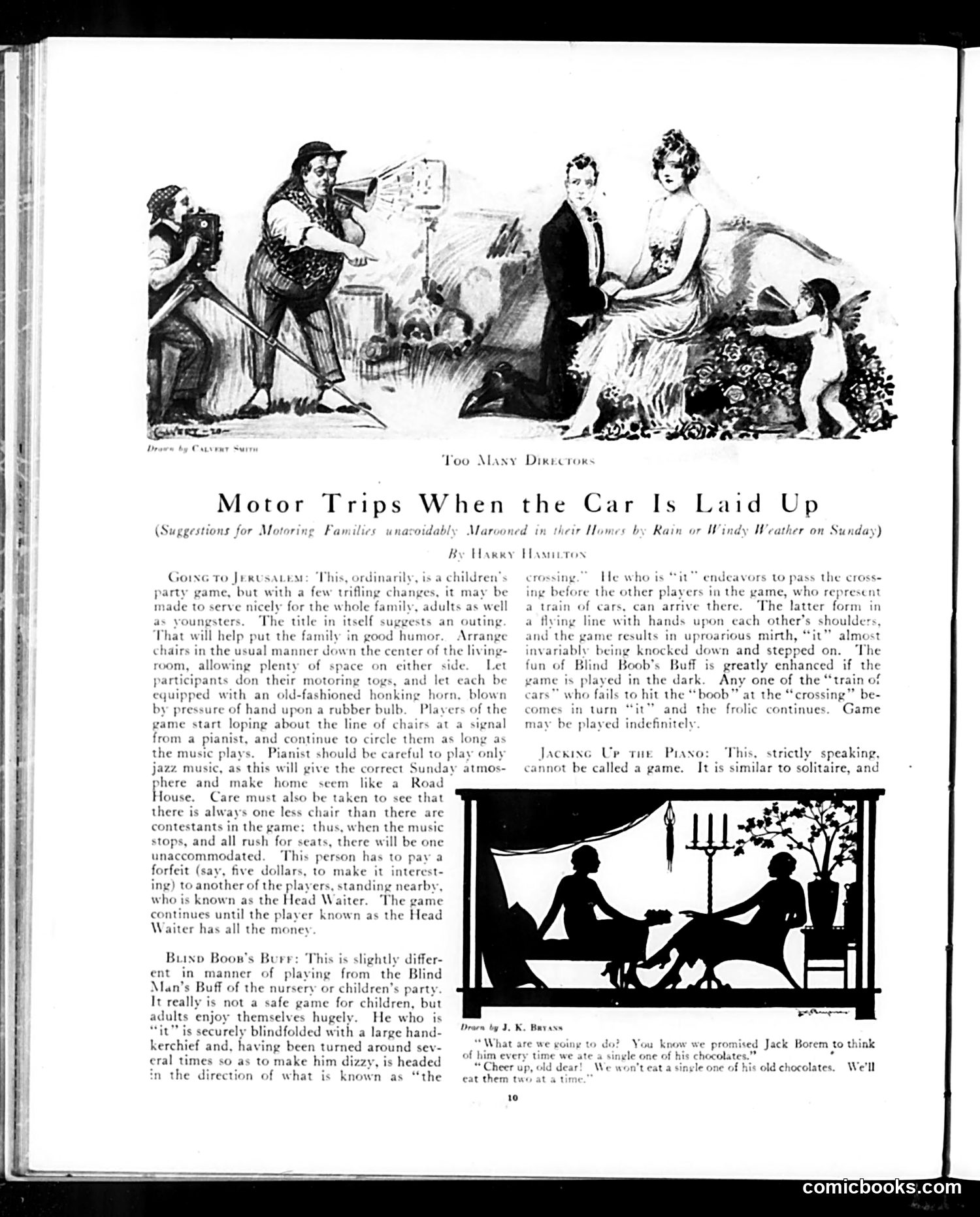
This is a humorous advice article by Harry Hamilton addressing a common early-20th-century problem: families stuck at home on rainy Sundays when their automobiles couldn't be used. The piece satirizes this inconvenience by proposing indoor "motor trip" games—parlor games adapted with motoring themes to entertain housebound families. The top cartoon "Too Many Directors" depicts film production chaos, likely mocking the era's emerging movie industry and its proliferation of competing directors on set. The games described—"Going to Jerusalem" (musical chairs), "Blind Boob's Buff," and "Jacking Up the Piano"—are traditional parlor games given motoring nomenclature. The satire lies in the absurdity of trying to recreate the excitement of automobile outings indoors while maintaining a facade of automotive adventure through renamed games. The illustration shows typical upper-middle-class indoor entertainment, reflecting how dependent leisure had become on automobiles—so much so that rainy weather demanded elaborate substitutes.
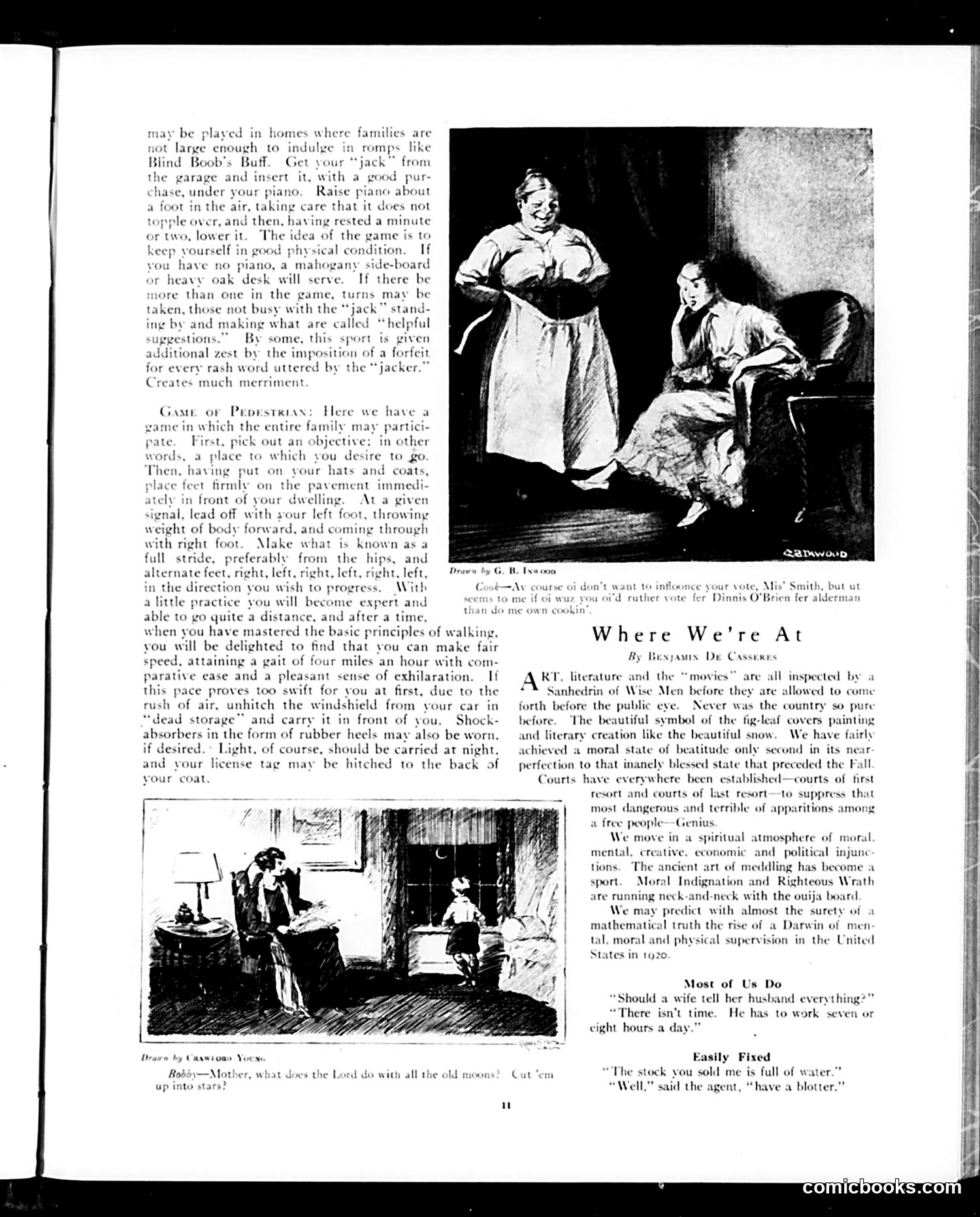
This page from *Judge* contains satirical commentary on 1920s American life, presented through humorous "games" and essays. **The Cartoons:** Two domestic sketches illustrate absurd "games"—one shows a woman and child performing gymnastics with furniture (the "Blind Boob's Buff" game), while another depicts pedestrians walking. These mock the era's obsession with health fads and physical culture. **"Where We're At" Essay:** Benjamin De Casseres critiques American censorship and moral policing. He sarcastically praises the "Sanhedrin of Wise Men" (referencing censorship boards) who suppress art and literature under the guise of public morality—comparing this sanitized culture to the biblical fig-leaf covering Adam and Eve's shame. He warns darkly that America will soon produce a "Darwin of mental, moral and physical supervision"—predicting totalitarian control. **The Jokes:** Brief quips mock marital communication and fraudulent stock sales, typical early-20th-century humor reflecting anxieties about honesty in business and relationships.
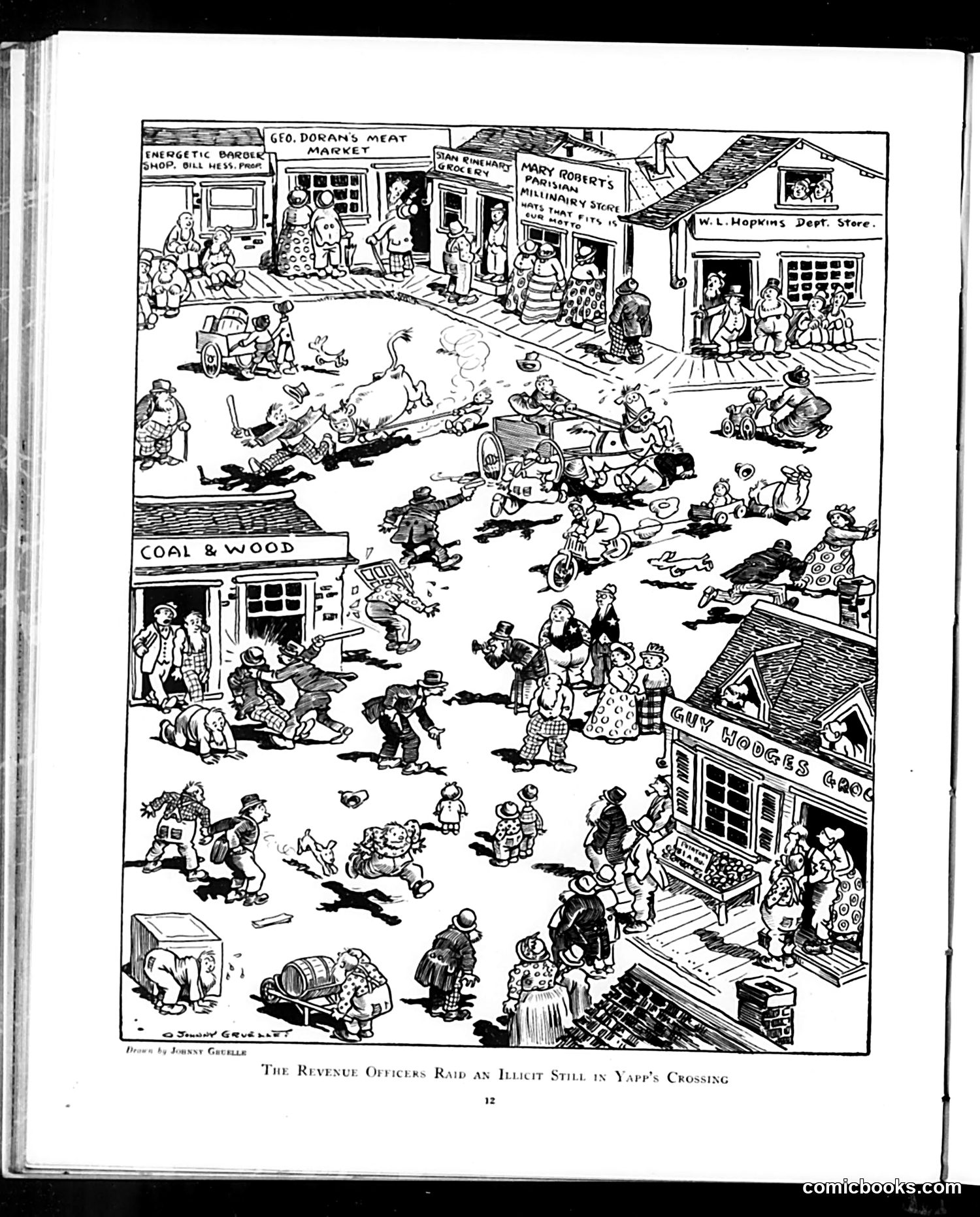
This is a single satirical cartoon titled "The Revenue Officers Raid an Illicit Still in Yapp's Crossing." It depicts Prohibition-era law enforcement attempting to shut down illegal alcohol production in a working-class neighborhood. The scene shows revenue officers (federal agents) conducting a raid on what appears to be a makeshift distillery hidden among local shops and residences. The chaos of the raid—with officers, residents, and children scattered throughout the street—satirizes the difficulty of enforcing Prohibition. The visible storefronts (Coal & Wood, Geo. Doran's Meat Market, etc.) suggest this is meant to represent an ordinary American town where illegal liquor production was commonplace and integrated into everyday community life, highlighting the unpopularity and impracticality of Prohibition enforcement.
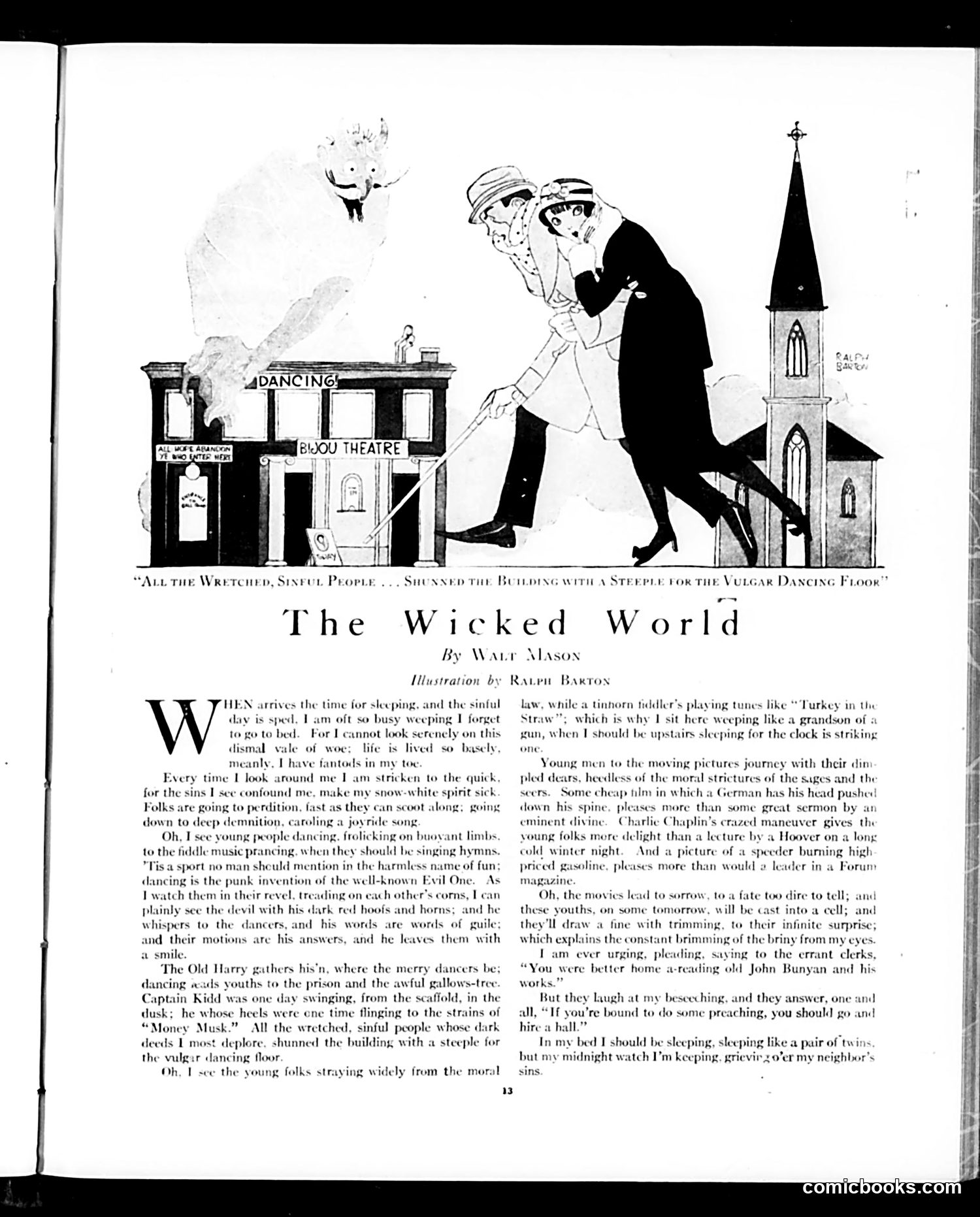
This is a moralistic satire attacking modern entertainment and youth behavior through the voice of an anxious, religiously-scrupulous narrator—likely representing conservative clergy or older moral authorities of the 1910s-1920s era. The cartoon depicts the narrator (right, in formal dress) using a church steeple as a weapon to destroy a "Bijou Theatre" dance hall, with a ghost or demon rising from the building. The accompanying poem rails against: - **Dancing** as sinful and linked to damnation - **Moving pictures (cinema)** for corrupting youth with immoral content - **Popular music** like "Turkey in the Straw" - **Charlie Chaplin films** and other entertainment distracting young people from moral instruction The satire mocks this censorious worldview, suggesting that worried elders blame modern amusements—not genuine social problems—for youth's supposed moral decline. The narrator's exaggerated hand-wringing ("weeping," "grieving") and inability to sleep over others' harmless pleasures emphasizes the absurdity of such pearl-clutching moralism.
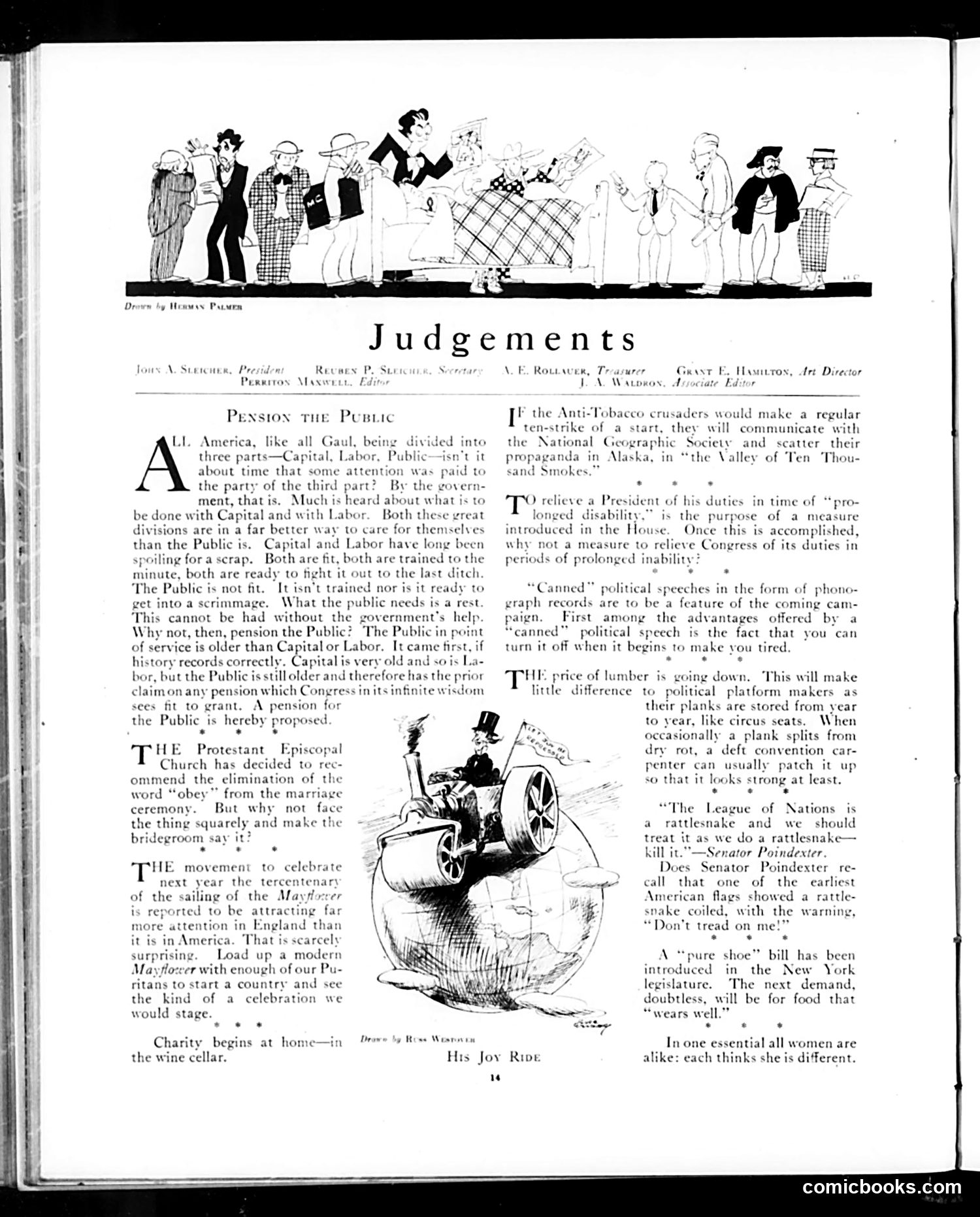
This page from *Judge* magazine contains several brief political satires and social commentary pieces, typical of the publication's format. **Main topics satirized:** 1. **"Pension the Public"** – argues the American public deserves government pensions like Capital and Labor do, being older institutions and neglected by government. 2. **Episcopal Church controversy** – mocks the church's removal of "obey" from marriage vows, suggesting they should fully commit to equality rather than half-measures. 3. **Anti-Tobacco crusade in Alaska** – jokes about prohibitionists' propaganda efforts in remote regions. 4. **Canned political speeches** – satirizes recorded speeches as campaign tools, noting the advantage is you can turn them off. 5. **Political platform planks** – quips that politicians reuse old platform planks like circus seats, patching them up when needed. 6. **League of Nations** – critiques Senator Poindexter's "kill the rattlesnake" rhetoric, ironically noting early American flags featured rattlesnakes with "Don't tread on me." The accompanying cartoon shows a figure riding atop a large spherical object, illustrating "His Joy Ride."
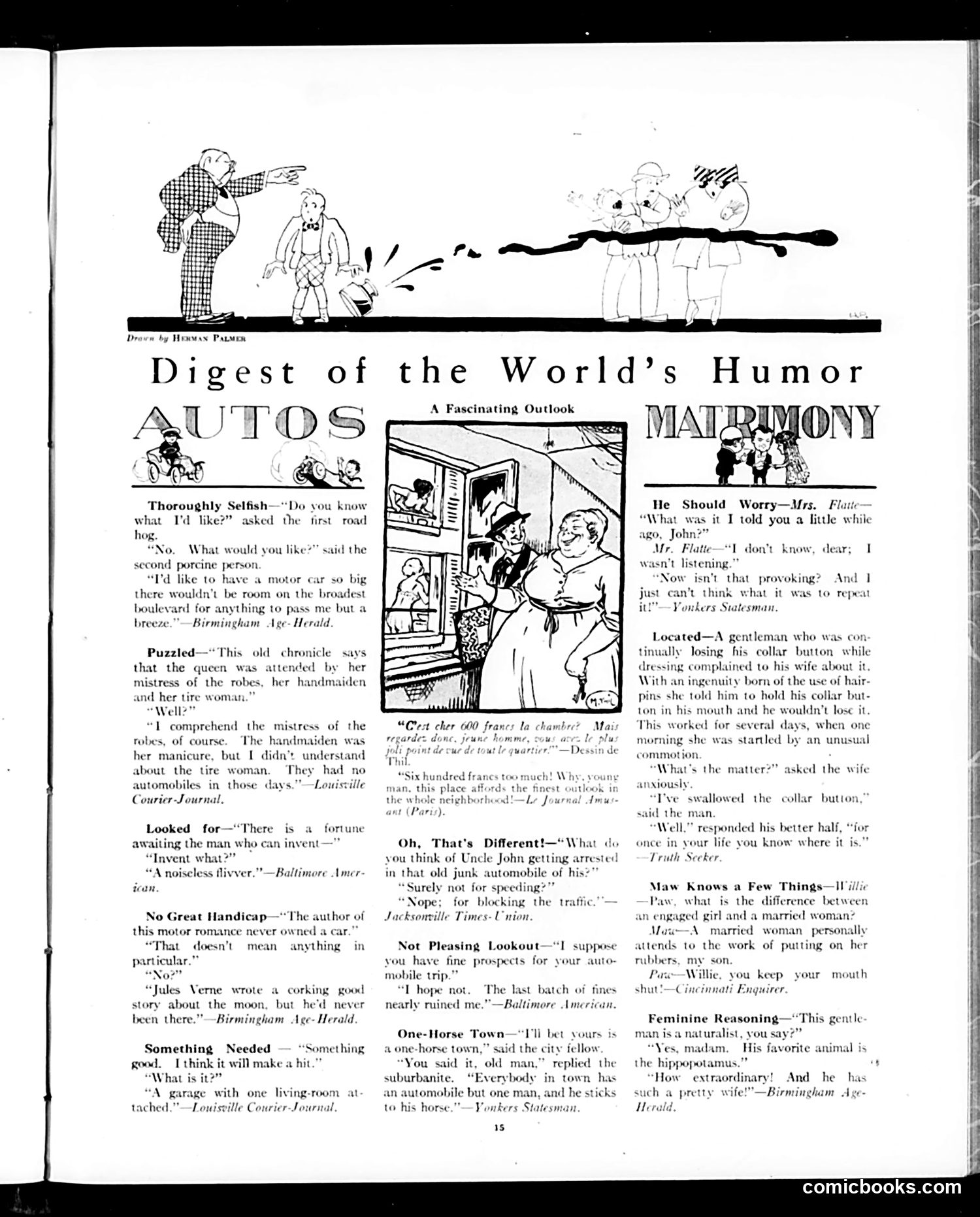
This page collects short jokes about **automobiles and early 1900s social life**, a relatively new technology causing social upheaval. The humor targets: **Automobile obsession**: "Thoroughly Selfish" mocks drivers so self-centered they want cars too wide for others to pass. "One-Horse Town" satirizes suburban automobile status-anxiety. **Fines and traffic chaos**: Multiple jokes reference speeding fines and traffic blocking—suggesting automobiles were creating novel legal/social problems. **Domestic friction**: "He Should Worry" and "Located" depict wives frustrated with husbands' distraction or carelessness (lost collar buttons). **Confusion with older language**: "Puzzled" jokes about "tire woman" (attendant)—readers misunderstanding old court terminology as relating to automobile tires, reflecting how cars dominated contemporary discourse. The cartoonist Palmer's top illustration shows figures pulling an absurdly long object, likely depicting automobile-related absurdity. These are gentle, domestic-focused jokes typical of *Judge* magazine's middle-class readership—less political satire than observational humor about how automobiles disrupted everyday life.
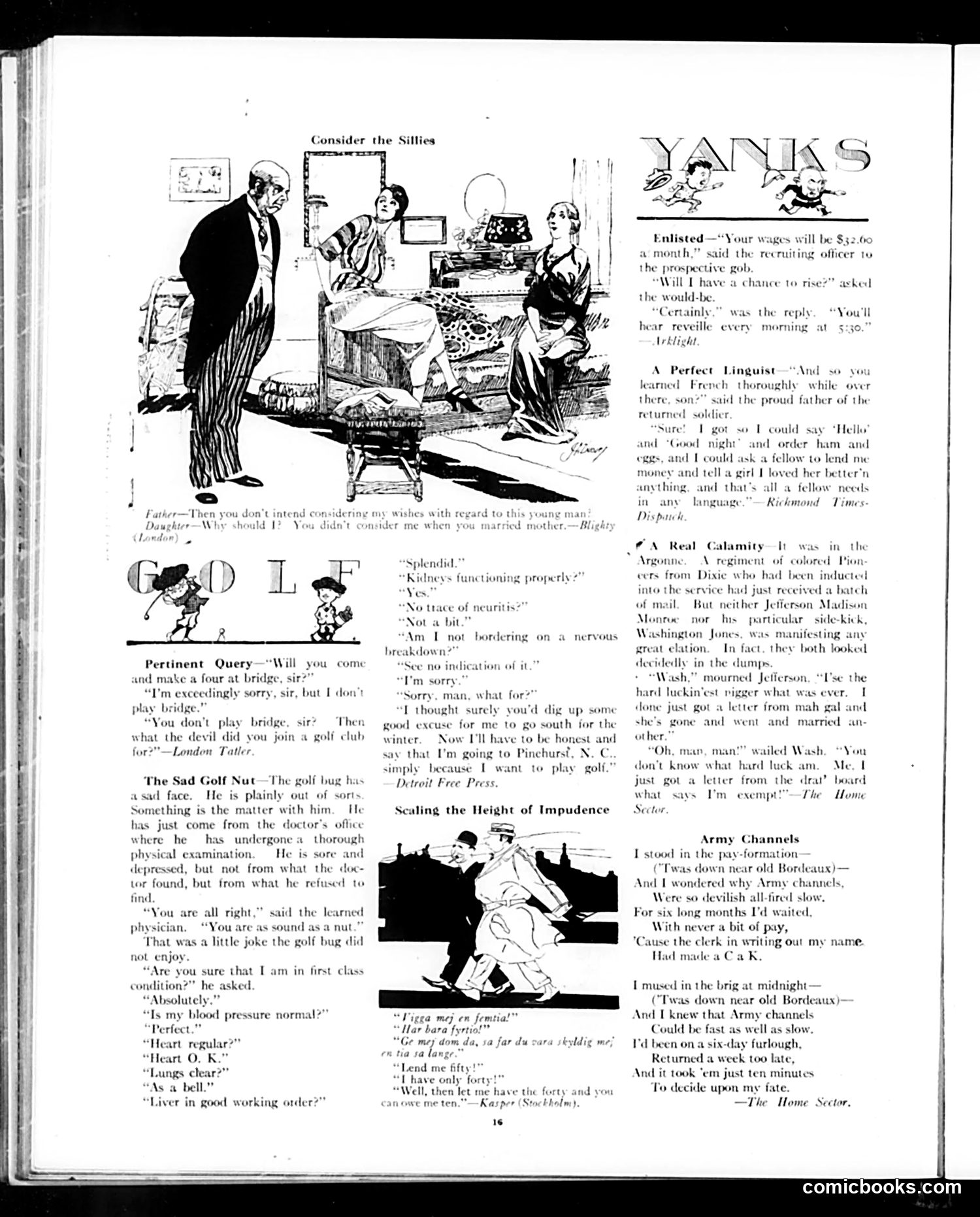
This page contains several humorous sketches satirizing post-WWI American life: **"The Sad Golf Nut"**: A man obsessed with golf visits his doctor seeking medical excuses to justify poor play. The joke is his disappointment when declared perfectly healthy—he wanted a legitimate reason for his golf troubles, not actual wellness. **"Enlisted"**: A recruit asks about promotion prospects; the officer jokes he'll hear reveille at 5:30 AM "every daylight"—a pun on "rise" (promotion vs. waking). **"A Perfect Linguist"**: A returning soldier claims fluency in French, but admits he only learned practical phrases: greetings, food orders, borrowing money, and romantic lines. The satire mocks soldiers' limited actual language acquisition despite wartime exposure. **"A Real Calamity" and "Army Channels"**: Two pieces about military bureaucratic inefficiency—soldiers receiving mail from girlfriends who've married others, and a clerk's typo ("Ca K" instead of the soldier's name) delaying pay for six months. These satirize Army administrative incompetence affecting servicemen's lives and finances.
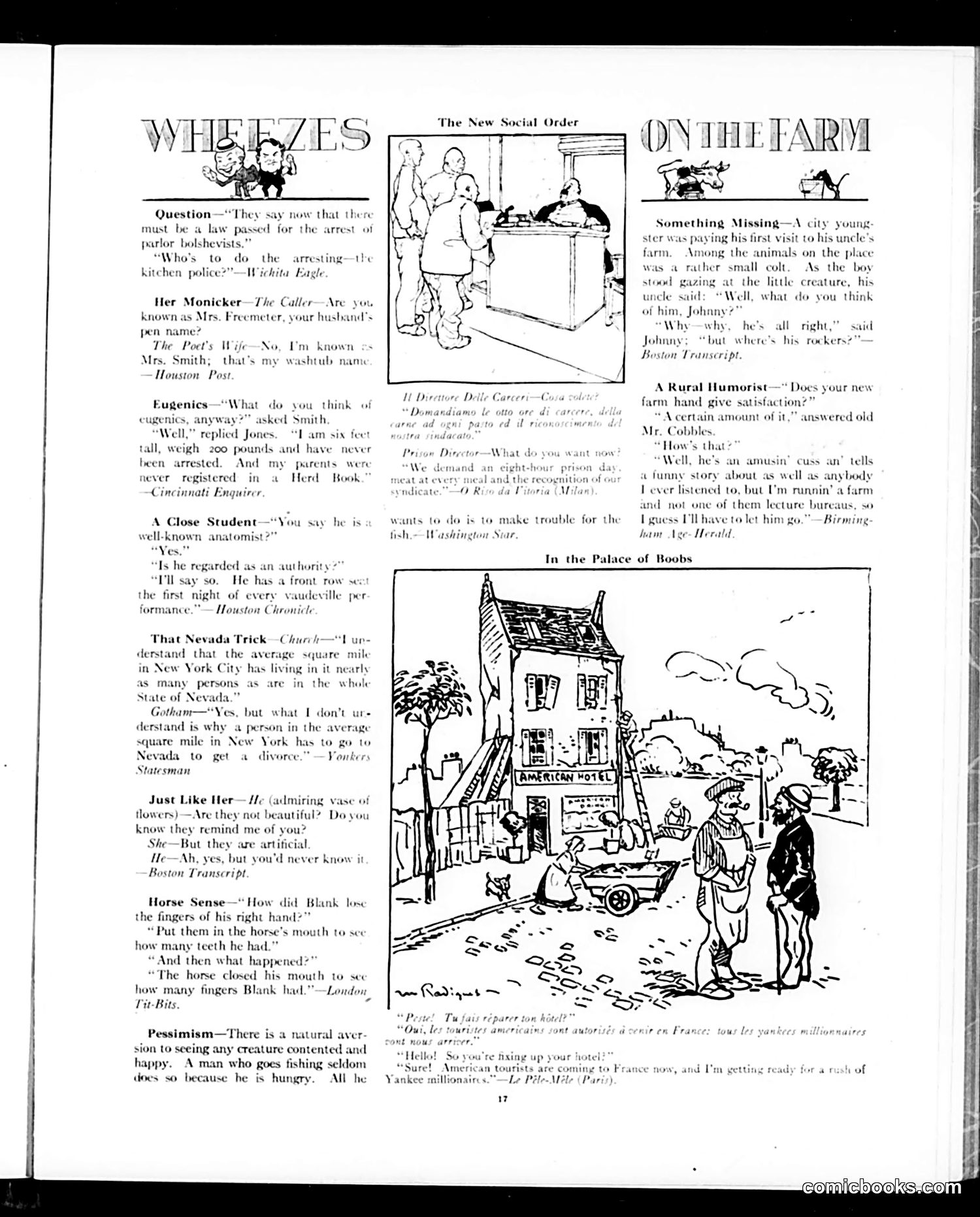
This page from *Judge* magazine contains several short satirical jokes and one cartoon titled "In the Palace of Boobs." **The jokes** mock various social types: a poet's wife known by her "washtub name" (satirizing pretentious pen names); a eugenics enthusiast who brags about his breeding and lack of arrest record (mocking the pseudoscientific eugenics movement popular in early 20th century America); and a "parlor bolshevik" (satirizing wealthy people who expressed socialist sympathies without genuine commitment). **The main cartoon** depicts what appears to be a rundown European inn or hotel. The caption suggests Americans ("Yankee millionaires") are arriving as tourists, with the innkeeper preparing to exploit them. This reflects post-WWI anxiety about American wealth and the stereotype of unsophisticated American tourists abroad being overcharged by shrewd Europeans. The humor targets both American tourist naiveté and European opportunism—a recurring theme in early 20th-century American satire about the newly wealthy nation's international presence.
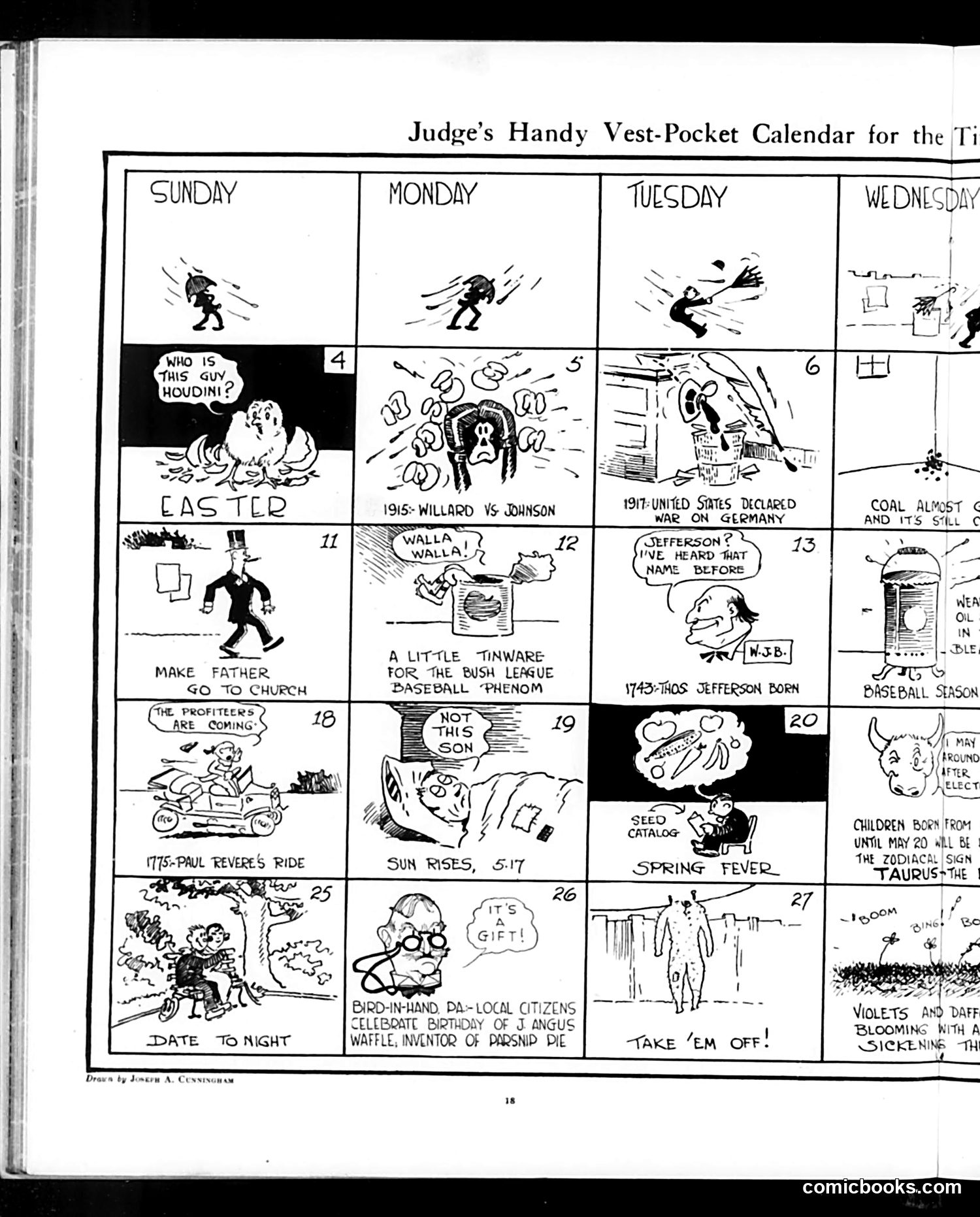
This is a satirical calendar page mixing historical events with absurdist humor typical of Judge magazine's style. Key references include: **Historical events depicted:** - Easter (top left, with "Who is this Houdini?" joke) - 1915 Willard vs. Johnson boxing match - 1917 U.S. declaration of war on Germany - 1743 Thomas Jefferson's birth - Paul Revere's ride (1775) - Spring seasonal references (seed catalogs, flowers blooming) **Satirical humor:** The cartoons mock trivial local celebrations (a "Parsnip Pie inventor" birthday), juxtapose them against major historical moments, and employ absurdist non-sequiturs ("Not this soon" with a sleeping figure). The overall joke appears to be deflating historical importance through incongruous placement alongside ridiculous provincial events. **Modern context needed:** "Bush League Baseball Phenom" refers to minor-league baseball; readers would recognize these historical dates as significant American moments being undermined by the calendar's trivializing treatment.
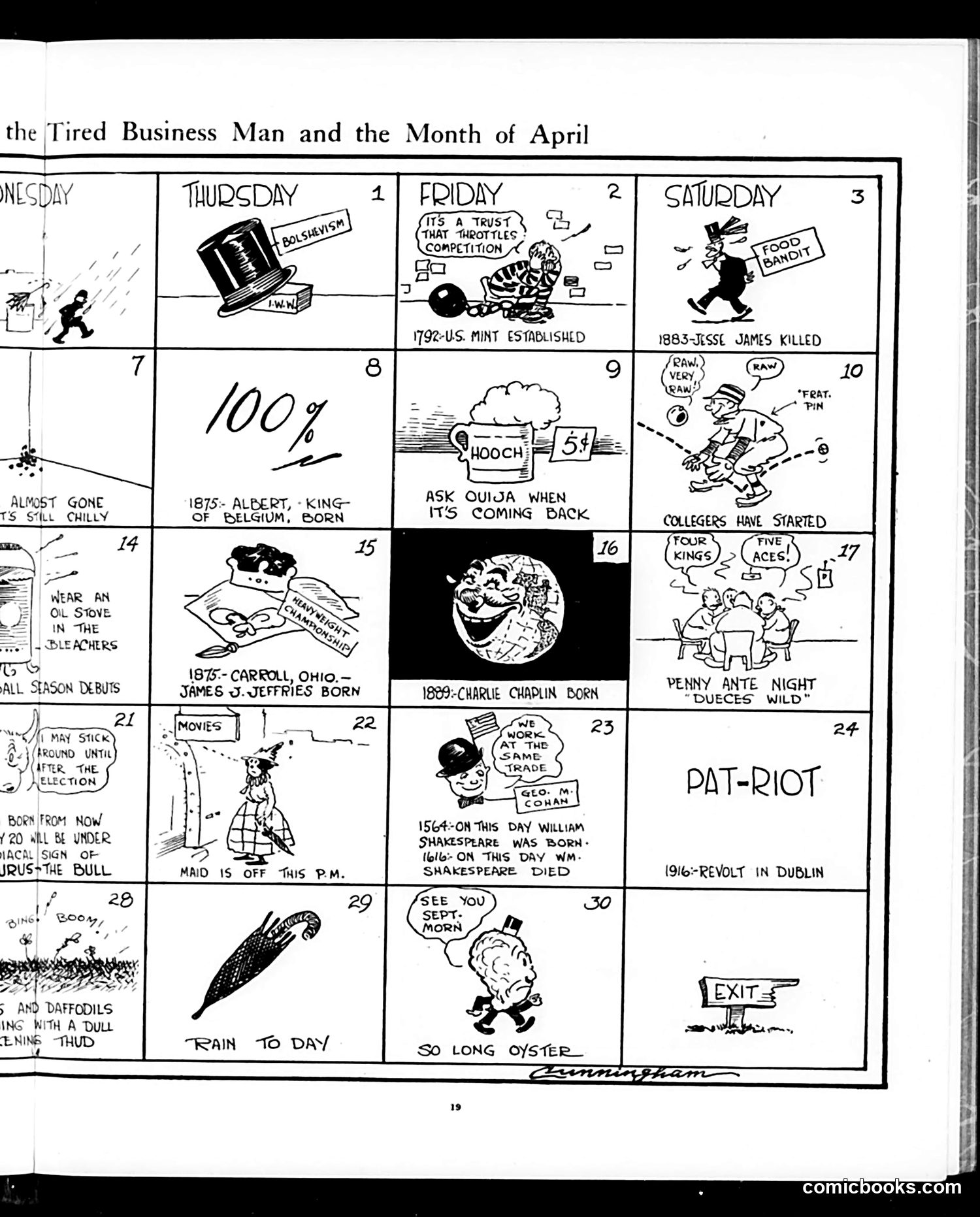
This is a daily calendar comic strip tracking April's events and observations for an exhausted businessman. Each panel combines humor with historical facts: **Key elements:** - April opening depicts a rainy, chilly season requiring absurd preparations (oil stoves in bleachers) - Panel 8 shows a "100%" graph—likely referencing stock market or business anxiety - Panel 15 mentions James J. Jeffries (heavyweight boxer), connecting sports to daily life - Panel 16: Shakespeare's birth and death both occurred on April 23, treated as cosmic coincidence - Panel 24: "Pat-Riot" appears to reference the 1916 Easter Rising in Dublin (Irish independence rebellion) - The final panel shows an "EXIT" sign—the exhausted businessman escaping April's chaos **The satire:** The strip mocks how April bombards the American businessman with competing demands—weather, markets, historical obligations, entertainment, and social upheaval—making it an impossibly chaotic month. The "tired businessman" persona was Judge magazine's recurring everyman character.
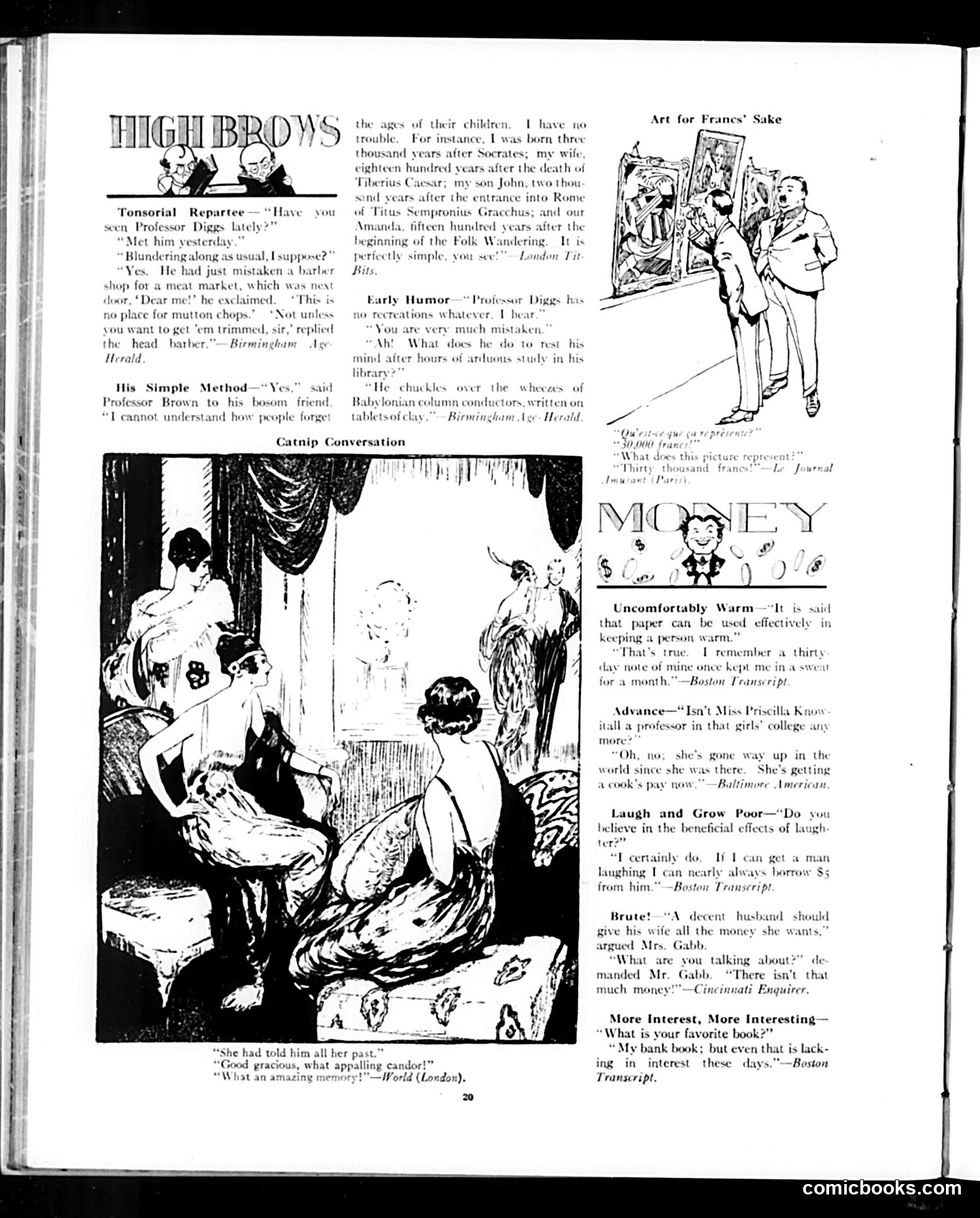
This page contains **humorous short anecdotes and quips** rather than political cartoons. The content satirizes early 20th-century American social life through brief jokes. Key sections include: **"Tonsorial Repartee"** and **"His Simple Method"**: Mock absent-minded Professor Diggs, a recurring character who confuses a barber shop with a meat market—satirizing academic types as impractical. **"Early Humor"**: Jokes about Professor Diggs relaxing by reading Babylonian clay tablets, poking fun at scholarly pedantry. **"Catnip Conversation"** through **"More Interesting"**: One-liners about marriage dynamics, money troubles, and banking—reflecting Depression-era anxieties. The final joke about a bank book lacking "interest" is a financial pun. **The illustration** (top right) depicts an art dealer or appraiser discussing a painting, likely mocking pretentious art criticism common among the wealthy. Overall, this page represents Judge's characteristic middle-class humor targeting academics, married couples, financial struggles, and cultural pretension.
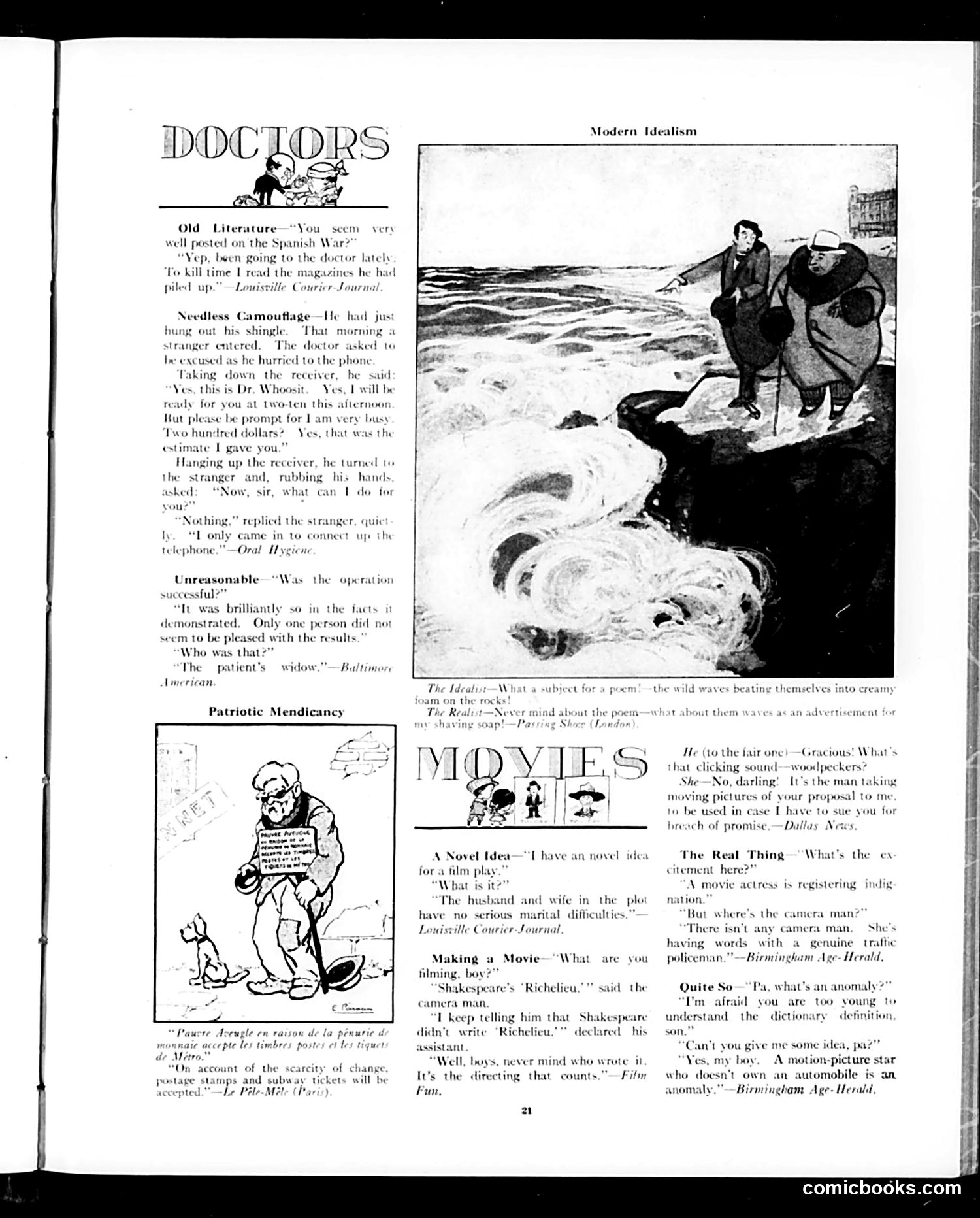
This page contains several short humorous anecdotes satirizing early 20th-century American life: **"Old Literature"** mocks how people read magazines in doctors' waiting rooms to kill time during the Spanish-American War era. **"Needless Camouflage"** jokes about a doctor pretending to be busy on the phone to justify high fees, then admitting to a stranger he has nothing to do—exposing medical profession dishonesty. **"Unreasonable"** satirizes a widow's complaint about a successful operation, suggesting patients are ungrateful or litigious. **"Patriotic Mendicancy"** (with cartoon) shows a beggar claiming disability to solicit donations—critiquing fraudulent charity appeals. The remaining items are brief quips about movies, filmmaking, and social conventions. Overall, the page reflects Judge's characteristic satire targeting professional pretension, commercialism, and American foibles rather than specific political figures or events.
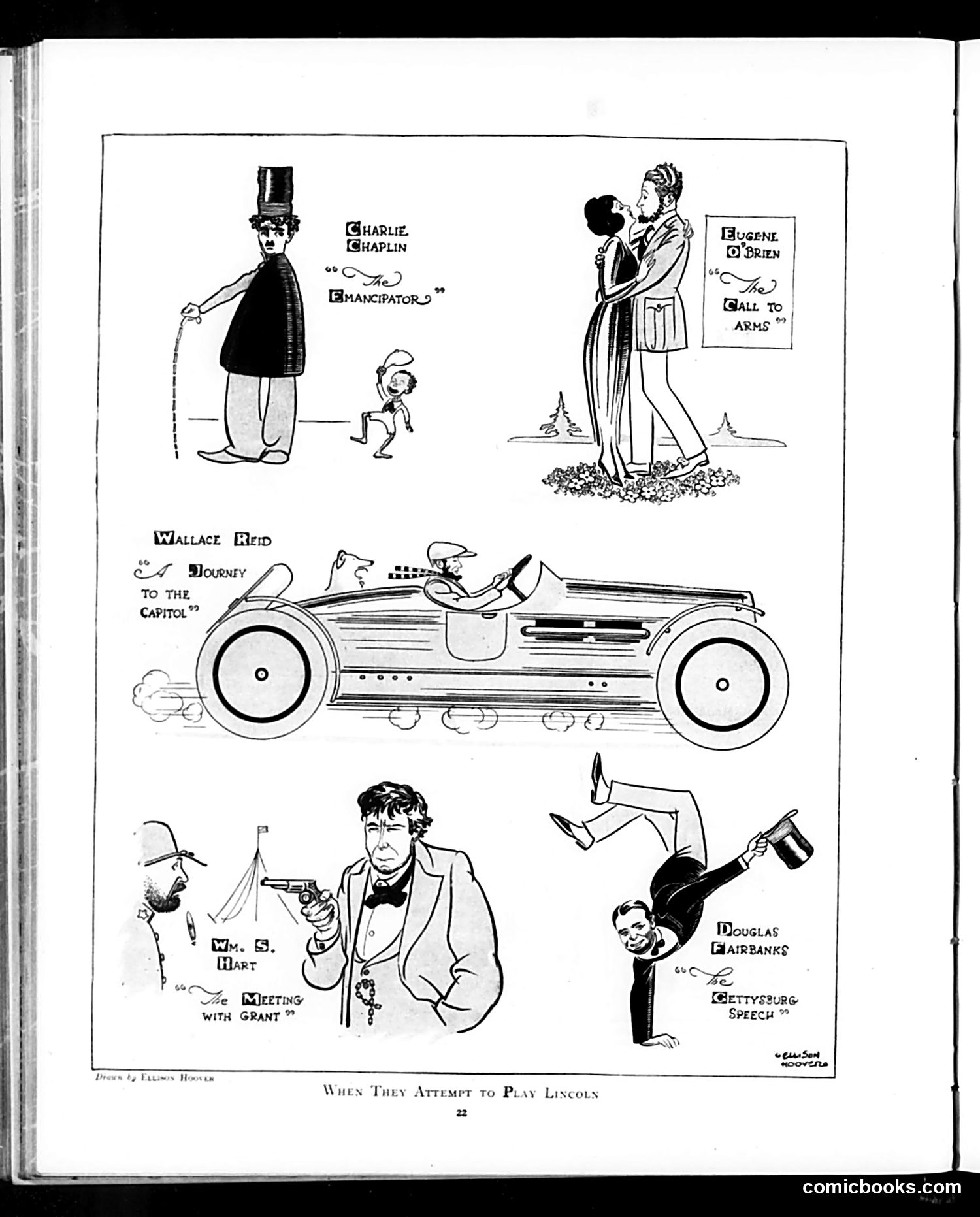
This Judge magazine cartoon satirizes famous actors and public figures attempting to portray Abraham Lincoln on stage. The page depicts: - **Charlie Chaplin** as "The Emancipator" (referencing his "Tramp" character with cane and bowler hat) - **Eugene O'Brien** in "The Call to Arms" - **Wallace Reid** in "A Journey to the Capitol" (shown in a racing car) - **W.S. Hart** "Meeting with Grant" (a Western actor, shown with gun) - **Douglas Fairbanks** performing "The Gettysburg Speech" (doing an acrobatic handstand) The satire mocks these entertainers for attempting serious historical drama about Lincoln—suggesting their natural personas (comedian, action hero, acrobat) make them unsuitable for such dignified roles. The joke targets both the absurdity of miscasting and possibly Hollywood's commercialization of American history.
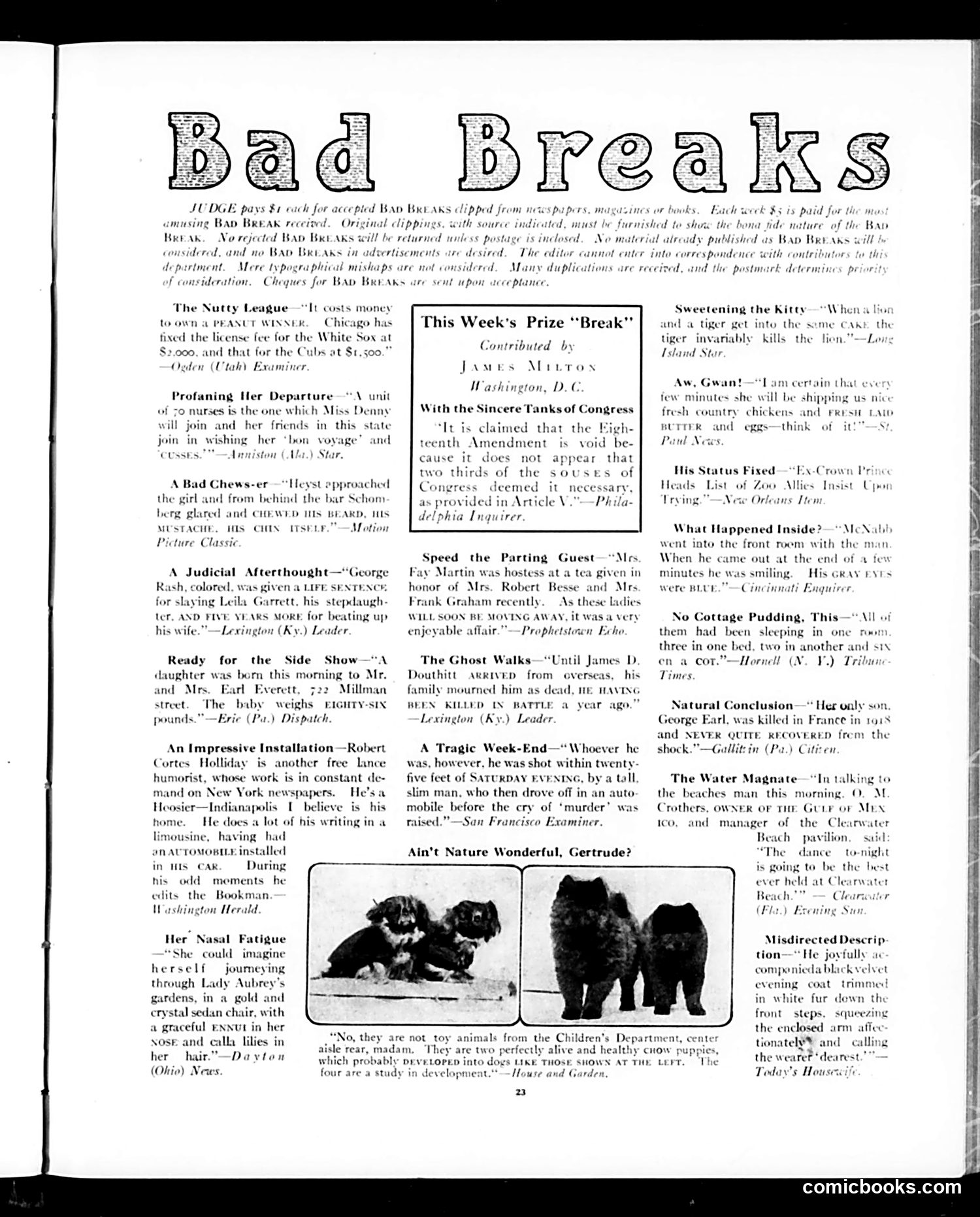
This page showcases "Bad Breaks," Judge magazine's humor feature paying $1 per accepted submission—newspaper clippings of unintentionally funny or absurd published sentences. The central cartoon "Ain't Nature Wonderful, Gertrude?" shows two young animals (appears to be puppies or similar creatures) with a caption explaining they're "perfectly alive and healthy" creatures from the Children's Department that "probably never[ed] into dogs like those shown at the left." The surrounding text consists of brief, funny newspaper excerpts—such as a Chicago baseball license fee described as a "Nutty League," a judicial sentence that adds years for "beating up his wife" after a murder conviction, and a birth announcement noting a baby weighs "SIXTY-SIX POUNDS." **The satire:** Judge ridiculed newspapers' careless editing and absurd reporting by republishing these genuine clippings. The humor relies on readers recognizing the logical contradictions, hyperbolic details, and editorial mishaps as real newspaper errors—satirizing press incompetence through simple reproduction.
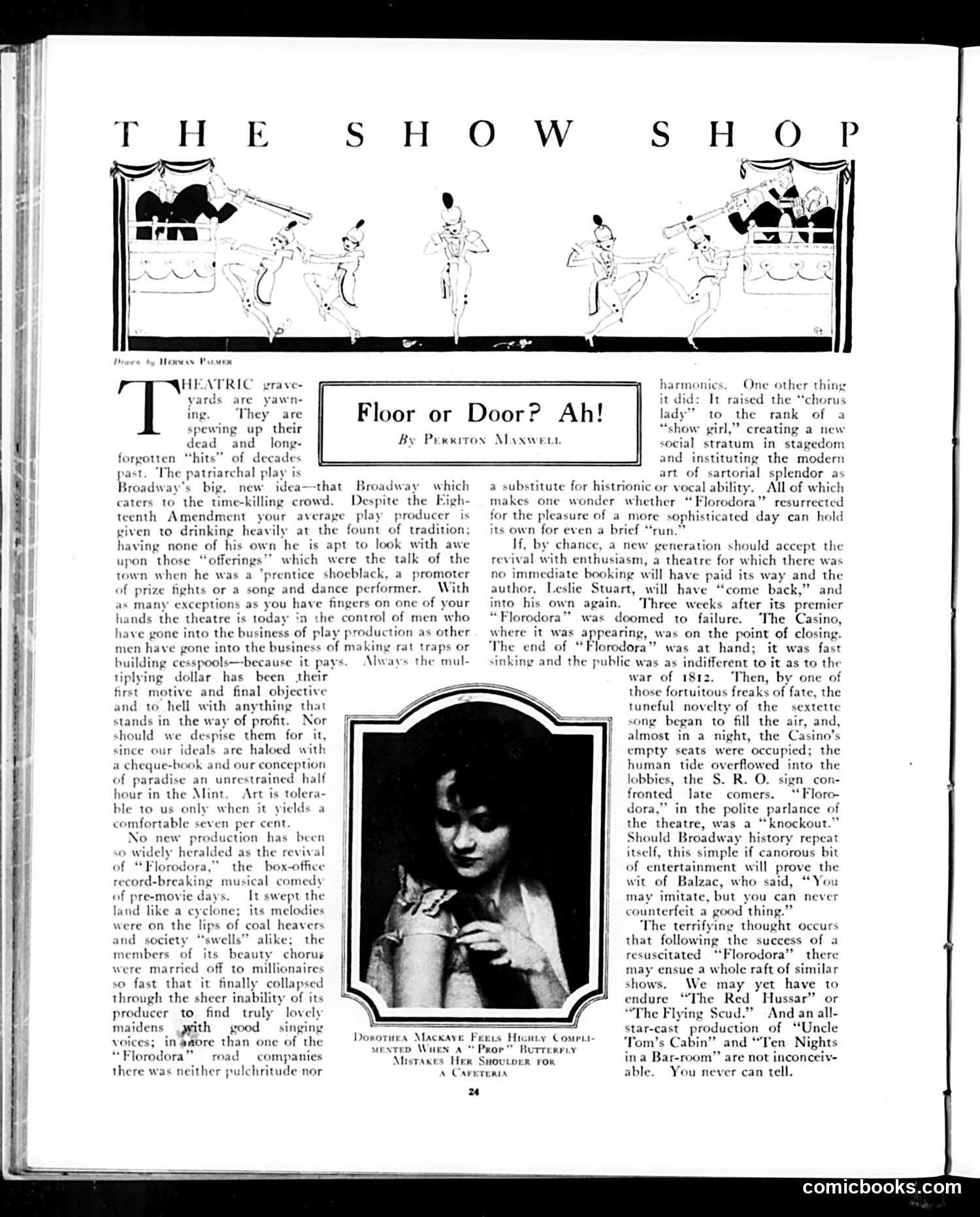
This article by Perckerton Maxwell critiques Broadway's commercial revival of the musical comedy *Florodora* (originally a 1899 hit). The satire targets several targets: **The Main Critique:** Broadway producers are profit-driven businessmen, not artists—they care only about money, comparing themselves to "rat trap" makers rather than cultivators of art. **The *Florodora* Revival:** The original show was famous for its beautiful chorus girls who married wealthy men, eventually causing the production to collapse from lack of replacement talent. Maxwell questions whether a modern audience will accept this resurrected spectacle, noting the show failed initially but succeeded through a catchy sextette song that created cultural frenzy—suggesting its appeal is superficial rather than substantial. **The Fear:** If the revival succeeds, Broadway will spawn countless similar revivals of old shows (*Red Hussar*, *Flying Scud*, *Uncle Tom's Cabin*) rather than creating new art. The illustration at top shows performers at "The Show Shop"—visualizing Broadway's theatrical entertainment factory mentality.
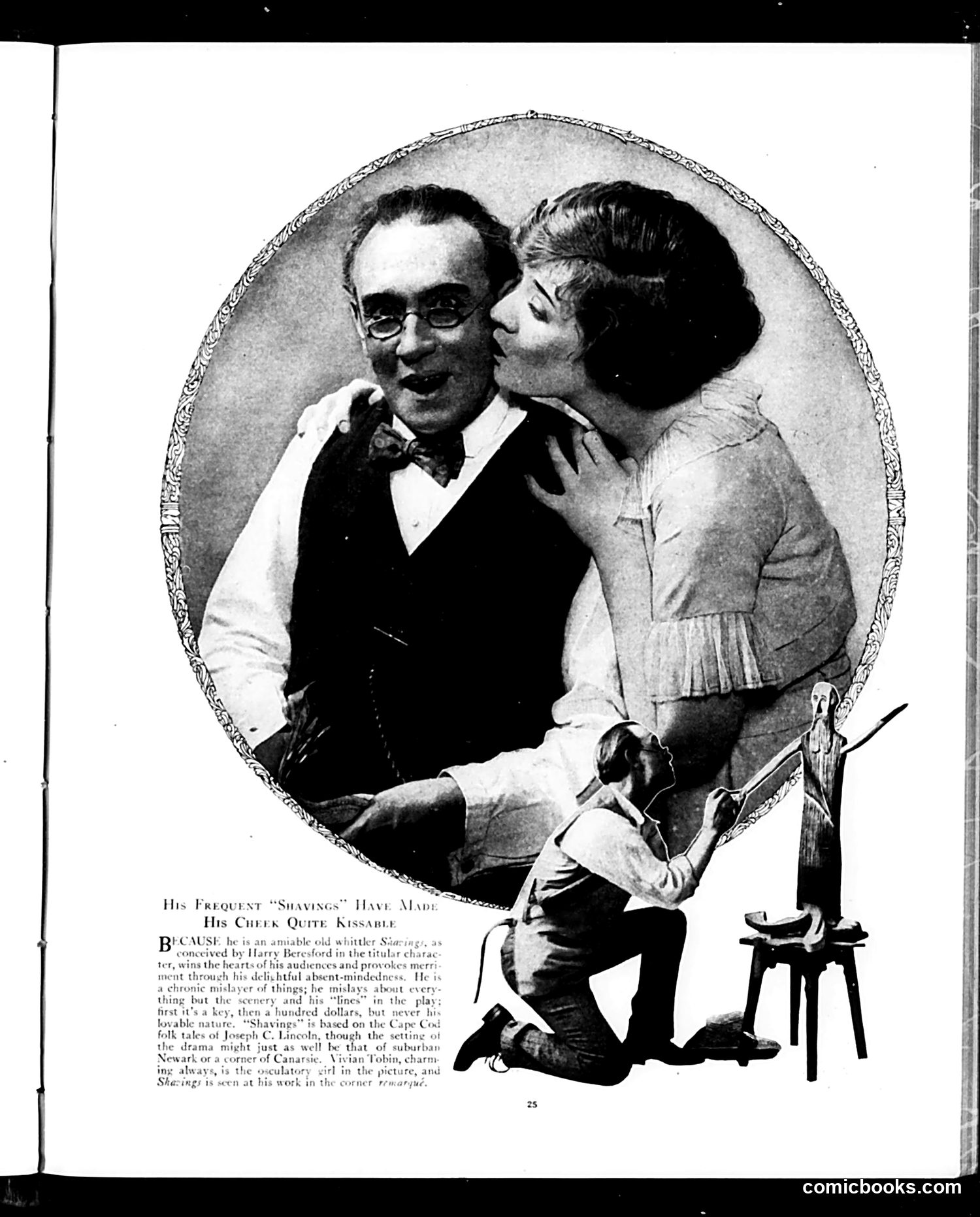
This page from *Judge* satirizes a theatrical character named "Shavings," described as "an absurd old winter" who is "chronic mislayer of things" and "midday about everything but the scenery and 'lines' in the play." The humor centers on Shavings's absent-minded personality—he loses keys, misplaces money, but never forgets his lines. The illustration shows what appears to be a scene from a play, with a man in formal attire (vest, bow tie, glasses) and a woman leaning in close. The caption's pun on "kissable" suggests the joke involves Shavings's romantic or comic misadventures on stage despite his scatterbrained nature. The satire mocks a particular theatrical type: the bumbling character actor whose competence on stage contradicts his chaos offstage—a common comic archetype in early 20th-century American theater.
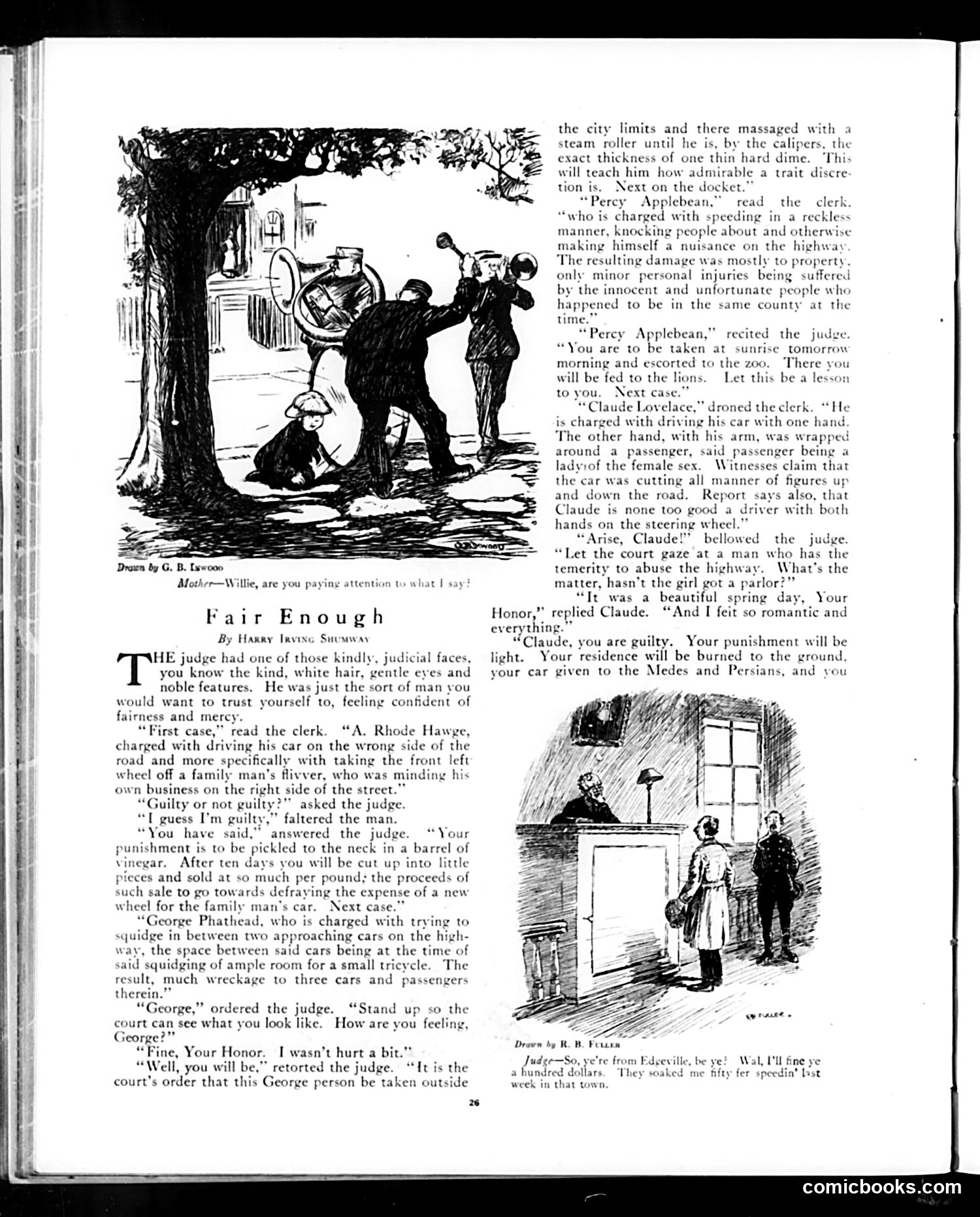
This satirical piece mocks judicial inconsistency and disproportionate punishment. A judge with a "kindly" appearance hands down absurdly severe sentences for minor traffic violations—pickled in vinegar, flattened by steamroller, fed to lions, burned alive—while treating romantic rule-breaking (driving one-handed while embracing a woman) with relative leniency. The satire targets early 20th-century traffic law enforcement, which was chaotic and newly codified. Judges apparently applied wildly inconsistent punishments, sometimes harsh and sometimes lenient, depending on circumstances. The exaggerated medieval-style tortures underscore how irrational these sentences appeared. The joke's edge lies in exposing class and moral bias: reckless endangerment deserves execution, but seduction during a joyride merits only property destruction. This lampoons how courts valued property damage and social propriety differently than actual human safety.
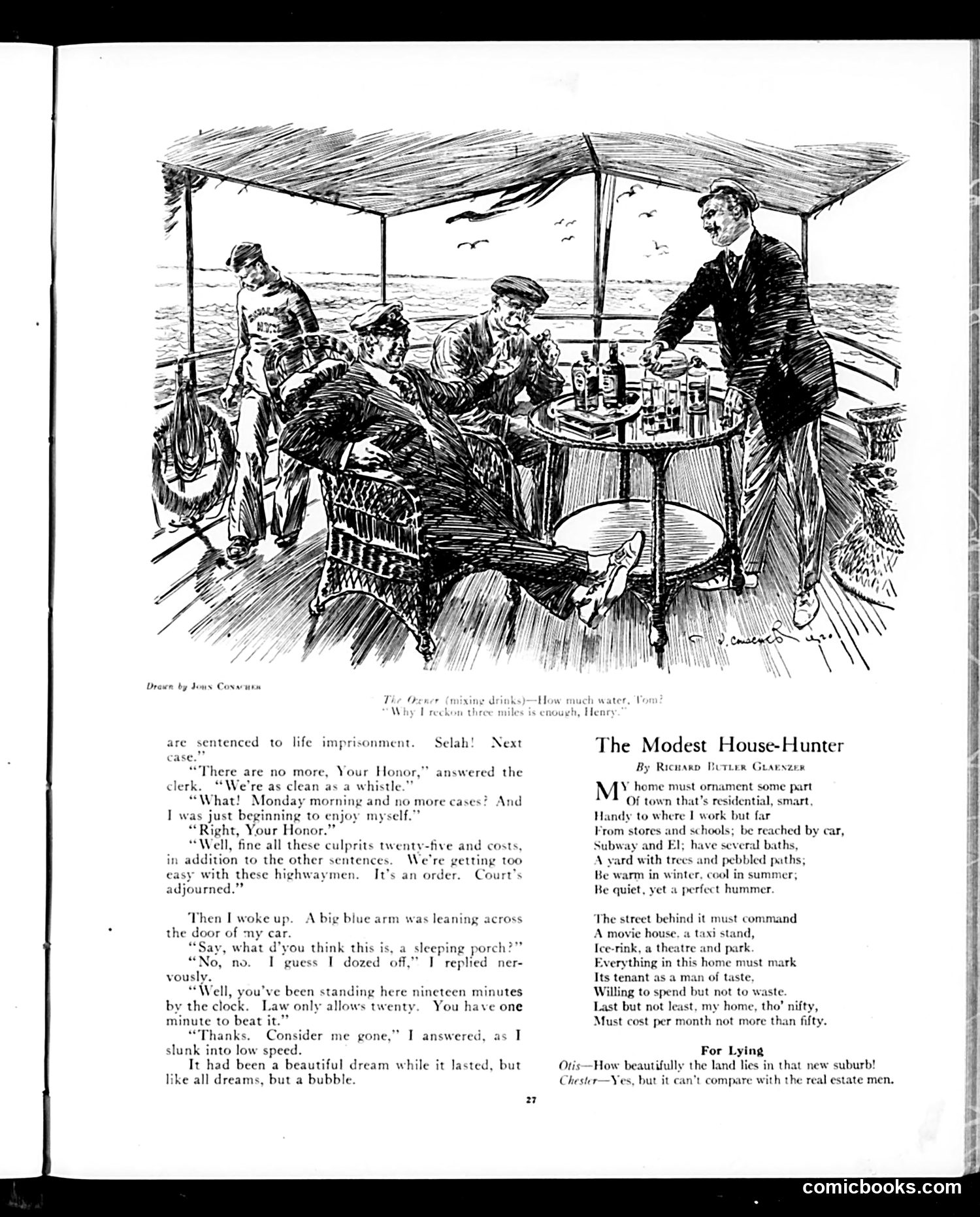
This page contains two distinct pieces of satire: **Top illustration**: A dream sequence mocking judicial leniency. A judge dreams of a courthouse so efficient it has no cases—then actually *fines* the remaining defendants extra money just to have something to do. The satire targets judicial corruption and judges who seem more interested in extracting fees than dispensing justice. The dream ends when a policeman rudely wakes the narrator for an illegal parking violation, suggesting ironic commentary: minor traffic enforcement is aggressively pursued while courtroom abuses go unchecked. **"The Modest House-Hunter" (poem)**: Satirizes unrealistic middle-class housing expectations. The narrator wants a fashionable residential home with impossible contradictions: near work yet far from stores/schools; quiet yet entertainment-adjacent (movie houses, theaters); luxurious (multiple baths, trees) yet affordable at under fifty dollars monthly. **"For Lying" (dialogue)**: A brief joke comparing lying—presumably about real estate—with actual real estate salesmen's deceptions, suggesting estate agents are even bigger liars than casual fibbers. All three pieces mock urban professionals' aspirations and institutional dishonesty.
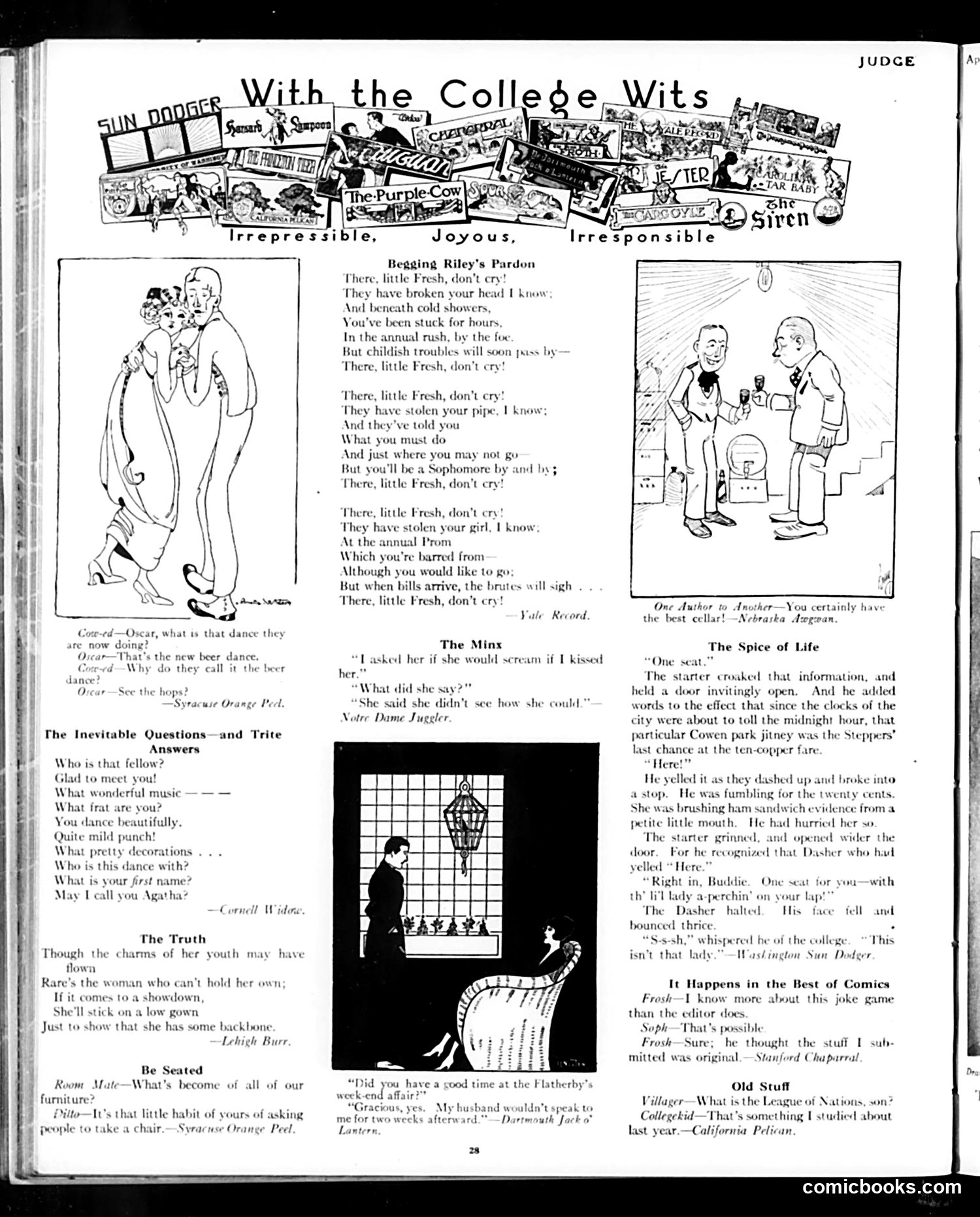
This page collects collegiate humor and satire targeting college students and campus life around the early 20th century. **Key content:** The main cartoon "Begging Riley's Pardon" mocks freshman hazing—a common college ritual where upperclassmen tormented new students by stealing their possessions, restricting their movement, and barring them from social events like the Prom. The poem sarcastically consoles a "little Fresh" about broken heads, stolen pipes and girlfriends, and imposed restrictions, promising relief only when becoming a Sophomore. **Other jokes satirize:** - College social conventions ("The Inevitable Questions"—tired small talk at dances) - Dating etiquette ("The Minx"—a woman's coy response to a kiss proposition) - Student poverty and rushing ("The Spice of Life") - Academic mediocrity ("It Happens in the Best of Comics") The overall tone treats collegiate life as simultaneously ridiculous and familiar to Judge's educated, middle-class readership. The humor assumes knowledge of campus traditions, social hierarchies, and the awkwardness of college socializing.
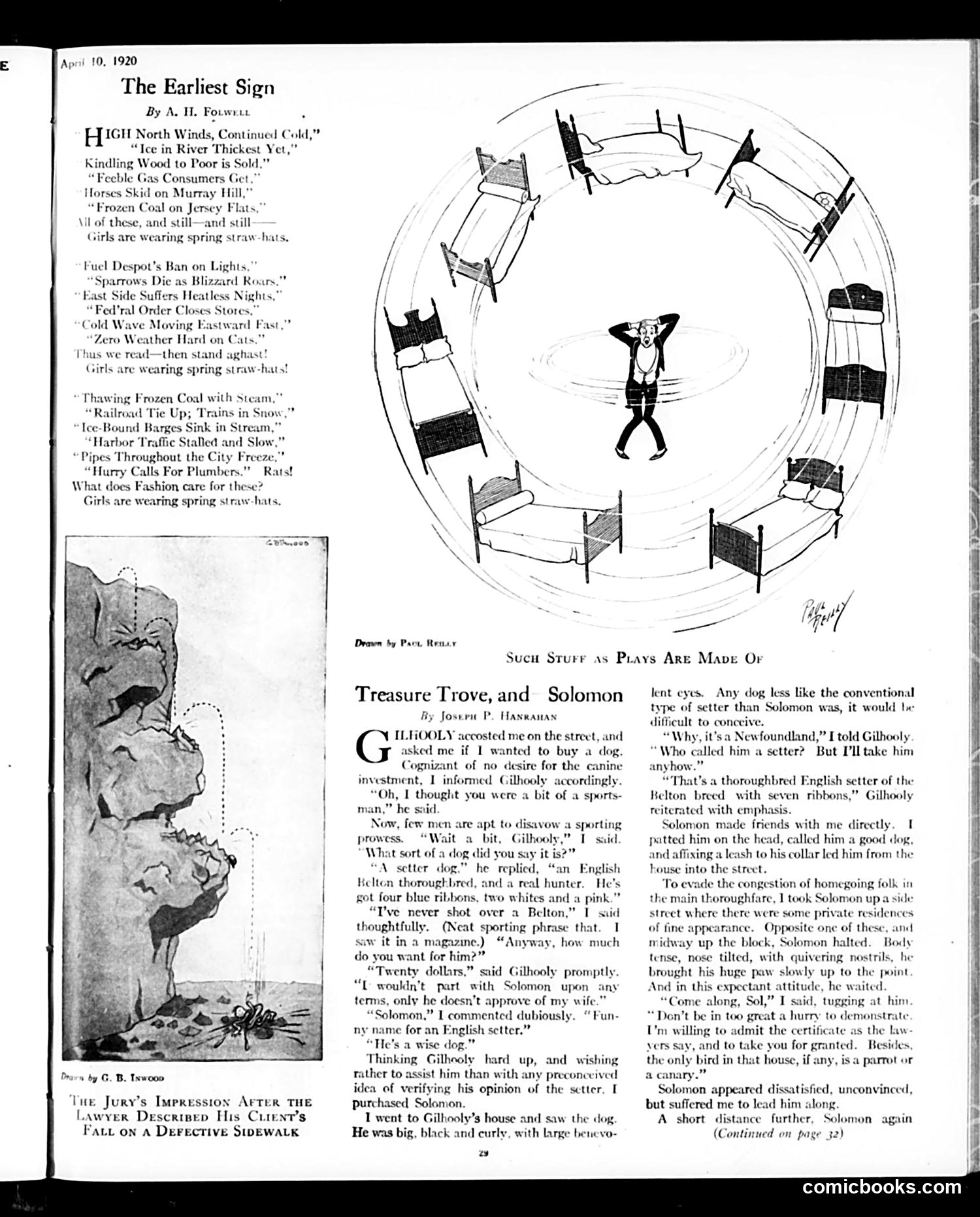
**Top poem**: Satirizes spring fashion's disconnect from brutal winter conditions. Despite newspaper headlines about severe cold, fuel shortages, frozen rivers, and city-wide suffering in 1920, women continue wearing spring straw hats—indicating fashion's imperviousness to practical hardship or economic crisis. The joke: fashion triumphs over reality. **Bottom illustration & story**: "Treasure Trove, and Solomon" depicts a con. Gilhooly sells the narrator a dog he claims is a prize English setter with ribbons, though it's obviously a Newfoundland. The buyer, wanting to appear sporting, purchases it cheaply. The story continues—Solomon's behavior suggests either Gilhooly's deception will be revealed or the dog's true breeding will emerge, making the narrator look foolish for the purchase. Both pieces mock people's susceptibility to foolish choices despite obvious contradictions—fashion ignoring weather, buyers ignoring what their eyes show them.
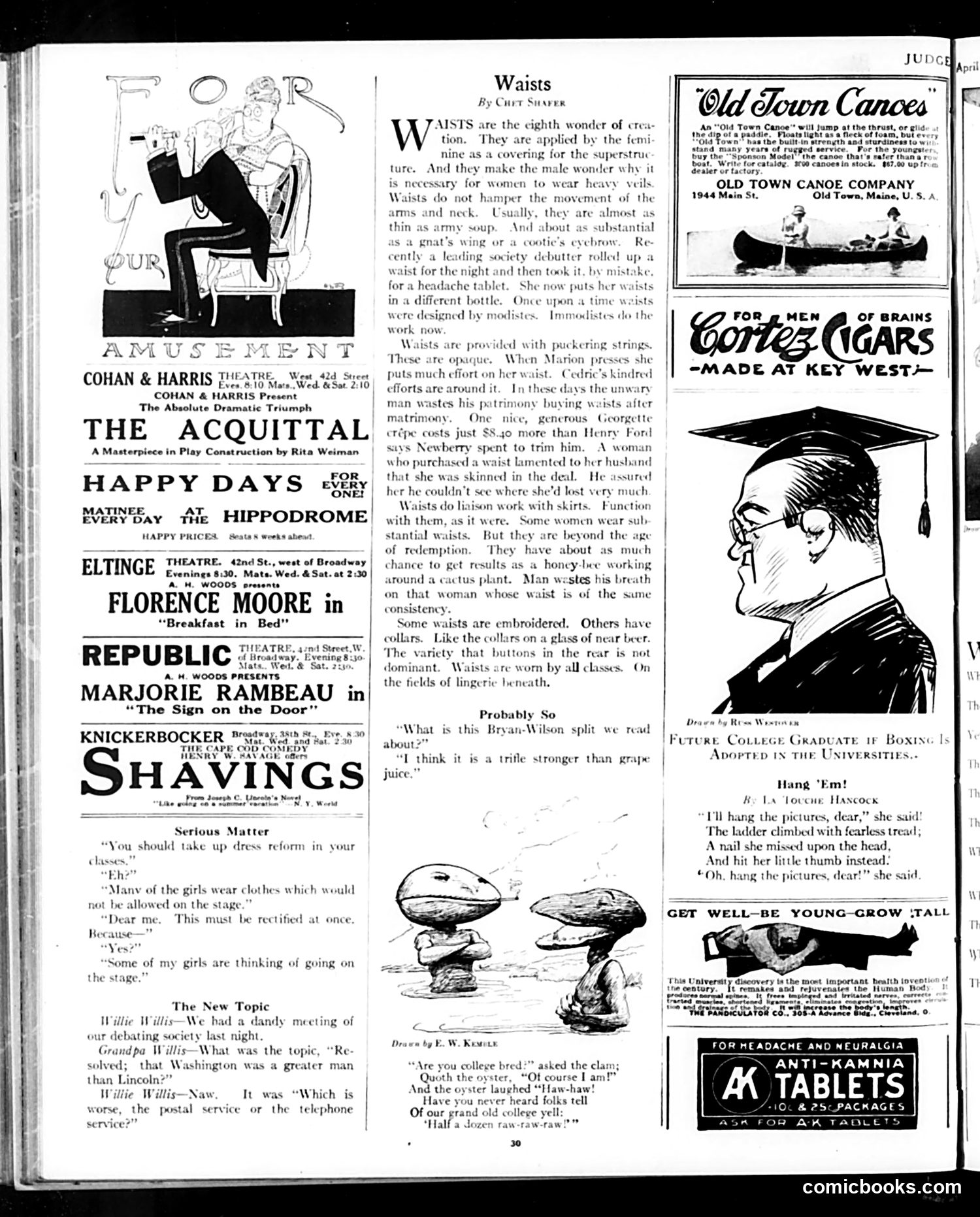
This page is primarily **advertising and theatrical listings** with minor satirical content. The main elements: **Theater advertisements** dominate the left side, promoting Broadway shows including "The Acquittal," "Shags," and others—typical Judge content targeting educated urban audiences. **The "Waists" article** is a humor piece mocking women's fashion, particularly the corset-like waist garments of the era. It satirizes their impracticality (women carrying them in bottles for headaches) and expense, while making crude observations about women's bodies and marriage. **Two brief jokes** appear: one about a debate society topic comparing Washington and Lincoln, another playing on "college bred" as a pun with oysters. **The cartoons** are minor: one shows mushroom-like figures (meaning unclear), another illustrates the "college yell" joke. The page reflects early-20th-century Judge magazine's formula: theatrical advertisements mixed with light social satire aimed at middle-to-upper-class readers, with humor often relying on gender stereotypes and wordplay that now reads as dated or crude.
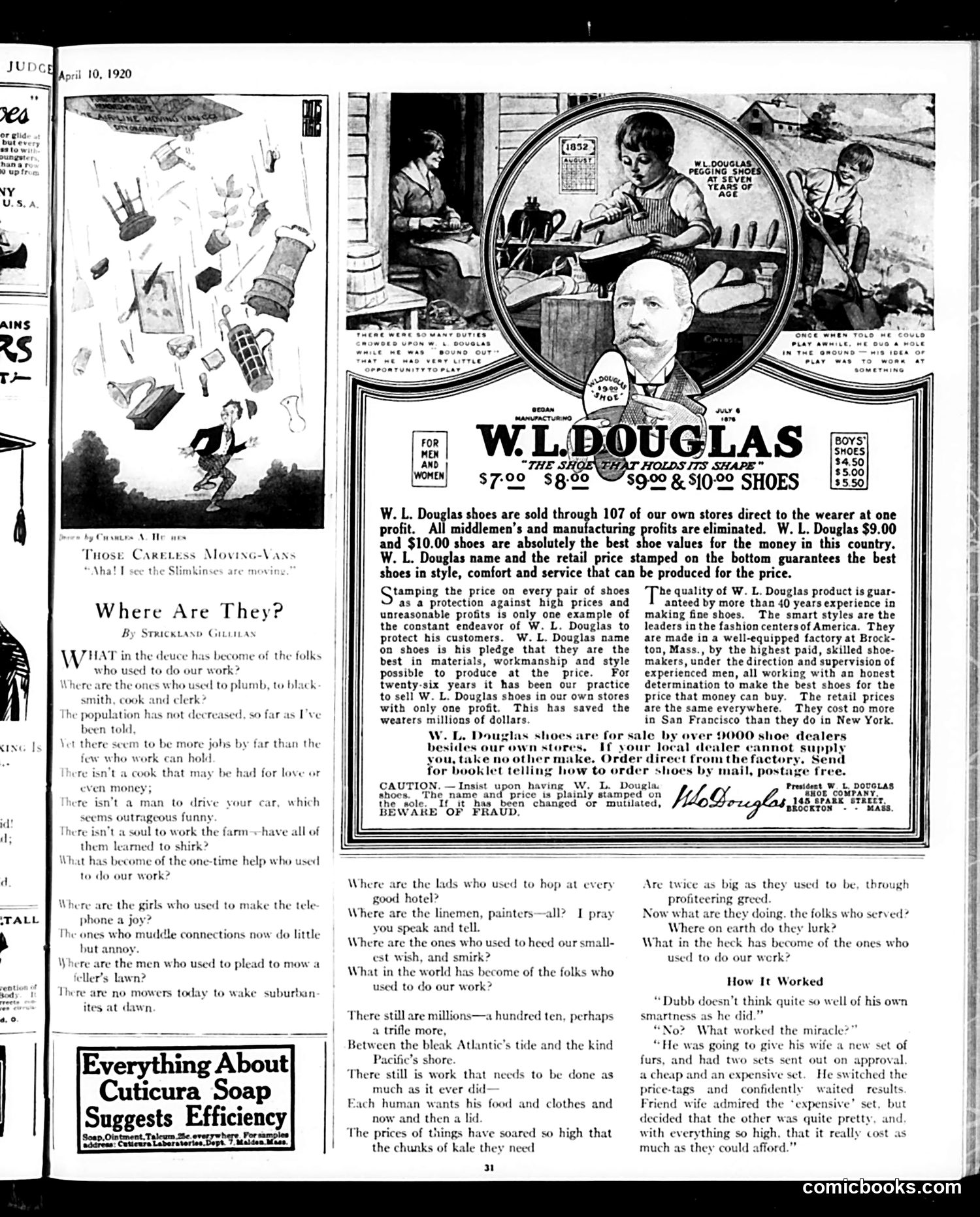
This page primarily features **W.L. Douglas shoe advertising**—a major brand emphasizing direct-to-consumer sales and price transparency. The ad claims shoes are stamped with retail prices to prevent fraud and "profiteering." The left column contains **"Where Are They?"**, a satirical poem by Struthers Burt lamenting labor shortages post-WWI. It repeatedly asks: what happened to the workers who used to do manual labor—plumbers, blacksmiths, cooks, farmhands, telephone operators? The poem attributes their absence to shirking or "profiteering greed," suggesting workers have abandoned their jobs or demands have inflated wages. The context: This reflects genuine 1920 anxieties about labor scarcity and rising prices following World War I. Workers had leverage and higher expectations; employers resented wage demands. The joke's bitterness: The poem presents worker absence as laziness rather than acknowledging improved bargaining power or post-war economic shifts—typical of era class tensions.
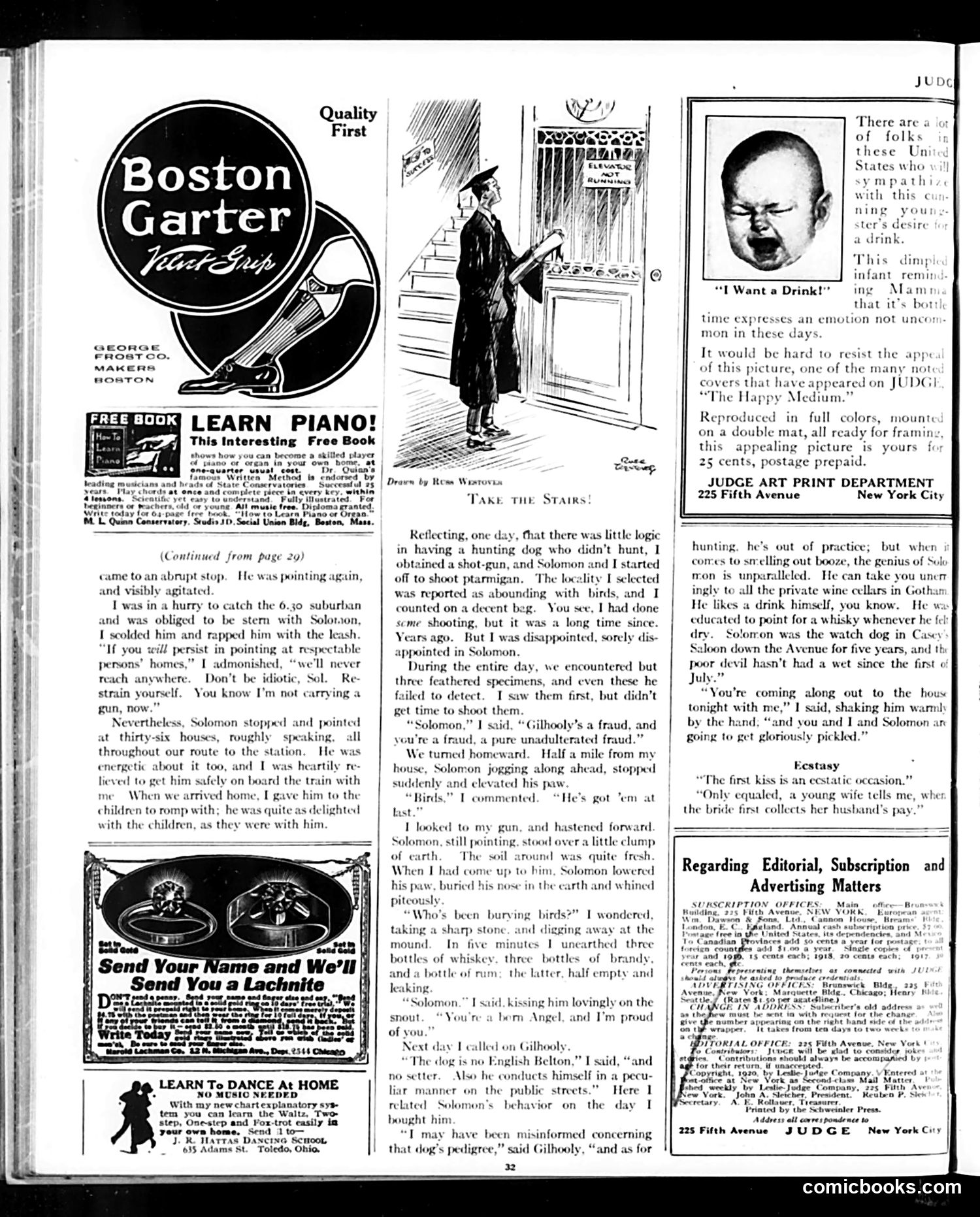
**Main Cartoon ("Take These Stairs")**: This story-cartoon ridicules a man who buys "Solomon," supposedly a hunting dog from a dealer named Gilhooly. The dog proves worthless at actual bird hunting but proves remarkably skilled at detecting buried bootleg whiskey—revealing three bottles of illicit liquor hidden in the ground. The satire targets both the dog-seller's fraud and Prohibition-era alcohol smuggling. Solomon's "pointing" behavior becomes comic irony: he has a talent for finding contraband booze, not game birds. **Side Panel ("I Want a Drink!")**: A caricatured man expresses desperation for alcohol. The accompanying text sympathizes with this emotion "not uncommon in these days," directly referencing the unpopularity of Prohibition among American drinkers. Both pieces mock Prohibition enforcement and celebrate the public's continued desire for alcohol during this legally dry period (1920-1933).
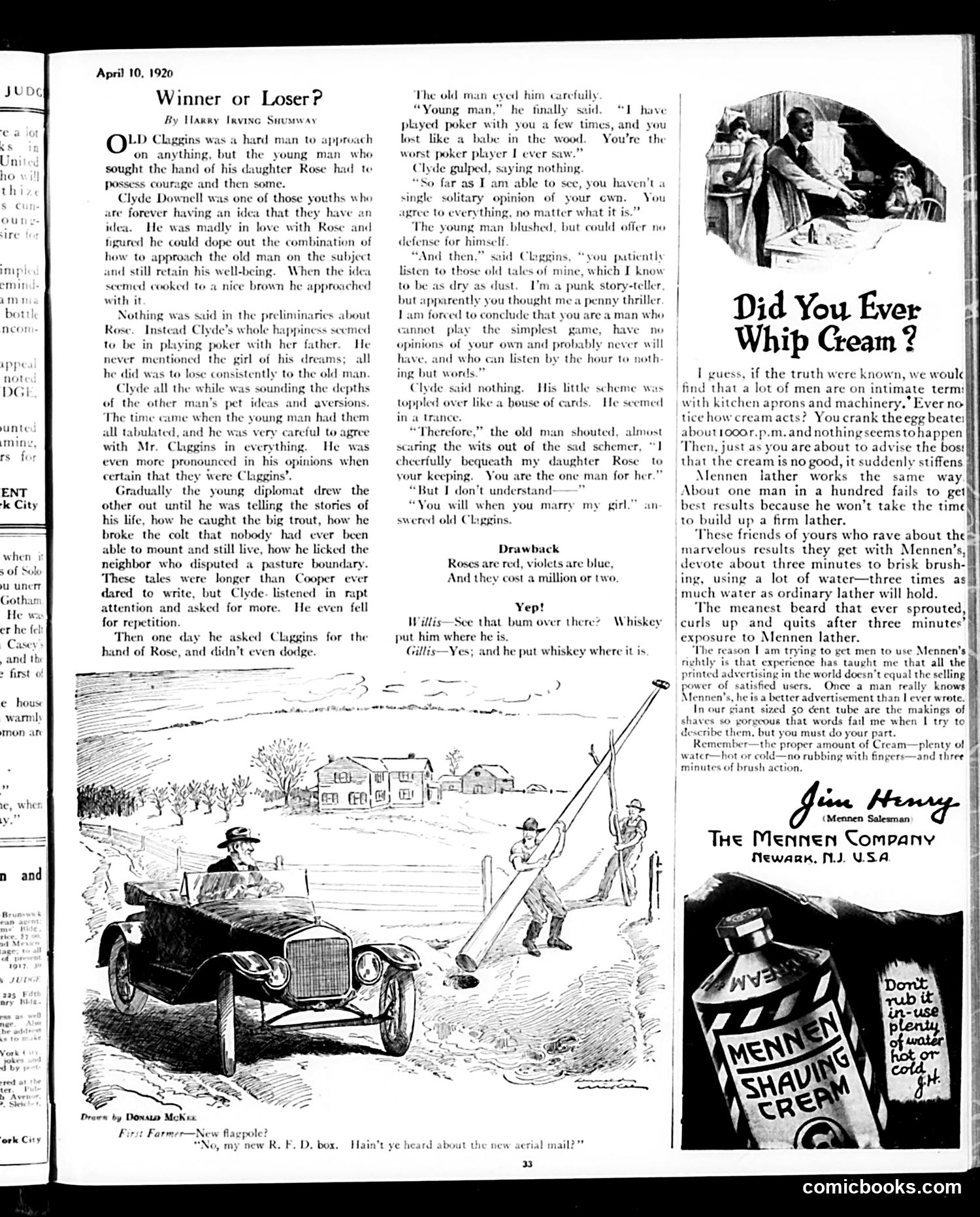
This story satirizes courtship strategy and male manipulation in the early 20th century. Young Clyde Downell pursues his sweetheart Rose by deliberately losing at poker to her father, Claggins, while pretending to agree with everything the older man says—a calculated performance designed to win his approval. The joke's twist: Claggins sees through the manipulation instantly. He recognizes that Clyde has no genuine opinions, cannot think strategically (poker skill), and merely flatters through false agreement. Claggins gives Rose to him *precisely because* he's identified Clyde as weak-willed—implying Rose will dominate the marriage anyway. The satire mocks both the elaborate courtship rituals of the era and the assumptions about masculine authority: the "successful" suitor is revealed as fundamentally spineless, making him suitable only for a wife who'll wear the pants. The page also contains a Mennen shaving cream advertisement and a brief joke about social class.
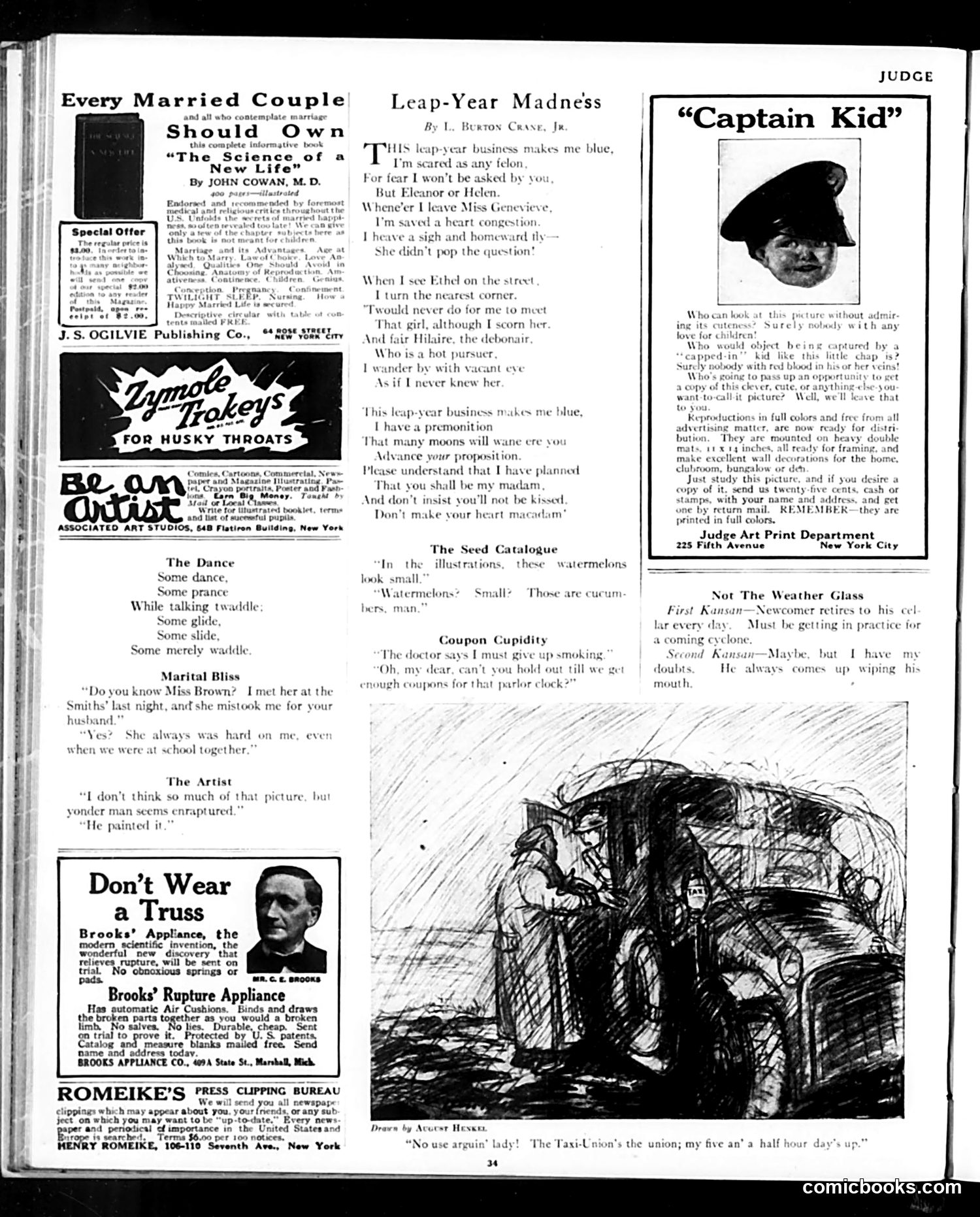
This page from *Judge* satirical magazine contains several distinct pieces: **"Leap-Year Madness"** (center) is a humorous poem exploiting the leap-year tradition where women propose to men. The satire mocks men's anxiety about being pursued for marriage during leap years—they hide, avoid streets, and fear commitment. It's gentle humor about gender role reversal. **"Captain Kid"** (right) advertises Judge's art print department, featuring a portrait of what appears to be a rough character. The accompanying text playfully questions whether viewers want to own such a "disreputable" image for home decoration—typical tongue-in-cheek advertising. The remaining content includes various short humor pieces ("The Dance," "Marital Bliss," "The Artist") alongside advertisements for marriage advice books, medical appliances, and newspaper clipping services. The page reflects early 20th-century concerns: marriage anxiety, gender dynamics, and commercialized "scientific" solutions to personal problems. The tone is lighthearted rather than cutting social commentary.
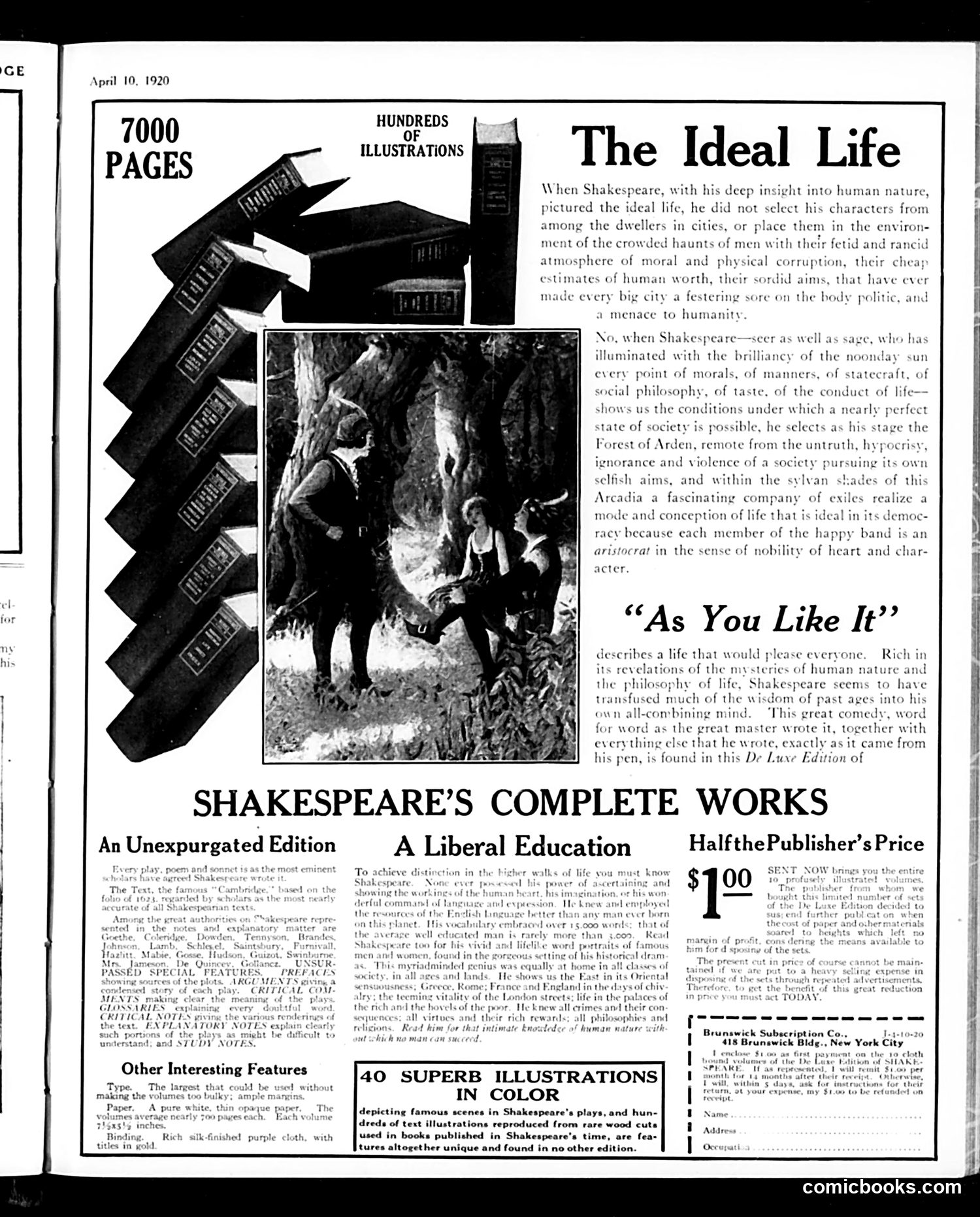
This is primarily **a book advertisement**, not a political cartoon. The page promotes a "De Luxe Edition" of Shakespeare's Complete Works, priced at $1.00. The editorial content uses Shakespeare's *As You Like It* to make a **social critique**: the essay argues that Shakespeare wisely set his ideal society in the Forest of Arden—a rural, remote setting—rather than in cities. The text explicitly contrasts this with urban life, describing cities as places of "moral and physical corruption," "sordid aims," and a "festering sore on the body politic." This reflects **early 20th-century anxieties about urbanization and industrialization**. By 1920, American cities were crowded, polluted industrial centers filled with immigrants and workers. The advertisement's framing suggests that true civilization and virtue exist in pastoral, aristocratic settings—not in modern urban society. The pitch essentially sells Shakespeare as both entertainment and moral education for the middle-class reader seeking escape from corrupt city life.
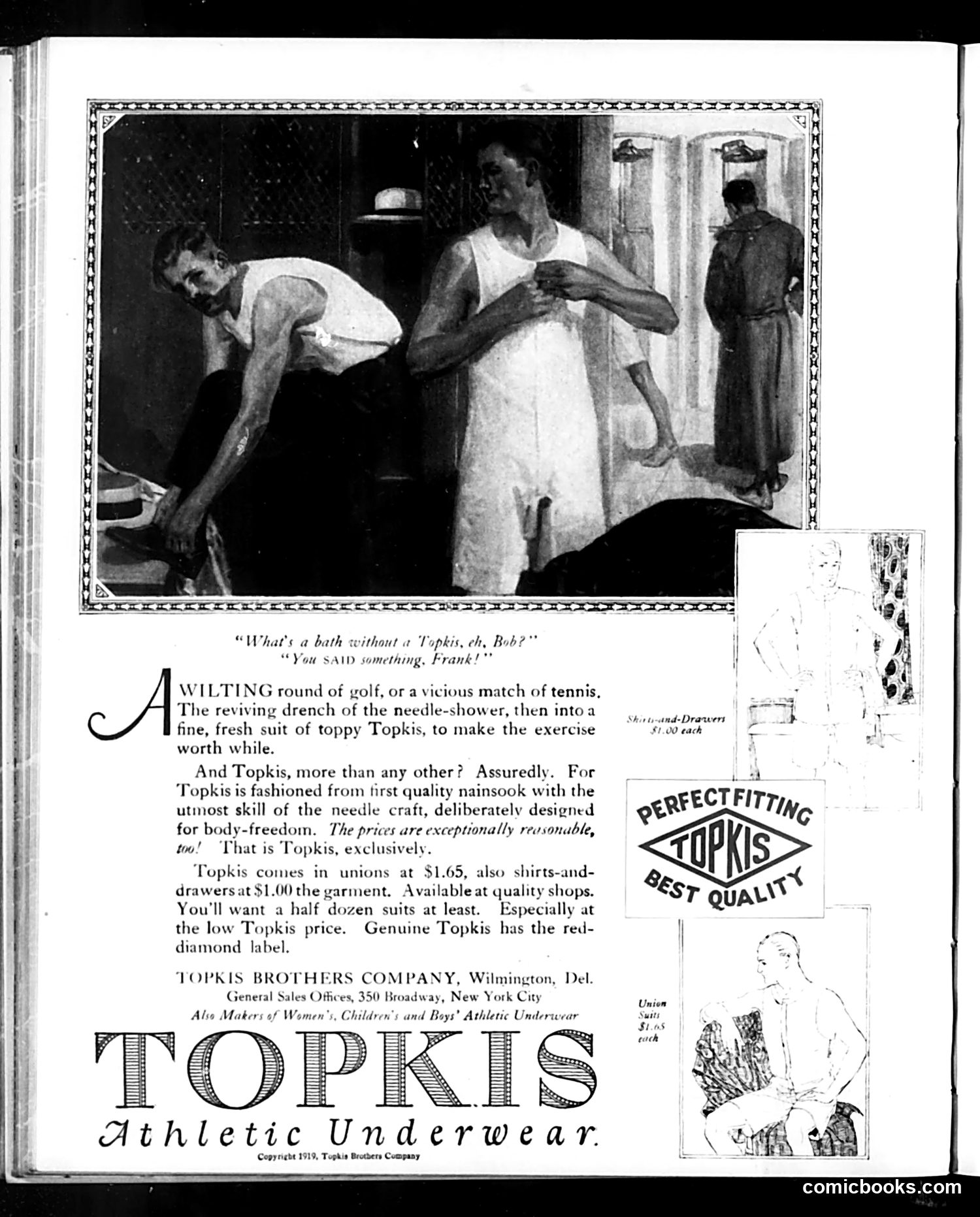
This is **primarily an advertisement**, not political satire. It promotes Topkis brand athletic underwear through a staged scene showing men after sports activity. The small comic dialogue ("What's a bath without a Topkis, eh, Bob?" / "You SAW something, Frank!") appears to be gentle humor about the practical need for fresh undergarments post-exercise—the implication being one man notices another's obvious need for a change. The page markets Topkis as premium athletic wear for active men, emphasizing comfort, quality nainsook fabric, and affordability ($1.65 for unions). The red-diamond label serves as an authenticity marker. **Historical context**: This 1919 advertisement in *Judge* reflects early 20th-century marketing that normalized discussing men's undergarments publicly and associated branded products with athletic masculinity and modern convenience—relatively new advertising strategies for the era.