
Judge, 1920-04-10 · page 7 of 36
Judge — April 10, 1920 — page 7: what you’re looking at
What you’re looking at
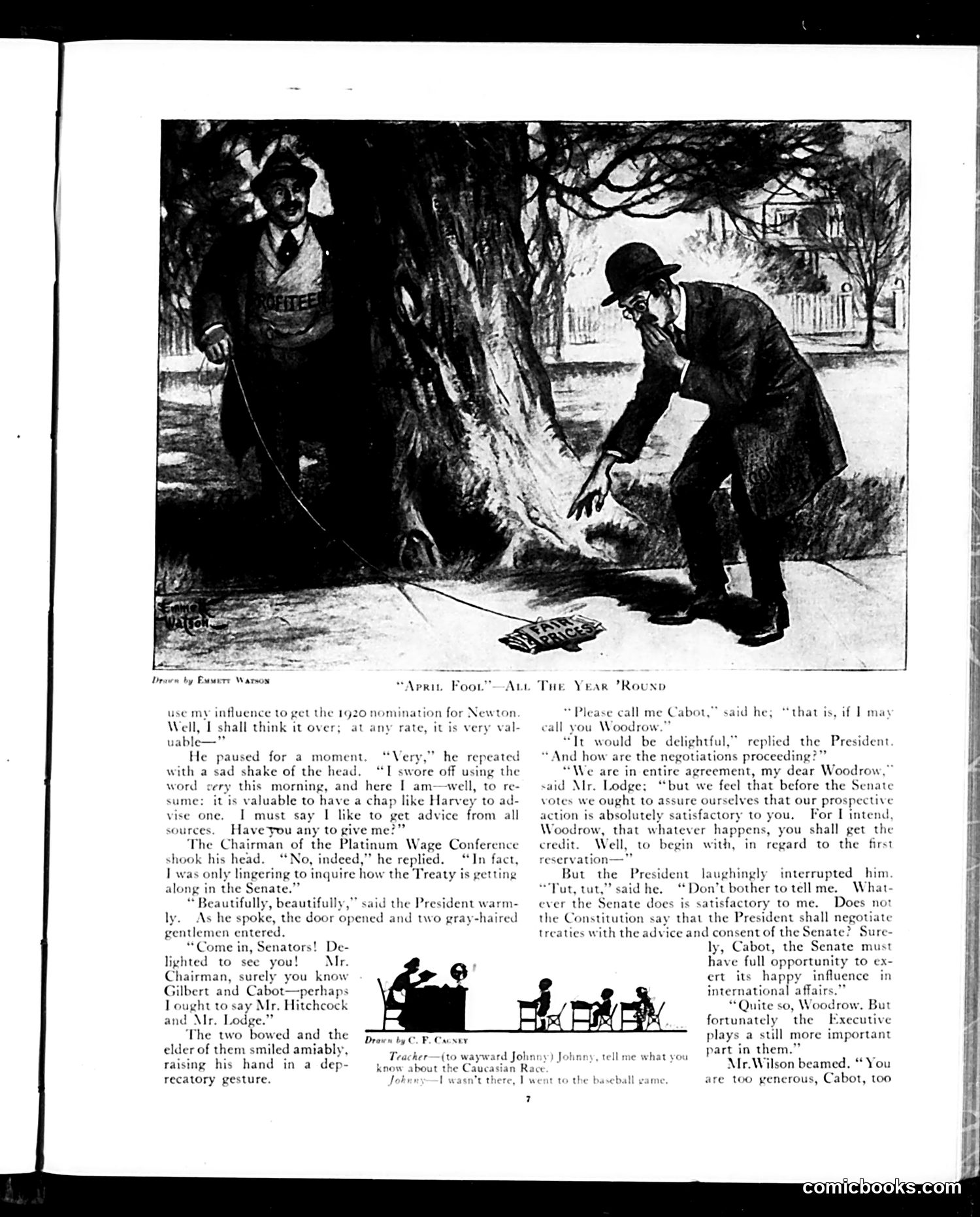
This 1920 Judge cartoon satirizes President Woodrow Wilson's handling of the League of Nations treaty ratification. The two visiting senators are **Henry Cabot Lodge** and **Gilbert Hitchcock**, key figures in the Senate's treaty debate. The satire targets Wilson's apparent passivity: Lodge and Hitchcock arrive ostensibly to consult him on Senate reservations to the treaty, but Wilson insists the Senate has full authority and that he's satisfied with whatever they decide. This is ironic, since historically Wilson *opposed* Lodge's reservations and fought hard against them. The cartoon mocks Wilson's diffident stance as political theater—he's so eager to appear cooperative that he's surrendering executive authority. The "April Fool" title suggests the entire exchange is foolish performance. The smaller panel with the "Teacher" makes an unrelated joke about the Caucasus Race (likely referencing baseball).
📄 Transcribed text from this page (OCR, searchable)
Machine-transcribed from the original scan — historical spelling and the odd misread are preserved.
“Aprit, Foon’ —Att use my influence to get the 1920 nomination for Newton Well, I shall think it over; at any rate, it is very val- uable—” He paused for a momer with a sad shake of the head. “I swore off using the word very this morning, and here | am—well, to re- sume: itis valuable to have a chap like Harvey to ad- vise one. I must say I like to get advice from all sources. Haveyou any to give me?” The Chairman of the Platinum Wage Conference shook his head. ‘*No, indeed,” he replied. “In fact, I was only lingering to inquire how the Treaty is getting along in the Senate.” “ Beautifully, beautifully,” said the President warm- ly. As he spoke, the door opened and two gray-haired gentlemen entered. “Come in, Senators! De- lighted to see you! = Mr. Chairman, surely you know Gilbert and Cabot—perhap I ought to say Mr. Hitchcock and Mr. Lodge.” The two bowed and the elder of them smiled amiably, raising his hand in a dep- 4, recatory gesture. I 2” he repeated g Drown by C.P. Caeser acher w about {to waywar the Caucasia 1 n't th The Year ’Rounp “Please call me Cabot,” said he; “that is, if | may call you Woodrow.” “It would be deli the “And how are the negotiations proceeding?” “We are in entire agreement, my dear Woodrow, said Mr. Lodge: “but we feel that before the Senate votes we ought to assure ourselves that our prospective action is absolutely satisfactory to you. For I intend Woodrow, that whatever happens, you shall get the credit. Well, to begin with, in regard to the first reservation But the President President laughingly interrupted him ut, tut idhe. “Don’t bother to tell me. What- ever the Senate does is satisfactory to me. Does not the Constitution say that the President shall negotiate treaties with the advice and consent of the Senate? Sure- ly, Cabot, the Senate must have full opportunity to ex- ert its happy influence i international affairs.” “Quite so, Woodrow. But fortunately the Executive plays a still more important part in them.” Mr.Wilson beamed. “ You are too generous, Cabot, too