
Judge, 1920-04-10 · page 24 of 36
Judge — April 10, 1920 — page 24: what you’re looking at
What you’re looking at
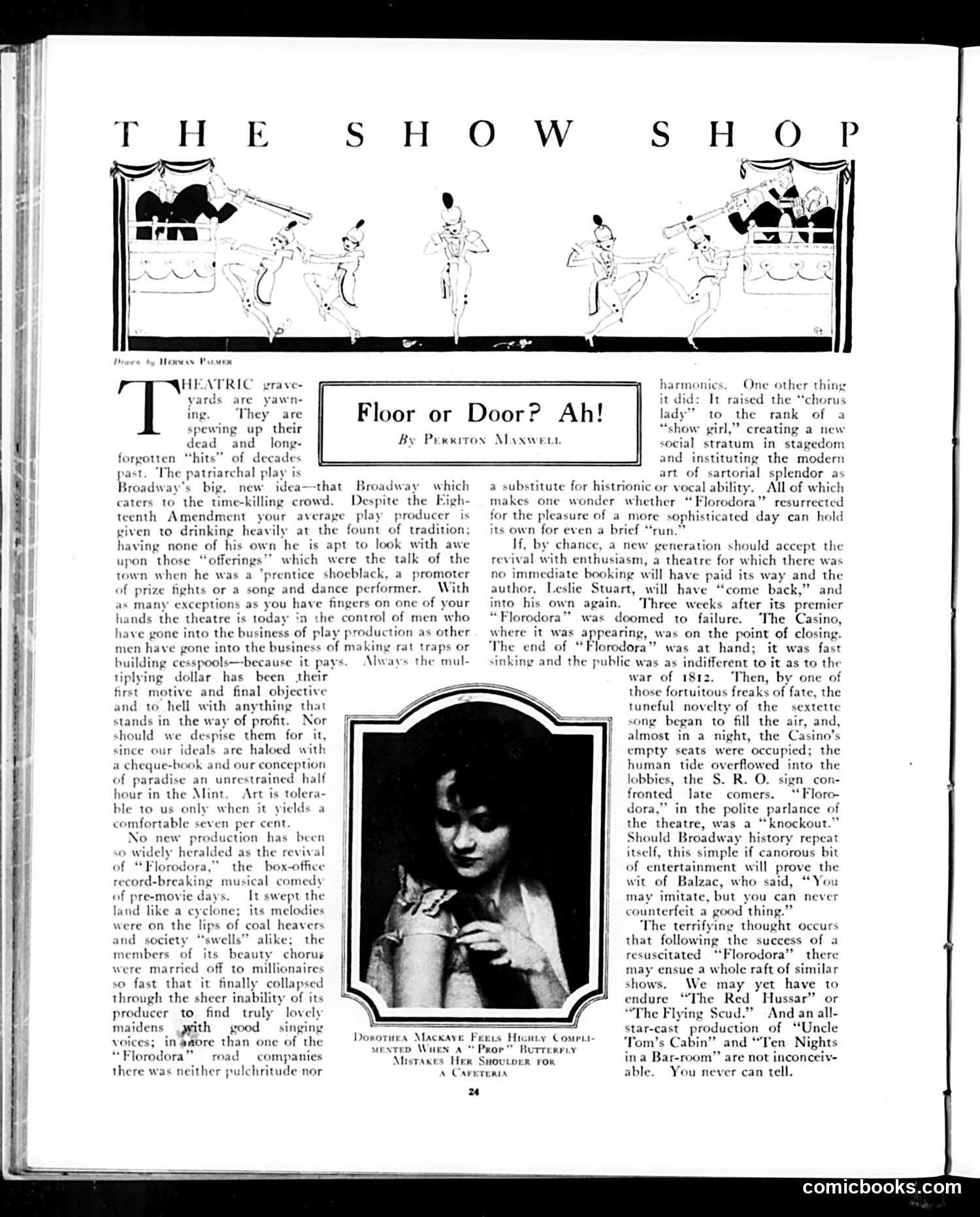
This article by Perckerton Maxwell critiques Broadway's commercial revival of the musical comedy *Florodora* (originally a 1899 hit). The satire targets several targets: **The Main Critique:** Broadway producers are profit-driven businessmen, not artists—they care only about money, comparing themselves to "rat trap" makers rather than cultivators of art. **The *Florodora* Revival:** The original show was famous for its beautiful chorus girls who married wealthy men, eventually causing the production to collapse from lack of replacement talent. Maxwell questions whether a modern audience will accept this resurrected spectacle, noting the show failed initially but succeeded through a catchy sextette song that created cultural frenzy—suggesting its appeal is superficial rather than substantial. **The Fear:** If the revival succeeds, Broadway will spawn countless similar revivals of old shows (*Red Hussar*, *Flying Scud*, *Uncle Tom's Cabin*) rather than creating new art. The illustration at top shows performers at "The Show Shop"—visualizing Broadway's theatrical entertainment factory mentality.
📄 Transcribed text from this page (OCR, searchable)
Machine-transcribed from the original scan — historical spelling and the odd misread are preserved.
A EE i QHEATRIC grave- yards are yawn- ing They are spewing up their ad and long- Floor or Door? Ah! By Pereirroxn Maxweut harmonies. One other thi it did: It raised the “chorus lady” to the rank of a “show girl,” creating a new social stratum in stagedom and instituting the modern forgotten “hits” of decades past. The patriarchal play is Broadway's big, new idea—that caters to the time-killing crowd. teenth Amendment your average play given to drinking heavily at the fount of tradition; having none of his own he is apt to look with awe upon those “offerings’’ which were the talk of the town when he was a ’prentice shoeblack, a promoter of prize fights or a song and dance performer. With 4s many exceptions as you have fingers on one of your hands the theatre is today in the control of men who have gone into the business of play production as other men have gone into the business of making rat traps or Always the mul- Broadway which Despite the Eig producer is building cesspools—because it pays tiplying dollar has been their first motive and final objective and to hell with anything that stands in the way of profit. Nor should we despise them for it, since our ideals are haloed with a cheque-book and our conception of paradise an unrestrained half hour in the Mint. Art is tolera- ble to us only when it yields a comfortable seven per cent. No new production has been o widely heralded as the revival of “Florodora,” the box-office record-breaking musical comedy of pre-movie days. It swept the land like a cyclone; its melodies were on the lips of coal heavers and society “swells” alike; the members of its beauty chorus were married off to millionaires so fast that it finally collapsed through the sheer inability of its producer to find truly lovely maidens ith good "singing voices; inaaore than one of the “Florodora” road — companies there was neither pulchritude nor wextep WHEN A Doxotues Mackaye Frets Hicnty Comp.i- “Pror” Burrerriy Mistaxes Hex Saoutper ror A CAPETERIA cy art of sartorial splendor as a substitute for histrionic or vocal ability. All of which makes one wonder whether “Florodora” resurrected for the pleasure of a more sophisticated day can hold its own for even a brief “run.” If, by chance, a new generation should accept the revival with enthusiasm, a theatre for which there wa no immediate booking will have paid its way and the author, Leslie Stuart, will have ‘come back,” and into his own again. Three weeks after its premier “Florodora” was doomed to failure. The Casino, where it was appearing, was on the point of closing. The end of “Florodora” was at hand; it was fast sinking and the public was as indifferent to it as to the war of 1812. Then, by one of those fortuitous freaks of fate, the tuneful novelty of the sextette song began to fill the air, and, almost in a night, the Casino's empty seats were occupied; the human tide overflowed into the lobbies, the S. R. O. sign con- fronted late comers. *‘Floro- dora,” in the polite parlance of the theatre, was a “knockout.” Should Broadway history repeat itself, this simple if canorous bit of entertainment will prove the wit of Balzac, who said, “You may imitate, but you can never counterfeit a good thing.” The terrifying thought occurs that following the success of a resuscitated “Florodora” there may ensue a whole raft of similar shows. We may yet have to endure “The Red Hussar’ or “The Flying Scud.” And an all- star-cast production of ‘Uncle ‘Tom’s Cabin” and “Ten Nights ina Bar-room” are not inconceiv- able. You never can tell. comicbooks.com