
A complete issue · 28 pages · 1917
Judge — November 10, 1917
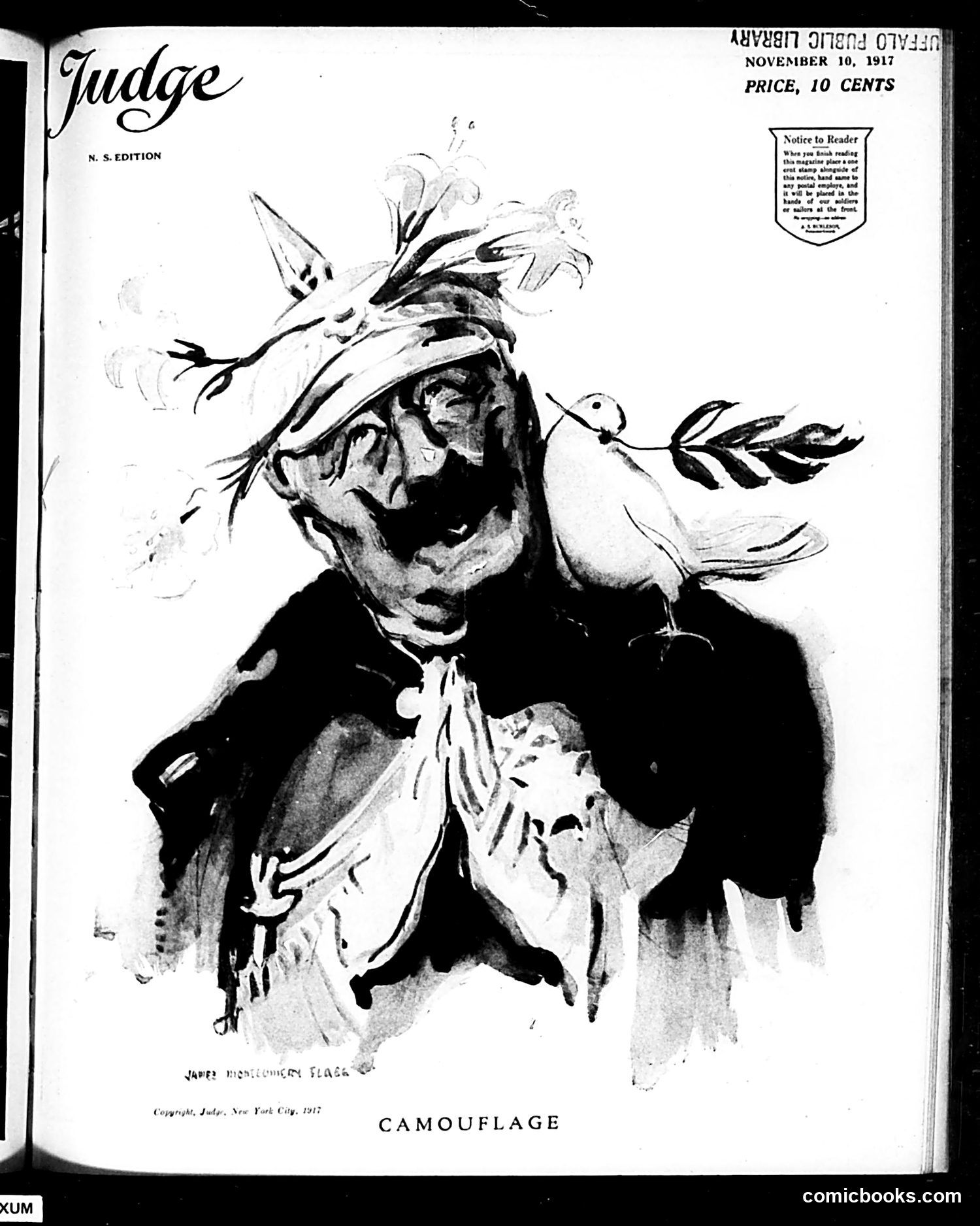
This Judge magazine cover depicts a caricatured figure wearing military attire with an exaggerated, distorted face. A white dove of peace perches on the figure's shoulder while branches and foliage sprout chaotically from the person's head. The title "Camouflage" suggests the cartoon critiques deceptive military or political concealment—likely referring to false peace gestures during World War I (America entered in April 1917). The dove symbolizes peace, but the grotesque face and wild vegetation suggest the figure's true nature is being hidden or disguised beneath peaceful rhetoric. The cartoon likely satirizes a political leader or military official whose public statements about peace contradict their actual warlike actions or intentions. The specific target remains unclear without additional context.

This page is **not a political cartoon or satire**—it's a straight product advertisement for Nujol, a laxative made by Standard Oil Company of New Jersey. The ad promotes Nujol as "The Healthiest Habit in the World," claiming it helps users develop regular bowel function "as clockwork" while being "absolutely harmless." The pitch suggests people can stop using Nujol but retain the habit it creates. This appears in *Judge*, a satirical magazine, but functions as paid advertising. The irony a modern reader might catch: Standard Oil—known for petroleum products—selling a medicinal oil for constipation. The "regular as clockwork" phrase was common period advertising language for digestive regularity.
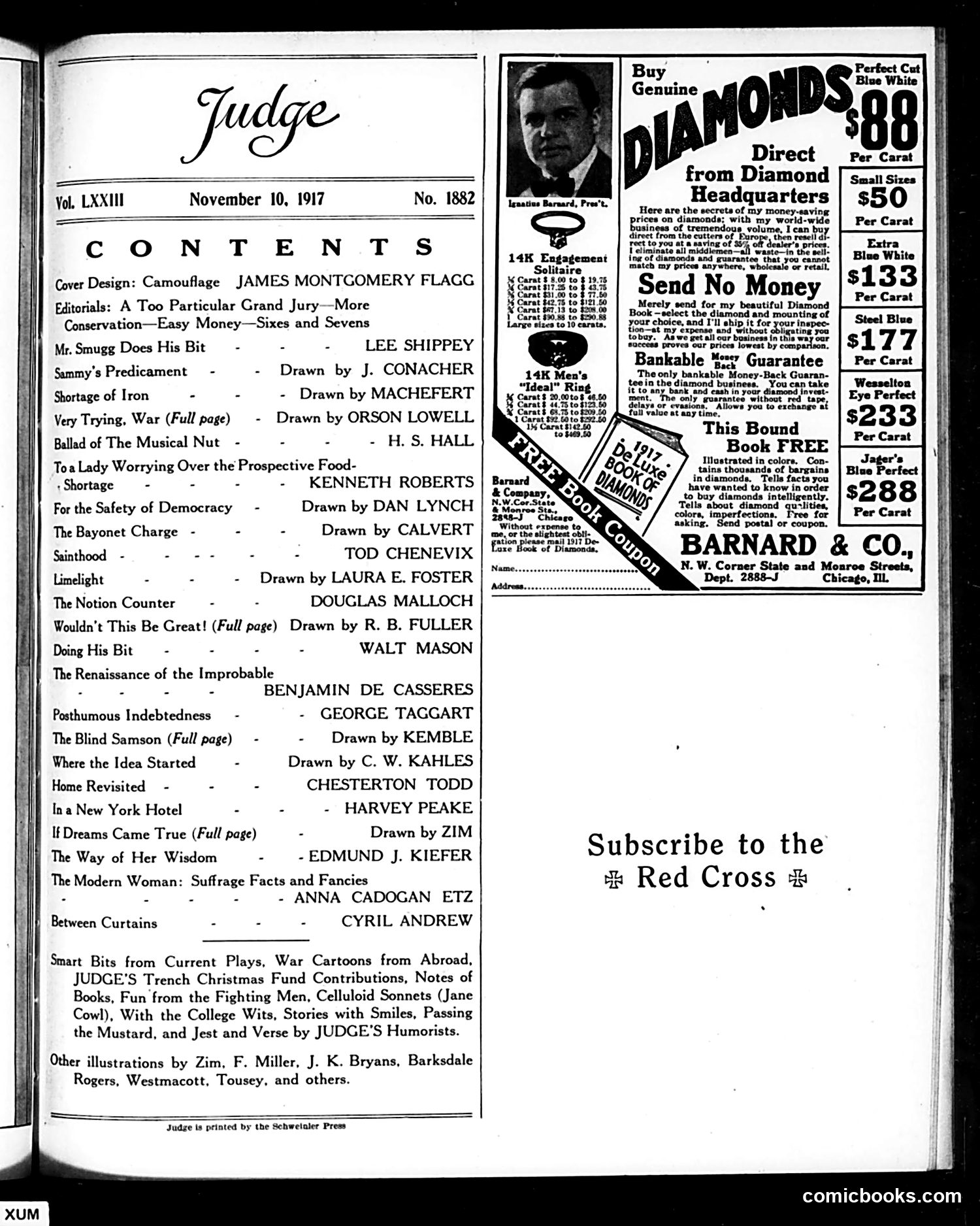
This is a contents page listing articles and cartoons for Judge's November 1917 issue—published during America's involvement in World War I. Notable pieces include: - "A Too Particular Grand Jury" (editorial) - "Very Trying, War" (full-page cartoon by Orson Lowell) - War-related satire: "To Lady Worrying Over Prospective Food-Shortage" and "The Bayonet Charge" - "The Modern Woman: Suffrage Facts and Fancies" by Anna Cadogan Etz The magazine promises "War Cartoons from Abroad" and contributions to Judge's Trench Christmas Fund—reflecting wartime patriotism. The right page features a diamond advertisement, typical of period magazine placement. The contents suggest Judge addressed contemporary anxieties: wartime food rationing, women's suffrage (still being debated nationally), and American military involvement—all prominent 1917 concerns.
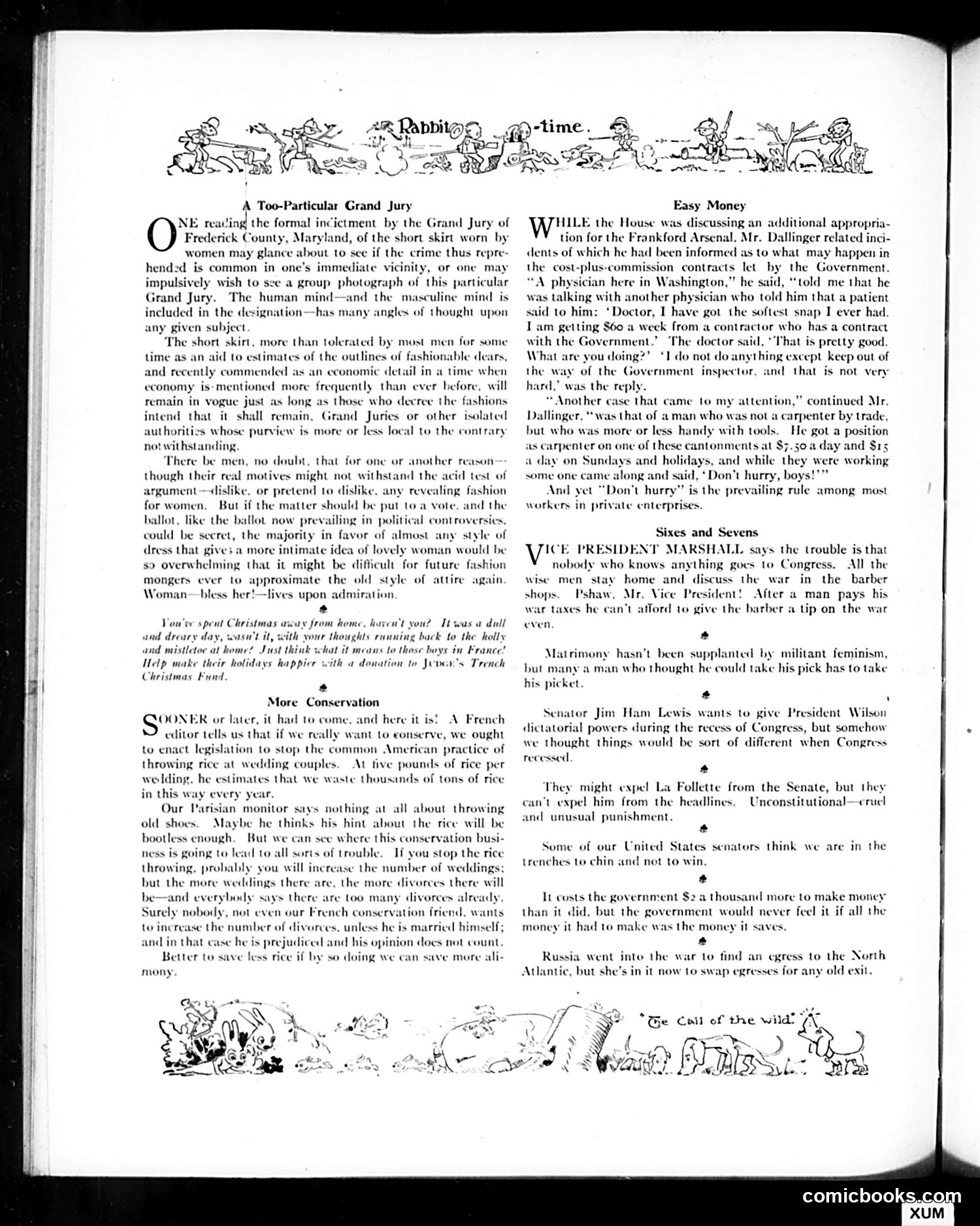
This page contains several short political satires rather than single cartoons. The "Easy Money" section mocks government inefficiency, citing a contractor earning $7-$10 daily on arsenals with Sundays off—contrasting private enterprise work standards. "Sixes and Sevens" criticizes Vice President Marshall's political irrelevance, suggesting he's uninformed about Congress. Additional items mock Senator Jim Ham Lewis's proposal for dictatorial presidential powers during congressional recess, question expelling La Follette from the Senate, and satirize senators' apparent defeatism about the war effort. The "More Conservation" section ridicules French conservation advice about throwing rice at weddings as wasteful, arguing France's real waste comes from excessive divorces—a gendered social critique typical of period satire. These brief quips reflect WWI-era political debate and American attitudes toward government efficiency.
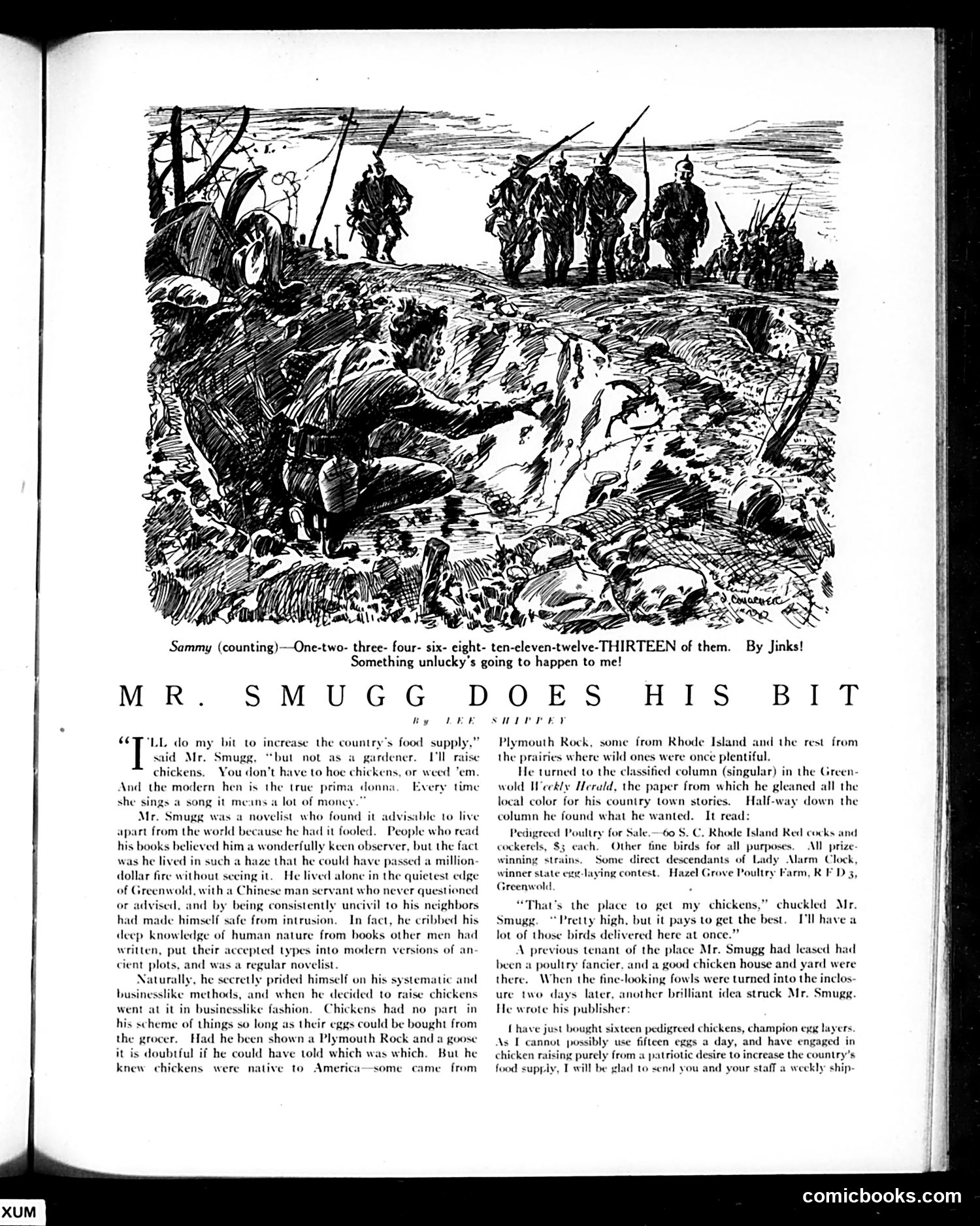
This is a humorous short story with an accompanying illustration, not a political cartoon. The sketch shows a WWI-era military scene with soldiers and casualties. The narrative satirizes a character named Mr. Smugg, a novelist living in rural seclusion who decides to contribute to the war effort. Rather than serving militarily, he proposes raising chickens to increase the country's food supply. He contacts poultry publications, buys pedigreed birds, and writes his publisher about his patriotic venture. The satire mocks civilians who perform trivial "war service" while avoiding actual military duty—using chicken-farming as a humorous proxy for home-front self-importance during wartime. The juxtaposition of Smugg's comfortable scheme against the brutal battlefield scene emphasizes the contrast between real sacrifice and performative patriotism.
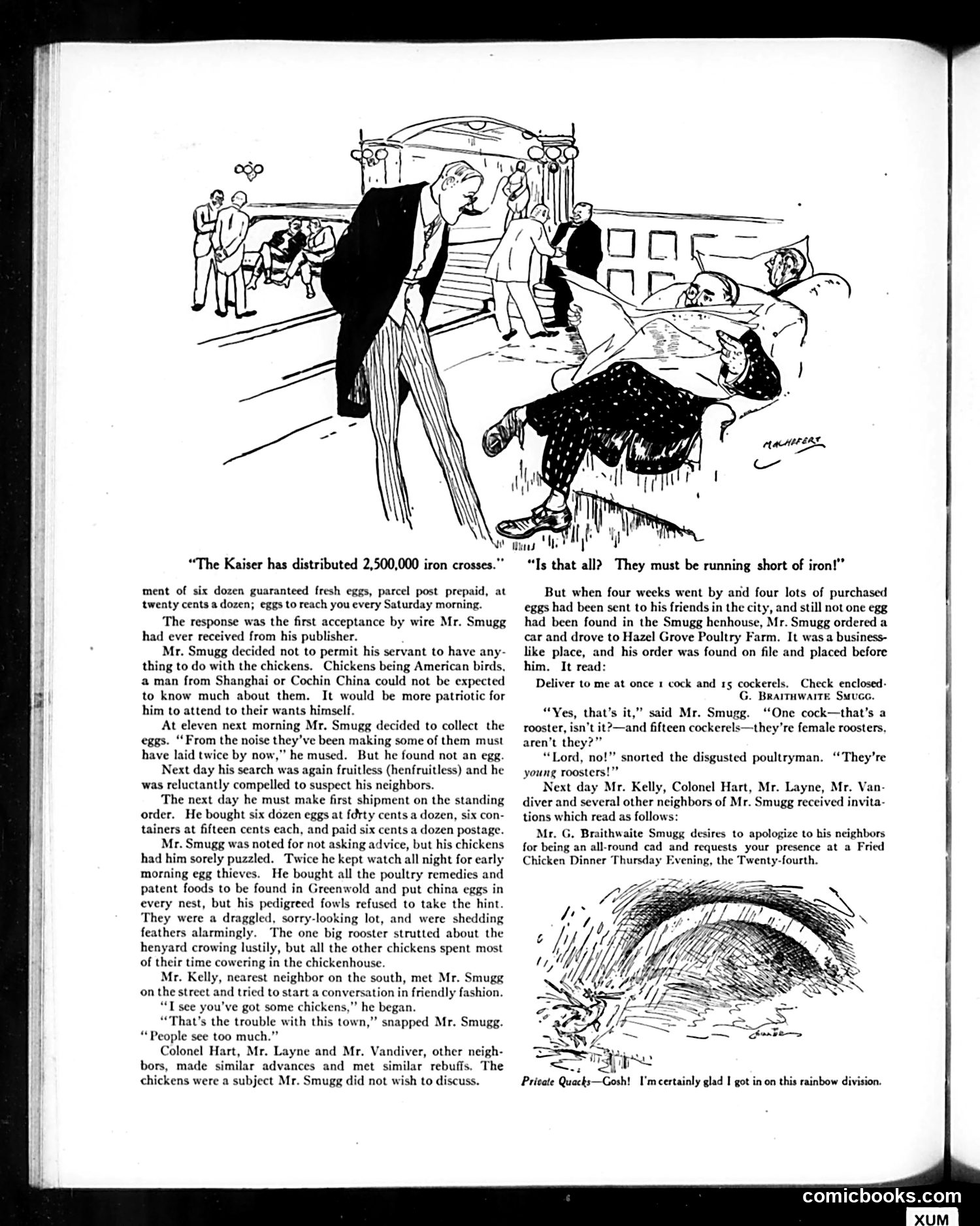
This page satirizes a real person: **Mr. Smugg**, a wealthy American businessman whose chickens have gone missing. The story describes his frustration as neighbors systematically steal his poultry, apparently as retaliation for his refusal to help them during wartime shortages. The top cartoon shows Smugg's exasperation with a neighbor, illustrating the central joke: his selfish hoarding has made him universally despised. He refuses to share eggs or permit neighbors to use his chickens, claiming patriotic concerns—yet receives no patriotism in return. The humor operates on social commentary about wartime resource scarcity and communal responsibility. Smugg's meanness provokes collective punishment through theft, suggesting that isolated selfishness invites community backlash. The invitations to a "Fried Chicken Dinner" are thinly veiled mockery.
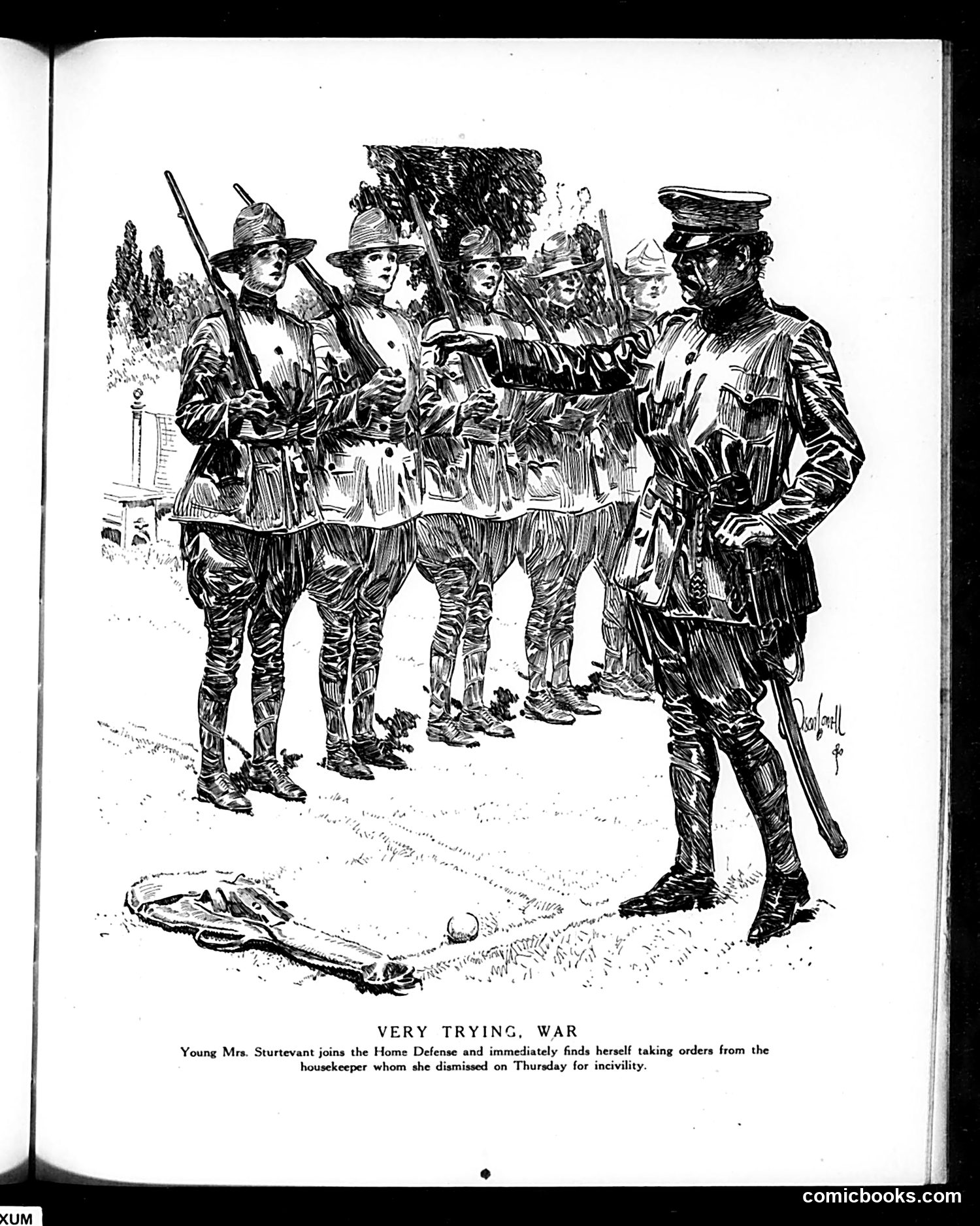
This cartoon satirizes the social upheaval caused by wartime mobilization. The joke hinges on ironic role reversal: a wealthy woman ("Young Mrs. Sturtevant") who recently fired her housekeeper for being rude now finds herself in the Home Defense (likely a civilian defense or volunteer organization) taking orders from that same former employee—now her superior in the military hierarchy. The humor exploits class anxiety: wartime has temporarily leveled social distinctions, forcing the upper-class woman into subordination to someone she considered beneath her. The cartoonist mocks both the woman's discomfort with this inversion and the absurdity of domestic conflicts persisting during national crisis. It's a commentary on how war disrupts peacetime social order and hierarchies, presented as a mild domestic comedy rather than serious social critique.
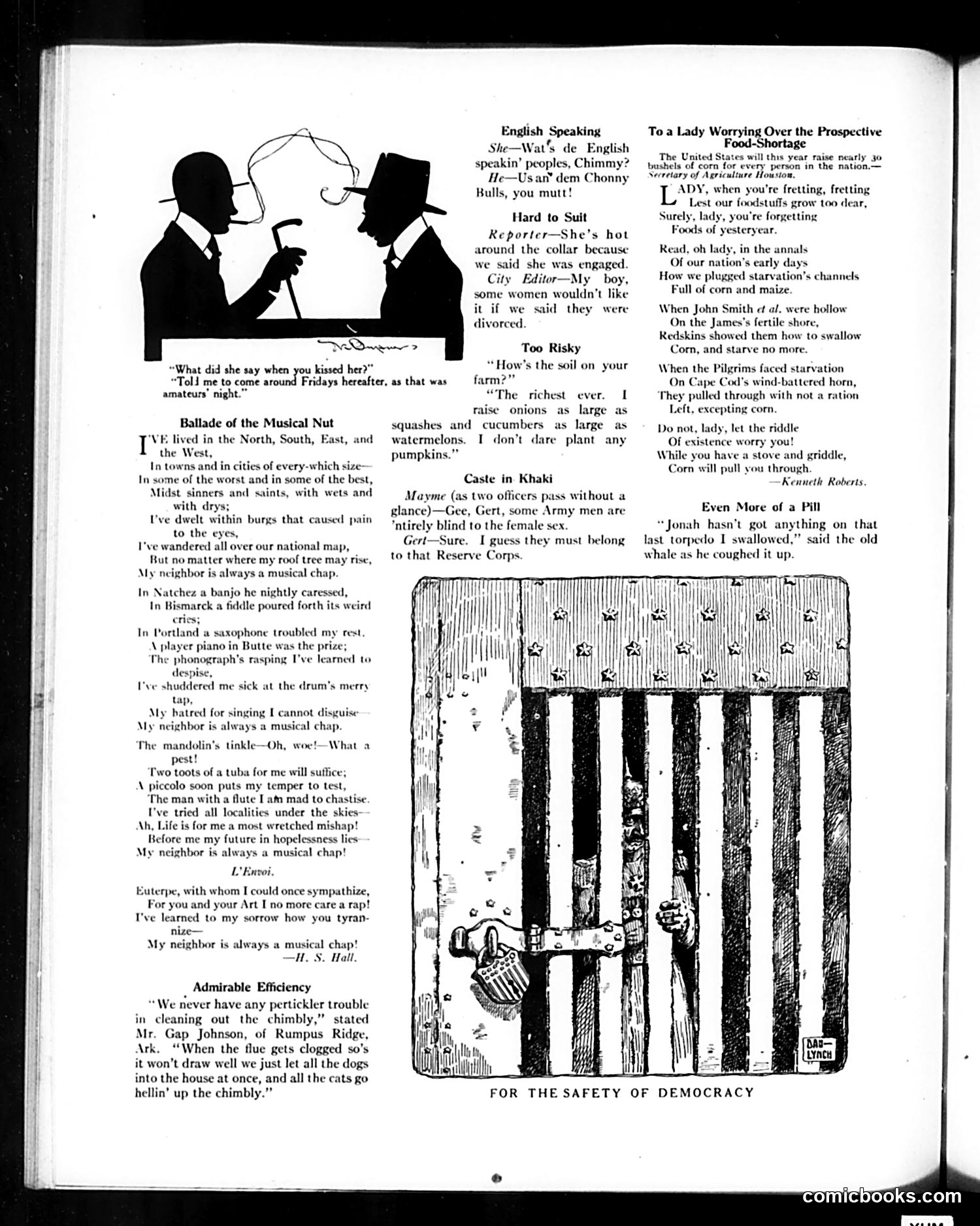
This page contains several satirical pieces typical of early 20th-century American humor: **Top cartoon** mocks amateur performers at "Fridays hereafter"—likely vaudeville amateur nights—through a man bragging about kissing a woman who dismissed him as an amateur. **"Ballad of the Musical Nut"** is a humorous poem lamenting that no matter where the narrator lives, his neighbor plays a musical instrument badly—banjo, fiddle, saxophone, player piano, phonograph. It's gentle domestic satire about annoying neighbors, a universal complaint. **Other brief jokes** mock: linguistic pretension ("English Speaking"), women's unpredictability ("Hard to Suit"), agricultural boasting ("Too Risky"), and military class divisions ("Caste in Khaki"). **Kenneth Roberts' poem** reassures a woman worried about food shortages, noting America produces abundant corn—referencing both historical survival (John Smith, Pilgrims) and present agricultural capacity under Secretary of Agriculture Houston. **Bottom cartoon** ("For the Safety of Democracy") shows a whale coughing up a torpedo, likely WWI-era commentary on submarine warfare. The page reflects wartime concerns and domestic preoccupations of approximately 1915-1920.
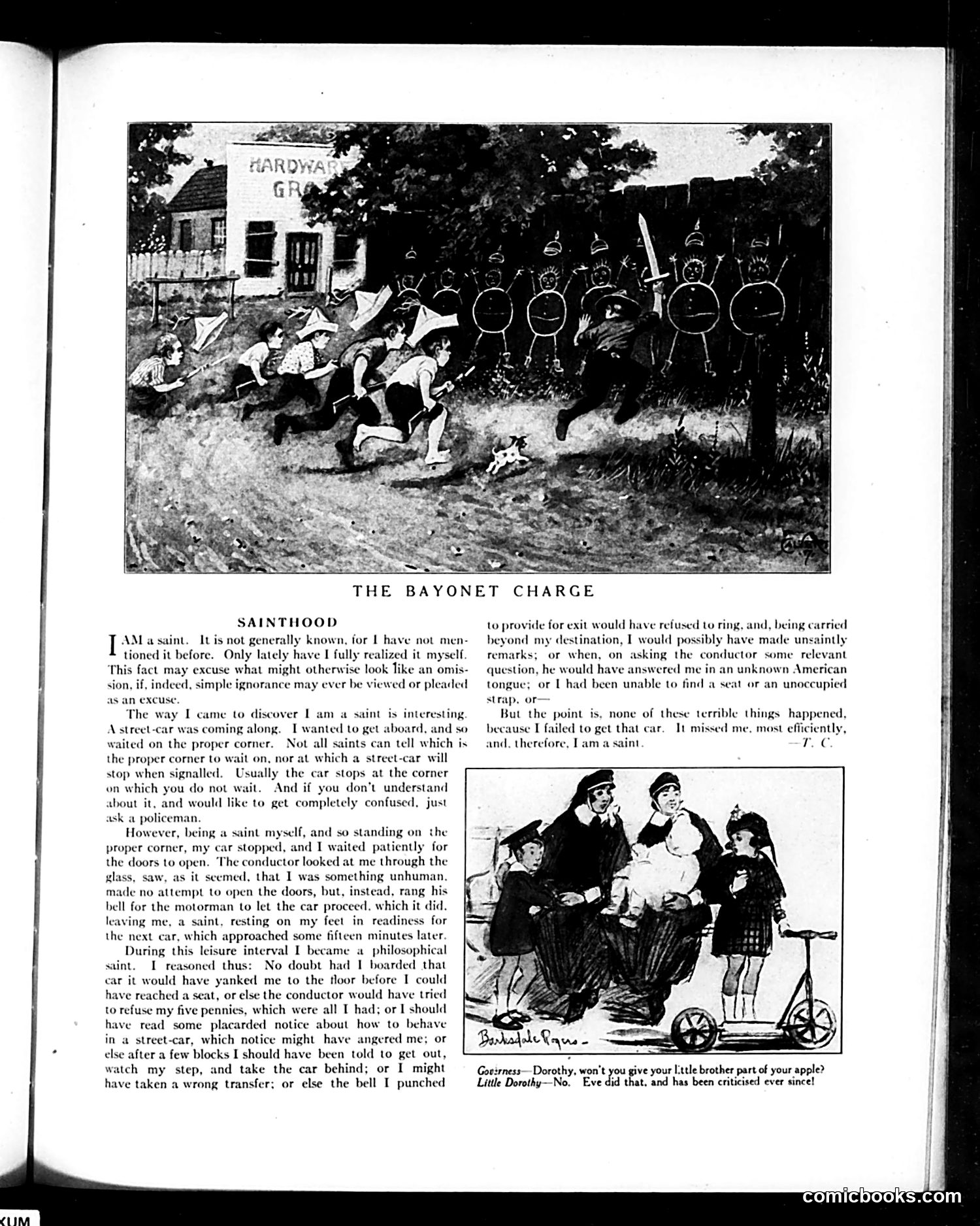
This page satirizes American urban life's minor indignities through the lens of "sainthood." The main article humorously describes how the narrator becomes a "saint" by missing a streetcar—a mundane modern frustration. The joke is that avoiding the car spares him from various unpleasant experiences (being yanked around, rude conductors, confusing transfers), which the author presents as divine providence. The small cartoon below illustrates a children's joke: when asked to share her apple with her brother, Dorothy refuses, citing the biblical precedent of Eve giving the apple to Adam—which brought humanity sin and suffering. It's a cheeky inversion of the expected moral lesson about sharing. Together, the page mocks both the chaos of modern city transportation and the way people rationalize minor disappointments as good fortune.
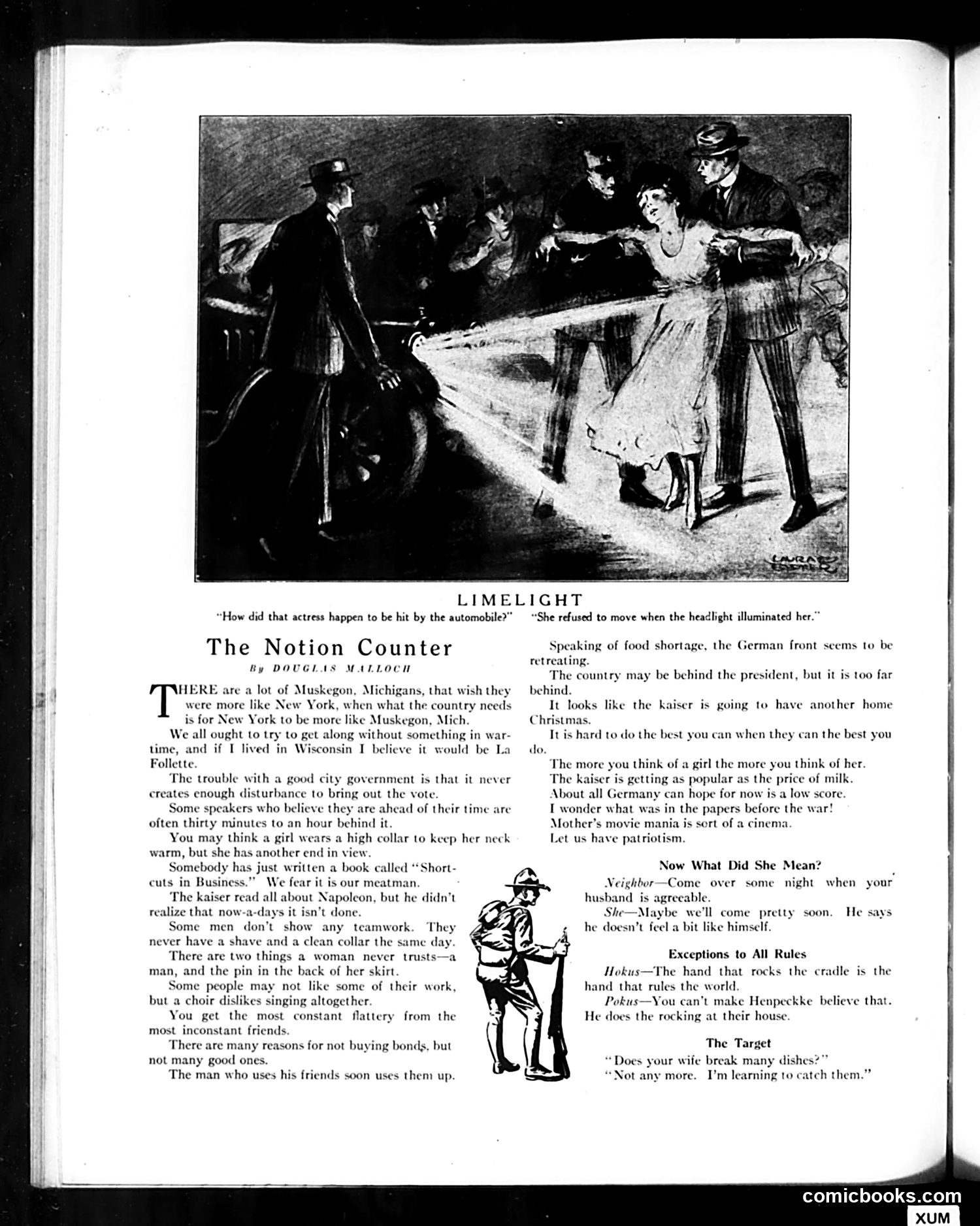
The page contains satirical commentary typical of Judge magazine during World War I. **"Limelight" cartoon** at top: Shows a woman hit by an automobile's headlights. The ironic captions suggest she deliberately positioned herself in the light for dramatic attention—satirizing actresses' self-promotion and their tendency to create "incidents" for publicity. **"The Notion Counter"** column by Douglas Mallock: A series of short, cynical observations about American life and the war effort. Notable references include criticism of Wisconsin politician La Follette (likely for his anti-war stance), comments on food shortage and German retreats, and jabs at the Kaiser's popularity declining "as the price of milk." The piece reflects wartime attitudes: patriotism is encouraged while pacifism is mocked. References to "buying bonds" suggest Liberty Bond campaigns. **Smaller jokes** include commentary on gender dynamics (women's clothing, marriage, domestic behavior) using contemporary stereotypes—typical of the era's humor. The overall tone is cynical yet patriotic, mixing domestic social satire with wartime messaging.
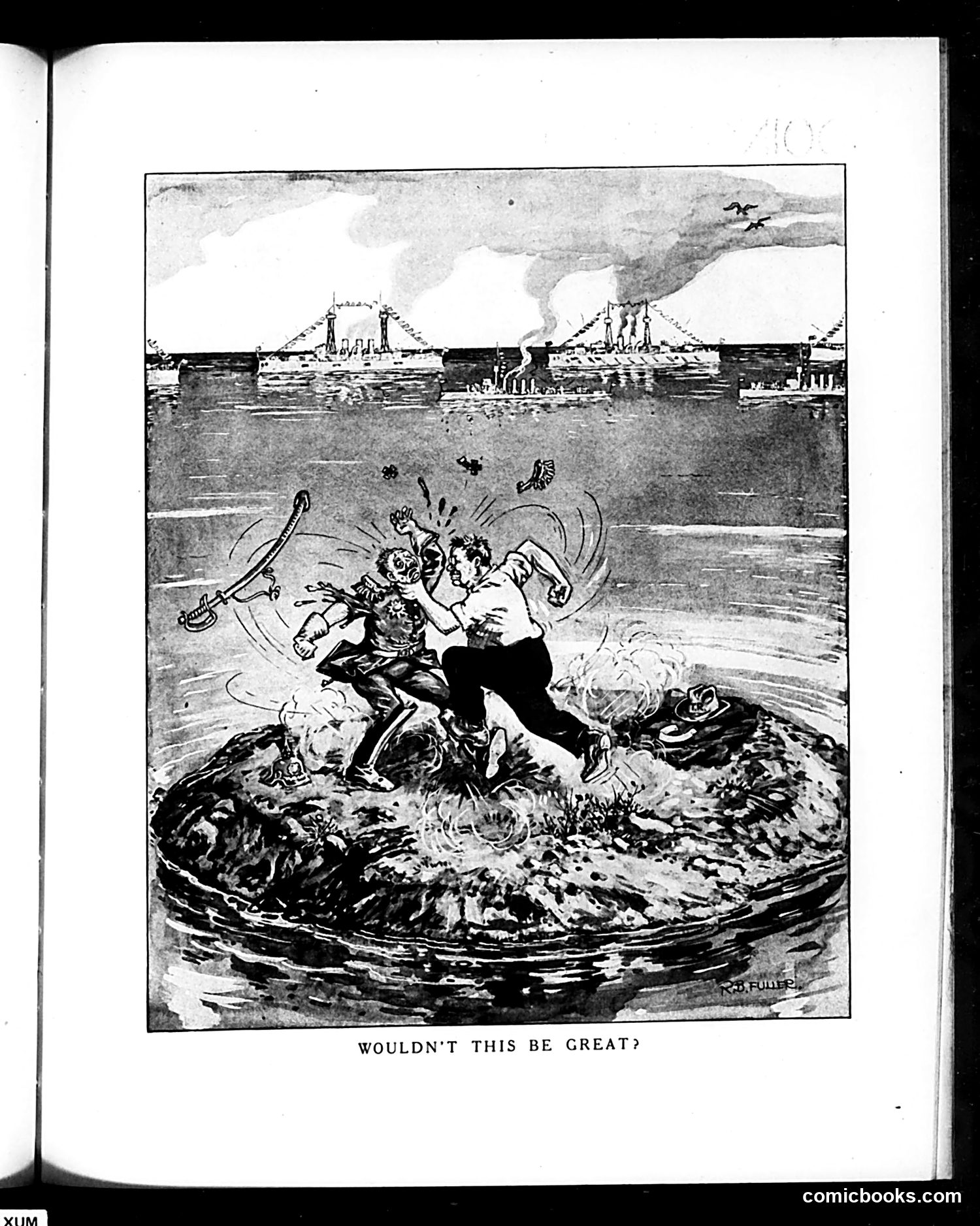
This political cartoon depicts a fantastical naval battle scenario. In the foreground, two figures (appearing to be political or military leaders) struggle dramatically in turbulent water amid explosions and chaos. In the background, a fleet of warships engages in combat, with smoke and fire visible across the harbor. The caption's rhetorical question suggests the cartoonist is sarcastically commenting on a proposed or imagined military conflict—likely referencing contemporary naval tensions or war rhetoric from Judge's publication era. The exaggerated, chaotic imagery and the ironic tone imply the cartoonist is mocking warmongering or unrealistic military fantasies, presenting such conflict as absurd or destructive rather than glorious. The specific historical context and identities of the figures remain unclear without additional dating information.
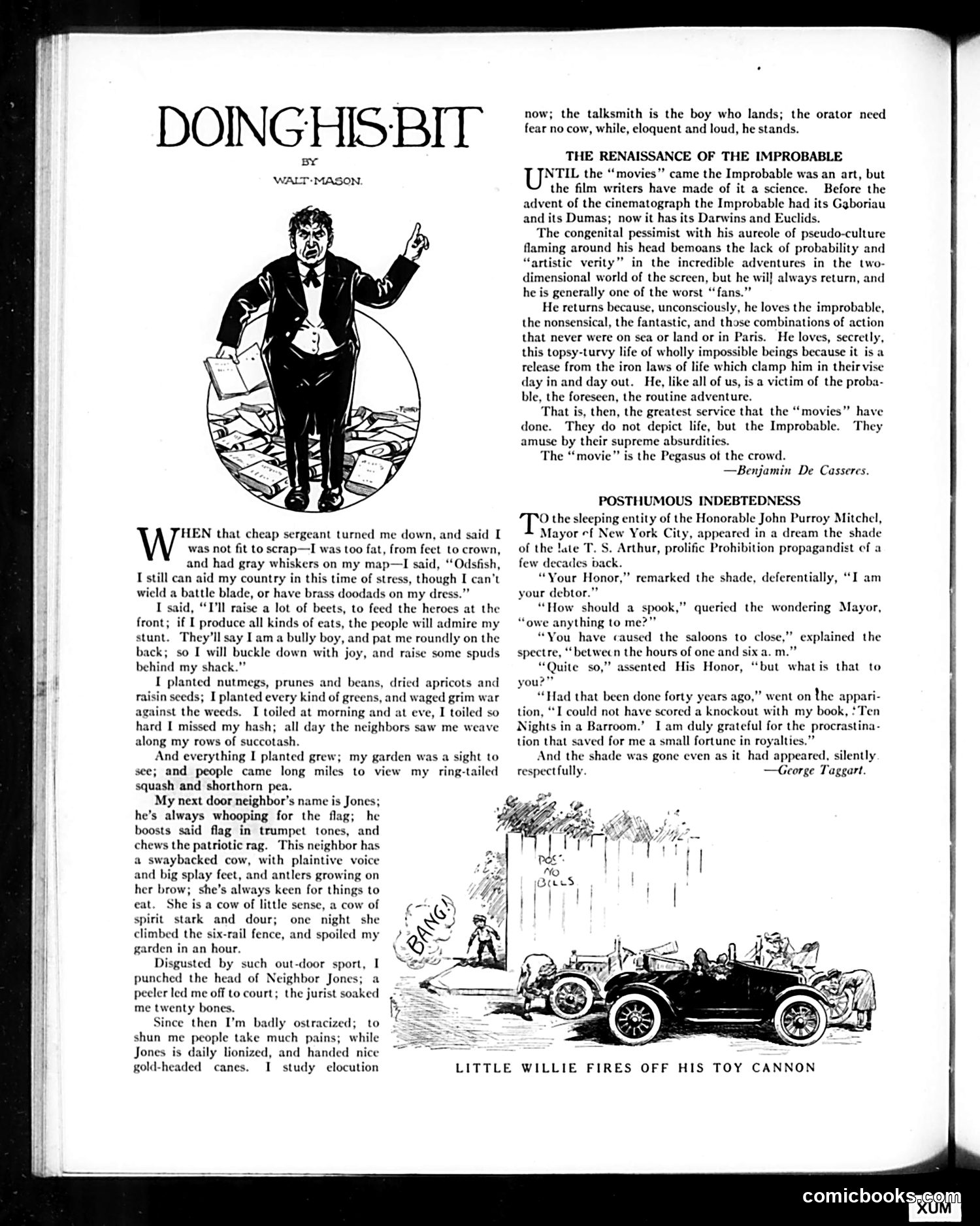
This Judge magazine page contains three separate pieces satirizing early 20th-century American life: **"Doing His Bit"** (left): A humorous poem by Walt Mason about a man rejected from military service who grows a spectacular vegetable garden to support the war effort. His patriotic neighbor Jones has a cow that destroys the garden; the narrator punches Jones and is fined in court. Now Jones is celebrated as a patriot while the narrator is shunned—the joke being that in America, eloquent loudmouths ("talksmith") get rewarded over quiet, genuine service. **"Renaissance of the Improbable"** (top right): An essay praising silent films for depicting impossible, fantastical scenarios—arguing audiences love this escape from mundane reality more than realistic art. References "Gaboriau and Dumas" (adventure novelists) as precursors to film. **"Posthumous Indebtedness"** (bottom): A satirical ghost story where a shade of temperance advocate T.S. Arthur thanks Mayor Mitchell for closing saloons during early morning hours (1-6 a.m.), suggesting prohibition's limited practical effect—a jab at both temperance activists and urban drinking culture.
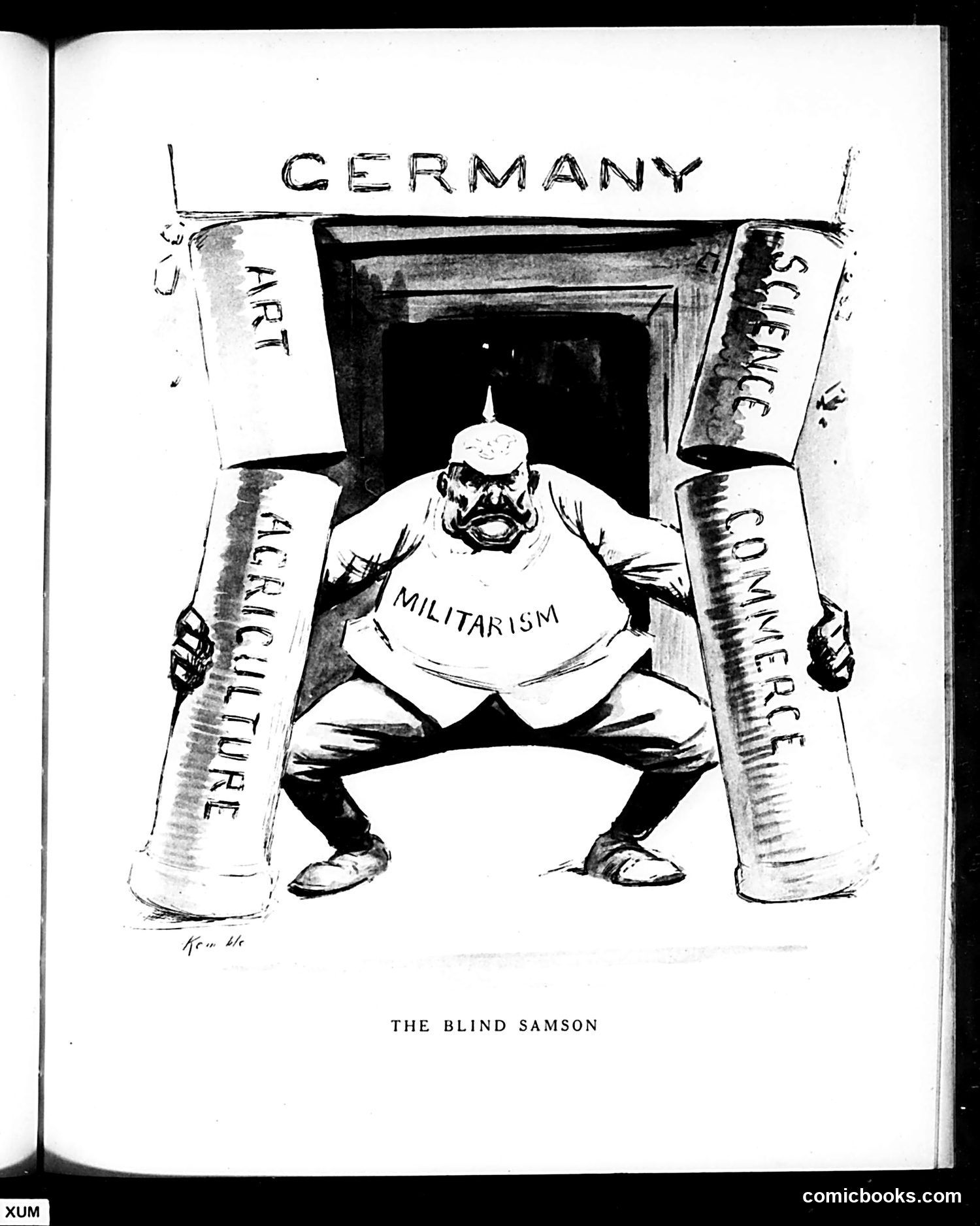
This political cartoon depicts Germany as a caricatured figure wearing a spiked Prussian helmet, labeled "MILITARISM" across his chest. He's portrayed as blindfolded and trapped between two massive pillars labeled "ARTE" (Art) and "SCIENCE" and "COMMERCE" (Commerce). The satire suggests Germany's militaristic ideology has blinded the nation to peaceful pursuits—art, science, and commerce. The biblical reference to Samson (the blind strongman) implies Germany possesses raw power but lacks vision or judgment, making it dangerous. The pillars appear to be collapsing or threatening to crush the figure, suggesting this militaristic path leads to Germany's destruction. This likely reflects pre-WWI or early WWI American anxieties about German militarism threatening civilization itself.
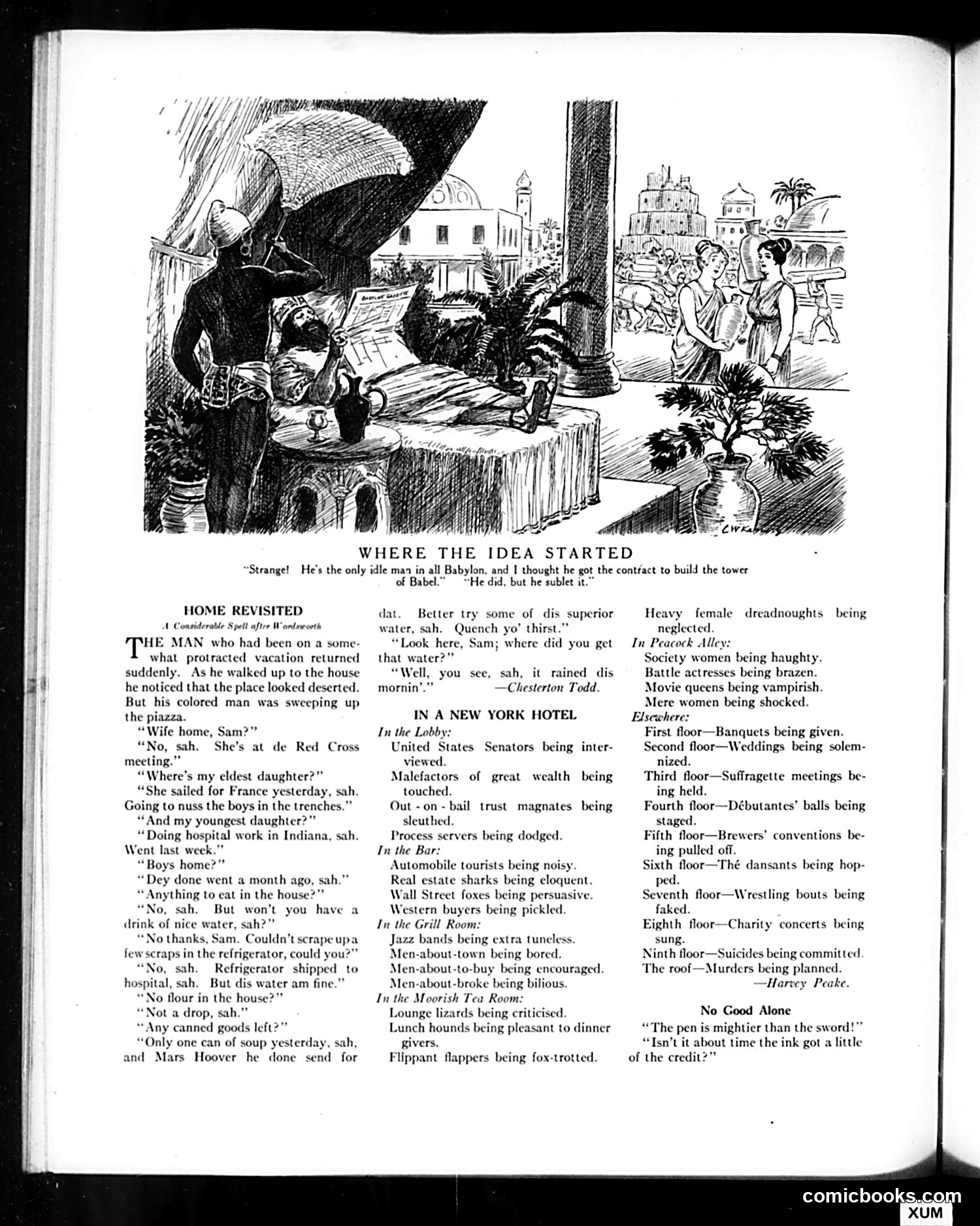
This two-part cartoon critiques American home-front mobilization during World War I (likely 1917-1918). **"Home Revisited"** depicts a man returning from vacation to find his entire household—wife, daughters, sons, and even the refrigerator—conscripted to war efforts. The Red Cross, military nursing, hospital work, and Herbert Hoover's food conservation program have emptied his home. The joke's bitter edge: only his servant remains, offering rainwater instead of meals. It satirizes how thoroughly WWI had absorbed American civilian life and resources. **"In a New York Hotel"** catalogs urban depravity allegedly flourishing while citizens sacrifice: corrupt senators, embezzling financiers, seduction, drunkenness, and vice pervade every floor—culminating in "suicides being committed" and "murders being planned" on upper levels. Together, these mock the gap between patriotic civilian sacrifice and the unchecked corruption and hedonism of the wealthy and powerful who profit from war.
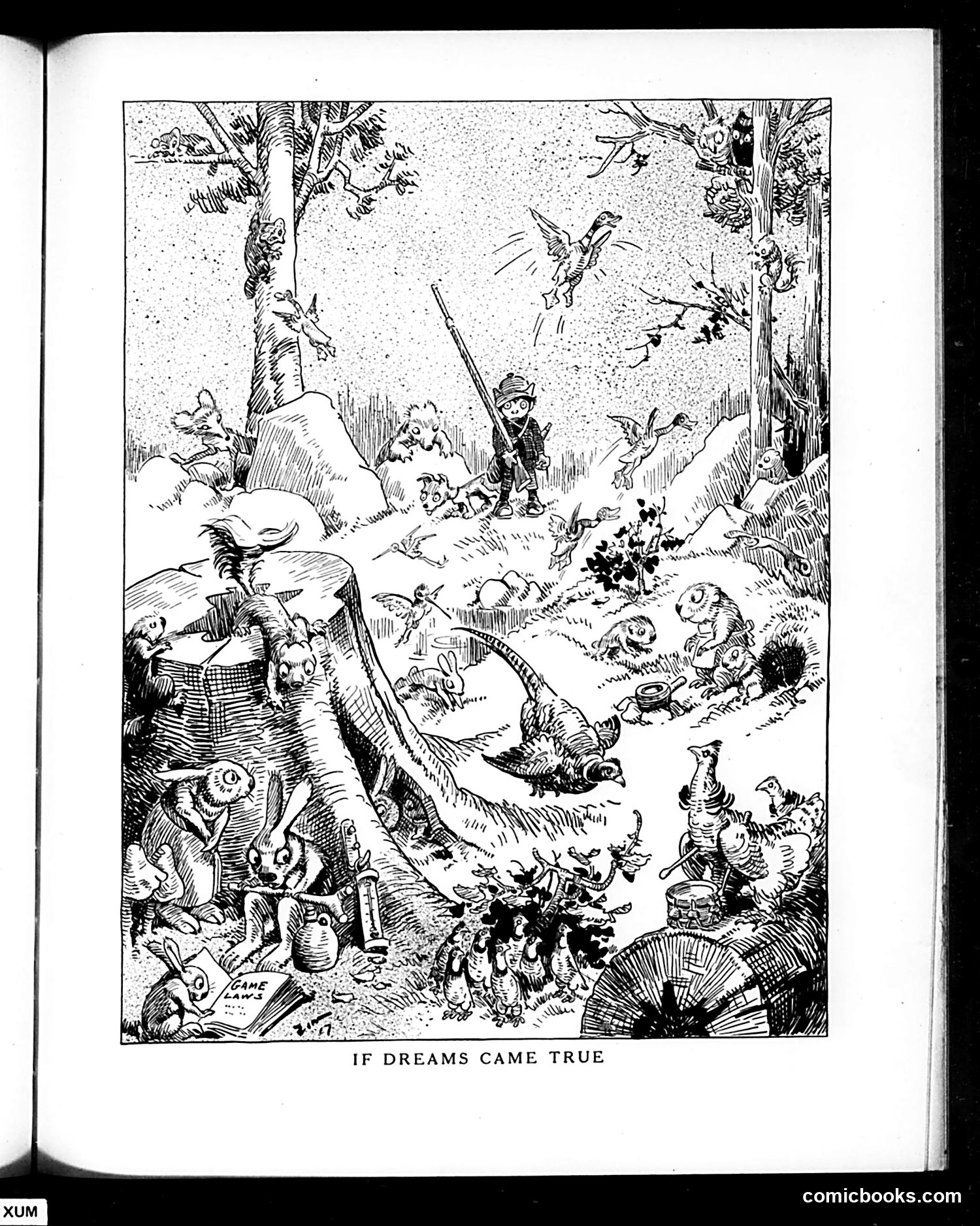
This illustration depicts a fantastical woodland scene where anthropomorphic animals and humanoid figures coexist in apparent harmony. A central human figure (appearing to be a hunter or soldier with a rifle) stands among various creatures—rabbits, birds, and other woodland animals—seemingly at peace rather than in conflict. The title "If Dreams Came True" suggests satirical commentary on an idealistic but unrealistic vision. Given Judge magazine's satirical nature, this likely mocks utopian fantasies or political ideologies promising impossible harmony between naturally opposing interests (predators and prey, hunters and hunted). The detailed, whimsical art style contrasts sharply with the sardonic message—that such peaceful coexistence remains merely wishful thinking rather than achievable reality.
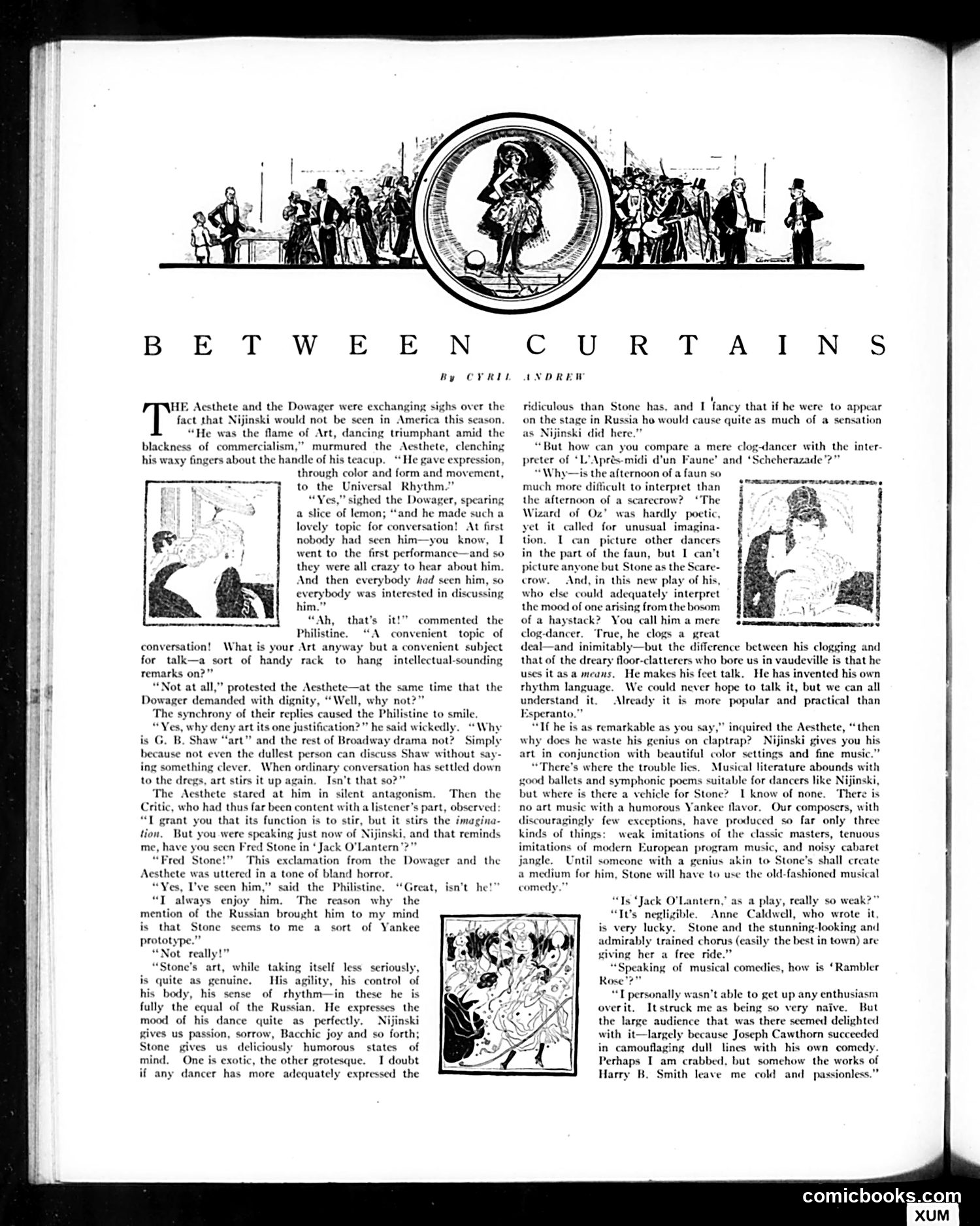
This satirical article mocks the pretentiousness of art aesthetes who lionize the Russian ballet dancer Nijinski while dismissing American vaudeville performer Fred Stone. The Aesthete and a Dowager lament Nijinski's absence from America, praising his artistic depth and "Universal Rhythm." A blunt Philistine character challenges them: isn't art just convenient dinner conversation? He argues that Stone—an American clog-dancer and comedic performer from "Jack O'Lantern"—demonstrates equal technical mastery and artistic validity, merely in a different mode (grotesque humor versus passion). The satire targets the cultural snobbery of the Jazz Age intelligentsia who valorized European high culture while dismissing homegrown American entertainment as inferior. The critic defends Stone's invented "rhythm language" as equally valid and more practically accessible than the Russian's approach, suggesting American popular entertainment deserves respect alongside European sophistication.
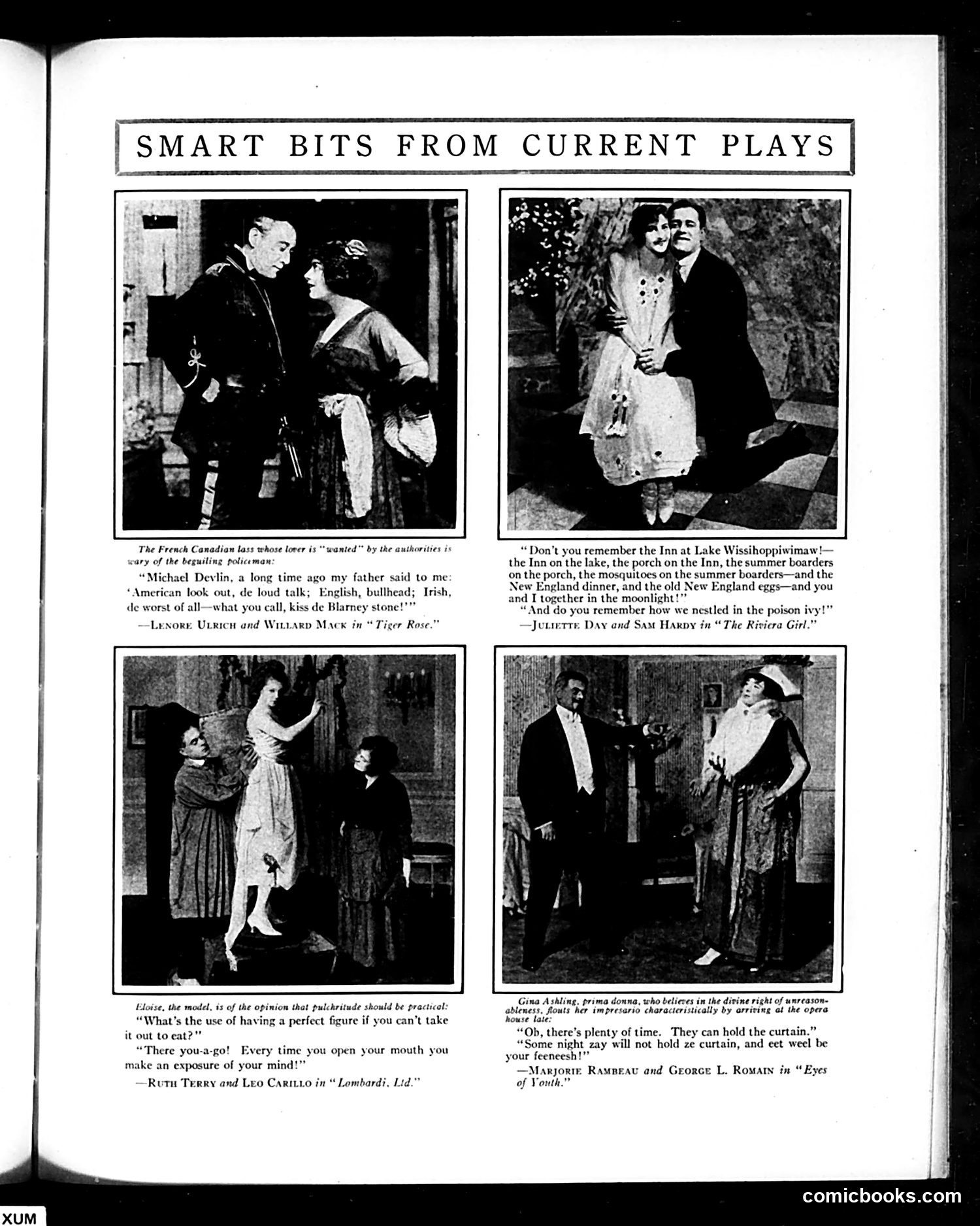
This page collects witty one-liners from contemporary theatrical productions, presented as "smart bits"—clever dialogue meant to amuse readers. Each caption pairs a photograph from an actual play with a quoted line of dialogue. The humor relies on period stereotypes and social commentary: a French-Canadian woman's wariness of police reflects immigrant anxieties; ethnic generalizations about American, English, and Irish behavior appear casually; a model's impractical nature is mocked; a diva's arrogance is presented as foreignly unreasonable (note the affected accent). The romantic exchange about an inn with mosquitoes and poison ivy trades in gentle, somewhat corny nostalgia. These are largely *character* jokes—the comedy derives from who says the line and what it reveals about their type, not from wordplay or narrative complexity. The page essentially advertises these theatrical productions while demonstrating their "clever" dialogue to Judge's readers.
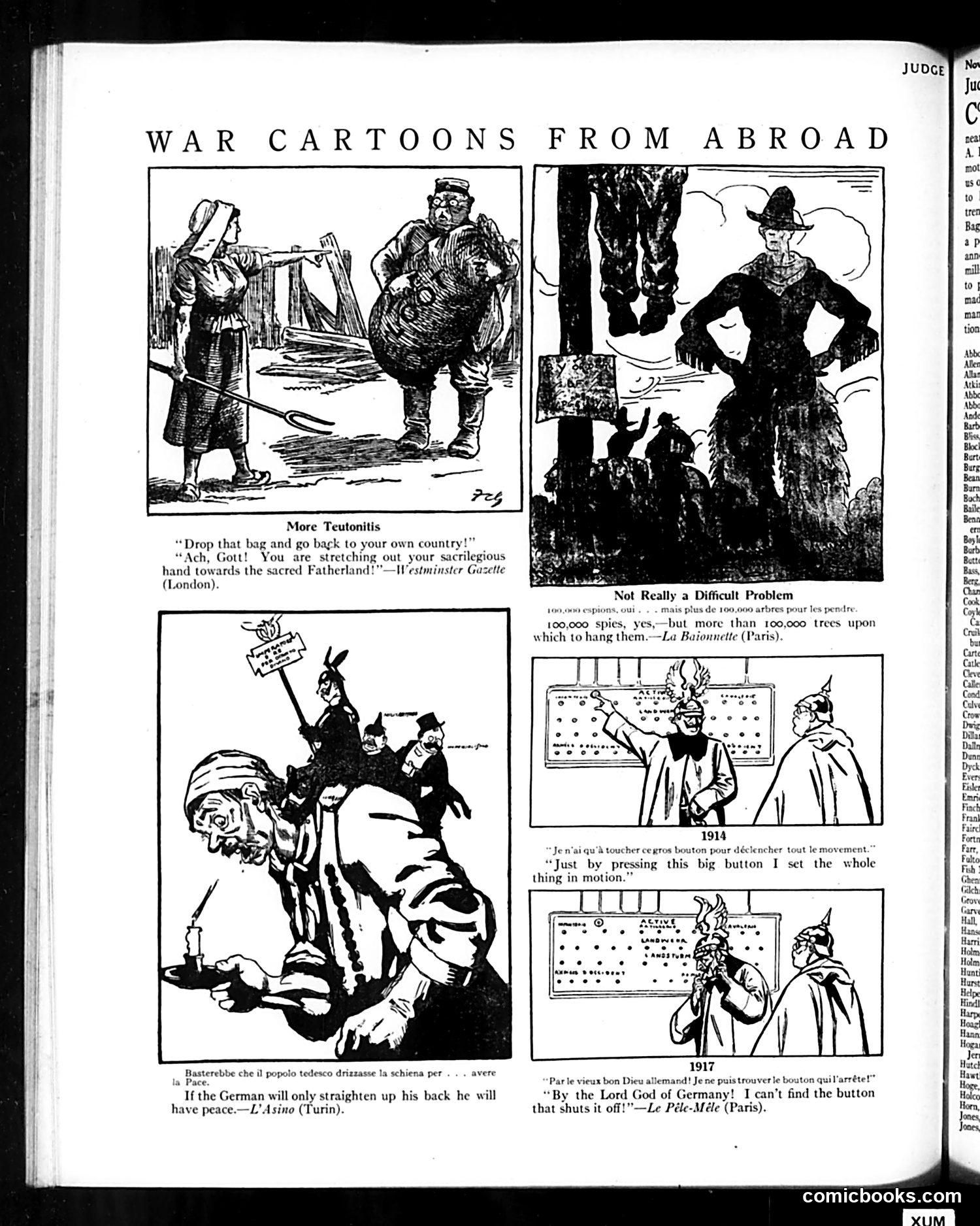
This page reprints satirical cartoons from Allied nations during World War I, mocking Germany and the Kaiser. **"More Teutonitis"** (British): Shows a German soldier being told to abandon stolen goods and leave, satirizing German aggression and territorial seizure. **"Not Really a Difficult Problem"** (French): Darkly jokes that France has 100,000 German spies to execute—but needs 100,000 trees to hang them from. It's gallows humor about perceived German infiltration. **"If the German will only straighten up..."** (Italian): Depicts the Kaiser as a rigid military automaton; straightening his back brings peace—mocking German militarism as mechanical and inhuman. **"I can't find the button"** (French): Shows the Kaiser unable to stop his war machine, suggesting he's lost control of the conflict he started—a critique of German leadership's inability or unwillingness to end the war. These represent propaganda art circulating among Allied nations, portraying Germany as aggressive, infiltrating, dehumanized, and trapped by its own militarism.
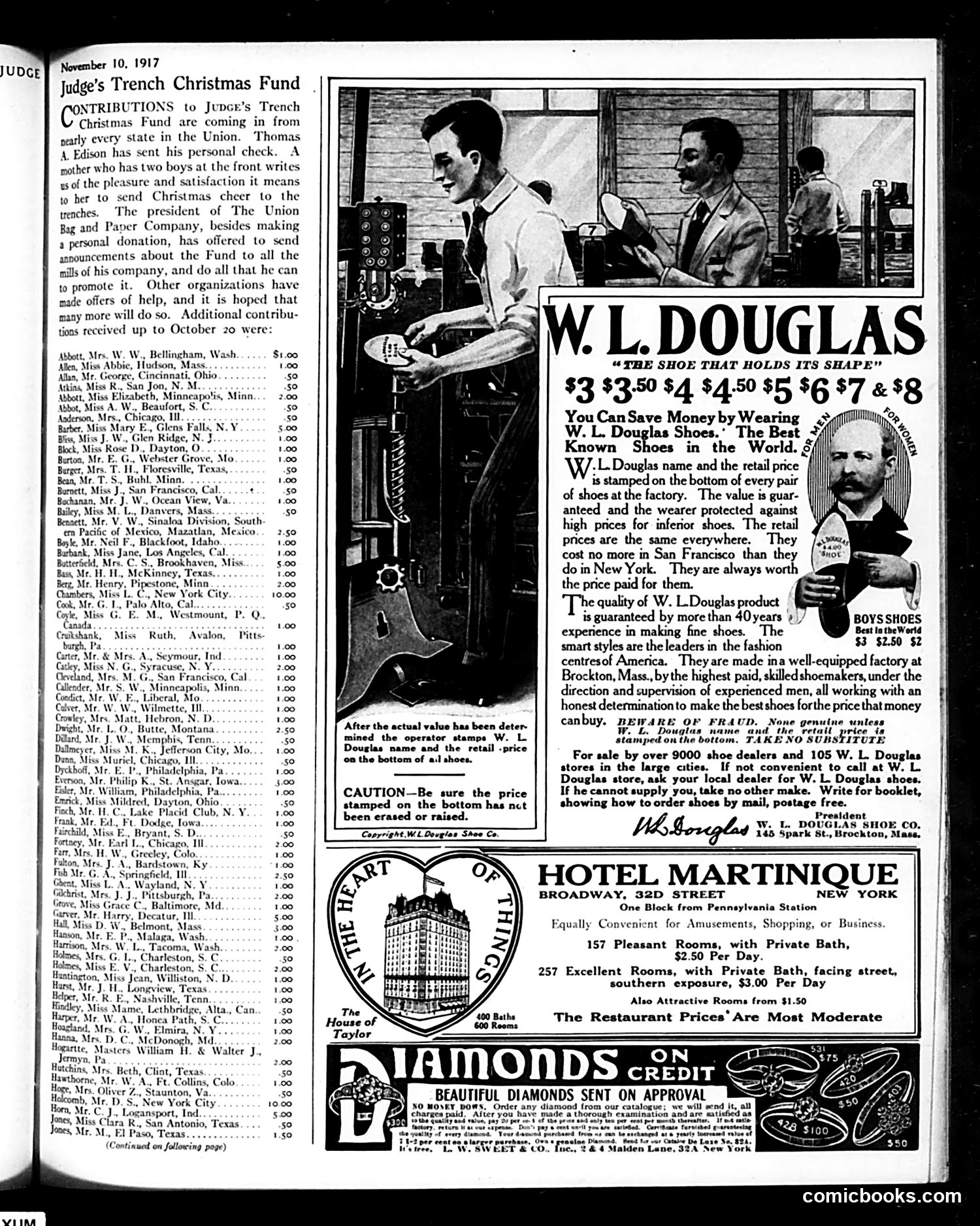
This page is primarily **advertising and fundraising content**, not political satire. The left column lists donors to "Judge's Trench Christmas Fund"—a genuine charitable campaign to send Christmas packages to American soldiers fighting in World War I (then ongoing). Notable contributors mentioned include Thomas Edison and company presidents. This reflects American civilian support for troops abroad during the Great War. The right side features large advertisements: a W.L. Douglas shoe ad (emphasizing quality and fair pricing) and promotions for the Hotel Martinique in New York and a diamonds-on-credit offer. The page reflects **1917 American concerns**: patriotic fundraising for soldiers in trenches, consumer confidence in branded products with guaranteed prices, and credit-based retail—all typical of wartime American print media. There is no visible political cartoon or satire on this particular page.
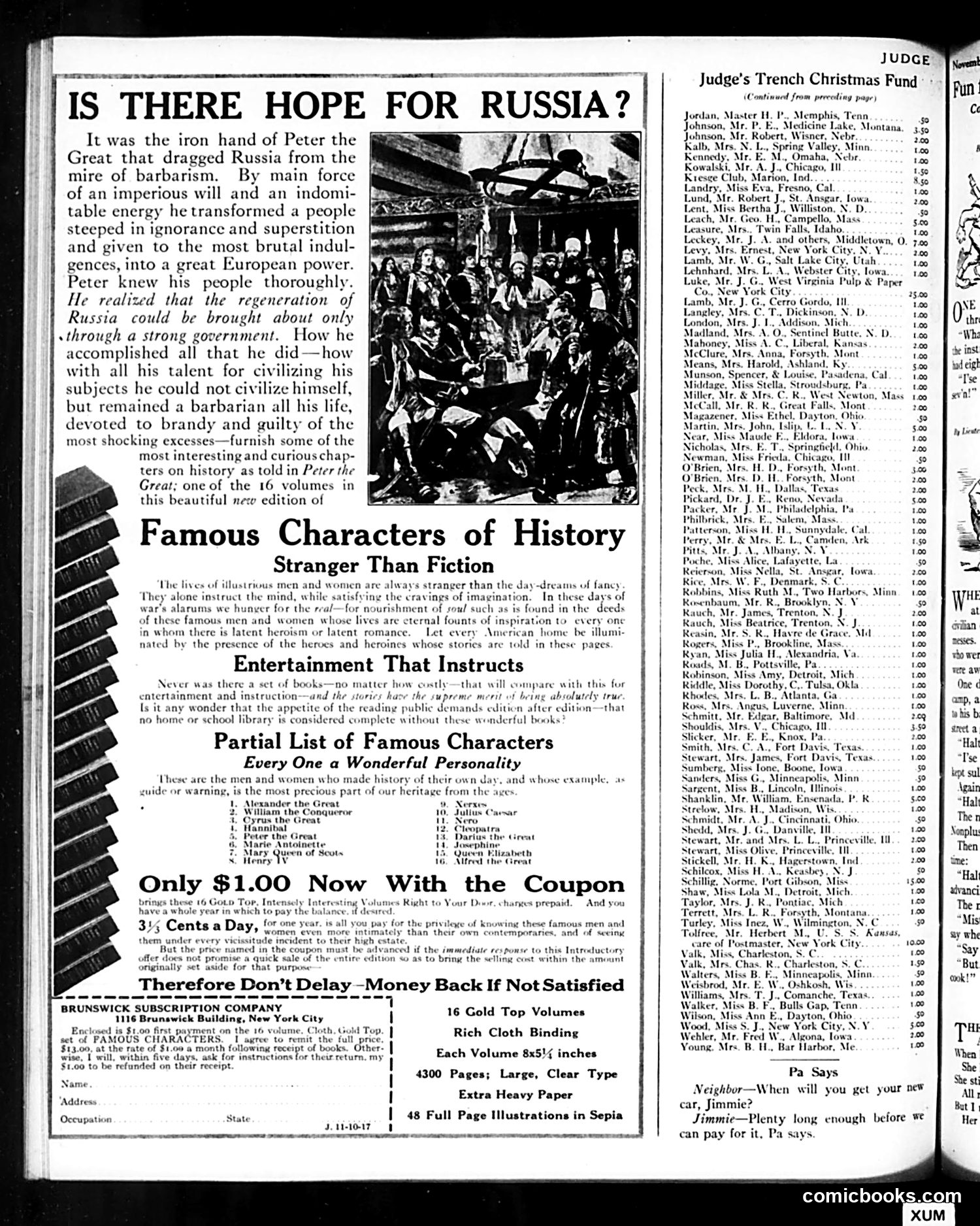
This page is primarily **advertising and fundraising**, not political satire. The main content is a promotional advertisement for a 16-volume book series titled *Famous Characters of History: Stranger Than Fiction*. The header "IS THERE HOPE FOR RUSSIA?" appears to be a hook for the advertisement. It references Peter the Great, arguing that Russia's regeneration required "a strong government"—this likely appeals to early 20th-century American readers concerned about Russian instability (possibly post-1917 Revolution context, though the date is unclear from the visible text). The bulk of the page lists donors to Judge's "Trench Christmas Fund" (a WWI-era charity) and promotes the book series, emphasizing its educational and inspirational value. The $1.00 price (with coupon) and money-back guarantee are sales tactics. **There is no identifiable political cartoon on this page**—it's primarily text-based advertising using historical and patriotic themes to drive book sales while simultaneously showcasing charitable fundraising efforts.
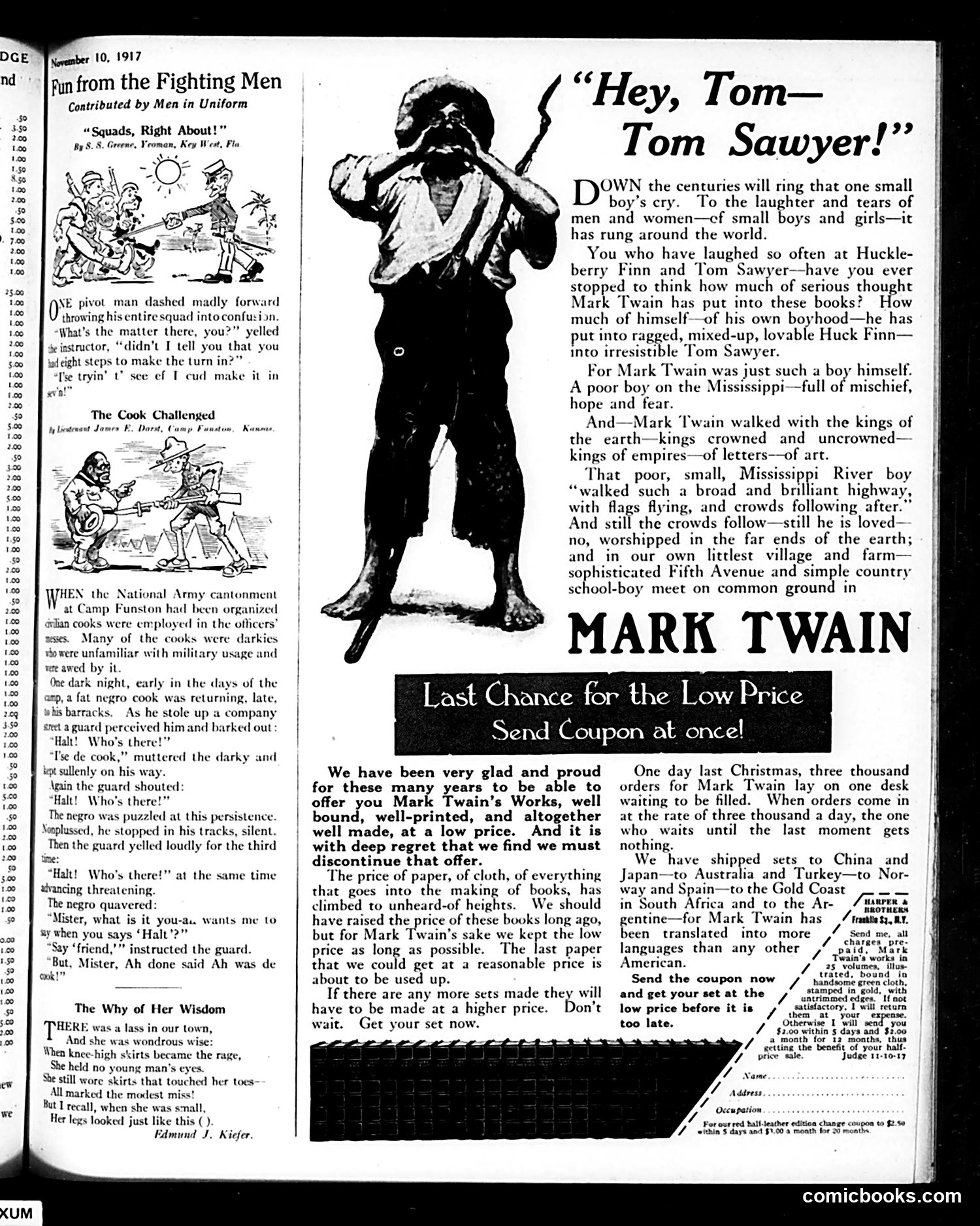
This page combines military humor with a major advertising push for Mark Twain's collected works. **Left side ("Fun from the Fighting Men"):** Two brief soldier anecdotes contributed by servicemen. "Squads, Right About!" depicts a confused recruit misunderstanding drill instructions. "The Cook Challenged" shows a comedic encounter where a Black cook at Camp Funston repeatedly answers "Halt! Who's there?" with confusion, playing on dialect humor typical of the era. **Right side (Major advertisement):** A tribute to Mark Twain (who died in 1910) emphasizing how his boyhood experiences on the Mississippi River shaped his beloved novels *Huckleberry Finn* and *Tom Sawyer*. The ad announces that Harper & Brothers must discontinue their low-price edition due to rising paper and cloth costs during World War I. It urgently solicits orders via coupon, claiming Christmas demand reached 3,000 orders daily. **Context:** Published during wartime paper rationing, the ad uses patriotic nostalgia for American literature and Twain's humble origins to justify price increases while capitalizing on holiday purchasing.
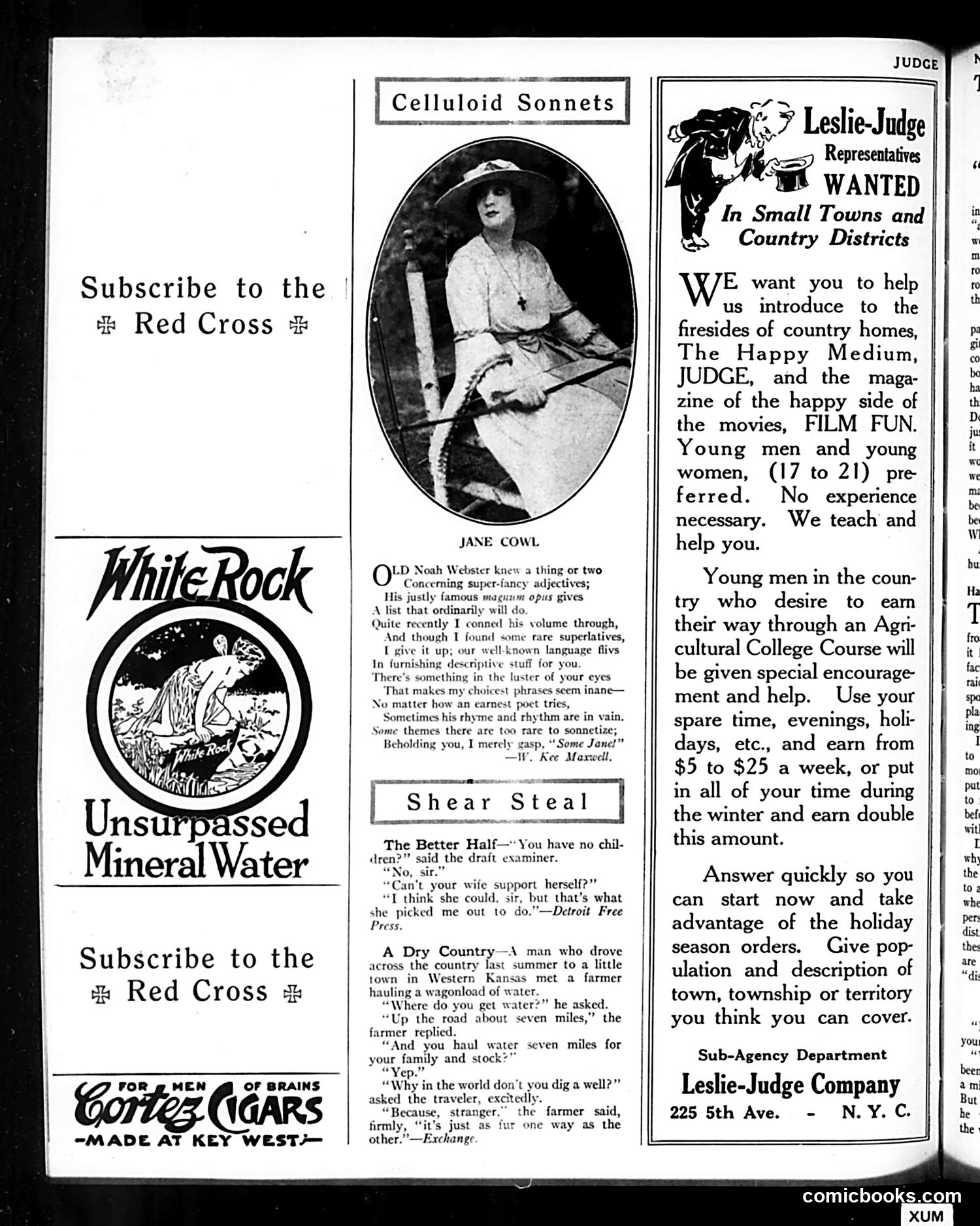
This page is primarily **advertising and light humor content** rather than political satire. The centerpiece features "Celluloid Sonnets"—romantic poetry about actress Jane Cowl, celebrating her beauty in overwrought language. The accompanying jokes ("Shear Steal") are gentle domestic humor: a draft examiner's exchange about spousal support, and a farmer's illogical refusal to dig a well despite hauling water seven miles. The major advertisement recruits young salespeople (ages 17-21) to distribute Judge, Film Fun, and The Happy Medium magazines to rural homes, offering $5-25 weekly earnings. This reflects early 20th-century magazine distribution networks relying on local agents. Sidebar ads promote Red Cross mineral water and Cortez cigars—typical commercial sponsorships of the era. The page reflects Judge's identity as an entertainment-focused magazine with light humor, celebrity content, and advertisements targeting middle-class consumers, rather than hard-hitting political commentary.
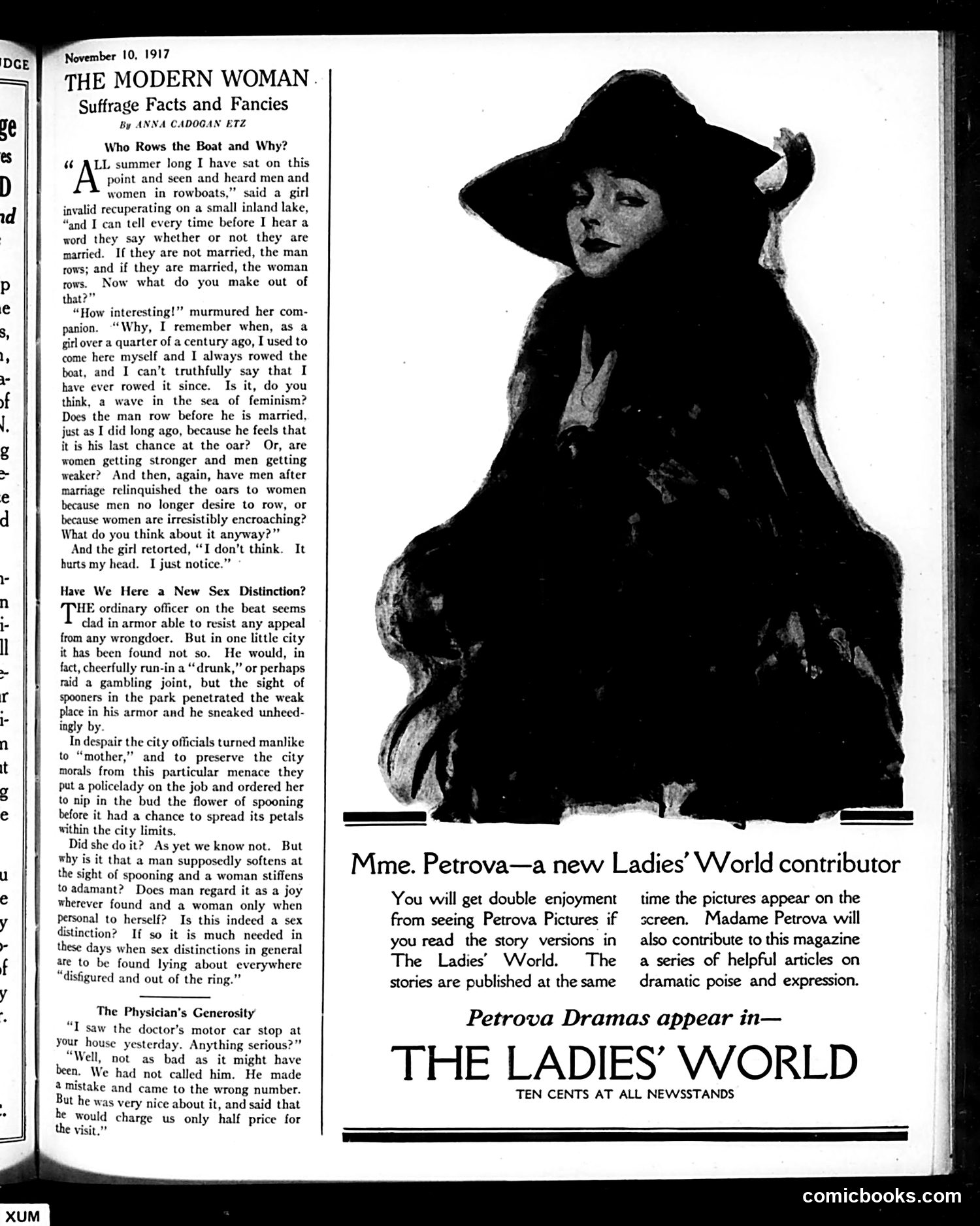
This page satirizes debates about changing gender roles during the women's suffrage era. The column by Anna Cadogan Utz presents three anecdotes mocking anxieties about women's liberation: 1. **"Who Rows the Boat"**: Observes that unmarried men row boats, but married women do—suggesting marriage reverses male authority. The commentary sarcastically questions whether this reflects feminism, female strength, or male weakness. 2. **"New Sex Distinction"**: Reports a city hiring a "policelady" because male officers were too distracted by courting couples ("spooning") to enforce morals. It mockingly asks why men find spooning joyful everywhere, but women find it acceptable only when personally involved. 3. **"The Physician's Generosity"**: A brief joke about a doctor's mistake call. The satire targets contemporary hand-wringing about women's changing social roles and independence. The advertisement for Madame Petrova's films occupies the right column—unrelated to the political content.
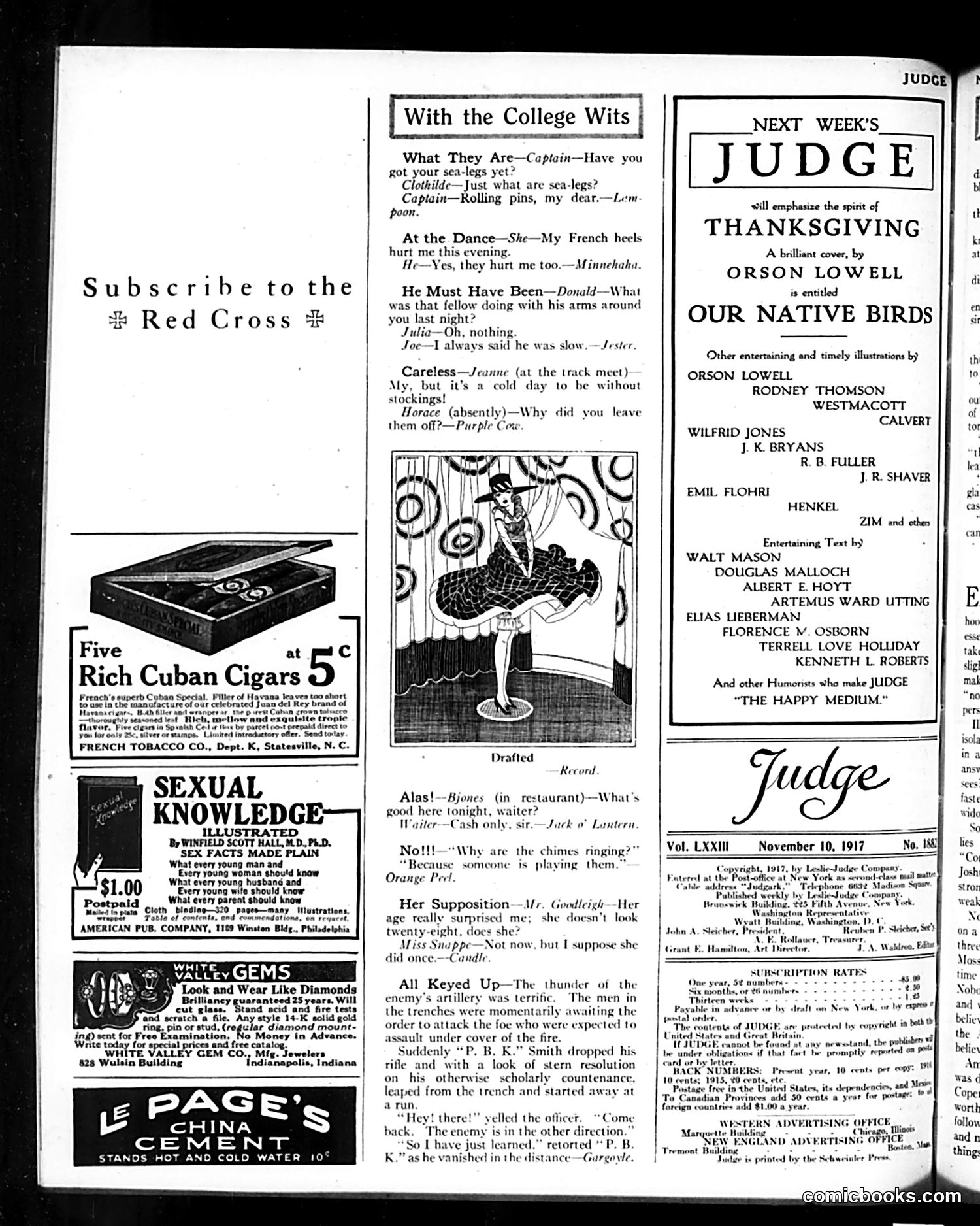
This is primarily a **humor/jokes page** from Judge magazine (November 10, 1917), featuring college-era witticisms and dating humor typical of the era. The cartoons and jokes satirize young romance and military life. **Key content:** - "With the College Wits" presents short comedic exchanges about dating, dancing, and romance—the humor relies on wordplay and mild flirtation (e.g., "sea-legs" as rolling pins, French heels causing pain). - One joke, "All Keyed Up," references **WWI trench warfare**—a soldier abandons his post mid-battle, claiming he "just learned" the enemy is in the *other* direction, satirizing military confusion or the chaos of modern warfare. **The surrounding ads** (Cuban cigars, "Sexual Knowledge" guides, fake diamonds) target young men, reflecting period consumer culture. The page emphasizes that next week's Thanksgiving issue will feature illustrations of native birds. This is essentially an entertainment/advertising page with light satirical humor rather than hard political commentary.
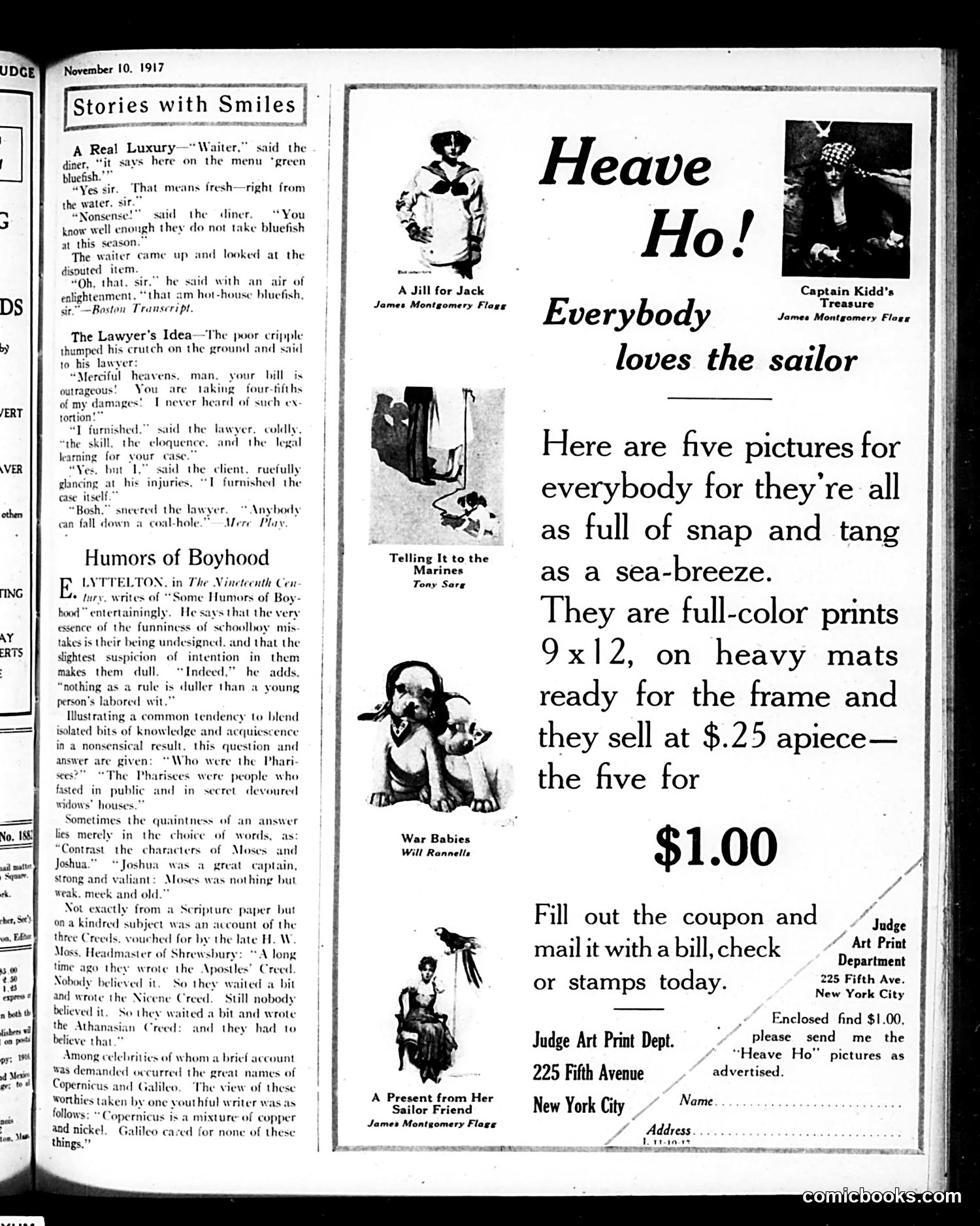
This page is primarily **advertising and filler content**, not political satire. The right side promotes five nautical-themed prints by illustrator James Montgomery Flagg—"A Jill for Jack," "Captain Kidd's Treasure," "Telling It to the Marines," "War Babies," and "A Present from Her Sailor Friend"—selling for $1.00 total. The left side contains three unrelated humorous anecdotes ("Stories with Smiles"): a waiter's excuse about hot-house bluefish, a lawyer's dismissal of a client's injury claim, and a collection of funny schoolboy misquotations from Scripture and history. These are gentle, non-satirical humor pieces typical of the era's magazine filler. The "Heave Ho! Everybody loves the sailor" tagline reflects WWI-era patriotic sentiment toward Navy personnel, capitalizing on public affection for sailors during America's recent 1917 entry into the war.
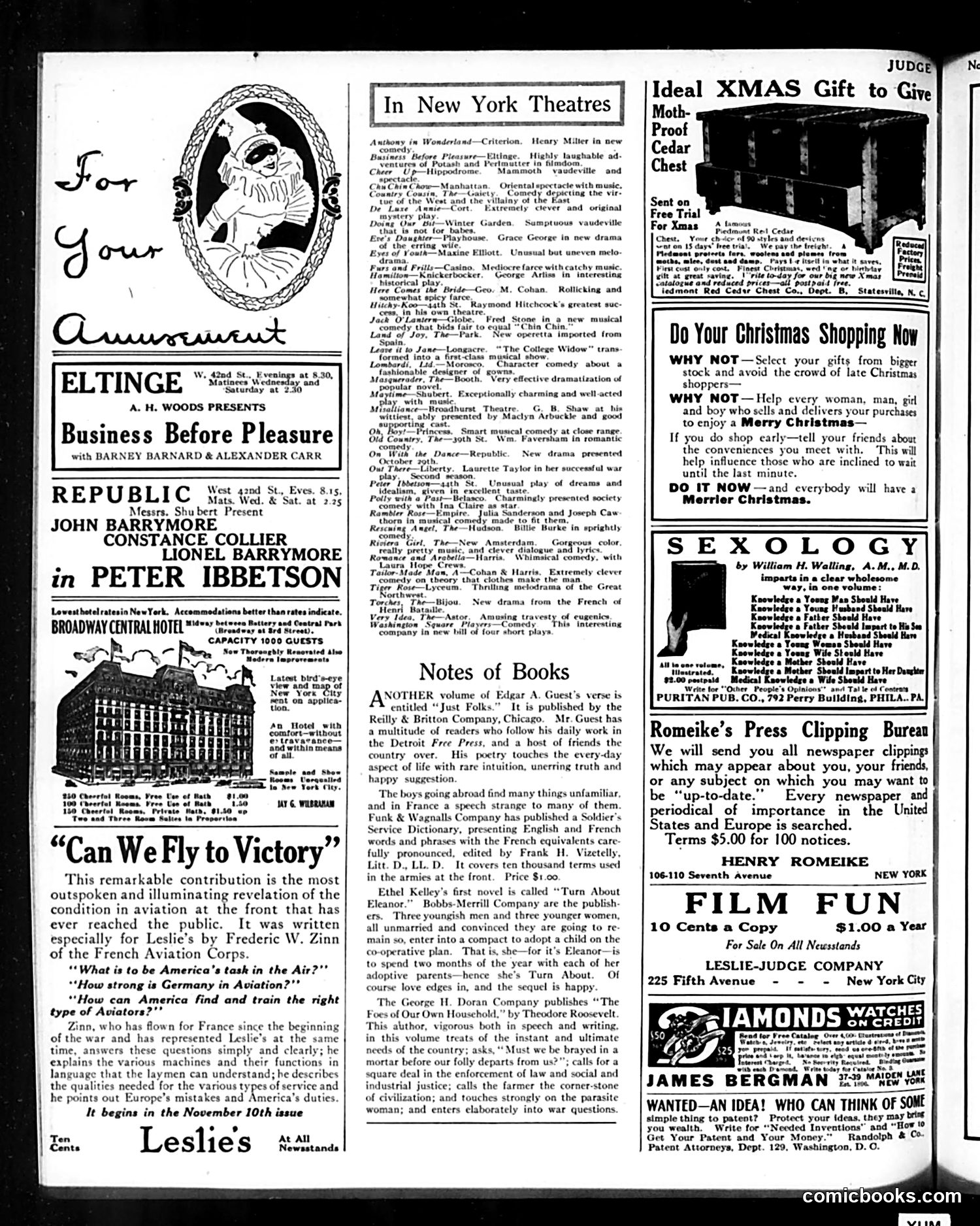
This page is primarily **advertising and theatrical listings** from Judge magazine. The main content includes: **Key Elements:** 1. **"Can We Fly to Victory"** — An article advertised for Leslie's magazine by Frederic W. Zinn of the French Aviation Corps. This addresses America's potential role in WWI aviation, asking "What is to be America's task in the Air?" This reflects the U.S. debate over entering World War I (the magazine likely dates to 1916-1917, before American entry in 1917). 2. **New York theater listings** — Broadway shows dominating the upper portion, typical entertainment advertising of the era. 3. **Various ads** — Including a moth-proof cedar chest, a press clipping service, and patent/invention solicitations. The page's primary purpose is commercial rather than satirical. The "For Your Amusement" header and Santa Claus illustration are seasonal Christmas content, not political commentary.
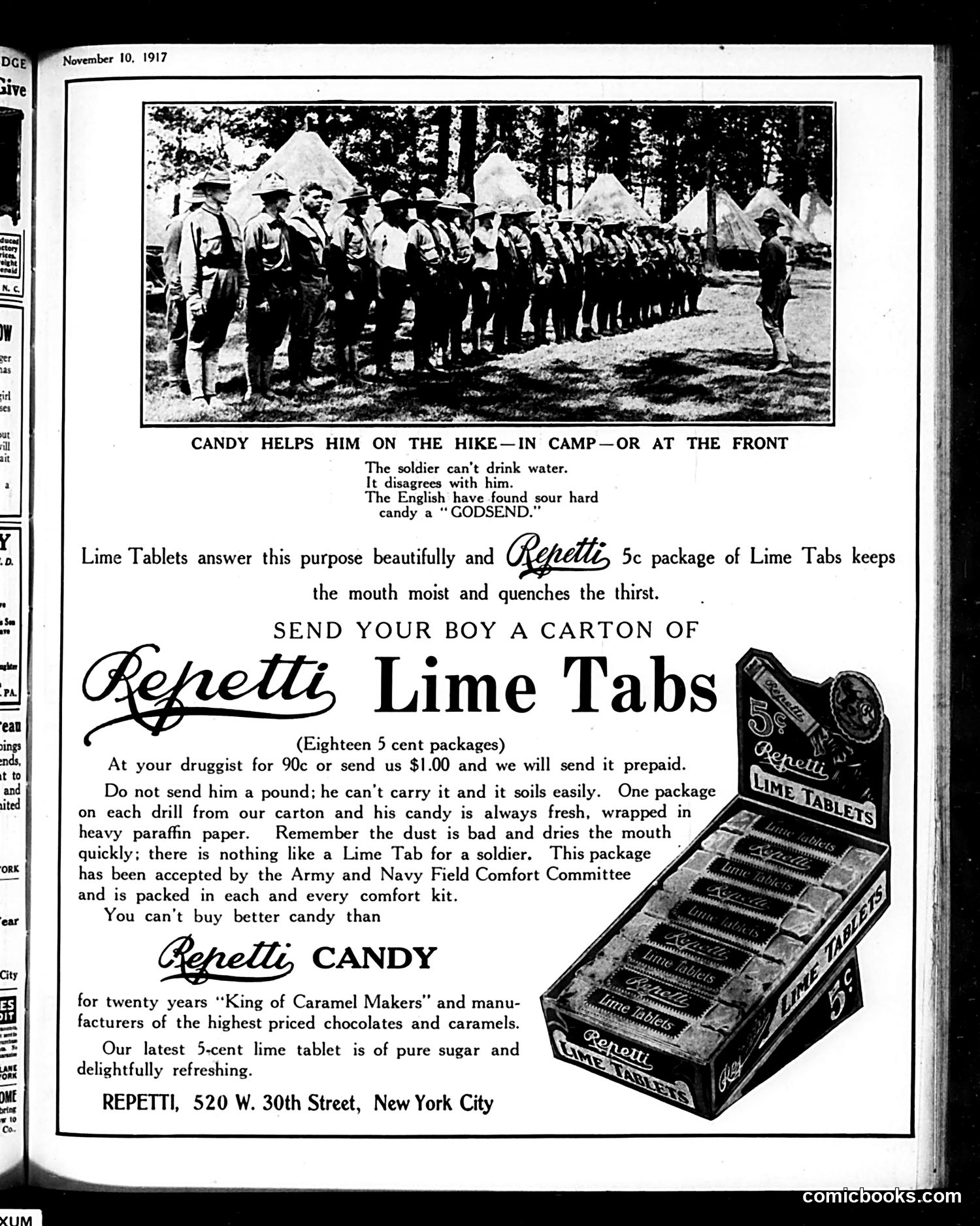
This is primarily a **World War I-era advertisement**, not a political cartoon. It uses a patriotic appeal to sell candy to families sending care packages to soldiers. The image shows soldiers in formation at a military camp. The advertisement claims that British forces discovered sour hard candy ("godsends") helped soldiers endure marching and combat because soldiers couldn't safely drink water in the field—it supposedly disagreed with them. Repetti positions their lime tablets as the solution: lightweight, compact, officially endorsed by the Army and Navy Field Comfort Committee, and already included in military comfort kits. The pitch targets American families: don't send heavy pound packages; instead buy their compact cartons (eighteen 5-cent packages for 90 cents) to keep your soldier's mouth moist and thirst quenched. This reflects genuine wartime logistics and morale concerns, using patriotic duty to drive sales.
This appears to be a title page or advertisement from *Judge* magazine containing only the text "Subscribe to the Red Cross" in a bordered box against a blank background. There is no cartoon or satirical content visible on this page. Rather, this is a straightforward public service message encouraging readers to support the Red Cross organization. Given *Judge*'s era as a satirical publication, this likely represents either a wartime patriotic appeal (possibly WWI or WWII era) or simply an advertising page. The Red Cross was a major humanitarian organization providing medical services and relief during armed conflicts and disasters. Without additional context about the magazine's publication date, we cannot determine the specific historical circumstances prompting this subscription appeal.