
Judge, 1917-11-10 · page 12 of 28
Judge — November 10, 1917 — page 12: what you’re looking at
What you’re looking at
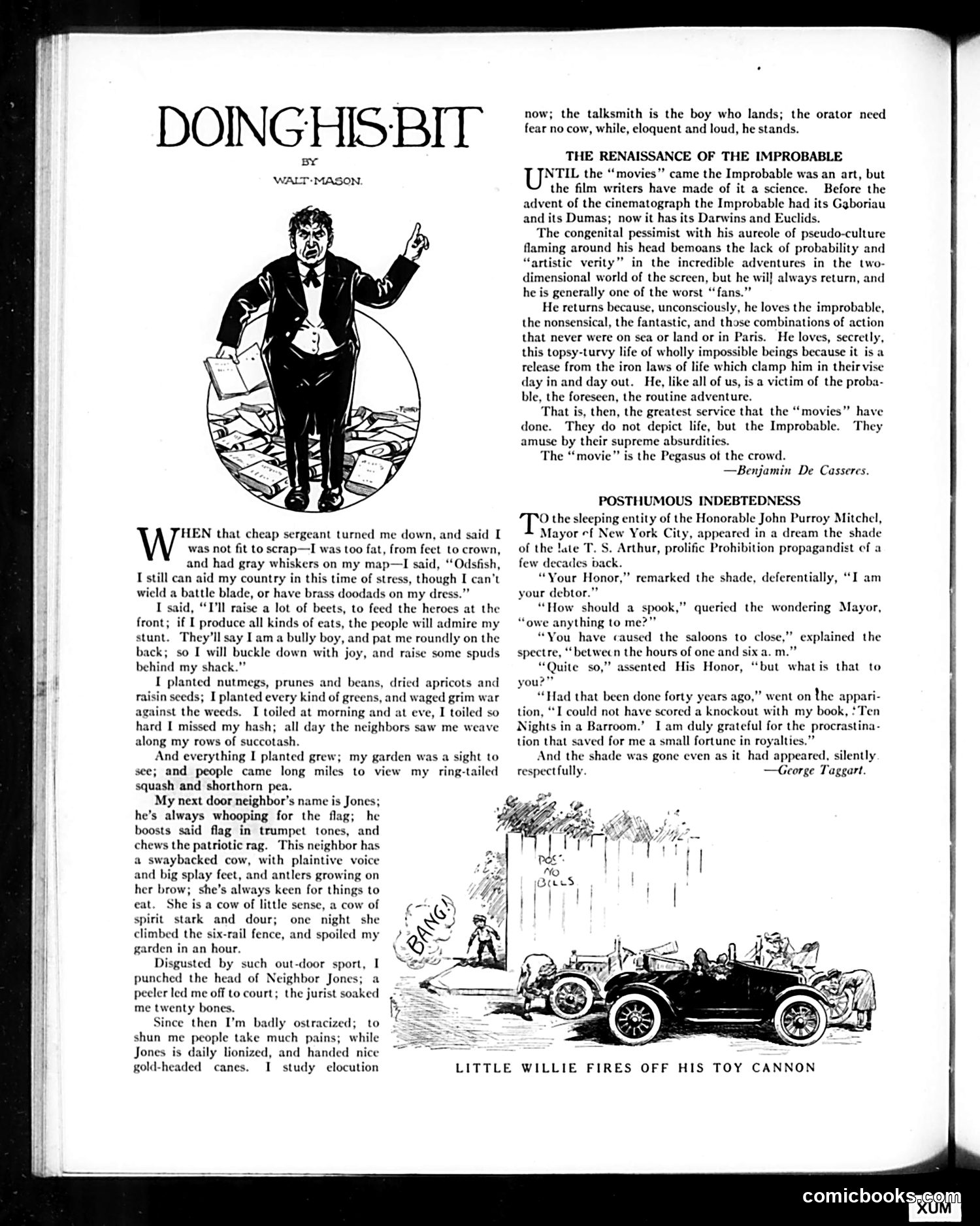
This Judge magazine page contains three separate pieces satirizing early 20th-century American life: **"Doing His Bit"** (left): A humorous poem by Walt Mason about a man rejected from military service who grows a spectacular vegetable garden to support the war effort. His patriotic neighbor Jones has a cow that destroys the garden; the narrator punches Jones and is fined in court. Now Jones is celebrated as a patriot while the narrator is shunned—the joke being that in America, eloquent loudmouths ("talksmith") get rewarded over quiet, genuine service. **"Renaissance of the Improbable"** (top right): An essay praising silent films for depicting impossible, fantastical scenarios—arguing audiences love this escape from mundane reality more than realistic art. References "Gaboriau and Dumas" (adventure novelists) as precursors to film. **"Posthumous Indebtedness"** (bottom): A satirical ghost story where a shade of temperance advocate T.S. Arthur thanks Mayor Mitchell for closing saloons during early morning hours (1-6 a.m.), suggesting prohibition's limited practical effect—a jab at both temperance activists and urban drinking culture.
📄 Transcribed text from this page (OCR, searchable)
Machine-transcribed from the original scan — historical spelling and the odd misread are preserved.
DOINGHISBIT WALT: MASON. HEN that cheap sergeant turned me down, and said I was not fit to scrap—I was too fat, from feet to crown, and had gray wi rs on my map—I said, “‘Odsfish, I still can aid my country in this time of stress, though I can't wicld a battle blade, or have brass doodads on my dress.” I said, “I'll raise a lot of beets, to feed the heroes at the front; if I produce all kinds of eats, the people will admire my stunt. They'll say Iam a bully boy, and pat me roundly on the back; so I will buckle down with joy, and raise some spuds behind my shack.” I planted nutmegs, prunes and beans, dried apricots and raisin seeds; I planted every kind of greens, and waged grim war against the weeds. I toiled at morning and at eve, I toiled so hard I missed my hash; all day the neighbors saw me we: along my rows of succotash. And everything I planted grew; my garden wa: see; and people came long miles to view my squash and shorthorn pea. My next door neighbor’s name is Jones; he’s always whooping for the flag; he boosts said flag in trumpet tones, and chews the patriotic rag. is neighbor has a swaybacked cow, with plaintive voice feet, and antlers growing on always keen for things to eat. She is a cow of little sense, a cow of spirit stark and dour; one night she climbed the six-rail fence, and spoiled my garden in an hour. Disgusted by such out-door sport, I punched the head of Neighbor Jones; a peeler led me off to court; the jurist soaked me twenty bones. Since then I’m badly ostraci to shun me people take much pains; while Jones is daily lionized, and handed nice gold-headed canes. I study elocution sight to ring-tailed now; the talksmith is the boy who lands; the orator need fear no cow, while, eloquent and loud, he stands. THE RENAISSANCE OF THE IMPROBABLE UNTIL the “movies” came the Improbable was an art, but the film writers have made of it a science. Before the advent of the cinematograph the Improbable had its Ggboriau and its Dumas; now it has its Darwins and Euclids. The congenital pessimist with his aureole of pseudo-culture flaming around his head bemoans the lack of probability and “artistic verity” in the incredible adventures in the two- dimensional world of the screen, but he wil] always return, and he is generally one of the worst “fans.” He returns because, unconsciously, he loves the improbable, the nonsensical, the fantastic, and those combinations of action that never were on sea or land or in Paris. He loves, secretly, this topsy-turvy life of wholly impossible beings because it is a release from the iron laws of life which clamp him in their vise day in and day out. He, like all of us, is a victim of the proba- ble, the foreseen, the routine adventure. That is, then, the greatest service that the “m done. They do not depict life, but the Improbable. amuse by their supreme absurdities. The “movie” is the Pegasus of the crowd. —Benjamin De Casseres. ovies” have They POSTHUMOUS INDEBTEDNESS ‘ the sleeping entity of the Honorable John Purroy Mitchel, Mayor ef New York City, appeared in a dream the shade of the late T. S. Arthur, prolific Prohibition propagandist of a few decades back. “Your Honor,” remarked the shade, deferentially, “I am your debtor.” “How should a spook,” queried the wondering Mayor, “owe anything to m “You have caused the saloons to close,” explained the spectre, “‘betwecn the hours of one and six a. m.”” “Quite so,” assented His Honor, “but whatis that to you?” “Had that been done forty yea: 1go,” went on the appari- tion, “I could not have scored a knockout with my book, ‘Ten Nights in a Barroom.’ I am duly grateful for the procrastina- tion that saved for me a s fortune in royalties.” And the shade was gone even as it had appeared, silently respectfully. —Gorge Taggart. LITTLE WILLIE FIRES OFF HIS TOY CANNON