
Judge, 1917-11-10 · page 5 of 28
Judge — November 10, 1917 — page 5: what you’re looking at
What you’re looking at
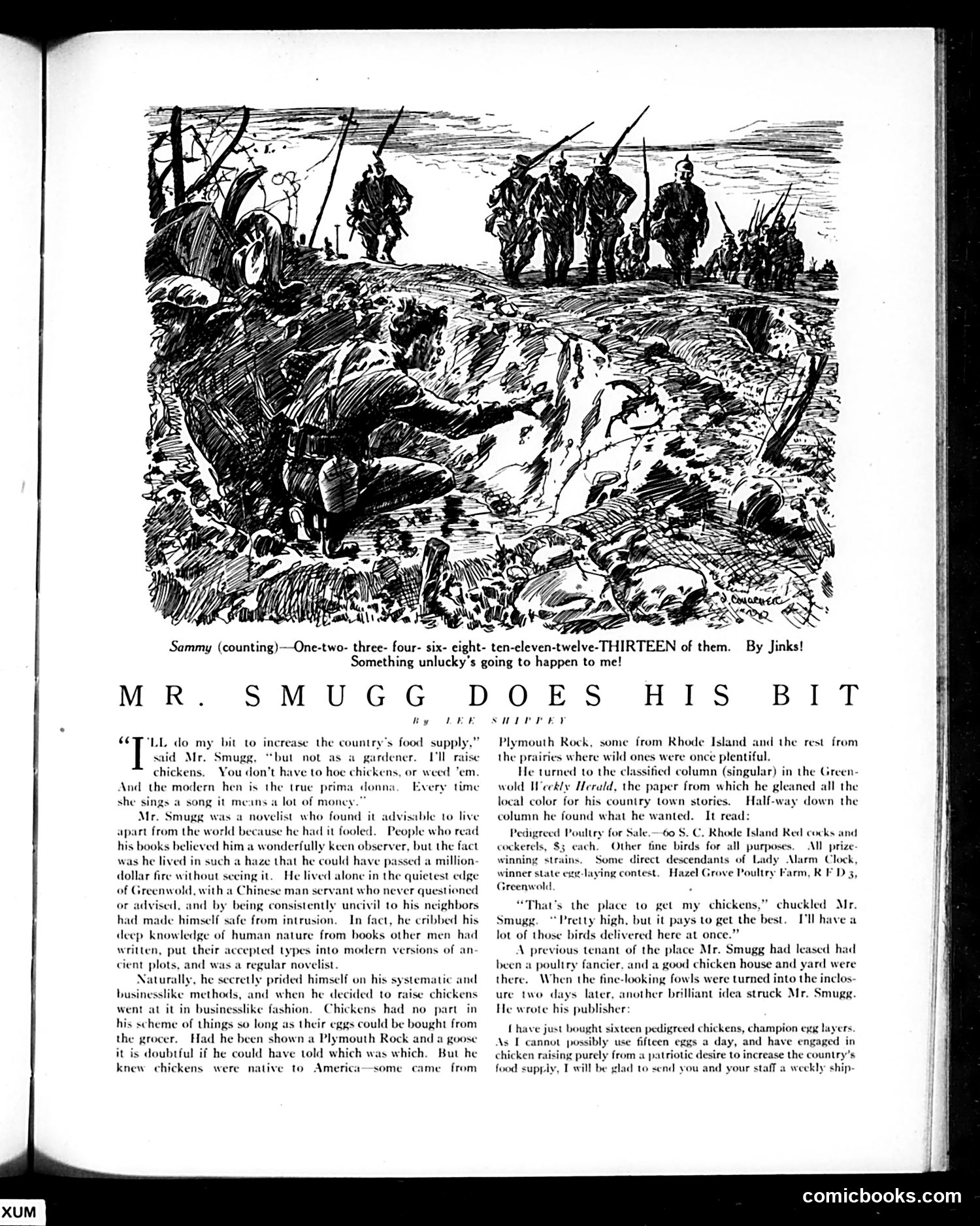
This is a humorous short story with an accompanying illustration, not a political cartoon. The sketch shows a WWI-era military scene with soldiers and casualties. The narrative satirizes a character named Mr. Smugg, a novelist living in rural seclusion who decides to contribute to the war effort. Rather than serving militarily, he proposes raising chickens to increase the country's food supply. He contacts poultry publications, buys pedigreed birds, and writes his publisher about his patriotic venture. The satire mocks civilians who perform trivial "war service" while avoiding actual military duty—using chicken-farming as a humorous proxy for home-front self-importance during wartime. The juxtaposition of Smugg's comfortable scheme against the brutal battlefield scene emphasizes the contrast between real sacrifice and performative patriotism.
📄 Transcribed text from this page (OCR, searchable)
Machine-transcribed from the original scan — historical spelling and the odd misread are preserved.
at Something unlucky’s going to happen to me! MR. hy LEE Smu “but not as a gardener. Ul raise You don’t have to hoe chickens, or weed 'em. Every time suid Mr. chickens, And the modern hen is the true prima she sings a song it means a lot of money Mr. Smugg was a novelist who found it advisable to live apart from the world because he had it fooled. People who read his books believed him a wonderfully keen observer, but the fact was he lived in such a haze that he could have passed a million dollar fire without seeing He lived alone in the quietest edge of Greenwold, with a Chinese man servant who never questioned or advised, and by being consistently uncivil to his neighbors had made himself safe from intrusion. In fact, he cribbed his deep knowledge of human nature from books other men had written, put their accepted types into modern versions of an cient plots, and was a regular novelist. Naturally, he secretly prided himself on his systematic and businesslike methods, and when he decided to raise chickens went at it in businesslike fashion. Chickens had no part in his scheme of things so long as their eggs could be bought from the grocer. Had he been shown a Plymouth Rock and a goose it is doubtful if he could have told which was which. But he knew chickens were native to America—some came from "Ts do my bit to increase the country’s food supply, lonna SMUGG DOES HIS BIT Plymouth Rock, some from Rhode Island and the rest from the prairies where wild ones were once plentiful. He turned to the classified column (singular) in the Green- wold Weekly Herald, the paper from which he gleaned all the local color for his country town stories. Half-way down the column he found what he wanted. It read: Pedigreed Poultry for Sale.—60 $. C. Rhode Island Red cocks and cockerels, $3 cach. Other fine birds for all purposes. All prize winning strains. Some direct descendants of Lady Marm Clock, winner state ex-laying contest. Hazel Grove Poultry Farm, R FD 3, Greenwoldd SHIPPEY “That's the place to get my chickens,” chuckled Mr. Smugg. “Pretty high, but it pays to get the best. I'll have a lot of those birds delivered here at once.” \ previous tenant of the place Mr. Smugg had leased had been a poultry fancier, and a good chicken house and yard were When the fine-looking fowls were turned into the inclos- a struck Mr. Smugg. there. ure two days later, another brilliant He wrote his publisher {have just bought sixteen pedigreed chickens, champion exg layers As E cannot possibly use fifteen eggs a day, and have engaged in chicken raising purely from a patriotic desire to increase the country food supply, T will be glad to send you and your staff a weekly ship- comicbooks.com