
Judge, 1917-11-10 · page 9 of 28
Judge — November 10, 1917 — page 9: what you’re looking at
What you’re looking at
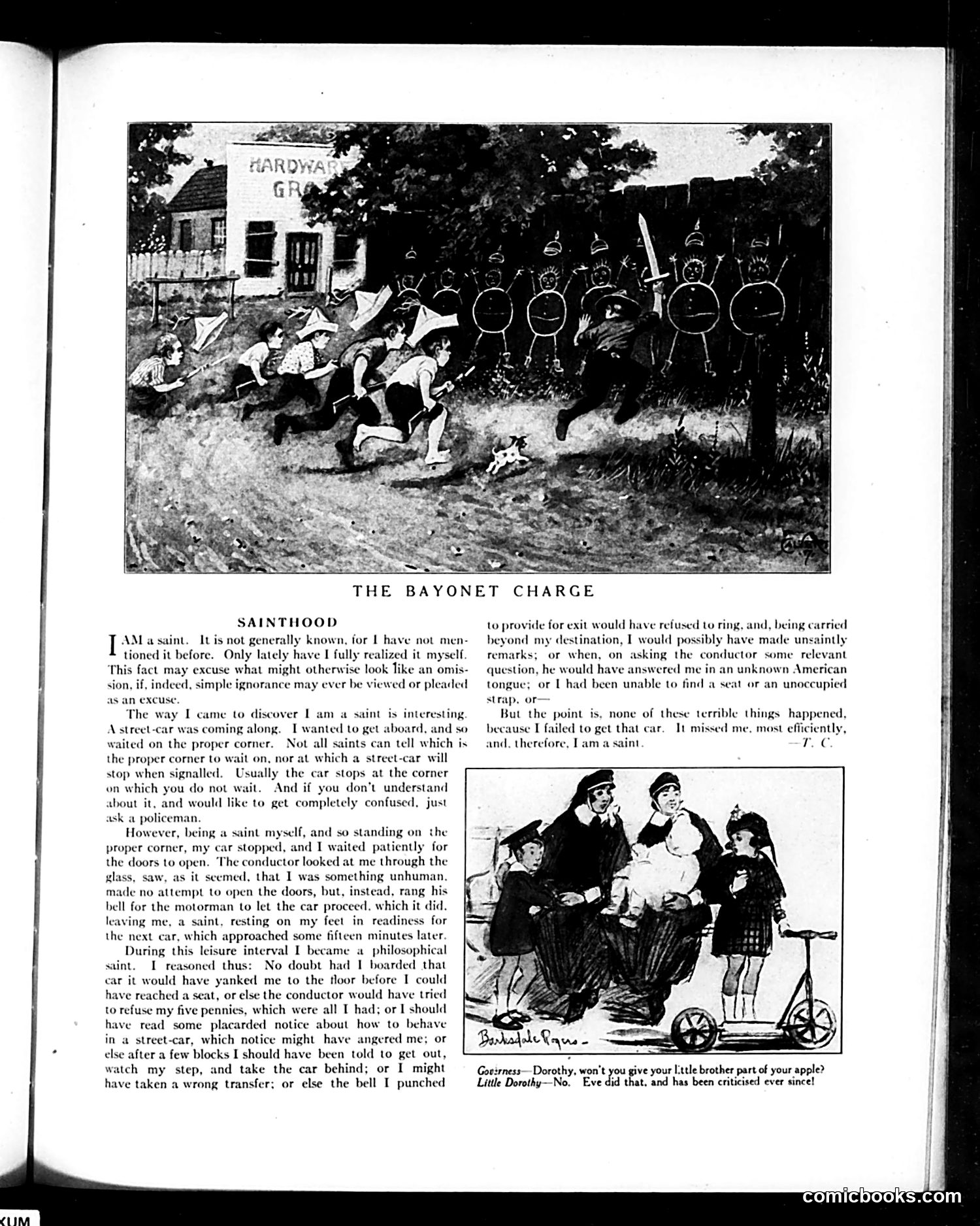
This page satirizes American urban life's minor indignities through the lens of "sainthood." The main article humorously describes how the narrator becomes a "saint" by missing a streetcar—a mundane modern frustration. The joke is that avoiding the car spares him from various unpleasant experiences (being yanked around, rude conductors, confusing transfers), which the author presents as divine providence. The small cartoon below illustrates a children's joke: when asked to share her apple with her brother, Dorothy refuses, citing the biblical precedent of Eve giving the apple to Adam—which brought humanity sin and suffering. It's a cheeky inversion of the expected moral lesson about sharing. Together, the page mocks both the chaos of modern city transportation and the way people rationalize minor disappointments as good fortune.
📄 Transcribed text from this page (OCR, searchable)
Machine-transcribed from the original scan — historical spelling and the odd misread are preserved.
AS Fest THE BAYONET CHARGE SAINTHOOD to provide for exit would have refused to ring, and, being carried AM asaint. It is not generally known, for 1 not men- beyond my destination, I would possibly have made uns tioned it before. Only lately have I fully realized it myself. remarks; or when, on asking the conductor some rele This fact may excuse what might otherwise look like an omis- question, he would have answered me in an unknown Americ: sion, if, indeed, simple ignorance may ever be viewed or pleaded — tongue; or L had been unable to find a seat or an unoccupii as an excuse. strap, or- The way I came to discover I am a saint is interesting. But the point is. A street-car was coming along. I wanted to get aboard, and so — because I failed to get that car. It missed me, most efficiently, waited on the proper corner. Not all saints can tell which is and. therefore, Iam a sa T. C. the proper corner to wait on, nor at which a street-car will stop when signalled. Usually the car stops at the corner on which you do not wait. And if you don’t understand about it, and would like to get completely confused, just ask a policeman. However, being a saint myself, and so standing on the proper corner, my car stopped, and I waited patiently for the doors to open. The conductor looked at me through the glass, saw, as it seemed, that I was something unhuman,. made no attempt to open the doors, but, instead, rang his bell for the motorman to let the car proceed, which it did. leaving me, a saint, resting on my feet in readiness for the next car, which approached some fifteen minutes later. During this leisure interval I became a philosophical stint. I reasoned thus: No doubt had I boarded that ] car it would have yanked me to the floor before I could have reached a seat, or else the conductor would have tried none of these terrible things happened, to refuse my five pennies, which were all I had; or I should | have read some placarded notice about how to behave | in a street-car, which notice might have angered me; or | ByrhadleQaus - - 1 . else after a few blocks I should have been told to get out, - - watch my step, and take the car behind; or I might Goe:rness—Dorothy, won't you give your I:ttle brother part of your apple? have taken a wrong transfer; or else the bell I punched Little Dorothy—No. Eve did that, and has been criticised ever since! | ] comicbooks.com C11M