
Judge, 1917-11-10 · page 8 of 28
Judge — November 10, 1917 — page 8: what you’re looking at
What you’re looking at
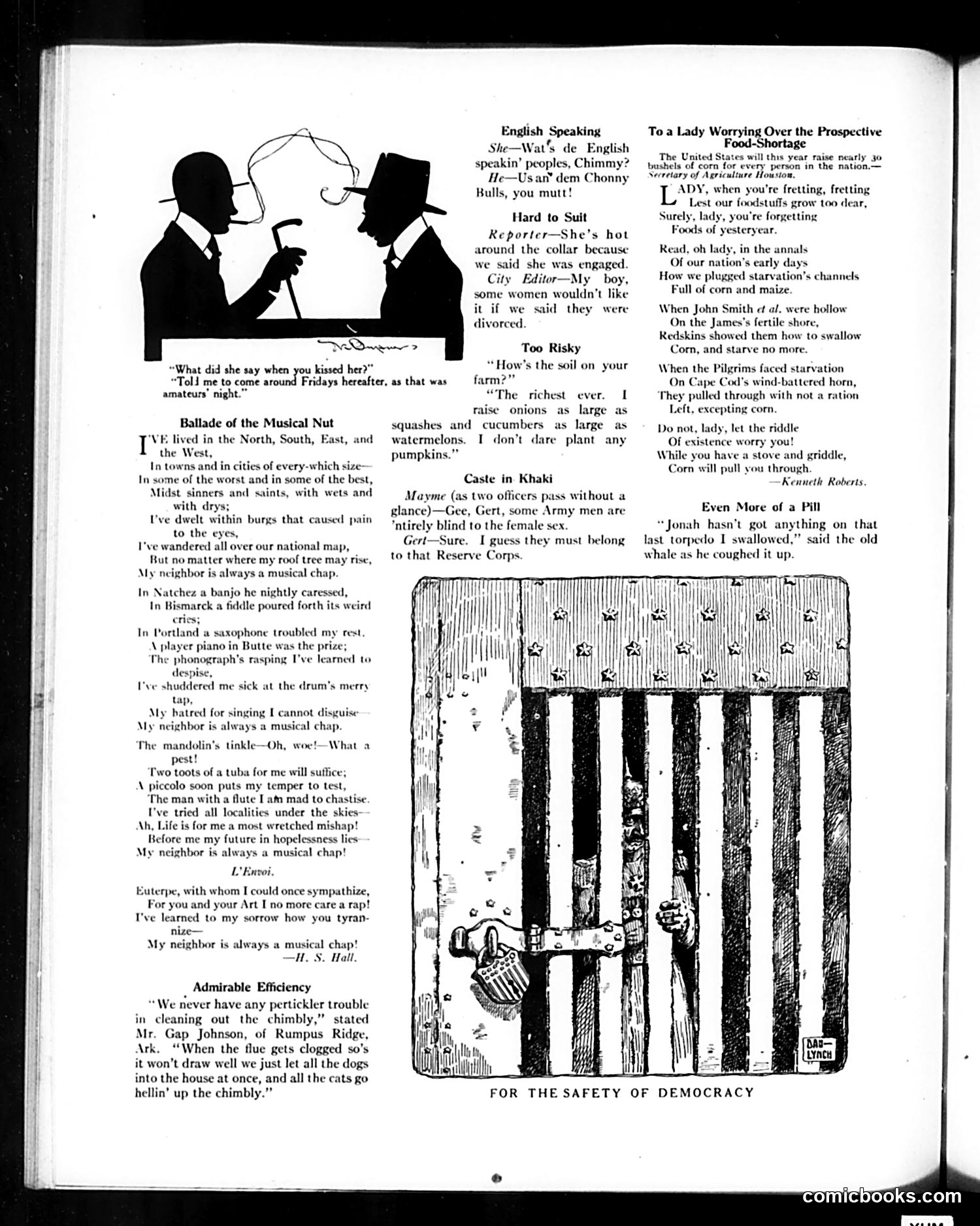
This page contains several satirical pieces typical of early 20th-century American humor: **Top cartoon** mocks amateur performers at "Fridays hereafter"—likely vaudeville amateur nights—through a man bragging about kissing a woman who dismissed him as an amateur. **"Ballad of the Musical Nut"** is a humorous poem lamenting that no matter where the narrator lives, his neighbor plays a musical instrument badly—banjo, fiddle, saxophone, player piano, phonograph. It's gentle domestic satire about annoying neighbors, a universal complaint. **Other brief jokes** mock: linguistic pretension ("English Speaking"), women's unpredictability ("Hard to Suit"), agricultural boasting ("Too Risky"), and military class divisions ("Caste in Khaki"). **Kenneth Roberts' poem** reassures a woman worried about food shortages, noting America produces abundant corn—referencing both historical survival (John Smith, Pilgrims) and present agricultural capacity under Secretary of Agriculture Houston. **Bottom cartoon** ("For the Safety of Democracy") shows a whale coughing up a torpedo, likely WWI-era commentary on submarine warfare. The page reflects wartime concerns and domestic preoccupations of approximately 1915-1920.
📄 Transcribed text from this page (OCR, searchable)
Machine-transcribed from the original scan — historical spelling and the odd misread are preserved.
wR > “What did she say when you kissed her?” “Tol me to come arou amateurs’ night.” Ballade of the Musical Nut I ed in the North, South, East, and the West, In towns and in cities of every-which size- In some of the worst and in some of the best, Midst sinners and saints, with wets and with di ve dwelt within burgs that caused pain to the eyes, I've wandered all over our national map, But no matter where my roof tree may rise, My neighbor is always a musical chap. In Natchez a banjo he nightly caressed, In Bismarck a fiddle poured forth its weird cries; In Portland a saxophone troubled my rest \ player piano in Butte was the prize; Phe phonograph’s rasping I’ve learned to despise, I've shuddered me sick at the drum’s merry tap, My hatred for singing I cannot disguise My neighbor is always a musical chap. The mandolin’s tinkle—Oh, woe!—What a pest! Two toots of a tuba for me will suffice; \ piccolo soon puts my temper to test, The man with a flute I I've tried all loca Nh, Lil for me a most wretched mis Before me my future in hopelessness lies My neighbor is always a musical chap! L'Envoi. Euterpe, with whom I could once sympathize, For you and your Art I no more care a rap! I've learned to my sorrow how you tyran- nize— My neighbor is always a musical chap! —H. S. Hall. Admirable Efficiency “We never have any pertickler trouble in cleaning out the chimbly,” stated Mr. Gap Johnson, of Rumpus Ridge, Ark. “When the flue gets clogged so’s it won't draw well we just let all the dogs into the house at once, and all the cats go hellin’ up the chimbly.” Fridays hereafter, as that was English Speaking She—Wat's de English speakin’ peoples, Chimmy? He—Usan’ dem Chonny Bulls, you mutt! Hard to Suit Reporter—She's hot around the collar because we said she was engaged c Editor—My boy, some women wouldn't like it if we said they were divorced Too Risky “How's the soil on your farm? “The richest ever. I raise onions as large as squashes and cucumbers us large as watermelons. I don’t dare plant any pumpkins.” Caste in Khaki Mayme (as two officers pass without a glance) —C Gert, some Army men are ‘ntirely blind to the female sex. Gert—Sure. I guess they must belong to that Reserve Corps. To a Lady Worrying Over the Prospective Food-Shortage The United States will this year raise nearly 30 bushels of corn for every person in the nation.— Secretary of Agriculture Houston. ADY, when you're fretting, fretting Lest our foodstuffs grow too dear, ‘ou're forgetting yesteryear. Read, oh lady, in the annals Of our nation’s early days How we plugged starvation’s channels Full of corn and maize. When John Smith et a/. were hollow On the James's fertile shore, Redskins showed them how to swallow Corn, and starve no more. When the Pilgrims faced starvation On Cape Cod’s wind-battered horn, They pulled through with not a ration Left, excepting corn. Do not, lady, let the riddle Of existence worry you! While you have a stove and griddle, Corn will pull you through Kenneth Roberts. Even More of a Pill “Jonah hasn't got anything on that last torpedo I swallowed,” said the old whale as he coughed it up. THE SAFETY OF DEMOCRACY