
Judge, 1917-11-10 · page 16 of 28
Judge — November 10, 1917 — page 16: what you’re looking at
What you’re looking at
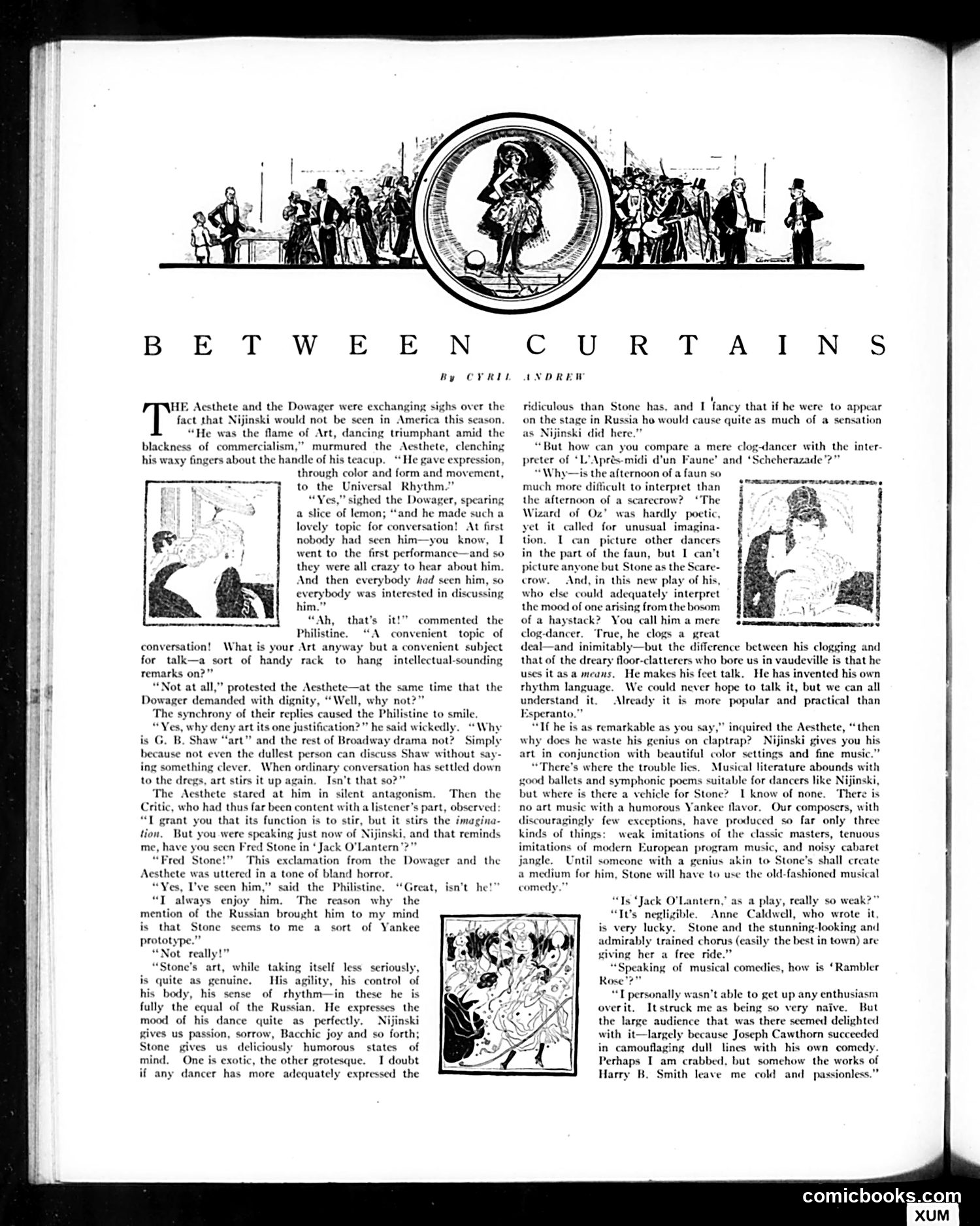
This satirical article mocks the pretentiousness of art aesthetes who lionize the Russian ballet dancer Nijinski while dismissing American vaudeville performer Fred Stone. The Aesthete and a Dowager lament Nijinski's absence from America, praising his artistic depth and "Universal Rhythm." A blunt Philistine character challenges them: isn't art just convenient dinner conversation? He argues that Stone—an American clog-dancer and comedic performer from "Jack O'Lantern"—demonstrates equal technical mastery and artistic validity, merely in a different mode (grotesque humor versus passion). The satire targets the cultural snobbery of the Jazz Age intelligentsia who valorized European high culture while dismissing homegrown American entertainment as inferior. The critic defends Stone's invented "rhythm language" as equally valid and more practically accessible than the Russian's approach, suggesting American popular entertainment deserves respect alongside European sophistication.
📄 Transcribed text from this page (OCR, searchable)
Machine-transcribed from the original scan — historical spelling and the odd misread are preserved.
B ET WEEN By CYRIL HE, Aesthete and the Dowager were exchanging sighs over the fact that Nijinski would not be seen in America this season. “He was the flame of Art, dancing triumphant amid the ness of commercialism,” murmured the Aesthete, clenching axy fingers about the handle of his teacup. “He gave expression, through color and form and movement, to the Universal Rhythm.” “Yes,” sighed the Dowager, spearing a slice of lemon; “and he made such a lovely topic for conversation! At first nobody had seen him—you know, I went to the first performance—and so they were all crazy to hear about him. And then everybody had seen him, so everybody was interested in discussing him.” Ah, tha commented the Philistine. “A convenient topic of conversation! What is your Art anyway but a convenient subject for talk—a sort of handy rack to hang intellectual-sounding remarks on?” ot at all,” protested the Aesthete—at the same time that the Dowager demanded with dignity, “Well, why not?” The synchrony of their replies caused the Philistine to smile. “Yes, why deny art its one justification?” he said wickedly. “Why is G. shaw “art” and the rest of Broadway drama not? Simply because not even the dullest person can discuss Shaw without ing something clever. When ordinary conversation has settled down to the dregs, art stirs it up again. Isn't that so: The Aesthete stared at him in silent antagonism. Then the Critic, who had thus far been content with a listener’s part, observed “I grant you that its function is to stir, but it stirs the imagina- tion. But you were speaking just now of Nijinski, and that reminds me, have you seen Fred Stone in ‘Jack O'Lantern’? “Fred Stone!” This exclamation from the Dowager and the Aesthete was uttered in a tone of bland horror. “Yes, I've seen him,” said the Philistine, ‘Great, isn’t he!” “I always enjoy him. The reason why the mention of the Russian brought him to my mind is that Stone seems to me a sort of Yankee prototype “Not reall: ‘one’s art, while taking itself less seriously, is quite as genuine. His agility, his control of his body, his sense of rhythm—in these he is fully the equal of the Russian. He expresses the mood of his dance quite as perfectly, Nijinski gives us passion, sorrow, Bacchic joy and so forth; Stone {eliciously humorous states of mind. i the other grotesque. I doubt if any dancer has more adequately expressed the N S$ C U RTA INDREW ridiculous than Stone has. and I fancy that if he were to appear on the stage in Russia ho would cause quite as much of a sensation as Nijinski did here.” But how can you compare a mere clog-dancer with the inter- preter of ‘L’Aprés-midi d’un Faune’ and ‘Scheherazade'?” “Why—is the afternoon of a faun so much more difficult to interpret than the afternoon of a scarecrow? ‘The Wizard of Oz’ was hardly poetic, yet it called for unusual imagina- tion. I can picture other dancers in the part of the faun, but I ca picture anyone but Stone as the Sc crow. And, in this new play of his, who else could adequately interpret the mood of one arising from the bosom of a haystack? You call him a mere clog-dancer. True, he clogs a great deal—and inimitably—but the difference between his clogging and that of the dreary floor-clatterers who bore us in vaudeville is that he uses it as a means, He makes his feet talk. He has invented his own rhythm language. We could never hope to talk it, but we can all understand it. Already it is more popular and practical than Esperanto.” “If he is as remarkable as you say,” inquired the Aesthete, “then why does he waste his genius on claptrap? Nijinski gives you his art in conjunction with beautiful color settings and fine music.” “There's where the trouble lies. Musical literature abounds with good ballets and symphonic poems suitable for dancers like Nijinski, but where is there a vehicle for Stone? 1 know of none. There is no art music with a humorous Yankee flavor. Our composers, with discouragingly few exceptions, have produced so far only three kinds of things: weak imitations of the classic masters, tenuous imitations of modern European program music, and noisy cabaret jangle. Until someone with a genius akin to Stone’s shall create a medium for him, Stone will have to use the old-fashioned musical comedy.” “Is ‘Jack O'Lantern,’ as a play, really so weak?” “It’s negligible. Anne Caldwell, who wrote it, is very lucky. Stone and the stunning-looking and admirably trained chorus (easily the best in town) are xiving her a free ride.” “Speaking of musical comedies, how Rose'?” “T personally wasn’t able to get up any enthusiasm overit. Itstruck me as being so very naive. But the large audience that was there seemed delighted with it—largely because Joseph Cawthorn succeeded in camouflaging dull lines with his own comedy. Perhaps I am crabbed, but somehow the works of Harry B. Smith leave me cold and passionless.” is ‘Rambler comicbooks com