
A complete issue · 28 pages · 1917
Judge — February 24, 1917
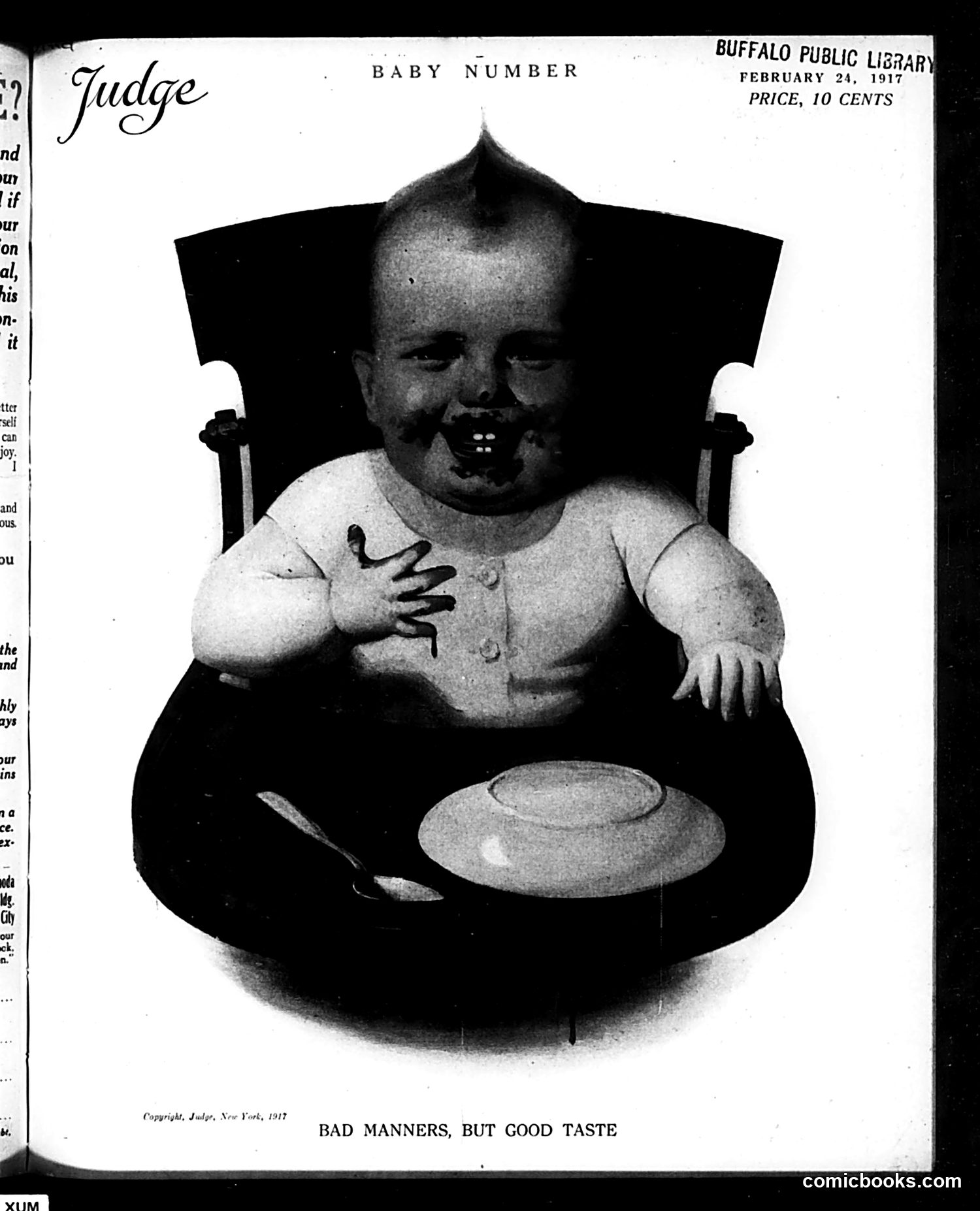
This is Judge magazine's "Baby Number" from February 24, 1917. The cover depicts a chubby infant seated in a high chair, eating messily from a plate—hence "bad manners." The satirical caption "Bad Manners, But Good Taste" suggests the joke plays on the infant's crude eating behavior contrasted with supposedly refined food preferences. Without additional context from the issue's contents, the specific reference remains unclear. It may mock contemporary public figures, social trends, or political absurdities of 1917 America (during World War I preparations). The exaggerated physical caricature and juxtaposition of childish behavior with "good taste" appears designed as humorous social commentary typical of Judge's satirical approach, though the exact target requires the full magazine context to identify with certainty.
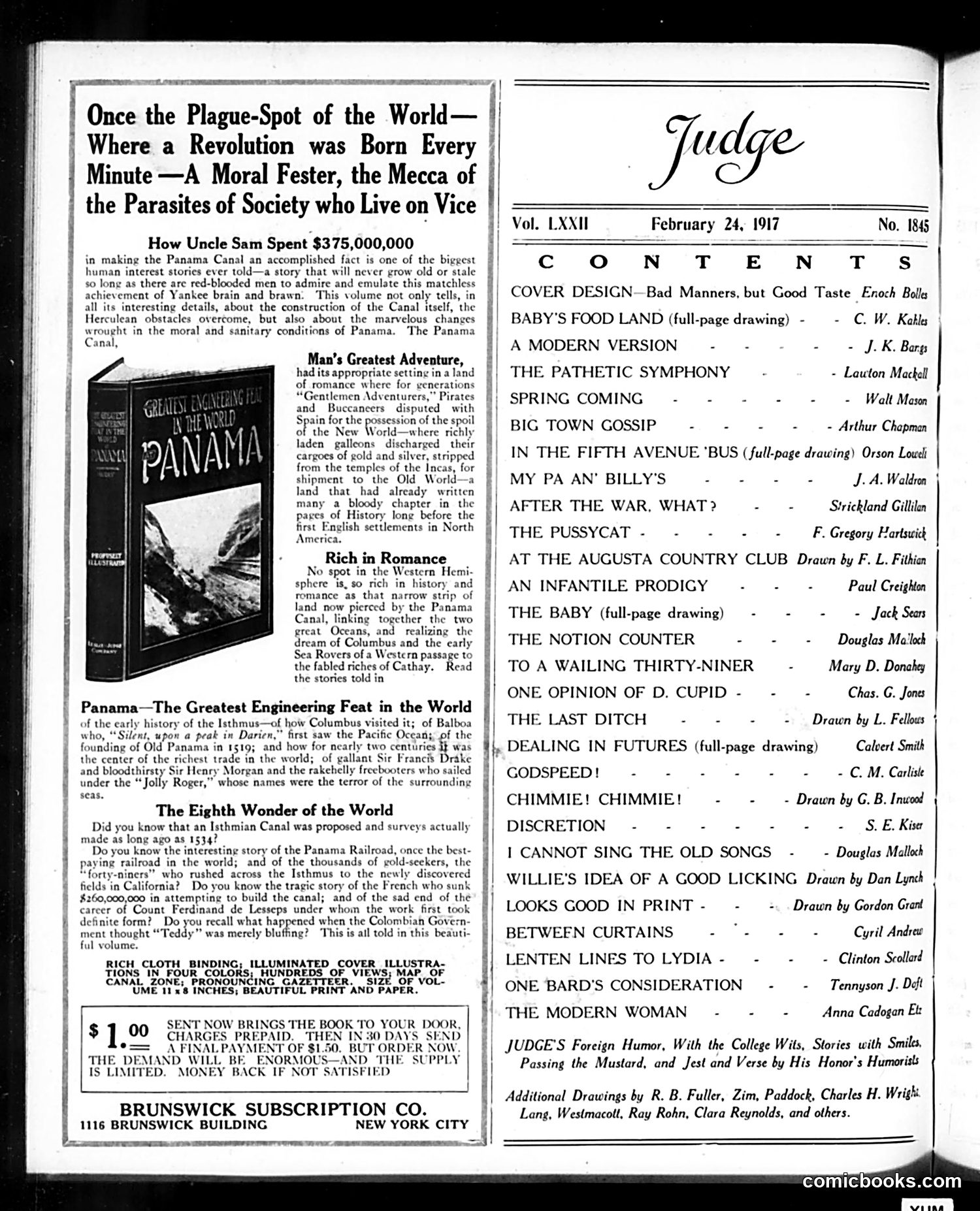
This page is primarily a **table of contents** for Judge magazine's humor and illustrations, with minimal visible cartoon content in this particular image. The left side features an **advertisement for a Panama Canal book**, capitalizing on American interest in this recently completed engineering marvel (opened 1914). The ad promises "romance" and adventure stories set in Panama, appealing to readers' fascination with this achievement of American imperial expansion. The main content listing shows Judge's typical format: humorous articles, satirical commentary on society ("Big Town Gossip"), illustrations, and verse. Bylines include prominent humor writers of the era. Published in **February 1917**—months before US entry into World War I—the magazine reflects pre-war American popular culture focused on domestic social satire and romantic adventure narratives.
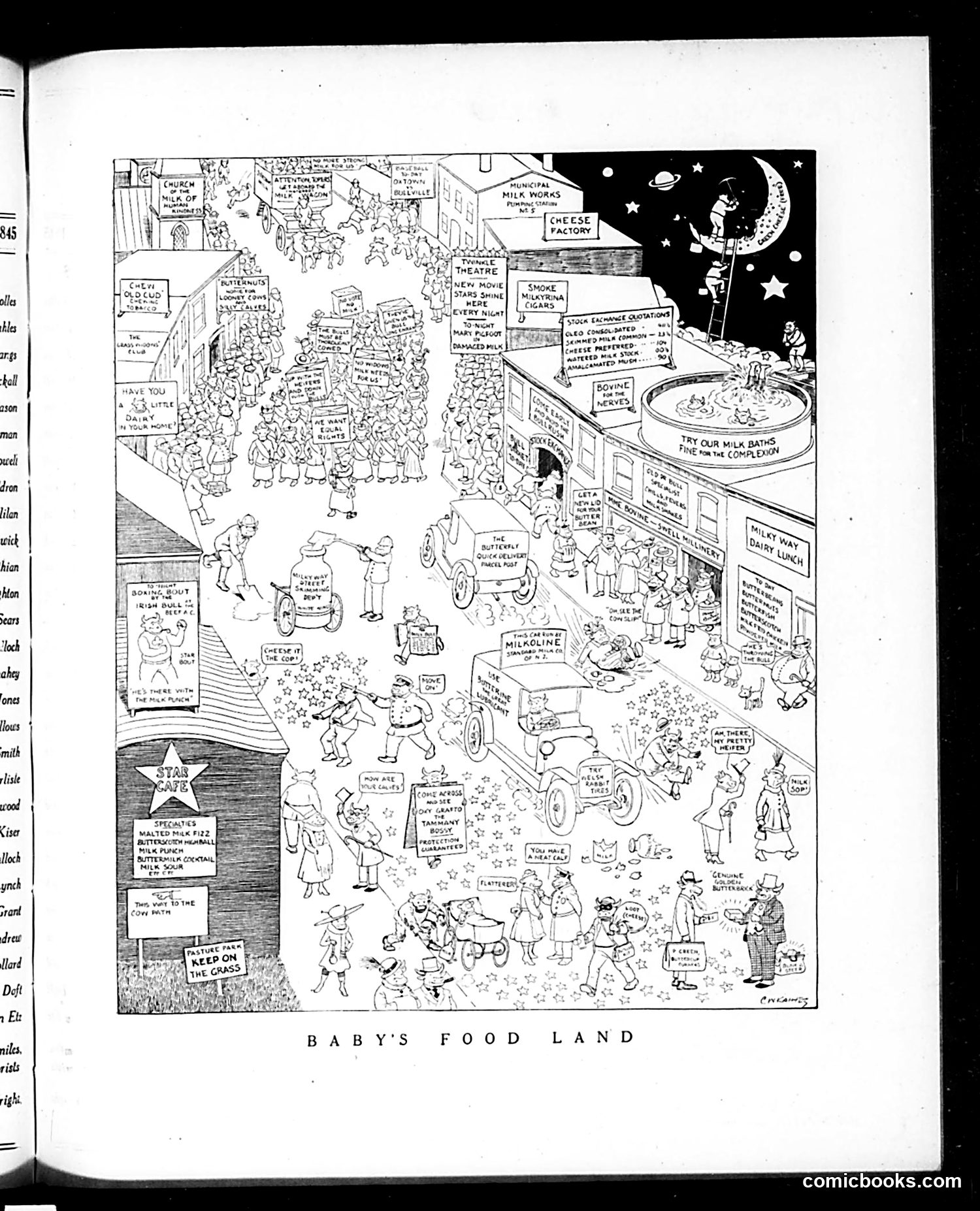
This satirical illustration depicts an idealized "Baby's Food Land"—a fantastical amusement park dedicated entirely to commercial baby food products. The cartoon mocks aggressive marketing to parents by presenting exaggerated establishments: a "Municipal Milk Factory," "Cheese Factory," "New Movie Palace," "Theatre," and various milk bath attractions. The packed crowds of babies and parents suggest how thoroughly commercial interests had colonized infant nutrition. Small text labels throughout advertise specific products ("Bovine News," milk baths "fine for complexion"). The starry nighttime scene in the upper right corner adds whimsy while emphasizing the fantasy element. The satire critiques how corporate food manufacturers had turned basic infant nutrition into entertainment and aggressive commerce, treating babies as a market to be exploited rather than simply nourished.
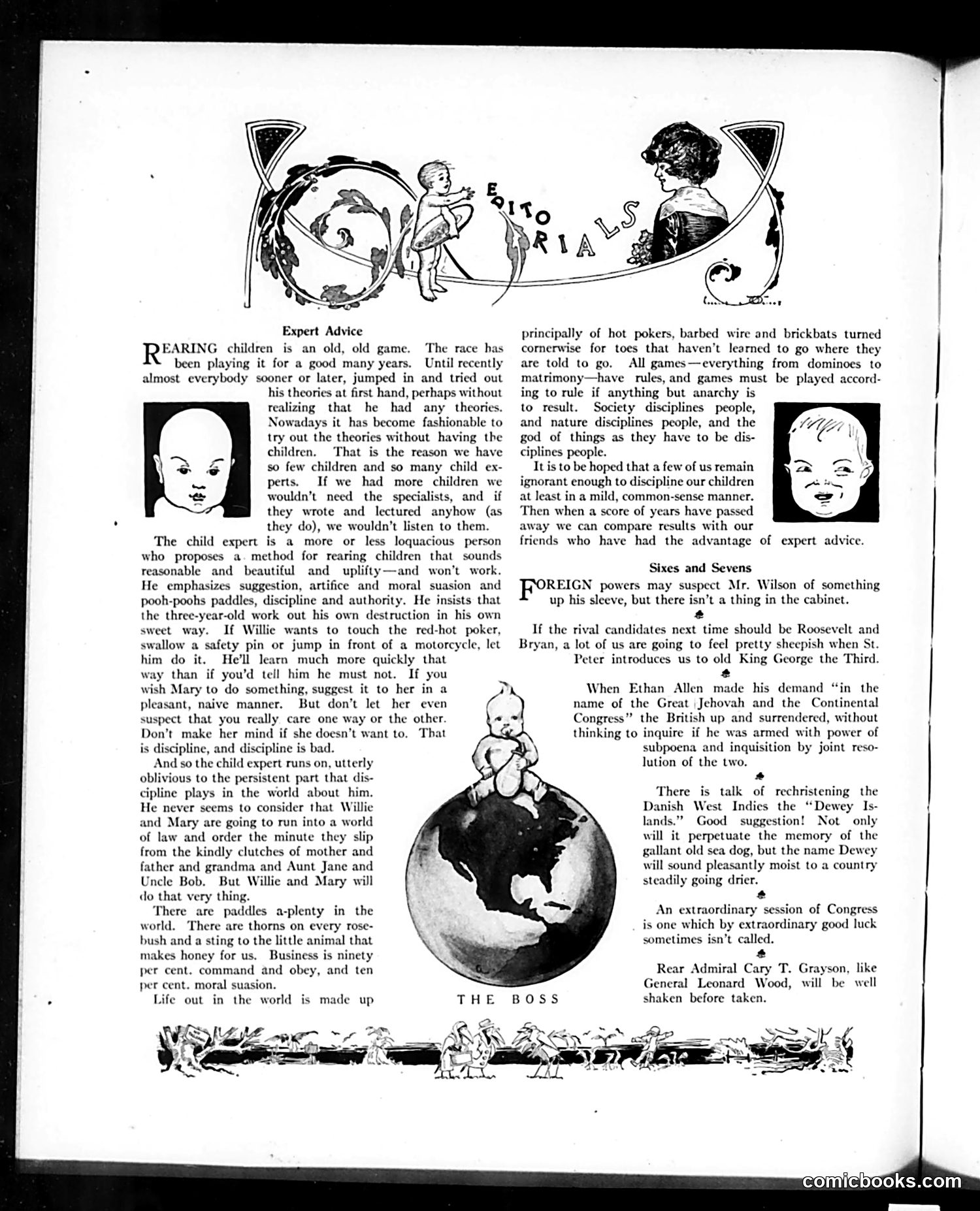
This page combines social commentary with political satire. The "Expert Advice" column mocks the contemporary trend of child-rearing experts who claim scientific authority while offering impractical suggestions. The author argues such experts haven't actually raised children successfully and advocates for traditional discipline instead. The right column, "Sixes and Sevens," contains brief political jabs. References include Theodore Roosevelt and William Jennings Bryan as presidential candidates, Ethan Allen's historical "Great Jehovah" quote, and mentions of King George III. The final item about Admiral Cary T. Grayson and General Leonard Wood appears topical to the magazine's era (likely early 1900s). The illustrations—including a baby atop a globe labeled "The Boss"—reinforce themes about authority and child-rearing philosophy.
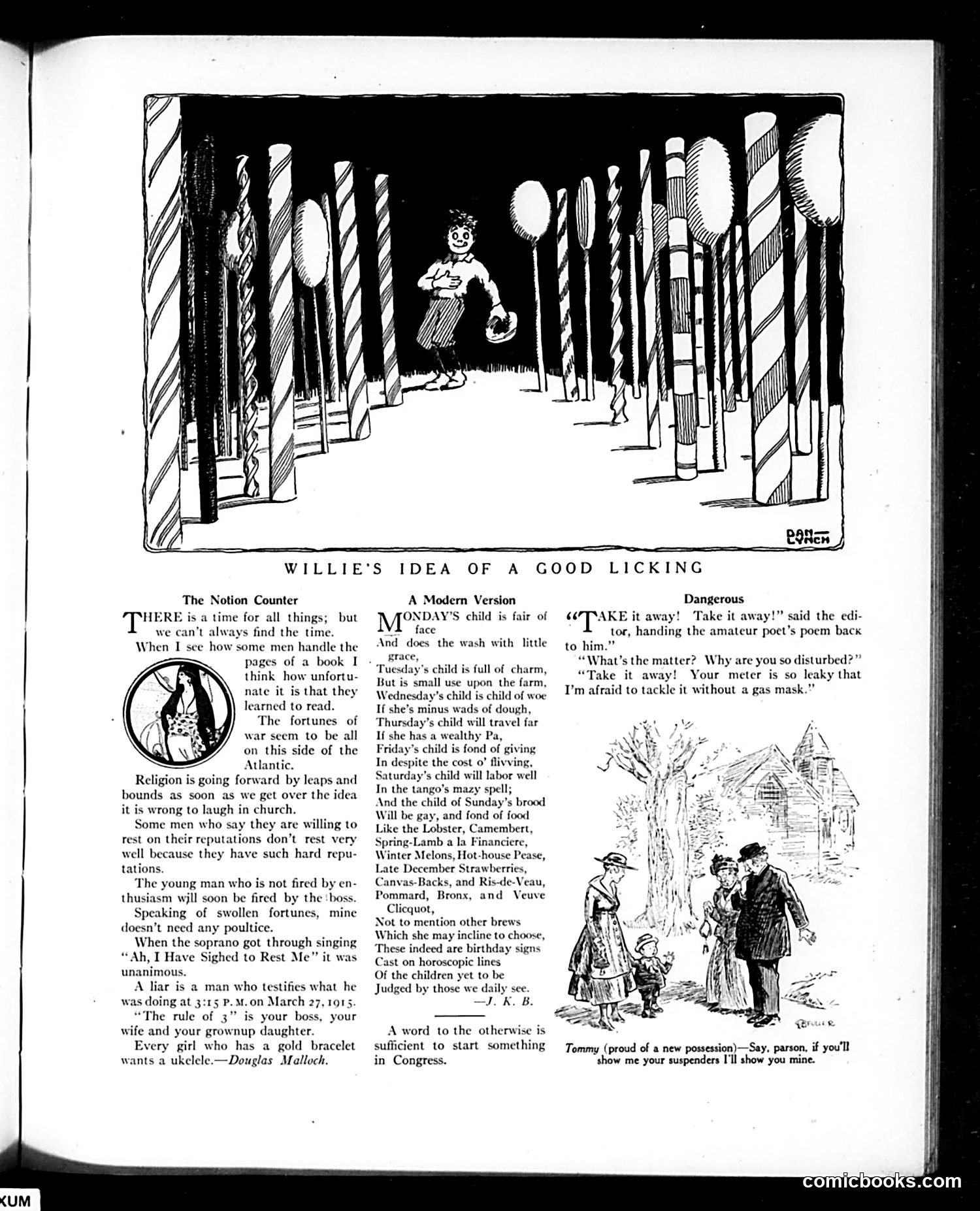
The top cartoon "Willie's Idea of a Good Licking" depicts a child walking through a colonnade of oversized lollipops—a literal visual pun on corporal punishment. The accompanying text columns offer social commentary typical of Judge's satirical style. The content mixes humorous observations about children's behavior, religious hypocrisy, and social customs. One piece jokes that girls with gold bracelets want uncles, while another satirizes Congress through horoscope-style predictions about different days' children. The bottom illustration shows what appears to be a street scene with working-class figures discussing Tommy's "new possession" (suspenders), with class-conscious humor about displaying one's possessions. Overall, this page combines visual wordplay with commentary on parenting, religion, and class differences—typical Judge magazine fare from the early 20th century.
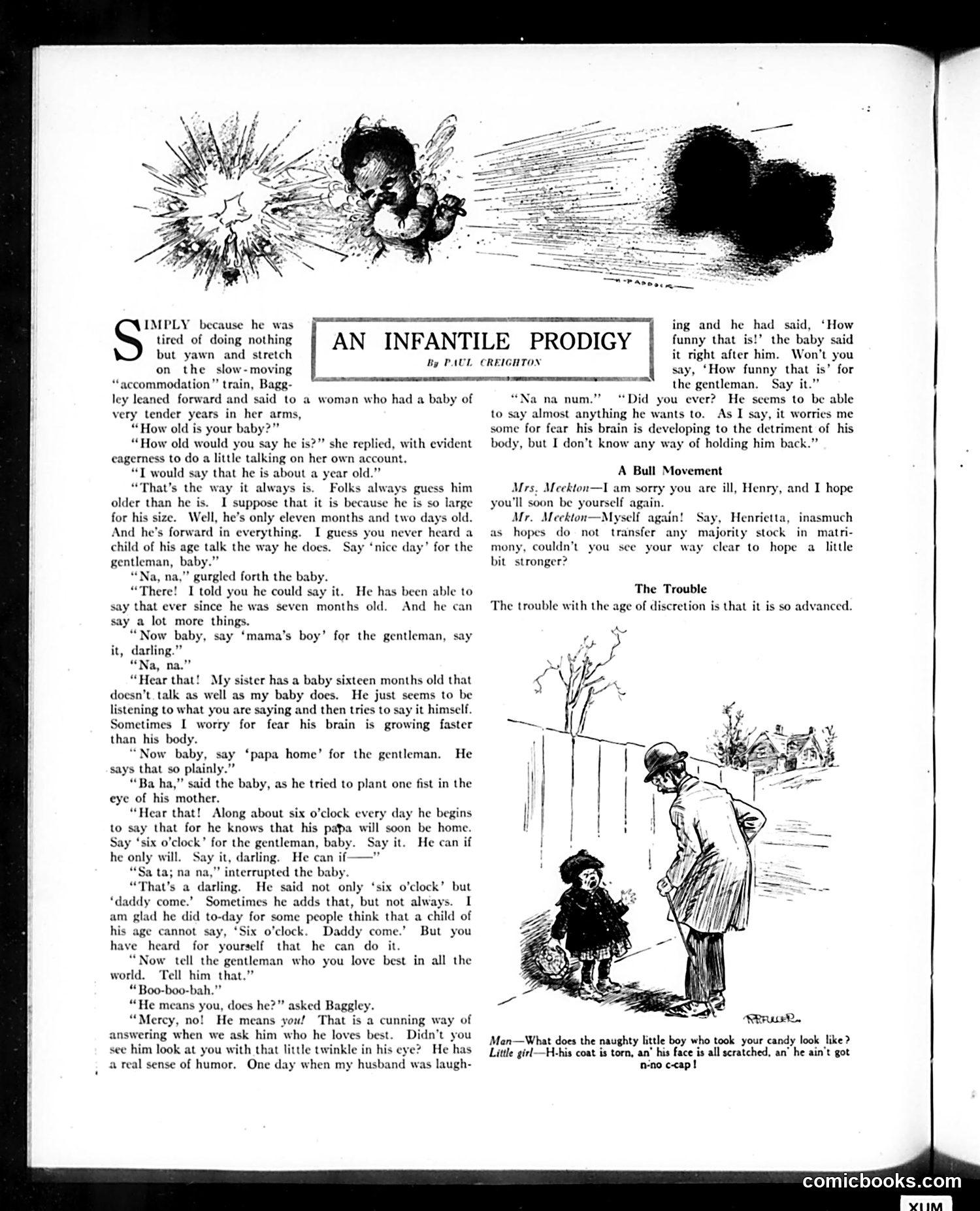
This piece satirizes the common parental behavior of showing off precocious children. The story describes a baby who can speak remarkably early and use adult phrases, with parents endlessly prompting him to perform linguistic tricks for visitors—saying "mama's boy," "papa home," "six o'clock," and "boo-bah." The accompanying cartoon illustrates "The Trouble" with such precocity: a well-dressed man encounters a shabby child who has apparently stolen his candy. The satire's point is that advancing a child's intellectual development too quickly creates behavioral problems—the prodigy may speak like an adult but lacks the maturity to behave properly. The humor targets middle-class parental vanity and the gap between superficial verbal accomplishment and genuine development.
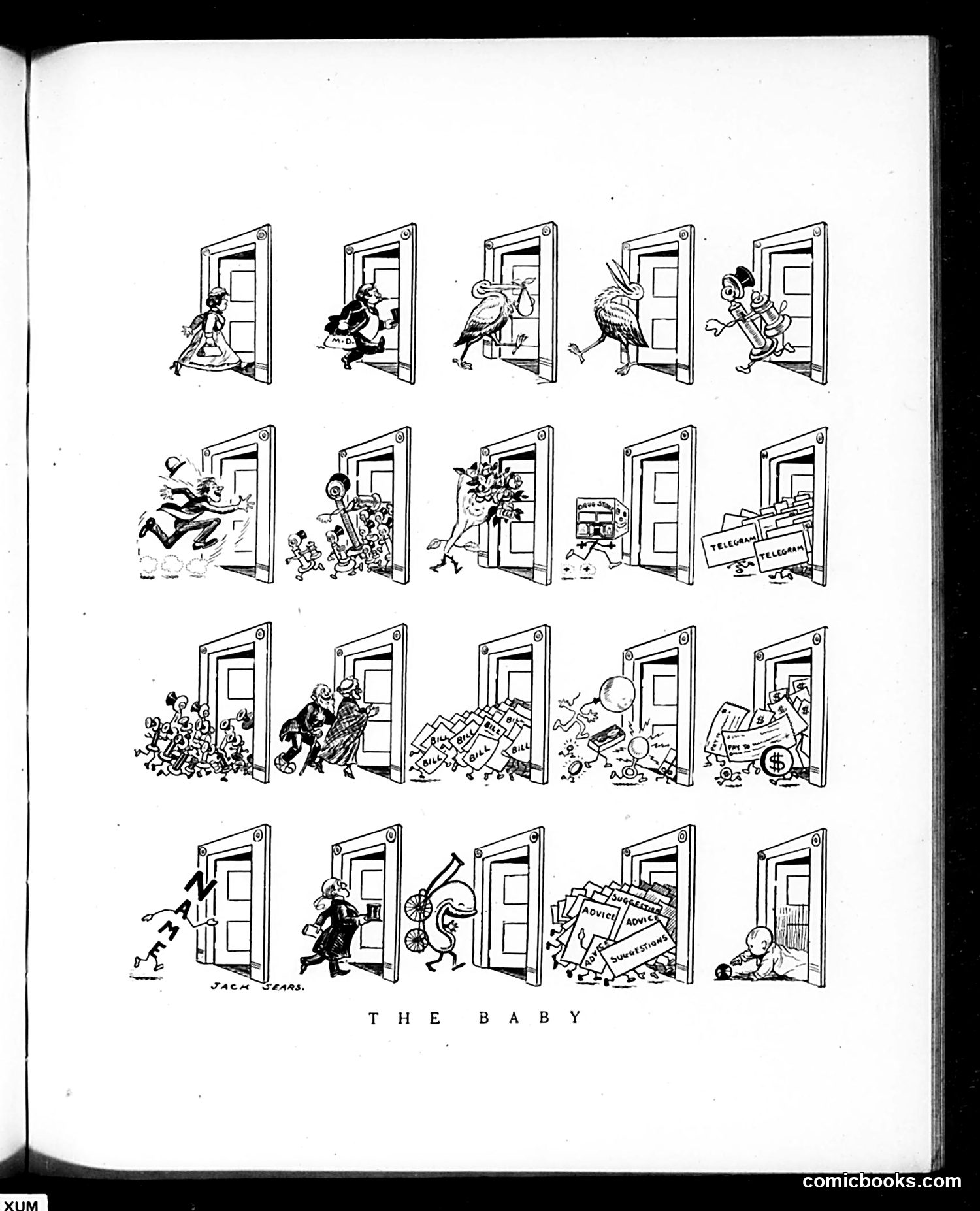
This is a satirical sequential comic titled "The Baby," showing 20 panels of various figures and creatures entering through a door, each carrying or associated with different objects and situations. The cartoon appears to be social satire about what different character types bring into a baby's life or world. The panels include recognizable figures (a clown, a businessman with money, someone with advice columns, a person with telephones/technology, crowds of people, and various symbolic representations of modern life's influences and complications). The satire likely critiques how a newborn child is immediately exposed to society's chaos—commercial interests, overstimulation, bad advice, materialism, and competing demands—suggesting the "baby" (possibly representing innocence or new life) cannot escape the complicated modern world pressing upon it from all sides.
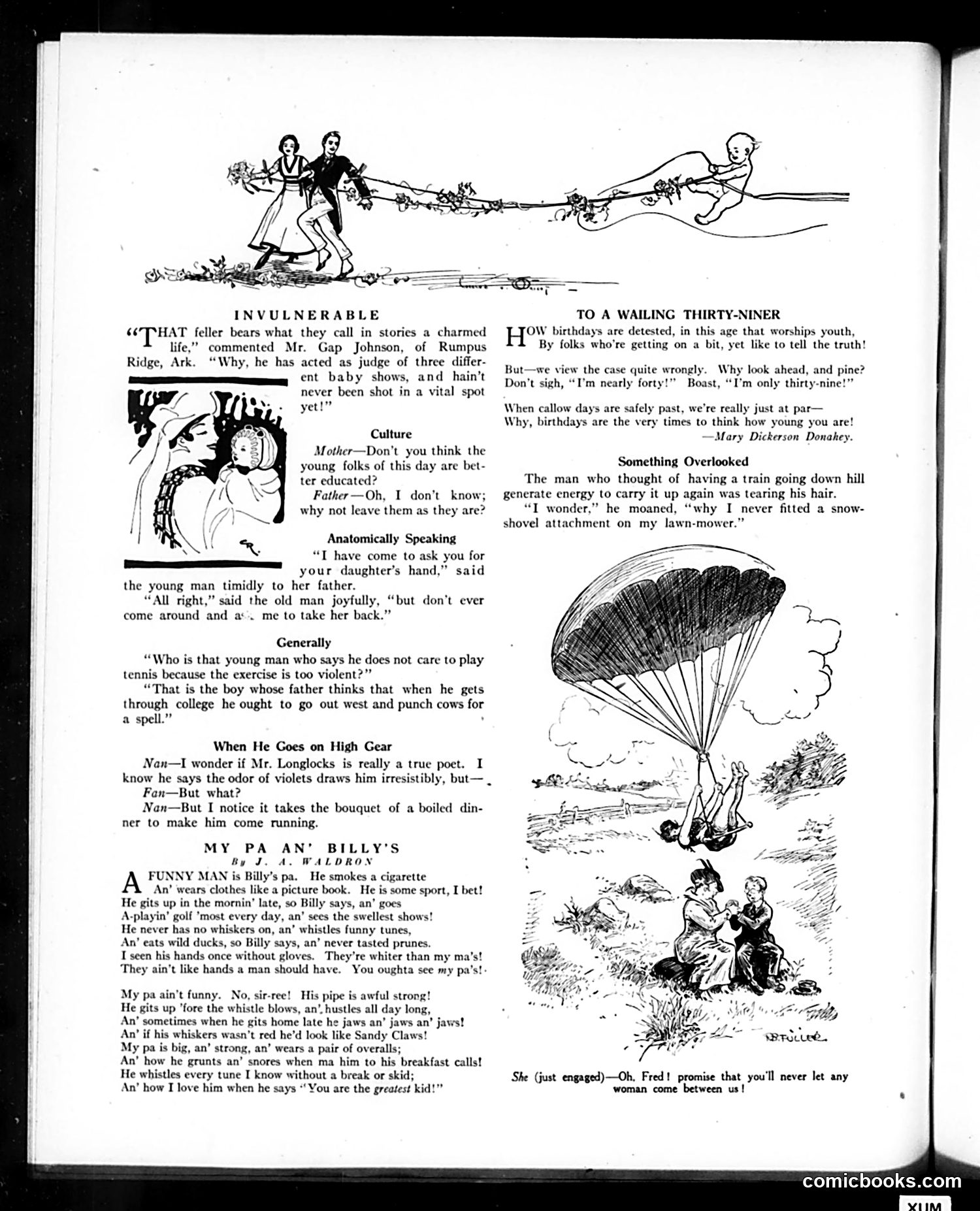
This page from the satirical magazine *Judge* contains several short humor pieces and illustrations typical of early 20th-century American comedy: **Main content includes:** 1. **"Invulnerable"** — A rural character joke about a man who's survived being a judge at baby shows without injury, suggesting the job is unexpectedly dangerous. 2. **"Culture," "Anatomically Speaking," "Generally"** — Brief one-liner jokes poking fun at social pretensions, courtship customs, and parental expectations about education and masculine toughness. 3. **"My Pa an' Billy's"** — A dialect poem contrasting a fashionable, leisure-class father ("Billy's pa") with a working-class father who labors, smokes a pipe, and wears overalls. The poem celebrates honest working-class masculinity over idle sophistication. 4. **"To a Wailing Thirty-Niner"** — Verse encouraging middle-aged people to appreciate aging rather than deny it. 5. **Illustration** — Shows people with a parachute, accompanying "Something Overlooked" about a man regretting he didn't invent a snow-shovel for his lawn-mower. The humor reflects period class anxieties and gender roles.
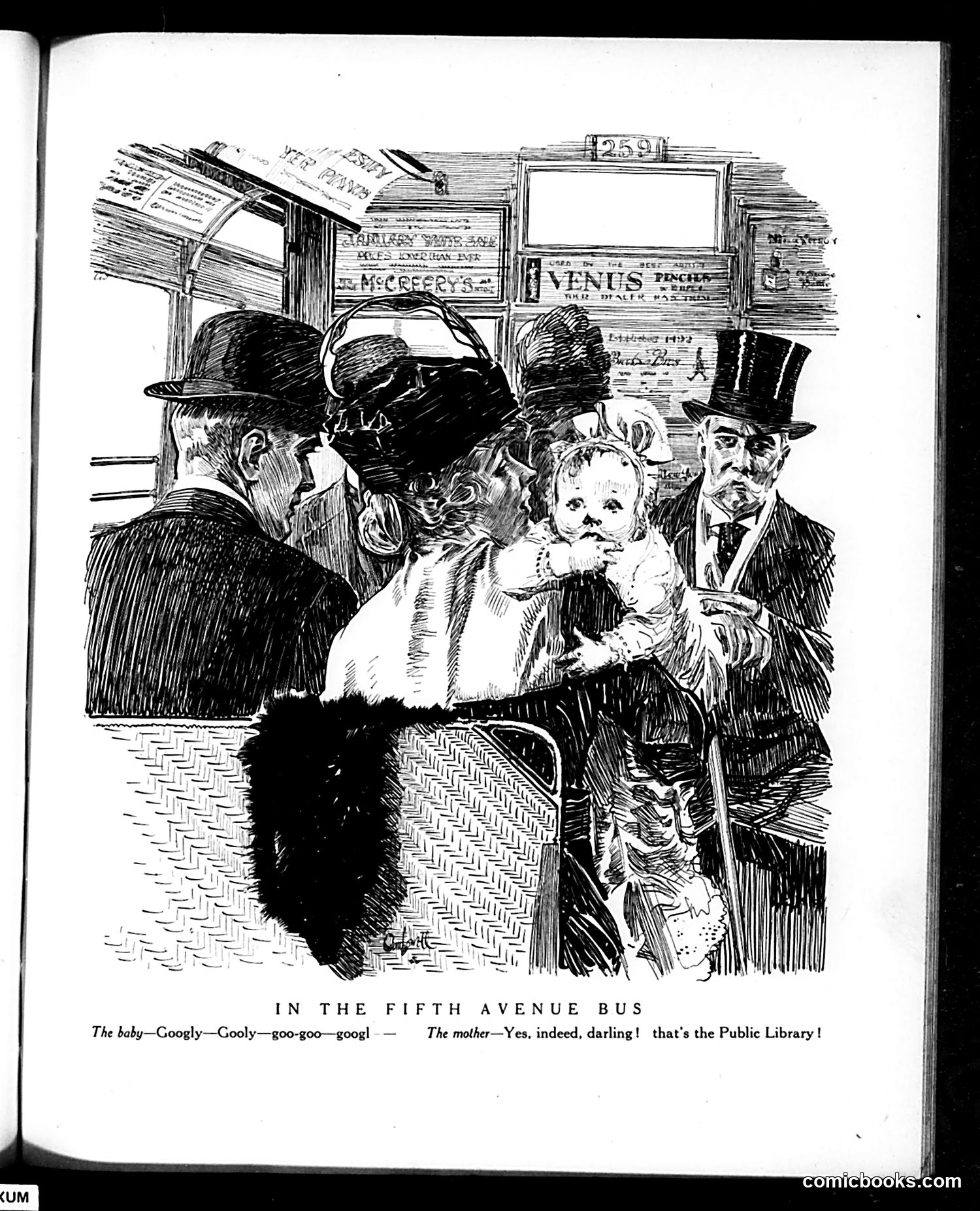
This cartoon satirizes New York City's Fifth Avenue bus as a crowded, chaotic space. A mother holds a baby while surrounded by well-dressed gentlemen in top hats. The baby makes nonsensical sounds ("Googly—Gooly—goo-goo—googl"), and the mother responds by pointing out the Public Library visible through the bus window, suggesting she's attempting to educate or distract her infant amid the urban bustle. The satire appears to mock the pretensions of Fifth Avenue society—the fancy-dressed men and refined setting—contrasted with the practical realities of crowded public transportation and a fussy baby. The joke likely critiques either the absurdity of trying to maintain civility in cramped buses or the mother's humorous attempt at cultural education in inappropriate circumstances. The venue (Fifth Avenue) signals commentary on New York's wealthy district and public institutions.
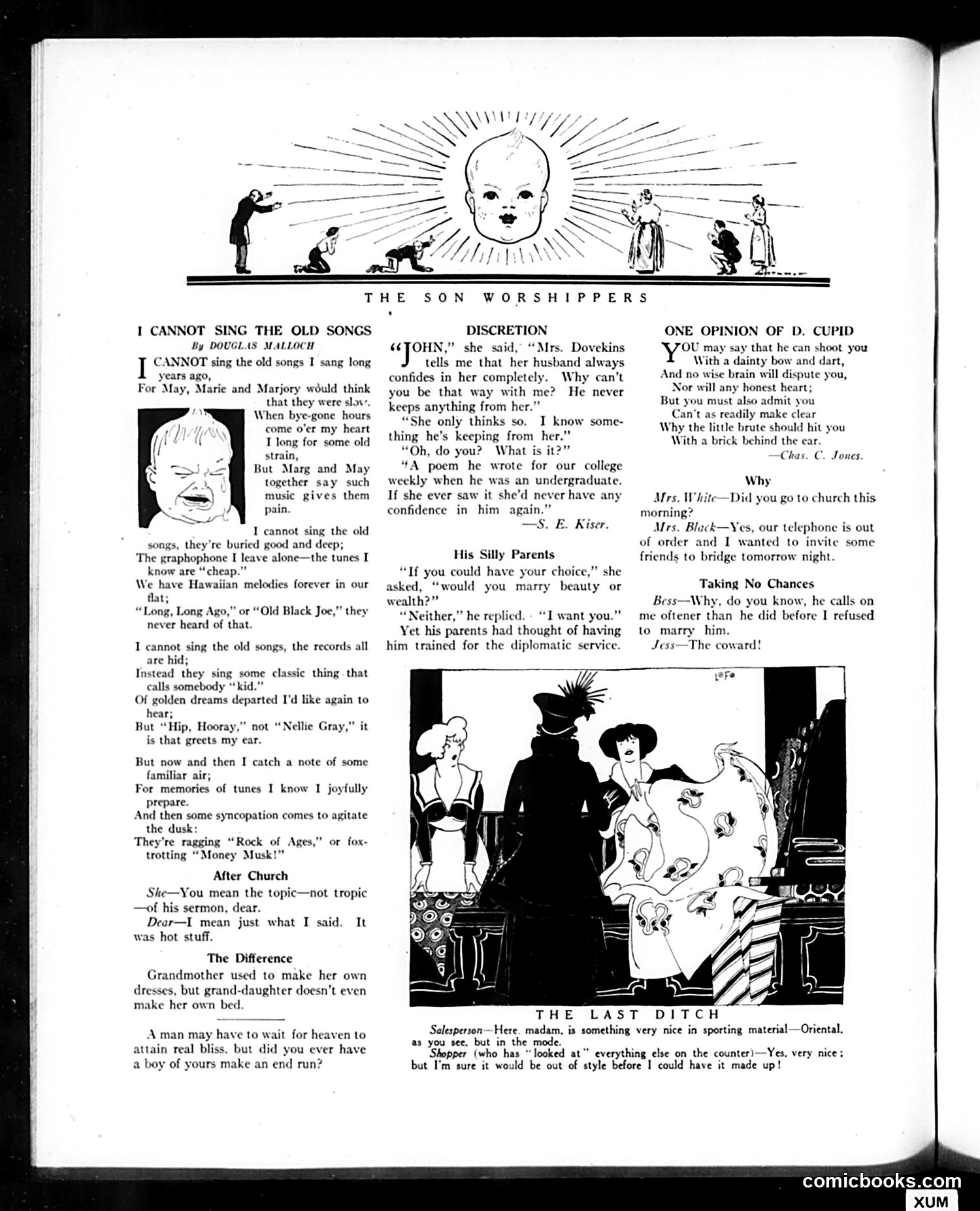
This page from Judge magazine contains several satirical pieces mocking generational and social trends of the era (likely 1920s). **"I Cannot Sing the Old Songs"** criticizes younger generations' rejection of traditional music in favor of modern syncopated jazz and "Hawaiian melodies." The poet laments daughters dismissing classics like "Old Black Joe" as "cheap." **The brief humor pieces** mock contemporary social anxieties: a husband keeping a mediocre college poem secret from his wife (satirizing marital transparency demands); parents' unrealistic expectations for their son; and a woman's obsessive shopping habit. **"The Last Ditch"** cartoon satirizes female consumers as perpetually dissatisfied—a shopper rejects fashionable Oriental fabric solely because it will be outdated before she can have it made into clothing. The overarching theme: generational and gender-based social changes. The magazine presents modern youth as frivolous (favoring jazz), modern women as unreasonable (demanding husbands' complete honesty, endless shopping), and contemporary values as shallow compared to older traditions.
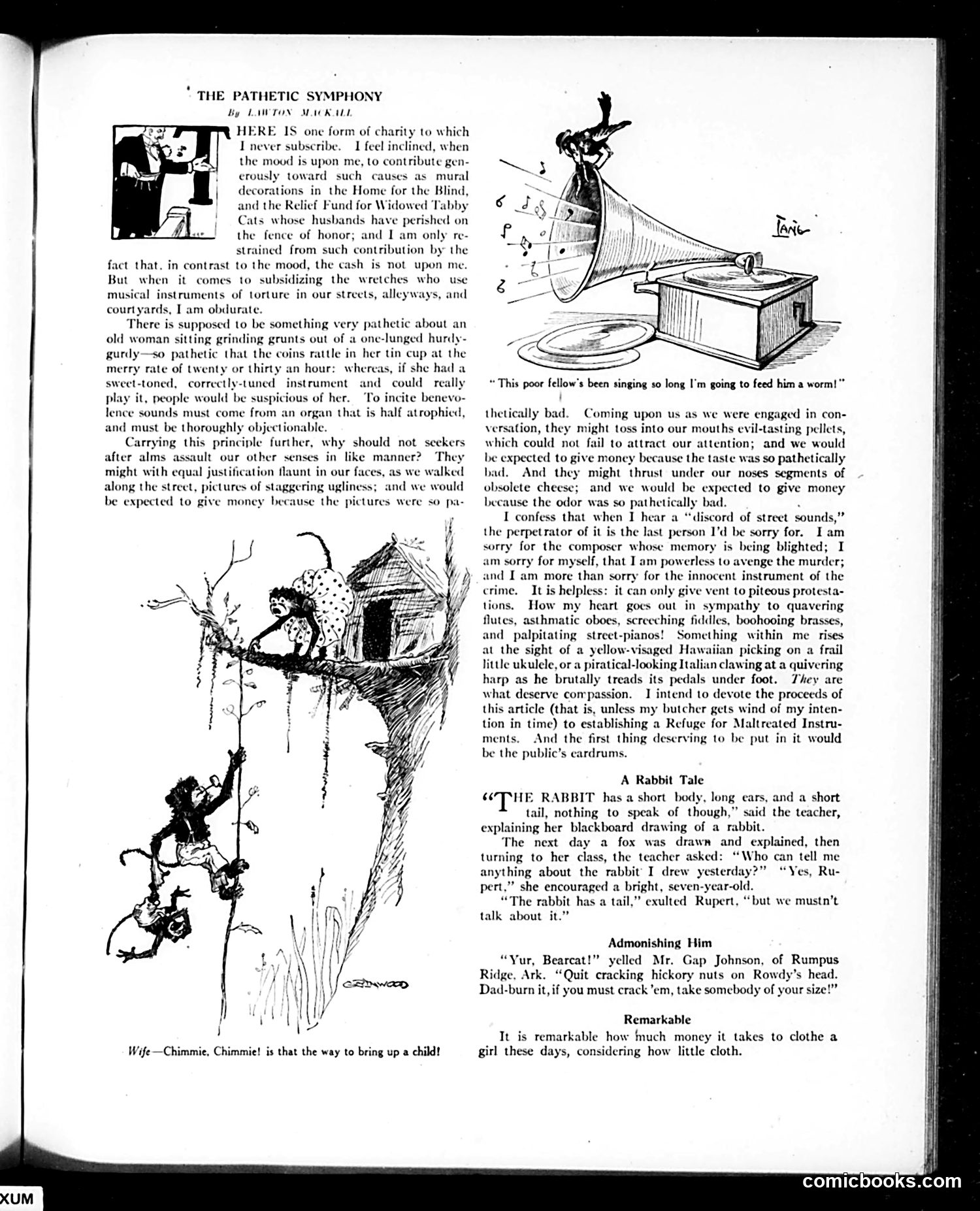
This page contains **social satire** mocking street musicians and beggars. Author Lawton Mackall argues that people donate to street performers *because* their music is terrible, not despite it. The logic is absurd: we give money to suffering instruments and bad music, yet would never donate if a street musician played *well*—suspecting them of fraud. Mackall extends this mockery to other senses: we'd pay to see ugly pictures, taste bad food, smell rotten cheese—all justified as "charitable" sympathy for the suffering. The cartoon shows a one-lunged hurdy-gurdy player, exemplifying this "pathetic" street performance that extracts coins through sonic torture rather than talent. The secondary cartoons offer unrelated humor: a child threatening to feed a beggar a worm, a schoolroom joke about rabbits' tails, and rural dialect humor. The satire ultimately targets both street beggars *and* the public's irrational charitable impulses—we reward incompetence masquerading as hardship.
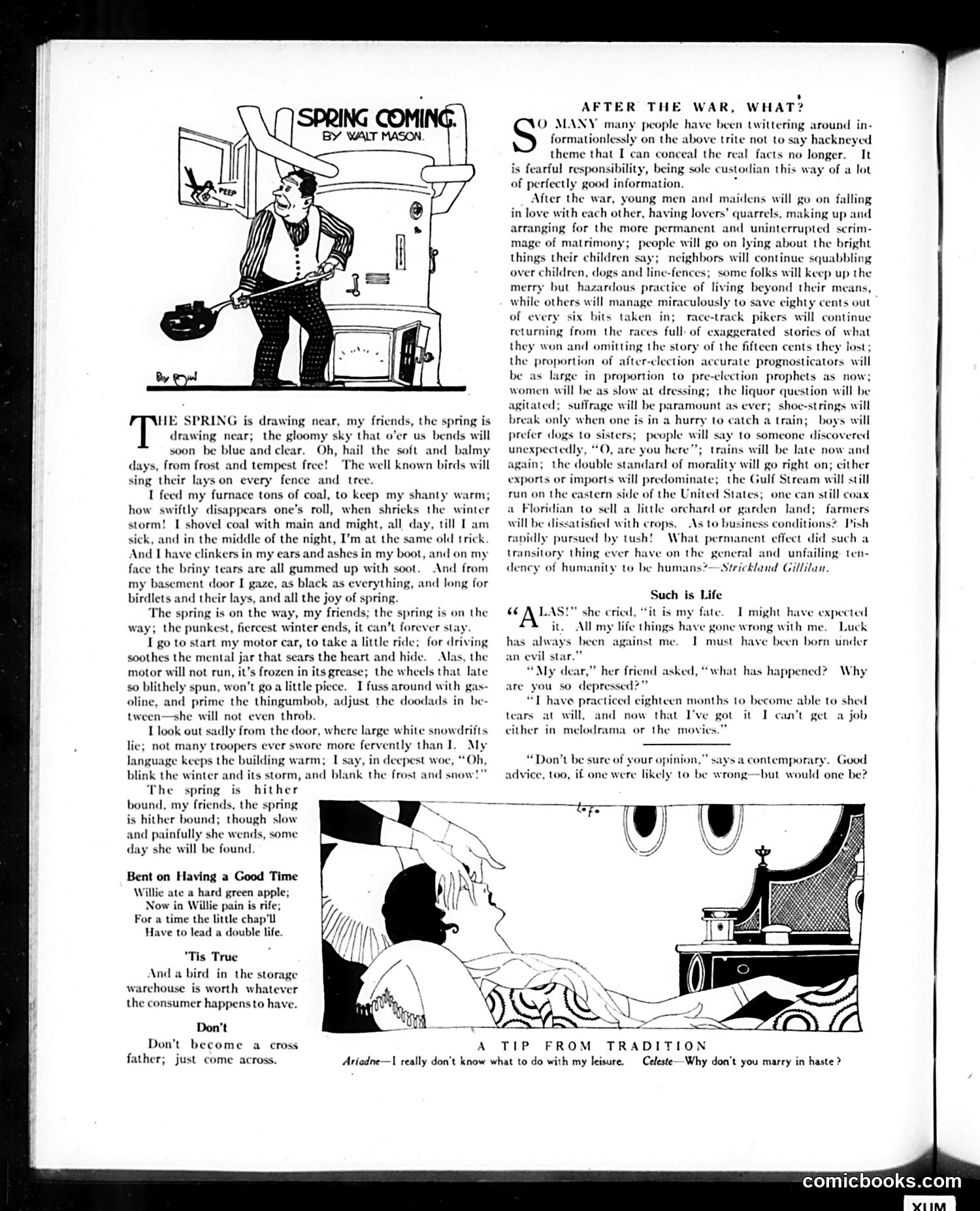
This page contains two distinct pieces of satire: **"Spring Coming" (top):** A humorous poem by Walt Mason, illustrated with a cartoon of a man struggling with winter chores. The satire mocks the gap between spring's romantic promise and harsh reality—the speaker fantasizes about mild weather and singing birds while actually shoveling coal, dealing with frozen car engines, and cursing in frustration. It's gentle social satire about working-class winter hardships versus poetic idealization. **"After the War, What?" (right column):** A cynical post-WWI piece predicting that despite the war's trauma, human nature won't change. It sarcastically catalogs inevitable social behaviors: romance, gossip, financial irresponsibility, gambling, suffrage debates, tardiness, and gender inequality will persist unchanged. The satire targets public naïveté about war's transformative power, suggesting optimistic postwar rhetoric is foolish. Both pieces employ Judge magazine's characteristic blend of humor and social criticism.
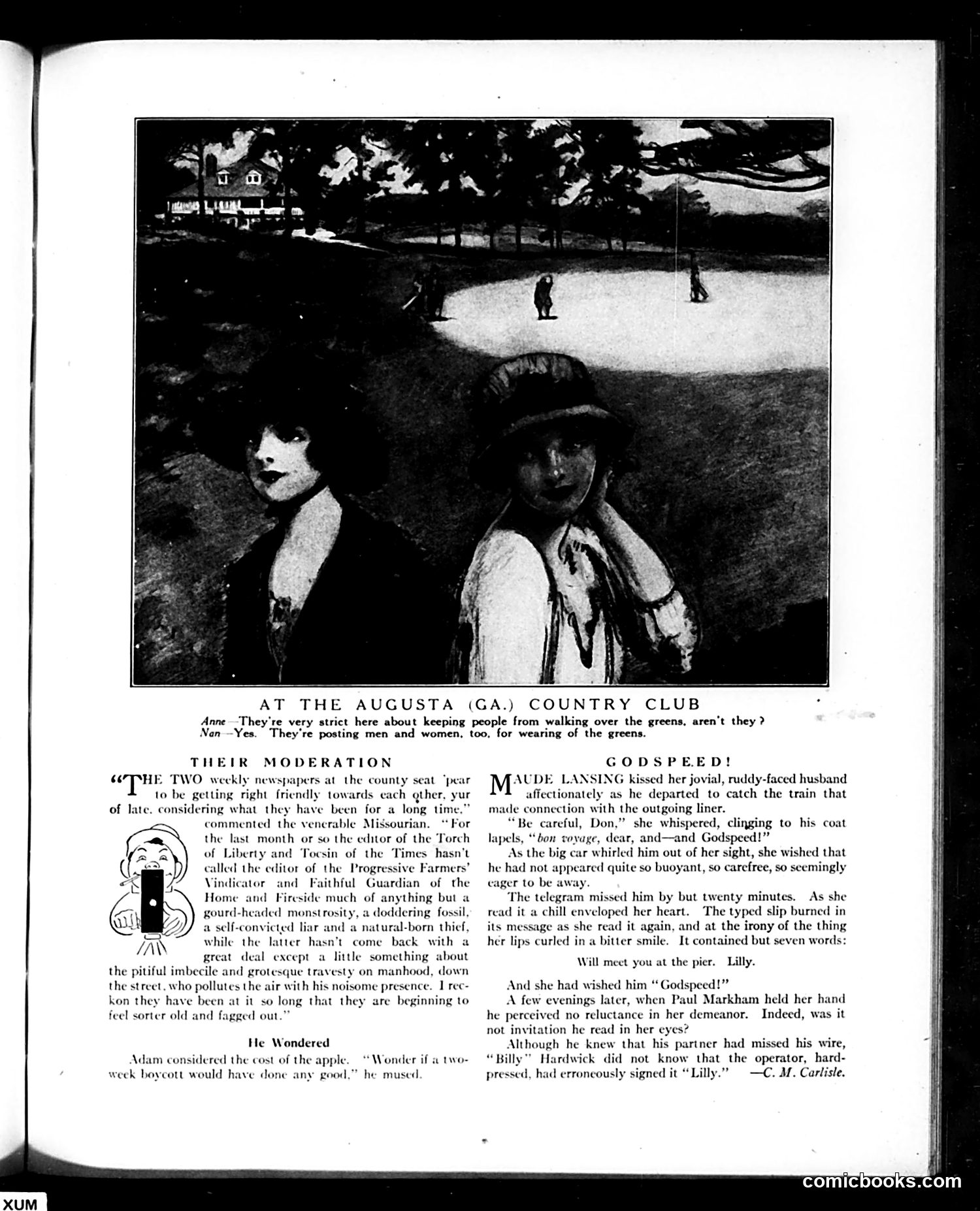
This page contains three distinct pieces of satirical content: **"At the Augusta Country Club"**: A brief joke about strict golf course etiquette. The humor lies in the exaggerated enforcement—posting guards to prevent people from walking on the greens is absurdly rigid, even for an exclusive country club. The satire mocks upper-class pretension and overwrought rule-enforcement. **"Their Moderation"**: A longer commentary on small-town newspaper rivalry. A Missourian observes that two competing county-seat newspapers have been viciously attacking each other for so long they're now exhausted ("fagged out"). The satire ridicules provincial journalism's petty feuds and inflammatory language. **"Godspeed!"**: A romantic melodrama about a wife wishing her husband well as he departs. A telegram meant for him arrives late, creating dramatic irony—it's from a woman named Lilly, signed ambiguously. The story plays on period anxieties about infidelity and miscommunication, likely concluding with misunderstanding. The "He Wondered" Adam vignette jokes about whether an apple boycott could have prevented humanity's fall—light biblical humor.
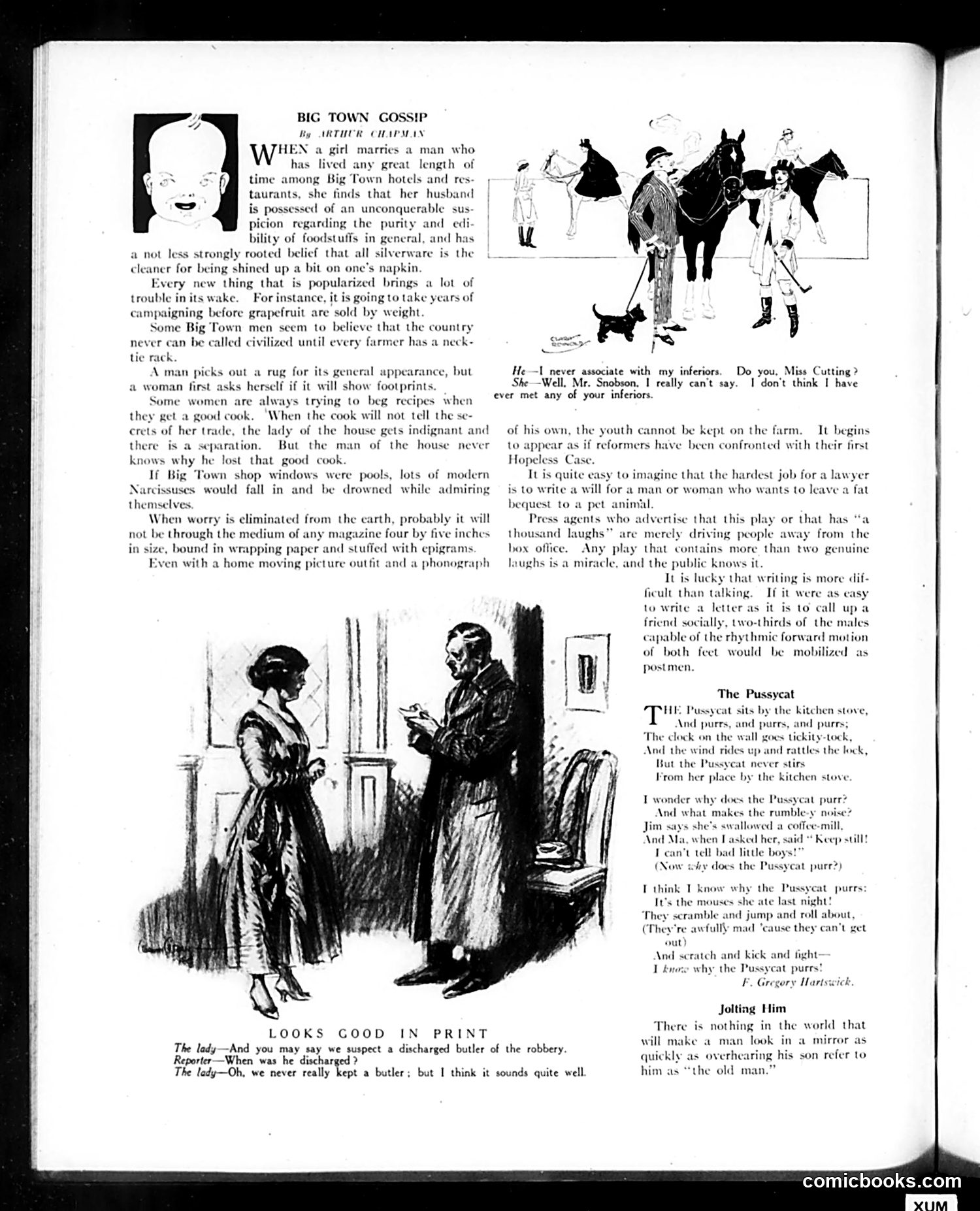
This page contains Arthur Chapman's satirical column mocking urban social pretension and domestic absurdities of early 20th-century "Big Town" (likely New York) life. **The main cartoon** depicts a snobbish exchange between "Mr. Snobson" and "Miss Cutting." When she notes she's never met his inferiors, the joke satirizes his class-consciousness—implying he has no inferiors (or, read inversely, that everyone is beneath him). This targets the nouveau riche and social climbers prevalent in expanding American cities. **The surrounding text** ridicules various urban affectations: men obsessing over silverware cleanliness, women trying to extract servants' recipes, shop-window narcissism, and the pretense of discharging butlers one never actually employed. The secondary cartoon "Looks Good in Print" directly mocks this last point: a lady claims she dismissed a butler for credibility, though she never had one. **Overall message:** Chapman satirizes how urbanization breeds shallow status-seeking and transparent social posturing among the middle and upper classes.
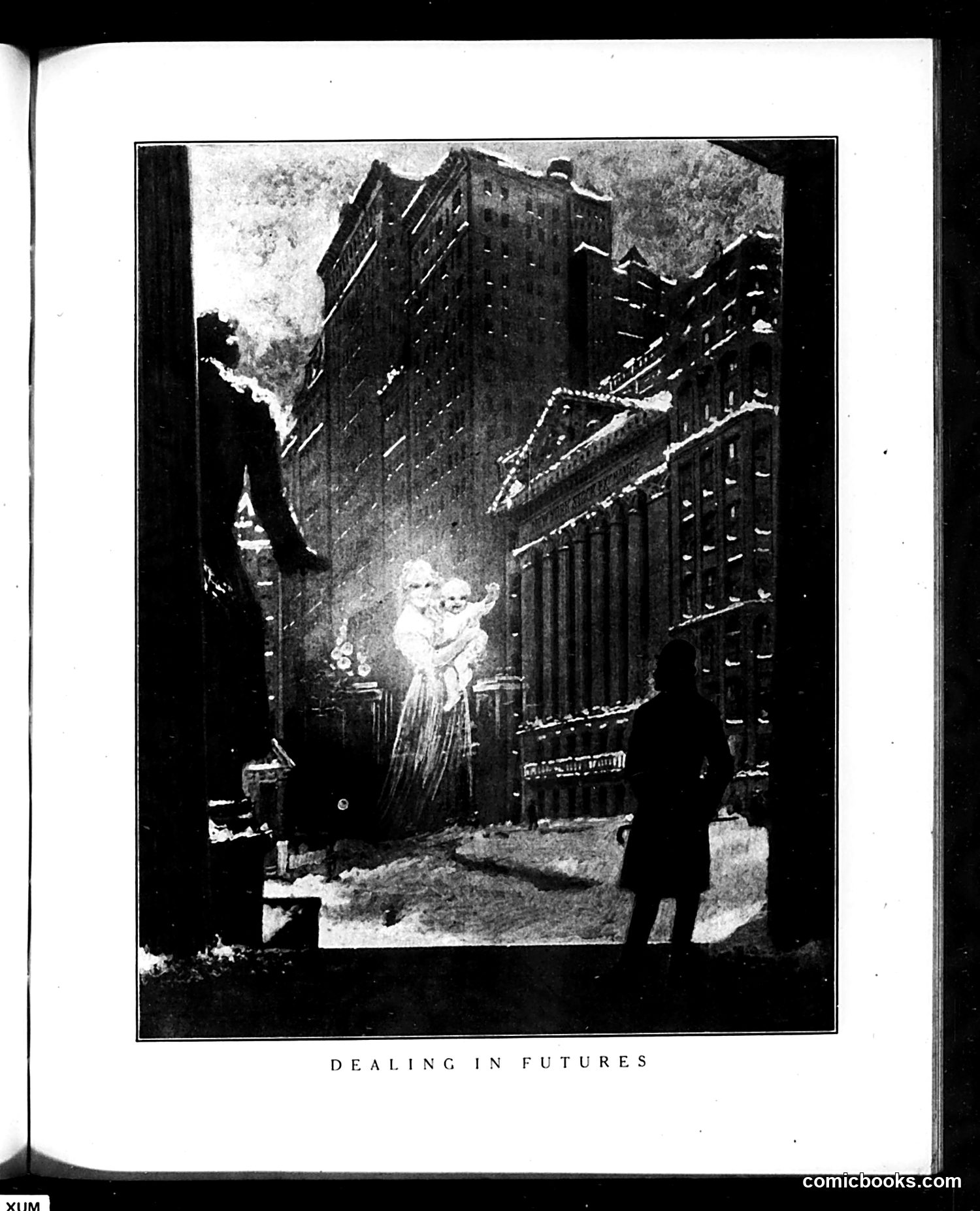
This appears to be a satirical illustration depicting financial speculation or stock market dealings. The image shows a ghostly or spectral figure in the center of an urban street canyon lined with tall buildings, with silhouetted figures on either side observing. The title "Dealing in Futures" is a financial term referring to trading contracts for goods/commodities to be delivered later. The ghostly apparition likely represents the intangible, insubstantial nature of futures trading—essentially betting on things that don't yet exist. The ominous nighttime setting and supernatural imagery suggest satire of the risks and moral hazards of speculation, implying such financial dealings are as ephemeral and potentially dangerous as ghosts. Without additional context from Judge magazine's publication date, the specific historical market reference remains unclear.
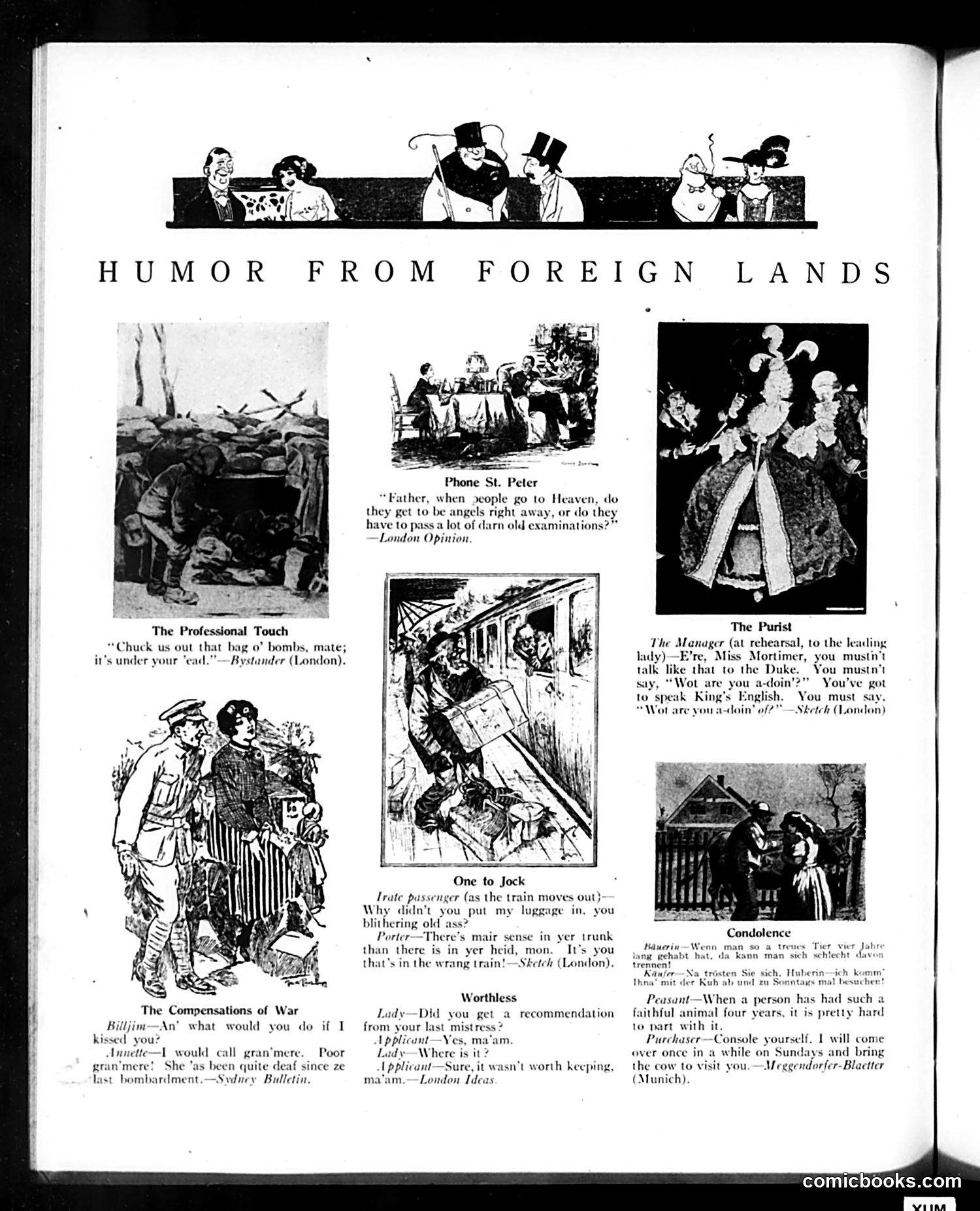
This page collects humorous anecdotes from British and European publications, likely from WWI era (references to bombs and bombardment suggest 1914-1918). The jokes mock various national stereotypes and wartime situations: - **"Phone St. Peter"** (London): Dark humor about heavenly bureaucracy during wartime deaths - **"The Professional Touch"** (London): Soldiers casually handling explosives - **"One to Jock"** (Scottish dialect): A porter's witty insult to a confused passenger - **"The Compensations of War"** (Sydney): Gallows humor about servants seeking employment after bombardment - **"The Purist"** (London): Theater manager correcting an actress's diction to use cockney dialect - **"Condolence"** (Munich): German sentiment about losing a beloved cow, with absurdist consolation about Sunday visits The content represents how different Allied and neutral nations used humor to process wartime trauma and cultural differences.
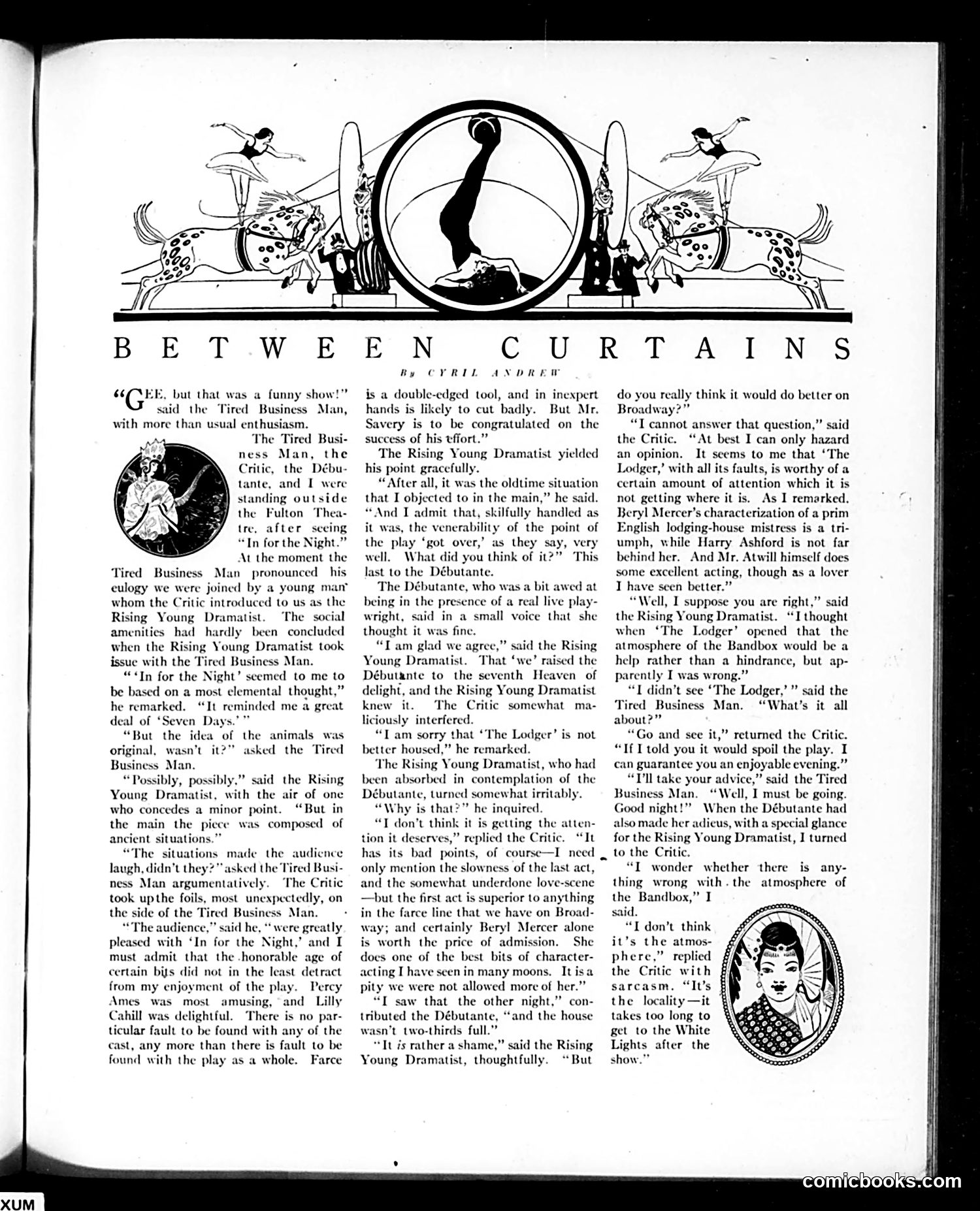
This theatrical satire by Cyril Andrew depicts a post-show conversation among four archetypal characters: a Tired Business Man, a Critic, a Débutante, and a Rising Young Dramatist. The humor targets the pretentiousness of avant-garde theatre criticism versus popular taste. The Rising Young Dramatist dismisses the successful farce "In for the Night" as derivative, while praising the under-attended play "The Lodger" for its artistic merit—particularly actress Beryl Mercer's performance. The Critic supports this highbrow assessment, though acknowledging the play's flaws. The satire mocks the disconnect between critical acclaim and box-office success, and the Dramatist's obvious attempt to impress the Débutante by appearing intellectually superior. The recurring theme suggests Judge's skepticism toward theatrical elitism: popular entertainment that makes audiences laugh has legitimate value, even if composed of "ancient situations."
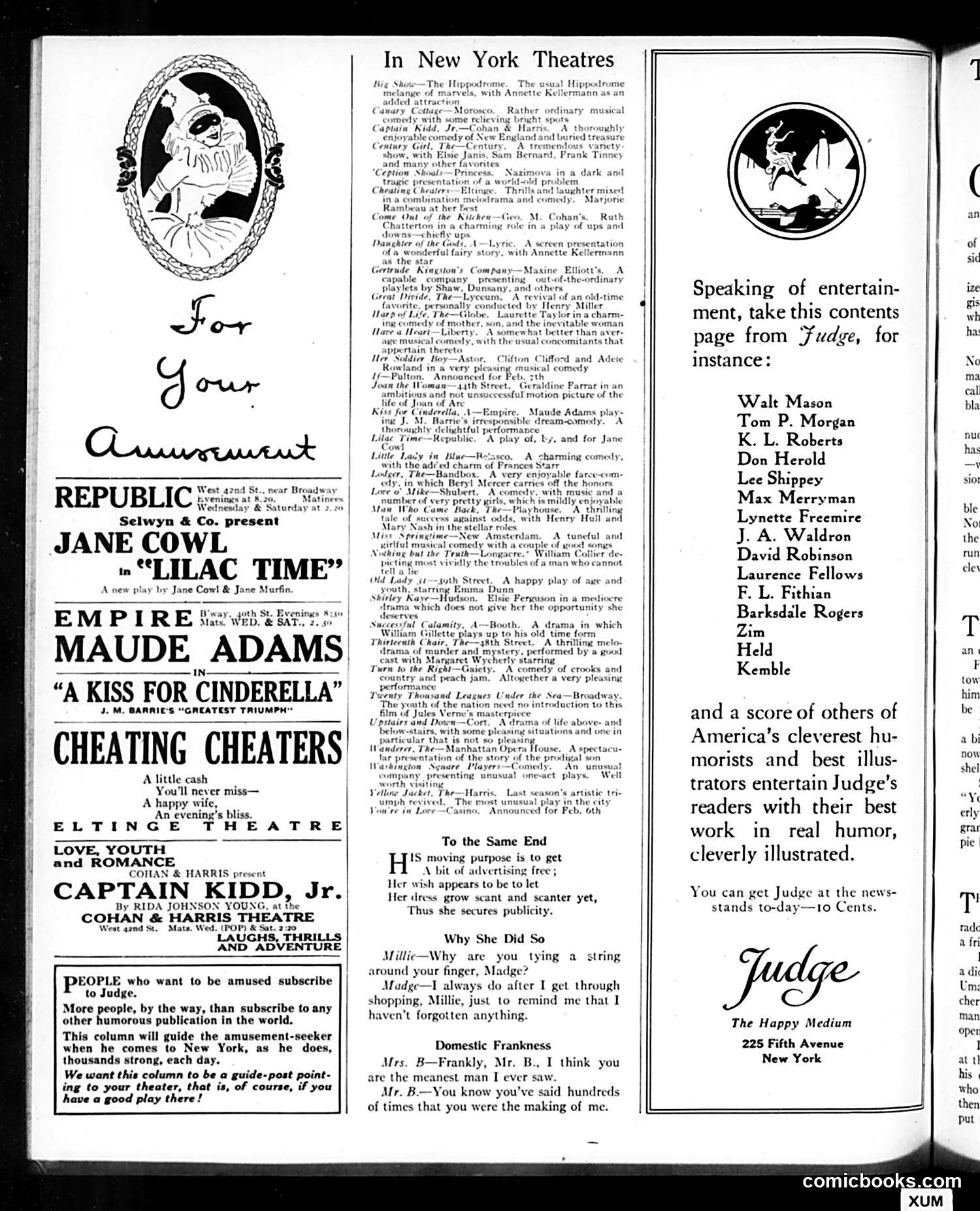
This is primarily a **theater advertisement and entertainment guide page**, not a political cartoon page. The left side lists current Broadway shows (Jane Cowl's "Lilac Time," Maude Adams in "A Kiss for Cinderella," etc.) with brief reviews and performance details. The page includes three brief **humorous sketches** rather than political satire: 1. **"To the Same End"** — A joke about a woman using scanty clothing to gain free publicity/advertising 2. **"Why She Did So"** — A domestic humor bit about tying a string around one's finger as a memory aid 3. **"Domestic Frankness"** — A married couple exchange where the wife calls her husband "the meanest man" while he reminds her she's claimed credit for his success The right side promotes **Judge magazine itself**, listing celebrity humorists and illustrators (Walt Mason, Don Herold, etc.) who contribute to the publication, positioning it as superior to competitors. **Context for modern readers:** This reflects early 20th-century entertainment culture—Broadway theater dominance, gentle domestic comedy humor, and magazines as primary entertainment media before radio/television.
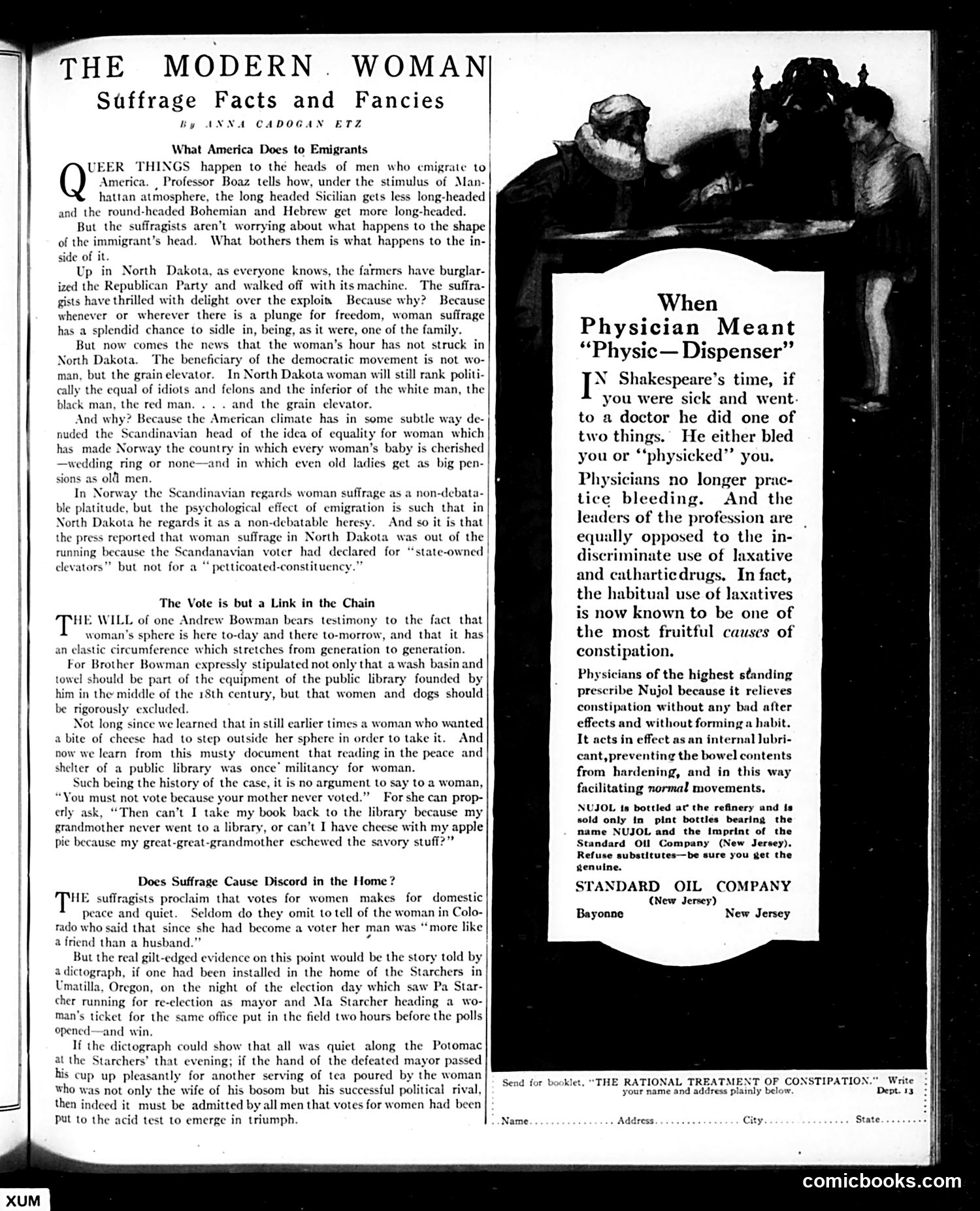
This is an **anti-suffrage satirical article** by Anna Cadogan Etz in Judge magazine, using mock-serious arguments to ridicule women's voting rights advocates. **Main arguments and satire:** The piece attacks suffragists through absurdist logic. It mocks the claim that woman suffrage brings domestic harmony by citing a Colorado woman who became "more like a friend than a husband" to her voter-husband—implying suffrage undermines traditional marriage roles (the actual goal of satire's ridicule). Etz sarcastically compares voting rights to historical restrictions (women excluded from libraries, forbidden cheese), implying suffrage demands are trivial grievances. She also lampoons Scandinavian immigrant voters in North Dakota who rejected woman suffrage, suggesting the American environment somehow made progressive ideas seem "heretical." The accompanying image appears to show a **dictograph** (early recording device)—referenced in the text's mention of documenting the Starchers' election-night discord, suggesting domestic conflict results from women's political participation. **The satire targets:** suffragists' reasoning, not women themselves, though it reinforces period anti-suffrage messaging about women's "proper sphere."
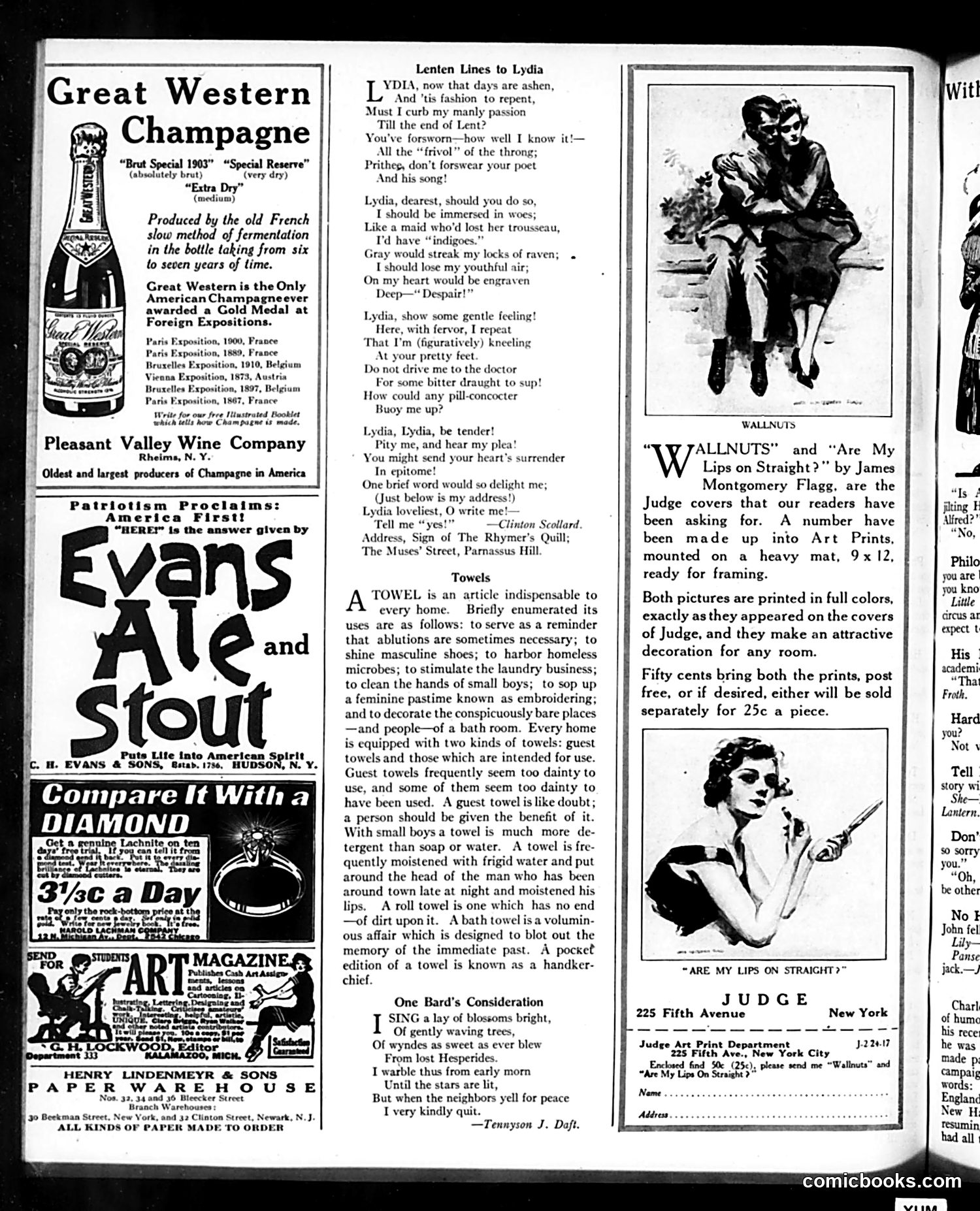
This is primarily an **advertising and literary content page** rather than political satire. The page contains: **Main Content:** - A poem "Lenten Lines to Lydia" by Clinton Scollard—a humorous love letter during Lent, where the speaker pleads with Lydia not to abandon him during her religious fasting season. The joke is his dramatic exaggeration of suffering. - An essay on towels using mock-serious language to humorously describe their practical and impractical uses in households—satirizing the mundane domestic object. - A brief poem about a bard who sings beautifully until neighbors demand silence—gentle mockery of artistic pretension. **Advertisements:** The bulk of the page features ads for American products (champagne, ale, diamonds, paper) emphasizing "America First"—likely from WWI-era when patriotic consumption was promoted. **Cover Art:** Two James Montgomery Flagg illustrations ("Walnuts" and "Are My Lips on Straight?") are offered as framed prints for sale. The content reflects early 20th-century magazine humor: light, domestic, and consumer-focused rather than sharply political.
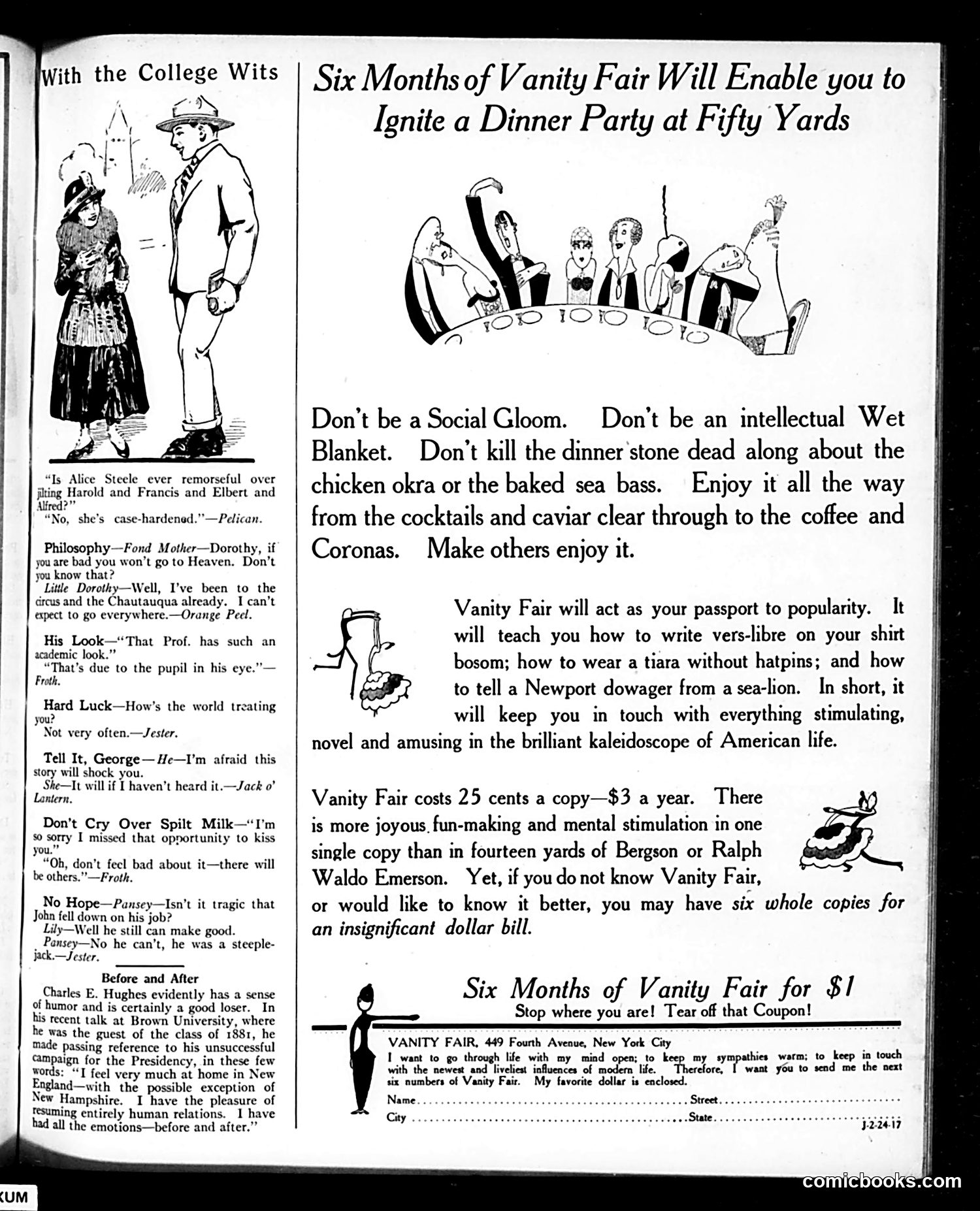
This page contains **unrelated content**: vintage humor columns ("College Wits") and a **Vanity Fair subscription advertisement**. The left side features brief comedic quips from various college humor publications—jokes about a woman named Alice Steele who serially dates men, a child's logic about heaven and Chautauqua, and references to academic life. These are simple, era-appropriate puns with no deeper satire. The dominant right side is a **product advertisement** for Vanity Fair magazine (a sophisticated lifestyle publication). It satirizes social anxiety by mocking those who are "social glooms" or "intellectual wet blankets" at dinner parties, positioning Vanity Fair as a cultural passport to witty sophistication. The ad name-drops philosophers (Bergson, Emerson) dismissively and promises readers will learn trendy skills like writing "vers-libre" poetry and identifying "Newport dowagers." The Charles E. Hughes anecdote at bottom left references his **1916 failed presidential campaign**, using his self-deprecating humor about New Hampshire as evidence he's "a good loser." This is primarily **advertising content**, not editorial satire.
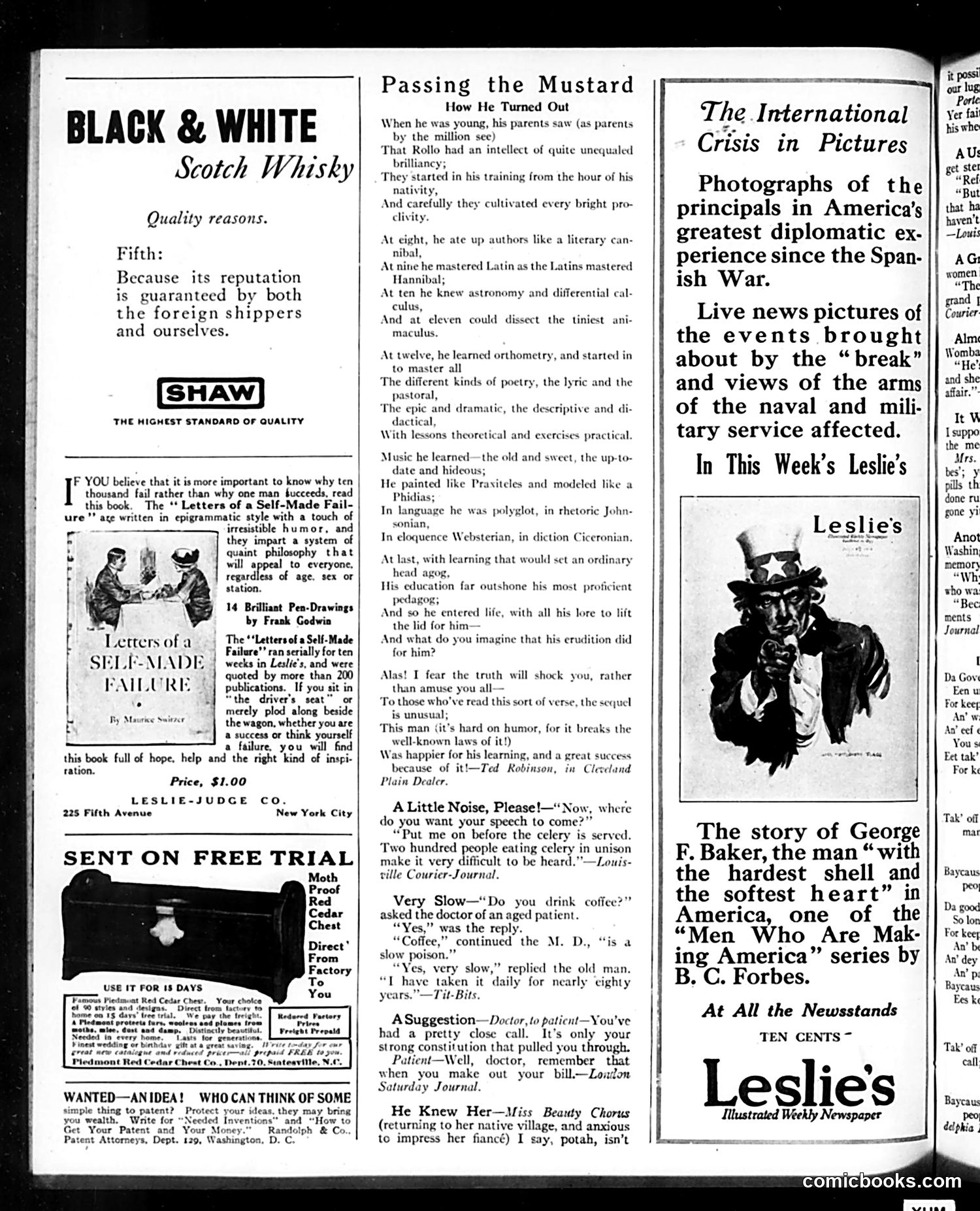
This page is primarily **advertising and literary content** rather than political cartooning. The main elements are: **Advertisements:** - Black & White Scotch Whisky (top left) - "Letters of a Self-Made Failure" book by Maurice Switzer, advertised with a pen-drawing by Frank Godwin - Patent/invention solicitation ads **Editorial Content:** The centerpiece is a humorous poem titled "Passing the Mustard: How He Turned Out" about an exceptionally gifted child—brilliant in languages, sciences, arts, and music—whose extraordinary education and erudition ultimately prove worthless in practical life. The satire mocks overspecialized classical education and the gap between academic achievement and real-world success. **Right Column:** Advertises Leslie's Illustrated Weekly Newspaper, featuring coverage of America's diplomatic crisis (likely referencing early 20th-century international tensions) and a biographical series on George F. Baker titled "Men Who Are Making America." The page contains miscellaneous humorous anecdotes but lacks sustained political satire or caricature.
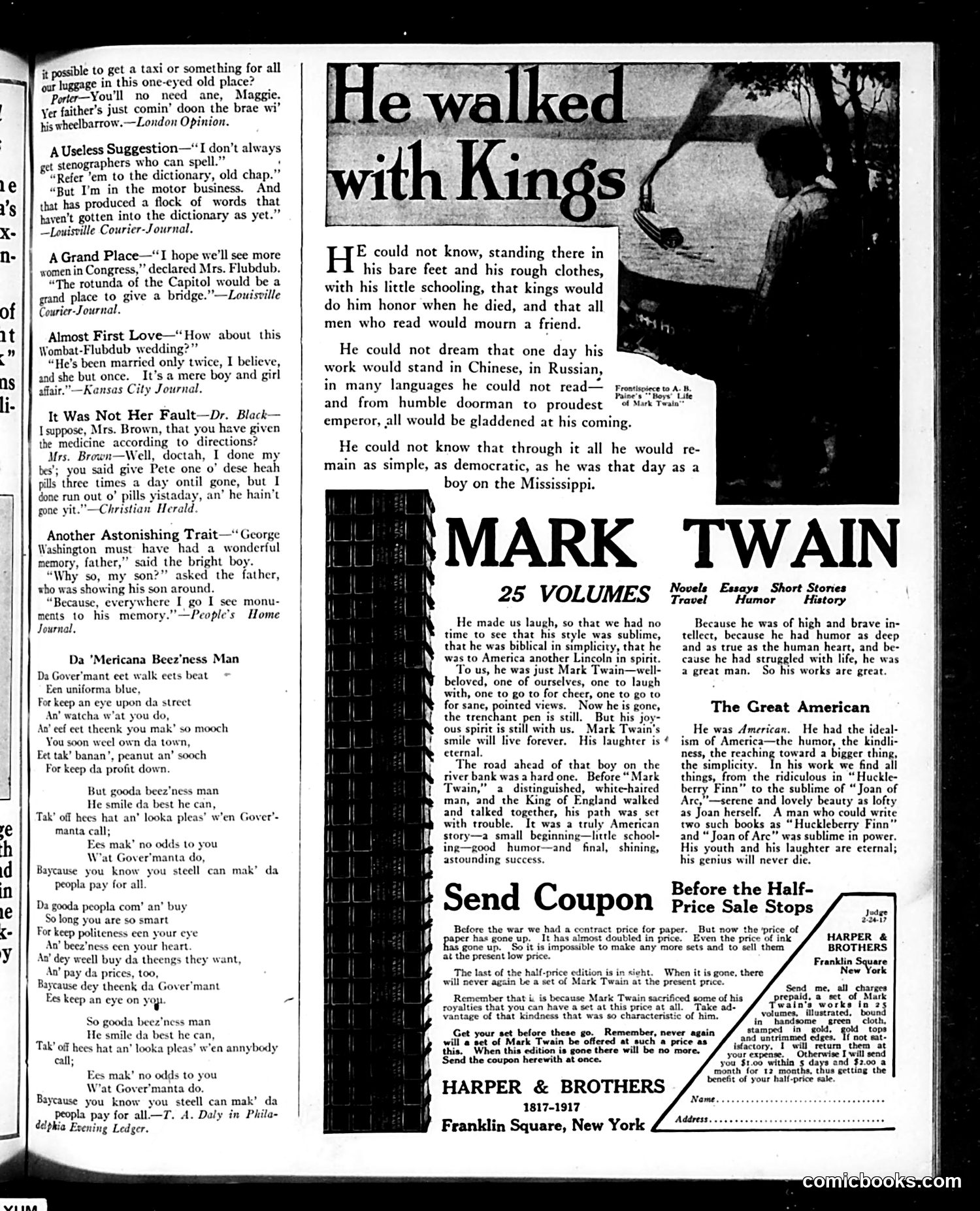
This page is primarily a **Mark Twain memorial advertisement** (circa 1917, based on the Harper & Brothers dating). The large illustrated article "He walked with Kings" celebrates Twain's life and literary significance following his death. The piece emphasizes Twain's humble origins—a barefoot boy on the Mississippi River—contrasting with his later international fame and influence on world literature. It notes his work appeared in Chinese, Russian, and multiple languages, and that even emperors were "gladdened at his coming." The advertisement promotes a 25-volume collected edition of Twain's works, describing him as America's equivalent to Lincoln in spiritual importance. The text stresses his democratic simplicity and enduring influence on readers. The left column contains typical Judge magazine humor—brief satirical quips about contemporary American life (stenographers, Congress, medicine dosages)—and a dialect poem mocking immigrant businessmen's relationship with government regulation. These elements provide the magazine's standard comedic content surrounding the Twain tribute.
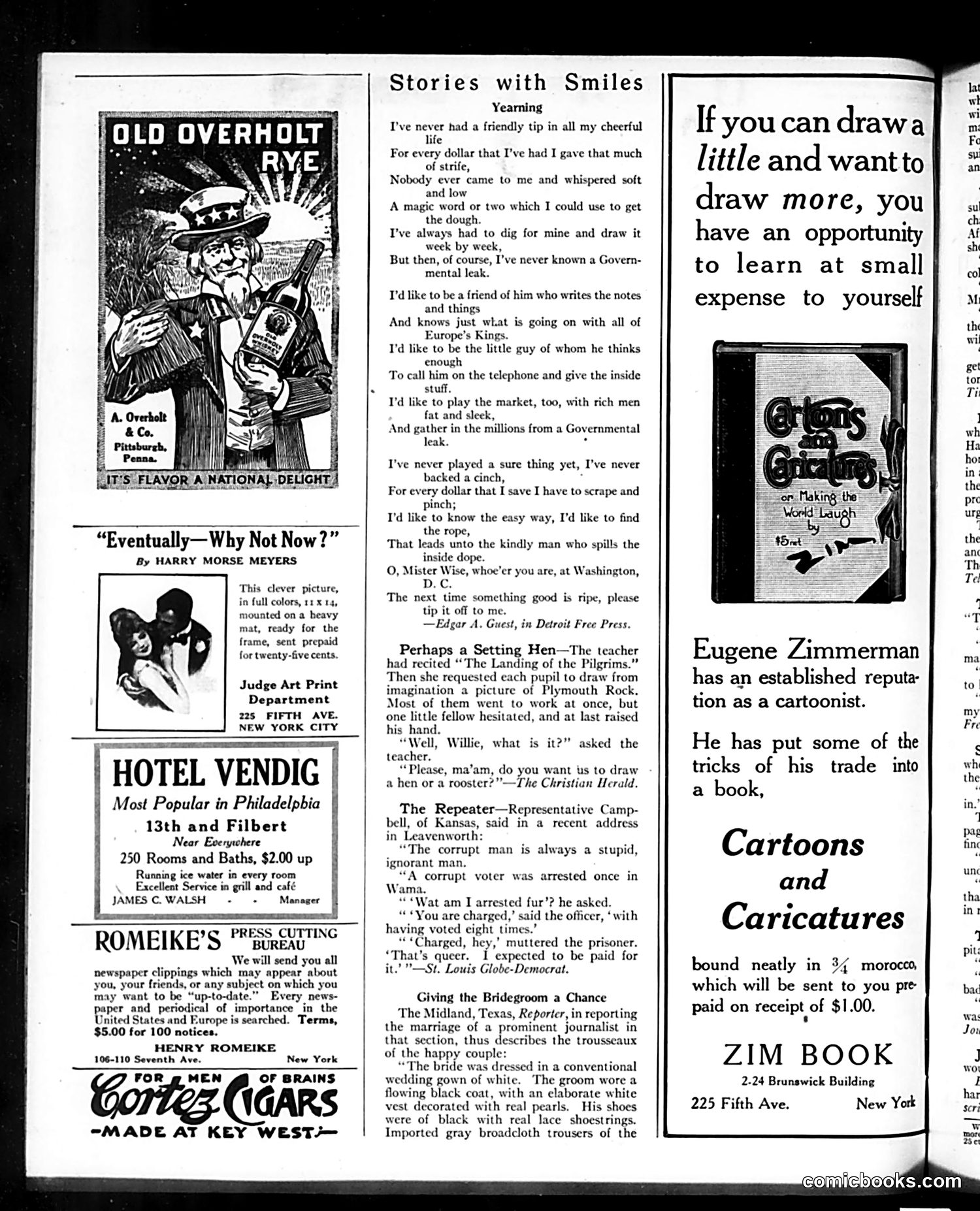
This 1910s-era page is mostly **advertisements and humorous anecdotal stories**, not political satire. The main content is "Stories with Smiles"—three brief jokes: one from poet Edgar A. Guest about a working man wishing for inside tips like Washington insiders get; one about a boy confused about drawing Plymouth Rock; and one satirizing vote fraud and corruption (a man "charged" with voting eight times protests he wasn't even *paid* for it). The left cartoon **"Eventually—Why Not Now?"** by Harry Morse Meyers appears to show Uncle Sam in an exaggerated pose; the text mentions it's a full-color print available for 25 cents, suggesting it's patriotic imagery likely promoting something American, though the specific message isn't clear from context. The remaining space contains typical magazine advertisements: Hotel Vendig in Philadelphia, Judge's art print department, a newspaper clipping service, and an ad for Eugene Zimmerman's cartooning instruction book. The page is principally a **commercial vehicle** rather than sustained political commentary.
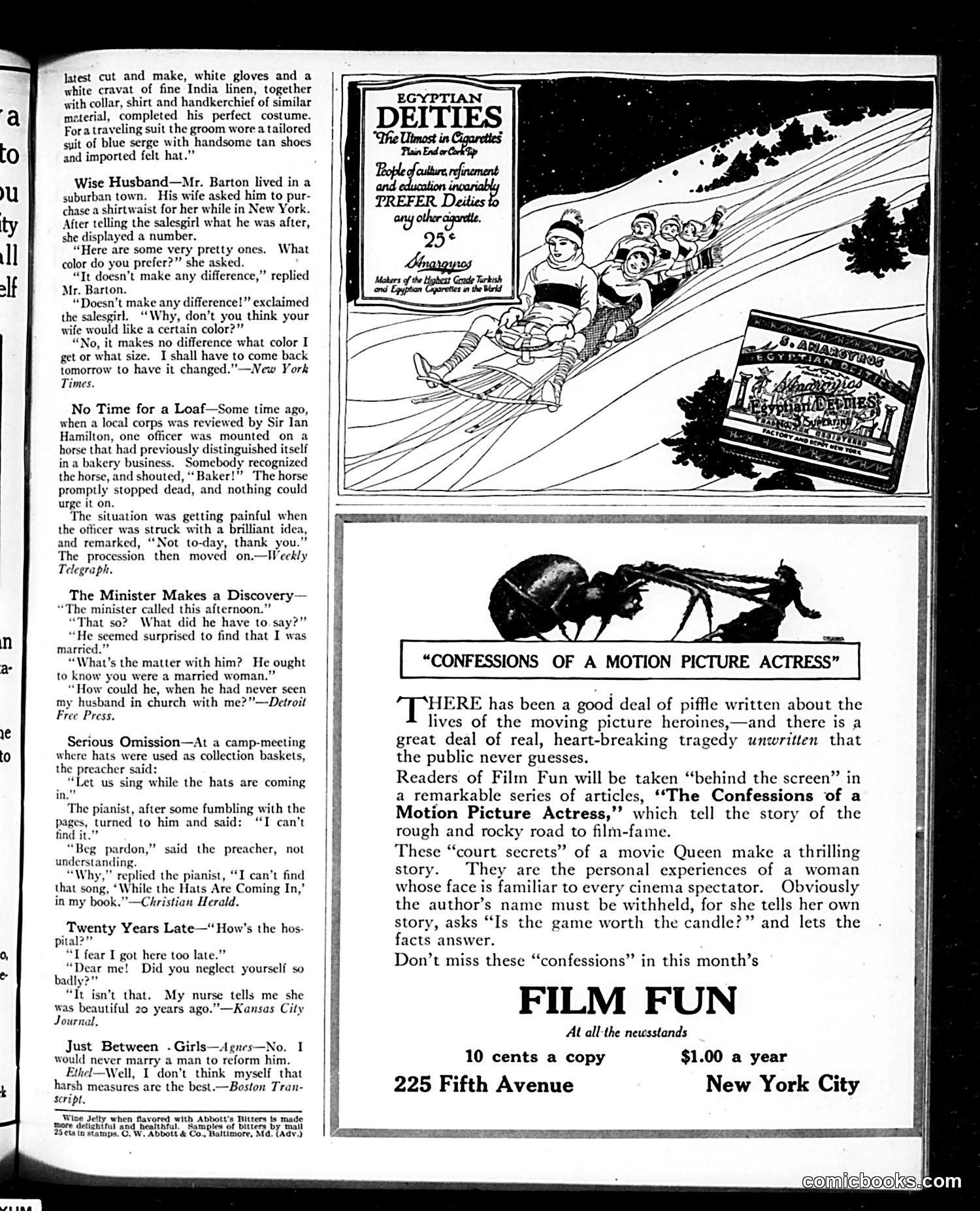
This page combines satirical humor pieces with period advertising. The left column contains short jokes typical of early 20th-century humor magazines: **"Wise Husband"** jokes about a husband's indifference to his wife's preferences—he knows she'll make him return whatever he buys anyway, a dig at marital dynamics and shopping culture. **"No Time for a Loaf"** recounts an anecdote where a military horse, formerly used in a bakery, stops at the command "Baker!"—absurdist humor about animal memory. **"The Minister Makes a Discovery"** satirizes a pastor surprised to learn his parishioner is married, suggesting the husband never attends church—poking fun at both clerical obliviousness and marital absence. The remaining jokes follow similar patterns: mild domestic satire and observational humor about courtship, hospital visits, and women's attitudes toward reform. **The advertisement** promotes *Film Fun* magazine's series on motion picture actresses' "confessions," marketed as scandalous behind-the-scenes revelations—reflecting 1920s fascination with Hollywood mystique and gossip.
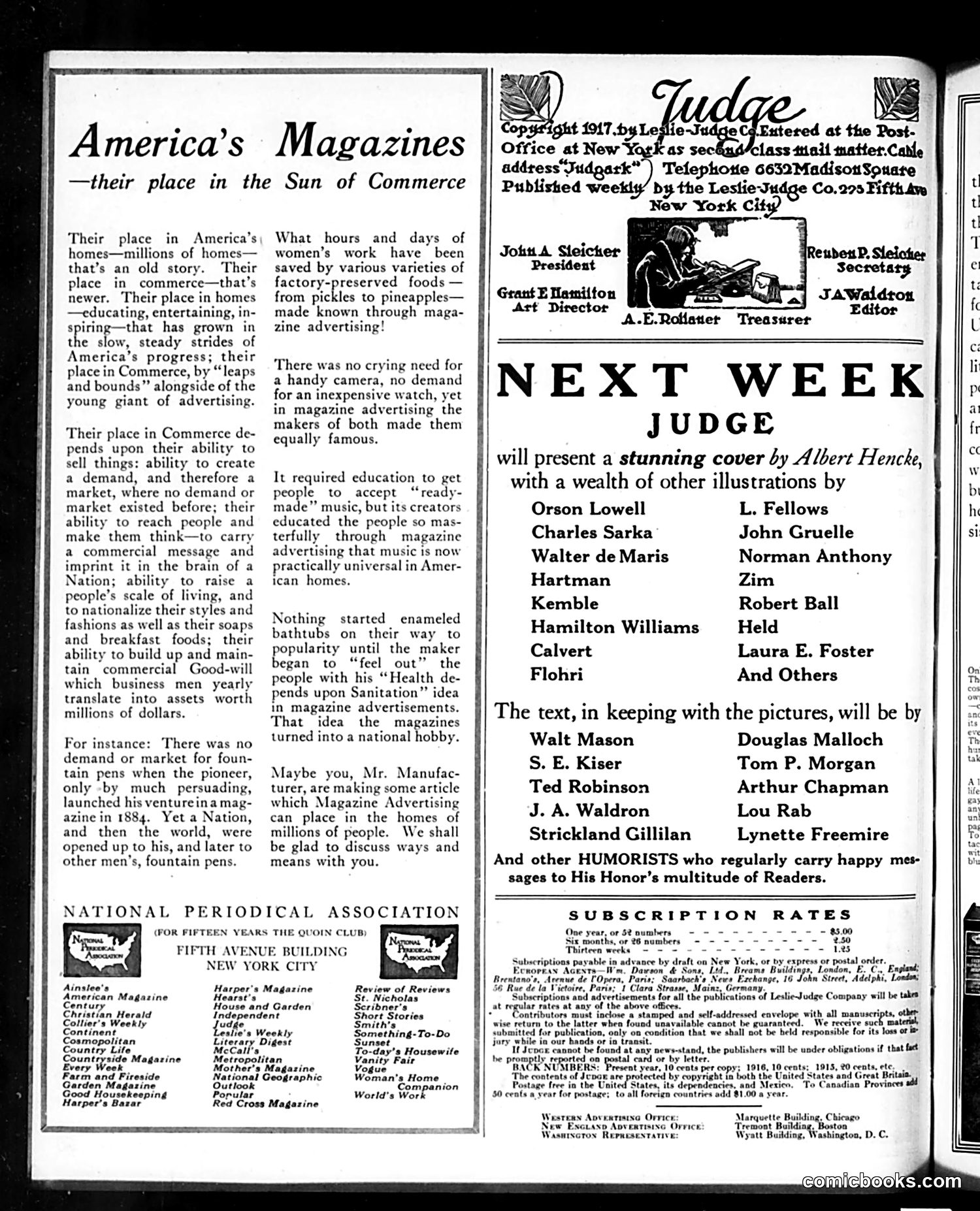
This is primarily **advertising and promotional content**, not a political cartoon. The page is Judge magazine's advertisement for itself and the National Periodical Association (representing major American magazines). The text argues that magazines have become essential commercial tools—not just for entertainment but for **creating consumer demand**. It cites examples: fountain pens (no market before 1884), cameras, watches, canned foods, and enameled bathtubs all became popular through magazine advertising that "educated" the public about these products' benefits. The underlying message targets manufacturers: magazines can place products "in the homes of millions of people" by making people "think" and raising "a people's scale of living." This reflects **early 20th-century advertising philosophy**—the idea that magazines didn't just sell existing products but actively shaped consumer desires and modernized American homes. The "Sanitation" example typifies this: manufacturers used magazines to convince Americans they *needed* new products for health reasons. The page concludes by promoting Judge's own upcoming issue and subscription rates, positioning the magazine as part of this powerful commercial apparatus.
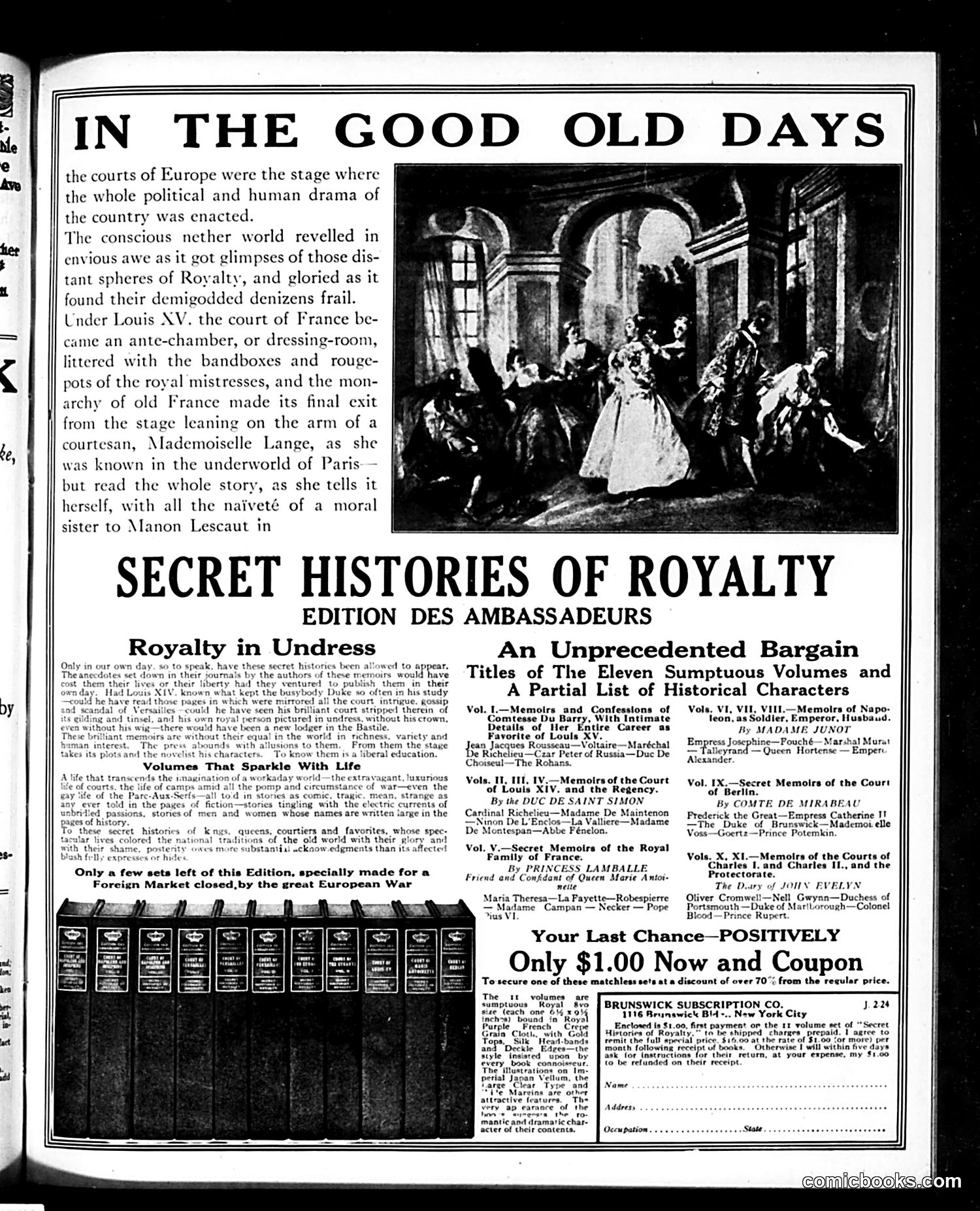
This page is primarily **advertising**, not political satire. It promotes a subscription book series called "Secret Histories of Royalty: Edition des Ambassadeurs." The accompanying article at top uses romantic language to frame European royal courts—particularly Louis XV's France—as sites of scandal and intrigue. It specifically references **Mademoiselle Lange**, a real courtesan, and **Manon Lescaut** (a fictional character symbolizing moral compromise), to suggest the "undress" version of royalty: their private scandals, affairs, and moral failings. The advertisement exploits this appeal by listing the 11-volume set's contents: memoirs and "secret histories" allegedly featuring famous historical figures (Napoleon, Marie Antoinette, Cardinal Richelieu, etc.). The pitch emphasizes unprecedented access to royal "secrets." **The satire is implicit**: Judge mocks the public's voyeuristic appetite for royal scandal and the publishing industry's exploitation of that appetite by repackaging historical gossip as scandalous "insider" revelation—a common marketing tactic then and now.
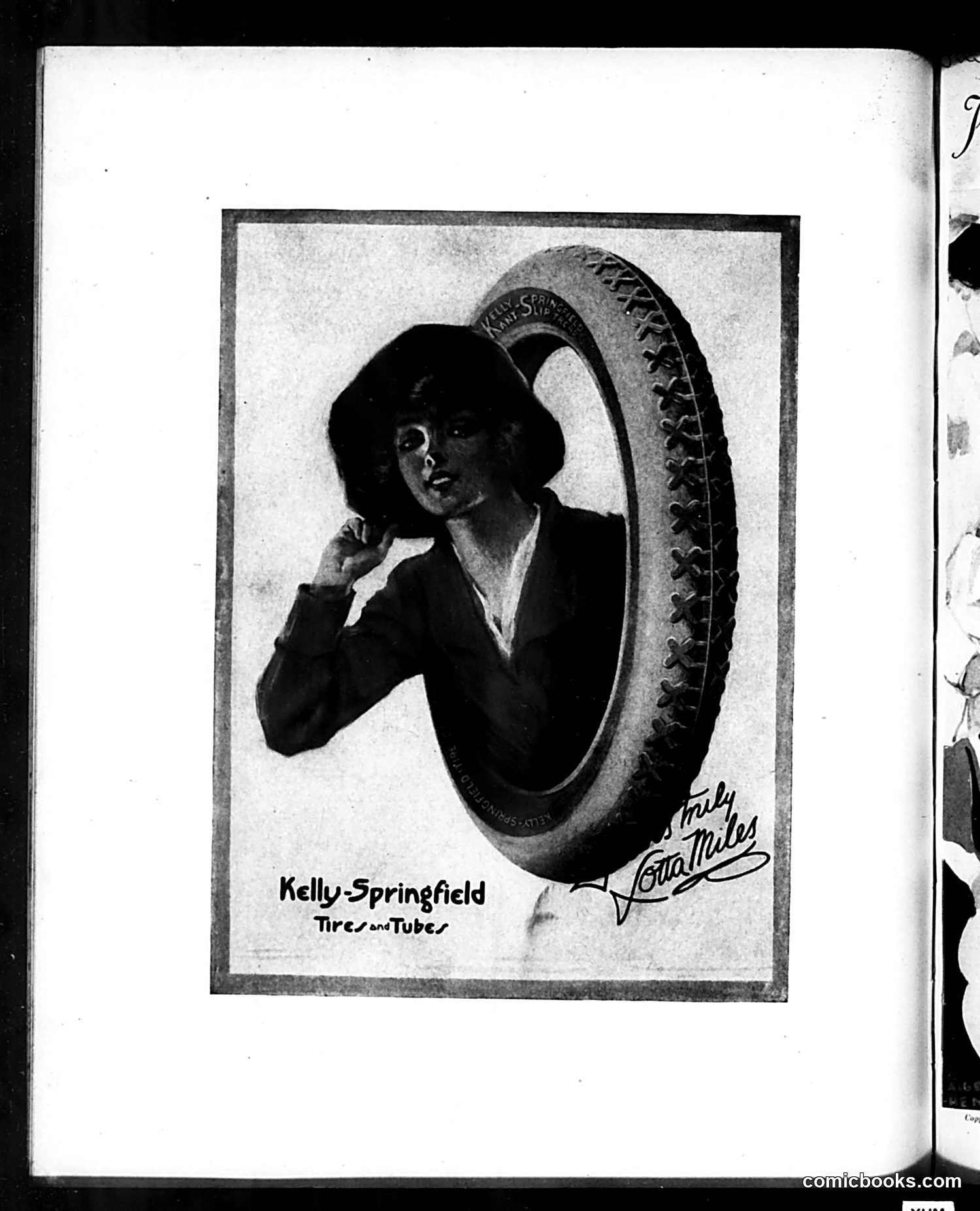
This is a product advertisement for Kelly-Springfield Tires and Tubes, not a political cartoon. The image shows a woman's face emerging from or framed by a large automobile tire, with her hand raised thoughtfully to her chin. The composition creates an artistic, portrait-like effect using the tire as a decorative border. The advertisement uses an attractive female figure as a marketing device—a common advertising strategy of the early-to-mid 20th century. The "Quality Tubes" signature appears to emphasize the product's reliability. There is no political satire or social commentary present; this is straightforward commercial advertising designed to promote automotive tires and tubes to consumers through appealing imagery.