
Judge, 1917-02-24 · page 17 of 28
Judge — February 24, 1917 — page 17: what you’re looking at
What you’re looking at
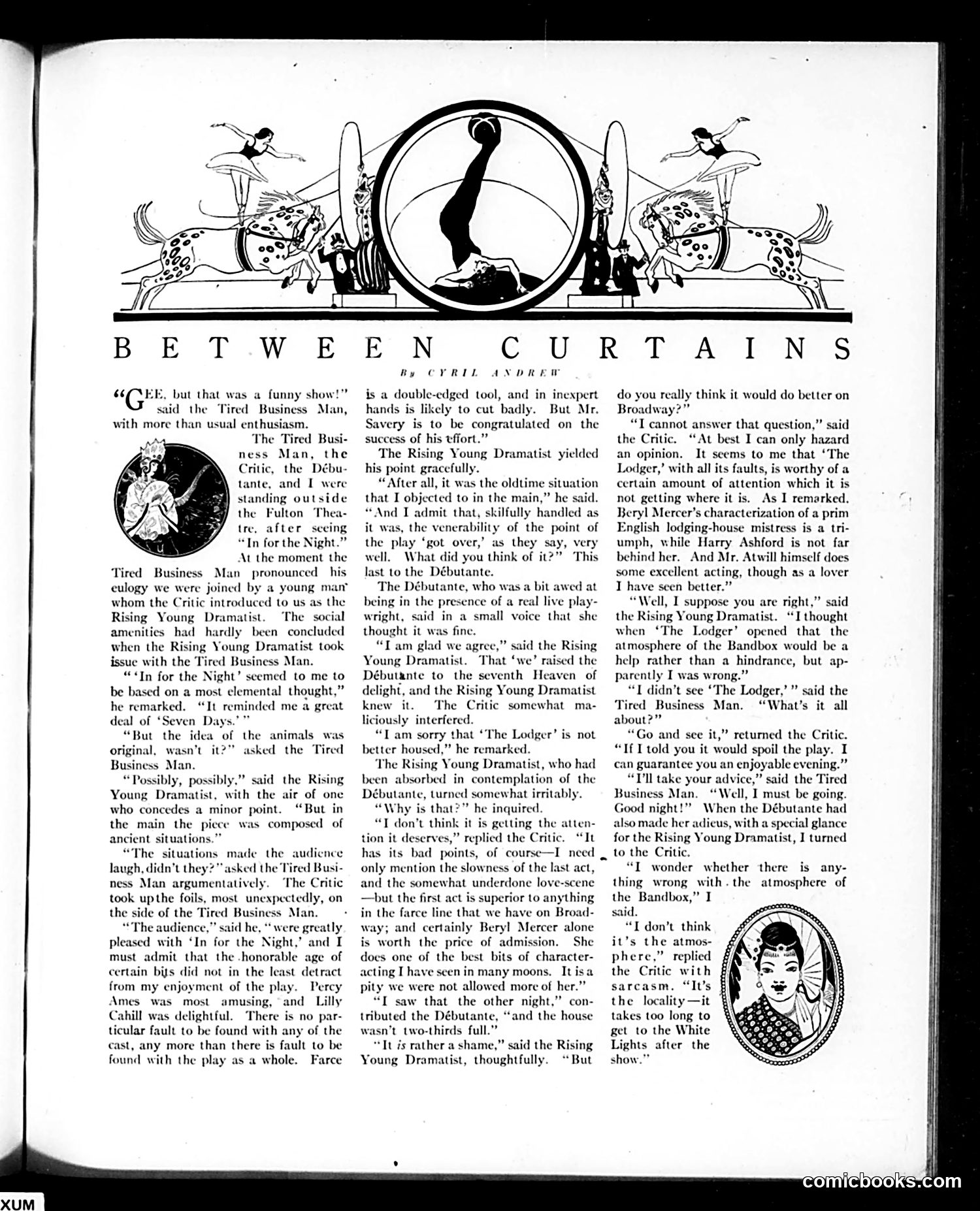
This theatrical satire by Cyril Andrew depicts a post-show conversation among four archetypal characters: a Tired Business Man, a Critic, a Débutante, and a Rising Young Dramatist. The humor targets the pretentiousness of avant-garde theatre criticism versus popular taste. The Rising Young Dramatist dismisses the successful farce "In for the Night" as derivative, while praising the under-attended play "The Lodger" for its artistic merit—particularly actress Beryl Mercer's performance. The Critic supports this highbrow assessment, though acknowledging the play's flaws. The satire mocks the disconnect between critical acclaim and box-office success, and the Dramatist's obvious attempt to impress the Débutante by appearing intellectually superior. The recurring theme suggests Judge's skepticism toward theatrical elitism: popular entertainment that makes audiences laugh has legitimate value, even if composed of "ancient situations."
📄 Transcribed text from this page (OCR, searchable)
Machine-transcribed from the original scan — historical spelling and the odd misread are preserved.
XUM BE T WE 66(XEE, but that was a funny show!” said the Tired Business Man, with more than usual enthusiasm. The Tired Busi- ness Man, the Critic, the Débu- tante, and I were standing outside the Fulton Thea- tre, after ng “In forthe Night.” At the moment the Tired Business Man pronounced his eulogy we were joined by a young man whom the Critic introduced to us as the Rising Young Dramatist. The social amenities had hardly been concluded when the Rising Young Dramatist took issue with the Tired Business Man. “In for the Night’ seemed to me to be based on a most elemental thought,” he remarked. “It reminded me a great deal of ‘Seven Days.’ ” “But the idea of the animals was original, wasn’t it?” asked the Tired Business Man. “Possibly, possibly.” said the Rising Young Dramatist, with the air of one who concedes a minor point. “But in the main the piece was composed of ancient situations.” “The situations made the audicnce laugh, didn’t they?” asked the Tired Busi- ness Man argumentatively. The Critic took up the foil the side of th ness Man. “The audience,” said he, “ were greatly pleased with ‘In for the Night,’ and I must admit that the .honorable age of certain bits did not in the least detract from my enjoyment of the play. Percy Ames was most amusing, and _ Lilly Cahill was delightful. There is no par- ticular fault to be found with any of the cast, any more than there is fault to be found with the play as a whole. Farce pectedly, on E N Ry CYRIL ANDREW is a double-edged tool, and in inexpert hands is likely to cut badly. But Mr. Savery is to be congratulated on the success of his tffort.” The Rising Young Dramatist yielded his point gracefully. “After all, it was the oldtime situation that I objected to in the main,” he said. “And I admit that, skilfully handled as it was, the venerability of the point of the play ‘got over,’ as they say, well. What did you think of it?” last to the Débutante. The Débutante, who was a bit awed at being in the presence of a real live p . said in a small voice that she thought it was fine. “Tam glad we agree,” said the Rising Young Dramatist. That ‘we’ raised the Débutante to t enth Heaven of delight, and the Rising Young Dramatist knew it. The Critic somewhat ma- liciously interfered. “Tam sorry that ‘The Lodger better housed,” he remarked. The Rising Young Dramatist, who had been absorbed in contemplation of the Débutante, turned somewhat irritably. “Why is thai he inquired. “T don’t think it is getting the atten- tion it deserves,” replied the Critic. “It not has its bad points, of course—I need . only mention the slowness of the last act, and the somewhat underdone love-scene —but the first act is superior to anything in the farce line that we have on Broad- way; and certainly Beryl Mercer alone is worth the price of admission. She does one of the best bits of character- acting I have seen in many moons, It isa pity we were not allowed more of her.” “I saw that the other night,” con- tributed the Débutante, “and the house wasn’t two-thirds full.” “It is rather a shame,” said the Rising Young Dramatist, thoughtfully. “But CURTAINS do you really think it would do better on Broadway?” “T cannot answer that question,” said the Critic. “At best I can only hazard an opinion. It seems to me that ‘The Lodger,’ with all its faults, is worthy of a certain amount of attention which it is not getting where it is. As I remarked. Beryl Mercer’s characterization of a prim English lodging-house mistress is a tri- umph, while Harry Ashford is not far behind her. And Mr. Atwill himself does some excellent acting, though as a lover I have seen better.” “Well, I suppose you are right,” said the Rising Young Dramatist. “I thought when ‘The Lodger’ opened that the atmosphere of the Bandbox would be a help rather than a hindrance, but ap- parently I was wrong.” “I didn’t see ‘The Lodger,’ ” said the Tired Business Man. ‘“What’s it all about?” “Go and see it,” returned the Cri “If I told you it would spoil the play. I can guarantee you an enjoyable evening.” “T'll take your advice,” said the Tired Business Man. “Well, I must be going. Good night!” When the Débutante had also made her adieus, with a special glance for the Rising Young Dramatist, 1 turned to the Critic. “I wonder whether there is any- thing wrong with.the atmosphere of the Bandbox,” I said. “T don’t think it’s the atmos- phere,” replied the Critic with sarcasm. “It’s the locality —it takes too long to get to the White after the