
Judge, 1917-02-24 · page 12 of 28
Judge — February 24, 1917 — page 12: what you’re looking at
What you’re looking at
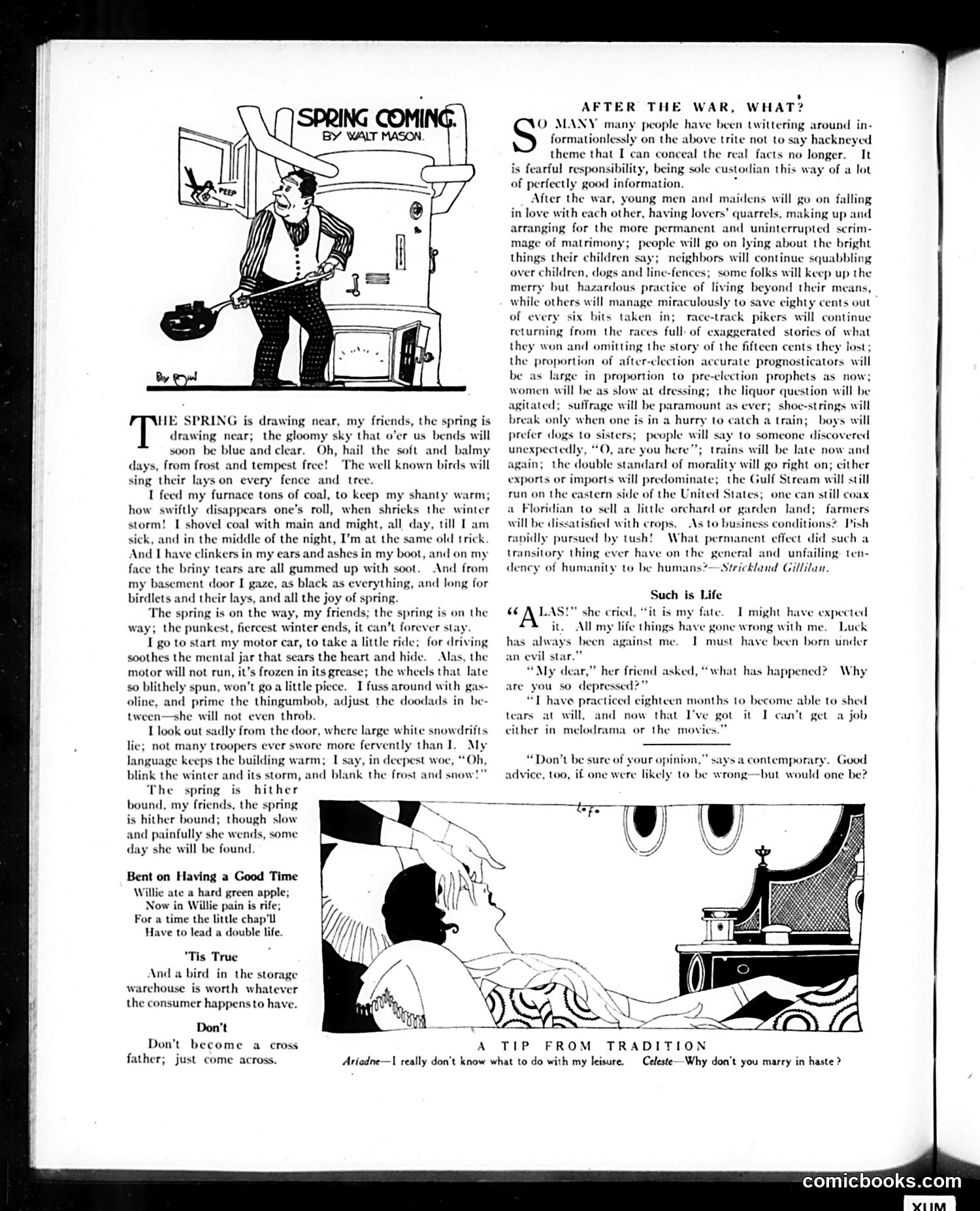
This page contains two distinct pieces of satire: **"Spring Coming" (top):** A humorous poem by Walt Mason, illustrated with a cartoon of a man struggling with winter chores. The satire mocks the gap between spring's romantic promise and harsh reality—the speaker fantasizes about mild weather and singing birds while actually shoveling coal, dealing with frozen car engines, and cursing in frustration. It's gentle social satire about working-class winter hardships versus poetic idealization. **"After the War, What?" (right column):** A cynical post-WWI piece predicting that despite the war's trauma, human nature won't change. It sarcastically catalogs inevitable social behaviors: romance, gossip, financial irresponsibility, gambling, suffrage debates, tardiness, and gender inequality will persist unchanged. The satire targets public naïveté about war's transformative power, suggesting optimistic postwar rhetoric is foolish. Both pieces employ Judge magazine's characteristic blend of humor and social criticism.
📄 Transcribed text from this page (OCR, searchable)
Machine-transcribed from the original scan — historical spelling and the odd misread are preserved.
HE SPRING is drawing n my friends, the spring is drawing near; the gloom: that o’er us bends will soon be blue and clear. Oh, hail the soft and balmy days, from frost and tempest free! The well known birds will sing their layson every fence and tree. I feed my furnace tons of coal, to keep my shanty warm; how swiftly disappears one’s roll, when shricks the winter storm! I shovel coal with main and might, all day, till I am sick, and in the middle of the night, I’m at the same old trick And I have clinkers in my ears and ashes in my boot, and on my face the briny tears are all gummed up with soot. And from my basement door I gaze, as black as everything, and long for birdlets and their lays, and all the joy of spring. The spring is on the way, my friends; the spring is on the the punkest, fiercest winter ends, it can’t forever sti I go to start my motor car, to take a little ride; for driving soothes the mental jar that sears the heart and hide. Alas, the motor will not run, it’s frozen in its grease; the wheels that late so blithely spun, won't go a little piece. I fuss around with gas- oline, and prime the thingumbob, adjust the doodads in be- tween—she will not even throb. I look out sadly from the door, where large white snowdrifts ; not many troopers ever swore more fervently than I. My language keeps the building warm; I say, in deepest woe, “Oh, blink the winter and its storm, and blank the frost and snow!” The spring is hither bound, my friends, the spring is hither bound; though slow and painfully she wends, some day she will be found. way Bent on Having a Good Time Willie ate a hard green apple; Now in Willie pain is rife; For a time the little chap'll Have to lead a double life. ‘Tis True And a bird in the storage warehouse is worth whatever the consumer happens to have. ’ AFTER THE WAR, WHAT? O MANY many people have been twittering around in- S formationlessly on the above trite not to say hackneyed theme that I can conceal the real facts no longer. It is fearful responsibility, being sole custodian this way of a lot of perfectly good information. . After the war, young men and maidens will go on falling in love with cach other, having lovers’ quarrels, making up and arranging for the more permanent and uninterrupted scrim- of matrimony; people will go on lying about the bright things their children say; neighbors will continue squabbling over children, dogs and line-fences; some folks will keep up the merry but hazardous practice of living beyond their means, while others will manage miraculously to save eighty cents out of every six bits taken in; race-track pikers will continue returning from the races full: of exaggerated stories of what they won and omitting the story of the fifteen cents they lost; the proportion of after-clection accurate prognosticators will be as large in proportion to pre-election prophets as now women will be as slow at dressing; the liquor question will be agitated; suffrage will be paramount as ever; shoe-strings will break only when one is in a hurry to catch a train; boys will prefer dogs to sisters; people will say to someone discovered unexpectedly, “O, are you here”; trains will be late now and again; the double standard of morality will go right on; cither exports or imports will predominate; the Gulf Stream will still run on the eastern side of the United States; one can still coax a Floridian to sell a little orchard or garden land; farmers will be dissatisfied with crops. As to business conditions? Pish rapidly pursued by tush! What permanent effect did such a transitory thing ever have on the general and unfailing: ten- dency of humanity to be humans?—Strickland Gillilan. “ALS she cried, “it is my fate. 1 might have expected it. All my life things have gone wrong with me. Luck uways been ag: T must have been born under an evil star.” “My dear,” her friend asked, “what has happened? are you so depressed “T have practiced eighteen months to become able to shed tears at will, and that I've got it I can’t get a job cither in melodrama or the movies.” Such is Life has nst_ me. Why now says a contemporary. Good but would one be? “Don’t be sure of your opinion, advice, too, if one were likely to be wrong Don't Don't become a father; just come across. cross, A Ariadne—I really don't know what to do with my leisure. TRADITION Celeste—Why don't you marry in haste > TIP FROM comicbooks.com