
Judge, 1917-02-24 · page 26 of 28
Judge — February 24, 1917 — page 26: what you’re looking at
What you’re looking at
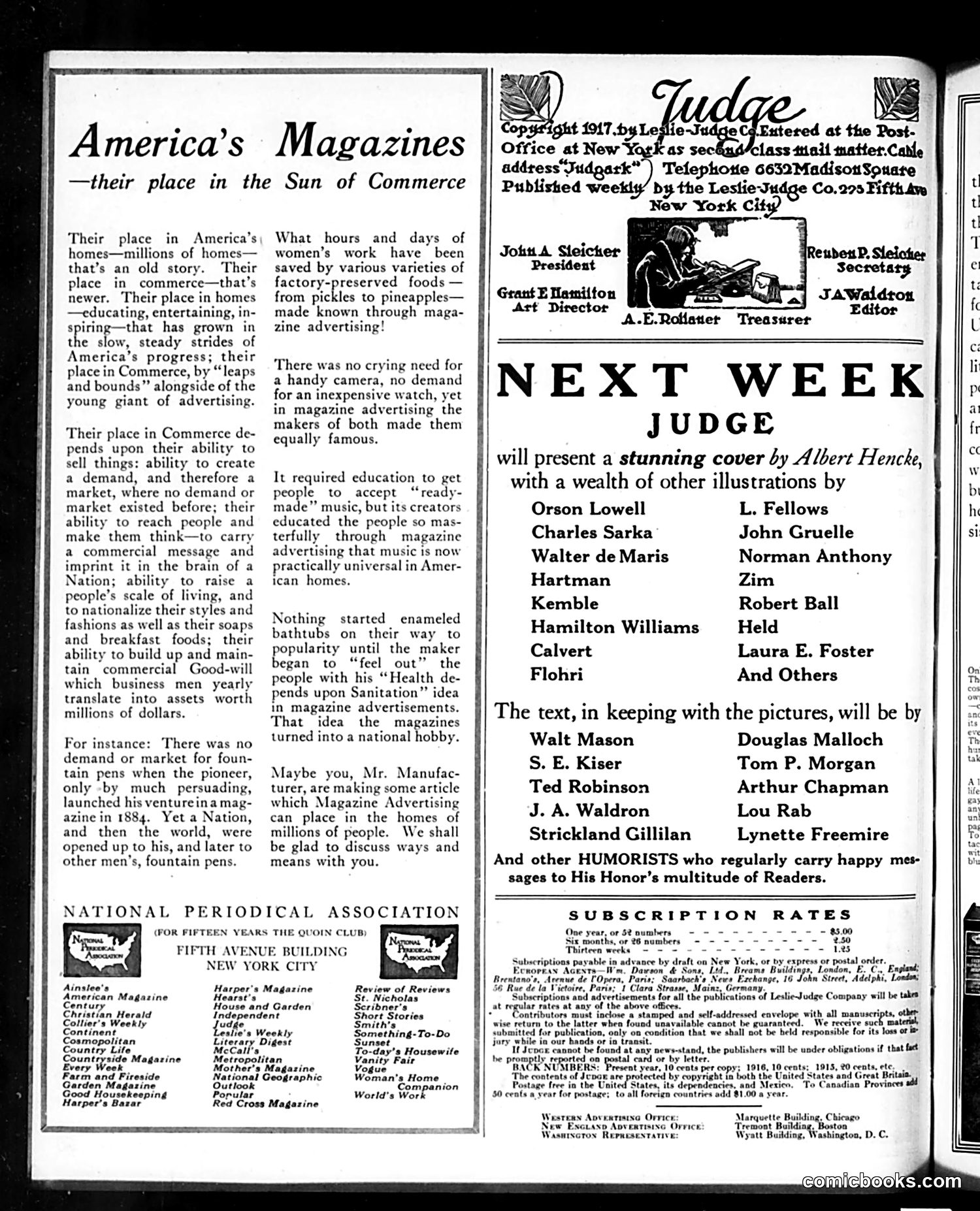
This is primarily **advertising and promotional content**, not a political cartoon. The page is Judge magazine's advertisement for itself and the National Periodical Association (representing major American magazines). The text argues that magazines have become essential commercial tools—not just for entertainment but for **creating consumer demand**. It cites examples: fountain pens (no market before 1884), cameras, watches, canned foods, and enameled bathtubs all became popular through magazine advertising that "educated" the public about these products' benefits. The underlying message targets manufacturers: magazines can place products "in the homes of millions of people" by making people "think" and raising "a people's scale of living." This reflects **early 20th-century advertising philosophy**—the idea that magazines didn't just sell existing products but actively shaped consumer desires and modernized American homes. The "Sanitation" example typifies this: manufacturers used magazines to convince Americans they *needed* new products for health reasons. The page concludes by promoting Judge's own upcoming issue and subscription rates, positioning the magazine as part of this powerful commercial apparatus.
📄 Transcribed text from this page (OCR, searchable)
Machine-transcribed from the original scan — historical spelling and the odd misread are preserved.
America’s Magazines —their place in the Sun of Commerce Their place in America’s homes—millions of homes— that’s an old story. Their place in commerce—that’s newer. Their place in homes —ceducating, entertaining, in- spiring—that has grown in the slow, steady strides of America’s progress; their place in Commerce, by “leaps and bounds” alongside of the young giant of advertising. Their place in Commerce de- pends upon their ability to sell things: ability to create a demand, and therefore a market, where no demand or market existed before; their ability to reach people and make them think—to carry a commercial message and imprint it in the brain of a Nation; ability to raise a people’s scale of living, and to nationalize their styles and fashions as well as their soaps and breakfast foods; their ability to build up and main- tain commercial Good-will which business men yearly translate into assets worth millions of dollars. For instance: There was no demand or market for foun- tain pens when the pioncer, only -by much persuading, launched his ventureina mag- azine in 1884. Yet a Nation, and then the world, were opened up to his, and later to other men’s, fountain pens. NATIONAL (Por FF FIFTH AV PERIODICAL EN YEARS THE QUOIN CLUB) UE BUILDING What hours and days of women’s work have been saved by various varieties of factory-~ =preserved foods — from pickles to pineapples— made known through maga- zine advertising! There was no crying need for a handy camera, no demand for an inexpensive watch, yet in magazine advertising the makers of both made them equally famous. It required education to get people to accept “ready- made” music, but its creators educated the people so mas- terfully through magazine advertising that music is now practically universal in Amer- ican homes. Nothing started enameled bathtubs on their way to popularity until the maker began to “feel out” the people with his “Health de- pends upon Sanitation” idea in magazine advertisements. That idea the magazines turned into a national hobby. Maybe you, Mr. Manufac- turer, are making some article which Magazine Advertising can place in the homes of millions of people. We shall be glad to discuss ways and means with you. ASSOCIATION NEW YORK CITY Harper's Magazine and Garden Independent mn Leche. 's Weekly Digest Hearst's fou: Collier 's Weekly Continent Cosmopo! Country Countryside Magazine Every Week Literar: Popular Magazine Geographic Review of Reviews St. Nicholas Scribner’ Short Stories Smit. Something- To-Do Fo day's Housewite Vanity Fair Vogue Woman's Home companion World's Wor Red Cross Magazine a Me ered at the Post- Lass tail matter.Cable Telephotie 6632Madisott Sonate by the Lestie Judge Co.275 Fifth.sv New York sk Clty) sy) 1917 by Leglie-J1 as sec! Office at New Yo addtess‘Judgark” Dabned ae wee! R P. Sleioker 4 sn Socrates TAWaidton Editor NEXT WEEK JUDGE will present a stunning cover by Albert Hencke, with a wealth of other illustrations by L. Fellows John Gruelle Norman Anthony Zim Robert Ball Held Laura E. Foster And Others Orson Lowell Charles Sarka Walter de Maris Hartman Kemble Hamilton Williams Calvert Flohri The text, in keeping with the pictures, will be by Walt Mason Douglas Malloch S. E. Kiser Tom P. Morgan Ted Robinson Arthur Chapman J. A. Waldron Lou Rab Strickland Gillilan Lynette Freemire And other HUMORISTS who regularly carry happy mes- sages to His Honor’s multitude of Readers. SUBSCRIPTION RATES One year, or 5? numbers - Six months, or 26 numbers Thirteen weeks Subscriptions payable in advance by draft Evrorras Acexts—We. Dawson & Brentano's, Avenue de FOpe : ‘ork, of by express or postal order. Breams Buildings, London, E. anges 16 Jokn Street; Adelphi, Londo many. ions of LeslieJudge Company will be taker self-addressed envelope with all manuscripts, other ble cannot be guaranteed. We receive teh mitted for publication, that we shall not be held responsible for its loss ot i jury while in our hands of ia tran: f dcoce cannot be found at any newsstand, the publishers will be uader obligations if that fad he promptly. te et card or by letter. BA 5 year, 10 ceats per copys copyrigh 1916, 10 cents: 1915, 20 cents, ete, both the United States and Great Britais. ‘and Mexico, To Canadian Provinces sdf 1.00 a year. Marquette Building, Chicago Tremont Buildi Westeay Avy 4; Boston Wyatt Building, Washingtoa, D. C. New Exousx Wasmixeroy Re icomicbooks.com