
A complete issue · 28 pages · 1916
Judge — December 16, 1916
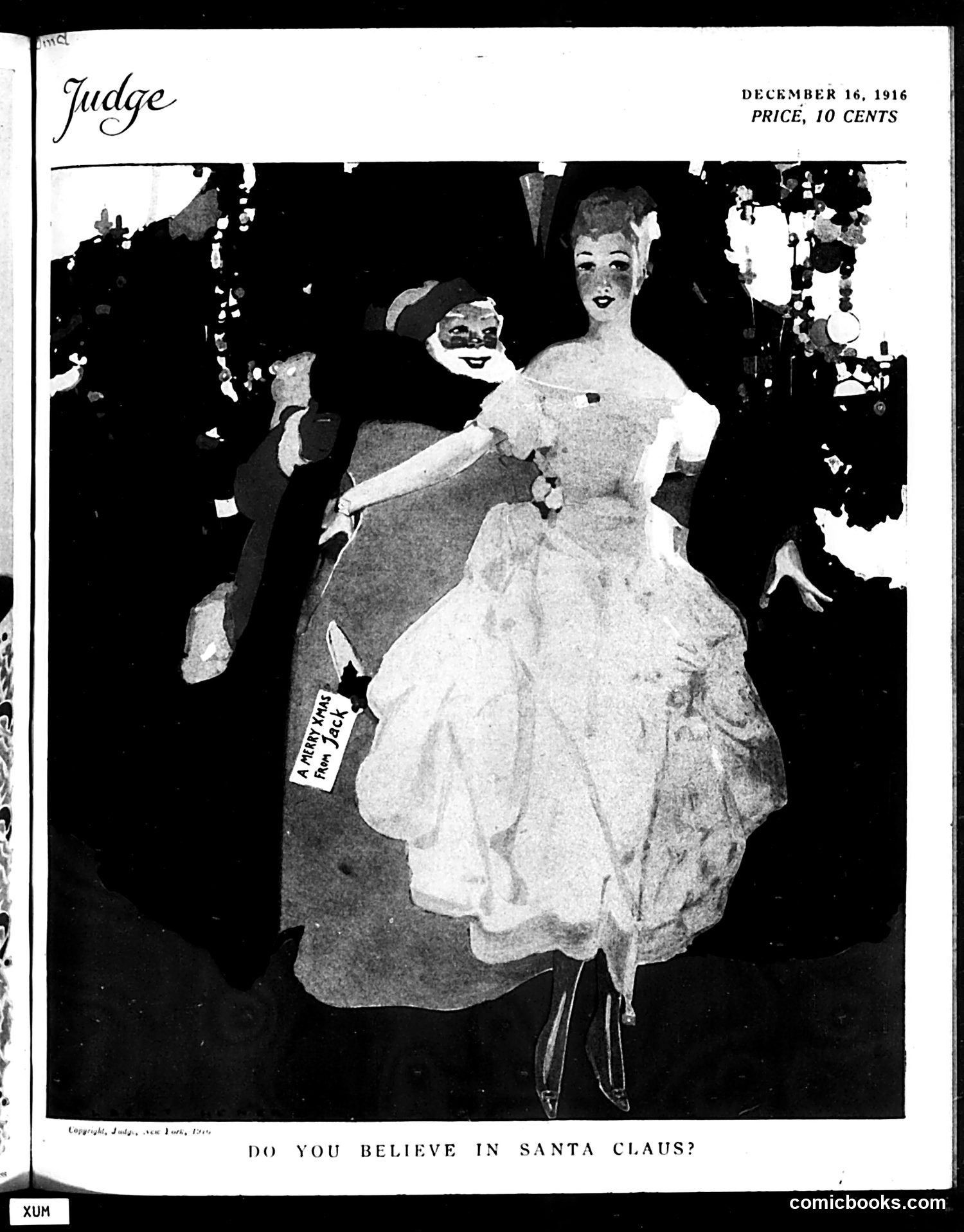
This December 1916 *Judge* cover uses holiday imagery for political satire. A woman in an elegant ball gown holds a ventriloquist's dummy of Santa Claus, suggesting that Santa—and by extension, certain Christmas promises or political assurances—is merely a puppet controlled by others, not a genuine force. The timing (just after the 1916 presidential election) suggests this critiques political rhetoric or promises made during the campaign. The satirical question asks readers whether they still believe in comforting fictions presented by politicians or public figures, implying that like Santa, these promises are manipulated illusions rather than reality. The sophisticated woman may represent the electorate, foolishly clutching at hollow promises.
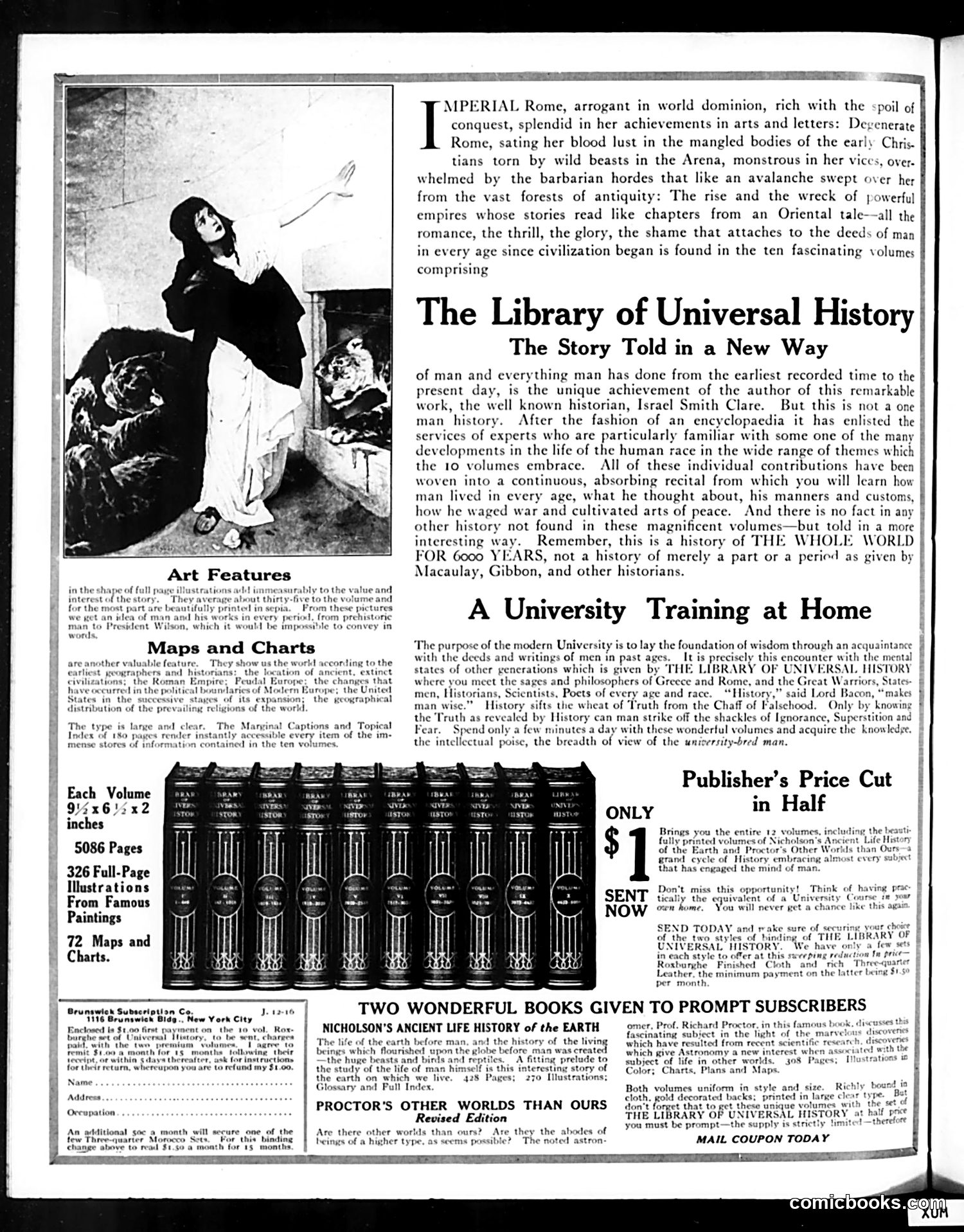
This page is primarily a **book advertisement**, not political satire. It promotes "The Library of Universal History" by historian Israel Smith Clare—a 10-volume encyclopedia set offering comprehensive world history "from the earliest recorded time to the present day." The artistic illustration on the left depicts a allegorical female figure (likely representing History or Knowledge) surrounded by historical imagery. The ad emphasizes the set's scope: 5,086 pages, 326 illustrations, 72 maps and charts. The main sales pitch targets self-education ("A University Training at Home"), appealing to readers seeking knowledge without formal schooling. The "Publisher's Price Cut" of $1 (down from higher cost) suggests this is a direct-mail campaign offering affordable access to comprehensive historical knowledge. No political satire is evident on this page.
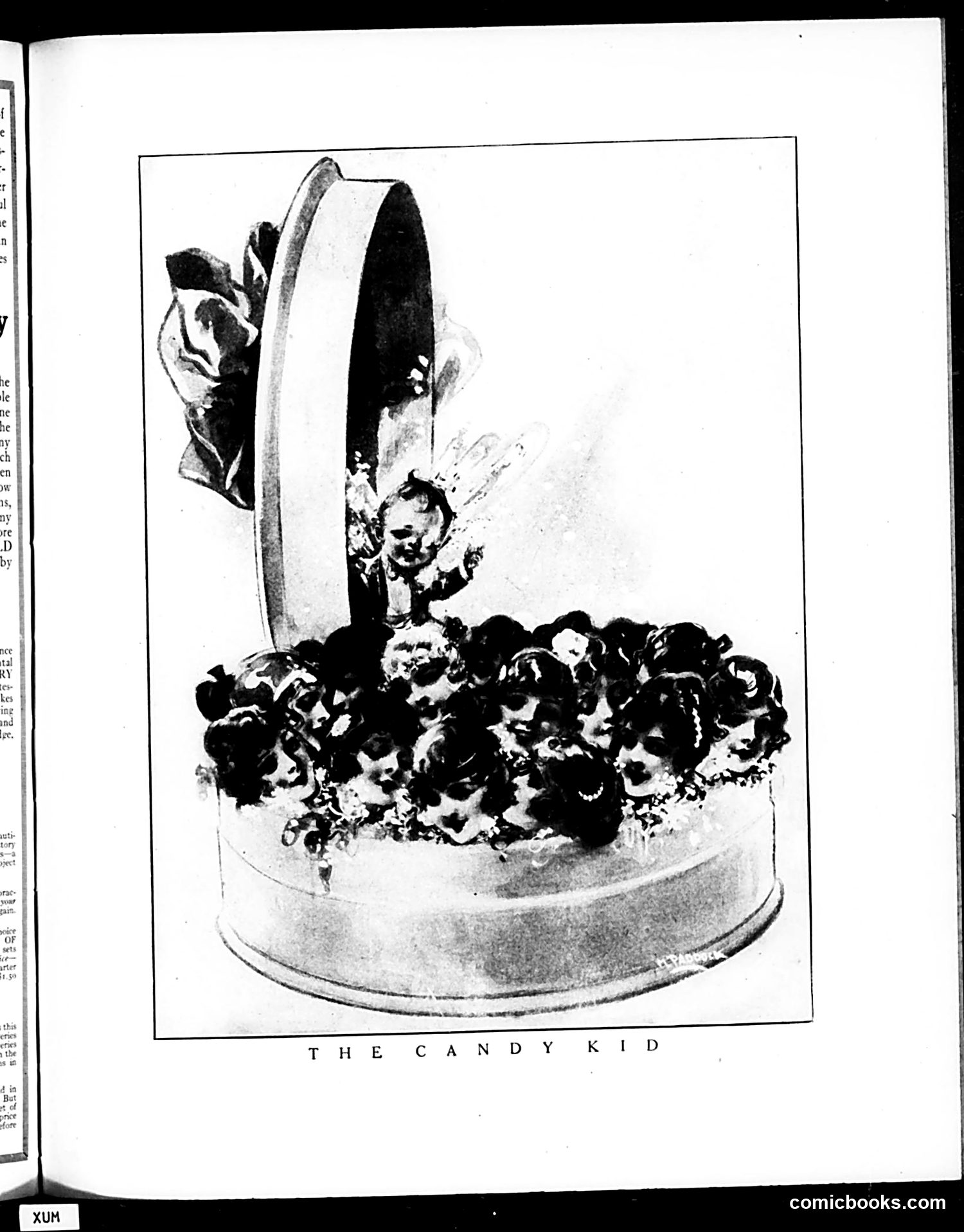
This cartoon depicts a child in a large candy basket or container, reaching upward. The image appears to be satirizing American consumer culture and childhood indulgence, likely from the early 20th century based on Judge magazine's era. The title "The Candy Kid" suggests commentary on children's access to sweets and perhaps parental indulgence or commercialization of childhood. The oversized basket and the child's eager posture may satirize excess consumption or the candy industry's marketing toward young audiences. Without additional context from surrounding text on this page, the specific political or social target remains unclear, though Judge typically lampooned contemporary social trends, business practices, and cultural excess. The image likely represents broader concerns about childhood, commerce, and American consumption habits of that period.
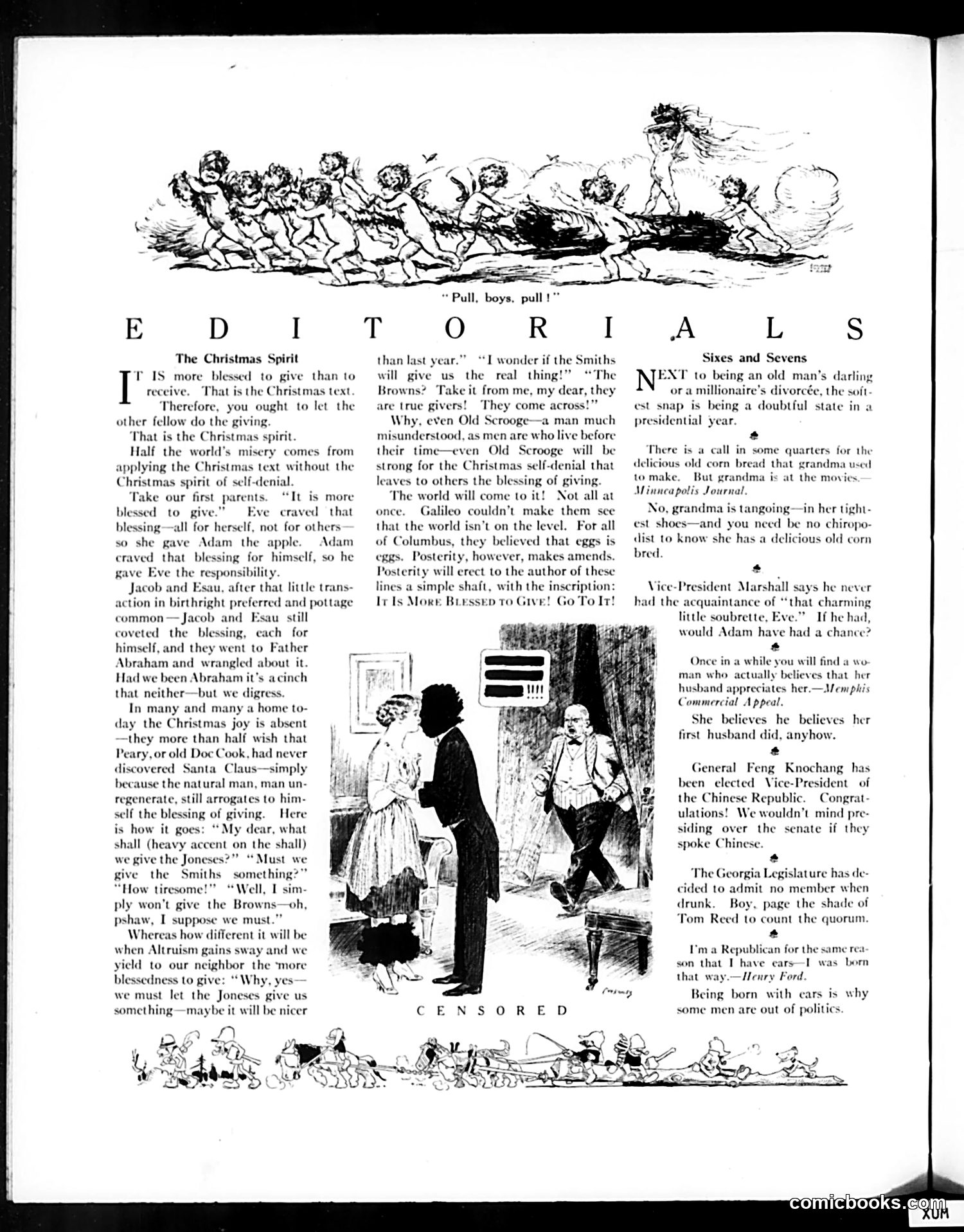
This page from Judge magazine presents satirical editorials on Christmas generosity and social commentary. "The Christmas Spirit" argues that giving is more spiritually valuable than receiving, critiquing self-denial and hypocrisy in charitable giving. The central cartoon labeled "CENSORED" depicts what appears to be a domestic or political scene with a woman and man, with heavy black redaction bars obscuring the image's full meaning. This censorship itself becomes the joke—Judge is satirizing government or editorial censorship by showing readers exactly what's been suppressed. The right column contains brief satirical notes on contemporary figures: Vice-President Marshall, General Feng Knochang (Chinese politics), Georgia legislature, and a quip about cars and politics. These are typical Judge-style one-liners mocking political figures and social trends of the era.
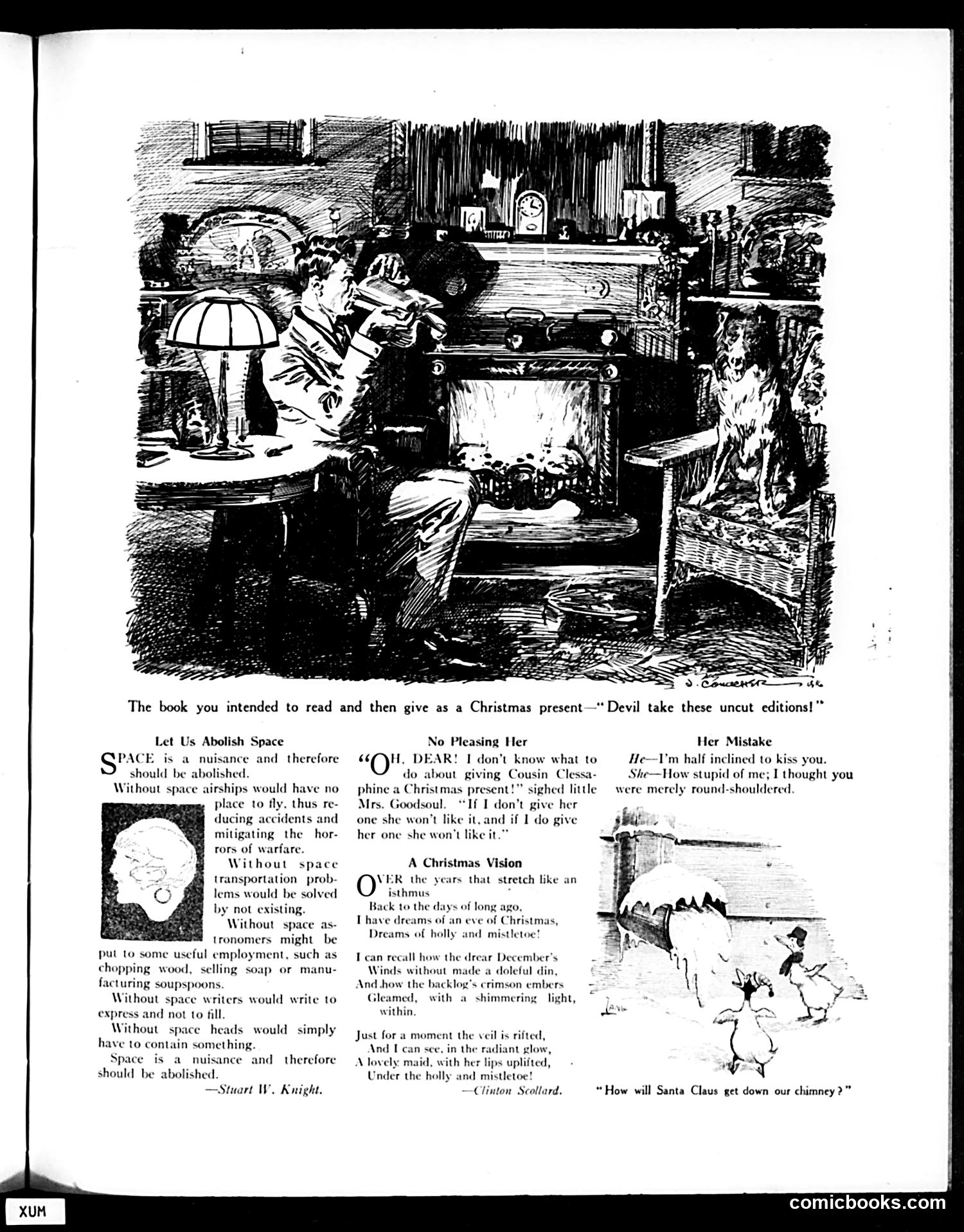
This page contains several humorous pieces about Christmas gift-giving and holiday themes, typical of Judge's satirical approach. The main cartoon shows a frustrated man by a fireplace with the caption "The book you intended to read and then give as a Christmas present—'Devil take these uncut editions!'" This jokes about a common holiday gift problem: receiving unread books with pages still uncut (standard before modern binding), making them unsuitable as gifts. Below are brief humorous pieces: "Let Us Abolish Space" satirizes space as wasteful; "No Pleasing Her" presents marital discord over gift-selection; "Her Mistake" plays on romantic miscommunication; and "A Christmas Vision" is sentimental verse about nostalgic holidays. The final illustration shows a child asking "How will Santa Claus get down our chimney?"—poking fun at housing modernization concerns. These pieces reflect early 20th-century middle-class anxieties about gift-giving, domesticity, and changing home life.
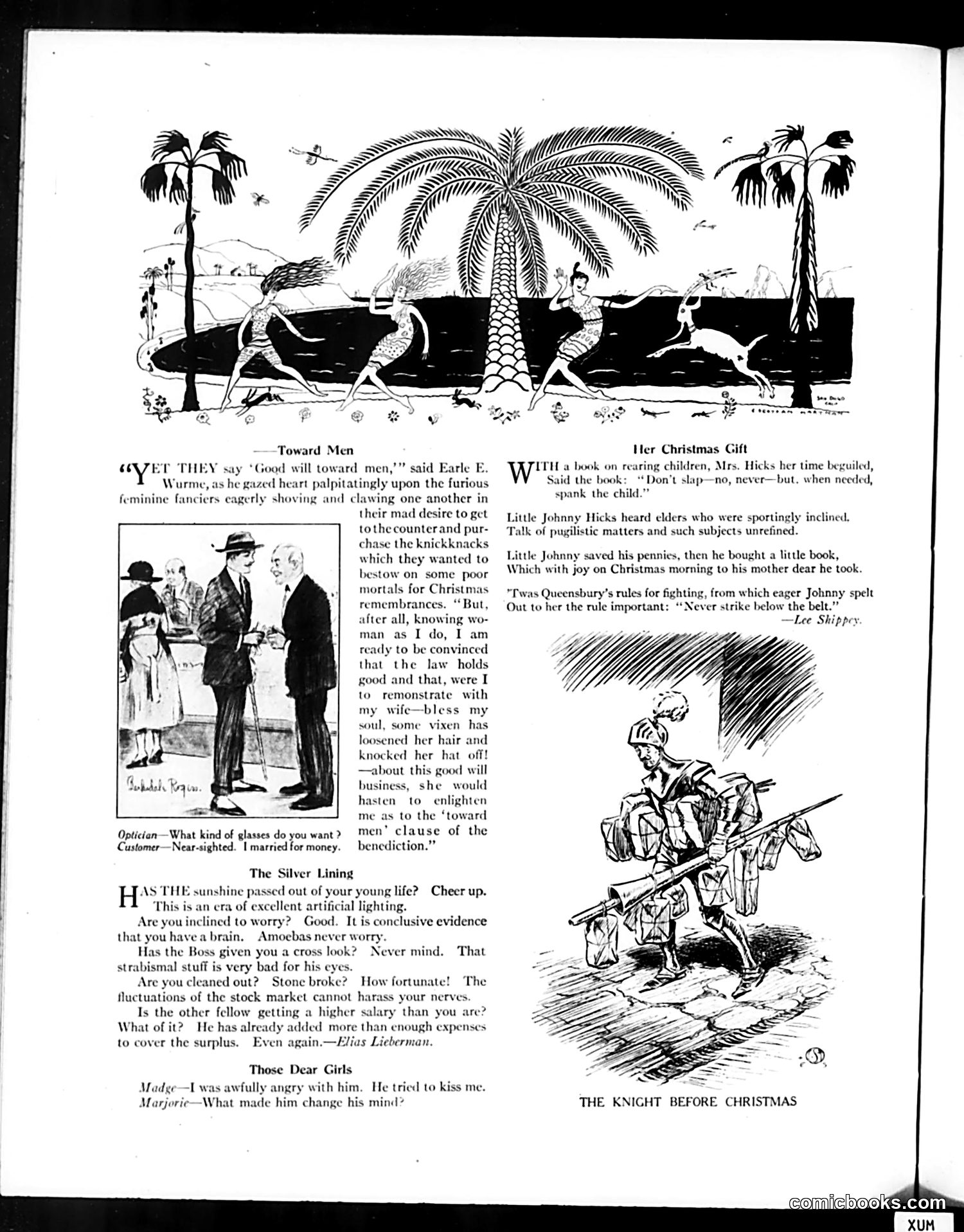
This page contains several satirical pieces mocking early 20th-century social attitudes: **"Toward Men"** ridicules the Christmas shopping frenzy, depicting women violently competing for merchandise to give as gifts. The joke relies on misogynistic stereotypes—that women are irrational consumers and that wives are aggressive and materialistic. The reference to "good will toward men" from the Christmas benediction is ironic commentary on women's supposed lack of such sentiment. **"The Silver Lining"** offers sardonic life advice: consolation for misfortune through dark humor (artificial lighting instead of sunshine; worry proves intelligence; financial ruin prevents stock anxiety). **"Her Christmas Gift"** describes a boy purchasing a book on boxing rules to give his mother—the humor deriving from the absurdity of gifting a manual on fighting to a woman, and the innocent boy quoting boxing rules about "never strike below the belt." The tone throughout is cynical about gender relations, consumerism, and human nature—typical of Judge's satirical approach during this era.
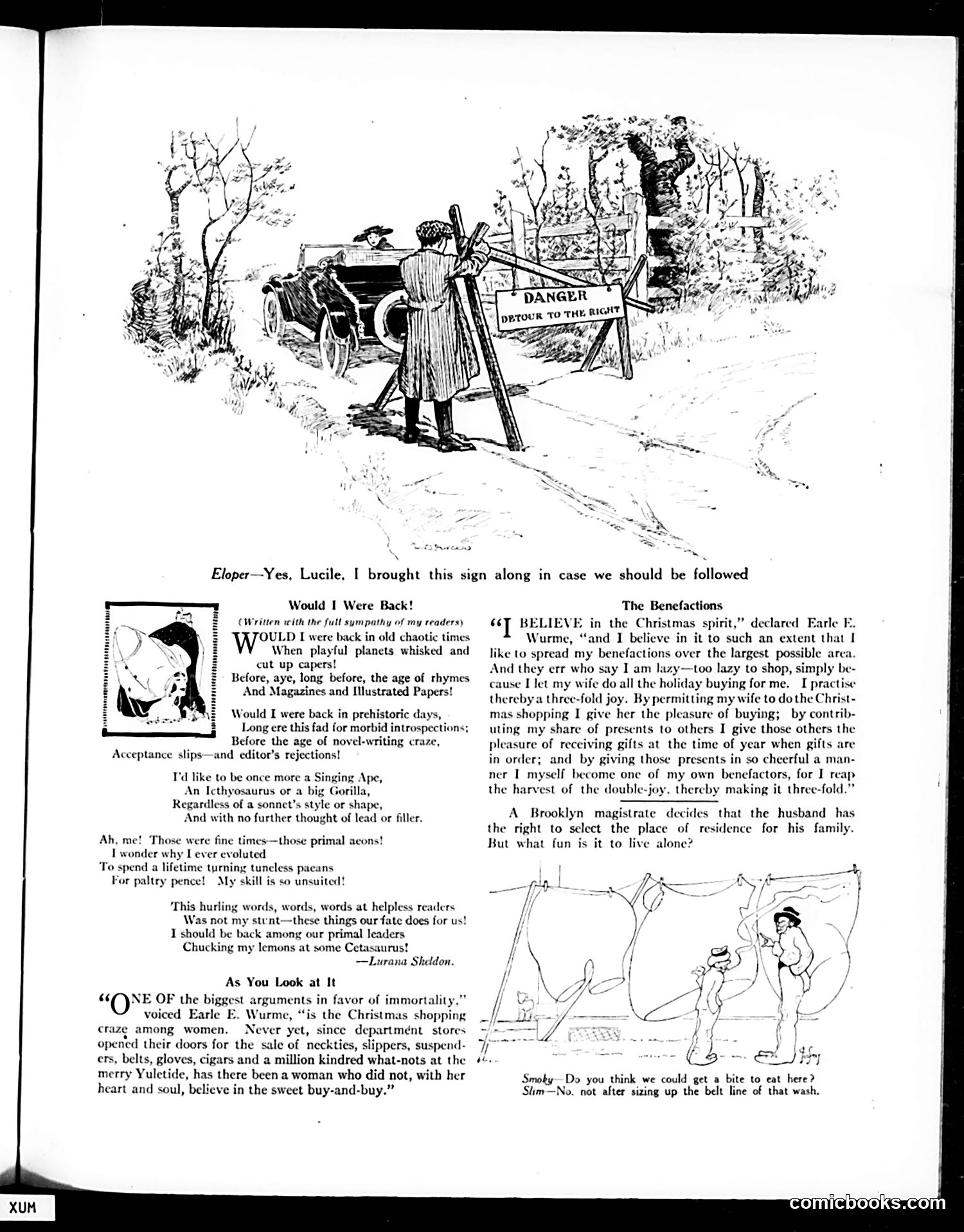
This page from Judge magazine (likely early 20th century) satirizes Christmas consumerism and gender roles through three pieces: **Top cartoon**: A couple eloping encounters a "Danger" sign, humorously suggesting marital conflict follows romantic escape. **"Would I Were Back!"**: A nostalgic poem by Lurana Sheldon mocking overwrought literary sentiment. The author laments modern life's tedium—writing for "paltry pence"—and romanticizes prehistoric simplicity. It's satirizing both excessive sentimentality in magazines and the drudgery of professional writing. **"The Benefactions"**: Character Earle E. Wurme's twisted logic justifies lazy Christmas shopping: by letting his wife buy gifts, *she* gets pleasure; recipients get gifts; and *he* gets credit for generosity. A Brooklyn magistrate's ruling about husbands' residence rights adds commentary on marital power dynamics. **Bottom cartoon**: Two men ("Smoky" and "Slim") consider eating at what appears to be a laundry, with a joke about the proprietor's weight. Overall, the page critiques consumer culture, lazy masculinity, and overwrought literary pretension through humor.
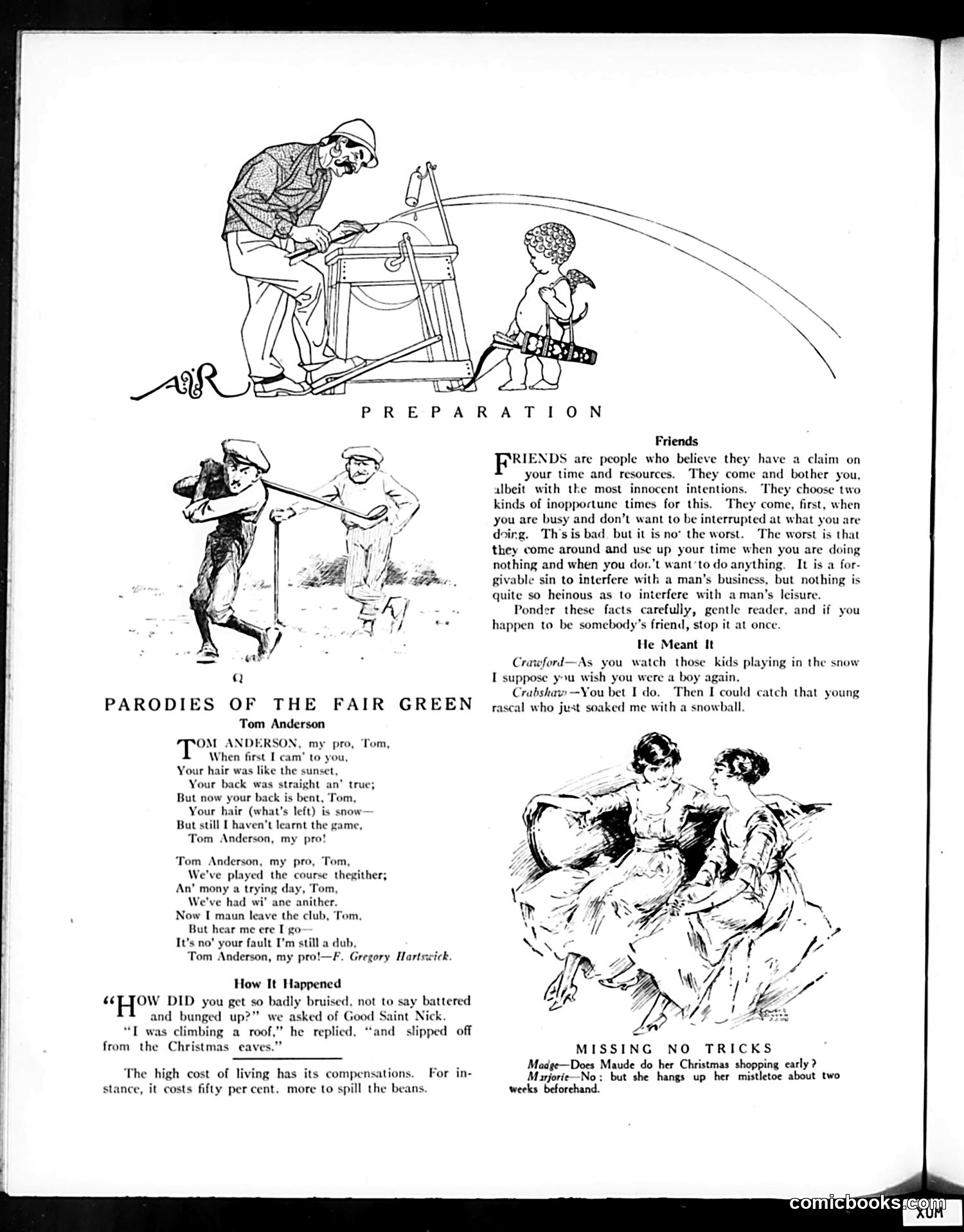
This Judge magazine page contains three distinct satirical pieces: **"Parodies of the Fair Green"** mocks golf culture through a Scottish-dialect poem about Tom Anderson, an aging golf pro. The humor lies in the student's decades-long failure to improve at golf despite Anderson's instruction—the pro hasn't aged him into competence. **"How It Happened"** is a brief joke about Santa Claus injuring himself on a roof. The punchline about "Christmas eaves" is a visual pun (eaves/eves), now dated wordplay typical of era humor. **"Friends" and accompanying vignettes** offer satirical social commentary: the essay defines friends as time-vampires who interrupt both work and leisure. "Missing No Tricks" includes a joke about a woman strategically hanging mistletoe early to catch a man—implying calculated romanticism during the Christmas season. The illustrations show leisure activities (fishing, children playing) reflecting upper-middle-class concerns. The satire targets social pretension, romantic scheming, and the pursuit of frivolous pastimes—concerns of Judge's affluent readership.
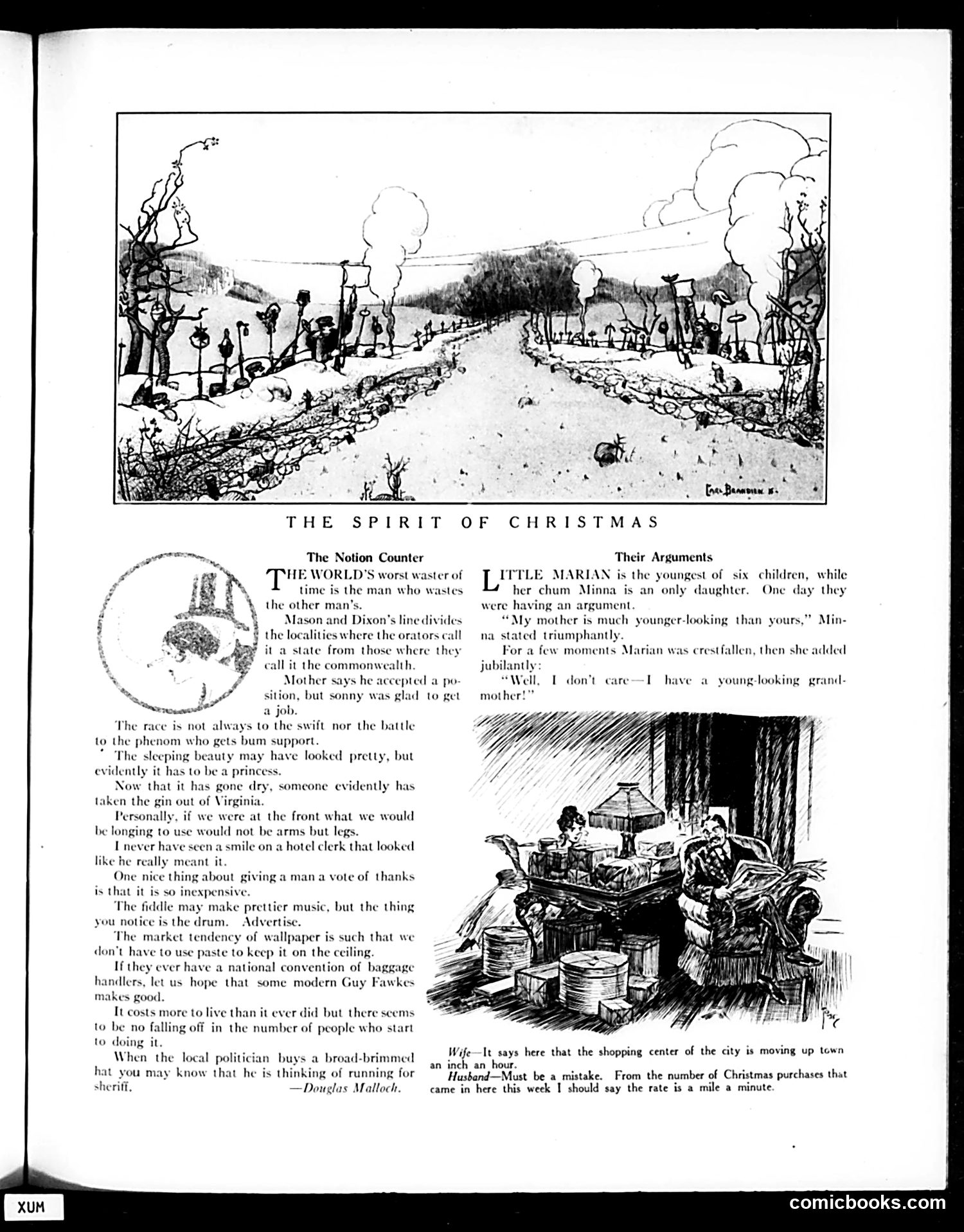
This page contains three distinct satirical pieces: **Top illustration**: A landscape scene depicting a cemetery or graveyard, likely symbolizing death or loss—thematically appropriate to the "Spirit of Christmas" title, suggesting ironic contrast between holiday cheer and mortality. **"The Notion Counter"**: A column of brief, cynical observations about American life by Douglas Malloch. These are disconnected one-liners mocking social pretension, inefficiency, and hypocrisy—typical Judge fare. References to "Mason and Dixon's line" evoke North-South regional divisions; "gin out of Virginia" likely references Prohibition-era alcohol restrictions. **"Little Marian" anecdote**: A children's story where young Marian one-ups her friend Minna in a vanity competition about mothers' youth by claiming a "young-looking grandmother"—gentle humor about childish logic and competitive boasting. **Bottom dialogue**: A husband-wife exchange joking that Christmas shopping crowds prove the shopping district is moving uptown faster than reported—light seasonal humor about commercial Christmas excess. The overall tone is cynical, anti-sentimental satire masquerading under a Christmas title.
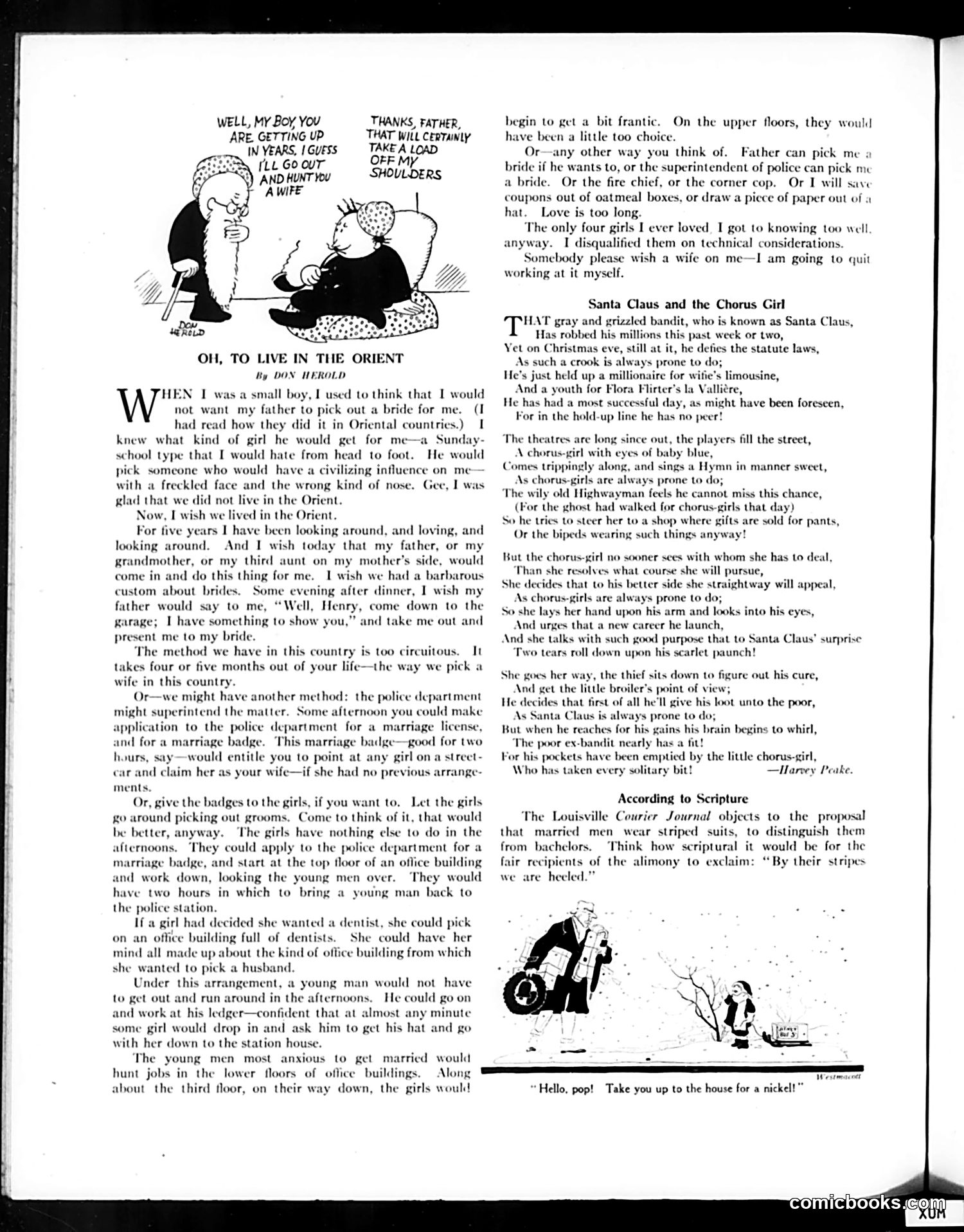
This Judge magazine page contains two satirical pieces: **"Oh, to Live in the Orient"** (by Don Herold) satirizes the exhausting American courtship process. The author humorously argues that arranged marriages or government-administered "marriage badges" would be more efficient than the current five-month dating ritual. He fantasizes that fathers or police departments could assign wives, or women could "shop" for husbands in office buildings like selecting merchandise. The satire mocks both romantic idealization of "Oriental" customs and American dating's inefficiency—treating marriage selection as an absurd bureaucratic problem rather than a matter of love. **"Santa Claus and the Chorus Girl"** appears to be a poem satirizing a wealthy criminal ("Santa Claus") who commits robberies during the holiday season, including holding up millionaires for their limousines. The accompanying cartoon shows someone on a motorcycle offering a ride. Both pieces use exaggeration and absurdist humor to critique social conventions and behavior.
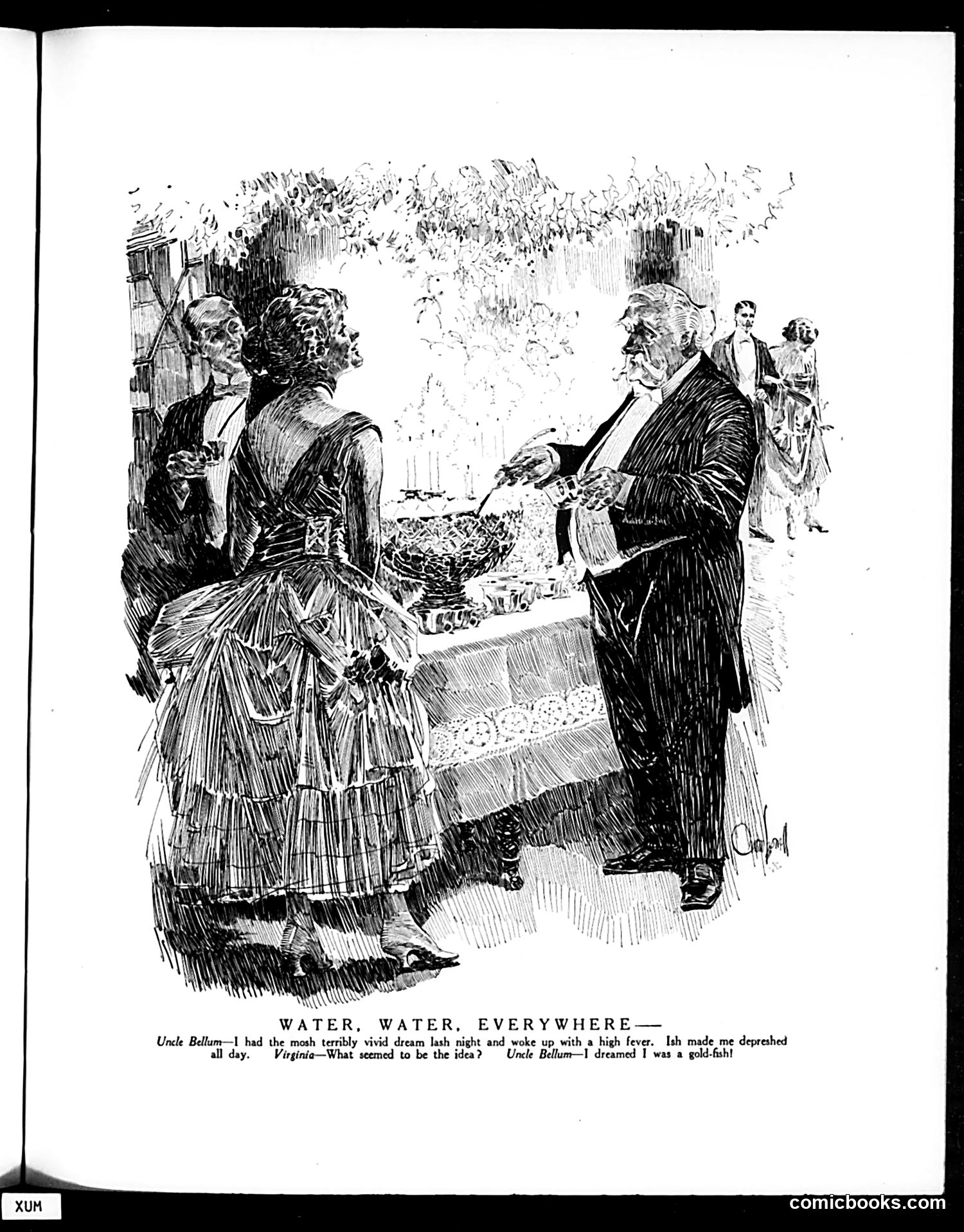
This Judge cartoon depicts a social scene with two main figures: "Uncle Bellum" (a wealthy older gentleman) and "Virginia" (a young woman). The satire plays on Uncle Bellum's complaint about a fevered dream where he imagined himself as a goldfish—an absurd, lowly creature far beneath his social status. The joke targets wealthy, self-important men of the era who would be so horrified by the mere *thought* of social degradation that even dreaming it causes genuine distress. The title "Water, Water, Everywhere" likely references the famous Coleridge poem about deprivation and thirst, suggesting Uncle Bellum's despair at imagining himself confined and diminished. The cartoon mocks aristocratic vanity and class anxiety through this ridiculous nightmare scenario.
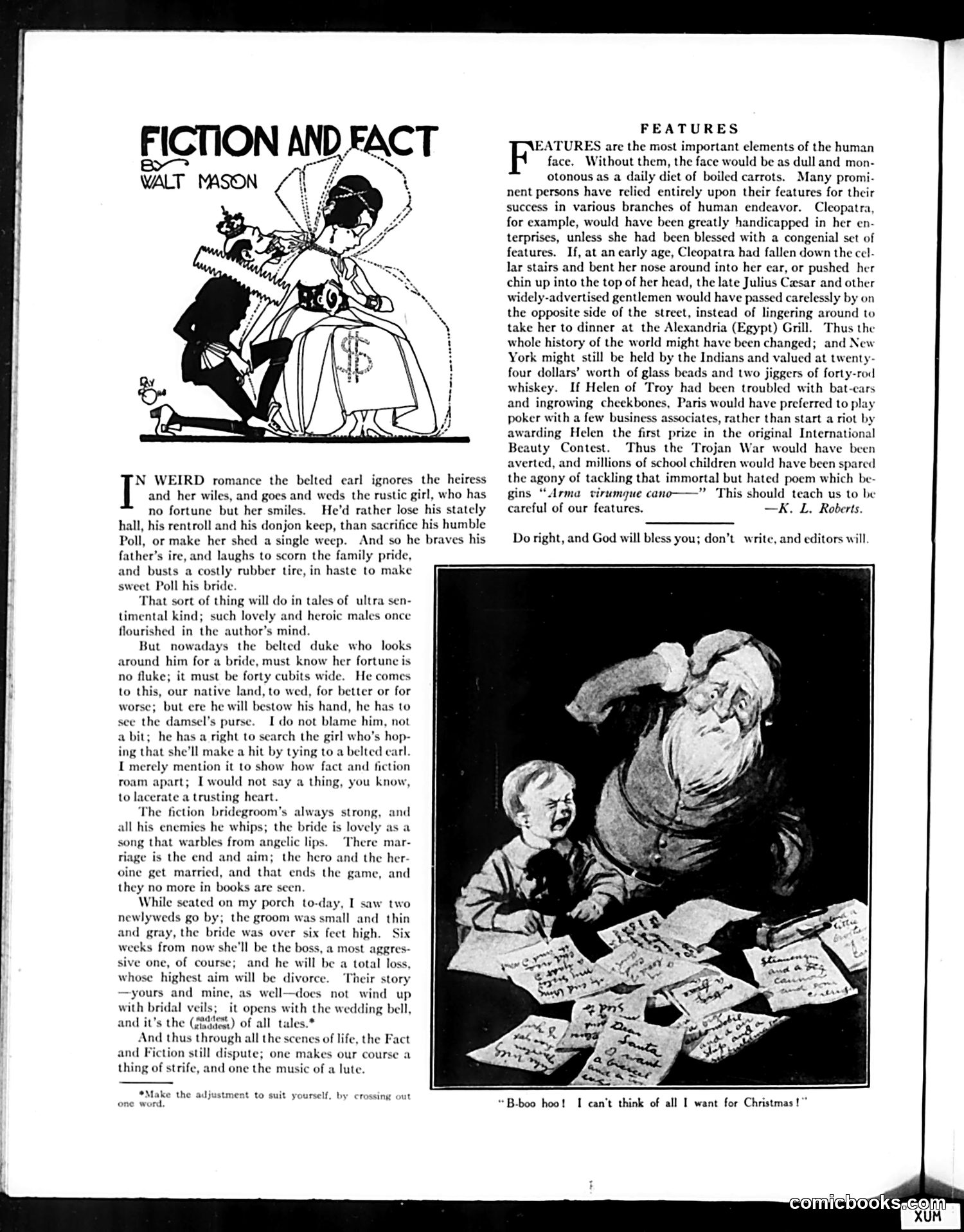
This page contains two satirical pieces from Judge magazine: **"Fiction and Fact" by Walt Mason** (left column): A poem contrasting romantic fiction with modern reality. Mason mocks how old stories featured noble lords marrying poor but virtuous girls, whereas today's wealthy suitors demand financial security. He then describes witnessing a real newlywed couple—a small, thin groom and a towering bride—predicting she'll dominate him and they'll divorce. The satire critiques how real marriages rarely match storybook ideals. **"Features" article** (right column): A humorous essay arguing that facial features determine success. Using historical examples (Cleopatra, Helen of Troy), it absurdly suggests that if these women had been physically unattractive, world history would have changed dramatically. The accompanying illustration shows a child's disappointed reaction to Christmas gifts. Both pieces mock conventional sentimentality and expectations—whether romantic ideals or the notion that appearance alone determines destiny—through exaggeration and ironic observation.
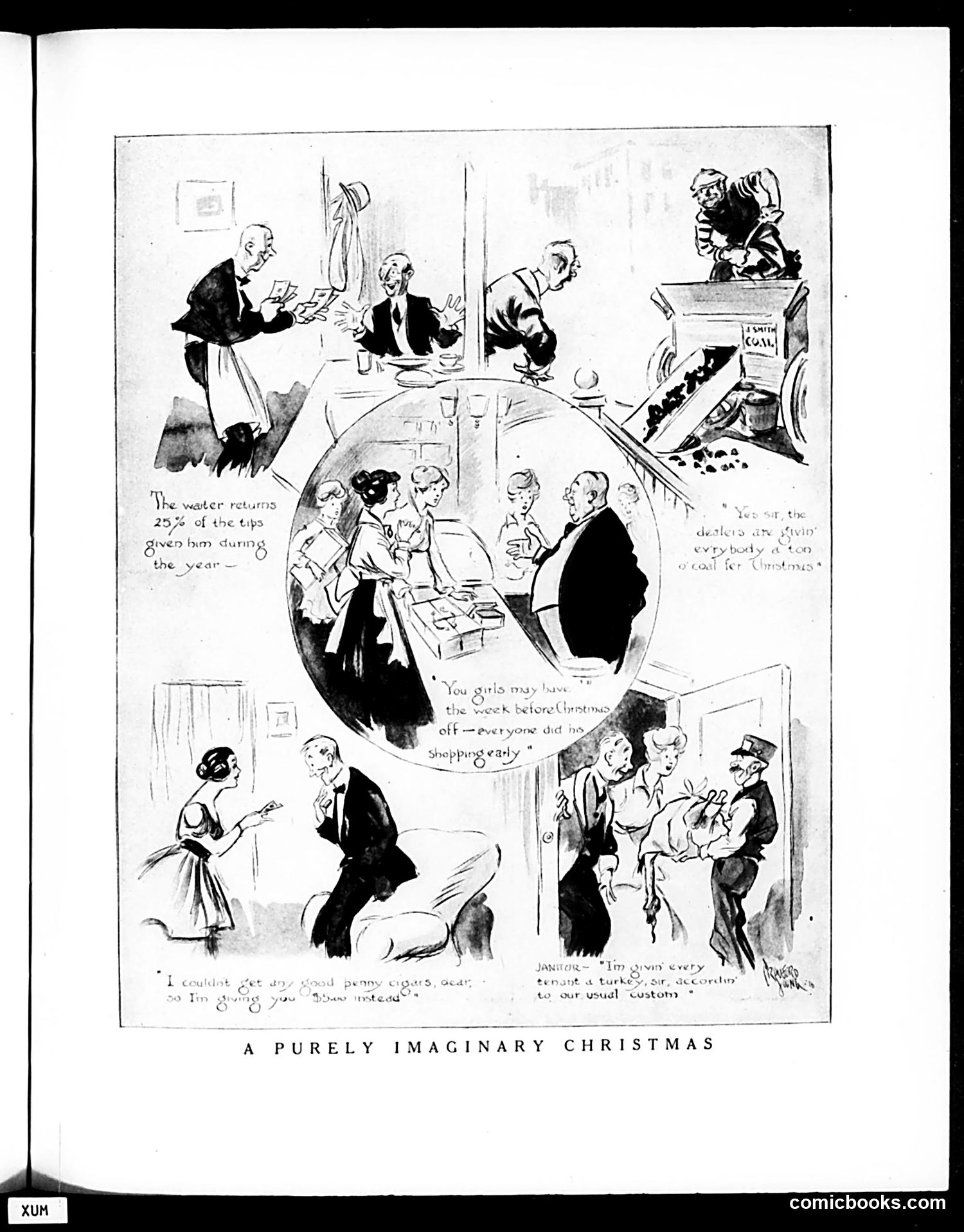
This Judge cartoon satirizes wealthy employers' stingy Christmas practices. The central bubble shows servants fantasizing about generous holiday bonuses and time off—luxuries they'll never receive. Surrounding vignettes mock the reality: a waiter receives only tips "given him during the year"; servants get a week off "everyone did so shopping early"; a maid gets "good permissions" instead of wages; a janitor receives a turkey "according to our usual custom." The satire contrasts what workers *imagine* receiving with what employers actually grant—minimal compensation disguised as tradition or privilege. The title "Purely Imaginary" emphasizes that workers' hopes for fair Christmas treatment are mere fantasy. It's social commentary on labor exploitation and class inequality dressed as holiday humor.
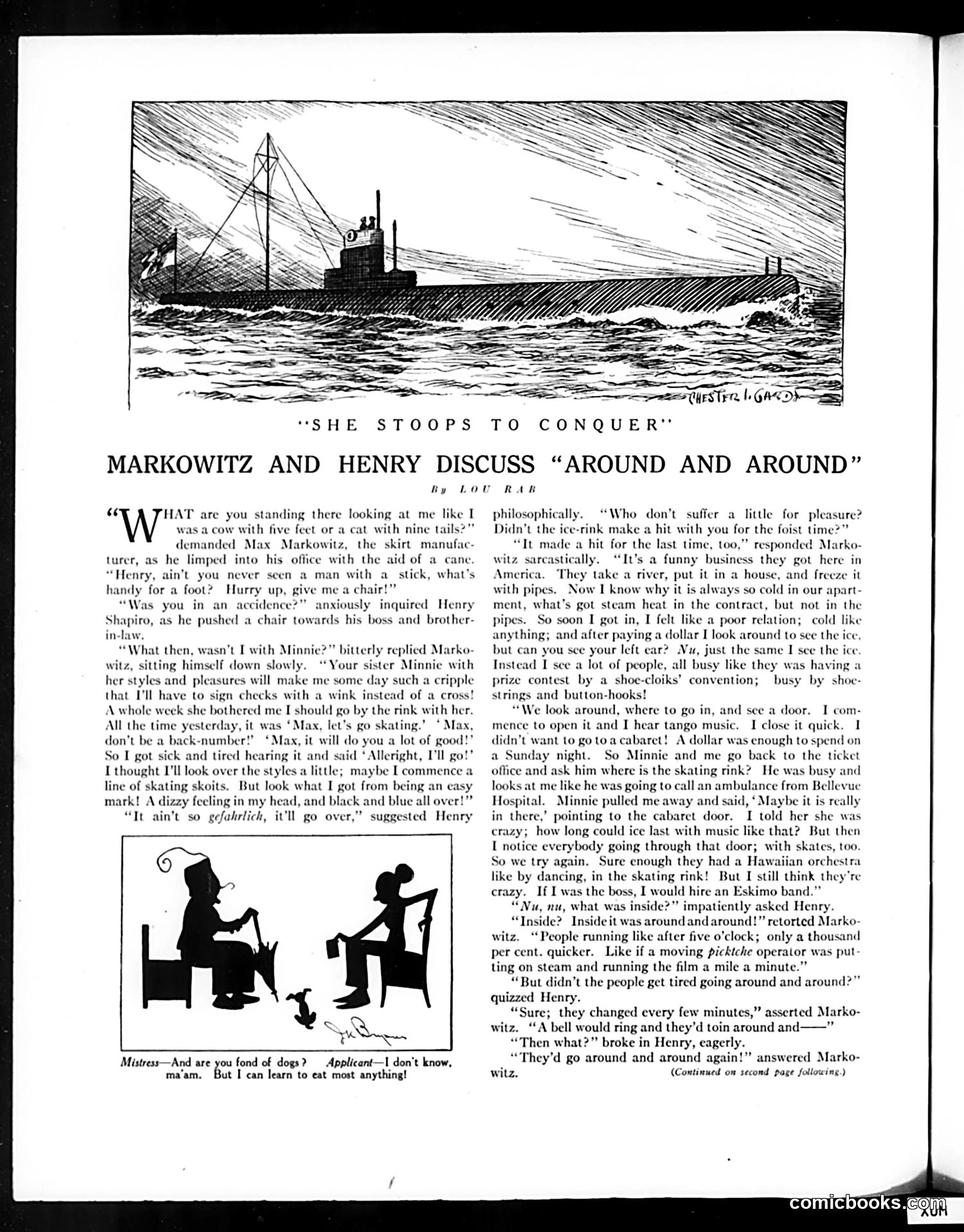
This page presents a comedic dialogue between two Jewish characters—Max Markowitz (a skirt manufacturer) and his brother-in-law Henry Shapiro—discussing Max's disastrous first ice-skating experience. **The Satire:** The humor relies on ethnic stereotyping typical of early 20th-century American comic magazines. Max speaks in a heavily Yiddish-inflected dialect ("gefahrlich," "picktche") and displays the perspective of an immigrant bewildered by American leisure activities. His wife Minnie pressures him to modernize and participate in fashionable pastimes like ice skating, which he finds absurd—particularly the repetitive circular motion and the commercialized "American" spectacle of freezing a river indoors. **The Point:** The joke mocks both the gap between immigrant and American culture, and the obsessive nature of modern recreation. Max's inability to understand why people endlessly circle an ice rink mirrors broader anxieties about American consumer culture and leisure—presented through the lens of an outsider's bewildered commentary. The accompanying illustration shows a silhouetted couple in conversation, unrelated to the main text.
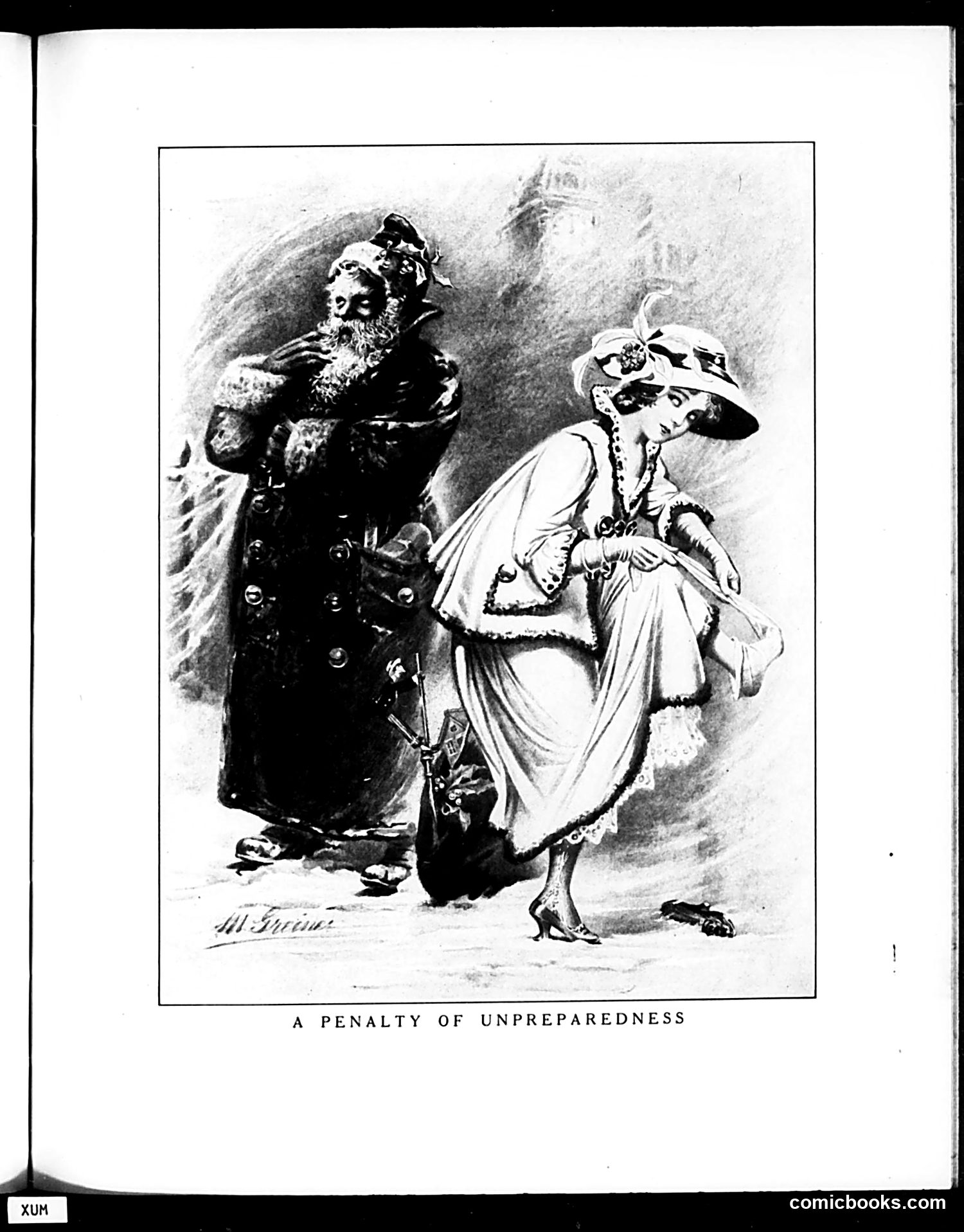
This political cartoon depicts a woman in fashionable dress encountering an older, bearded man in dark formal clothing. The title suggests social satire about inadequate preparation leading to negative consequences. The cartoon likely critiques a woman caught unprepared for an unexpected encounter—possibly satirizing courtship, social expectations, or women's readiness for romantic or social situations. The woman's elaborate hat and dress contrast with her apparent discomfort, while the older man appears to be accosting or confronting her. Without additional context about the specific historical moment or Judge magazine's publication date, the precise political or social target remains unclear, though the satire appears to mock either female vanity/lack of preparedness or perhaps social impropriety of the era.
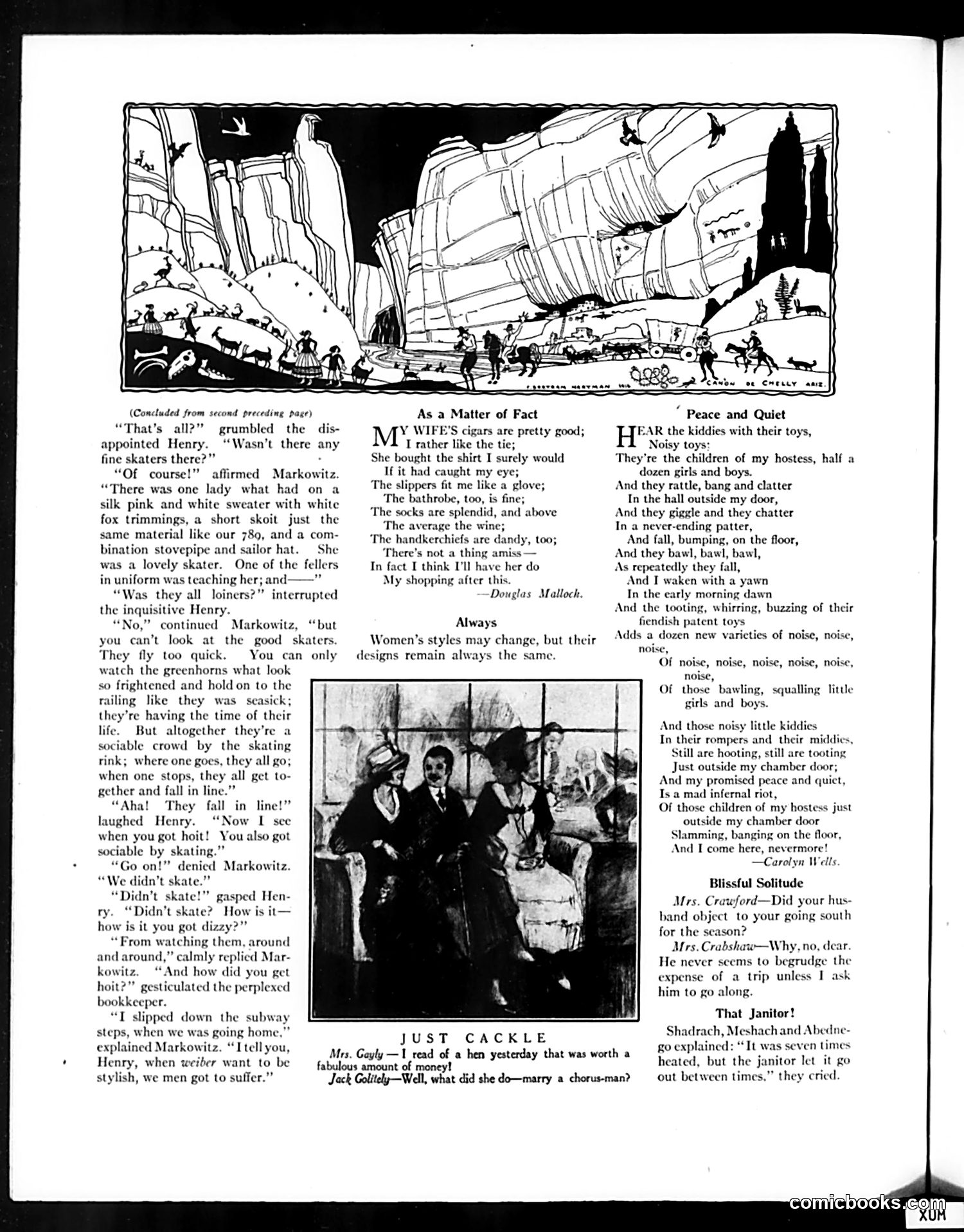
This page from *Judge* magazine contains several pieces of social humor reflecting early 20th-century American life: **Main Narrative**: Two Jewish characters (Markowitz and Henry, identifiable by the Yiddish-inflected dialogue) discuss a skating rink visit. The humor derives from their working-class perspective and malapropisms ("weib" for woman, "hoit" for hurt). Markowitz describes fashionable women skaters while Henry jokes about their sociability—"They fall in line!"—a mild gibe at conformity. **Other Pieces**: - "As a Matter of Fact" satirizes wives' shopping—praising their purchases while the husband injured himself getting home - "Always" makes a tired joke about women's unchanging fashion obsessions - "Peace and Quiet" humorously depicts guest children's noise as unbearable - "Just Cackle" makes a light joke equating an expensive hen's value to marrying a chorus girl The humor is gentle, domestic, and class-conscious, reflecting *Judge*'s target audience of middle-class readers amused by working-class characters and domestic complaints.
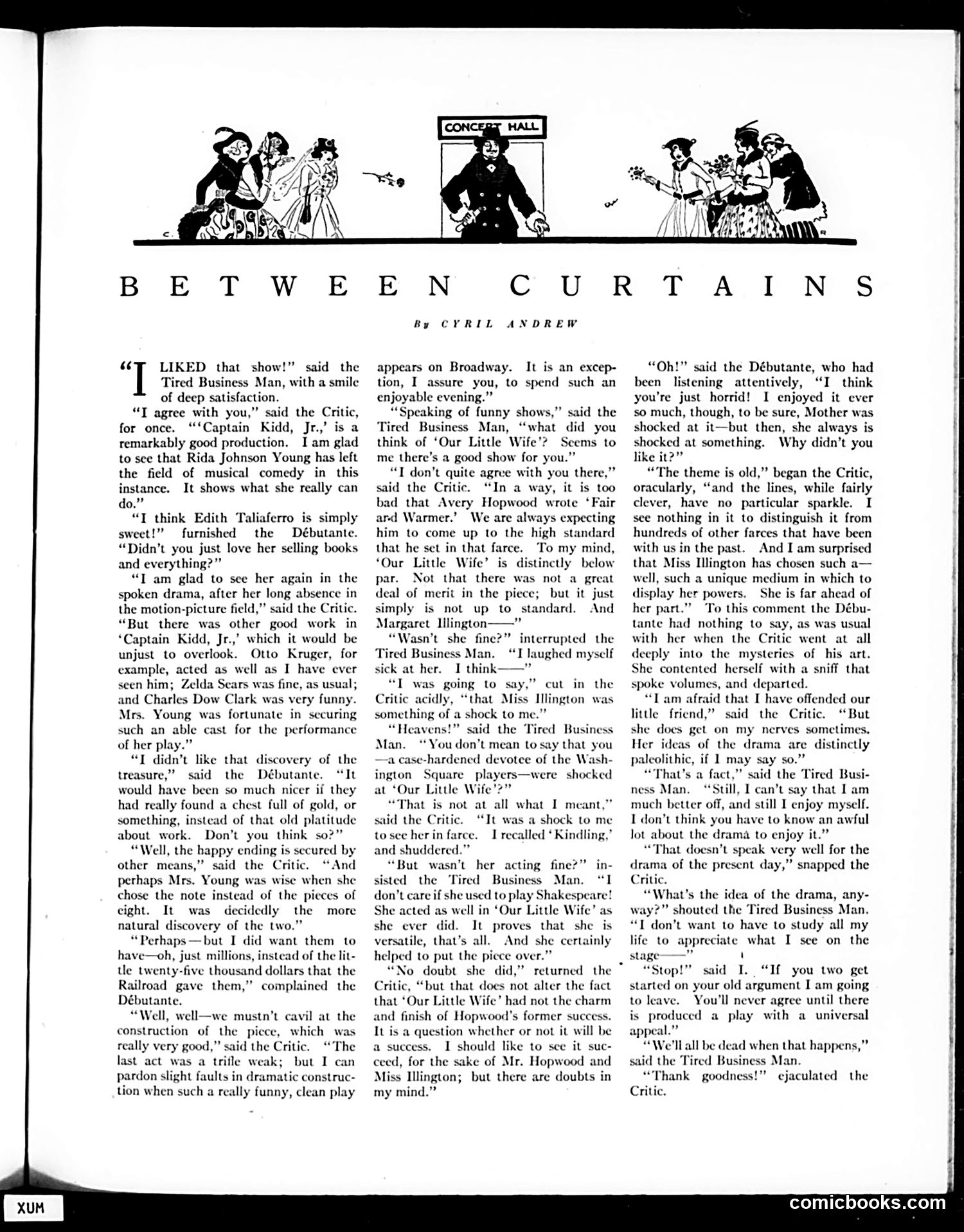
This piece by Cyril Andrew satirizes theater criticism and Broadway audiences circa the 1910s. The dialogue features three characters—a Tired Business Man, a naive Débutante, and a Pretentious Critic—discussing two Broadway productions: "Captain Kidd, Jr." (which they praise) and "Our Little Wife" (which the Critic dismisses). The satire targets the Critic's affectations and inconsistency. He pompously name-drops playwrights (Avery Hopwood, Rida Johnson Young) and actors, yet admits to reservations. The Débutante's simplistic preferences (wanting "millions" instead of moral lessons about work) and the Tired Business Man's straightforward enjoyment contrast with the Critic's overwrought analysis. The joke: the Critic complains Margaret Illington's farce performance shocked him because he remembers her serious work in "Kindling," exposing how personal nostalgia, not objective merit, drives his criticism. He demands Broadway meet impossible standards while contradicting himself—classic pretentious theater criticism mocked.
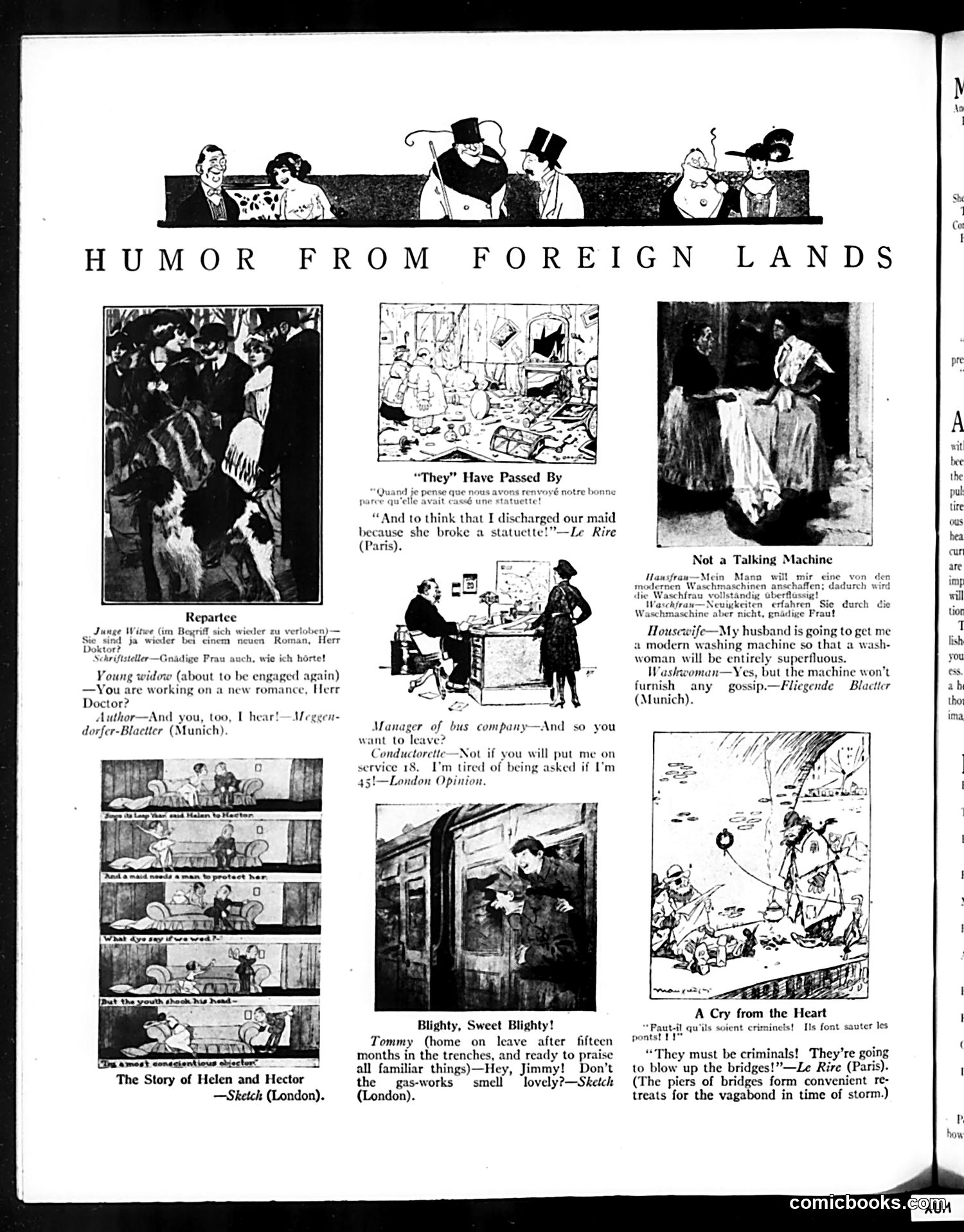
This is a collection of international humor reprints, showcasing jokes from European publications (primarily German, French, and British). The page translates foreign-language cartoons for American readers, capturing early 20th-century social attitudes. **Key satirical themes:** - **Gender roles**: A wife jokes about becoming "superfluous" once washing machines arrive; a conductorette tired of being asked her age - **Class commentary**: A widow seeking romantic engagement; domestic servants' struggles - **WWI context**: "Blighty, Sweet Blighty!" depicts a British soldier (Tommy) on leave from trenches, finding comfort in familiar (even unpleasant) things like gas-works smell—dark humor about wartime reality - **Misidentification satire**: Parisians mistake vagabonds sheltering under bridges for bomb-plotters during wartime paranoia The cartoons reflect period concerns: mechanization threatening employment, aging anxieties, class distinctions, and wartime hysteria. The international selection suggests Judge's educated audience appreciated European wit.
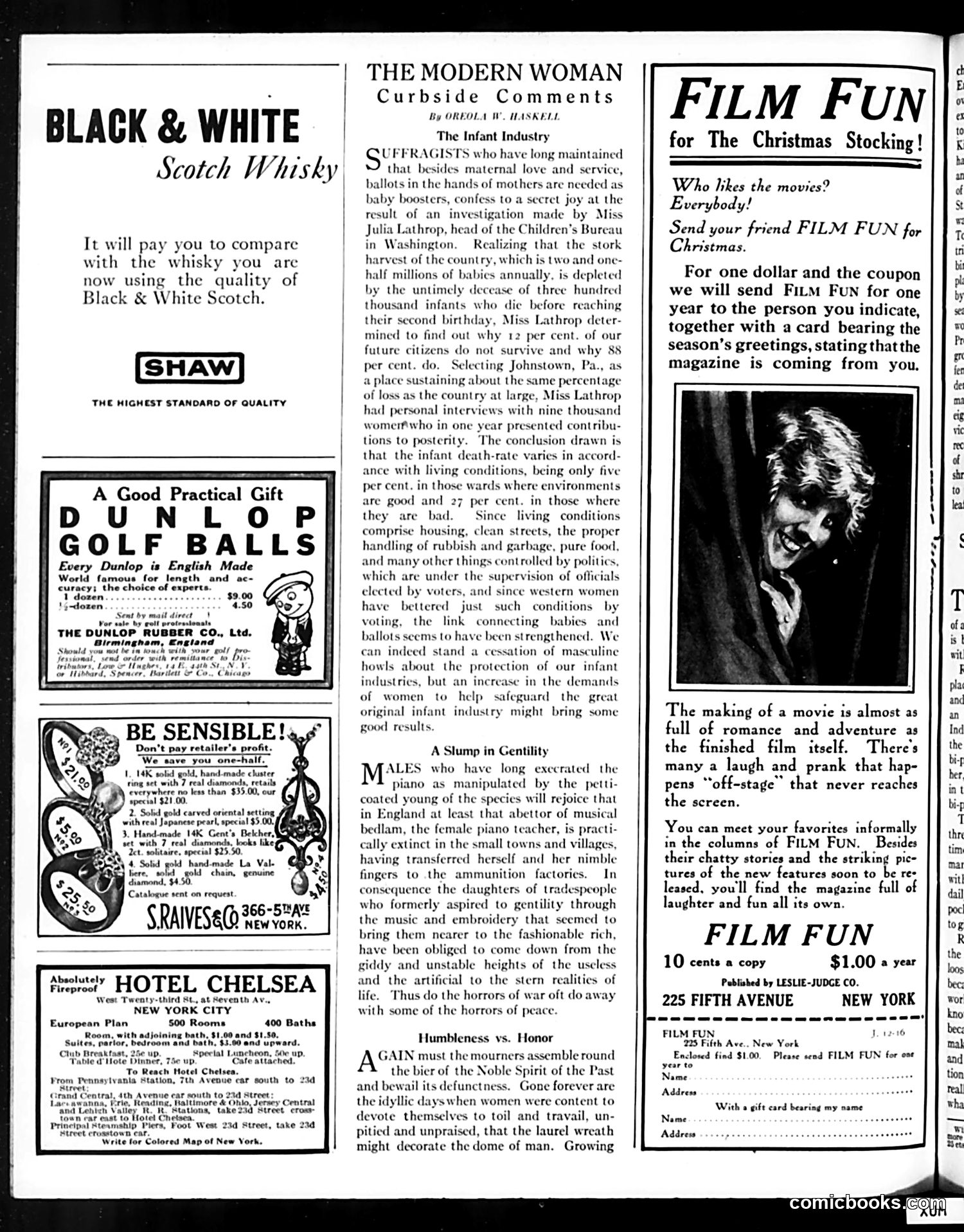
This page is primarily **advertisements and magazine content**, not political satire. The main article, "The Modern Woman: Curbside Comments" by Oreola W. Haskell, discusses infant mortality statistics gathered by Julia Lathrop of the Children's Bureau. **The key point:** Suffragists (women's voting rights advocates) are using empirical data—lower infant death rates in well-maintained neighborhoods versus poor ones—to argue that **women need the ballot to improve public health conditions** like housing, sanitation, and food safety. The article suggests voting women have already improved such conditions, so voting mothers could further reduce child mortality. This represents **early 20th-century feminist argumentation**: women framed voting rights not as abstract equality but as practical necessity for protecting children and families. It's pro-suffrage advocacy disguised as public health reporting. The remainder of the page contains standard advertisements (whisky, golf balls, jewelry, hotels)—typical Judge magazine filler content.
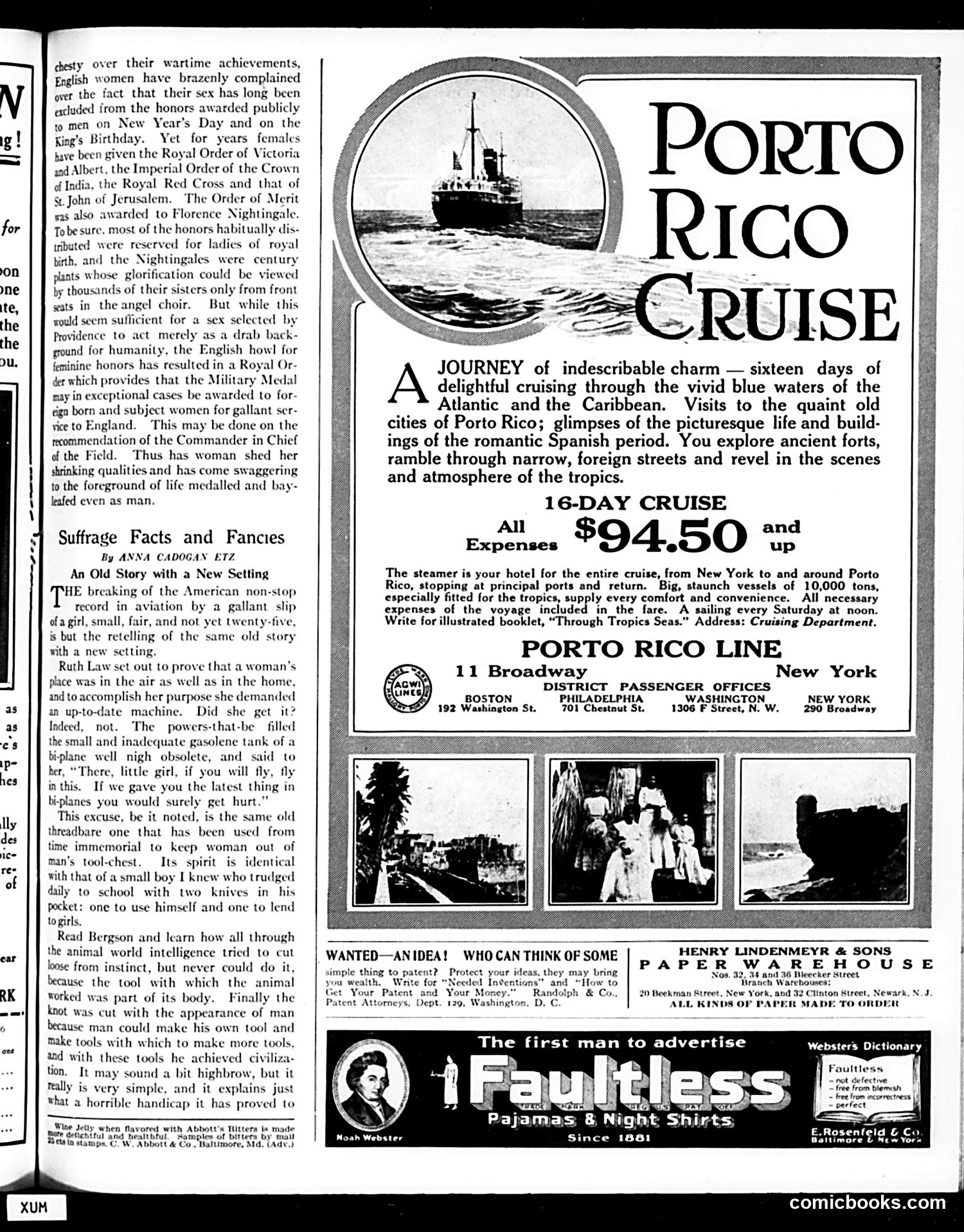
This page contains two distinct elements: **Main Article: "Suffrage Facts and Fancies"** by Anna Cadogan Etz discusses women's recent achievements. The first section notes English women's complaints about being excluded from public honors despite wartime service—they've now been granted the Military Medal in exceptional cases. The second section, "An Old Story with a New Setting," celebrates aviator Ruth Law's non-stop flight record. The author argues that Law had to overcome the same old obstacle women face: denial of proper tools. The piece uses a metaphor about a boy who kept a second, inferior knife to lend girls, suggesting society systematically prevents women from accessing quality equipment and resources. The underlying point: women achieve despite deliberate handicapping, not because of equal opportunity. **Advertisements:** The page also features cruise and pajama ads, typical of magazine padding from this era. The article reflects early-1920s feminism debates around women's capabilities and systemic barriers.
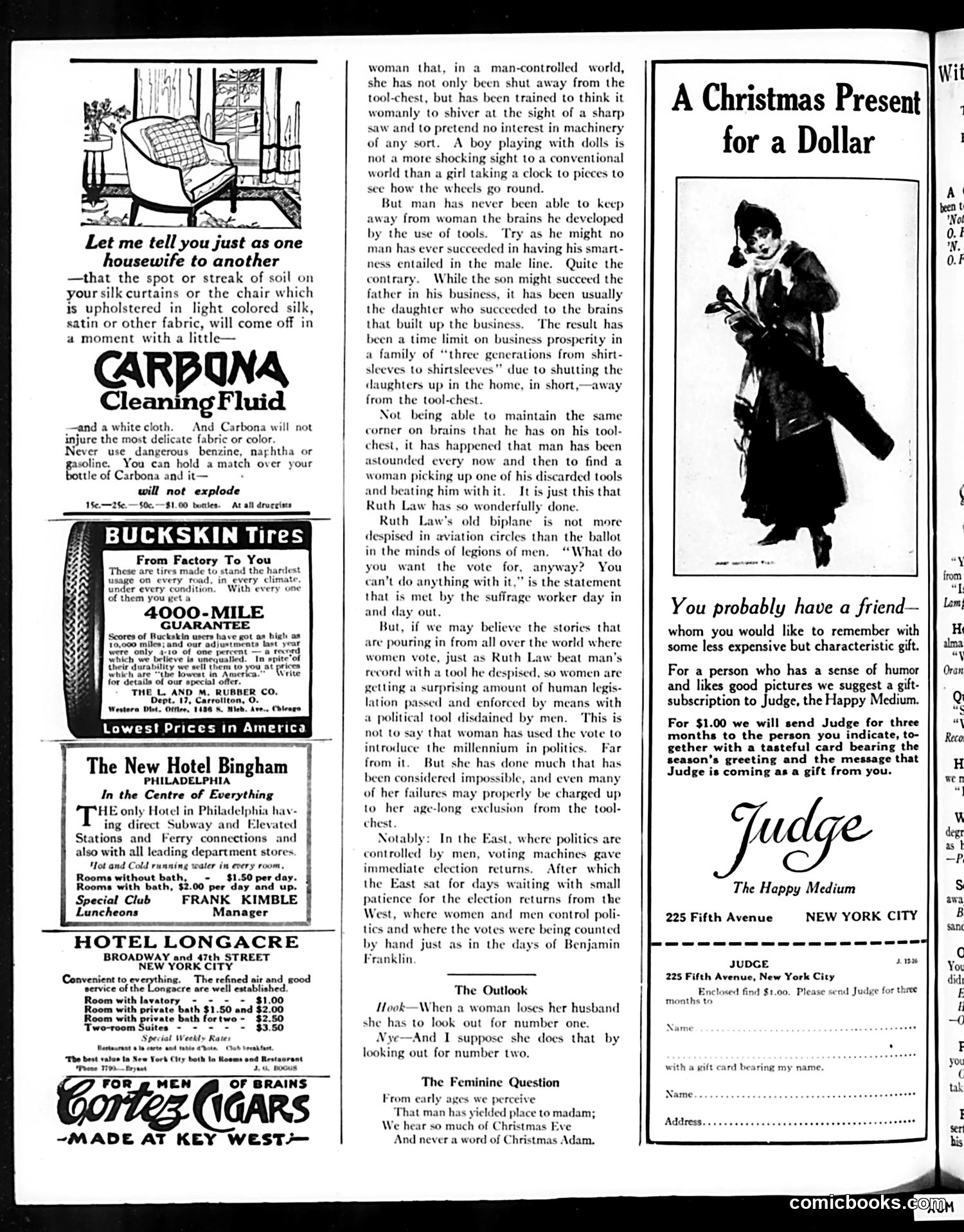
This page is primarily **advertising** for consumer products (Carbona cleaning fluid, Buckskin tires, hotels, cigars), typical of early 20th-century magazine layouts. The substantive editorial content is a **political argument about women's suffrage and capability**. The unsigned essay argues that men have historically excluded women from using tools and engaging with machinery, training them to fear such things as "unwomanly." However, men cannot prevent women from inheriting intelligence. The piece uses **Ruth Law** (an aviator who set records in early aviation) as proof that women, when given opportunity, can master "tools" men dismissed—just as Law succeeded with aviation equipment men despised. The essay then extends this metaphor to **voting**: men similarly dismissed the ballot as a tool women shouldn't want, yet women voting have accomplished substantial reforms. This is **pro-suffrage advocacy** arguing women's demonstrated competence warrants political equality. The essay's tone is satirical toward male resistance to women's capabilities.
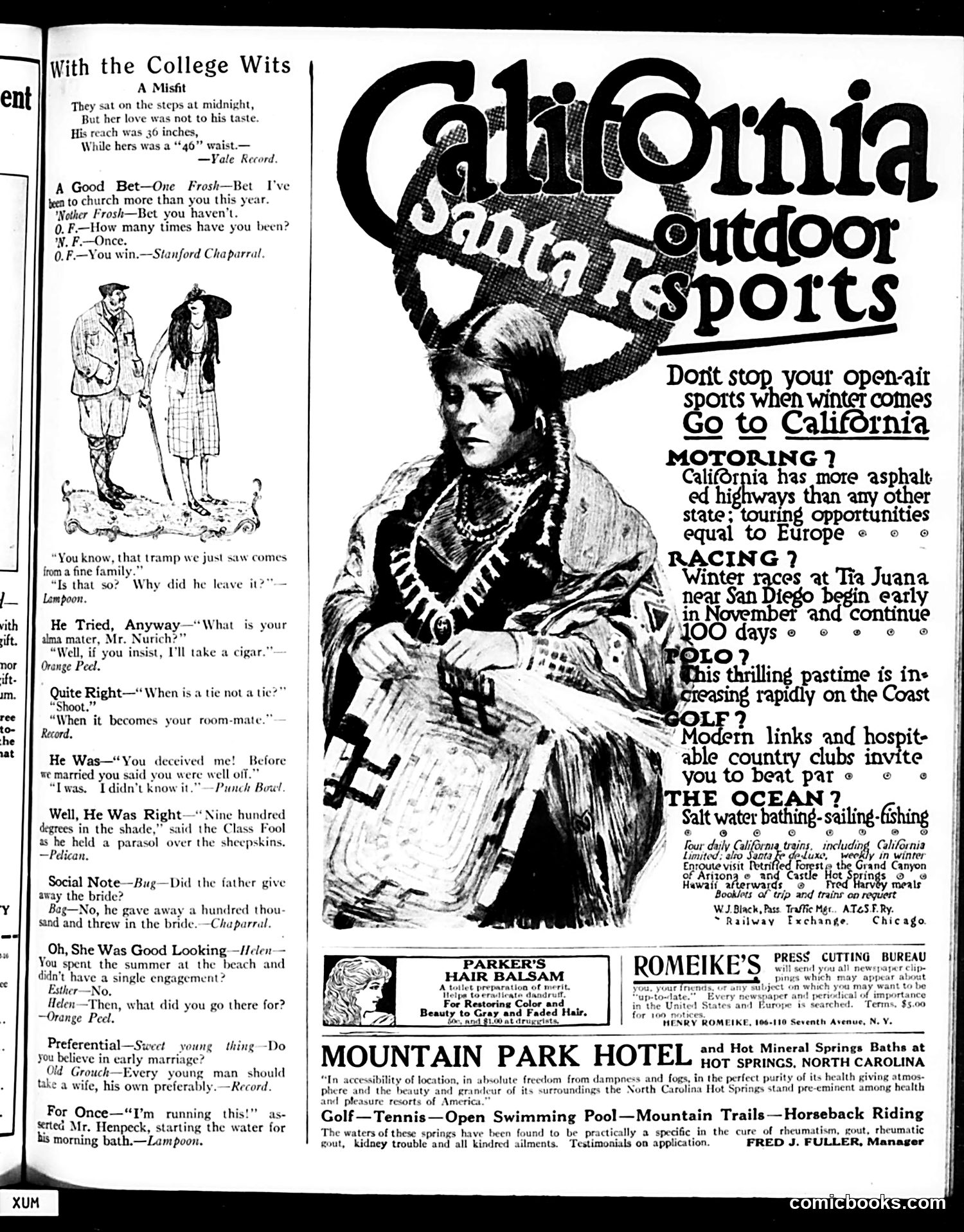
This Judge magazine page contains two distinct sections: **Left side: "With the College Wits"** — A humor column collecting jokes from college newspapers (Yale, Stanford, etc.). The jokes target college students' social awkwardness: a couple's physical mismatch on a romantic outing, freshman confusion about church attendance, a tramp from a "fine family," and marital mishaps. The humor relies on wordplay and gentle mockery of collegiate life and courtship customs of the era. **Right side: California tourism advertisement** — A large illustrated ad promoting California's year-round outdoor sports (motoring, racing, polo, golf, ocean activities). The image shows a Native American figure, reflecting period advertising's use of Indigenous imagery as exotic Americana. The ad targets wealthy leisure travelers, emphasizing California's superior infrastructure and climate compared to European alternatives. The page reflects early 20th-century upper-class concerns: dating etiquette, higher education, and leisure tourism for the affluent.
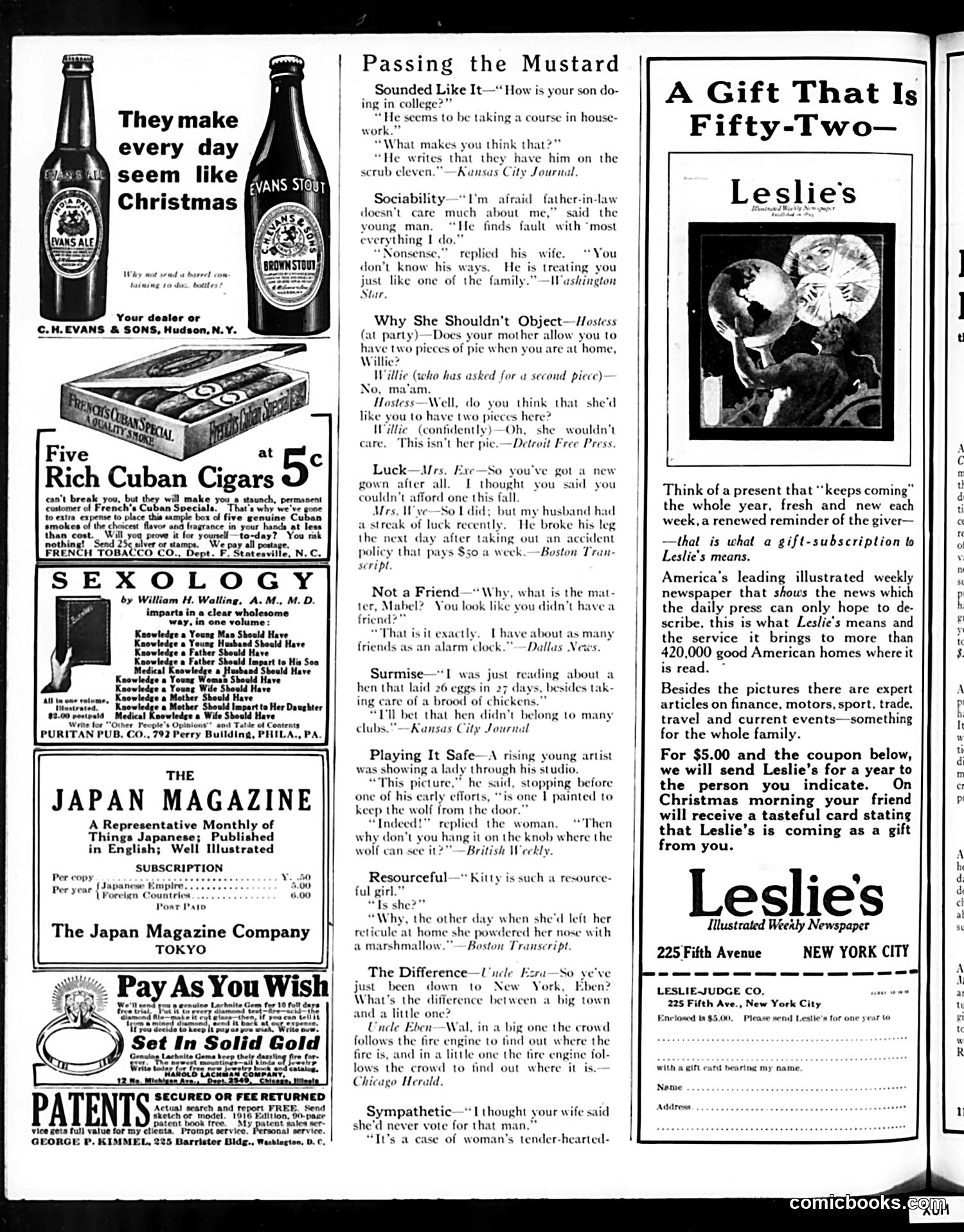
This page is primarily **advertisements and humor pieces**, not political cartoons. The content includes: **Visual Advertisements:** - Beer bottles (Evans Stout) with tagline "They make every day seem like Christmas" - Cigar box ad - Ring/jewelry ad ("Pay As You Wish") - Patent and book advertisements **Humor Section ("Passing the Mustard"):** A collection of brief jokes playing on domestic and social situations—a common magazine feature. Examples include jokes about: - A son doing "housework" (college course humor) - A father-in-law's criticism - A child asking for seconds of pie - A woman's "lucky" accident insurance payout These are gentle, family-friendly jokes reflecting early 20th-century middle-class life and gender roles. They contain no apparent political satire or social commentary beyond mild observations about marriage dynamics and social propriety. **Right side:** An advertisement for Leslie's Illustrated Weekly Newspaper (a gift subscription offer). The page reflects Judge magazine's mixed format: advertisements funding editorial content, including light humor rather than sharp political satire.
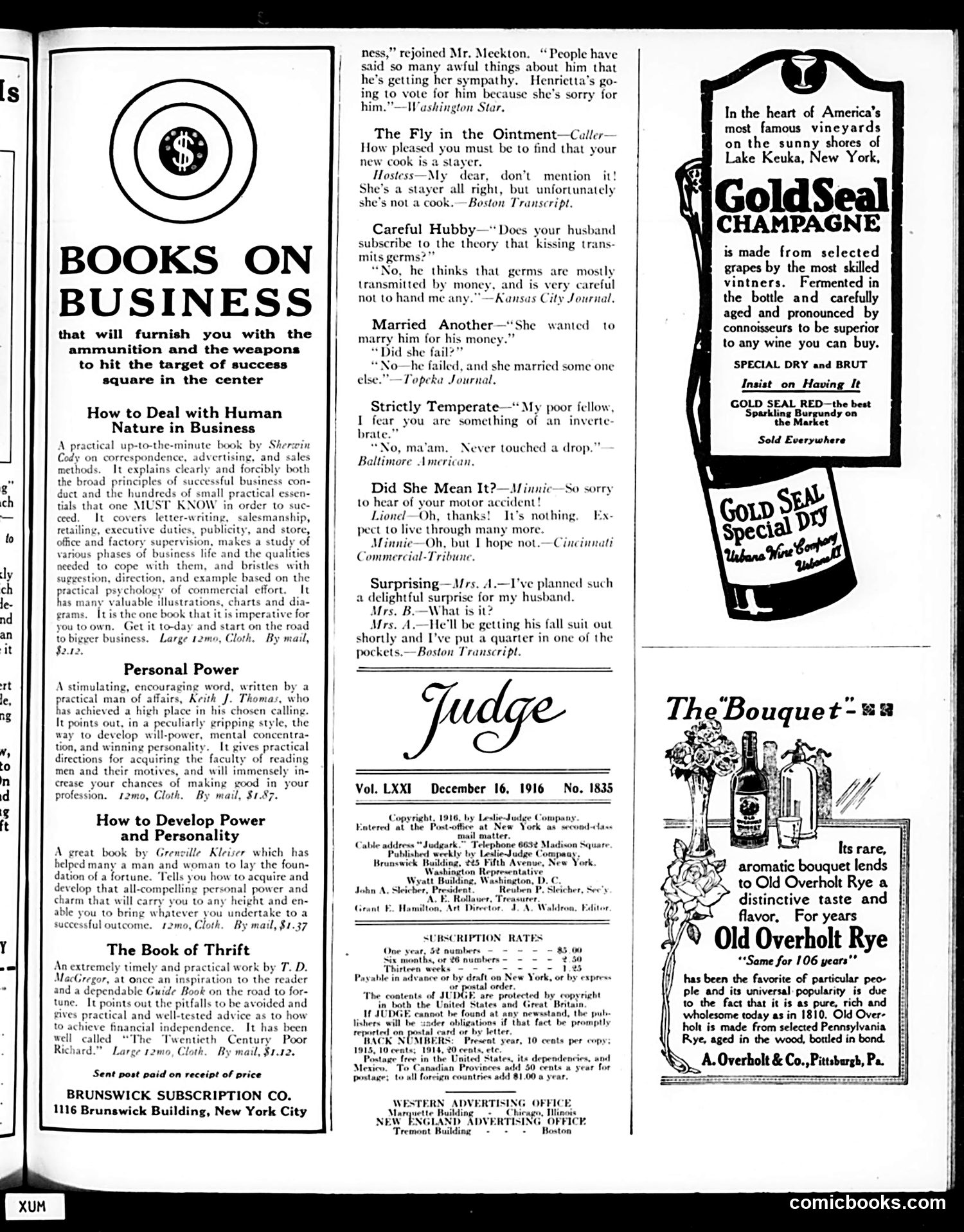
This page is primarily advertising and title matter for Judge magazine's December 16, 1916 issue, with only brief comedic snippets rather than substantial cartoons. The small jokes below the business book advertisements are typical period humor: a woman votes for a political candidate out of sympathy rather than conviction; a cook who stays but can't cook; a husband who won't kiss his wife because germs travel by money; someone marrying a man *after* he's failed financially; someone claiming temperance while being an "invert"; and a wife planning to surprise her husband with a quarter in his pocket. These reflect contemporary social concerns—women's voting rights (newly won), domestic service quality, germ theory fears, class anxieties, and modest family finances during World War I era America. The page is largely taken up by advertisements for business self-help books ("How to Deal with Human Nature," "Personal Power") and products like Gold Seal Champagne and Old Overholt Rye—typical Judge revenue sources.
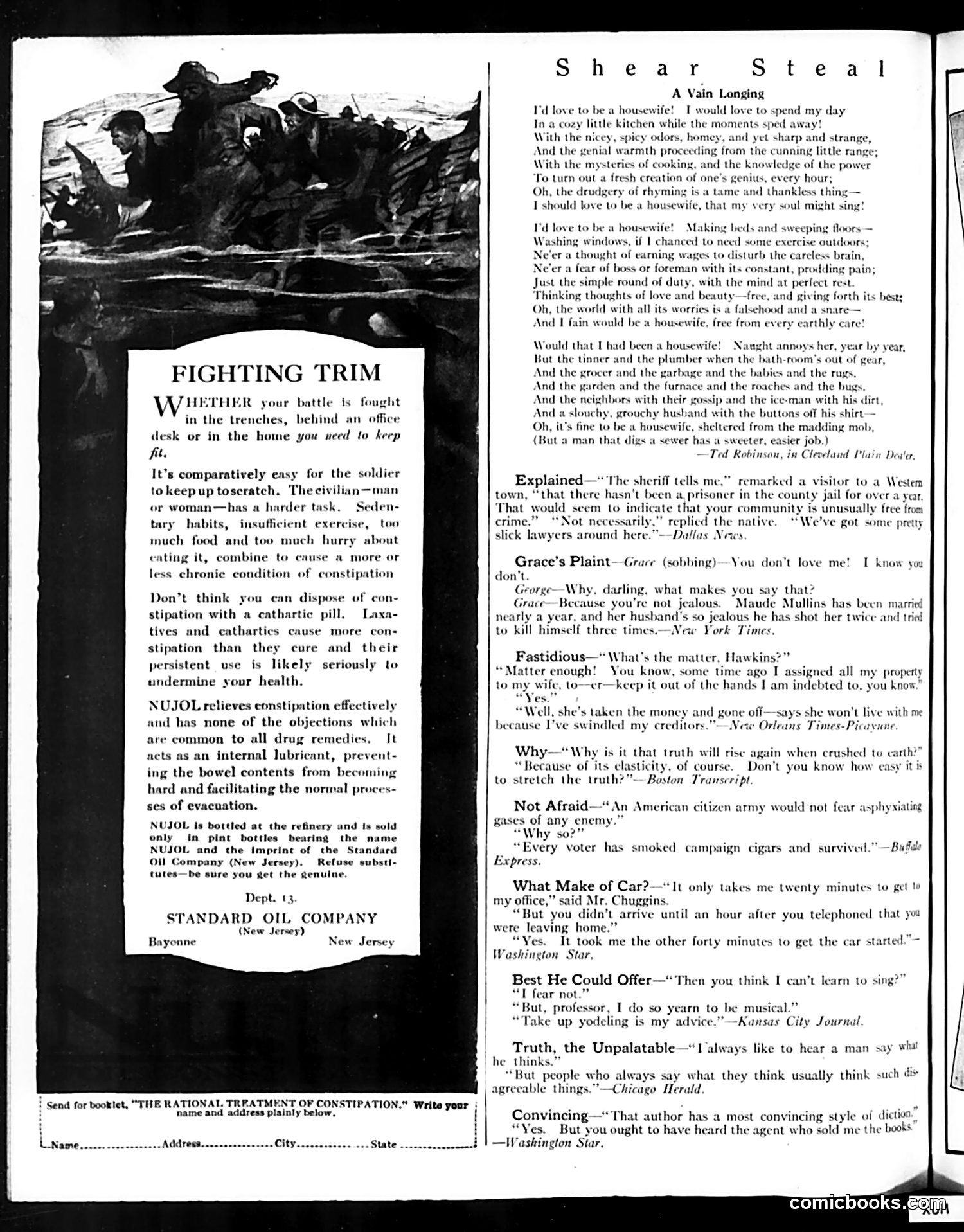
This page mixes advertisement and humor content typical of Judge magazine's format. **The Main Advertisement** (left): A Standard Oil Company (NUJOL) ad addressing WWI-era civilians about digestive health, contrasting soldiers' fitness routines with civilians' sedentary office work and poor eating habits. The ad promotes their laxative product as superior to cathartics. **The Poetry & Humor Section** (right): "A Vain Longing" by Ted Robinson presents ironic satire on housework. A female speaker romanticizes domestic life—cooking, cleaning, the "genial warmth" of home—as liberating from the "drudgery of rhyming." The joke's reveal comes in the final stanza: housewives aren't actually free from worry; they face plumbers, garbage, unruly husbands, and endless domestic problems. The punchline: a sewer-digger has an "easier job." This satirizes both women's idealization of housework and critiques the harsh reality of domestic labor—a pointed social commentary on gender roles during the WWI period, when women were increasingly entering the workforce. The remaining humor items appear to be short joke exchanges on unrelated topics.
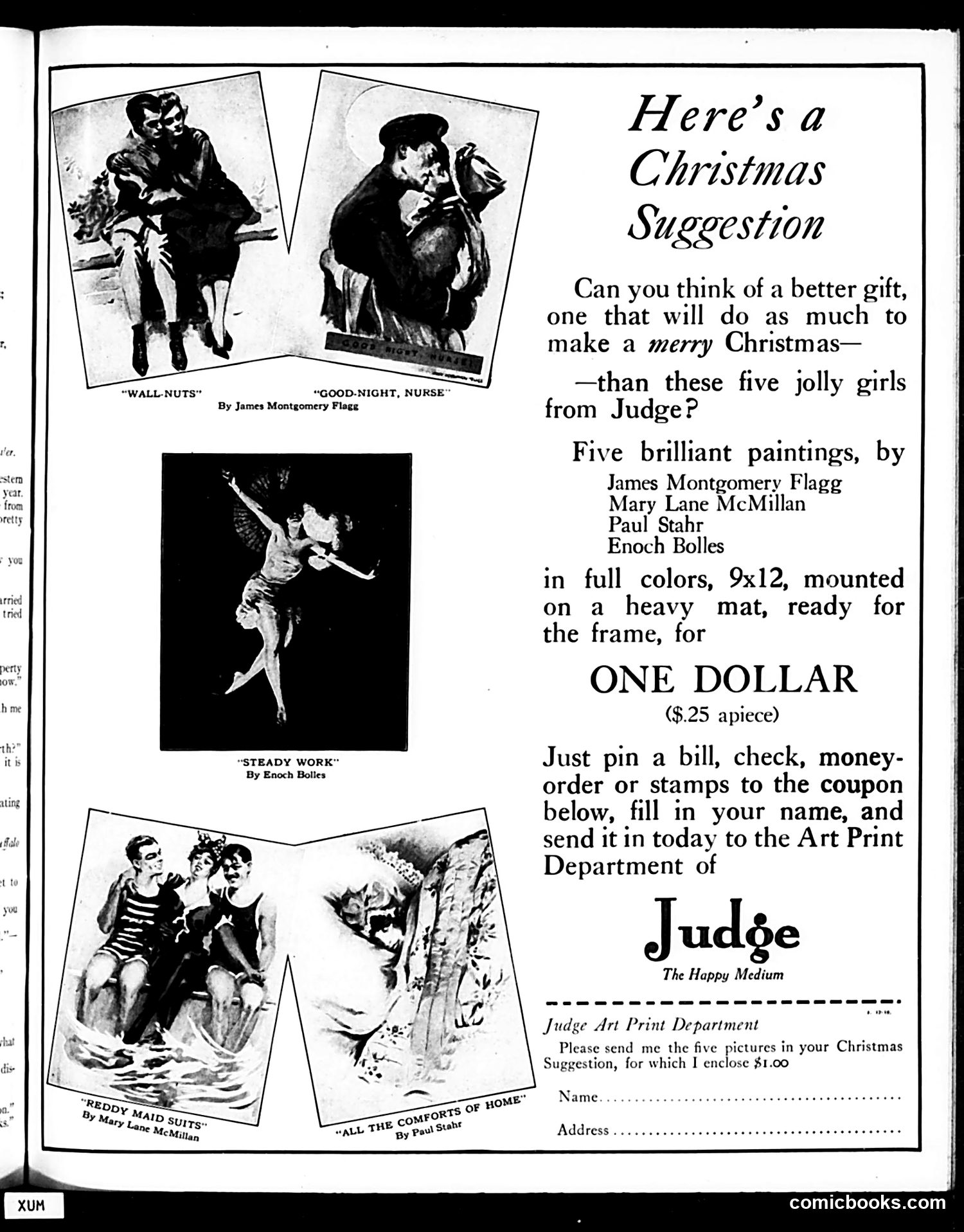
This is primarily **advertising content**, not editorial satire. It promotes art prints as Christmas gifts through Judge magazine's Art Print Department. The page features five paintings by prominent illustrators of the era (James Montgomery Flagg, Mary Lane McMillan, Paul Stahr, and Enoch Bolles). The images depict stylized figures—"wall-nuts," a nurse, a dancing woman labeled "steady work," and romantic/domestic scenes. These appear to represent idealized feminine subjects popular in early 20th-century American commercial art. The "Christmas Suggestion" frames fine art reproductions as an affordable luxury gift ($1 total for five prints, 25 cents each)—positioning art as accessible to middle-class consumers. The language ("jolly girls," "merry Christmas") uses light humor to market the prints. **Context for modern readers:** This reflects how Judge monetized its illustrated content by selling reproductions, while also showcasing the decorative commercial art style that dominated American magazines of this period.
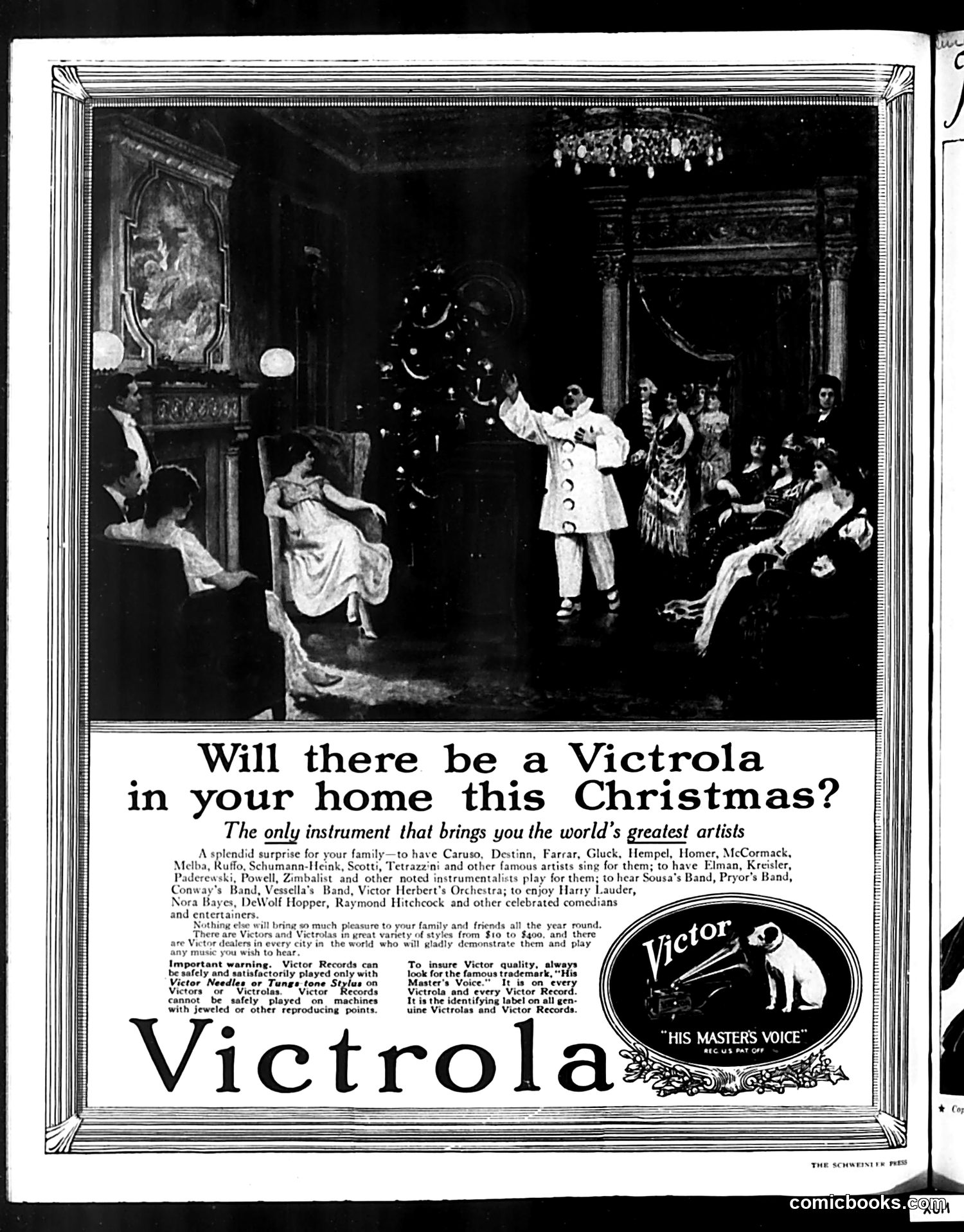
This is **not a cartoon or satire**—it's a straightforward advertisement for the Victrola phonograph, appearing in *Judge* magazine (likely early 1900s-1920s based on styling). The ad promotes the Victrola as a Christmas gift by listing celebrated opera singers (Caruso, Tetrazzini, Farrar), instrumentalists, and comedians whose recordings could be played at home. The illustration depicts an elegant parlor scene where people listen to the device—positioning it as aspirational entertainment for the middle/upper class. The "important warning" section—insisting Victor Records play only with Victor needles/stylus—reflects early phonograph industry competitive battles. Competitors made incompatible machines; Victor was protecting its market by warning consumers against knockoffs. The "His Master's Voice" trademark (the dog listening to a gramophone) was Victor's famous logo. For modern readers: this represents pre-radio home entertainment, when recorded music was novel luxury technology promoted through celebrity endorsements.