
Judge, 1916-12-16 · page 10 of 28
Judge — December 16, 1916 — page 10: what you’re looking at
What you’re looking at
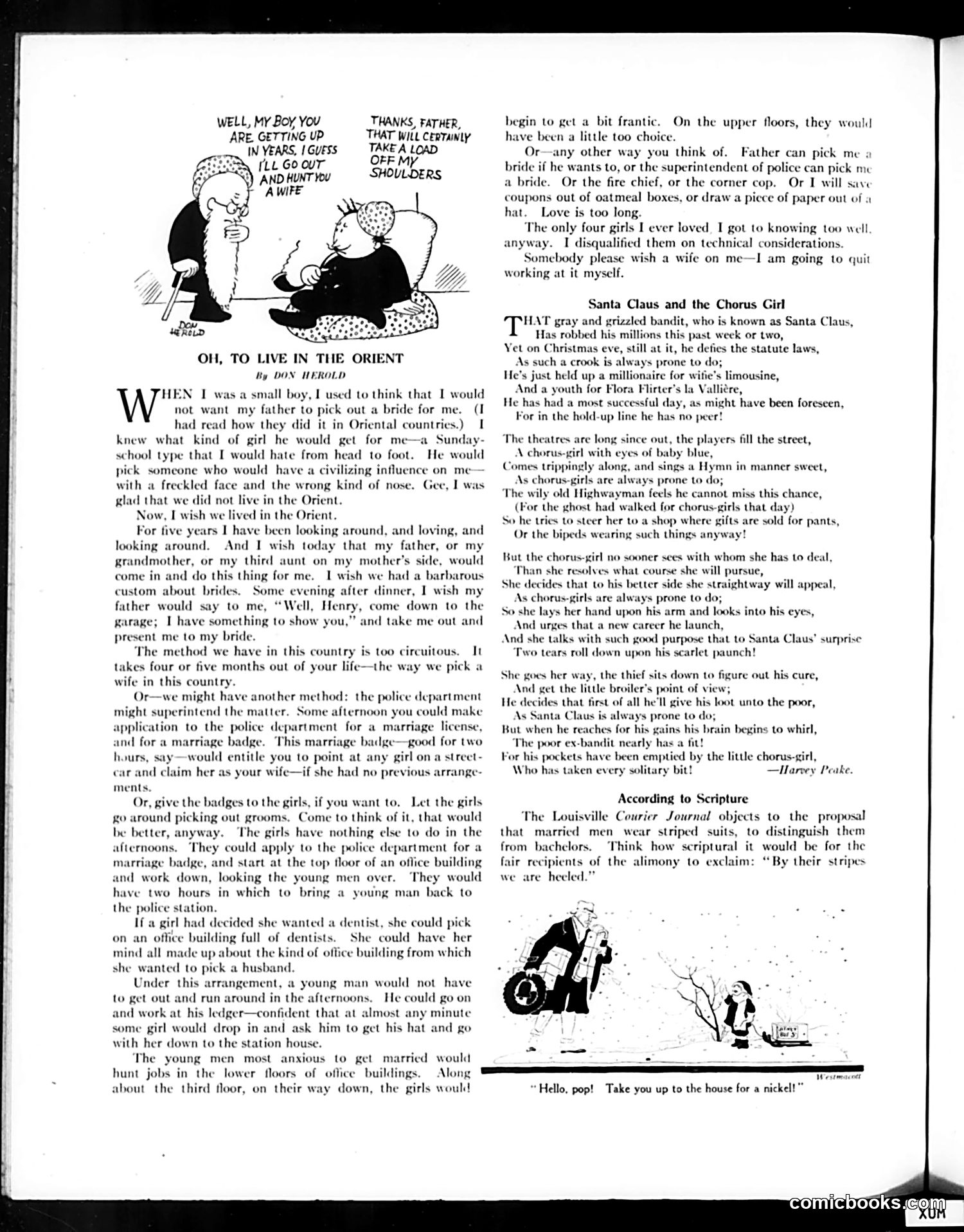
This Judge magazine page contains two satirical pieces: **"Oh, to Live in the Orient"** (by Don Herold) satirizes the exhausting American courtship process. The author humorously argues that arranged marriages or government-administered "marriage badges" would be more efficient than the current five-month dating ritual. He fantasizes that fathers or police departments could assign wives, or women could "shop" for husbands in office buildings like selecting merchandise. The satire mocks both romantic idealization of "Oriental" customs and American dating's inefficiency—treating marriage selection as an absurd bureaucratic problem rather than a matter of love. **"Santa Claus and the Chorus Girl"** appears to be a poem satirizing a wealthy criminal ("Santa Claus") who commits robberies during the holiday season, including holding up millionaires for their limousines. The accompanying cartoon shows someone on a motorcycle offering a ride. Both pieces use exaggeration and absurdist humor to critique social conventions and behavior.
📄 Transcribed text from this page (OCR, searchable)
Machine-transcribed from the original scan — historical spelling and the odd misread are preserved.
WELL, My Boy You ARE GETTING UP IN YEARS, | GUESS [LL GO OUT AND HUNT You AWIFE THANKS, FATHER, THAT WILL CERTANLY TAKE A LOAD OFF My SHOULDERS OH, TO LIVE IN THE ORIENT By DON HEROLD HEN I was a small boy, I used to think that I would W not want my father to pick out a bride for me. (I had read how they did it in Oriental countries.) I knew what kind of girl he would get for me—a Sunday- school type that I would hate from head to foot. He would pick someone who would have a civilizing influence on me— with a freckled face and the wrong kind of nose. Gee, 1 was glad that we did not live in the Orient. Now, I wish we lived in the Orient. For five years I have been looking around, and loving, and looking around. And I wish today that my father, or my grandmother, or my third aunt on my mother’s side, would come in and do this thing for me. L wish we had a barbarous custom about brides. Some evening after dinner, I wish my father would say to me, “Well, Henry, come down to the garage; I have something to show you,” and take me out and present me to my bride. The method we have in this country is too circuitous. It takes four or five months out of your life—the way we pick a wife in this country. Or—we might have another method: the police department might superintend the matter. Some afternoon you could make application to the police department for a marriage license, and for a marriage badge. This marriage badge—good for two hours, say—would entitle you to point y girl on a street- car and claim her as your wife—if she had no previous arrange- ments. Or, give the badges to the girls, if you want to, Let the girls go around picking out grooms, Come to think of it, that would be better, anyway. The girls have nothing else to do in the afternoons, They could apply to the police department for a marriage badge, and start at the top floor of an office building and work down, looking the young men over. They would have two hours in which to bring a young man back to the police station. If a girl had decided she wanted a dentist, she could pick on an office building full of dentists. She could have her mind all made up about the kind of office building from which she wanted to pick a husband. Under this arrangement, a young man would not have to get out and run around in the afternoons. He could go on and work at his ledger—confident that at almost any minute some girl would drop in and ask him to get his hat and go with her down to the station house. The young men most anxious to get n would hunt jobs in the lower floors of office buildings, Along about the third floor, on their way down, the girls would Tied begin to get a bit frantic. have been a little too choic Or—any other way you think of. Father can pick me ¢ bride if he wants to, or the superintendent of police can pick mc a bride. Or the fire chief, or the corner cop. Or I will save coupons out of oatmeal boxes, or draw a piece of paper out of « hat. Love is too long. The only four girls I ever loved. I got to knowing too well anyway. I disqualified them on technical considerations. Somebody please wish a wife on me—I am going to quit working at it myself. On the upper floors, they would Santa Claus and the Chorus Girl T! AT gray and grizzled bandit, who is known as Santa Claus, Has robbed his millions this past week or two, Yet on Christmas eve, still at it, he defies the statute laws, As such a crook is always prone to do He's just held up a millionaire for wi limousine, And a youth for Flora Flirter’s la Vallitre, He has had a most successful day, as might have been foreseen, For in the hold-up line he has no peer! The theatres are long since out, the players fill the street, A chorus-gitl with eyes of baby blue, Comes trippingly along, and sings a Hymn in manner sweet, As chorus-girls are always prone to do; The wily old Highwayman feels he cannot miss this chance, (For the ghost had walked for chorus-girls that day) So he tries to steer her to a shop where gifts are sold for pants, Or the bipeds wearing such things anyw: But the chorus-girl no sooner sees with whom she has to deal, Than she resolves what course she will pursue, She decides that to his better side she straightway will appeal, As chorus-girls are always prone to do; So she lays her hand upon his arm and looks into his eyes, And urges that a new career he launch, And she talks with such good purpose that to Santa Claus’ surprise Two tears roll down upon his scarlet paunch! She goes her way, the thief sits down to figure out his cure, And get the little broiler’s point of vi He decides that first of all he'll give his loot unto the poor, As Santa Claus is always prone to do; But when he reaches for his gains his brain begins to whirl, ‘The poor ex-bandit nearly has a fi For his pockets ‘¢ been emptied by the litle chorus-girl, Who has taken every solitary —Harvey Peake. According to Scripture The Louisville Courier Journal objects to the proposal that married men wear striped suits, to distinguish them from bachelors. ‘Think how scriptural it would be for the fair recipients of the alimony to exclaim: “By their stripes we “Hello, pop! Take you up to the house for a nickel!”