
Judge, 1916-12-16 · page 12 of 28
Judge — December 16, 1916 — page 12: what you’re looking at
What you’re looking at
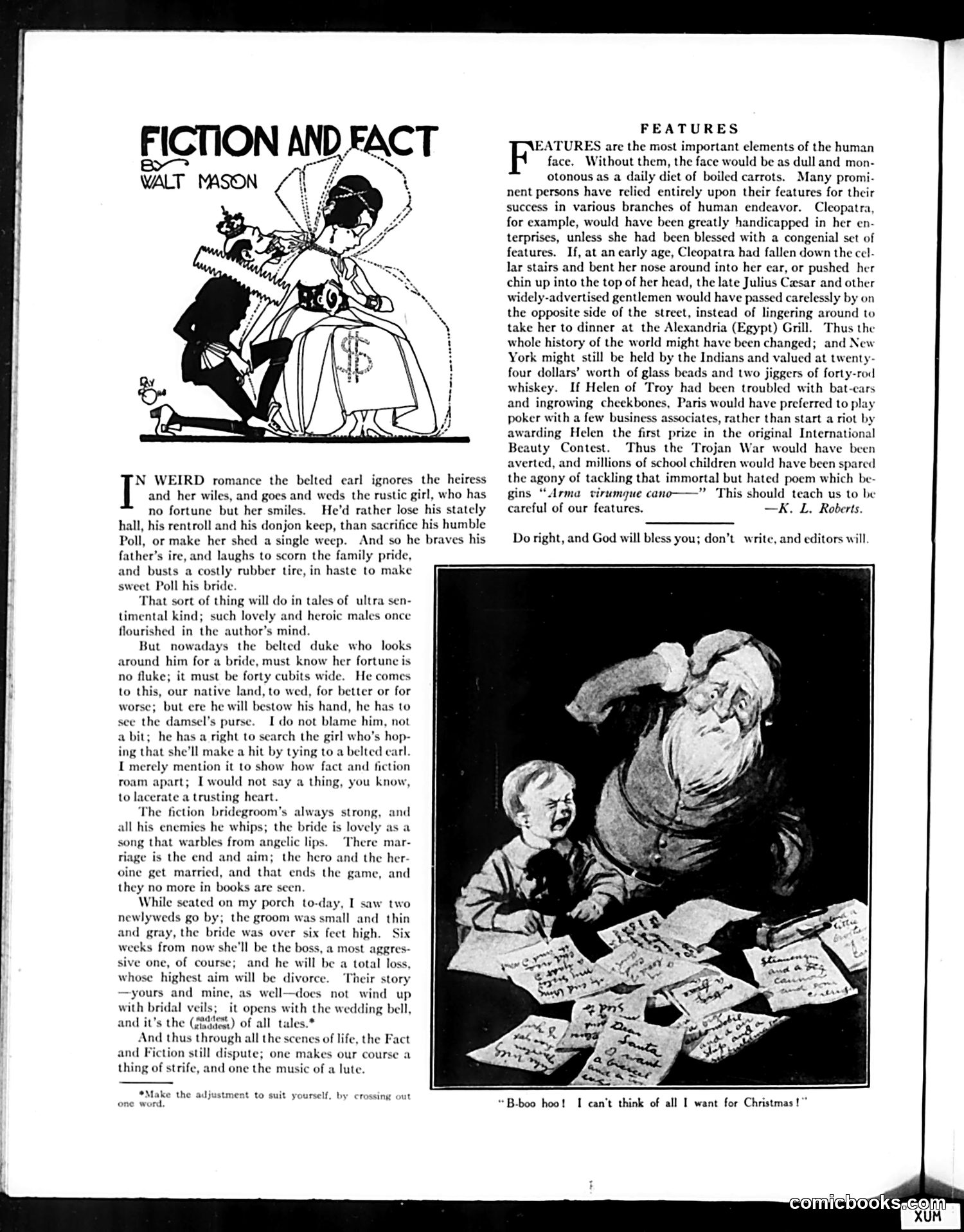
This page contains two satirical pieces from Judge magazine: **"Fiction and Fact" by Walt Mason** (left column): A poem contrasting romantic fiction with modern reality. Mason mocks how old stories featured noble lords marrying poor but virtuous girls, whereas today's wealthy suitors demand financial security. He then describes witnessing a real newlywed couple—a small, thin groom and a towering bride—predicting she'll dominate him and they'll divorce. The satire critiques how real marriages rarely match storybook ideals. **"Features" article** (right column): A humorous essay arguing that facial features determine success. Using historical examples (Cleopatra, Helen of Troy), it absurdly suggests that if these women had been physically unattractive, world history would have changed dramatically. The accompanying illustration shows a child's disappointed reaction to Christmas gifts. Both pieces mock conventional sentimentality and expectations—whether romantic ideals or the notion that appearance alone determines destiny—through exaggeration and ironic observation.
📄 Transcribed text from this page (OCR, searchable)
Machine-transcribed from the original scan — historical spelling and the odd misread are preserved.
FICTION WALT MASON AND FACT and her wiles, and goes and weds the rustic girl, who has no fortune but her smiles. He'd rather lose his stately hall, his rentroll and his donjon keep, than sacrifice his humble Poll, or make her shed a single weep. And so he braves his father’s ire, and laughs to scorn the family pride, and busts a costly rubber tire, in haste to make sweet Poll his bride. That sort of thing timental kind; such love flourished in the author’s mind. But nowadays the belted duke who looks around him for a bride, must know her fortune is no fluke; it must be forty cubits wide. He comes to this, our native land, to wed, for better or for worse; but ere he will bestow his hand, he has to see the damsel’s purse. I do not blame him, not abit; he has a right to search the girl who's hop- ing t she'll make a hit by tying to a belted carl. I merely mention it to show how fact and fiction roam apart; [would not say a thing, you know, to lacerate a trusting heart. The fiction bridegroom’s always strong, and all his enemies he whips; the bride is lovely as a song that warbles from angelic lips. There mar- riage is the end and aim; the hero and the her- oine get married, and that ends the game, and they no more in books are seen. While seated on my porch to-day, I saw two newlyweds go by; the groom was small and thin and gray, the bride was over six feet high. Six weeks from now she'll be the boss, a most aggres- sive one, of course; and he will be a total loss, whose highest aim will be divorce. Their story —yours and min well—does not wind up with bridal veils; it opens with the wedding bell, and it’s the (fiiiijen) of all tales.* And thus through all the scenes of life, the Fact and Fiction still dispute; one makes our course a thing of strife, and one the music of a lute. r WEIRD romance the belted earl ignores the heiress ll do in tales of ultra sen- y and heroic males once *Mak the adjustment to suit yourself. by crossing out FEATURES EATURES are the most important elements of the human F face. Without them, the face would be as dull and mon- otonous as a daily dict of boiled carrots. Many promi- nent persons have relied entirely upon their features for their success in various branches of human endeavor. Cleopatra, for example, would have been greatly handicapped in her en- terprises, unless she had been blessed with a congenial set of features. If, at an early age, Cleopatra had fallen down the cel- lar stairs and bent her nose around into her ear, or pushed her chin up into the top of her head, the late Julius Caesar and other widely-advertised gentlemen would have passed carelessly by on the opposite side of the street, instead of lingering around to take her to dinner at the Alexandria (Egypt) Grill. Thus the whole history of the world might have been changed; and New York might still be held by the Indians and valued at twenty- four dollars’ worth of glass beads and two jiggers of forty-rod whiskey. If Helen of Troy had been troubled with bat-cars and ingrowing cheekbones, Paris would have preferred to play poker with a few business as es, rather than start a riot by awarding Helen the first prize in the original International Beauty Contest. Thus the Trojan War would have been averted, and millions of school children would have been spared the agony of tackling that immortal but hated poem which be- gins “Arma virumque cano—”" This should teach us to be careful of our features. —K. L. Roberts. Do right, and God will bless you; don’t write, and editors will. “B-boo hoo! I can’t think of all I want for Christmas!”