
A complete issue · 28 pages · 1916
Judge — May 6, 1916
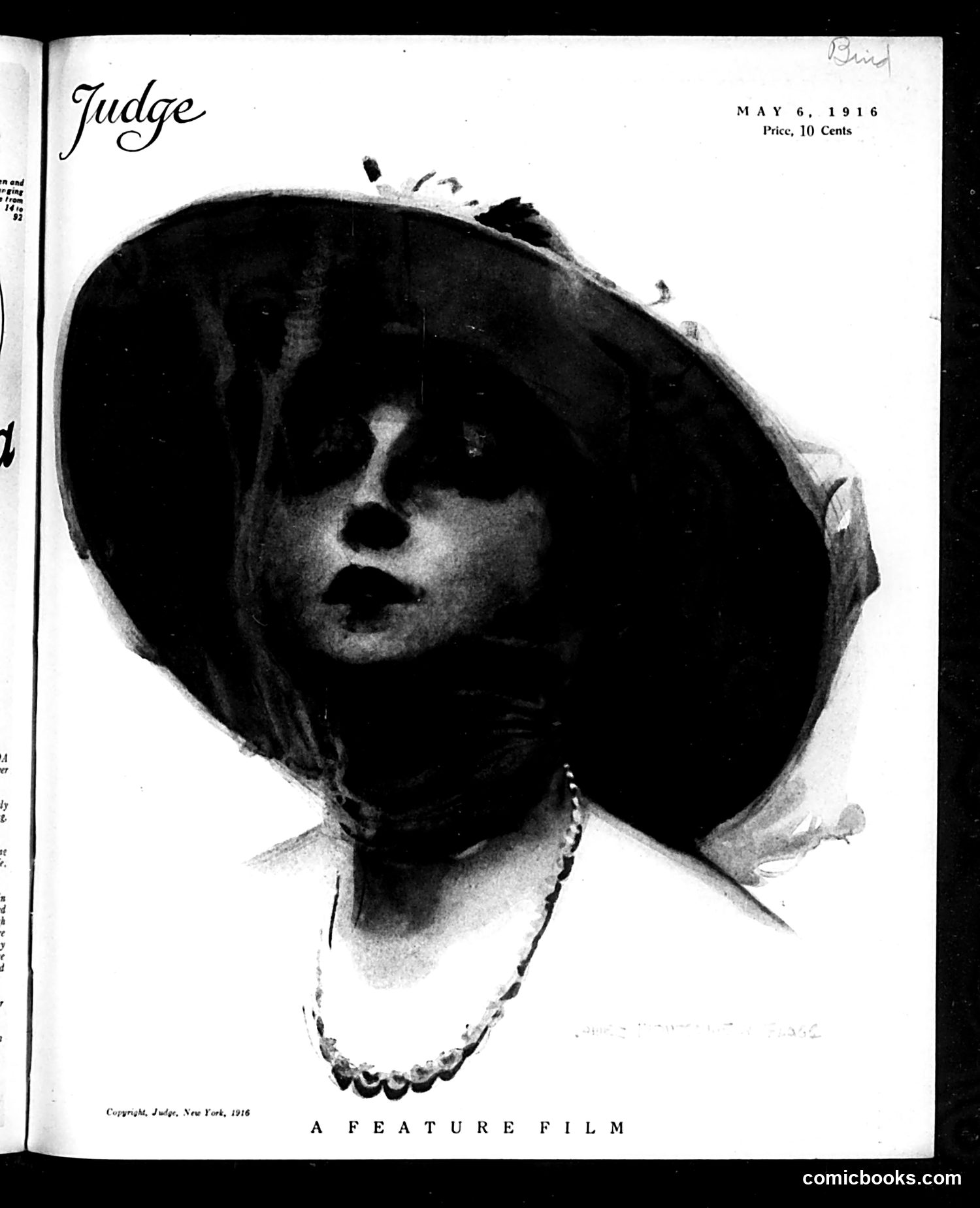
This is a **Judge magazine cover from May 6, 1916** featuring a striking photograph labeled "A Feature Film" at the bottom. The image shows a woman's face partially obscured by an enormous, circular dark hat or veil, with only her eyes, nose, and mouth visible. She wears a pearl necklace. **The satire likely mocks**: Exaggerated women's fashion of the 1910s, specifically the absurdly large hats that were fashionable during this era. By presenting the hat as so oversized it nearly obscures the wearer's face entirely, Judge ridicules this trend as impractical and ridiculous. The "Feature Film" reference suggests Judge is satirizing cinema's influence on fashion trends, implying movies promoted these excessive styles. The photograph's dramatic presentation emphasizes the comedy of the fashion excess.
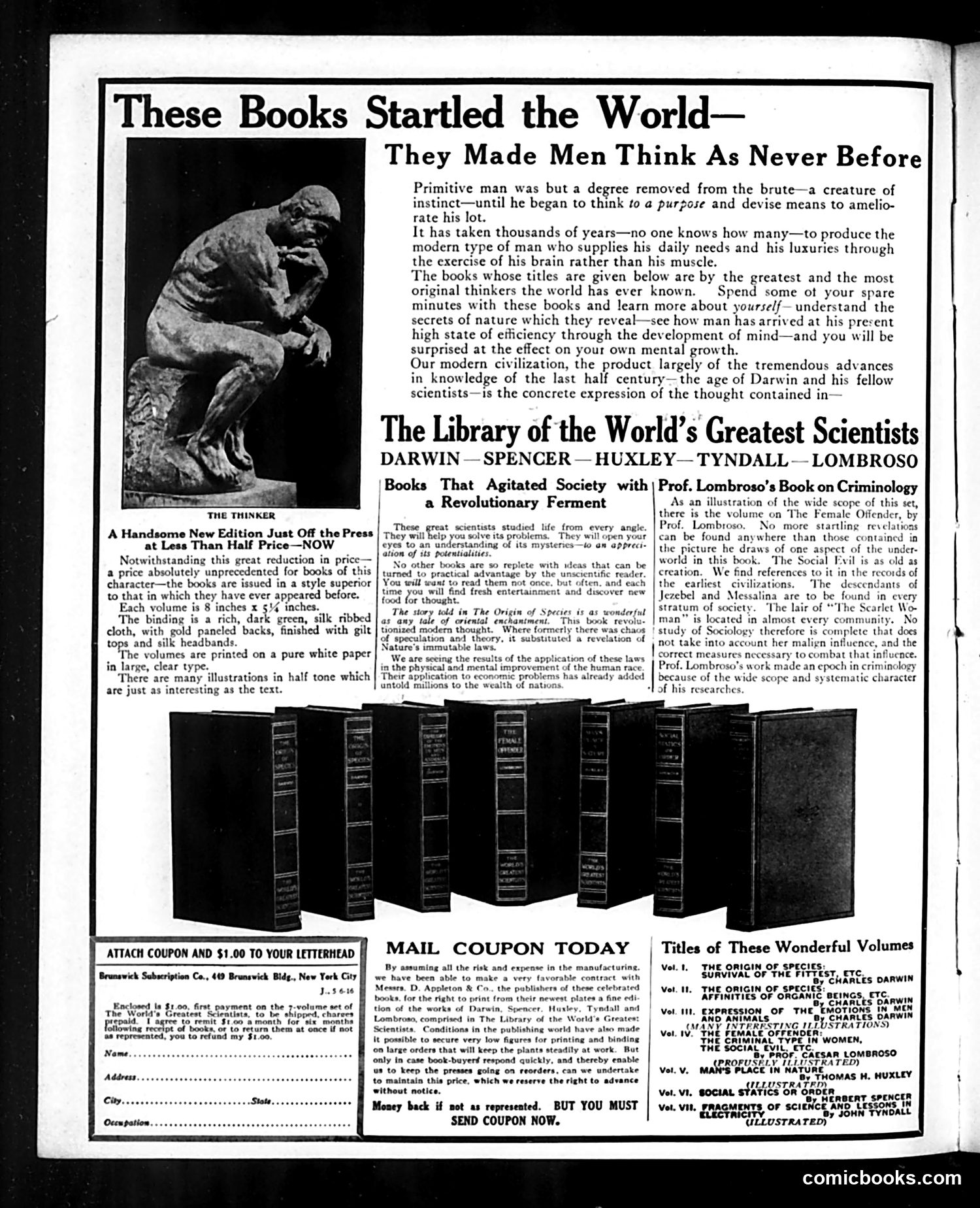
This page is primarily **advertising, not satire or political commentary**. It promotes "The Library of the World's Greatest Scientists"—a book subscription series featuring works by Darwin, Spencer, Huxley, Tyndall, and Lombroso. The single image is Rodin's famous sculpture "The Thinker," used to symbolize intellectual achievement and scientific thought. The advertisement's text emphasizes how these foundational scientific works enabled modern civilization and human progress through rational thought rather than instinct. The page includes a mail-coupon subscription offer at the bottom. There is no apparent political cartoon or satire—this is straightforward commercial marketing disguised within Judge magazine's pages, leveraging the prestige of 19th-century scientific pioneers to sell books to educated readers.
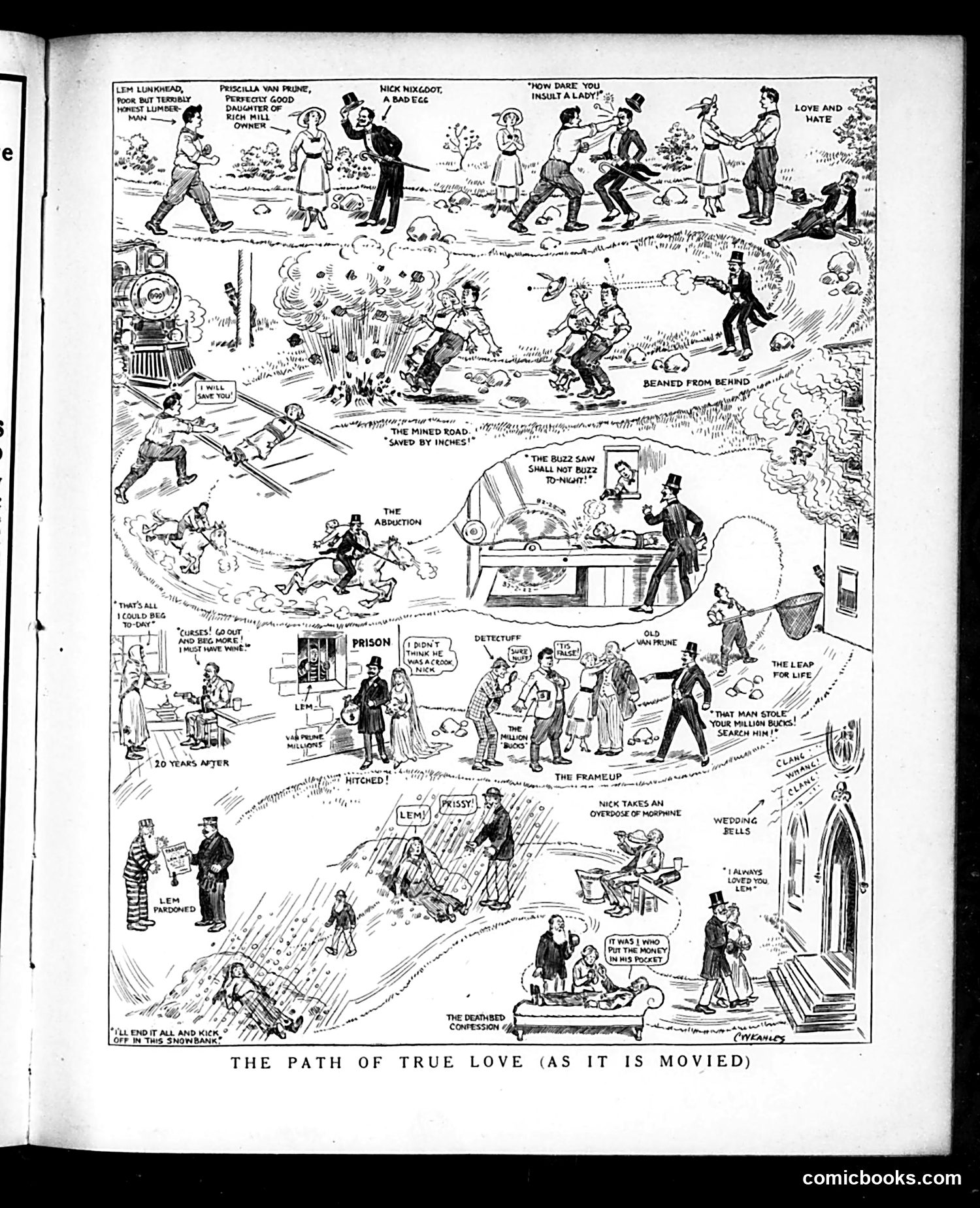
This satirical cartoon mocks how Hollywood romanticizes romance compared to reality. The title suggests this depicts love stories "as they are movied"—cinematic versions rather than truth. The winding narrative path shows exaggerated movie scenarios: dramatic confrontations ("How dare you insult a lady!"), explosions, train chases, prison escapes, and melodramatic declarations. Characters labeled include "Lem Lunkhead," "Priscilla Van Prude," and "Nick Neckgot," suggesting stereotypical movie archetypes. The satire critiques how films inflate ordinary relationships with absurd action sequences, improbable coincidences, and theatrical emotionalism. Real life—shown as mundane domesticity and ordinary problems—contrasts sharply with cinema's manufactured drama. This reflects early 1900s concern about movies' influence on public expectations of romance and morality.
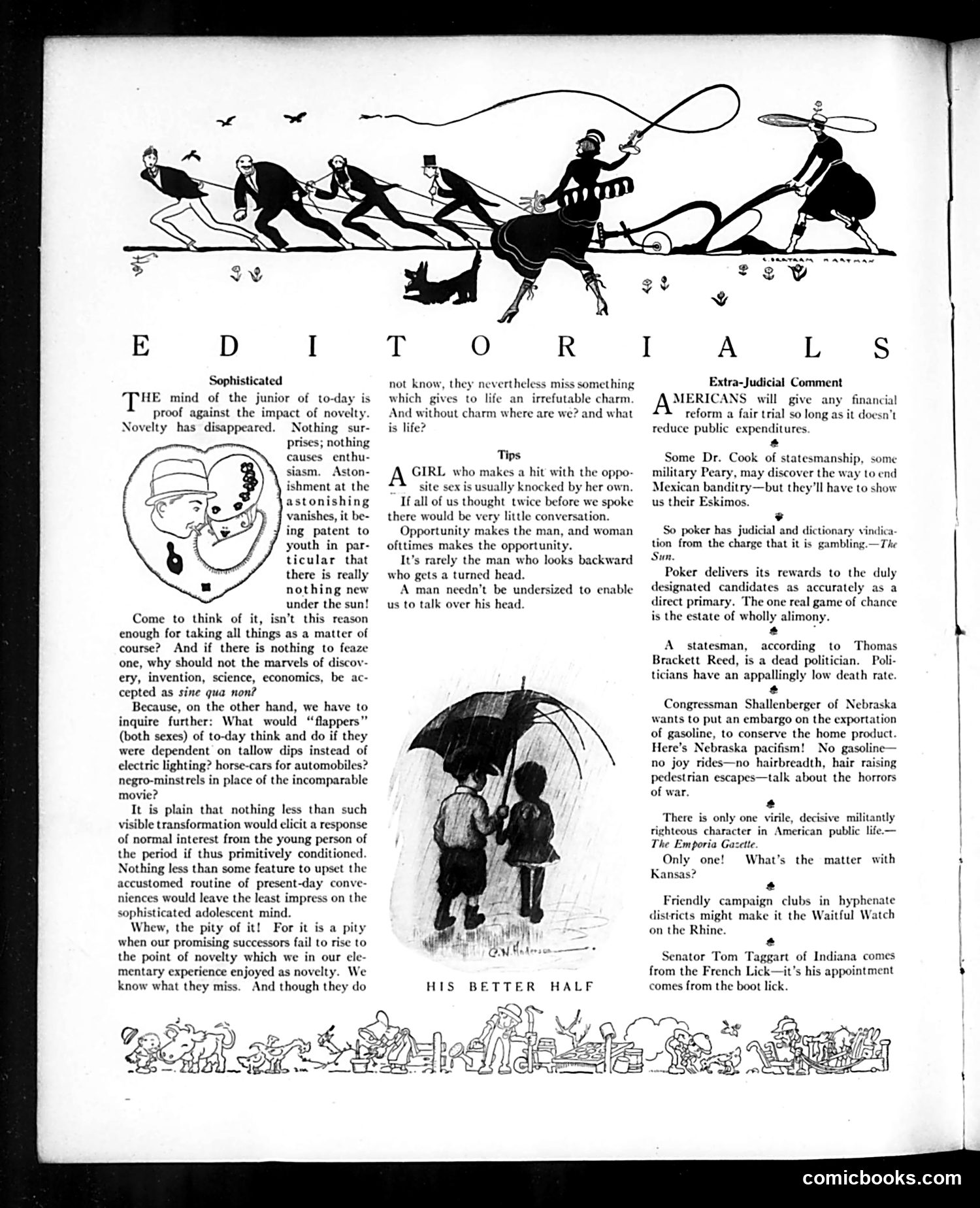
**Top Cartoon ("Editorials"):** A satirical procession shows men being pulled along by various forces—representing how modern novelties (automobiles, electric lighting, movies) have transformed society and captured public attention away from serious matters. The figure with the net suggests catching or controlling these trends. **Middle Section:** Essays critique modern youth's fascination with novelty while lacking appreciation for discovery and invention. The text questions whether younger generations truly understand fundamental innovations. **"His Better Half":** A domestic scene showing a couple under an umbrella, likely satirizing marriage dynamics or gender relations—a common Judge theme. **Right Column ("Editorials"):** Brief political commentary on congressional matters, including Congressman Shallenberger's pacifism stance and references to Kansas politics, typical of the magazine's satirical news commentary.
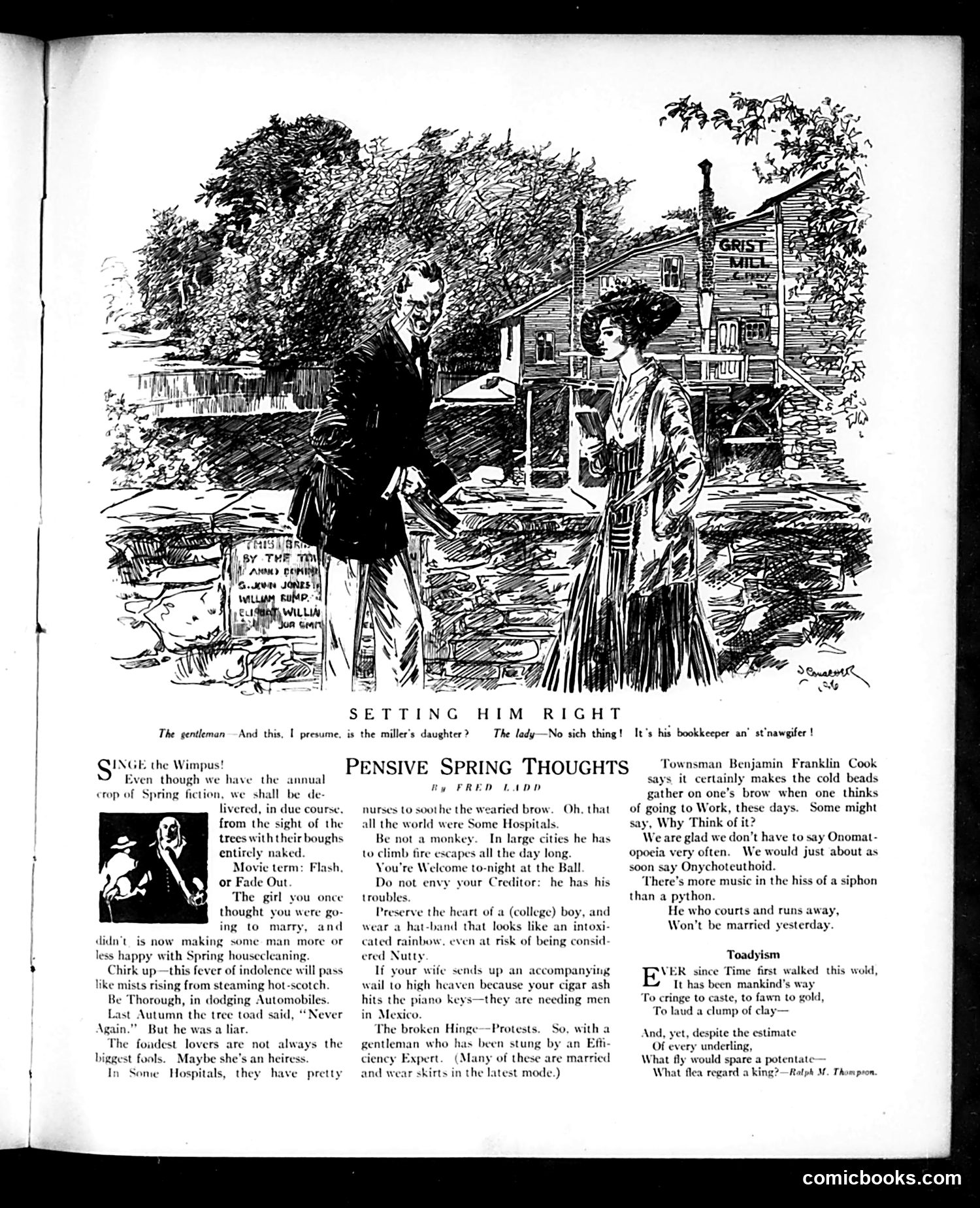
The cartoon depicts a gentleman confronting a woman at a grist mill, with the caption revealing the joke: he mistakes her for the miller's daughter, but she's actually the miller's bookkeeper and stenographer—a "typewriter" (period slang for female office worker). The satire targets early 20th-century gender assumptions. The gentleman's error reflects the era's surprise at women entering professional roles beyond domestic service. The punchline—that a woman at an industrial site must be the owner's daughter rather than an independent working woman—mocks men's difficulty accepting female wage-earners in modern business positions. The accompanying "Pensive Spring Thoughts" column continues this theme, offering lighthearted social commentary on relationships and modern life during the spring season.
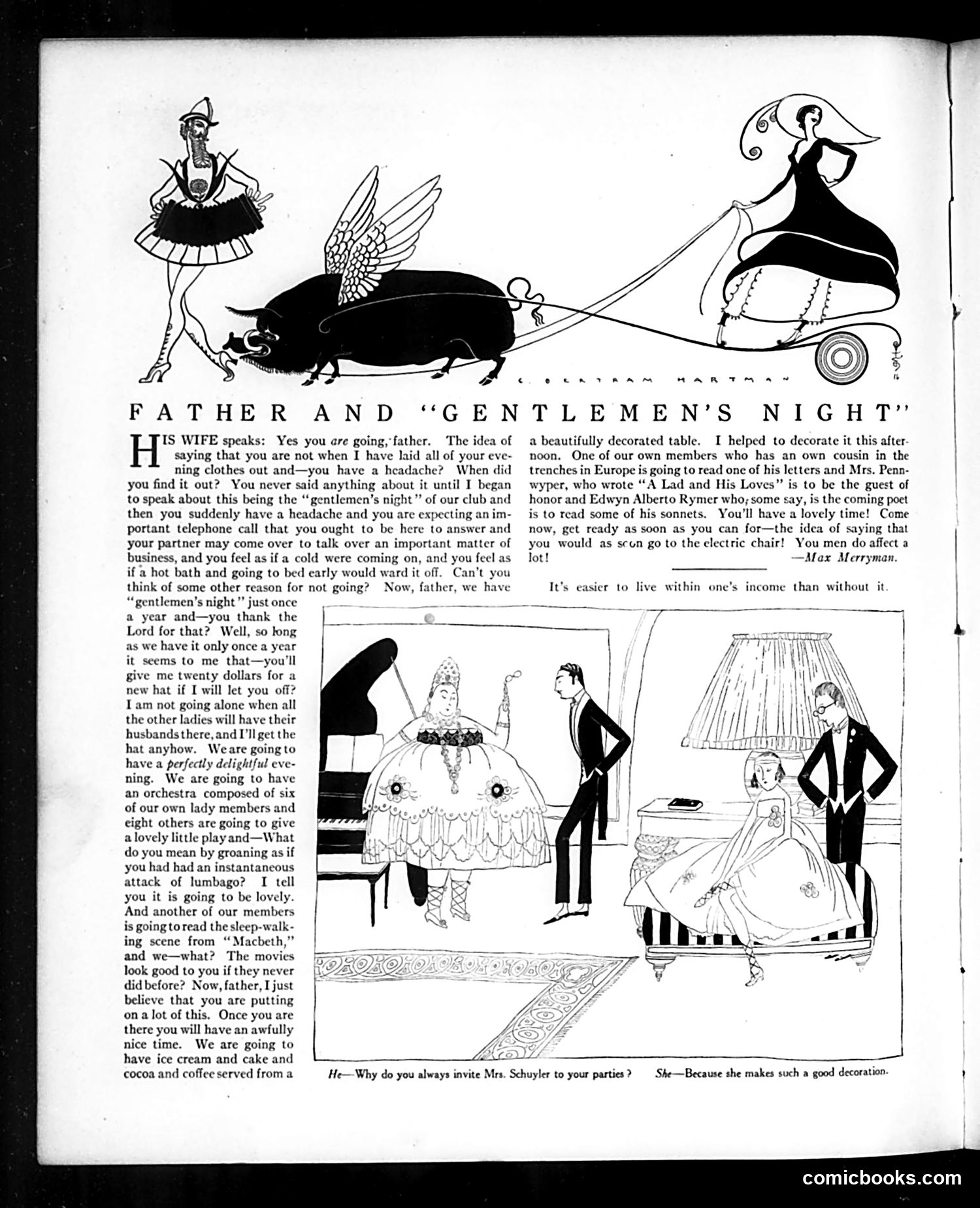
This satirical piece mocks domestic dynamics of the era. A husband fabricates excuses (headache, important call, business matters) to avoid his wife's club's annual "Gentlemen's Night" event. The wife, speaking to the reader, systematically dismantles each excuse while enthusiastically detailing the evening's attractions: a decorated table, a guest reading letters from European trenches, a poet reading sonnets, a female orchestra, and theatrical performances. The satire targets male reluctance toward cultural events their wives organize, and male resistance to social obligations generally. The husband's dramatic comparison—going "as soon go to the electric chair"—exaggerates his resistance to what the wife clearly views as a refined, worthwhile evening. A secondary joke appears below: a woman admits she invites another guest "because she makes such a good decoration," mocking superficial social conventions where people are valued as aesthetic objects rather than companions.
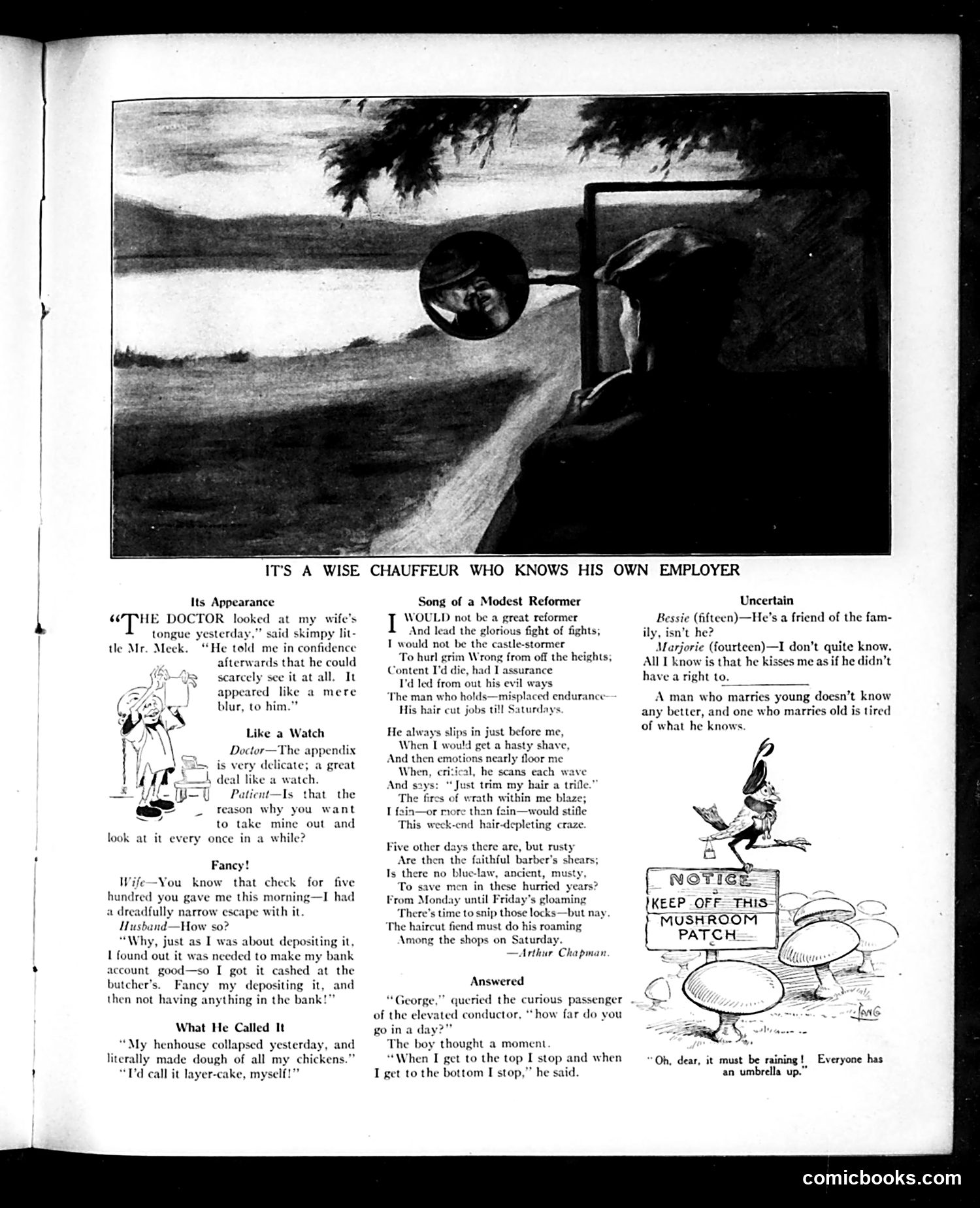
This page collects humorous anecdotes and light satire typical of early-20th-century American humor magazines. **Main content:** - "Its a Wise Chauffeur" presents brief comedic dialogues mocking professional incompetence and domestic absurdities - The doctor's inability to see the wife's tongue; the patient questioning why the doctor repeatedly examines the appendix - Marital humor about a wife nearly depositing a check she needed for household expenses **"Song of a Modest Reformer"** satirizes selective social activism—a reformer content to fight one specific nuisance: barbers cutting hair only on Saturdays, creating a weekly grooming crisis. The poet laments this "haircut fiend" rather than addressing major societal wrongs, poking fun at narrow-minded crusaders. **"Answered"** jokes about an elevator operator's literal interpretation of his job's limits. **Marginal humor** includes observations on youthful romance and marriage—cynicism about young men's ignorance versus old men's resigned indifference. The overall tone: domestic, class-conscious satire with no specific political content—typical of Judge's gentle mockery of American middle-class life.
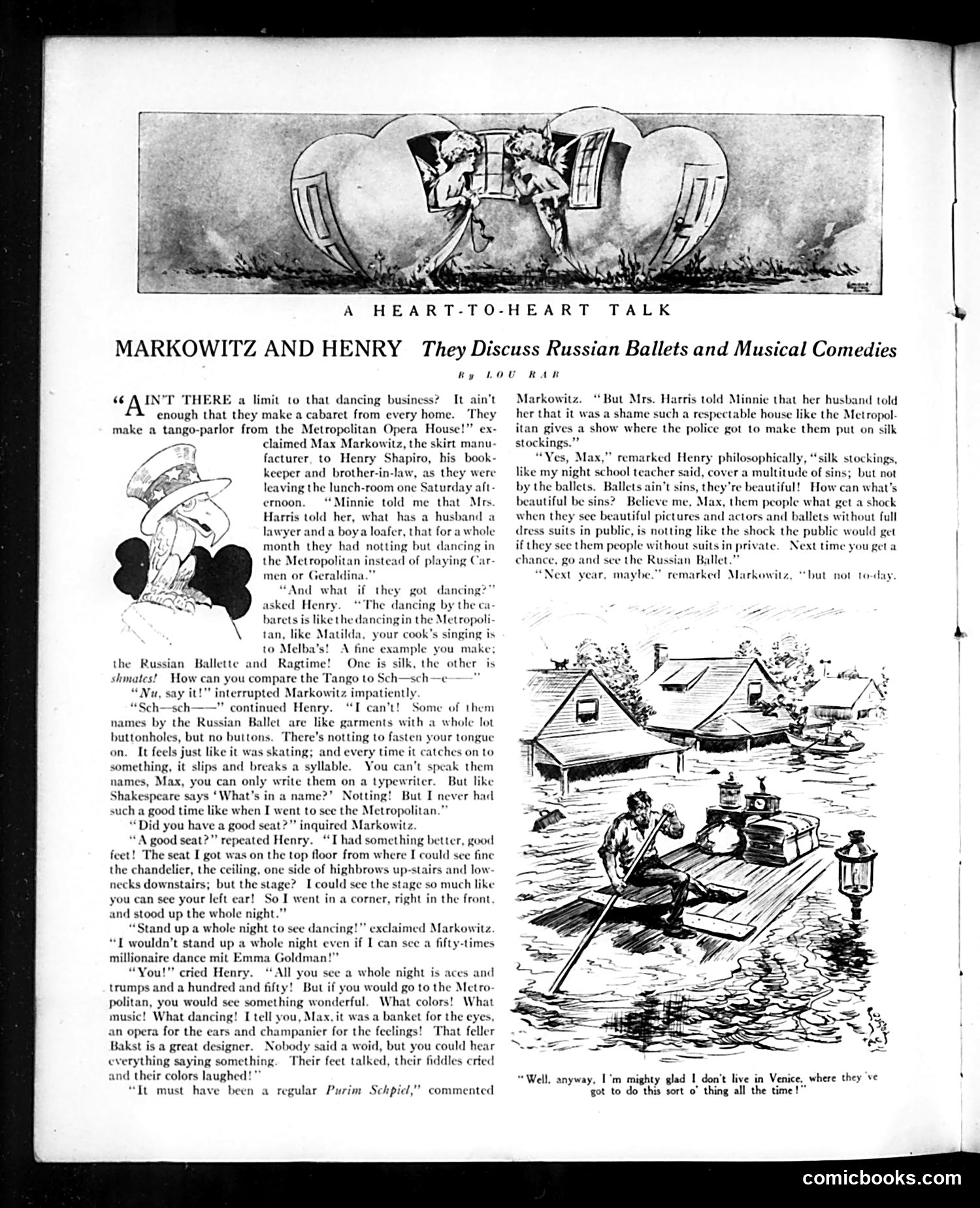
This is a humorous dialogue between two Jewish immigrant characters debating the merits of the Russian Ballet at New York's Metropolitan Opera House. Max Markowitz (a skirt manufacturer) complains the ballet is scandalous—dancers wear insufficient clothing, requiring police enforcement of modesty. He mocks the incomprehensible Russian names and suggests theater should stick to familiar fare like *Carmen*. Henry Shapiro (a bookkeeper) enthusiastically defends the ballet's artistry, describing the visual spectacle, music, and emotional impact. He attended from the cheapest seats but found it transcendent. The satire targets both characters: Markowitz's provincial prudishness and resistance to highbrow culture; Henry's pretentious enthusiasm despite his working-class perspective. The Yiddish-inflected English ("notting," "mit," "schpiel") marks them as immigrants, while the debate reflects early 20th-century tension between traditional entertainment and modernist art forms among urban Jewish audiences.
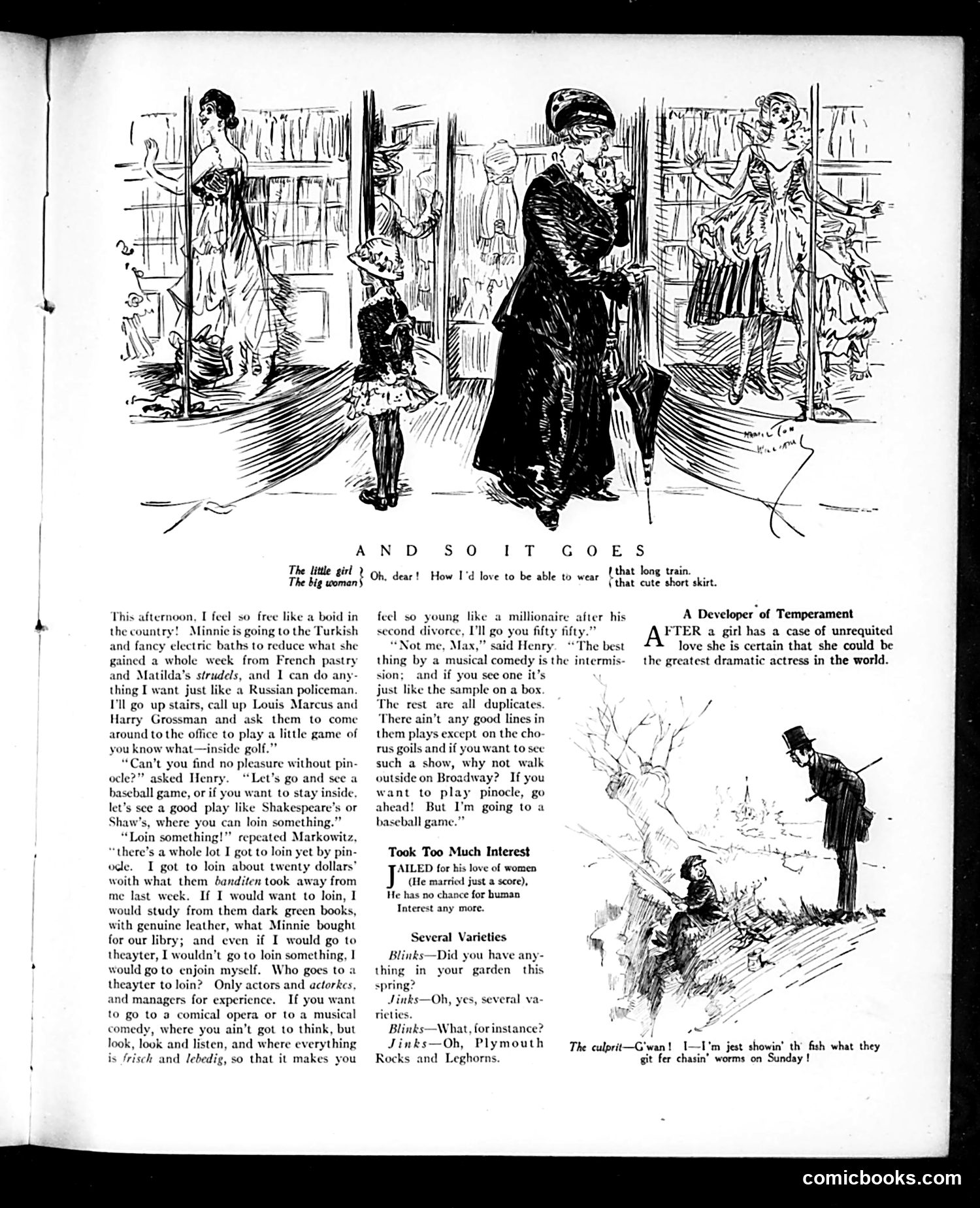
This page from *Judge* contains three satirical pieces: **"And So It Goes"** (top): A dialogue between Jewish characters (identified by dialect spelling: "loin" for "learn," "libry" for "library") about leisure activities. The satire mocks immigrant aspirations—one character wants to spend the afternoon gambling and carousing while his wife attends Turkish baths, while another advocates for "improving" activities like theater and Shakespeare. The humor derives from the tension between lowbrow and highbrow entertainment, stereotyping working-class Jewish immigrants as preferring games and musicals over intellectual pursuits. **"Took Too Much Interest"**: A brief joke about a serial marrier who has exhausted romantic prospects. **"Several Varieties"**: A pun-based joke about garden vegetables (Plymouth Rocks and Leghorns are chicken breeds, not plants). The page reflects early 20th-century ethnic stereotyping common in American humor magazines, using exaggerated accents to comedic effect while satirizing class and cultural pretensions.
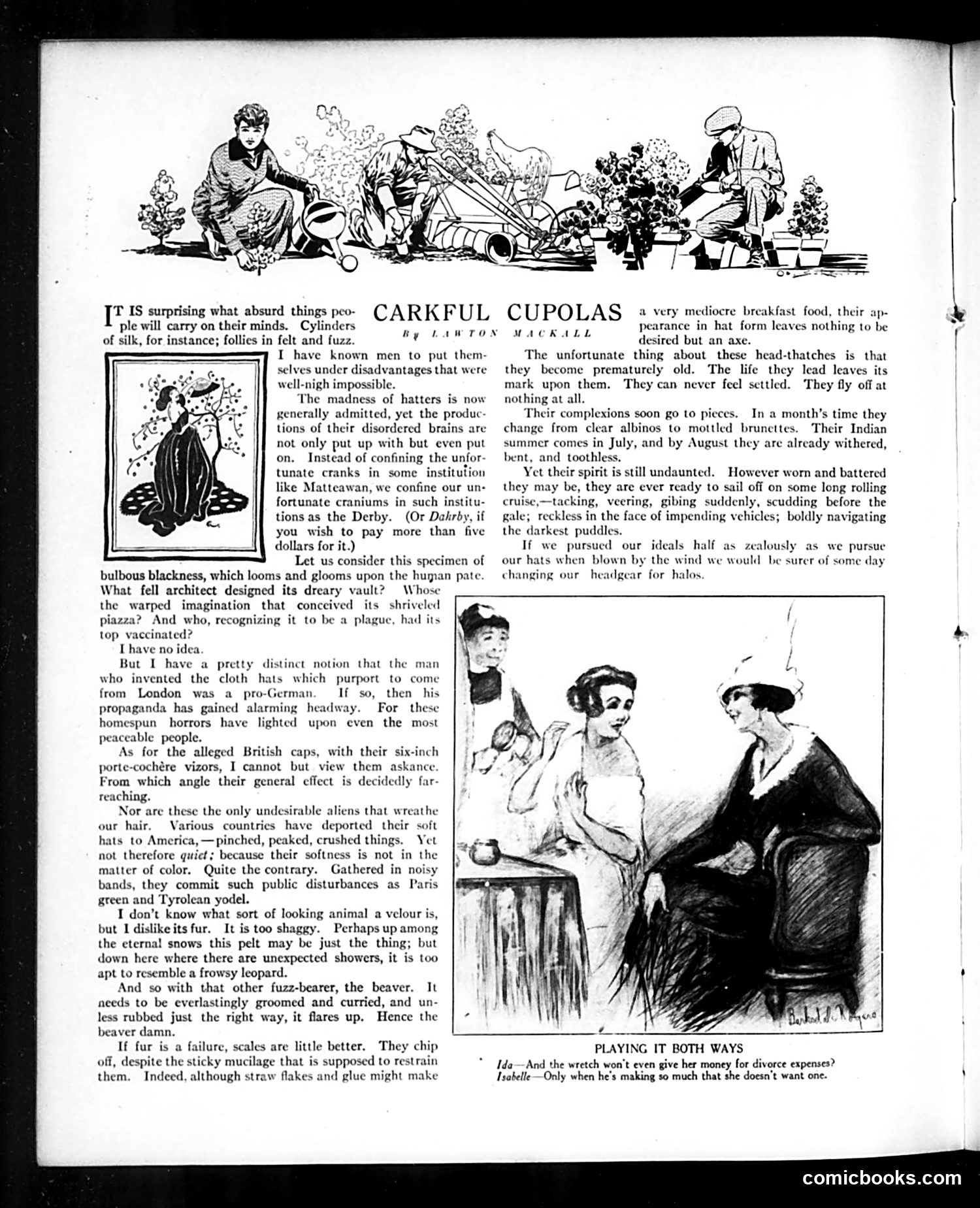
This is a humorous essay attacking the absurdity of fashionable men's hats. The author (Lawton Mackall) mocks hat-makers as mad, comparing them to inmates of an asylum like Matteawan (a real New York mental hospital). He ridicules specific hat styles: British caps with oversized visors, imported soft hats from various countries, velour (too shaggy), and beaver fur (requiring constant grooming). The satire extends to hats' impermanence—they deteriorate within a month, turning from "clear albinos to mottled brunettes," yet men chase them obsessively when blown by wind, as if pursuing ideals. The article includes a jab at German propaganda ("pro-German" hat inventors), reflecting WWI-era xenophobia common in *Judge* magazine. The bottom cartoon, "Playing It Both Ways," is unrelated marital satire: a woman won't divorce her stingy husband when he's poor, but won't divorce him when rich either—he can't win.
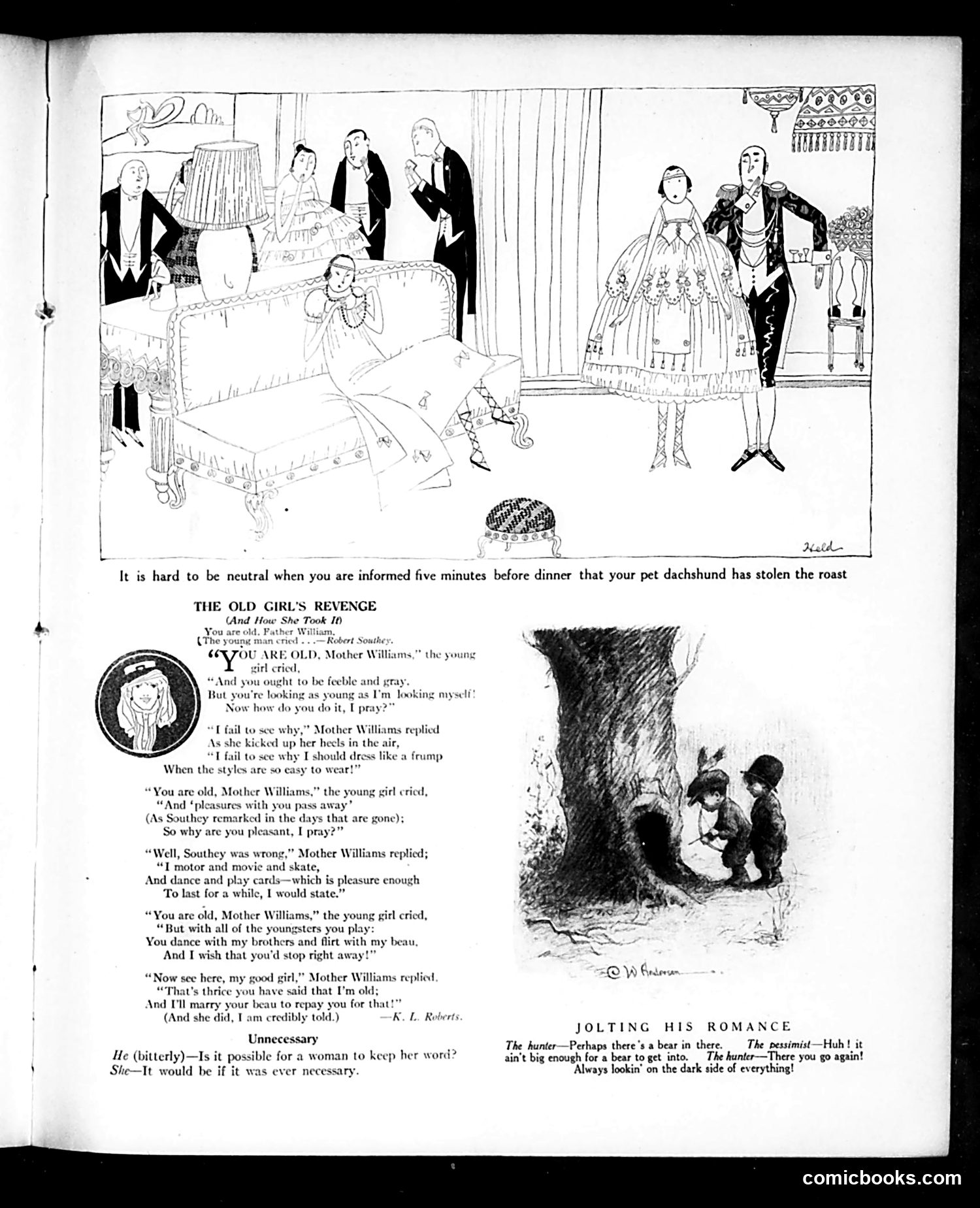
This Judge page contains three separate pieces of humor: **"The Old Girl's Revenge"** (top): A poem-based comic mocking outdated Victorian attitudes about aging women. A young girl criticizes "Mother Williams" for being old, citing Robert Southey's famous poem "The Old Woman." Williams defends herself by embracing modern leisure activities (motoring, movies, dancing, cards) and ultimately wins by marrying the girl's boyfriend—turning the tables on her critic. The satire targets rigid expectations that older women should become invisible or dowdy, celebrating instead the "New Woman" of the 1920s who refuses such limitations. **"Unnecessary"** (middle): A brief joke about women's untrustworthiness—a conventional misogynist gag from the era. **"Jolting His Romance"** (bottom right): A cartoon showing a pessimistic man dampening a romantic moment by focusing on danger ("bear in there"). The humor targets his glumness and inability to enjoy pleasant moments. The page reflects 1920s attitudes: progressive views on aging and women's autonomy mixed with traditional gender stereotypes.
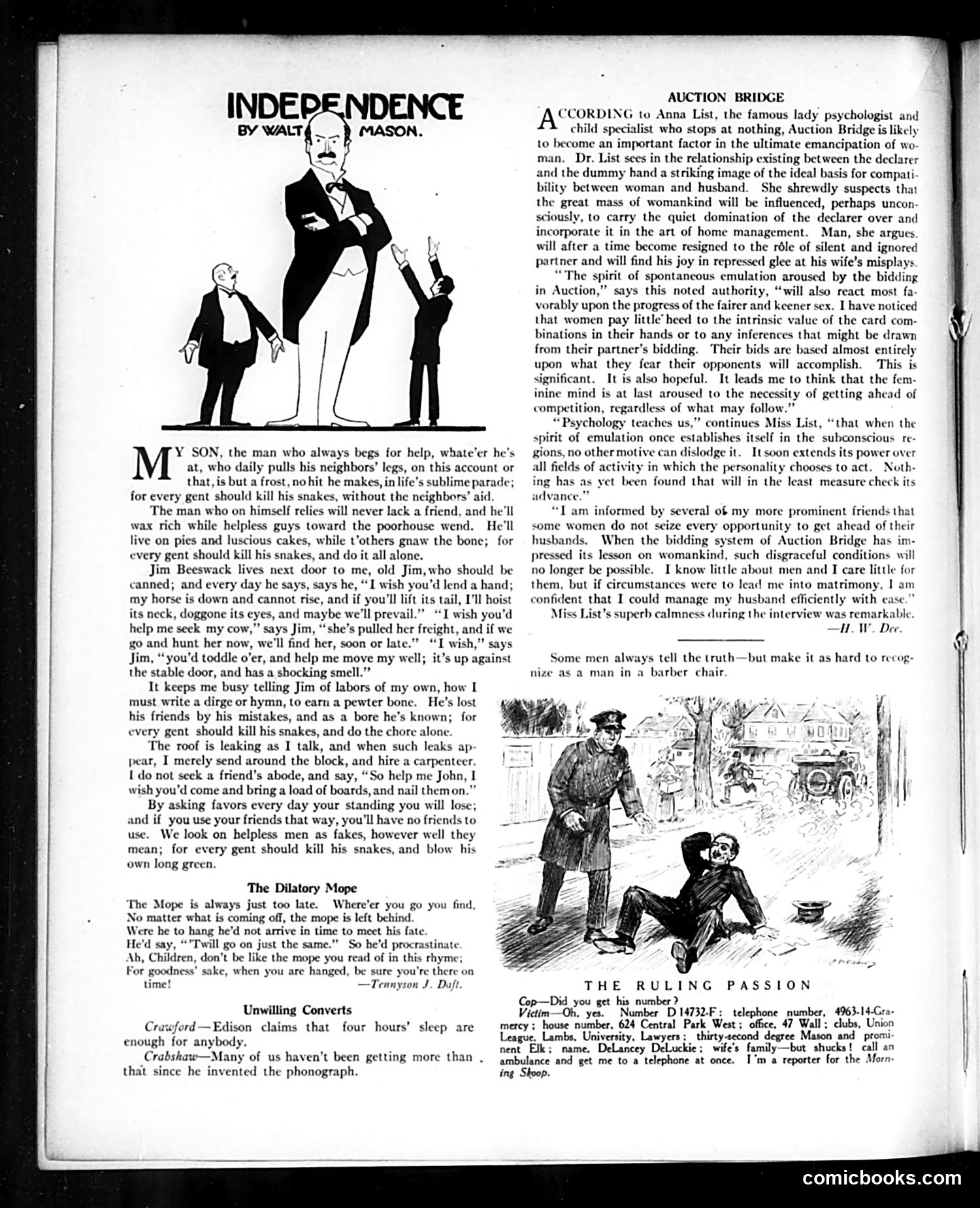
This page satirizes **dependency and self-reliance** through two main pieces: **"Independence" (left cartoon):** A tall man towers over two smaller men in formal dress. The accompanying poem mocks men who constantly ask neighbors for help—"Jim Beeswack" exemplifies this type, perpetually borrowing assistance with his horse, cow, and leaky roof. The satire's message: real manhood means solving your own problems without burdening others. Self-reliance builds respect and friendships; chronic neediness destroys both. **"Auction Bridge" (right article):** A humorous pseudo-psychological piece praising the card game as beneficial to women's emancipation. Anna List (likely a fictional expert) argues that Auction Bridge teaches women competitive strategy and independence by casting the "declarer" role as dominant. The satire gently mocks both pop-psychology trends and gender dynamics of the era. Both pieces reflect early 20th-century American values emphasizing self-sufficiency and competitive individualism.
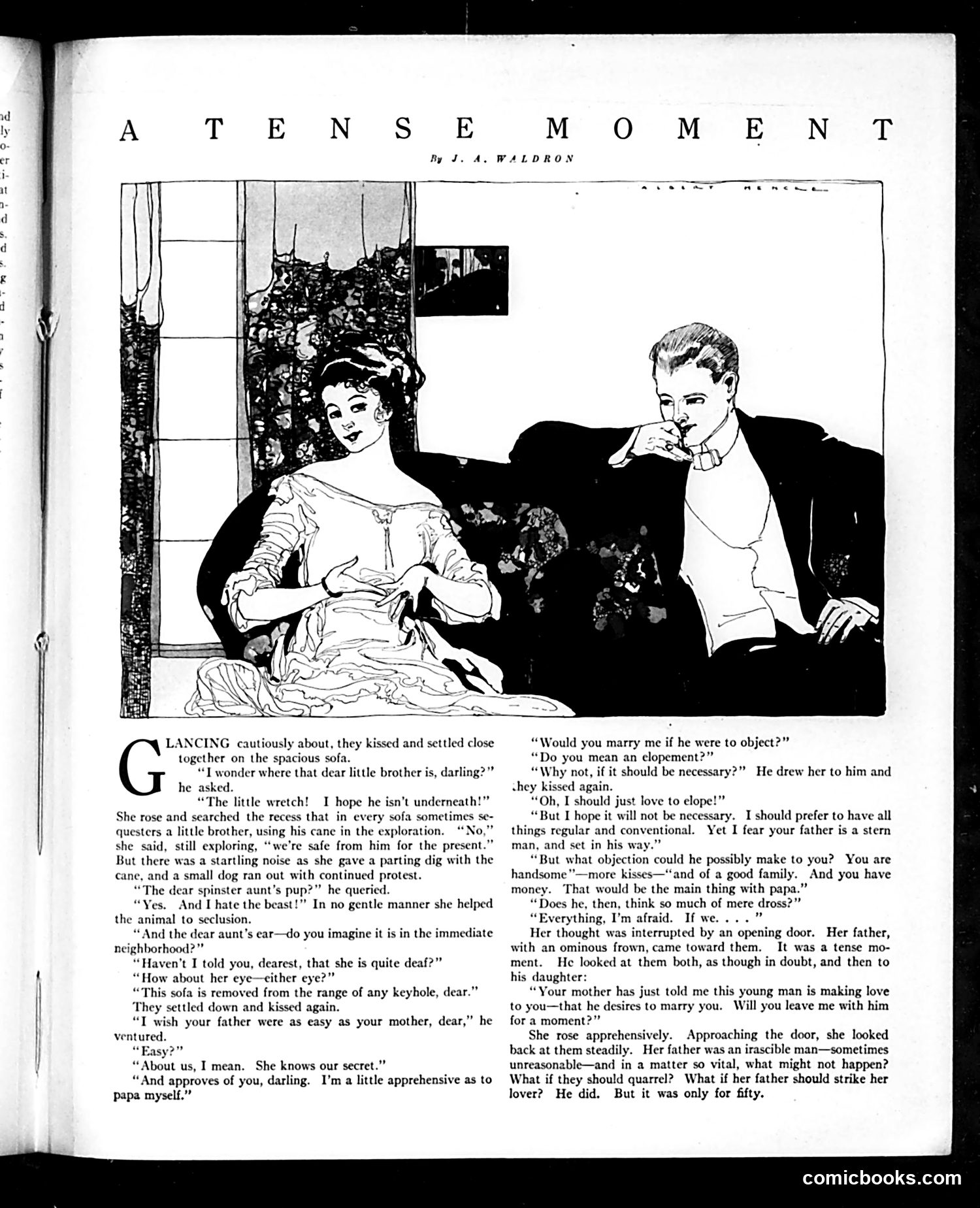
This is a romantic comedy story illustration, not political satire. It depicts a young couple kissing on a sofa, nervously checking that they won't be discovered—worrying about the presence of a little brother, a deaf aunt, and most importantly, the girl's father. The humor centers on Victorian-era courtship anxieties: the couple must hide their affection from authority figures, particularly the stern father. The girl's parents have different reactions—her mother approves but her father is "irascible" and strict about money. The punchline (cut off but visible) appears to be that despite the father's stern demeanor and the couple's fears, he ultimately approves—"only for fifty" (likely dollars, suggesting he's mercenary but ultimately buyable). The illustration captures the era's social conventions where parental approval was crucial and young people had limited privacy for courtship.
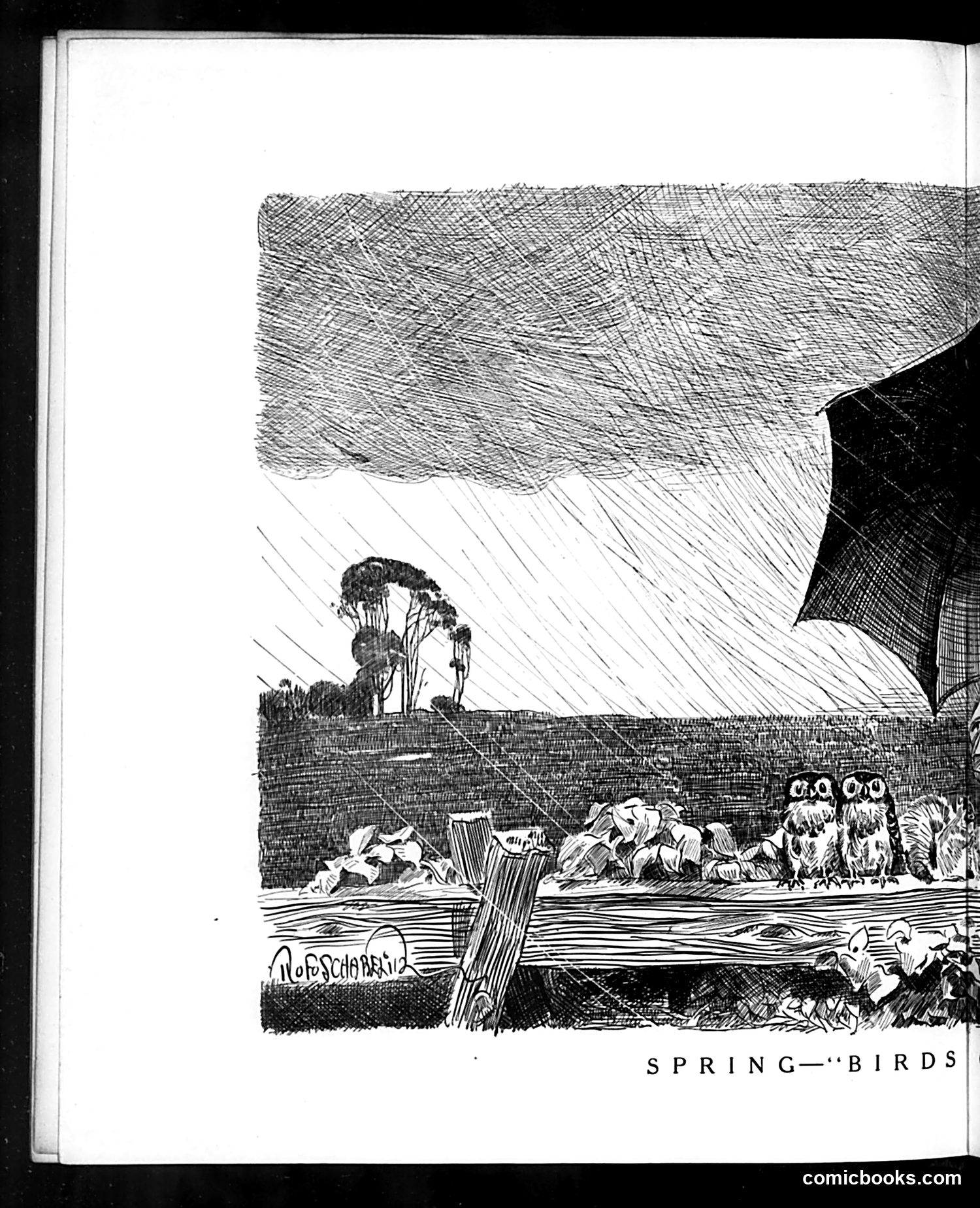
This appears to be an illustration titled "Spring—'Birds'" from *Judge* magazine. The image depicts a rainy spring scene with several owls perched on a wooden fence or log, looking somewhat bedraggled in the weather. There's a gravestone visible on the left with text that's difficult to read clearly, and stormy clouds dominate the sky above. The cartoon likely uses "birds" as satirical slang—a common term in early 20th-century American humor for people of dubious character or foolish individuals. The owls' unhappy expressions in the dreary spring rain may suggest commentary on foolish people suffering consequences, though without clearer visible text or additional context, the specific political or social target remains unclear.
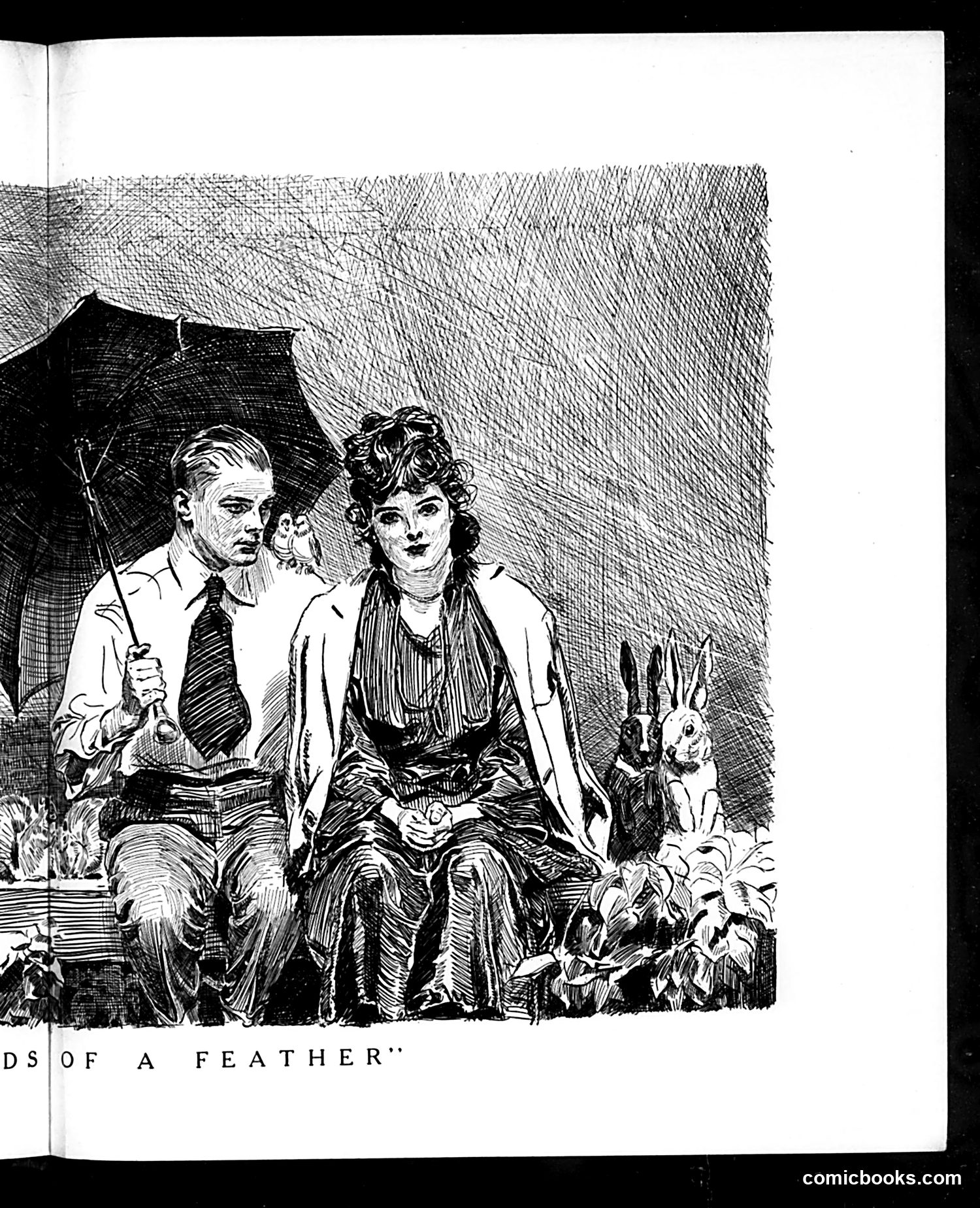
This appears to be a illustration from *Judge* magazine showing a domestic scene titled "**...DS OF A FEATHER**" (likely "Birds of a Feather"). The image depicts a man with an umbrella, a fashionably dressed woman in the center, and a rabbit on the right, seated together indoors with potted plants visible. The style and clothing suggest early-to-mid 20th century. Without the complete title text visible, the precise satirical target is unclear. However, the phrase "birds of a feather" typically suggests people of similar character or morality associating together. The domestic setting and formal dress suggest social commentary on courtship, marriage, or class relations, common themes in *Judge*'s satirical humor. The incomplete OCR text limits identification of specific figures or political references intended.
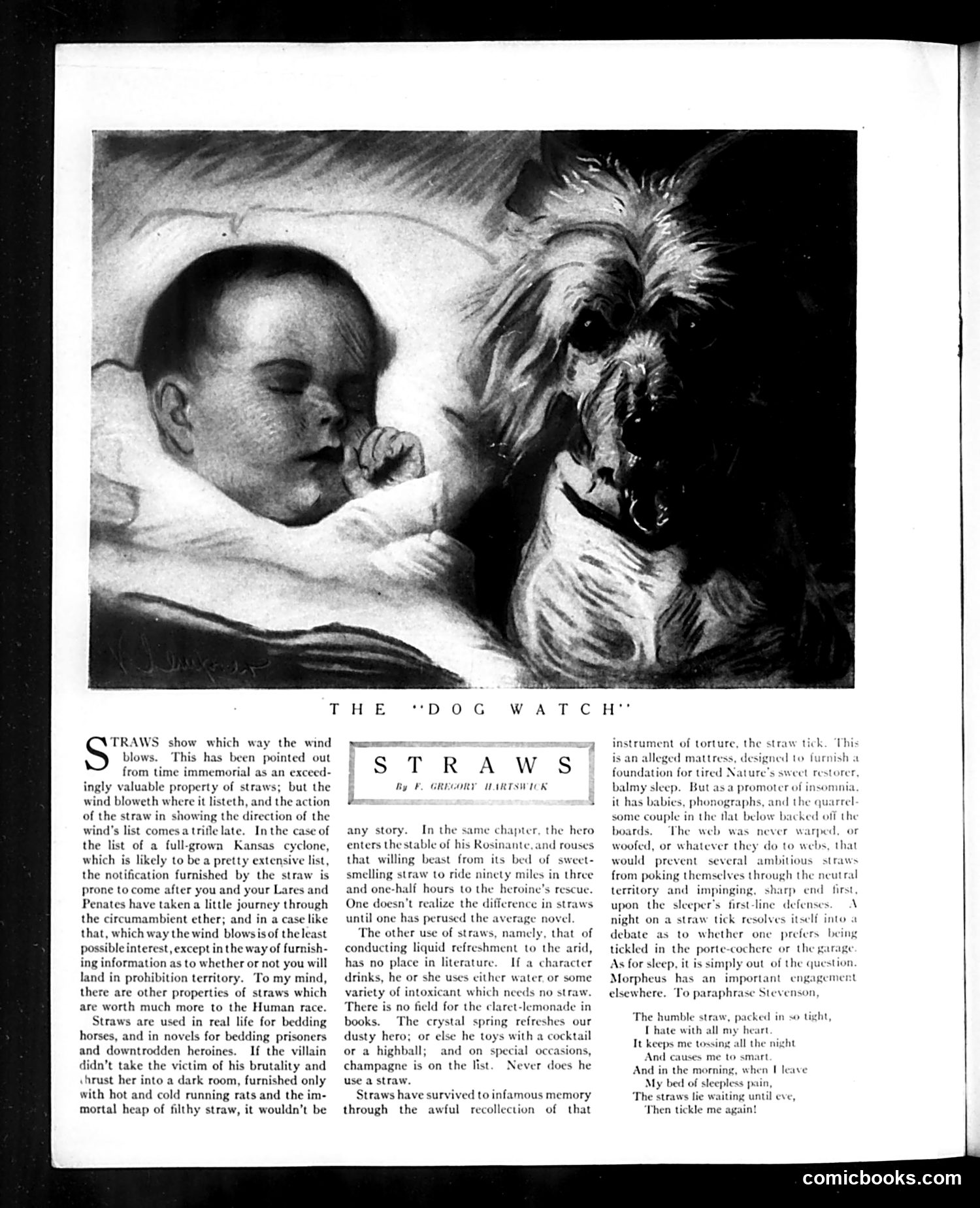
This page contains an essay by F. Gregory Hartswick titled "Straws," accompanying an illustration of a sleeping infant and small dog (the "dog watch" — a playful reference to the dog guarding sleep). **The Content:** Hartswick humorously catalogs straws' uses in literature and life. He notes straws appear in melodrama (villains throw heroines onto straw in dark rooms, heroes ride horses from straw beds), but absent from refined drinking scenes. His main target: **straw-filled mattress ticks** — allegedly designed for comfort but actually instruments of torture, their sharp ends poking sleepers all night, causing insomnia and frustration. **The Joke:** The essay uses mock-serious tone to elevate a mundane complaint (lumpy, scratchy mattresses) into grand social commentary. The accompanying poem reinforces the humorous complaint about sleepless nights on straw ticks — a common household problem readers would recognize. **Social Context:** This reflects early 20th-century domestic life where straw mattresses were standard working/middle-class bedding, known for being uncomfortable despite claims of being restful.
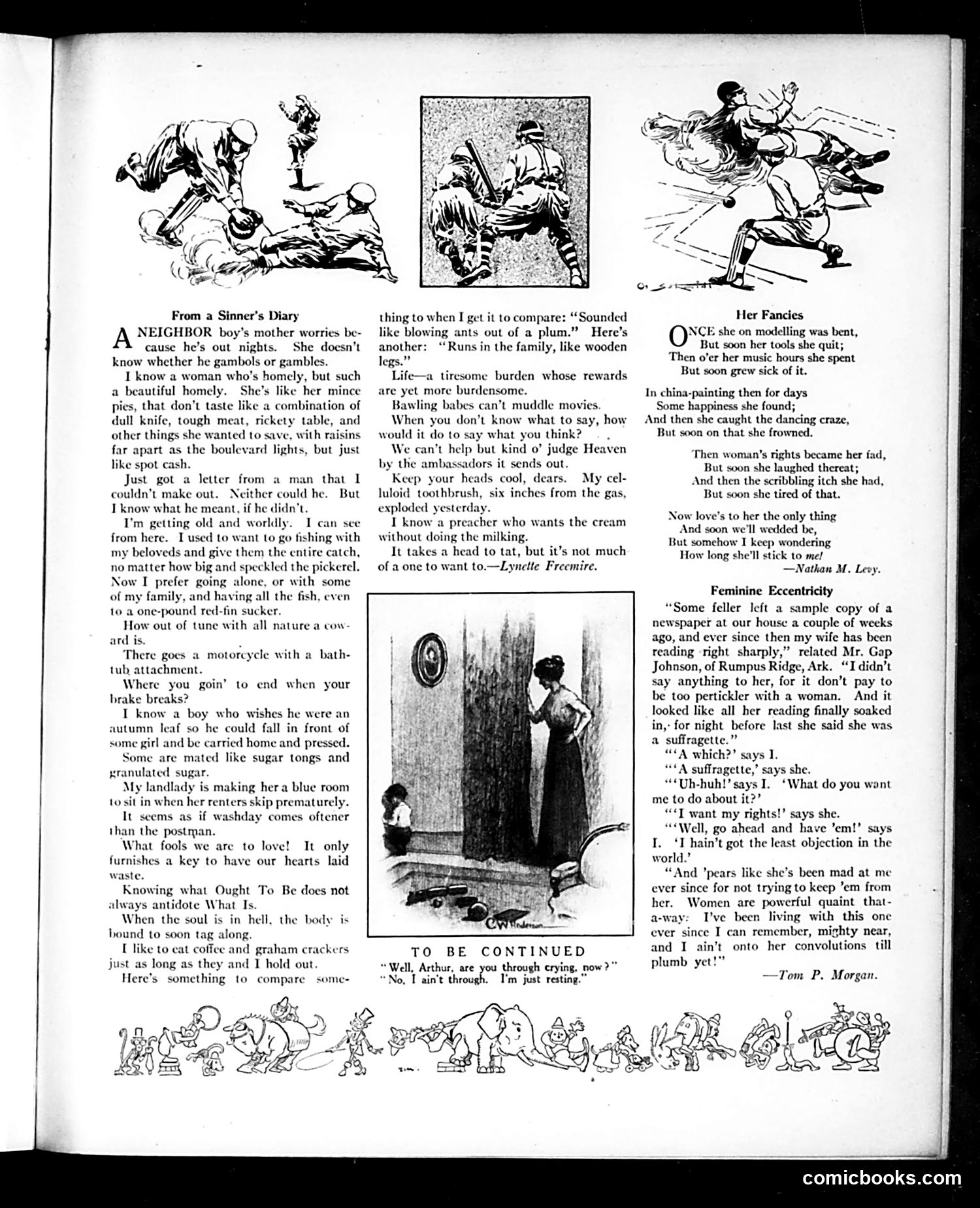
This page contains satirical commentary on contemporary social issues, primarily targeting women's changing roles and behavior. **"From a Sinner's Diary"** presents cynical observations on modern life—gambling concerns, motorcycles with bathtubs (novelty vehicles), and romantic disillusionment. The tone mocks both romantic idealism and practical selfishness. **"Her Fancies"** satirizes women as fickle and inconstant, cycling through hobbies (modeling, music, painting, dancing, women's rights, writing) before settling on marriage—implying women lack serious commitment. **"Feminine Eccentricity"** directly mocks women's suffrage. A husband reports his wife became a "suffragette" after reading newspapers, now demanding "her rights." His bemused indifference ("go ahead and have 'em") suggests the movement is absurd. The joke portrays suffragists as irrational women seeking unreasonable entitlements, and husbands' exasperation with their newfound activism. The central illustration shows a woman at a doorway, possibly representing domestic confinement—ironically juxtaposed with satire about women demanding freedom. This reflects early-20th-century anti-suffrage sentiment treating women's political activism as frivolous or threatening.
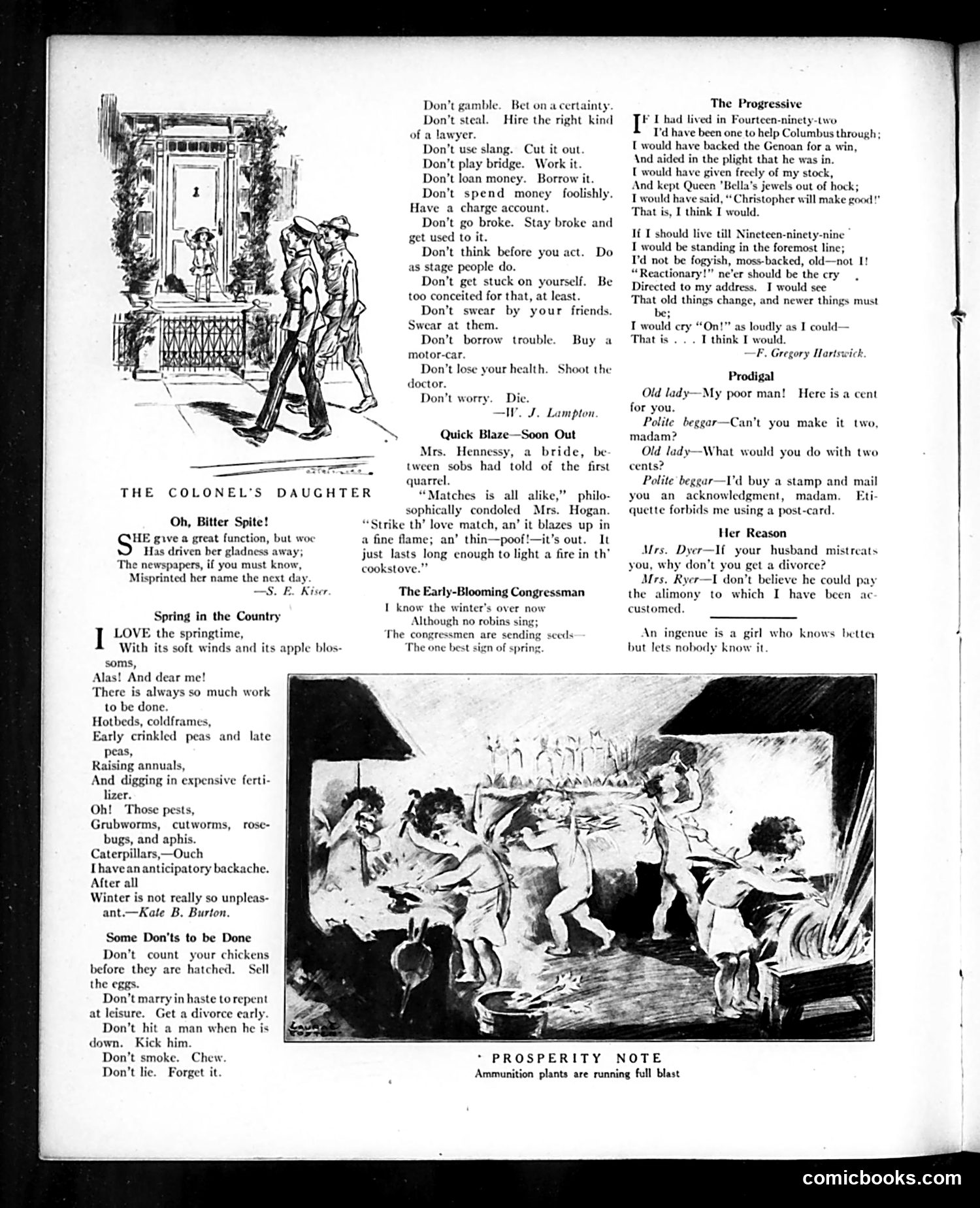
This page contains multiple short satirical pieces typical of early-20th-century humor magazines. **"The Colonel's Daughter"** jokes about a society woman whose name was misprinted in newspaper coverage of her grand party—a mild jab at both newspaper incompetence and the vanity of the wealthy. **"Some Don'ts to be Done"** is ironic advice that inverts conventional wisdom (e.g., "Don't marry in haste to repent at leisure. Get a divorce early"; "Don't hit a man when he is down. Kick him"). It satirizes both modern permissiveness and the era's increasing acceptance of divorce. **"The Early-Blooming Congressman"** mocks congressmen for sending out free seeds to constituents as self-promotion—a common patronage practice of the era. **"Prosperity Note"** references ammunition plants operating "full blast," likely referencing World War I industrial production (U.S. involvement 1917-1918), suggesting economic boom tied to war manufacturing. The remaining pieces are light domestic humor about marriage, begging, and gardening. The overall tone is gentle mockery of American manners and politics.
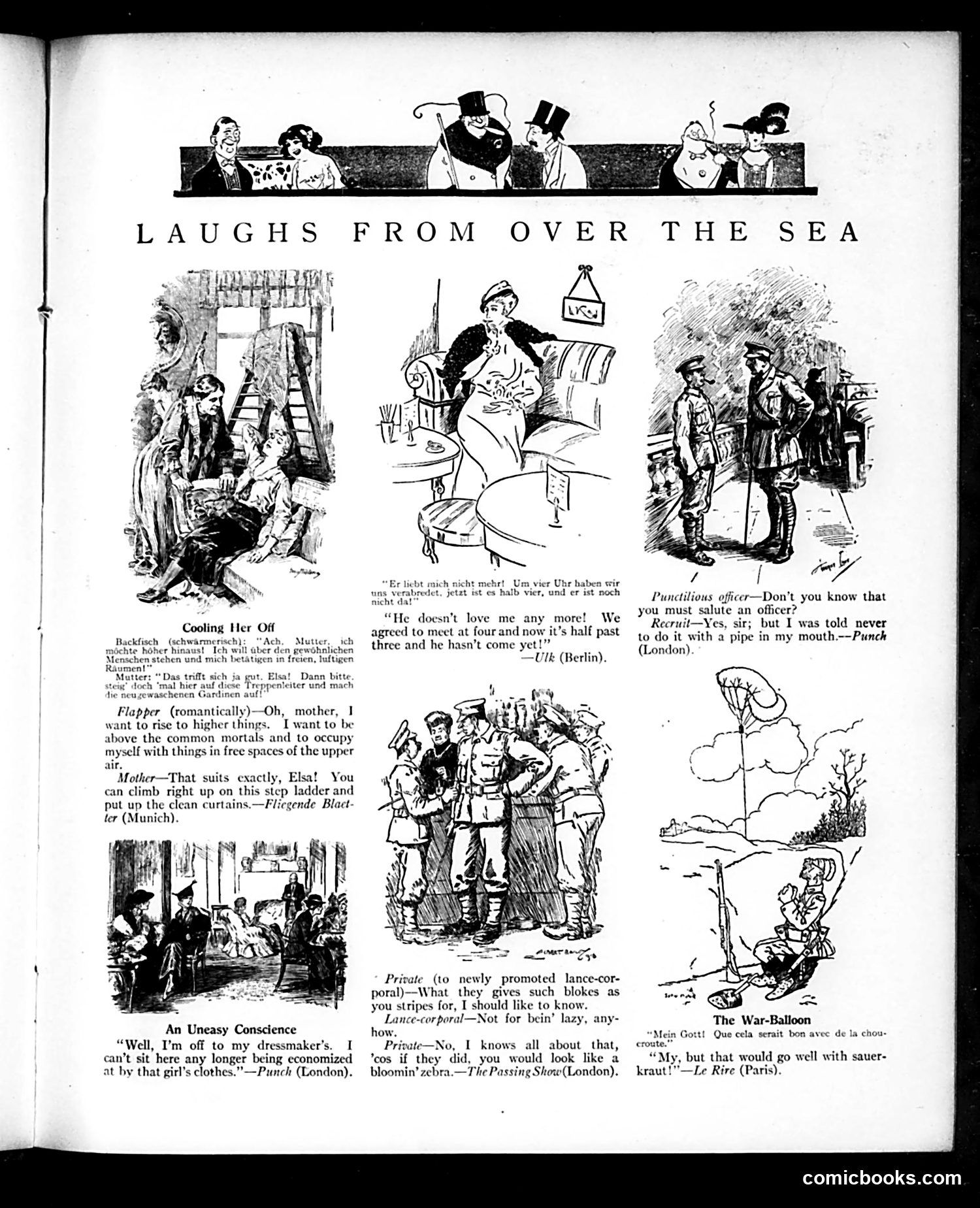
This page collects humorous cartoons and jokes translated from European satirical magazines (German *Ulk*, *Fliegende Blätter*; British *Punch*, *The Passing Show*; French *Le Rire*). The content reflects post-WWI social humor: **"Cooling Her Off"** and **"An Uneasy Conscience"**: Domestic comedy about romantic disappointment and women's wartime economizing. **"The Flapper"**: Satire on 1920s youth culture—a young woman romantically aspires to "higher things" but is merely assigned mundane household tasks (climbing a ladder to hang curtains). **Military jokes**: Several cartoons mock military hierarchy and the absurdity of newfound authority among newly-promoted soldiers. **"The War-Balloon"**: References sauerkraut, likely mocking German food/culture during post-war tensions. The page's appeal lay in sharing European wit with American readers, while gently satirizing contemporary social changes: women's liberation aspirations, military class systems, and lingering wartime prejudices.
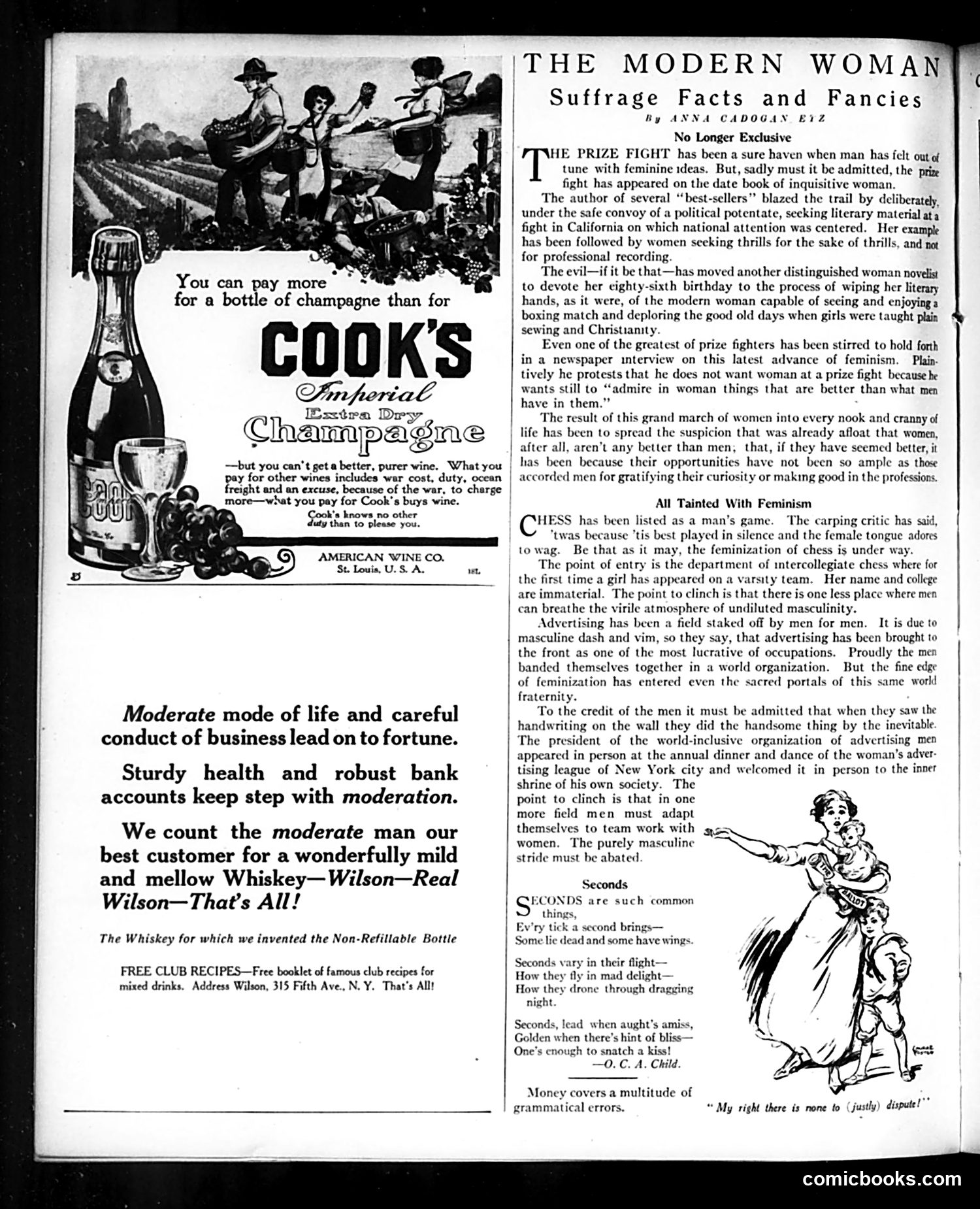
This page primarily features **advertisements** (Cook's Champagne and Wilson Whiskey) alongside a satirical article titled "The Modern Woman: Suffrage Facts and Fancies" by Anna Cadogan Eiz. The article mocks women's expanding social participation during the suffrage era. It criticizes female authors attending prize fights for "thrills," expresses dismay that women now play chess competitively, and laments women entering advertising—traditionally male-dominated fields. The satire's point: progressive women infiltrating male spaces supposedly proves women aren't inherently superior to men, merely had fewer opportunities. The author presents women's equality ironically as a *loss*—men lose exclusive havens of "undiluted masculinity." The piece exemplifies early 20th-century anti-feminist sentiment using humor to argue that expanding women's freedoms reveals they're ordinary, not morally better, thus undermining suffrage arguments about women's special virtues.
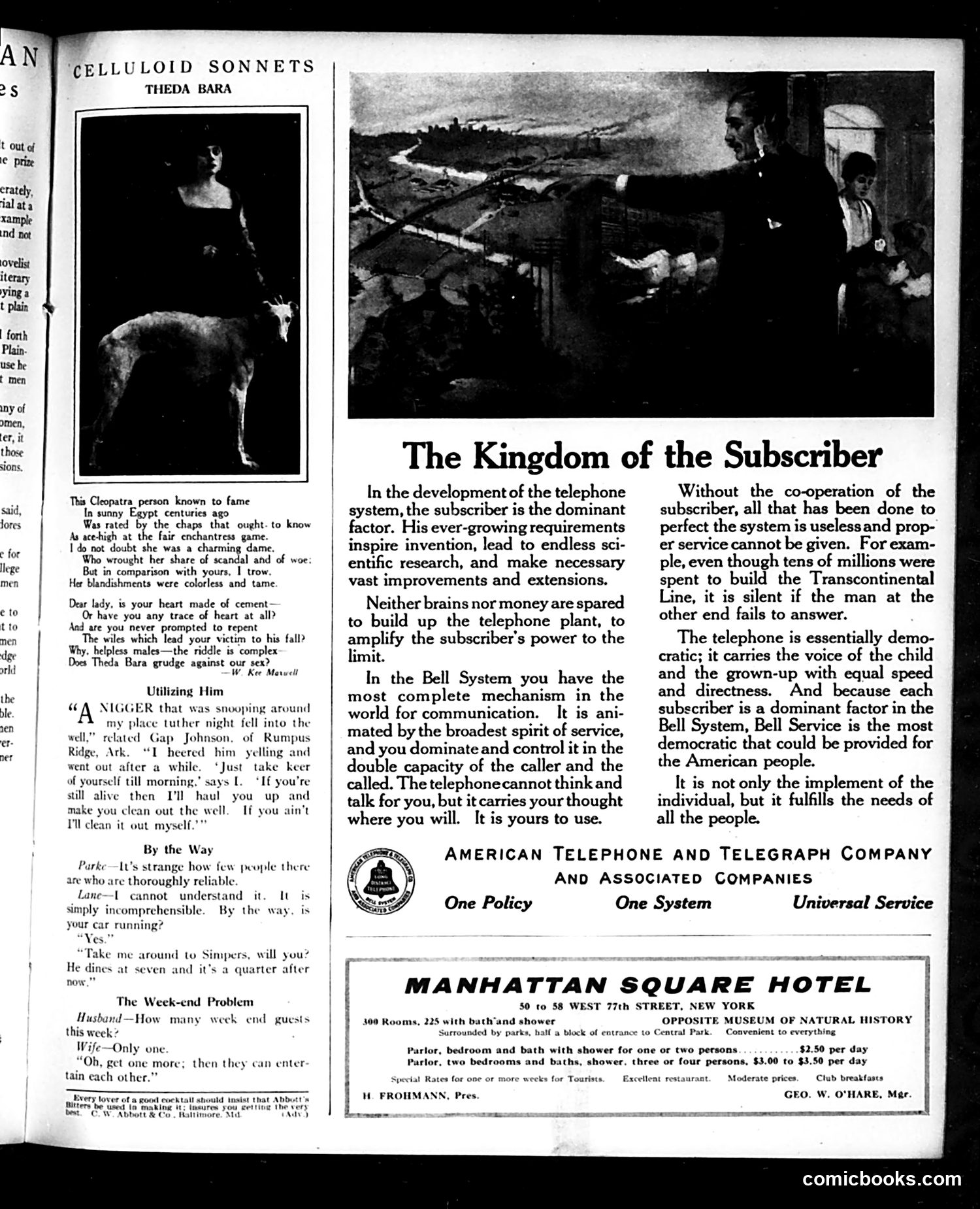
This page contains satirical poetry about the actress **Theda Bara**, a famous silent film star known for playing seductive, dangerous women ("vamp" roles). The "Celluloid Sonnets" mock her screen persona by comparing her to Cleopatra—suggesting her on-screen seductions are even more destructive than the historical figure's, and sarcastically asking if she has any genuine human emotion beneath her manipulative exterior. The humor targets both Bara's manufactured movie image and contemporary anxieties about female sexuality and power. The page also includes unrelated humorous anecdotes ("Utilizing Him," "By the Way," "The Week-end Problem") typical of Judge's miscellaneous joke sections. The remainder is dominated by a **Bell Telephone advertisement** ("The Kingdom of the Subscriber") presenting corporate rhetoric about service and democracy—ironic placement alongside satire mocking artificial personas.
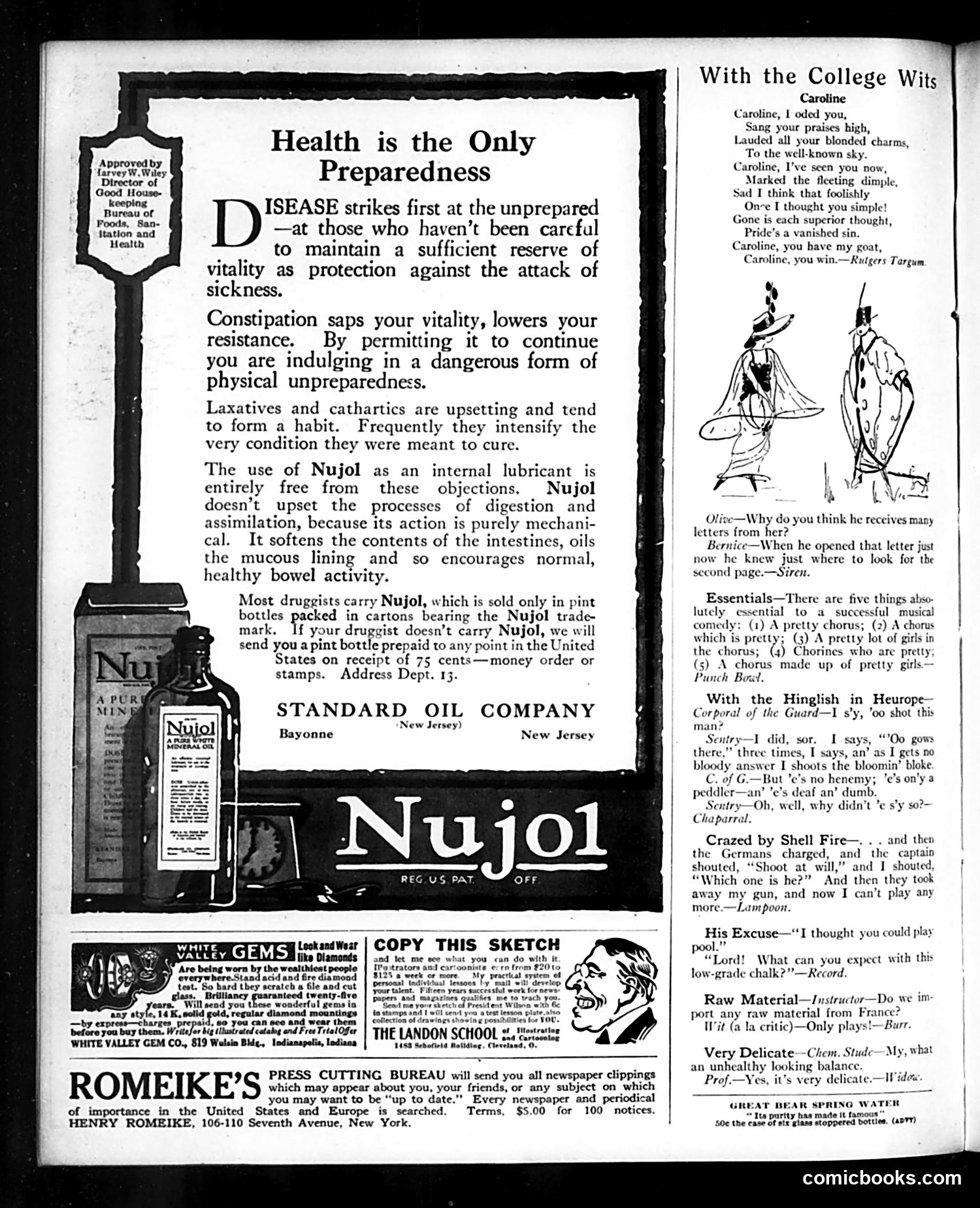
This page is primarily **advertising**, dominated by a large Nujol (mineral oil) laxative ad endorsed by Harvey W. Wiley, a famous "muckraking" food safety official. The ad uses **wartime "preparedness" rhetoric**—popular during World War I—to sell constipation relief, claiming poor digestion weakens one's resistance to disease and thus represents "physical unpreparedness." The right column contains humor excerpts titled "With the College Wits," featuring short jokes about romance and military life that appear reprinted from college humor magazines (Rutgers Targum, Siren, etc.). These include a soldier's confusion about following orders and sexual innuendo about letter-reading. The satire is subtle: the ad cynically weaponizes patriotic health language to market a mundane product. The college humor is typical period banter—mildly risqué by 1910s standards but now mostly quaint. Bottom ads include diamond simulants and a press-clipping service.
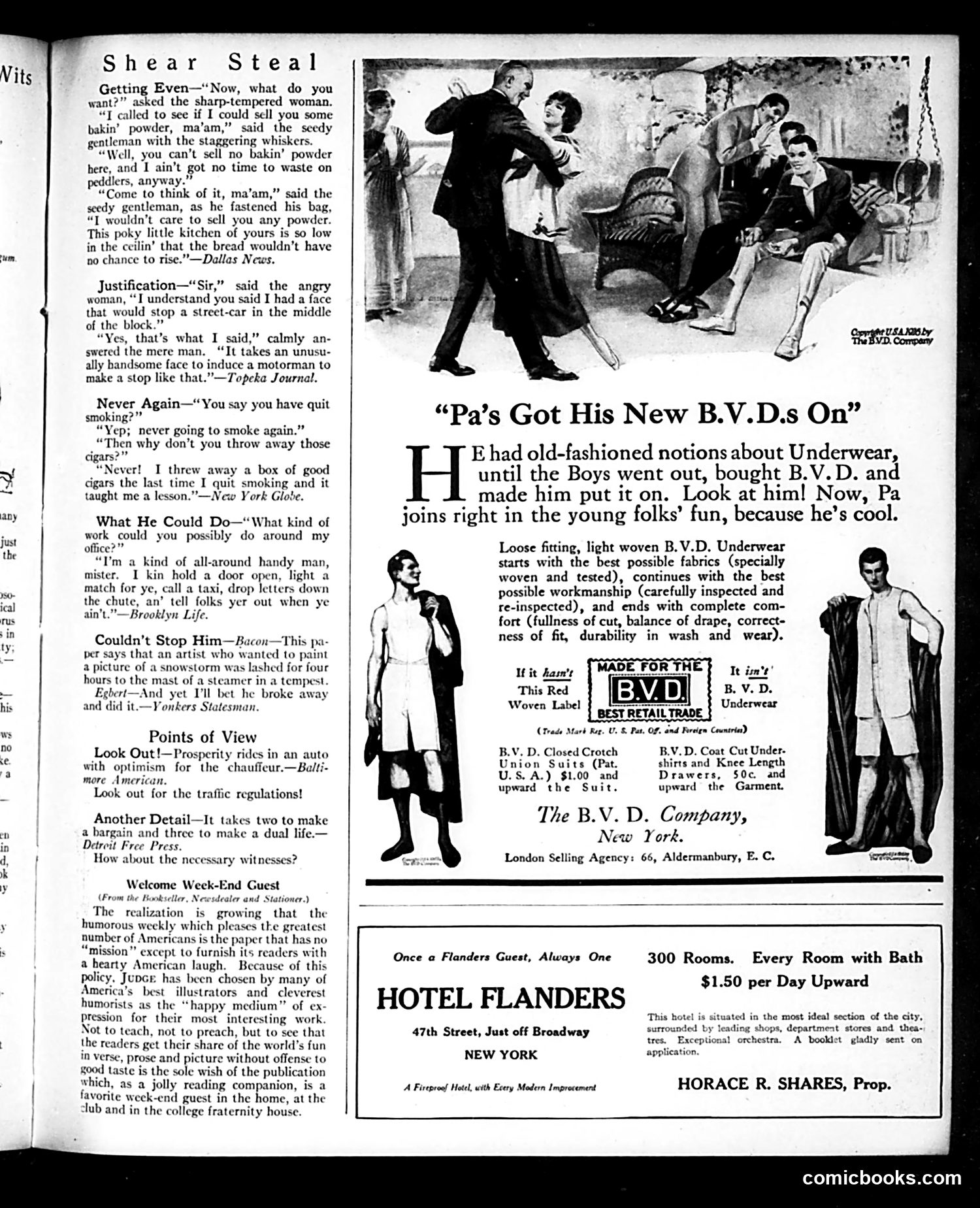
This page combines satirical humor with advertising, typical of Judge magazine's format. **The "Shear Steal" section** contains four brief humorous anecdotes mocking social interactions: - A door-to-door salesman insults a woman's kitchen ceiling to avoid rejection - A man compliments a woman's face as "handsome enough to stop a streetcar" (sarcastically praising her after allegedly insulting her) - A man explains he threw away good cigars when quitting smoking because keeping them tempted relapse - A job applicant lists absurdly menial tasks as qualifications These jokes rely on wordplay, ironic comebacks, and social awkwardness—typical early-20th-century humor. **The main advertisement** promotes B.V.D. men's underwear, claiming it's modern and cool enough that an old-fashioned father now joins young people's fun by wearing it. The ad emphasizes quality construction and comfort—marketing casual modern dress to an older generation resistant to change. The page is primarily advertising-driven content framed by light satirical humor reflecting period attitudes about commerce, gender relations, and generational differences.
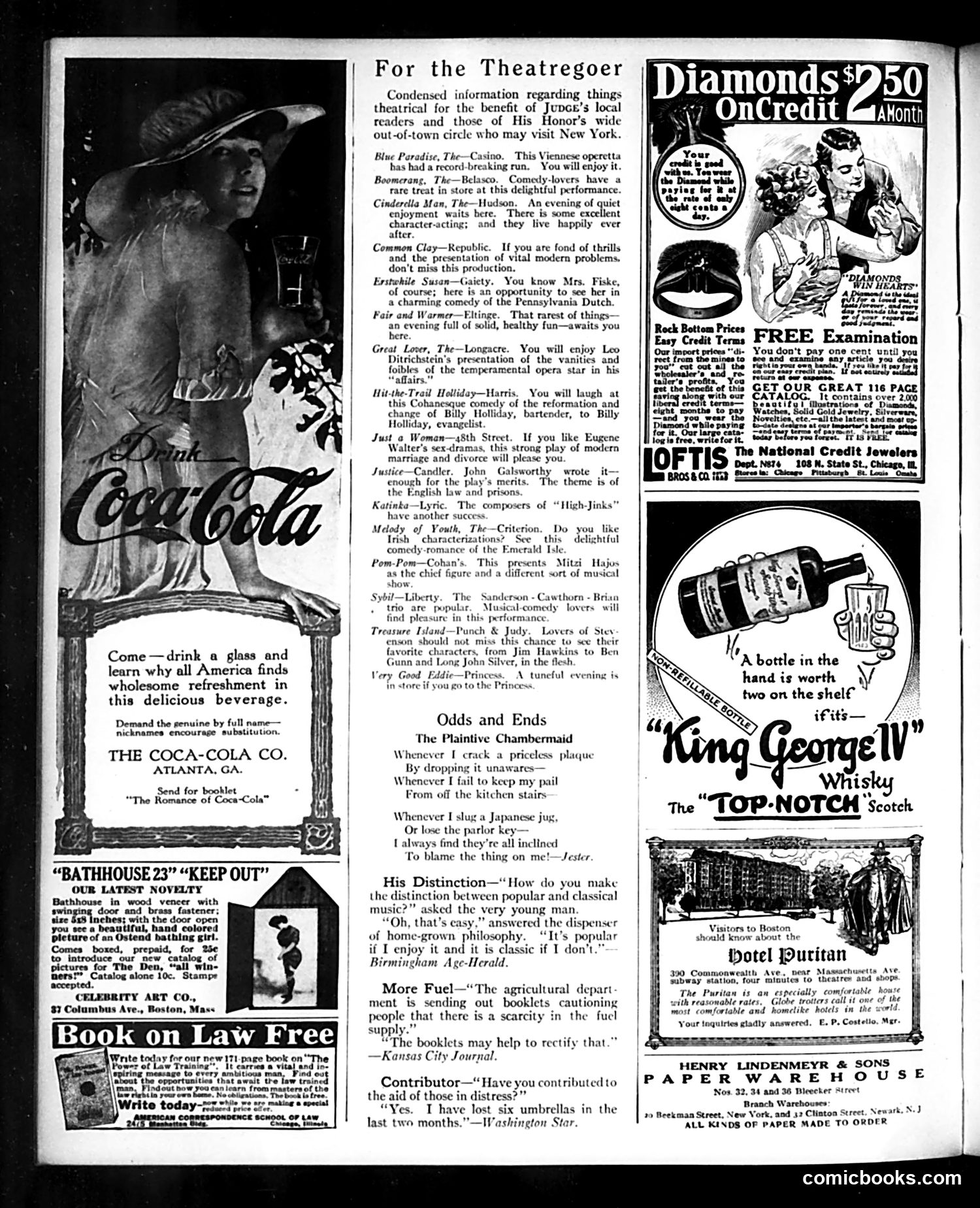
This page is primarily **advertising and theatrical listings**, not political satire. It contains: **Main Content:** - A large Coca-Cola advertisement featuring a woman in elegant dress, promoting the beverage as "wholesome refreshment" - A "For the Theatregoer" section listing Broadway shows with brief reviews (Blue Paradise, Common Clay, Justice, etc.) - Multiple product advertisements (Bathhouse novelty item, diamonds on credit, whiskey, hotel) **Notable Elements:** The Coca-Cola ad emphasizes authenticity ("Demand the genuine by full name—nicknames encourage substitution"), reflecting early 20th-century concerns about product counterfeiting. The theatrical reviews reflect contemporary theatrical tastes: operettas, comedies about modern marriage/divorce, and literary adaptations (Galsworthy, Stevenson). **No clear political cartoon or satire is visible**—this appears to be a typical Judge magazine page mixing entertainment content with commercial advertising, representative of early 1900s leisure-class publications.
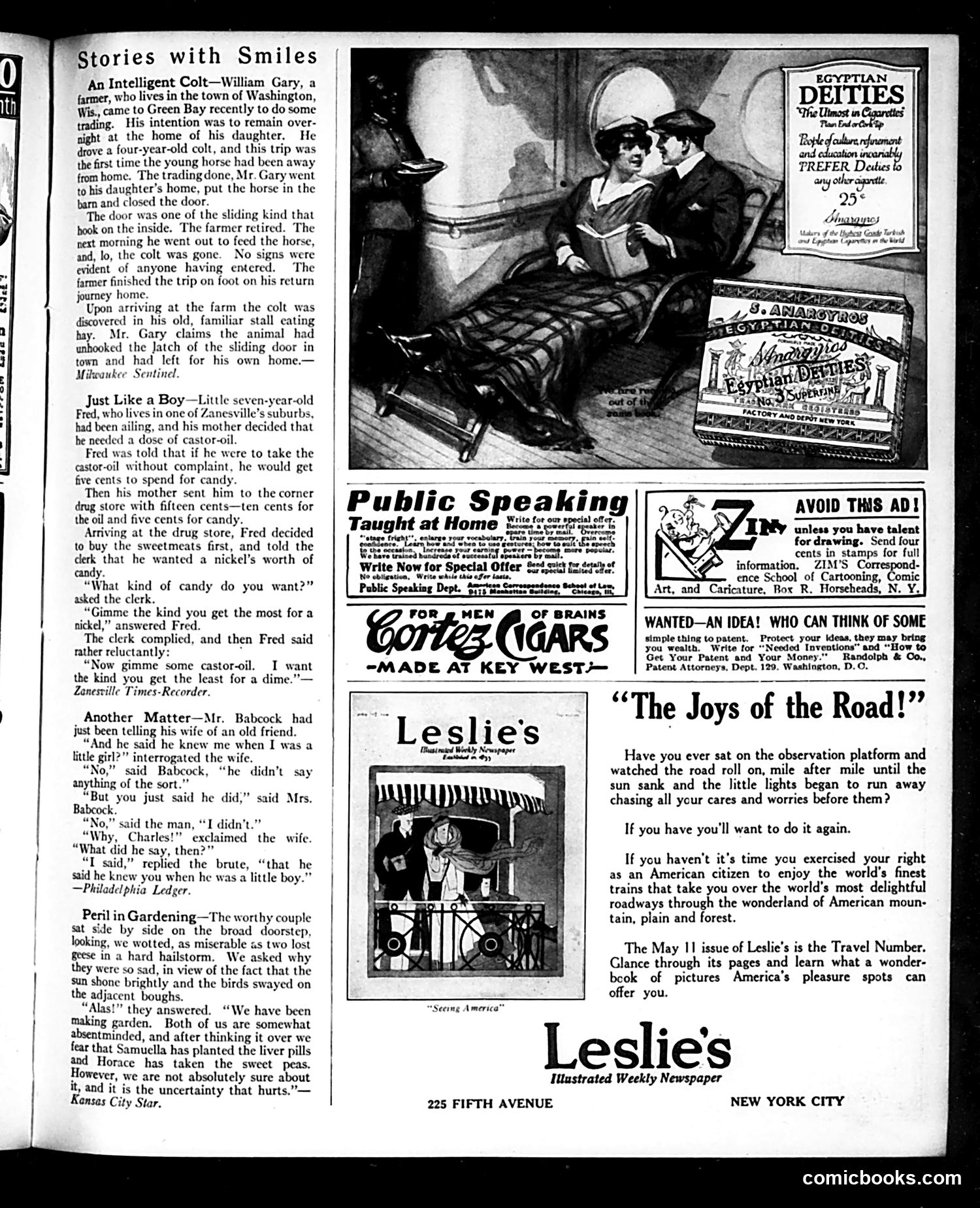
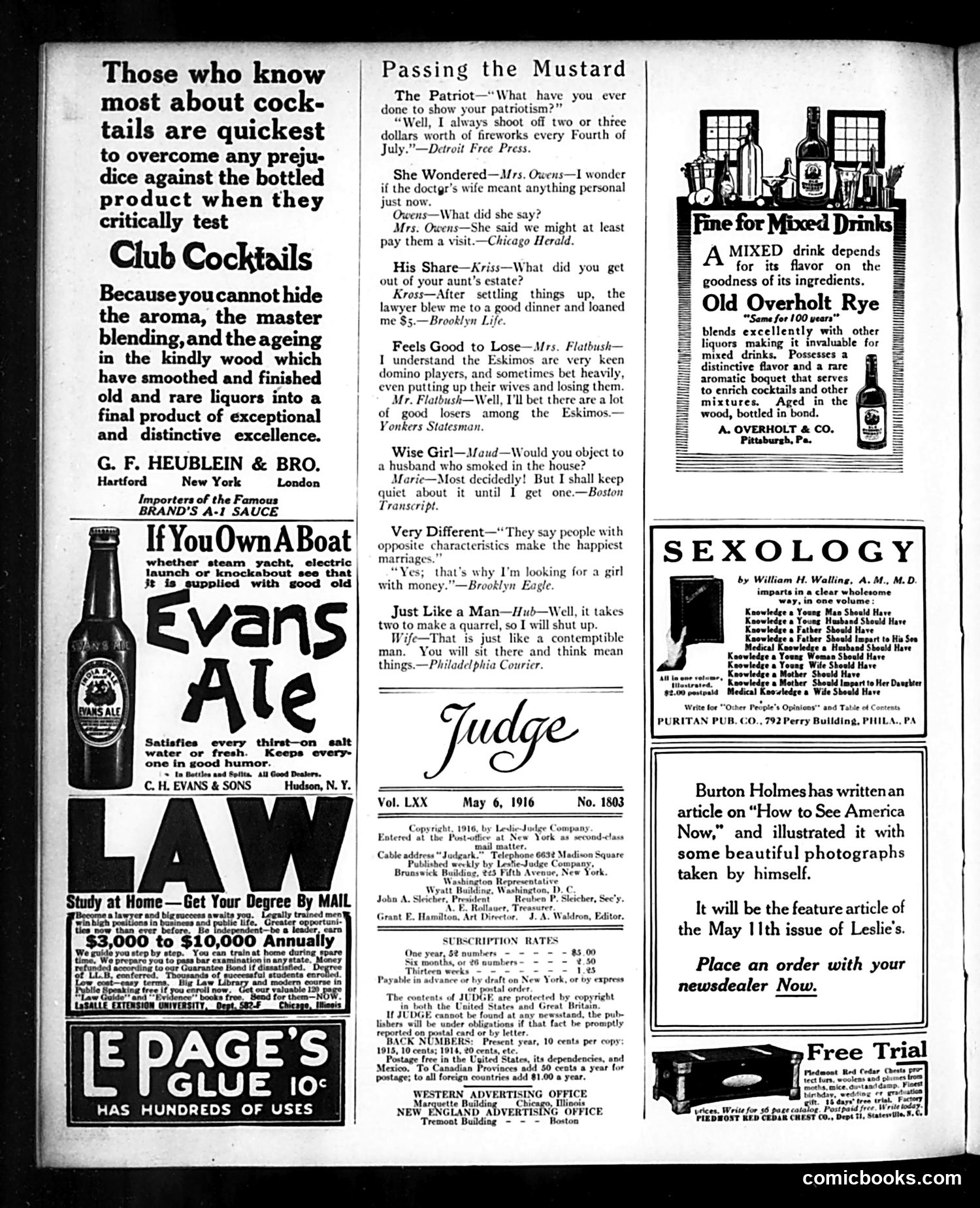
This is primarily a **title/advertising page** from Judge magazine rather than a satirical cartoon page. The center features brief humor anecdotes under "Passing the Mustard"—short jokes about patriotism (spending money on fireworks), marriage dynamics, inheritance, gambling, and spousal compromises. These are light social satire reflecting early 20th-century domestic concerns. The surrounding advertisements reveal period interests: cocktail mixers (Club Cocktails, Old Overholt Rye), boat supplies, Evans Ale, correspondence law degrees, and notably a "Sexology" book—suggesting audience concerns about modern knowledge and propriety. The page includes a Burton Holmes travel photography announcement, reflecting the magazine's mix of humor, consumer goods, and educational content for middle-class readers. No specific political figures or events are caricatured here; instead, the humor targets universal domestic and social pretensions.
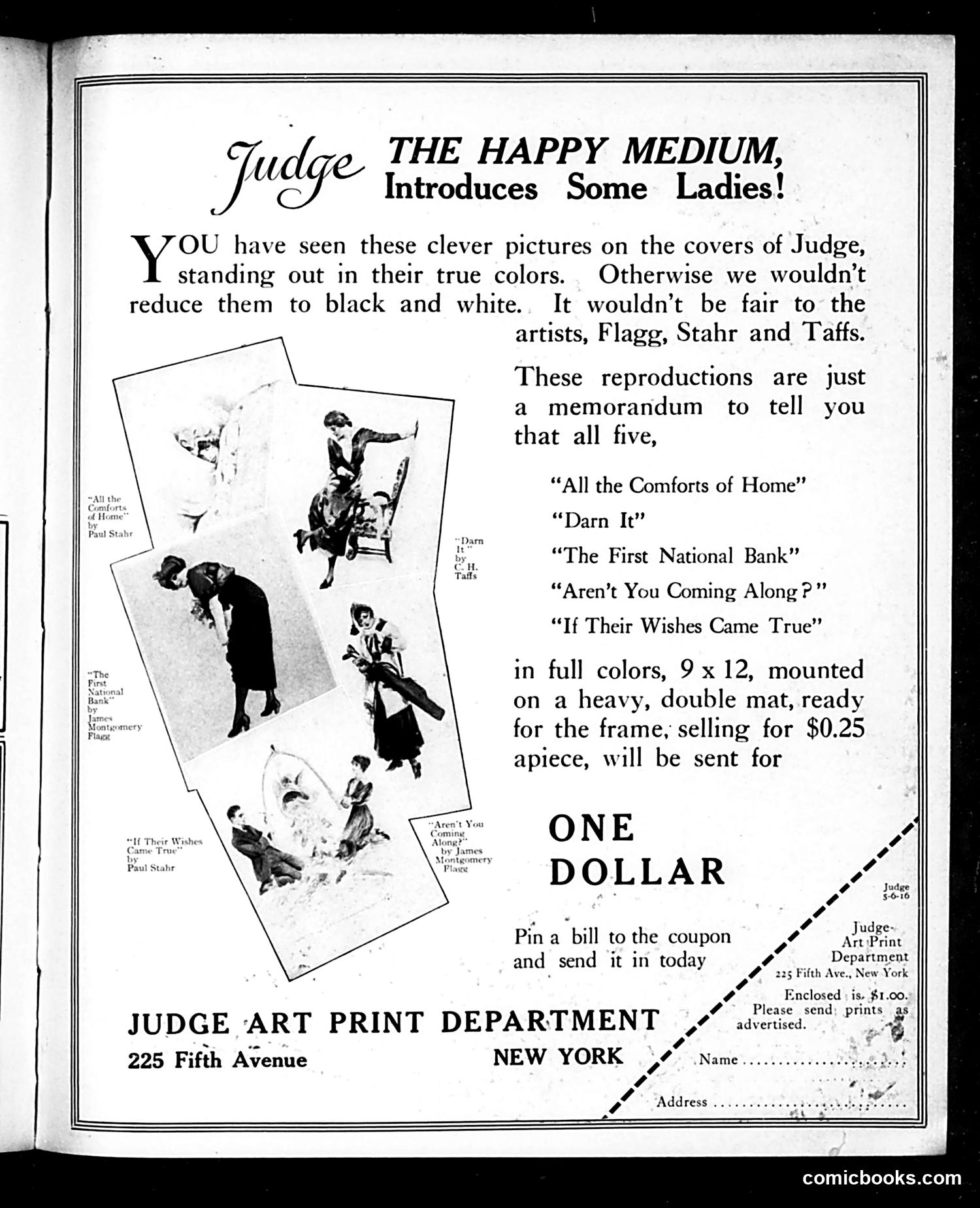
This is primarily **advertising content**, not satire. Judge magazine is promoting art prints based on cover illustrations by artists Flagg, Stahr, and Taffs. The page explains that these colorful cover artworks are being reproduced in black-and-white here as a "memorandum"—essentially a preview. The five titles listed ("All the Comforts of Home," "Darn It," "The First National Bank," "Aren't You Coming Along?," "If Their Wishes Came True") appear to be humorous domestic or social scenes typical of Judge's satirical style, though their specific jokes aren't visible in this reproduction. **The pitch**: Full-color prints (9x12 inches, matted and framed-ready) normally sell for 25 cents each, but customers can buy all five for **one dollar**—a promotional bundle deal. Readers mail payment with the coupon to Judge's Art Print Department in New York. This represents early 20th-century merchandising: magazines monetizing their editorial content through print sales.
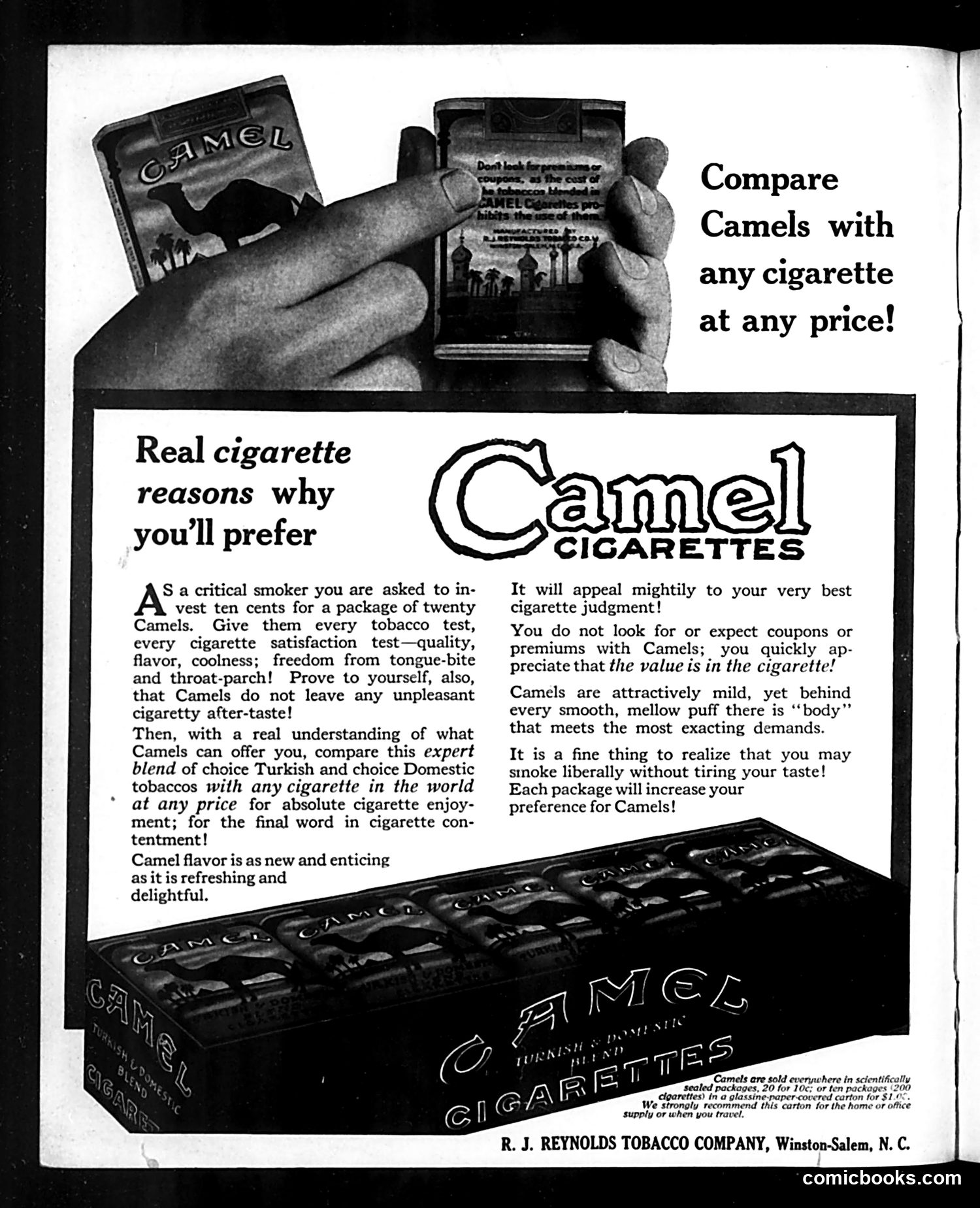
This page is **primarily a Camel cigarette advertisement**, not satire or political commentary. It dates from the early 20th century, when such advertising was common in magazines like *Judge*. The ad features a hand holding two cigarette packages, with text urging readers to compare Camels favorably against competitors "at any price." The messaging emphasizes quality attributes—mildness, flavor, "body"—and notably highlights that Camels offer **no coupons or premiums**, positioning this as a selling point rather than a disadvantage. This reflects contemporary marketing strategy: appealing to consumers who valued the product itself over gimmicks. The phrase "value is in the cigarette" underscores this positioning. There is no satire here—this is straightforward product marketing targeting "critical smokers" as an aspirational audience.