
Judge, 1916-05-06 · page 12 of 28
Judge — May 6, 1916 — page 12: what you’re looking at
What you’re looking at
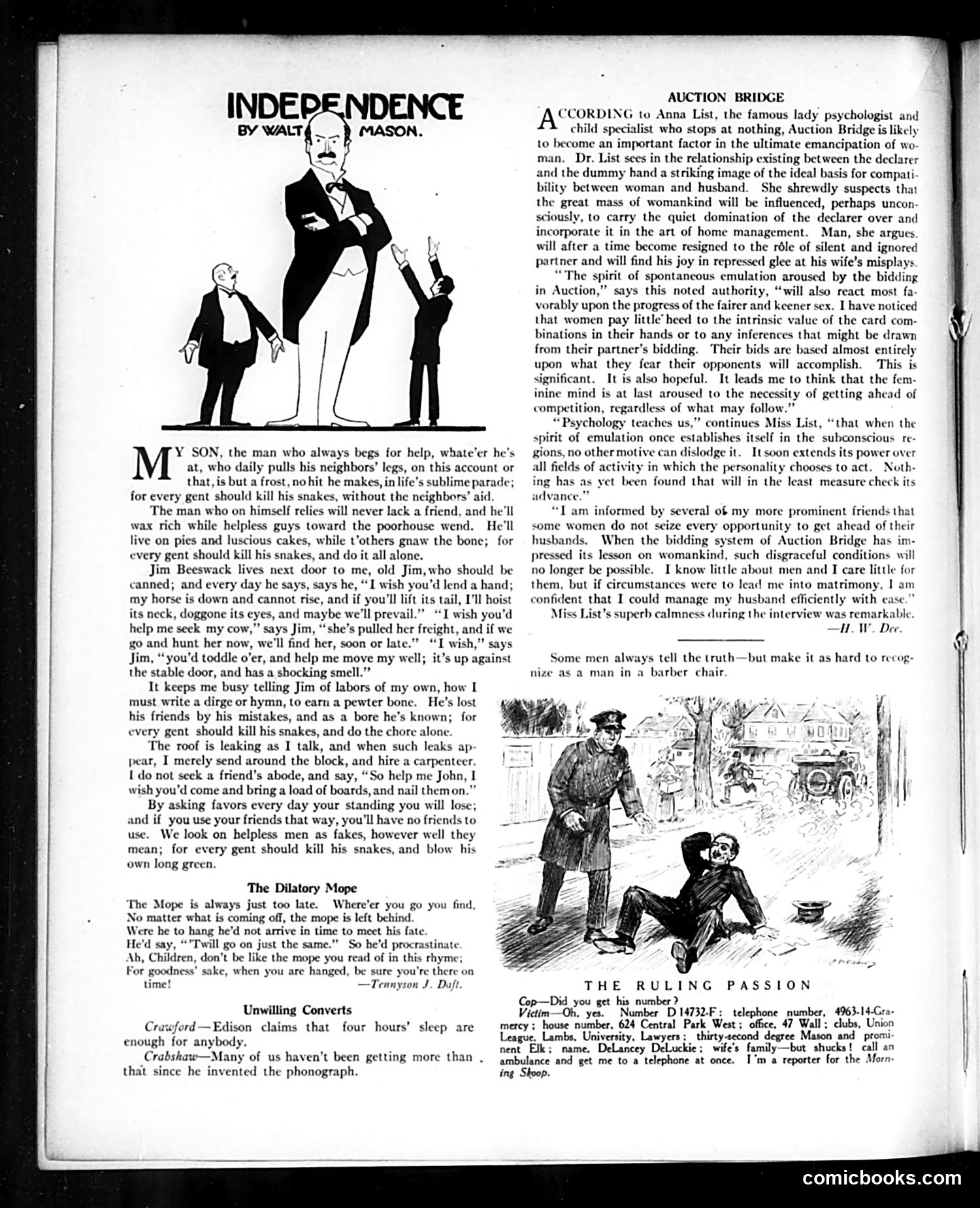
This page satirizes **dependency and self-reliance** through two main pieces: **"Independence" (left cartoon):** A tall man towers over two smaller men in formal dress. The accompanying poem mocks men who constantly ask neighbors for help—"Jim Beeswack" exemplifies this type, perpetually borrowing assistance with his horse, cow, and leaky roof. The satire's message: real manhood means solving your own problems without burdening others. Self-reliance builds respect and friendships; chronic neediness destroys both. **"Auction Bridge" (right article):** A humorous pseudo-psychological piece praising the card game as beneficial to women's emancipation. Anna List (likely a fictional expert) argues that Auction Bridge teaches women competitive strategy and independence by casting the "declarer" role as dominant. The satire gently mocks both pop-psychology trends and gender dynamics of the era. Both pieces reflect early 20th-century American values emphasizing self-sufficiency and competitive individualism.
📄 Transcribed text from this page (OCR, searchable)
Machine-transcribed from the original scan — historical spelling and the odd misread are preserved.
at, who daily pulls his neighbors’ legs, on this account or that, is but a frost, no hit he makes, in life’s sublime parade; for every gent should kill his snakes, without the neighbors’ aid. The man who on himself relies will never lack a friend, and he'll wax rich while helpless guys toward the poorhouse wend. He'll live on pies and lus s, while t'others gnaw the bone; for every gent should kill his snakes, and do it all alone. Jim Beeswack lives next door to me, old Jim, who should be canned; and every day he says, says he, “I wish you'd lend a hand; my horse is down and cannot rise, and if you'll lift its tail, I'll hoist its neck, doggone its eyes, and maybe we'll prevail.” “I wish you'd help me seek my cow,” says Jim, “‘she’s pulled her freight, and if we go and hunt her now, we'll find her, soon or late.” “I wish,” says Jim, “you'd toddle o’er, and help me move my well; it’s up against the stable door, and has a shocking smell.”” It keeps me busy telling Jim of labors of my own, how I must write a dirge or hymn, to earn a pewter bone. He’s lost his friends by his mistakes, and as a bore he’s known; for y gent should kill his snakes, and do the chore alone. he roof is leaking as I talk, and when such leaks ap- pear, I merely send around the block, and hire a carpenteer. I do not seek a friend’s abode, and say, “So help me John, I wish you'd come and bring a load of boards, and nail themon.” By asking favors every day your standing you will lose; and if you use your friends that way, you'll have no friends to use. We look on helpless men as fakes, however well they mean; for every gent should kill his snakes, and blow his own long green. M SON, the man who always begs for help, whate’er he’s The Dilatory Mope ‘The Mope is always just too late. Where’er you go you find, No matter what is coming off, the mope is left behind. Were he to hang he'd not arrive in time to meet his fate. He'd say, “’Twill go on just the same.” So he'd procrastinate. Ab, Children, don’t be like the mope you read of in this rhyme; For goodness’ sake, when you are hanged, be sure you're there on AUCTION BRIDGE AS “ORDING to Anna List, the famous lady psychologist and child specialist who stops at nothing, Auction Bridge is likely to become an important factor in the ultimate emancipation of wo. man. Dr. List sees in the relationship existing between the declarer and the dummy hand a striking image of the ideal basis for compati bility between woman and husband. She shrewdly suspects that the great mass of womankind will be influenced, perhaps uncon- sciously, to carry the quiet domination of the declarer over and incorporate it in the art of home management. Man, she argues. will after a time become resigned to the réle of silent and ignored partner and will find his joy in repressed glee at his wife’s misplays. “The spirit of spontaneous emulation aroused by the bidding in Auction,” says this noted authority, “will also react most fa- vorably upon the progress of the fairer and keener sex. I have noticed that women pay little’ heed to the intrinsic value of the card com- binations in their hands or to any inferences that might be drawn from their partner’s bidding. Their bids are based almost entirely upon what they fear their opponents will accomplish. This is significant. It is also hopeful. It leads me to think that the fem- inine mind is at last aroused to the necessity of getting ahead of competition, regardless of what may follow.” “Psychology teaches us,” continues Miss List, “that when the spirit of emulation once establishes itself in the subconscious re- gions, no other motive can dislodg It soon extends its power over all fields of act y in which the personality chooses to act. Noth- ing has as yet been found that will in the least measure check its advance “I am informed by several of my more prominent friends that some women do not ¢ every opportunity to get ahead of their husbands. When the bidding system of Auction Bridge has im- pressed its lesson on womankind, such disgraceful conditions will no longer be possible. I know little about men and I care little for them, but if circumstances were to lead me into matrimony, | am confident that I could manage my husband efficiently with ease.” Miss List’s superb calmness during the interview was remarkable. H.W. Dee. Some men always tell the truth—but make it as hard to recog- nize as a man in a barber chair. THE RULING PASSION Cop—Did you get his number? Victim—Oh, yes. Number D 14732-F: telephone number, 4963-14-Gra- mercy ; house number, 624 Central Park West; office, 47 Wall ; clubs, Union League, Lambs. University, Lawyers; thirty-second degree Mason and _promi- nent Elk; name, DeLancey DeLuckie; wife’s family—but shucks! call an ambulance and get me to a telephone at once. I'm a reporter for the Morn- ing Skoop. time! —Tennyson J. Daft. Unwilling Converts Crawford —Edison claims that four hours’ sleep are enough for anybody. Crabshaw—Many of us haven't been getting more than . that since he invented the phonograph. comicbooks.com