
A complete issue · 28 pages · 1916
Judge — March 25, 1916
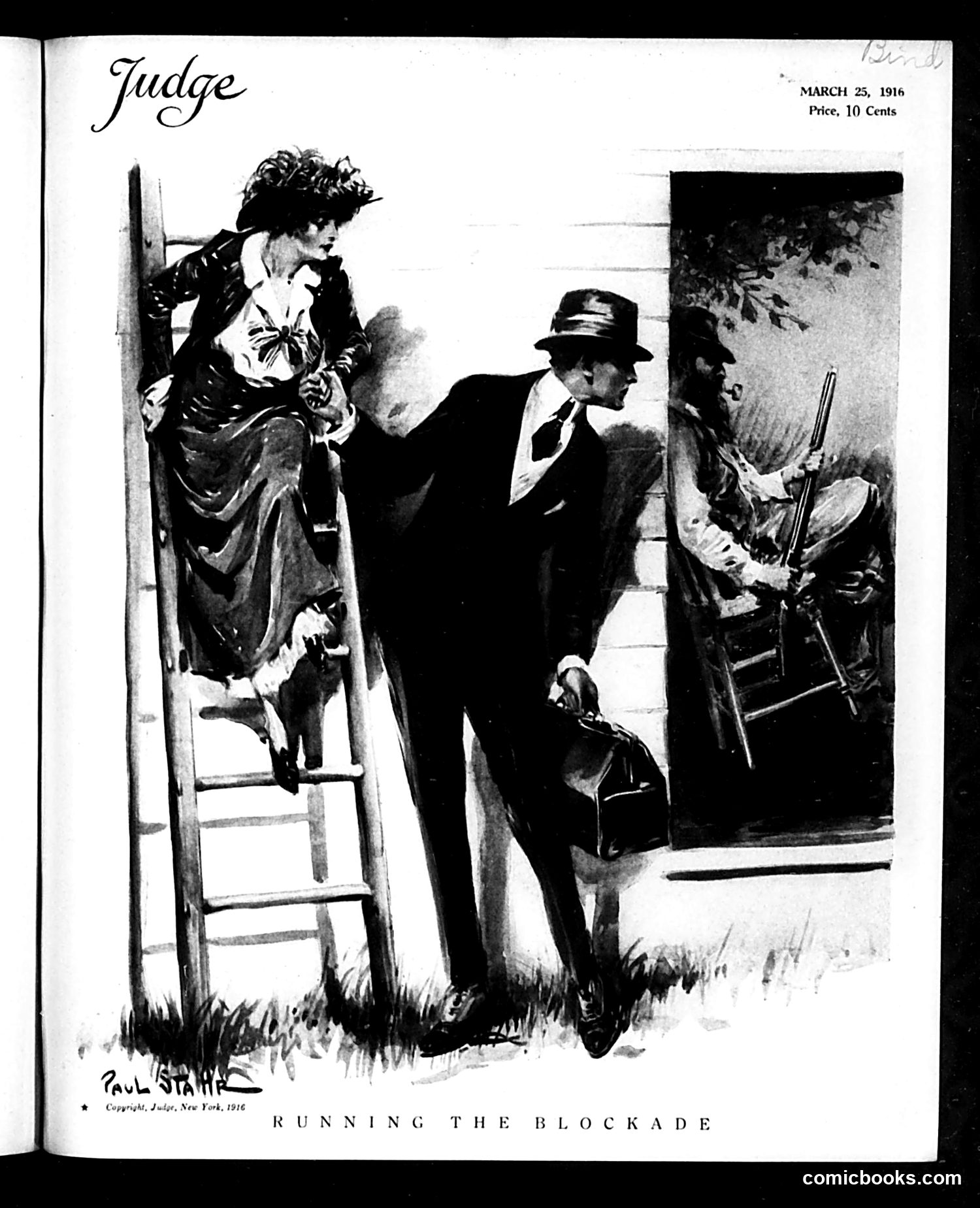
This political cartoon satirizes efforts to circumvent the British naval blockade of Germany during World War I. The well-dressed man in the center appears to represent a neutral trader or smuggler attempting to conduct business with Germany despite the blockade. The woman on the ladder (likely representing America or American commerce) is being pulled back, while the figure on the right (possibly a British official) watches the illegal transaction. The cartoon criticizes American merchants who profited by running supplies through the British blockade to supply Germany. This was a contentious issue in 1916—the U.S. remained officially neutral until 1917, but American businesses traded with both sides, fueling debate about true neutrality and national allegiances during the war.

This page is **primarily a cigarette advertisement**, not political satire. It's a Camel cigarettes ad from R.J. Reynolds Tobacco Company (Winston-Salem, N.C.), featuring the product's packaging and promotional claims. The ad emphasizes Camel's "new" blend of Turkish and Domestic tobaccos, claiming superior quality and taste compared to competitors. It highlights the scientific sealing process (shown in the circular detail at top) that preserves freshness during travel. There is **no political cartoon or satire** on this page. The visual elements—the large cigarette package, individual cigarettes, and product shots—serve purely commercial purposes. This represents typical early-to-mid 20th century tobacco marketing, before health warnings were required. Judge magazine apparently sold advertising space to cigarette manufacturers.
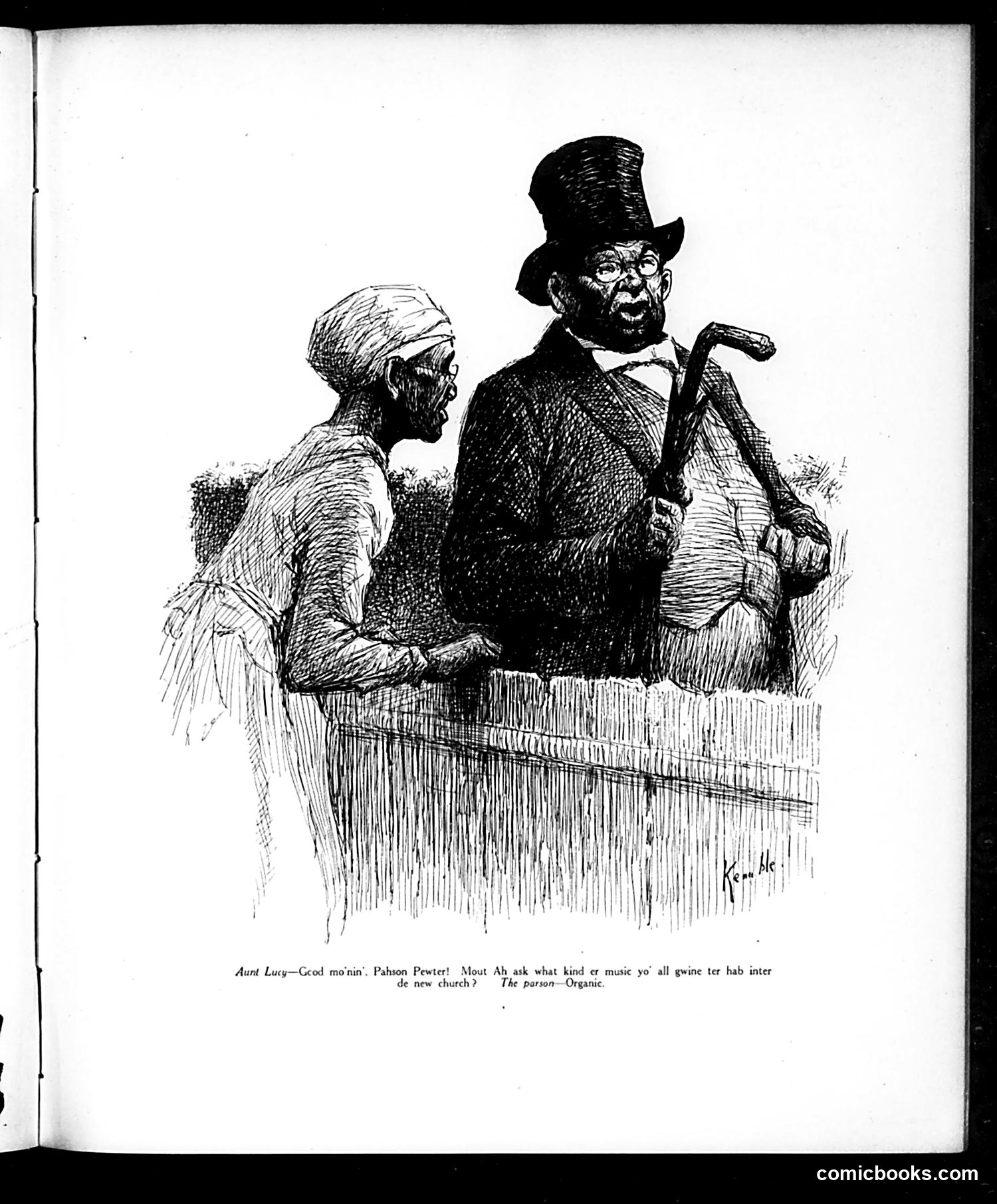
This cartoon depicts a conversation between "Aunt Lucy" and what appears to be a **Parson (church organist)** regarding music selection for a new church. The figure on the right—wearing a top hat and holding a cane, rendered in caricatured style—represents the parson. The joke centers on a **class or cultural clash**: Aunt Lucy asks what "kind er music yo' all gwine ter hab inter de new church," with the parson responding "The parson—Organist." The dialect suggests this involves rural or working-class perspectives versus formal church authority. The satire likely mocks either church pretension, disagreements over musical taste in religious settings, or the friction between traditional community practices and institutional formality. The specific historical context remains unclear without additional information about the magazine's date.
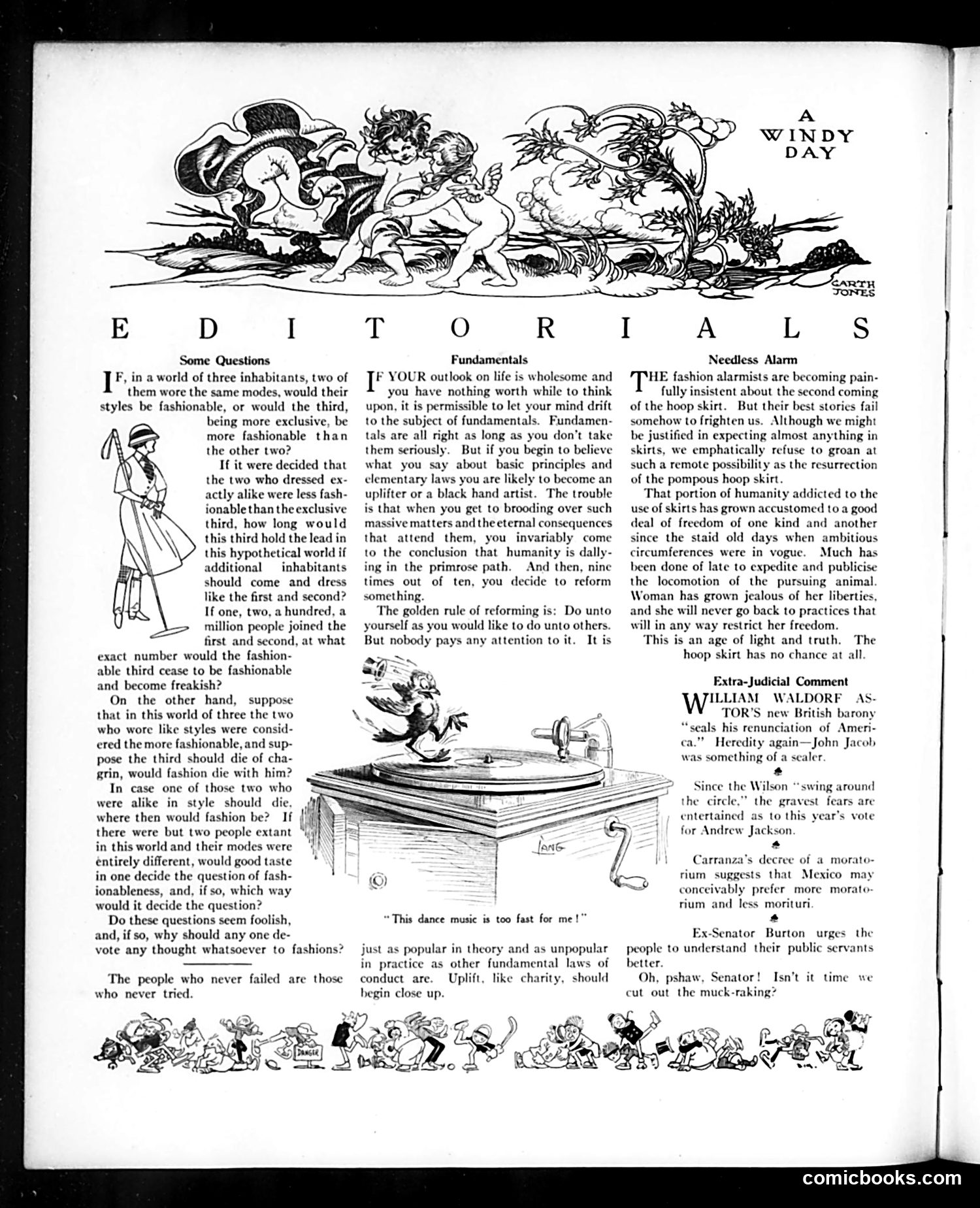
This page combines fashion commentary with political satire. The header illustration shows cherubs and wind-swept elements, establishing a "windy day" theme. The main text critiques fashion alarmists opposing the "second coming of the hoop skirt," sarcastically defending women's freedom to wear what they choose—a jab at moral reformers. The piece argues that complaints about fashion are futile: "This is as much a part of their and trivial. The hoop skirt has no chance of all." The "Extra-Judicial Comment" section references William Waldorf Astor's renunciation of American citizenship (calling him a "scaler"), Andrew Jackson's electoral prospects, and Mexican political matters under Carranza. The final item mocks ex-Senator Burton for suggesting public servants deserve better understanding—sardonic commentary on political entitlement.
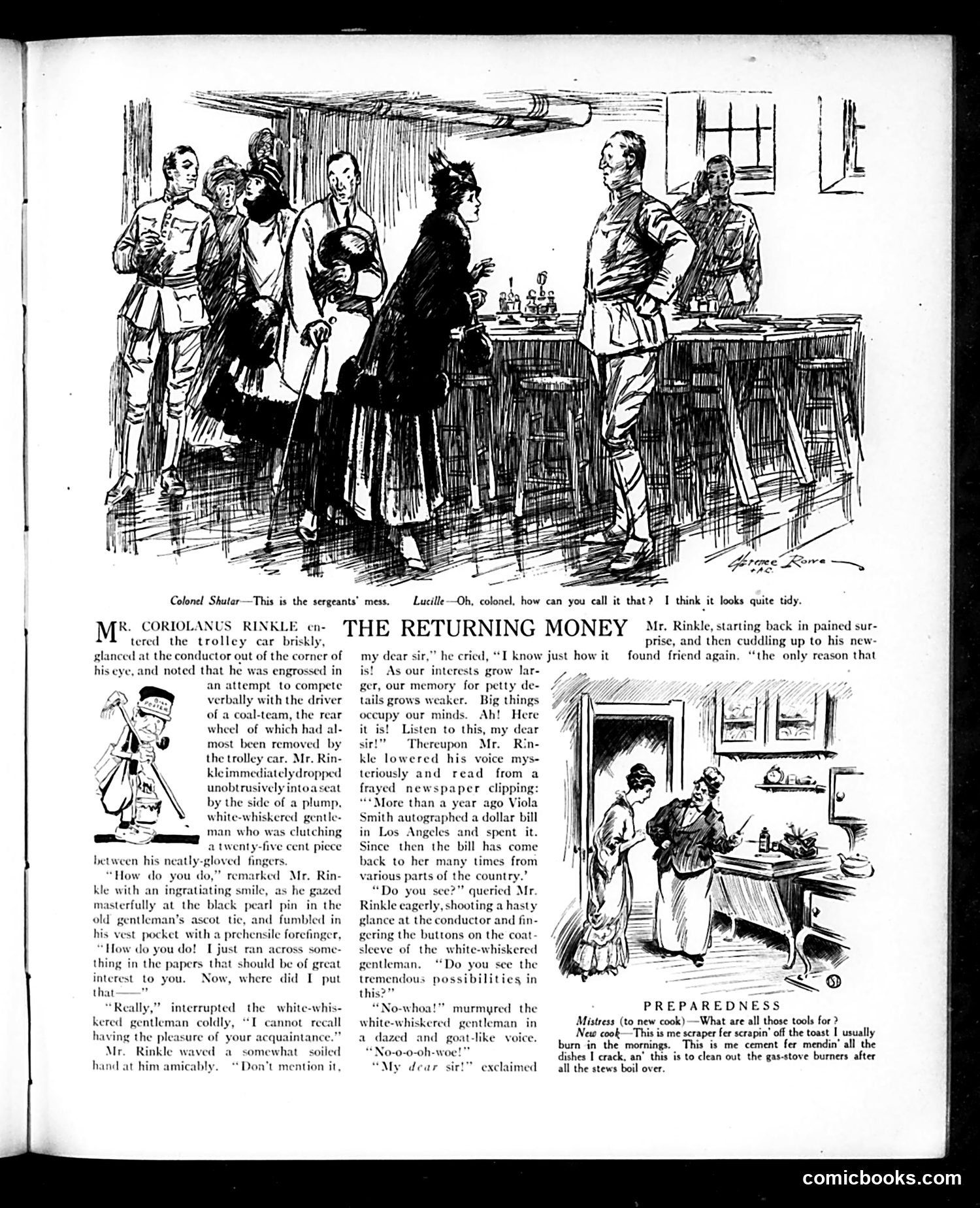
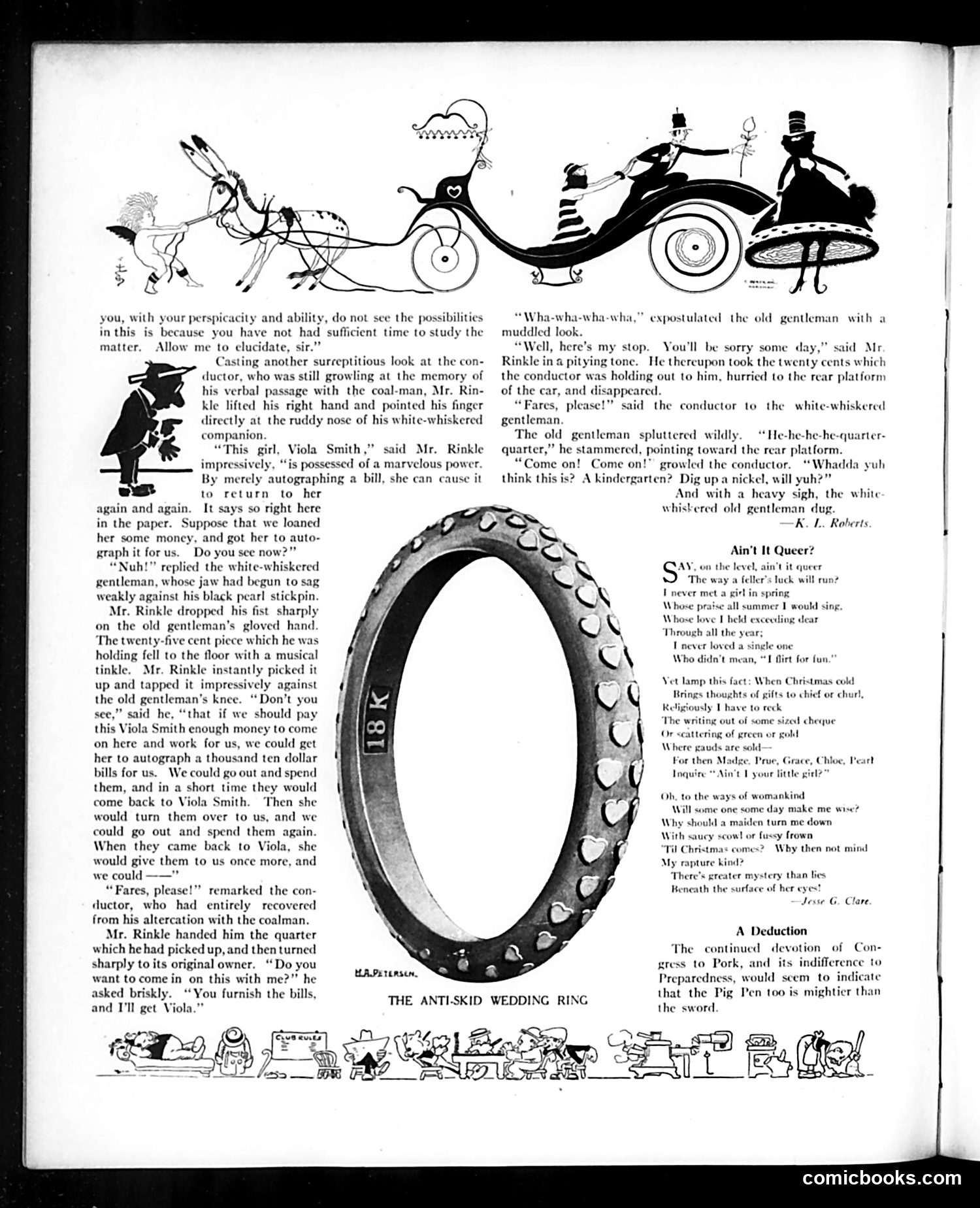
This page satirizes financial naïveté and get-rich-quick schemes. Mr. Rinkle proposes an absurd money-doubling plan: lend money to "Viola Smith" (a girl whose autographed bills allegedly "return to her"), have her sign thousand-dollar bills, spend them repeatedly, and profit infinitely as they cycle back. The scheme is transparently nonsensical—money doesn't magically regenerate through signatures—yet presented with complete earnestness to a gullible elderly gentleman. The cartoon mocks both con-men and marks: Rinkle's pseudointellectual "perspicacity" and finger-pointing, versus the old gentleman's gradual jaw-sagging comprehension of his own foolishness. The conductor's interruption for fares provides comic relief while highlighting the scheme's absurdity—real money matters (a 25-cent fare) intrude on fantasy. The page also includes unrelated poetry and a brief political quip about Congressional spending priorities favoring "Pork" over military preparedness.
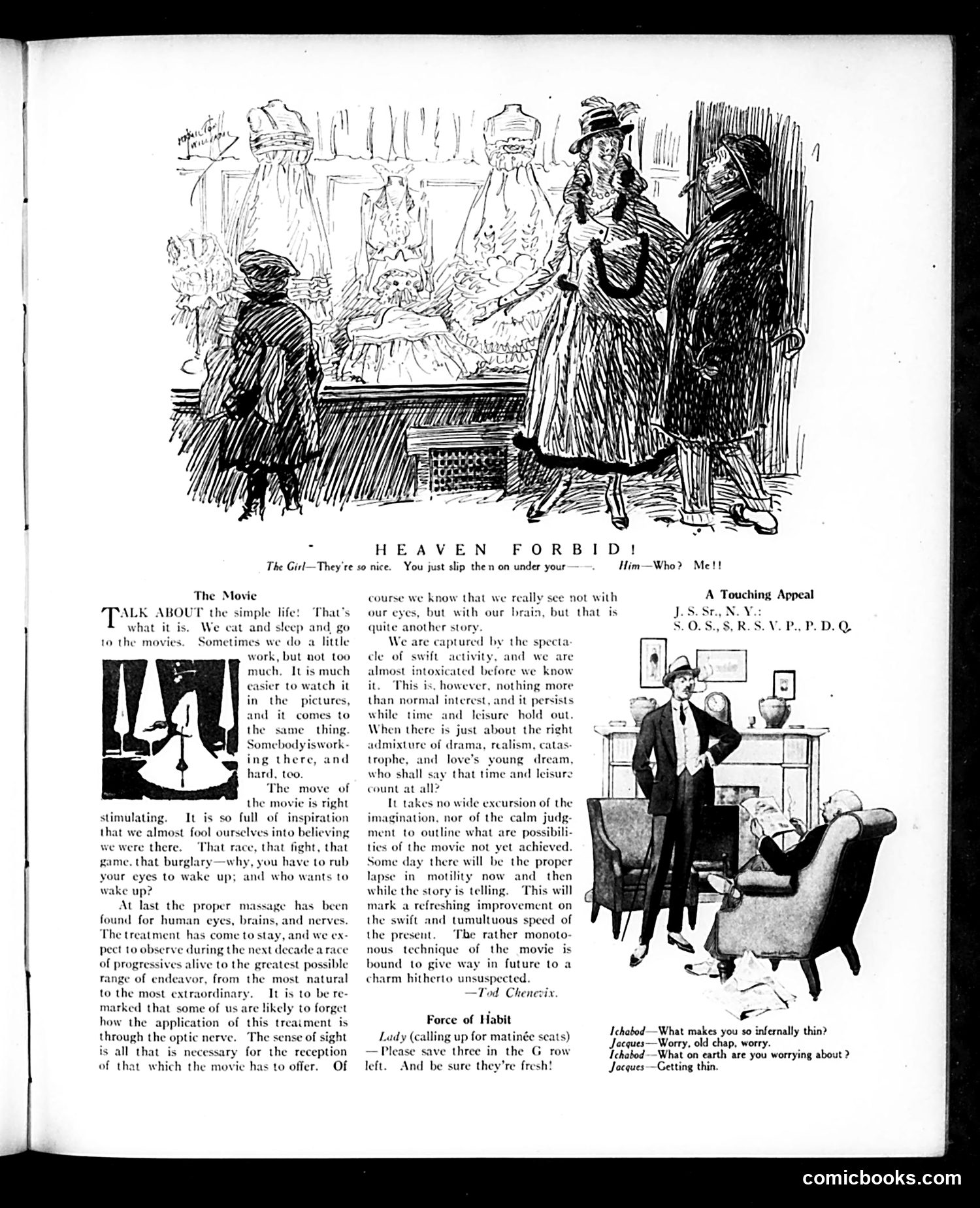
This page contains three separate satirical pieces about early cinema and urban life: **"The Movie"** is a lengthy essay praising motion pictures as mental escapism—arguing that watching films requires less effort than living, yet provides stimulation and inspiration. It celebrates cinema's ability to captivate audiences through visual spectacle. **"Heaven Forbid!"** (top cartoon) depicts a theater scene where a girl compliments men as "nice," and one man anxiously asks "Who? Me!!"—a joke about male vanity and social awkwardness in public spaces. **"Force of Habit"** satirizes theatergoers' detachment from reality: a lady calls ahead to reserve matinée seats and requests they be "fresh"—treating theater seats as if they were food, suggesting audiences are so habitually passive they've lost touch with how things actually work. **"A Touching Appeal"** shows a concerned man asking a thin acquaintance the cause of his thinness; the answer—"Worry"—becomes circular when asked what he's worrying about: "Getting thin." Together, these pieces mock both cinema's escapist appeal and the mental laziness it encourages in audiences.
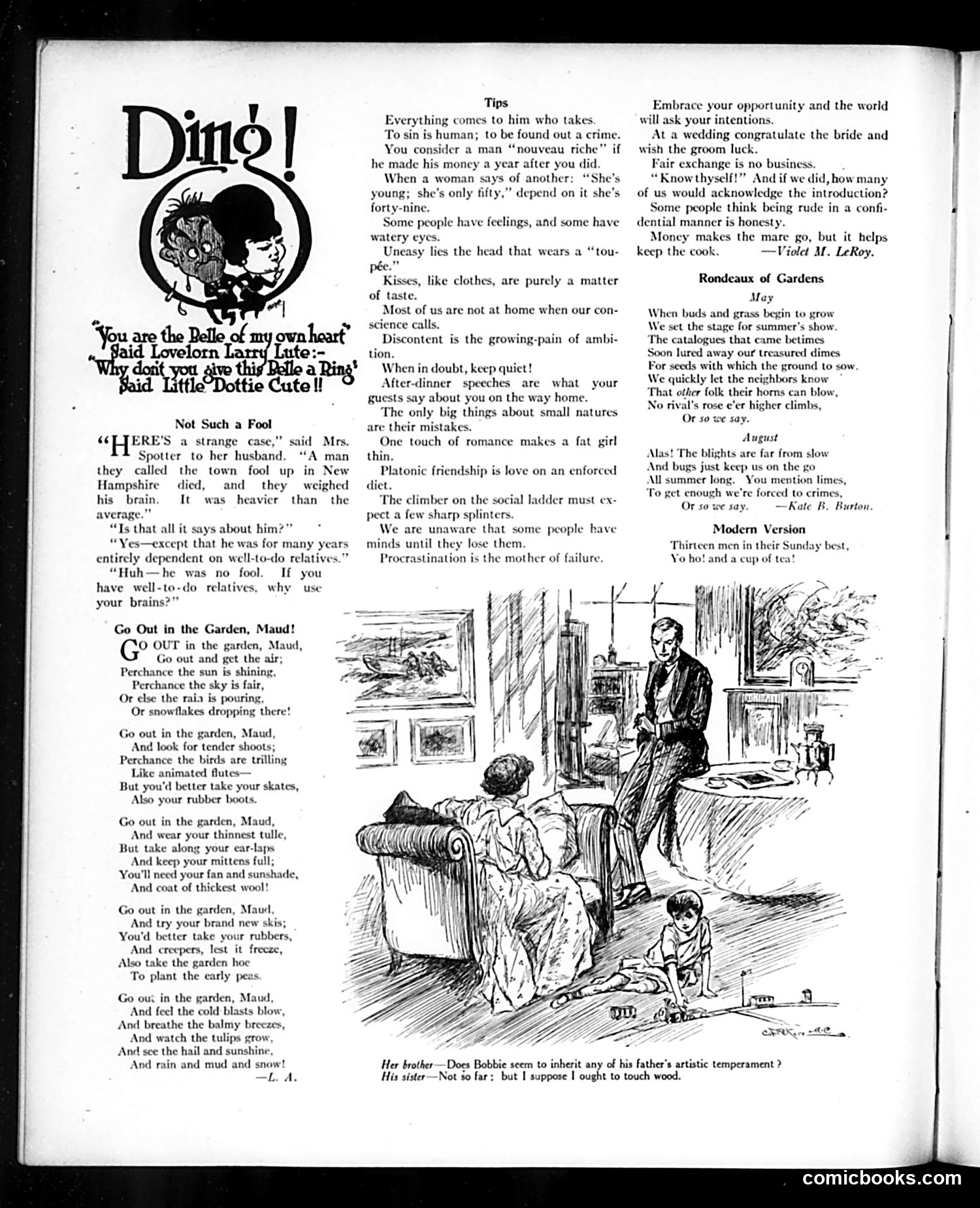
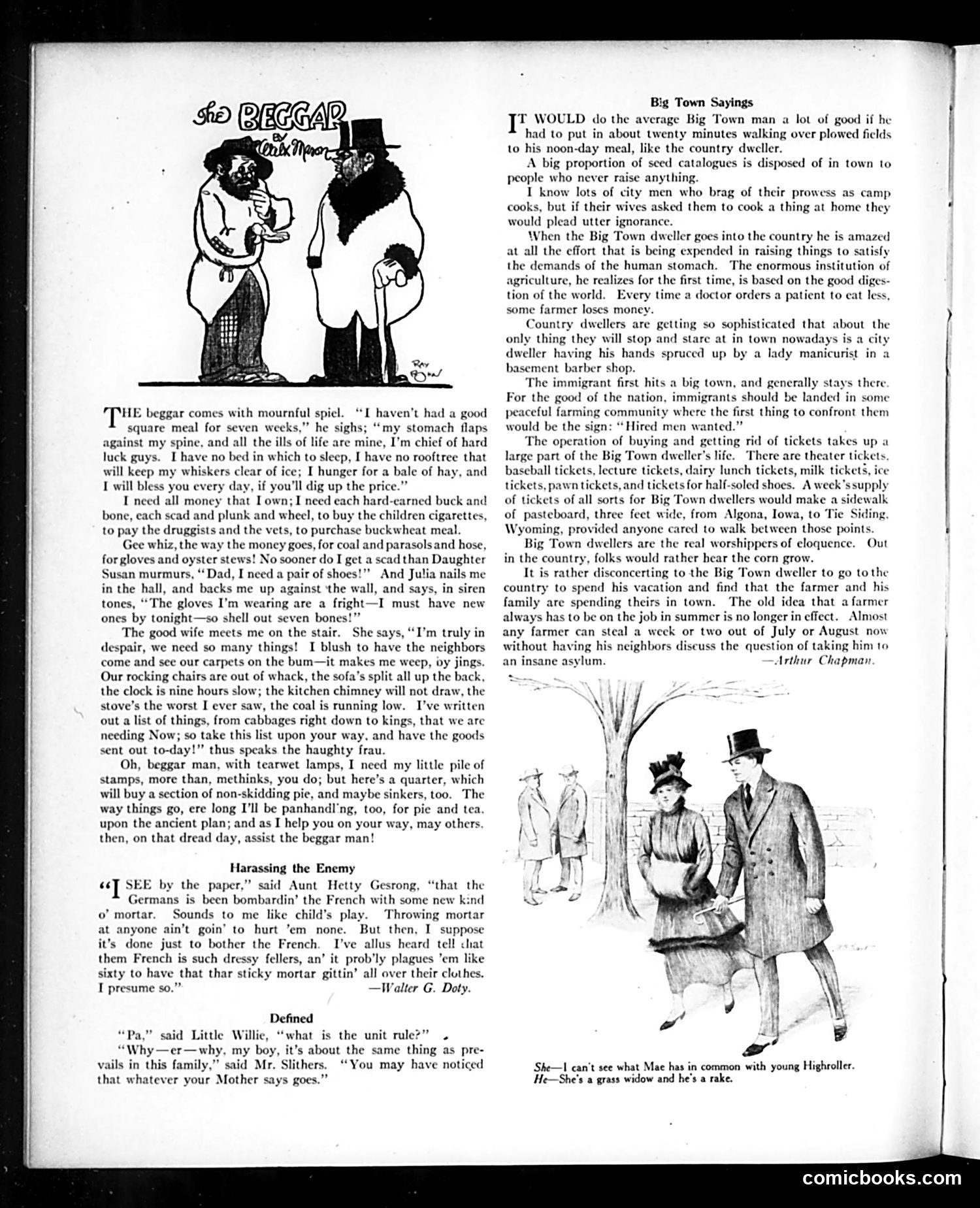
This page from the satirical magazine Judge contains several distinct pieces of social commentary typical of early 20th-century American humor. **"Not Such a Fool"** satirizes the assumption that poverty equals stupidity. A man labeled a "town fool" dies with an above-average brain weight, yet his real "foolishness" was depending on wealthy relatives rather than using his own mind. The joke: accepting financial dependence requires more stupidity than actual mental deficiency. **"Go Out in the Garden, Maud"** mocks contradictory Victorian advice given to women about outdoor activities. Each stanza tells Maud to go outside wearing increasingly contradictory clothing—simultaneously thin and thick garments, suggesting the absurd, conflicting expectations placed on women regarding propriety and health. The **"Tips"** and **"Rondeaux of Gardens"** sections offer light aphorisms and poetry about social behavior and gardening disappointments. The sketch at bottom shows a domestic conversation questioning whether a child inherited his father's artistic temperament, with class implications about inherited traits and "touch wood" superstition.
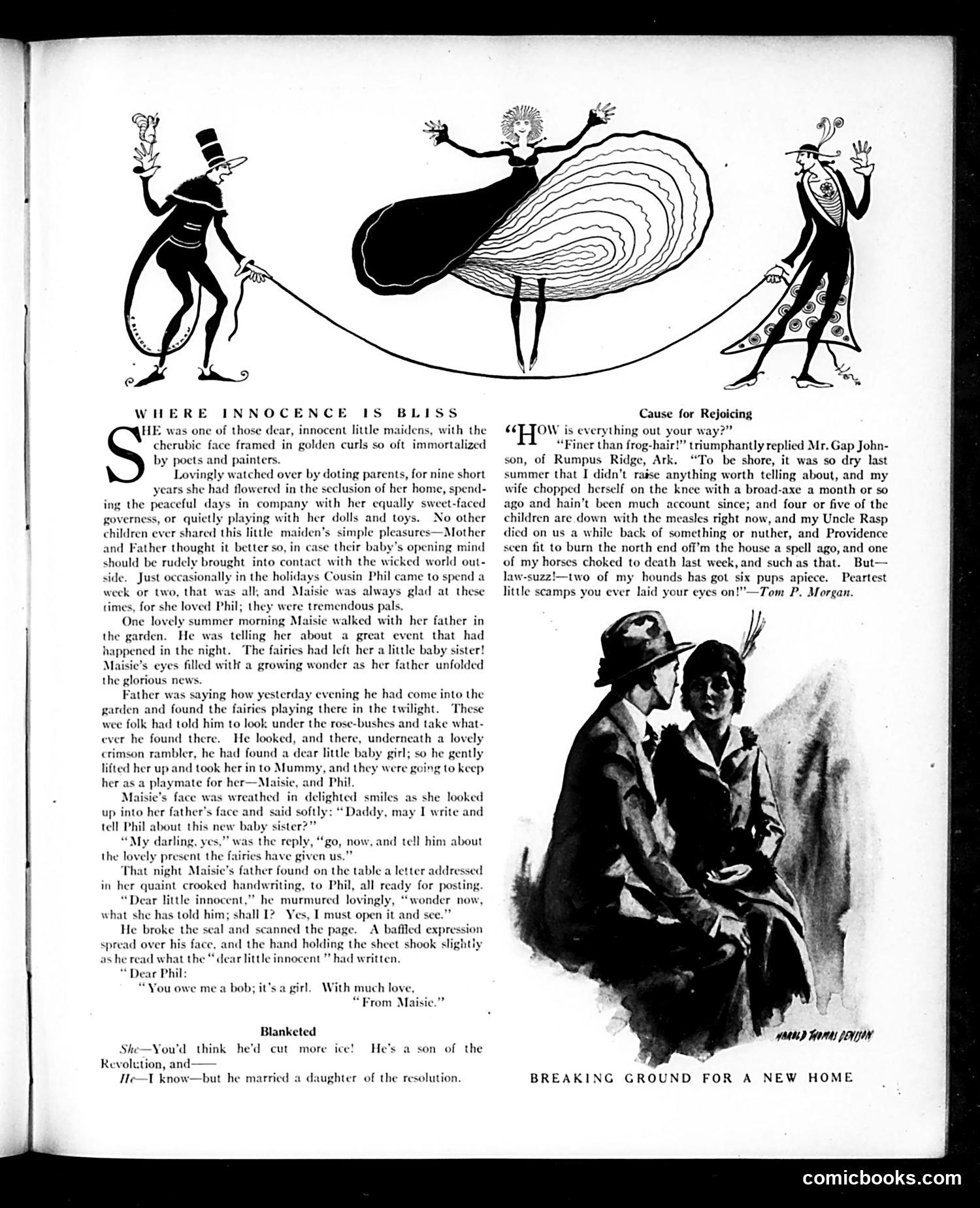
This page contains two distinct pieces of satirical humor: **"Where Innocence is Bliss"** (main story): A sentimental tale mocking Victorian attitudes toward sheltered girlhood. A naive father believes his innocent daughter Maisie will write sweetly to her cousin Phil about her new baby sister. The joke: her actual letter reads "You owe me a bob; it's a girl"—a crude, betting-related reference revealing that despite her sheltered upbringing, the child understands wagering on a baby's sex. The satire targets both parental delusion about childhood innocence and the hypocrisy of Victorian propriety. **"Cause for Rejoicing"** (right side): A rural character boasts that despite multiple family disasters (wife injured, children sick, uncle died, house burned), he's happy because his dogs produced six puppies. The humor lies in the grotesque disproportion between genuine tragedies and trivial rejoicing—mocking rural simplicity or stoicism taken absurdly far. **Top cartoons**: Appear to show theatrical or social figures in exaggerated poses, likely contemporary satirical commentary, though specific references are unclear without additional context.
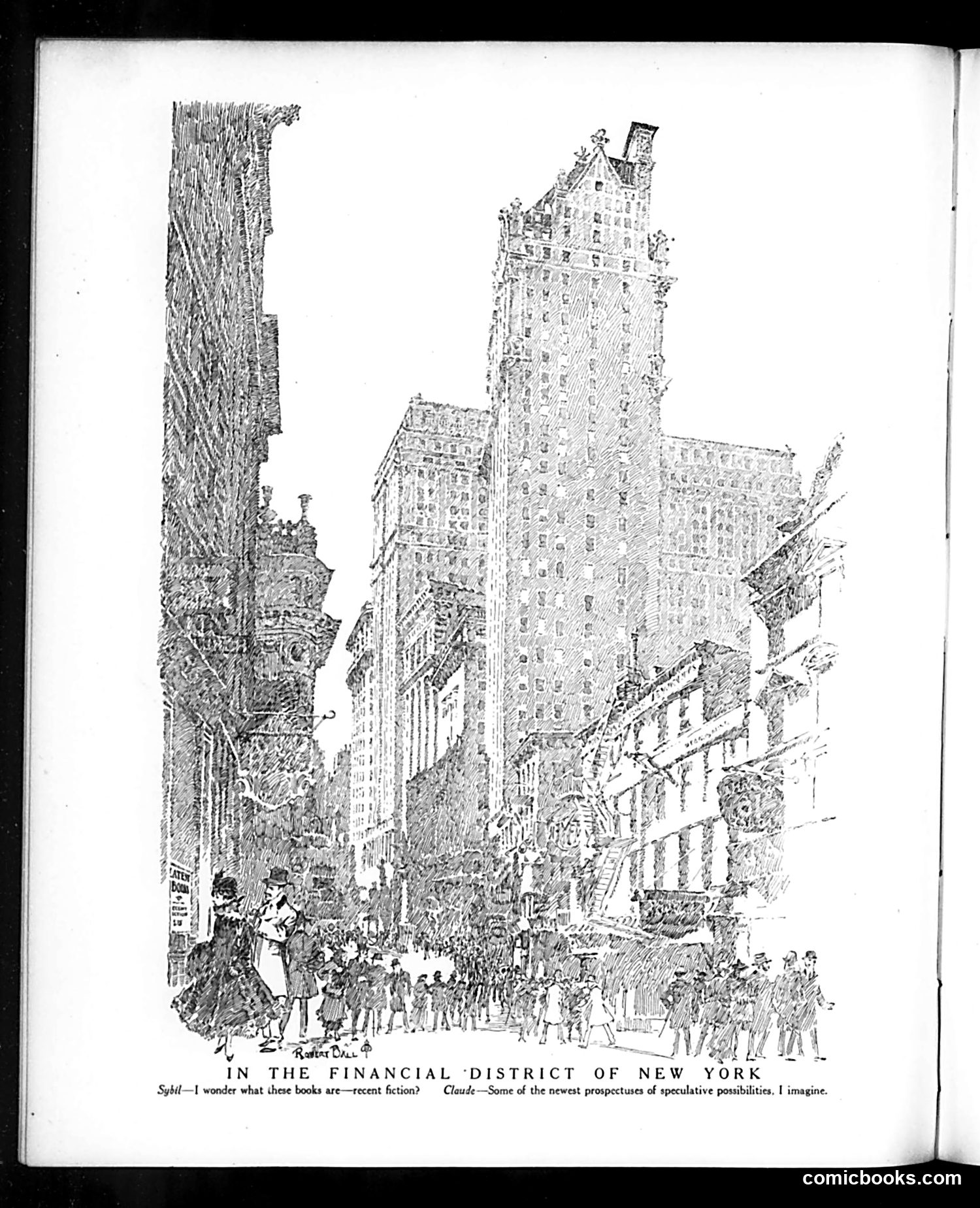
This cartoon depicts two figures observing impossibly tall, ornate skyscrapers in Manhattan's Financial District. One character (Sybil) asks if the massive buildings are "recent fiction," suggesting they seem unbelievably exaggerated. The satire targets **speculative real estate development and architectural excess** during what appears to be a boom period (likely early 20th century). The other character's response—"Some of the newest prospectuses of speculative possibilities"—reveals the joke: these towering buildings represent wildly optimistic financial schemes and investor prospectuses rather than practical structures. The cartoon mocks how speculators' dreams and promotional materials promised increasingly fantastical development, divorced from reality. The exaggerated architectural rendering emphasizes how investors' ambitions had become literally ungrounded.
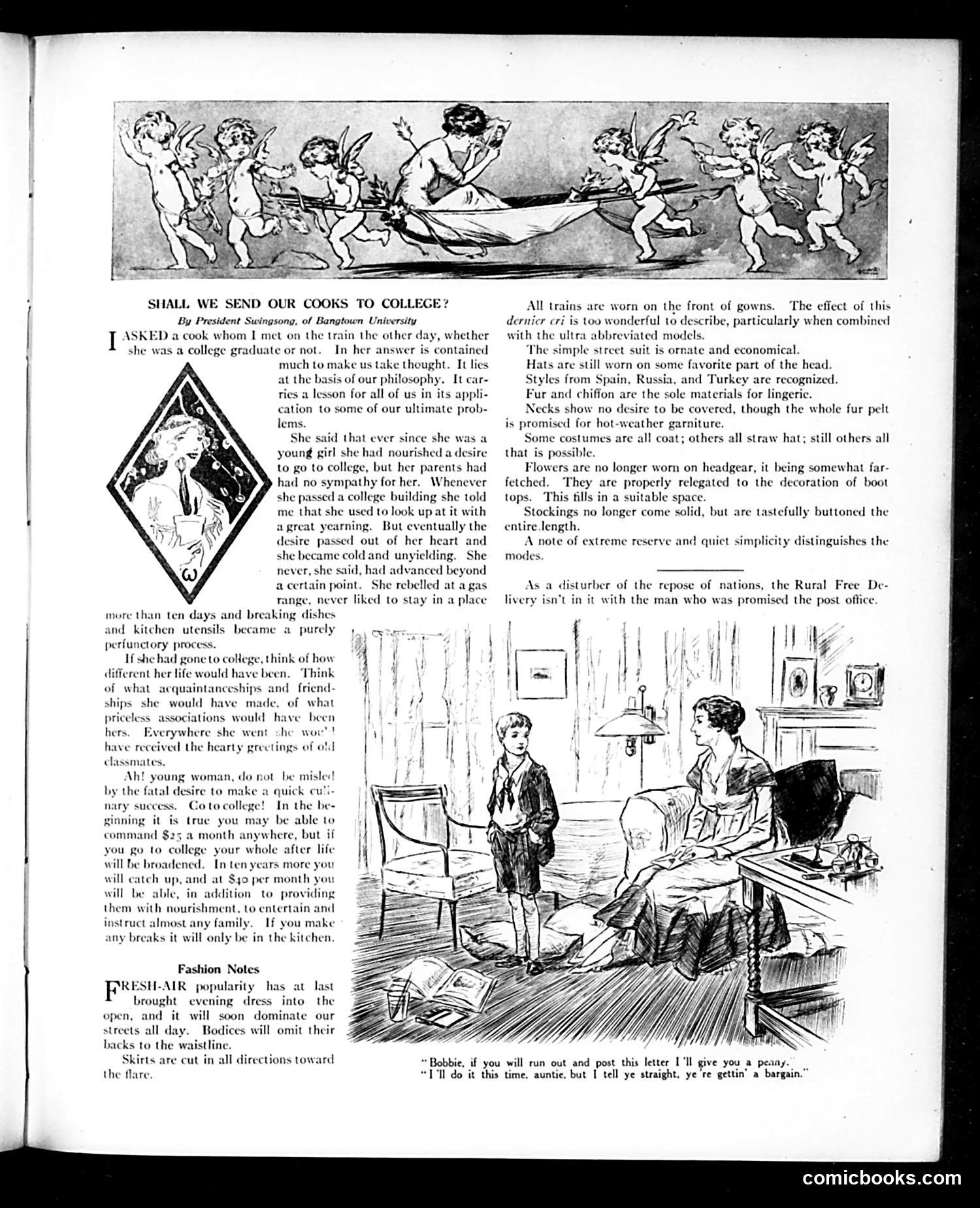
This *Judge* magazine page contains two satirical pieces: **"Shall We Send Our Cooks to College?"** mocks the era's class anxieties about education and social mobility. President Swingsong's anecdote about a cook who wanted college but couldn't attend serves as ironic commentary—he argues she'd earn only $25/month initially but $40 after ten years with a degree. The satire lies in the absurdity: suggesting domestic servants pursue higher education while remaining servants, and that modest wage increases justify the aspiration. It reflects early-20th-century tensions between expanding educational access and rigid class structures that prevented its practical benefit. **"Fashion Notes"** satirizes the era's increasingly absurd and contradictory women's fashion trends—dresses with no backs, minimal coverage, inconsistent hat placement, buttonholed stockings. The exaggeration mocks designers' chaotic, impractical aesthetic choices. The bottom cartoon shows a child shrewdly negotiating payment for running errands, suggesting even youth recognize labor's true value.
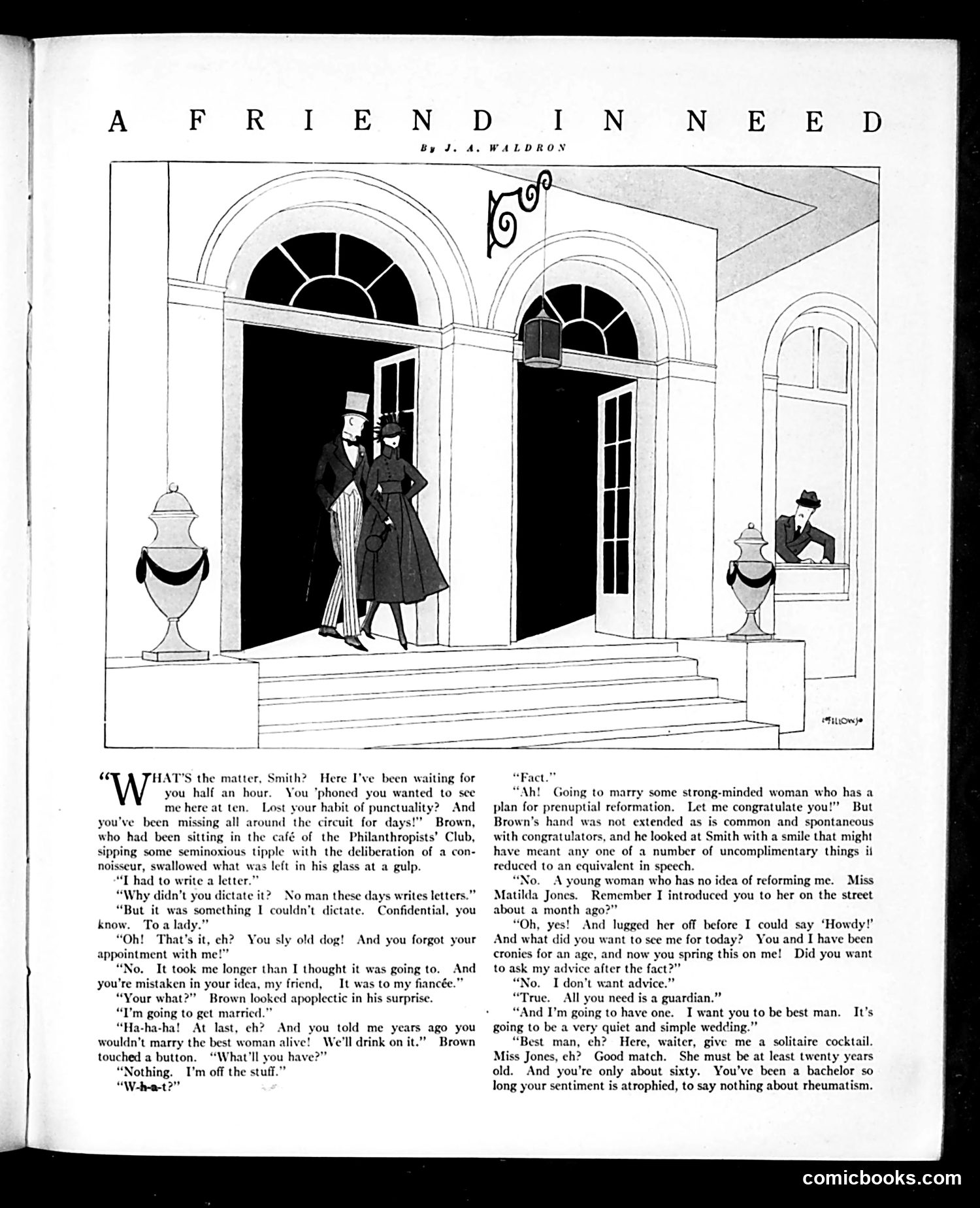
This is a satirical comic strip about a man (Smith) announcing his surprise engagement to Miss Matilda Jones. His friend Brown reacts with barely concealed mockery rather than genuine congratulations. The satire targets the bachelor lifestyle and late-in-life marriage. Brown's "congratulations" are backhanded insults: he assumes Smith is marrying a reformer trying to change him, mocks the age gap (suggesting Smith is ~60 and she's ~20), jokes that Smith's "sentiment is atrophied," and quips about his "rheumatism." The cartoon satirizes male friendship norms of the era—where friends expressed affection through verbal sparring and cynicism rather than genuine sentiment. Smith's choice to marry is treated as absurd and worthy of ridicule rather than celebration, reflecting early 20th-century attitudes about bachelorhood as preferable to marriage, at least among certain social circles.
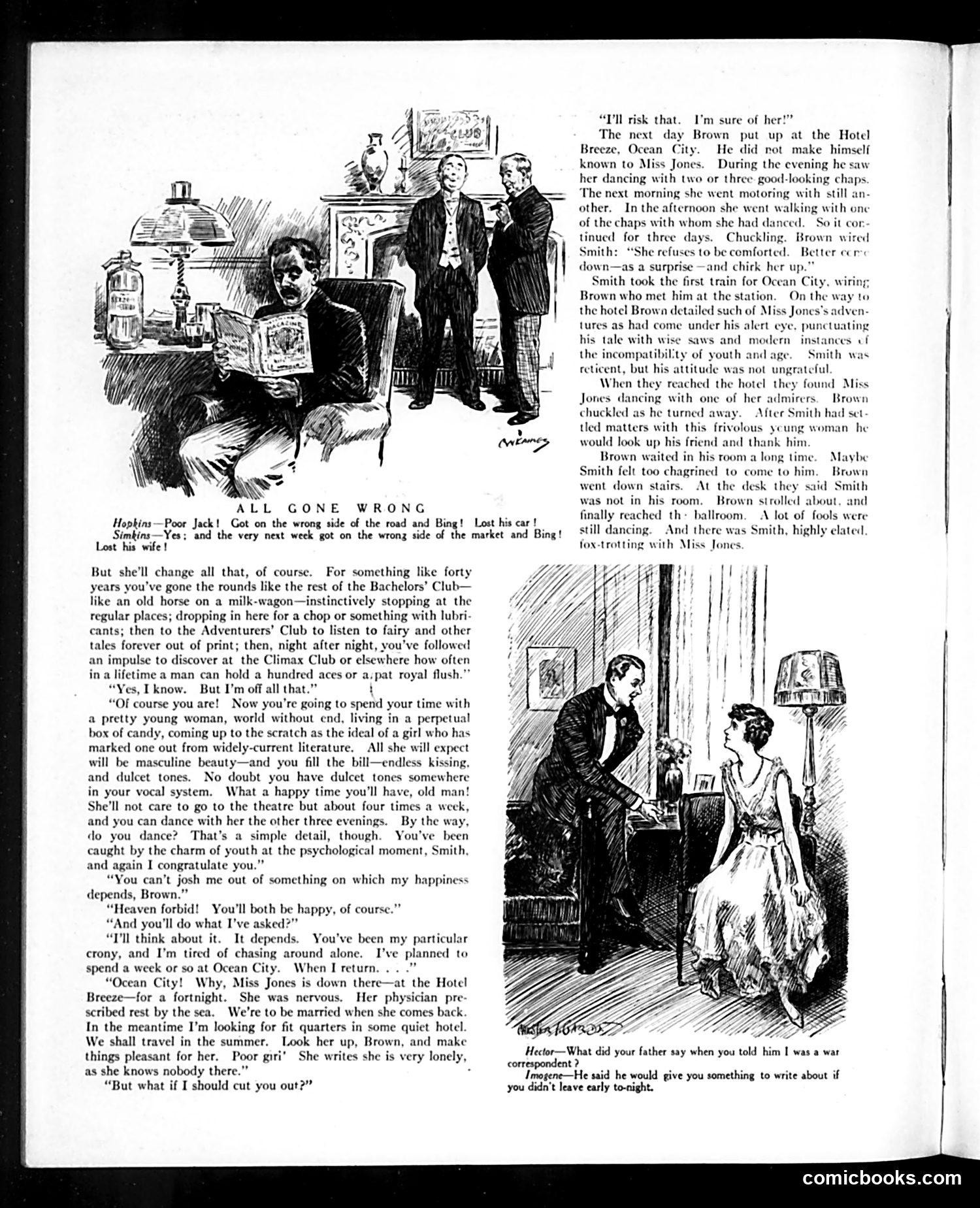
This page satirizes the foolishness of a bachelor named Smith who abandons decades of carefree bachelor club life to marry Miss Jones. His friend Brown warns him that marriage means endless domestic obligations—theater trips, dancing, candy boxes—replacing the freedom of gambling and leisure clubs. The satire deepens when Smith asks Brown to check on his fiancée at Ocean City's Hotel Breeze while she convalesces. Brown discovers Miss Jones is actually enjoying herself immensely, flirting and dancing with multiple admirers rather than being lonely and faithful as Smith imagines. The cartoon mocks Smith's naïveté about both women and marriage. It suggests that Smith, trading his independent bachelor life for domestic servitude, has ironically chosen a woman who may not be as devoted to him as he assumes. The humor lies in his misjudgment and the gap between romantic idealization and reality—a common Judge magazine theme critiquing both marriage and male gullibility.
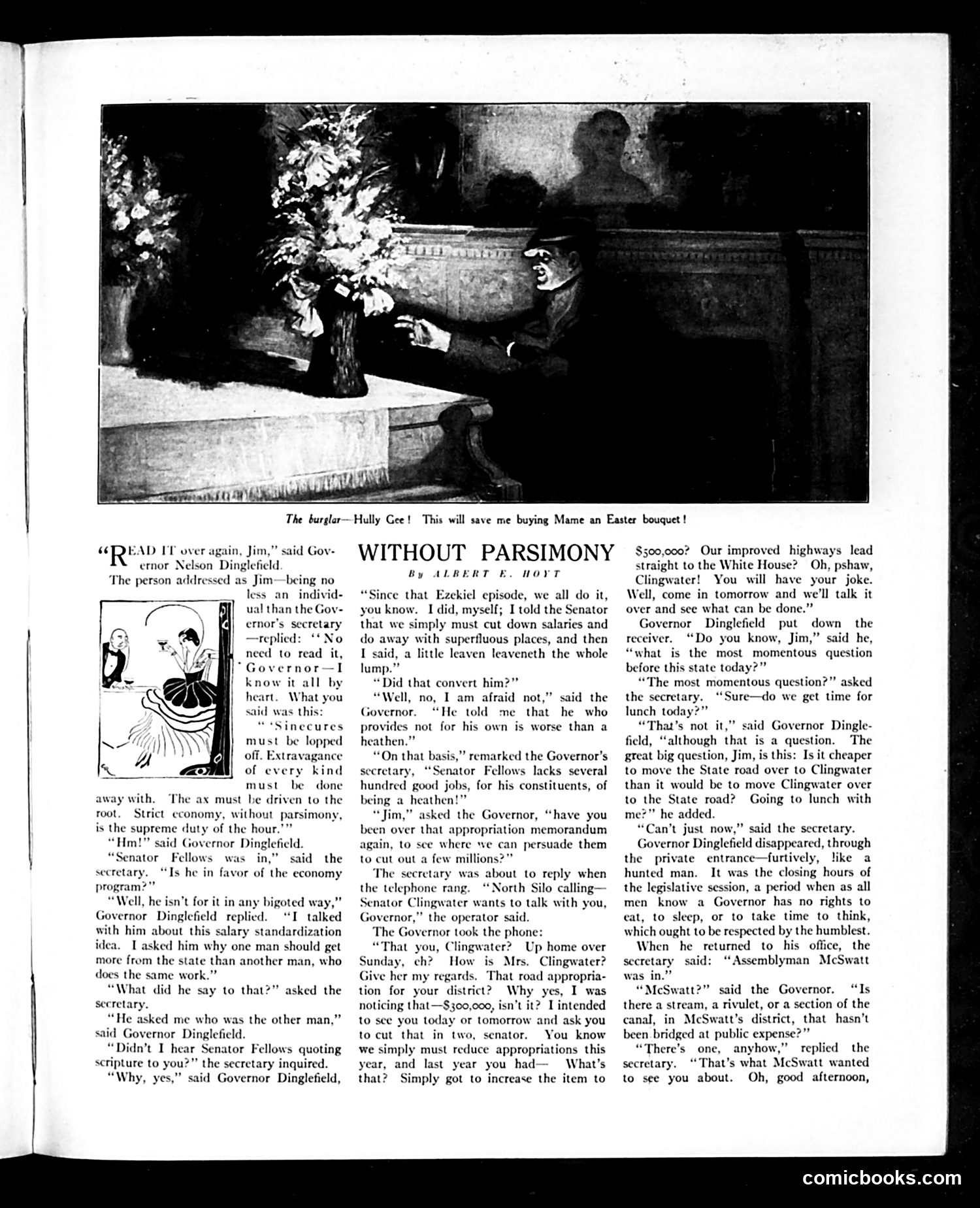
This story satirizes government hypocrisy during what appears to be an early 20th-century state legislature session. Governor Nelson Dinglefield publicly preaches budget cuts and eliminating "sinecures" (unnecessary jobs), citing scripture about frugality. However, the narrative reveals the reality: when Senator Fellows questions the governor's logic, the governor immediately contradicts himself. Senator Clingwater calls demanding continued highway funding for his district—money the governor had just claimed to eliminate—and the governor agrees without resistance. The satire's point is transparent: politicians publicly advocate fiscal responsibility while privately capitulating to constituent demands and special interests. The closing joke about Assemblyman McSwatt—who has apparently secured public bridges everywhere except one stream in his district—emphasizes that virtually every legislator successfully lobbies for local pork-barrel spending despite rhetoric about economy. The cartoon mocks the gap between politicians' stated principles and actual behavior during legislative budget cycles.
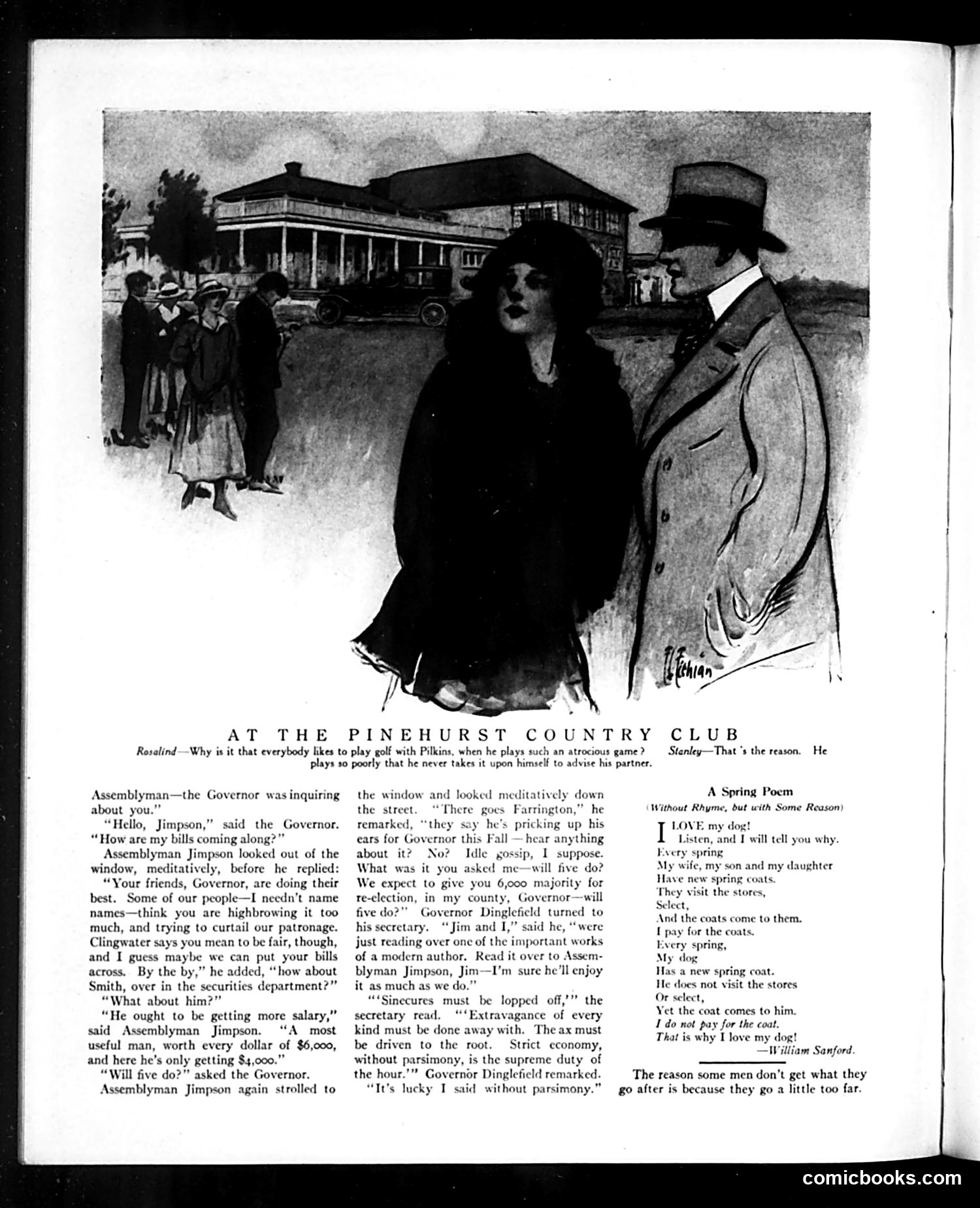
This cartoon satirizes political corruption and quid pro quo dealings among elected officials. **The Setup:** An Assemblyman named Jimpson approaches Governor Dinglefield at a country club. While ostensibly discussing legislative business, Jimpson subtly pressures the Governor: he mentions needing patronage appointments ("Smith, over in the securities department"), hints at delivering votes ("6,000 majority for re-election"), and implies a rival (Farrington) seeks the governorship. **The Satire:** The Governor and his secretary respond by reading aloud passages about eliminating "sinecures" and enforcing "strict economy"—high-minded reform rhetoric that contrasts sharply with their actual practice of dispensing favors. When Jimpson requests a $2,000 raise for Smith, the Governor immediately agrees ("Will five do?"), revealing that principles dissolve when political debts are called in. **The Point:** Judge mocks the hypocrisy of progressive-era politicians who publicly championed good government while privately trading favors, pay raises, and appointments for electoral support—business conducted casually over golf.
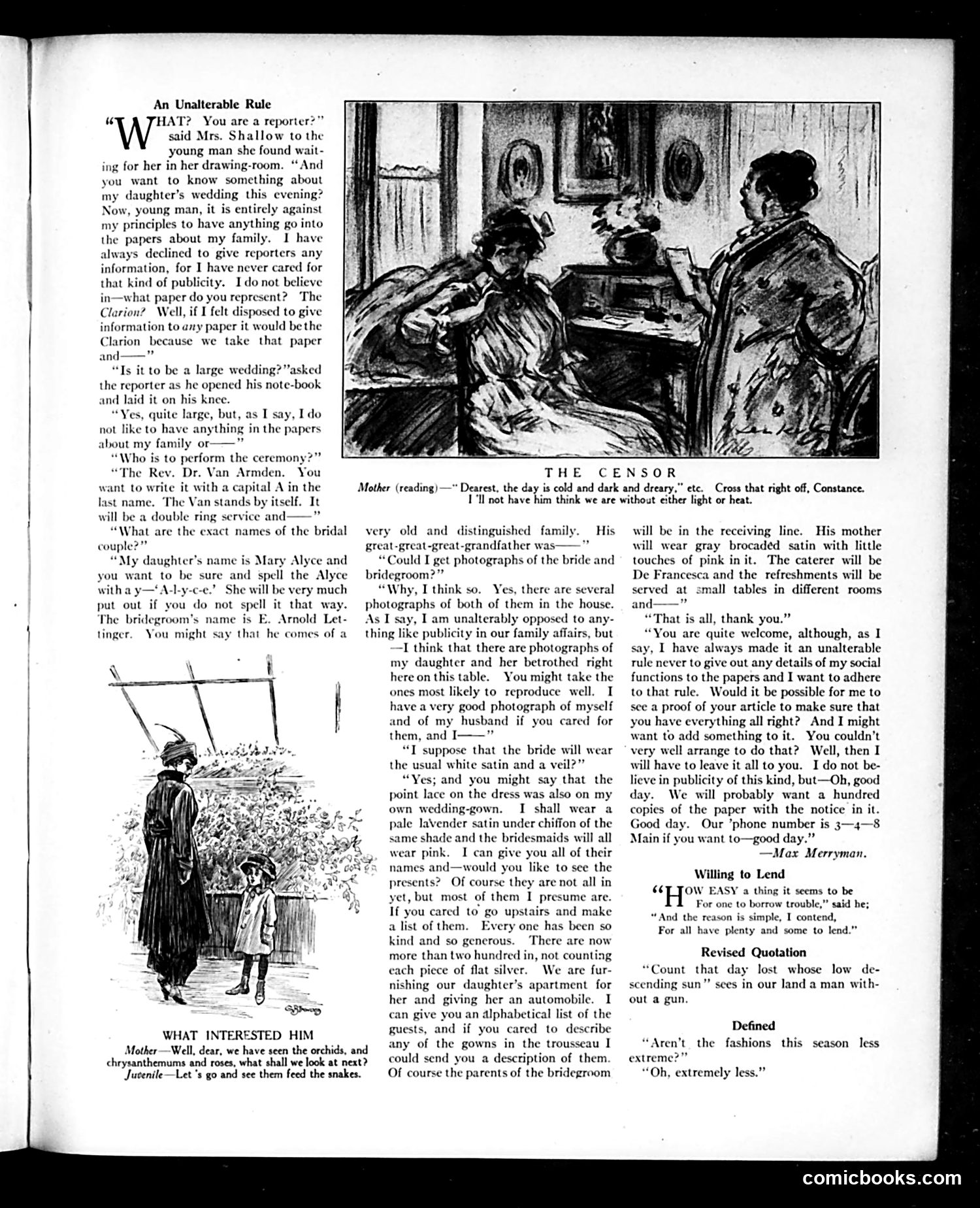
This cartoon satirizes social hypocrisy, specifically the contradiction between claiming to shun publicity while eagerly providing detailed information to reporters. Mrs. Shallow insists she has an "unalterable rule" against giving family information to newspapers, then immediately proceeds to supply the reporter with comprehensive wedding details: names (spelled precisely), guest count, menu, gifts inventory, descriptions of clothing, and even photographs. The joke is that her stated principle crumbles instantly when confronted with an actual reporter. Her repeated refrain about refusing publicity rings hollow as she volunteers increasingly intimate details. The satire targets the pretense of high-society discretion—what people *claim* to believe versus what they actually do when given opportunity for social visibility. The cartoon reveals how easily social principles bend when vanity is involved.
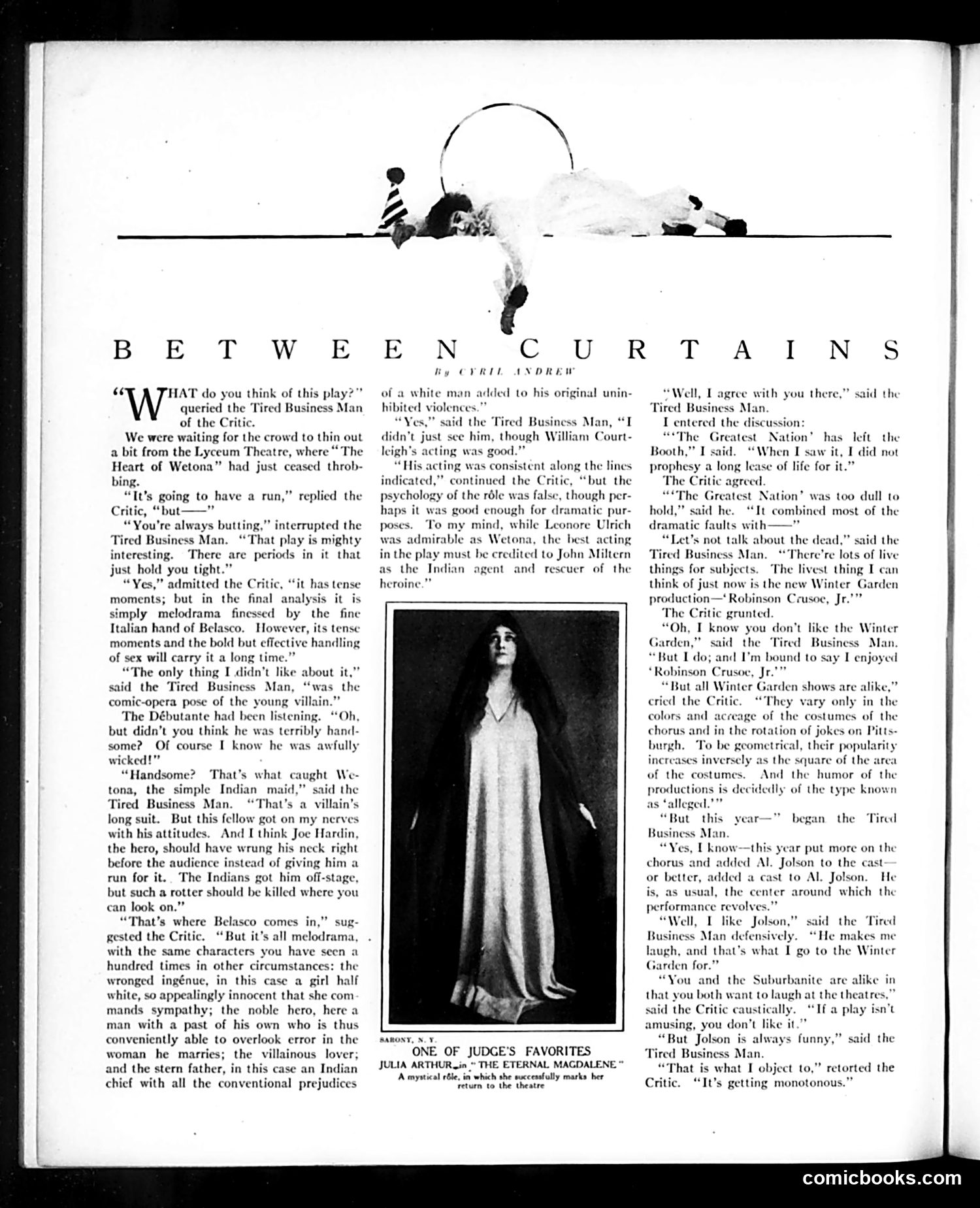
This dialogue satirizes theatrical criticism and audience taste in early 20th-century New York. A Critic and "Tired Business Man" debate the play "The Heart of Wetona" at the Lyceum Theatre, likely referencing a contemporary production (the text mentions actors William Courtleigh, Leonore Ulrich, and John Miltern). The satire targets: 1. **Critical pretension**: The Critic uses sophisticated language ("melodrama finessed by the fine Italian hand of Belasco") while the Businessman finds the play simply entertaining. 2. **Popular theater conventions**: The plot—featuring a "wronged ingénue," noble hero with a past, and villainous lover—was hackneyed melodrama, even then. 3. **Winter Garden productions**: The Critic dismissively notes these shows rely on scantily-clad choruses ("humor of the productions is decidedly of the type known as 'alleged'"), suggesting lowbrow entertainment. The cartoon pokes fun at theater-goers' divided reactions: critics demand psychological authenticity while audiences seek spectacle and handsome villains.
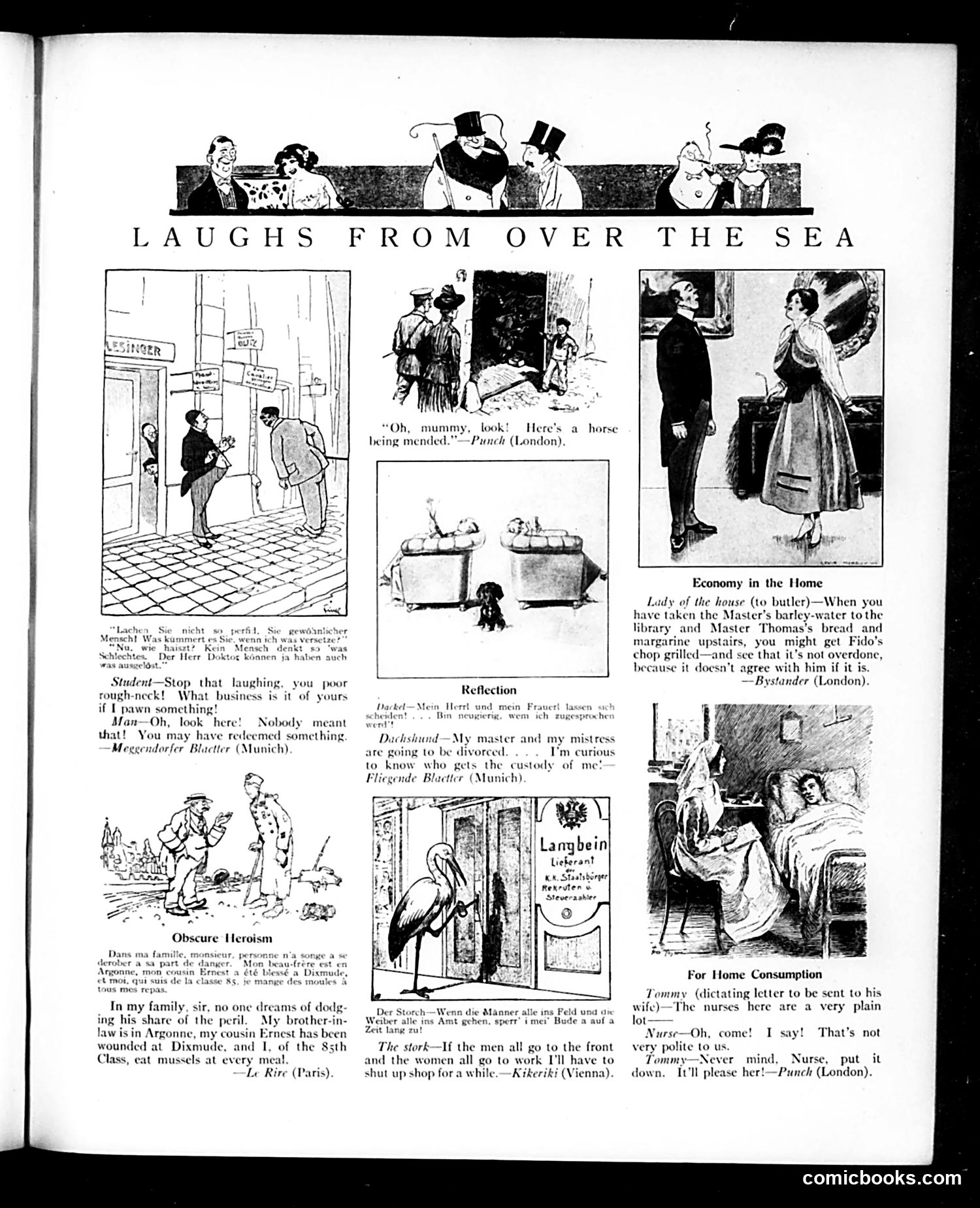
This page compiles humorous cartoons and jokes from European satirical magazines during World War I, showcasing how different nations' publications treated wartime themes. The recurring satirical subject is **wartime sacrifice and rationing**. "Economy in the Home" mocks class disparities—a wealthy household serves the dog better food than the family receives. "The Stork" cartoon darkly jokes that if all men go to war and women to factories, there will be no births. "Obscure Heroism" sardonically celebrates a man's patriotic contribution as eating mussels daily (implying minimal sacrifice compared to soldiers). Other jokes target marital instability and petty concerns during crisis: a dachshund worries about custody if his owners divorce; a nurse's plainness provokes "jokes" from a wounded soldier. The page demonstrates how Allied nations (Britain, France, Germany's enemies Austria and Munich publications) used humor to process wartime anxiety—mixing patriotic sentiment with cynicism about class privilege and civilian hardship during the conflict.
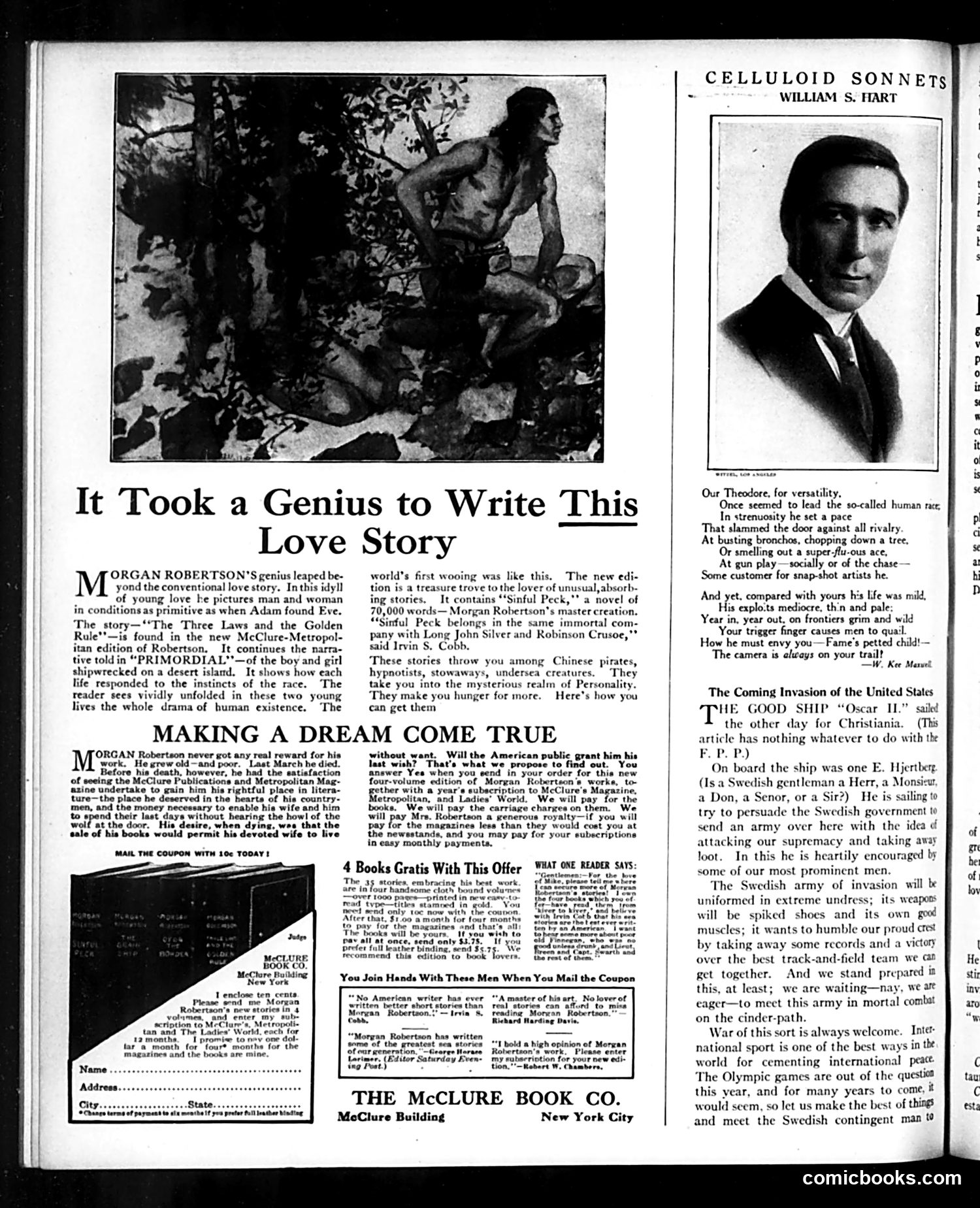
This page primarily consists of **advertisements and literary promotion** rather than political satire or editorial cartooning. The main content advertises **Morgan Robertson's literary works** through McClure Publications. The left side promotes Robertson's story "The Three Laws and the Golden Rule" — described as a primitive love story set on a desert island. The page emphasizes Robertson's literary genius and his poverty despite his contributions to American letters, appealing to readers' sympathy to purchase his collected works. The right side features a portrait of **William S. Hart**, a Western film star, accompanied by a humorous poem celebrating his versatility in action films (bronco-busting, tree-chopping, gunplay). Below is a brief satirical article titled **"The Coming Invasion of the United States,"** which appears to mock fears about Swedish military ambitions by describing a Swedish ship's arrival in America—likely light-hearted commentary on contemporary invasion anxieties. The page is primarily **commercial in nature**, promoting books and magazines rather than offering political or social commentary.
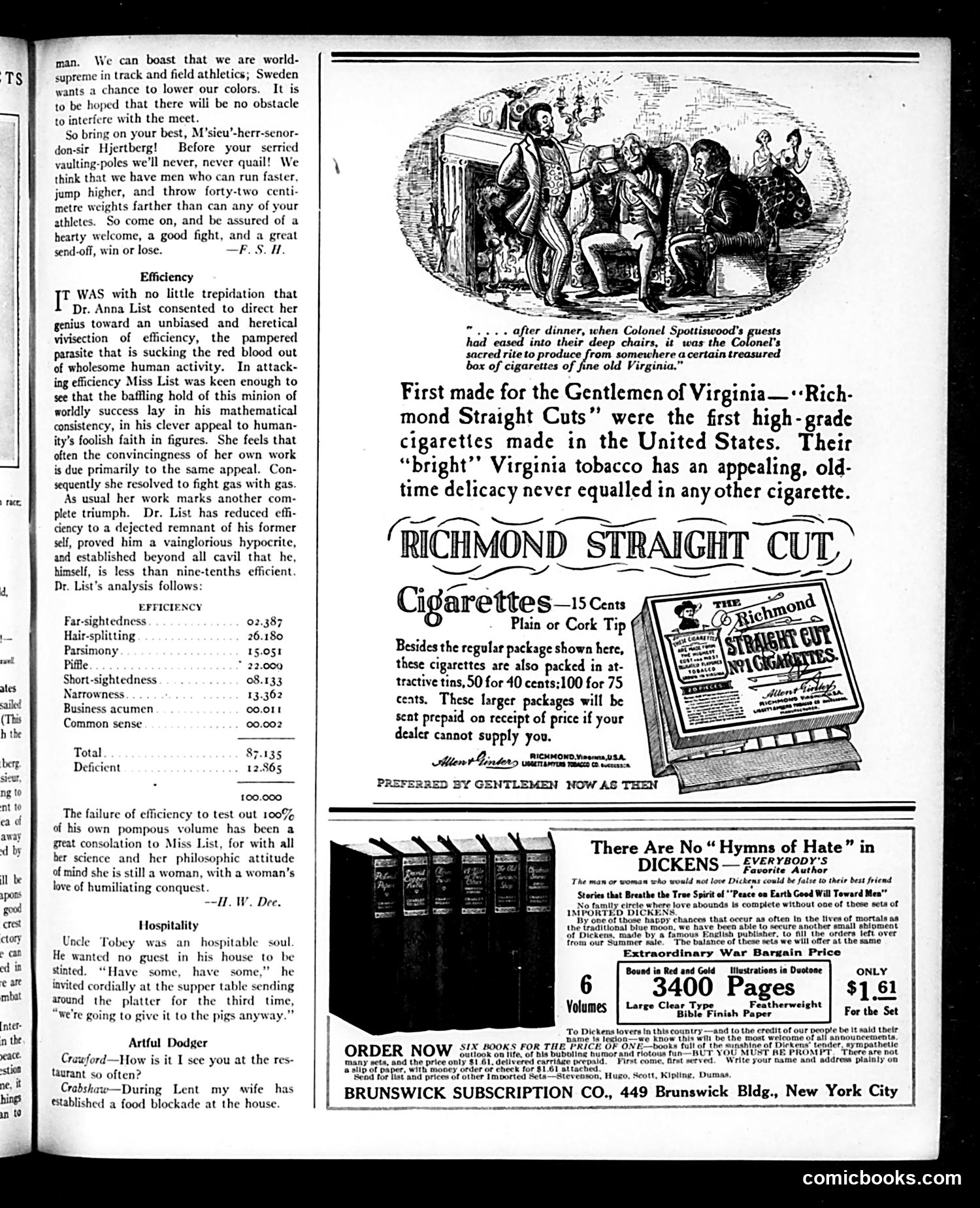
This page is primarily **advertising**, not political satire. The main content consists of three advertisements: 1. **Richmond Straight Cut Cigarettes** (center/right): Advertises Virginia tobacco cigarettes at 15 cents, with an illustrated vignette showing gentlemen after dinner smoking. The copy claims these were "first made for the Gentlemen of Virginia" and "first high-grade cigarettes made in the United States." 2. **Dickens Collected Works** (lower right): A book advertisement offering a 6-volume set of Charles Dickens's works for $1.61, emphasizing that Dickens contains "no hymns of hate" and promotes peace and goodwill. 3. **Small humorous pieces** (left column): Brief comedic anecdotes about efficiency, hospitality, and dining customs—typical filler content for Judge magazine. The page reflects early 20th-century advertising and consumer culture rather than containing political commentary or social satire.
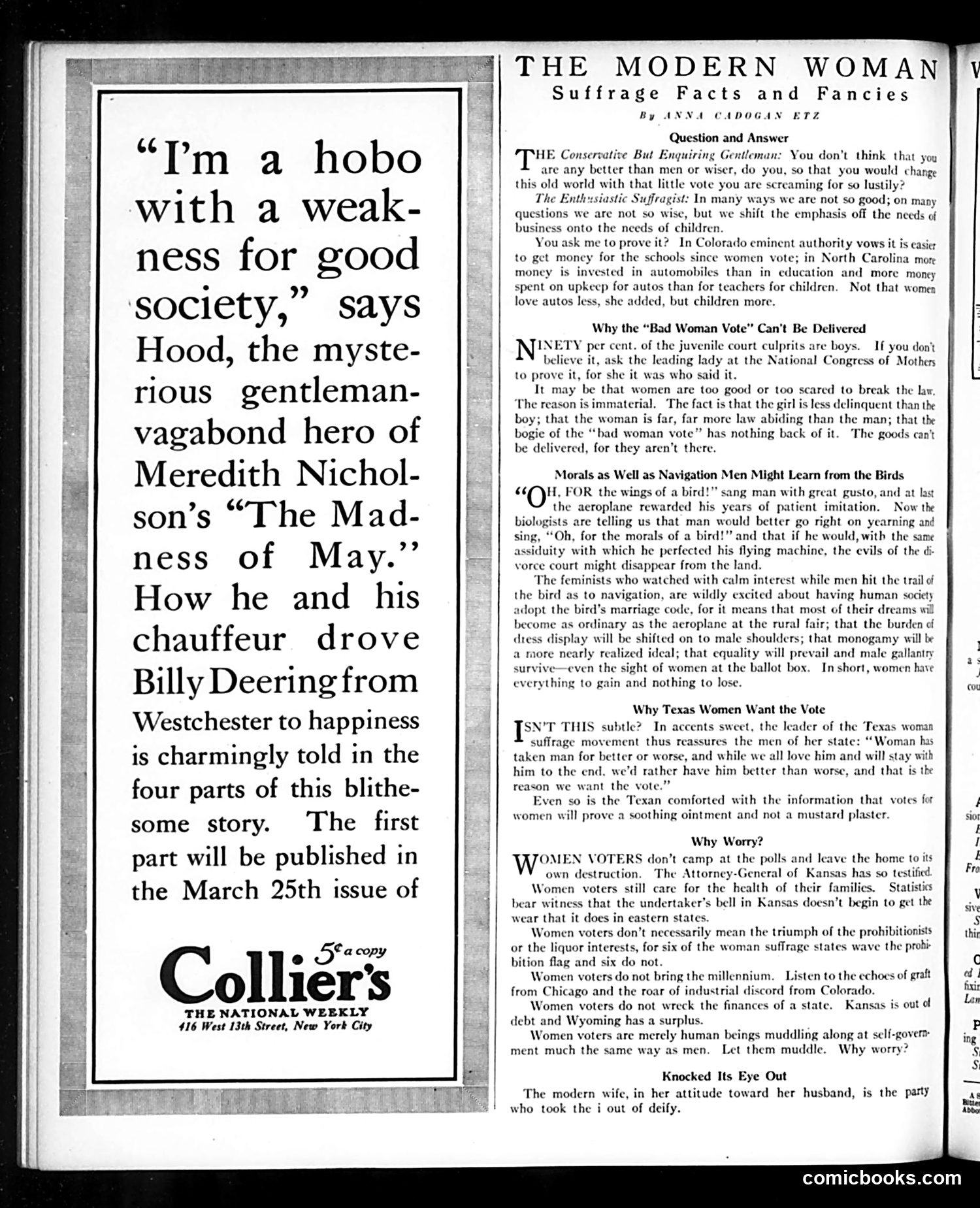
This page combines an advertisement with political satire about women's suffrage, a hotly contested issue of the early 20th century. **Left side:** Advertisement for Collier's magazine promoting a serialized story beginning March 25th, featuring a vagabond character named Hood from Meredith Nicholson's novel. **Right side:** "The Modern Woman: Suffrage Facts and Fancies" by Anna Cadogan Etz presents pro-suffrage arguments in Q&A format, directly countering anti-suffrage claims. She argues women voters would prioritize children's welfare over business interests, cites Colorado evidence that women voters increased school funding, and dismisses fears of a "bad woman vote" by noting women commit fewer crimes than men. A final section uses bird behavior as a metaphor—if men adopted birds' monogamous morals alongside learning their flight, society would benefit. The tone is gently mocking of male anxieties about female voting power, presenting suffrage as harmless or beneficial rather than revolutionary.
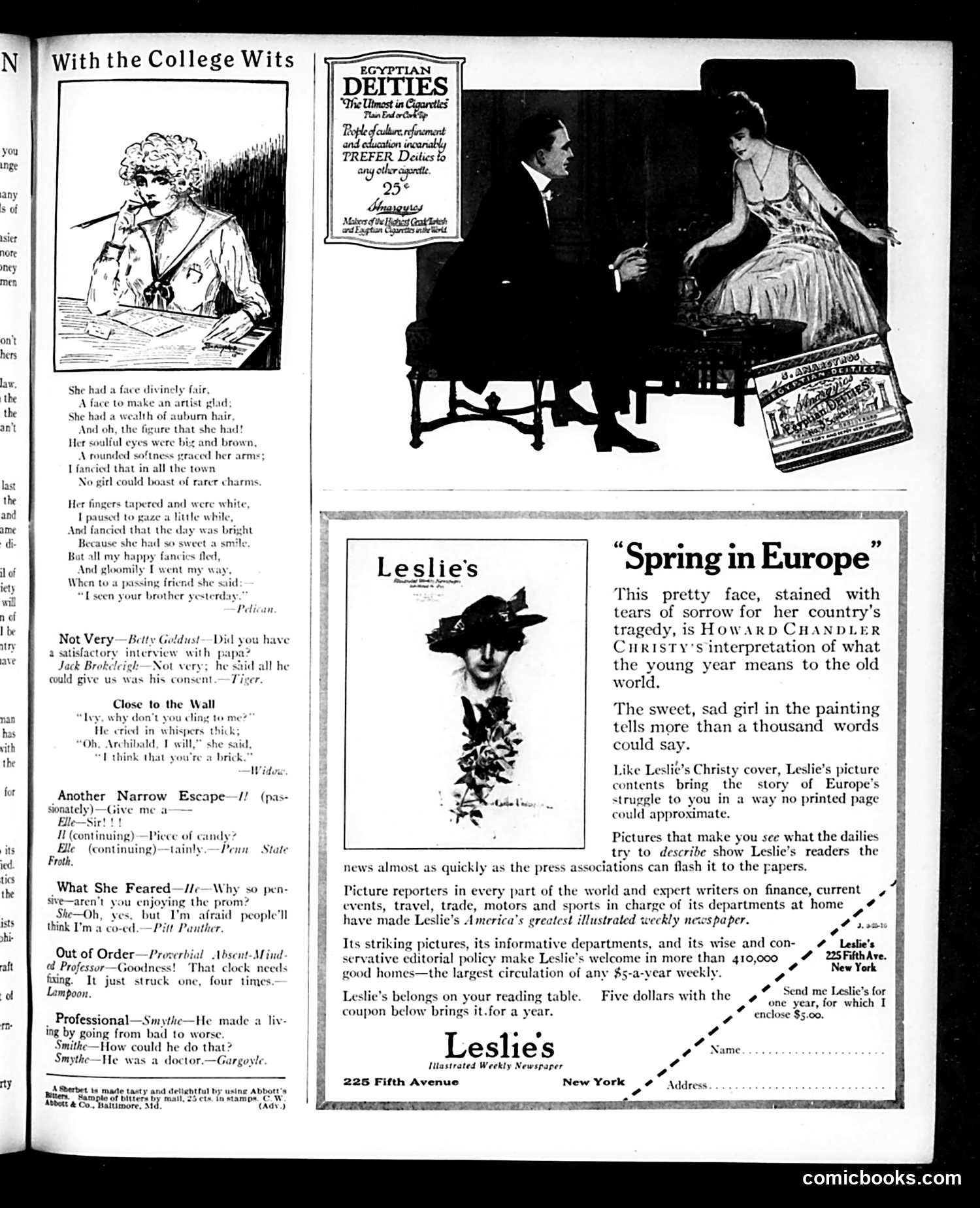
This page is primarily **humor and advertising** rather than political satire. The left side features "With the College Wits"—a collection of brief college-oriented jokes typical of Judge's regular humor section. These jokes play on romantic misunderstandings, wooing attempts gone wrong, and campus social anxieties ("What She Feared" mocks girls worried about being perceived as "co-eds"). The main content is a **Leslie's Weekly advertisement** featuring Howard Chandler Christy's illustration titled "Spring in Europe"—a sorrowful young woman representing Europe's wartime suffering (likely WWI era, though undated). The ad argues Leslie's illustrated weekly newspaper conveys war news and international events more effectively than text alone, boasting 410,000 circulation. The **Egyptian Deities cigarette advertisement** is incidental. This page reflects early 20th-century American magazine culture: light collegiate humor, romantic sentimentality, and visual journalism's growing importance.
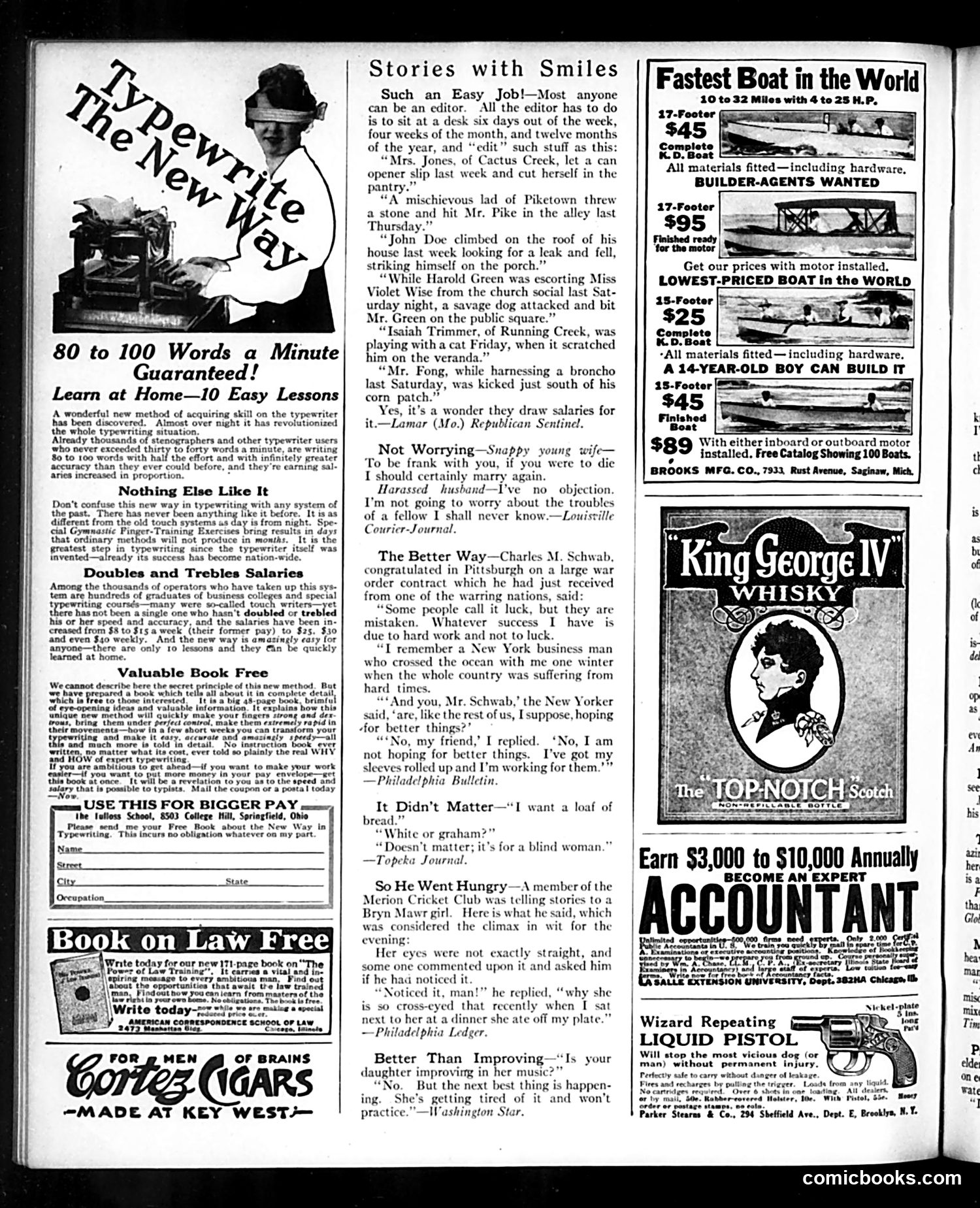
This page is primarily **advertising and filler content** rather than political satire. The main cartoon occupies the upper left: it depicts a woman at a typewriter with text "A Typewriter The New Way" promoting a typewriter-speed course (80-100 words per minute guaranteed). The "Stories with Smiles" section offers mild humor satirizing **small-town newspaper editors**—poking fun at the tedious, mundane local reporting they must edit (people getting injured, minor incidents, animal attacks). The joke is that editing such repetitive, trivial content hardly justifies their salaries. The remainder of the page consists of various **advertisements**: typing courses, law books, boat-building kits, King George IV Whisky, accountancy training, and cigars. This was typical for Judge magazine, which blended satirical editorial content with paid advertising. There are **no significant political figures or current events** referenced here. The content reflects early 20th-century American commercial culture and workplace concerns.
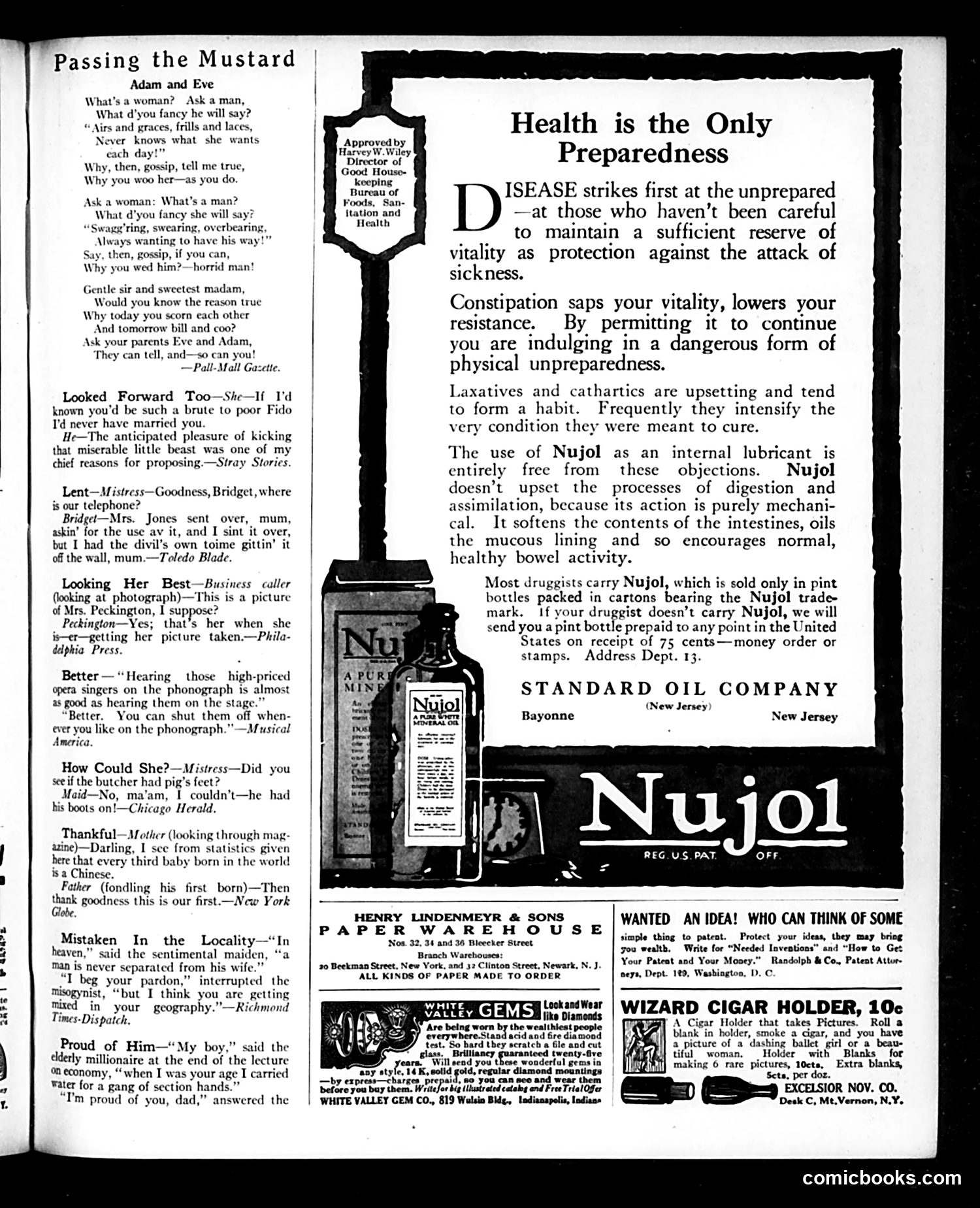
This page primarily contains **humorous short jokes and advertisements** rather than political cartoons. The content reflects early 20th-century domestic humor: **"Passing the Mustard" section:** Comic verses and brief jokes about marriage, gender relations, and domestic life—typical period humor exploring the puzzlement men and women have about each other's behavior. **Main advertisement:** A Nujol (mineral oil laxative) ad endorsed by Harvey W. Wiley, invoking "Health is the Only Preparedness"—likely referencing World War I-era concerns about national strength. It frames constipation as a patriotic health matter. **Supporting advertisements:** Paper warehouses, diamond rings, and a cigar holder—standard commercial ads. The jokes are genteel, focusing on married couples, household servants, and phonographs—reflecting a prosperous, domestic readership unconcerned with radical politics. No specific political figures or events are caricatured. This is a **society/lifestyle page** rather than satirical political commentary.
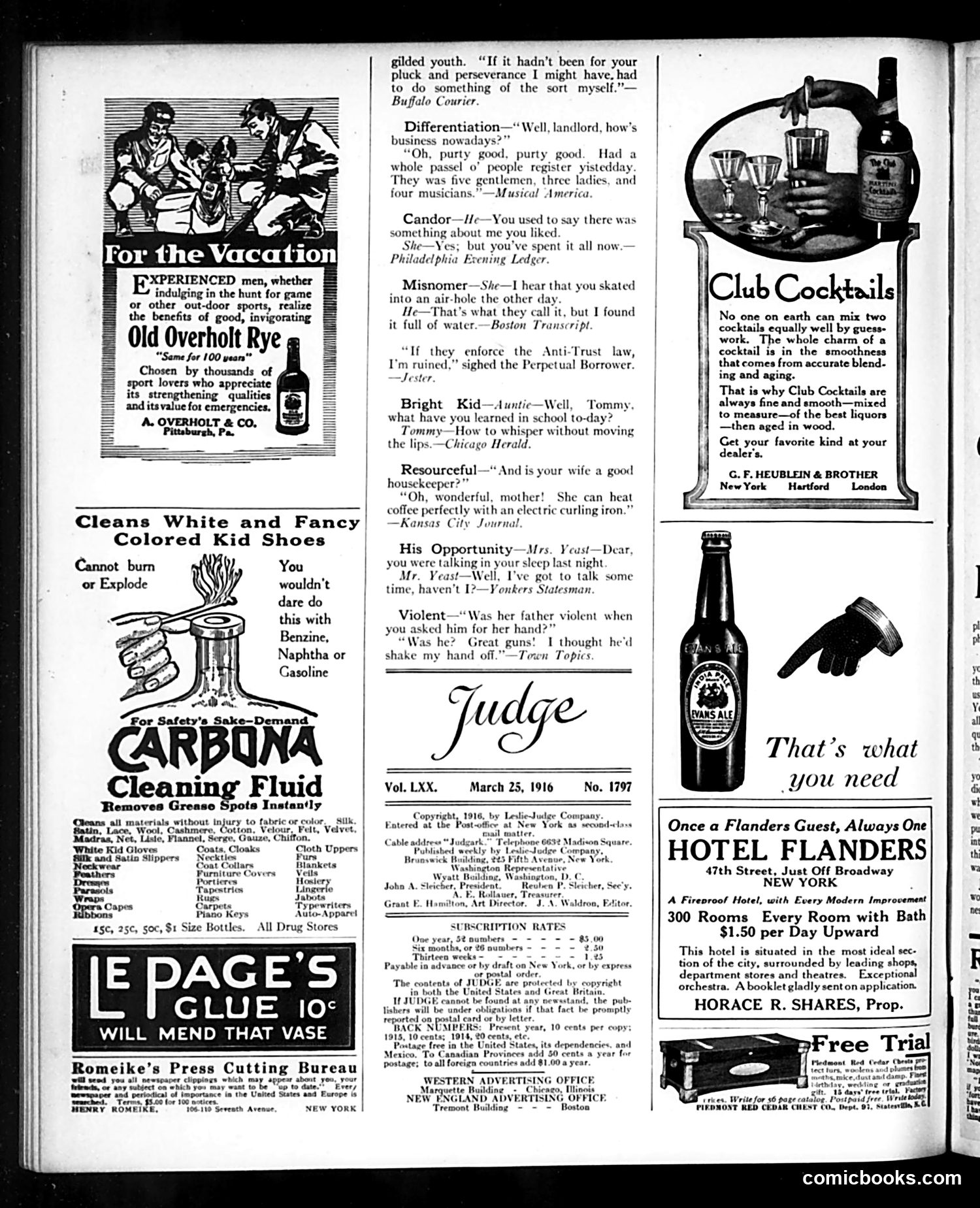
This page is primarily **advertising with brief satirical humor pieces**—typical of Judge's format. The main content consists of short, punchy jokes labeled by theme rather than a coherent cartoon narrative. The humor targets contemporary social types: a wealthy "gilded youth" claiming credit he doesn't deserve; a landlord bragging about business; couples with relationship tensions; a boy learning to whisper in school; a resourceful wife using a curling iron to heat coffee; and a man talking in his sleep. These reflect early 20th-century middle-class anxieties: economic uncertainty, marital dynamics, children's misbehavior, and domestic "efficiency." The advertisements—for Old Overholt Rye whiskey, Carbona cleaning fluid, Judge's glue, Club Cocktails, and the Hotel Flanders—are period artifacts showing products and consumer culture circa 1916. The advertorials blend commerce with lifestyle messaging typical of the era.
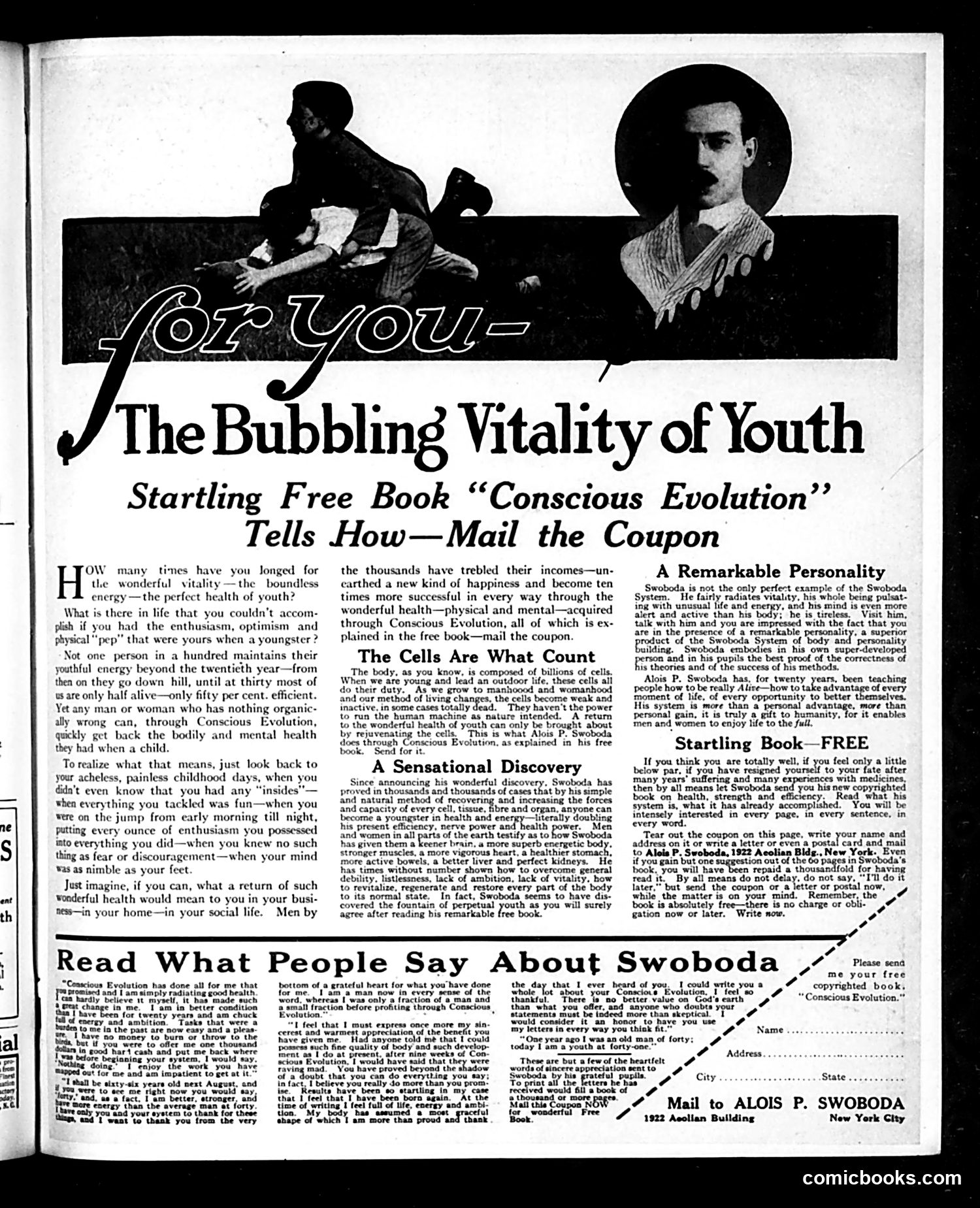
This is primarily a **pseudoscientific health advertisement**, not satire. It promotes "Conscious Evolution," a system by Alois P. Swoboda claiming to restore youthful vitality and health through unspecified methods. The page targets readers anxious about aging and declining energy, promising restored vigor, business success, and rejuvenated cells. The testimonials are typical marketing copy praising transformative results. **Historical context**: Early 20th-century magazines regularly featured such dubious health schemes. Judge's inclusion suggests either the magazine accepted paid advertisements uncritically, or satirical intent is subtle—though the earnest promotional tone and legitimate-seeming testimonials suggest genuine advertising rather than parody. The "free book" coupon and New York City address are standard mail-order tactics of the era. Without clear visual satire or ironic framing visible in the image, this appears to be straightforward quackery marketing, not satirical commentary on it.
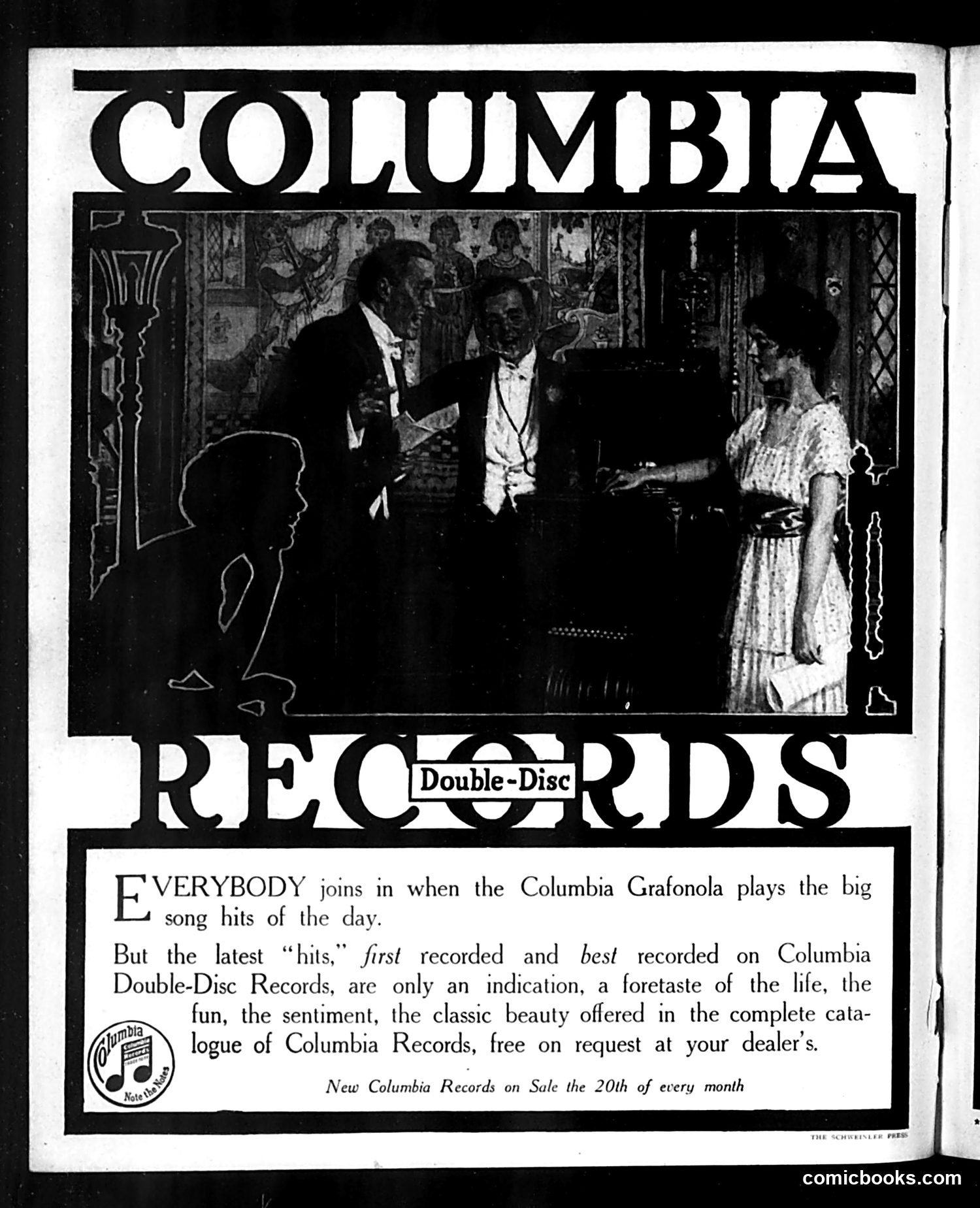
This is primarily a **Columbia Records advertisement**, not political satire. The page features a scene depicting a social gathering where people enjoy music from a Columbia Grafonola (early phonograph). The ad's message is straightforward: Columbia's current hit recordings represent only a sampling of the complete catalog available. The illustration shows well-dressed figures in an elegant interior, suggesting that Columbia Records offer "classic beauty" and refined entertainment for the middle/upper-class home. The "Double-Disc" format was a selling point—allowing longer recordings on a single record. The note that "New Columbia Records on Sale the 20th of every month" indicates regular releases to maintain consumer interest. There is no discernible political commentary or satirical jab here—it's simply vintage advertising using aspirational imagery to market phonograph records to affluent consumers. The page demonstrates Judge magazine's commercial advertising alongside editorial content.