
Judge, 1916-03-25 · page 12 of 28
Judge — March 25, 1916 — page 12: what you’re looking at
A restored page from Judge, 1916-03-25. Page through the whole issue in the reader above.
📄 Transcribed text from this page (OCR, searchable)
Machine-transcribed from the original scan — historical spelling and the odd misread are preserved.
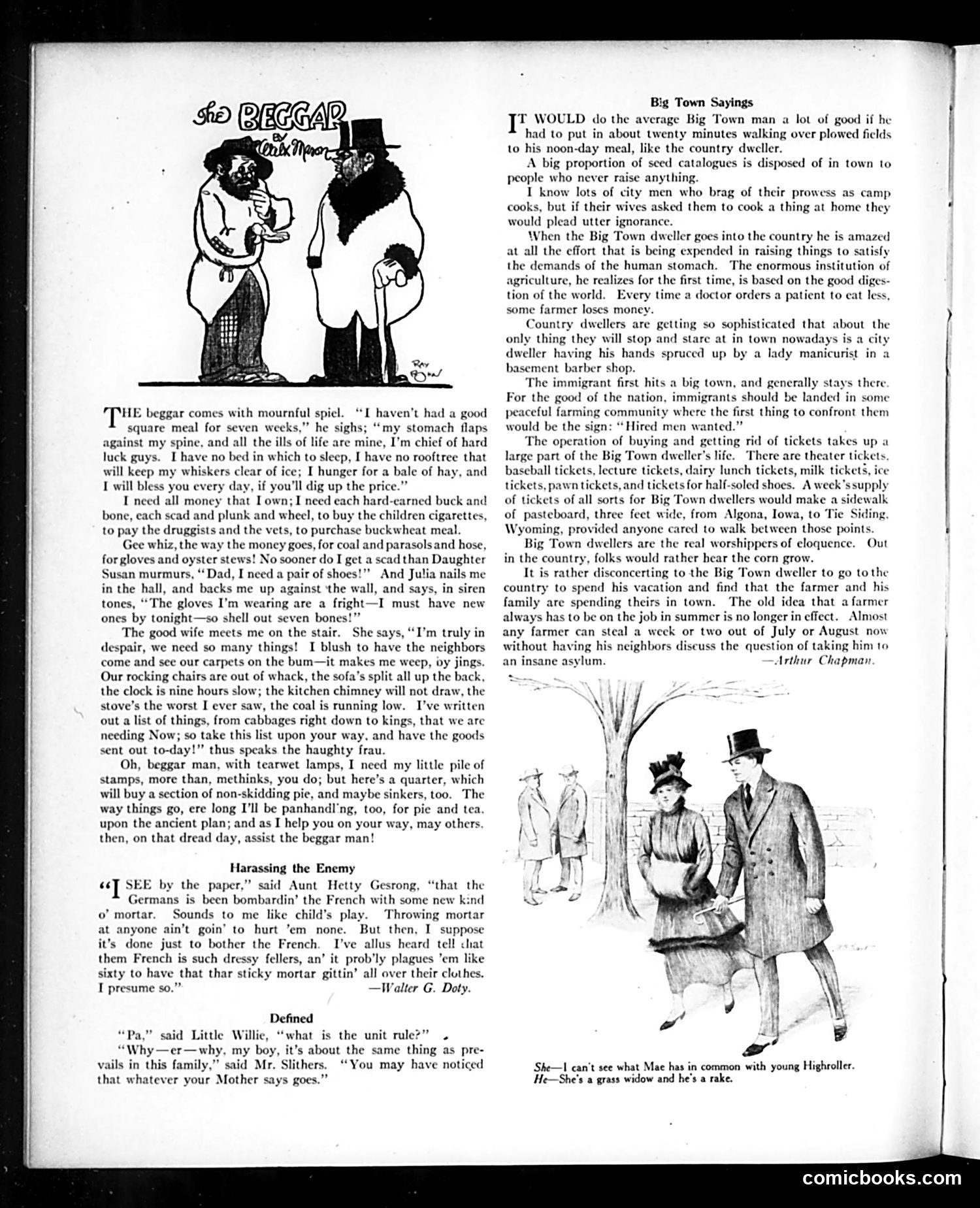
THE beggar comes with mournful spiel. “I haven't had a good square meal for s s,” he sighs; “my stomach flaps against my spine, and all the ills of life are mine, I’m chief of hard luck guys. I have no bed in which to sleep, I have no rooftree that will keep my whiskers clear of ice; I hunger for a bale of hay, and I will bless you every day, if you'll dig up the price.” I need all money that I own; I need each hard-earned buck a } bone, each scad and plunk and wheel, to buy the children cigarettes, to pay the druggists and the vets, to purchase buckwheat meal. Gee whiz, the way the moncy goes, for coal and parasols and hose, for gloves and oyster stews! No sooner do I get a scad than Daughter Susan murmurs, “Dad, I need a pair of shoes!” And Julia nails me in the hall, and backs me up against ‘the wall, and says, in siren tones, “The gloves I’m wearing are a fright—I must have new ones by tonight—so shell out seven bones!” The good wife mects me on the stair. She says, “I’m truly in despair, we need so many things! I blush to have the neighbors | come and see our carpets on the bum—it makes me weep, oy jings. Our rocking chairs are out of whack, the sofa’s split all up the back, the clock is nine hours slow; the kitchen chimney will not draw, the stove’s the worst I ever saw, the coal is running low. I’ve written out a list of things, from cabbages right down to kings, that we are | needing Now; so take this list upon your way, and have the goods | sent out to-day!” thus speaks the haughty frau. Oh, beggar man, with tearwet lamps, I need my little pile of stamps, more than, methinks, you do; but here’s a quarter, which will buy a section of non-skidding pie, and maybe sinkers, too. The | way things go, ere long I'll be panhandl'ng, too, for pie and tea, upon the ancient plan; and as I help you on your way, may others, } | then, on that dread day, ist the beggar man! Harassing the Enemy ZE by the paper,” said Aunt Hetty Gesrong, “that the Germans is been bombardin’ the French with some new kind Sounds to me like child’s play. Throwing mortar anyone ain’t goin’ to hurt ’em none. But then, I suppose it’s done just to bother the French. I’ve allus heard tell chat j them French is such dressy fellers, an’ it prob'ly plagues ’em like | sixty to have that thar sticky mortar gittin’ all over their clothes. I presume so.” —Walter G. Doty. { o’ mortar. Defined said Little Willie, ‘“‘what is the unit rule?” . Why —er—why, my boy, it’s about the same thing as pre- vails in this family,” said Mr. Slithe “You may have noticed that whatever your Mother says goe: Town Sayings T WOULD do the average Big Town man a lot of good if he had to put in about twenty minutes walking over plowed ficlds to his noon-day meal, like the country dweller. A big proportion of sced catalogues is disposed of in town to people who never raise anything. I know lots of city men who brag of their prowess as camp cooks, but if their w asked them to cook a thing at home they would plead utter ignorance When the Big Town dweller goes into the country he is amazed at all the effort that is being expended in raising things to satisfy the demands of the human stomach. The enormous institution of agriculture, he realizes for the first time, is based on the good diges- tion of the world. E y time a doctor orders a patient to cat less, some farmer loses money. Country dwellers are getting so sophisticated that about the only thing they will stop and stare at in town nowadays is a city dweller having his hands spruced up by a lady manicurist in a basement barber shop. The immigrant first hits a big town, and generally stays there. For the good of the nation, immigrants should be landed in some peaceful farming community where the first thing to confront them would be the sign: “Hired men wanted.” The operation of buying and getting rid of tickets takes up a large part of the Big Town dweller’s life. There are theater tickets baseball tickets, lecture tickets, dairy lunch tickets, milk tickets, ice tickets, pawn tickets, and tickets for half-soled shoes. A week's supply of tickets of all sorts for Big Town dwellers would make a sidewalk of pasteboard, three feet wide, from Algona, Iowa, to Tie Siding, Wyoming, provided anyone cared to walk between those points. Big Town dwellers are the real worshippers of eloquence. Out in the country, folks would rather hear the corn grow. It is rather concerting to the Big Town dweller to go tothe country to spend his vacation and find that the farmer and his family are spending theirs in town. The old idea that a farmer always has to be on the job in summer is no longer in effect. Almost any farmer can steal a week or two out of July or August now without having his neighbors diseuss the question of taking him to an insane asylum. Arthur Chapman She—I can’t see what Mae has in common with young Highroller. He—She's a grass widow and he's a rake. comicbooks.com