
Judge, 1916-03-25 · page 4 of 28
Judge — March 25, 1916 — page 4: what you’re looking at
What you’re looking at
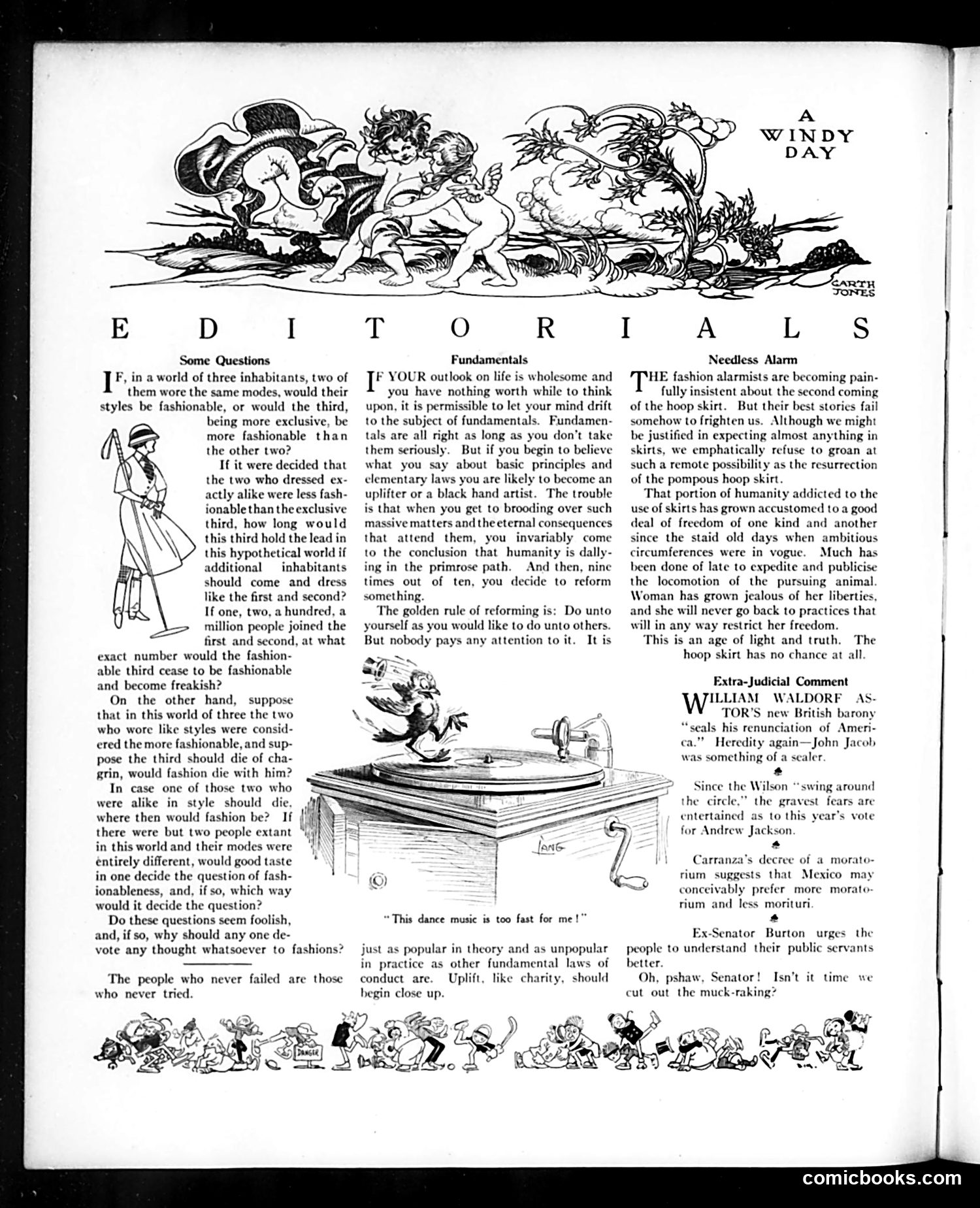
This page combines fashion commentary with political satire. The header illustration shows cherubs and wind-swept elements, establishing a "windy day" theme. The main text critiques fashion alarmists opposing the "second coming of the hoop skirt," sarcastically defending women's freedom to wear what they choose—a jab at moral reformers. The piece argues that complaints about fashion are futile: "This is as much a part of their and trivial. The hoop skirt has no chance of all." The "Extra-Judicial Comment" section references William Waldorf Astor's renunciation of American citizenship (calling him a "scaler"), Andrew Jackson's electoral prospects, and Mexican political matters under Carranza. The final item mocks ex-Senator Burton for suggesting public servants deserve better understanding—sardonic commentary on political entitlement.
📄 Transcribed text from this page (OCR, searchable)
Machine-transcribed from the original scan — historical spelling and the odd misread are preserved.
Some Questions | in a world of three inhabitants, two of them wore the same modes, would their styles be fashionable, or would the third, being more exclusive, be more fashionable than the other two? If it were decided that the two who dressed ex- actly alike were less f: ionable than the exclusi third, how long would this third hold the lead in this hypothetical world if additional inhabitants should come and dre like the first and second? If one, two, a hundred, a million people joined the first and second, at what exact number would the fashion- able third cease to be fashionable and become freakish? On the other hand, suppose that in this world of three the two who wore like styles were consid- ered the more fashionable, and sup- pose the third should die of cha- grin, would fashion die with him? In case one of those two who were alike in style should die. | where then would fashion be? If (1) there were but two people extant “iy in this world and their modes were entirely different, would good taste in one decide the question of fash- ionableness, and, if so, which way would it decide the question? Do these questions seem foolish, and, ifso, why should any one de- vote any thought whatsoever to fashions? The people who never failed are those who never tried. Fundamentals F YOUR outlook on life is wholesome and you have nothing worth while to think upon, it is permissible to let your mind drift to the subject of fundamentals. Fundamen- tals are all right as long as you don’t take them seriously. But if you begin to believe what you say about basic principles and elementary laws you are likely to become an uplifter or a black hand artist. The trouble is that when you get to brooding over such massive matters and the eternal consequences that attend them, you invariably come to the conclusion that humanity is dally- ing in the primrose path. And then, nine times out of ten, you decide to reform something. The golden rule of reforming is: Do unto yourself as you would like to do unto others. But nobody pays any attention to it. It is | “This dance music is too fast for me!” just as popular in theory and as unpopular in practice as other fundamental laws of conduct are. Uplift, like charity, should begin close up. Needless Alarm HE fashion alarmists are becoming pain- fully insistent about the second coming of the hoop skirt. But their best stories fail somehow to frighten us. Although we might be justified in expecting almost anything in skirts, we emphatically refuse to groan at such a remote possibility as the resurrection of the pompous hoop skirt. That portion of humanity addicted to the use of skirts has grown accustomed to a good deal of freedom of one kind and another since the staid old days when ambitious circumferences were in vogue. Much has been done of late to expedite and publicise the locomotion of the pursuing animal. Woman has grown jealous of her liberties, and she will never go back to practices that will in any way restrict her freedom. This is an age of light and truth. The hoop skirt has no chance at all Extra-Judicial Comment ILLIAM WALDORF AS- TOR’S new British barony cals his renunciation of Ameri- ca.” Heredity again—John Jacob was something of a scaler 2 Since the Wilson “swing around * the gravest fears are entertained as to this year’s vote for Andrew Jackson * Carranza’s decree of a morato- rium suggests that Mexico may conceivably prefer. more morato- rium and less morituri * ix-Senator Burton urges the people to understand their public servants better. Oh, pshaw, Senator! Isn't it cut out the muck-raking? time we NN comicbooks.com