
Judge, 1916-03-25 · page 11 of 28
Judge — March 25, 1916 — page 11: what you’re looking at
What you’re looking at
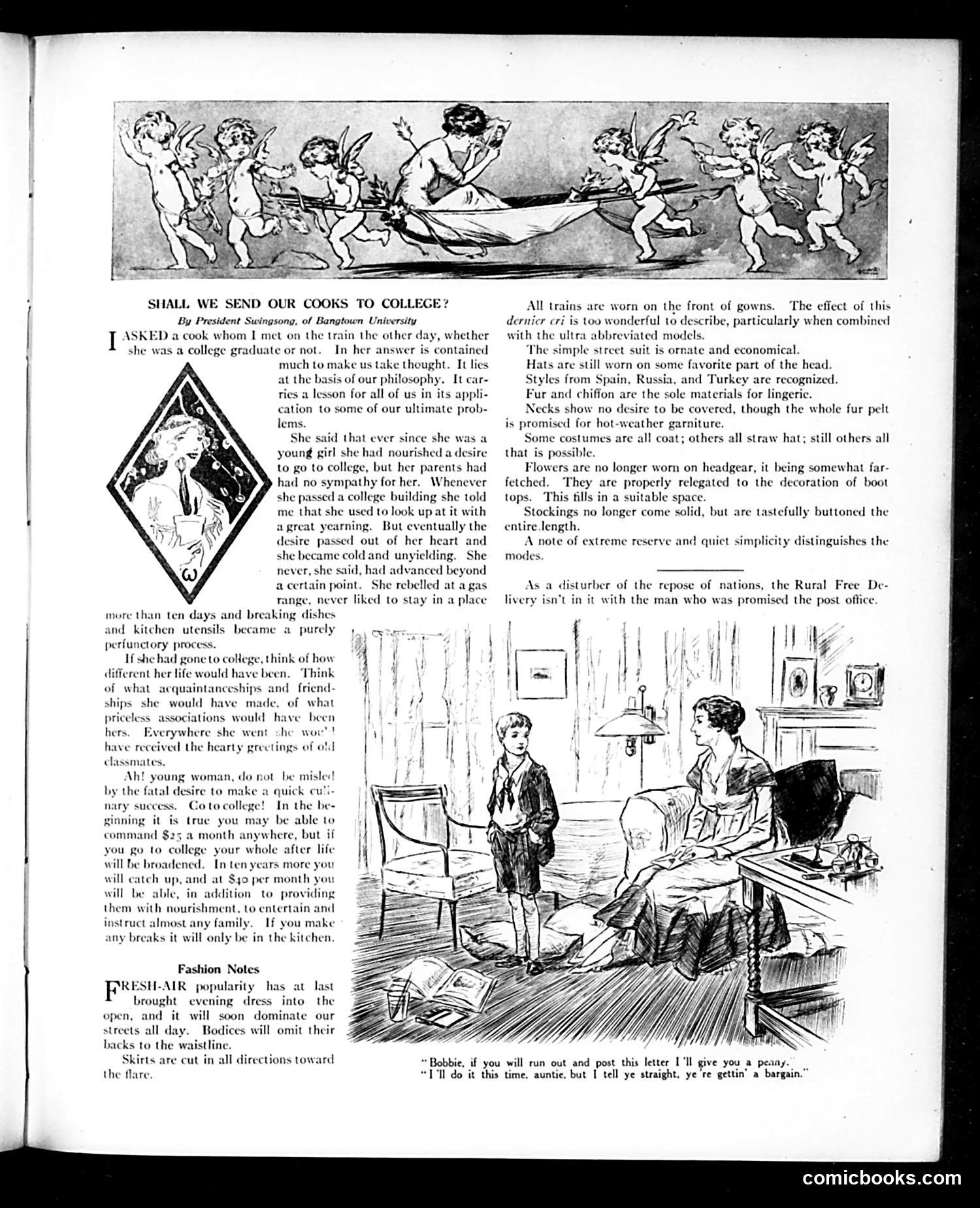
This *Judge* magazine page contains two satirical pieces: **"Shall We Send Our Cooks to College?"** mocks the era's class anxieties about education and social mobility. President Swingsong's anecdote about a cook who wanted college but couldn't attend serves as ironic commentary—he argues she'd earn only $25/month initially but $40 after ten years with a degree. The satire lies in the absurdity: suggesting domestic servants pursue higher education while remaining servants, and that modest wage increases justify the aspiration. It reflects early-20th-century tensions between expanding educational access and rigid class structures that prevented its practical benefit. **"Fashion Notes"** satirizes the era's increasingly absurd and contradictory women's fashion trends—dresses with no backs, minimal coverage, inconsistent hat placement, buttonholed stockings. The exaggeration mocks designers' chaotic, impractical aesthetic choices. The bottom cartoon shows a child shrewdly negotiating payment for running errands, suggesting even youth recognize labor's true value.
📄 Transcribed text from this page (OCR, searchable)
Machine-transcribed from the original scan — historical spelling and the odd misread are preserved.
SHALL WE ND OUR COOKS TO COLLEGE? By President Swingsong, of Bangtown University ASKED a cook whom I met on the train the other day, whether she was a college graduate or not. In her answer is contained much to make us take thought. It lies at the basis of our philosophy. It car- ries a lesson for all of us in its appli- cation to some of our ultimate prob- lems. She said that ever since she was a young girl she had nourished a desire to go to college, but her parents had had no sympathy for her. Whenever she passed a college building she told me that she used to look up at it with agreat yearning. But eventually the desire passed out of her heart and she became cold and unyielding. She never, she said, had advanced beyond a certain point. She rebelled at a gas range, never liked to stay in a place more than ten days and breaking dishes and kitchen utensils became a purely 1) eee perfunctory process. If she had gone to college, think of how different her life would have been. ‘Think q of what acquaintanceships and friend- ships she would have made, of what priceless associations would have been hers. Everywhere she went she woe’! have received the hearty greetings of old classmates. oung woman, do not be misle al desire to make a quick cu nary success. Gotocollege! In the be- ginning it is true you may be able to command $25 a month anywhere, but if you go to college your whole after life will be broadened. In ten years more you will catch up, and at $40 per month you will be able, in addition to providing them with nourishment, to entertain and instruct almost any family, If you make any breaks it will only be in the kitchen, Fashion Notes RESH-AIR popularity has at last brought evening dress into the open, and it will soon dominate our streets all day. Bodices will omit their backs to the waistline. Skirts are cut in all directions toward the flare. “Bobbie, if you will run out and post this letter I'll give you a peany. “T'll do it this time, auntie, but I tell ye straight, ye re gettin’ a bargain. All trains are worn on the front of gowns. ‘The effect of this dernier cri is too wonderful to describe, particularly when combined with the ultra abbreviated models. The simple street suit is ornate and economical. Hats are still worn on some favorite part of the head. Styles from Spain, Russia, and y Fur and chiffon are the sole materials for lingeric. Ne show no desire to be covered, though the whole fur pelt is promised for hot-weather garniture. Some costumes are all coat; others all straw hat; still others all that is possible. Flowers are no longer worn on headgear, it being somewhat far- fetched. They are properly relegated to the decoration of boot tops. This fills in a suitable space. Stockings no longer come solid, but are tastefully buttoned the entire length. A note of extreme reserve and quict simplicity distinguishes the modes, As a disturber of the repose of nations, the Rural Free De- livery isn’t in it with the man who was promised the post office MoT | | d 4 7 Tifwcrmens comicbooks.com