
Judge, 1916-03-25 · page 14 of 28
Judge — March 25, 1916 — page 14: what you’re looking at
What you’re looking at
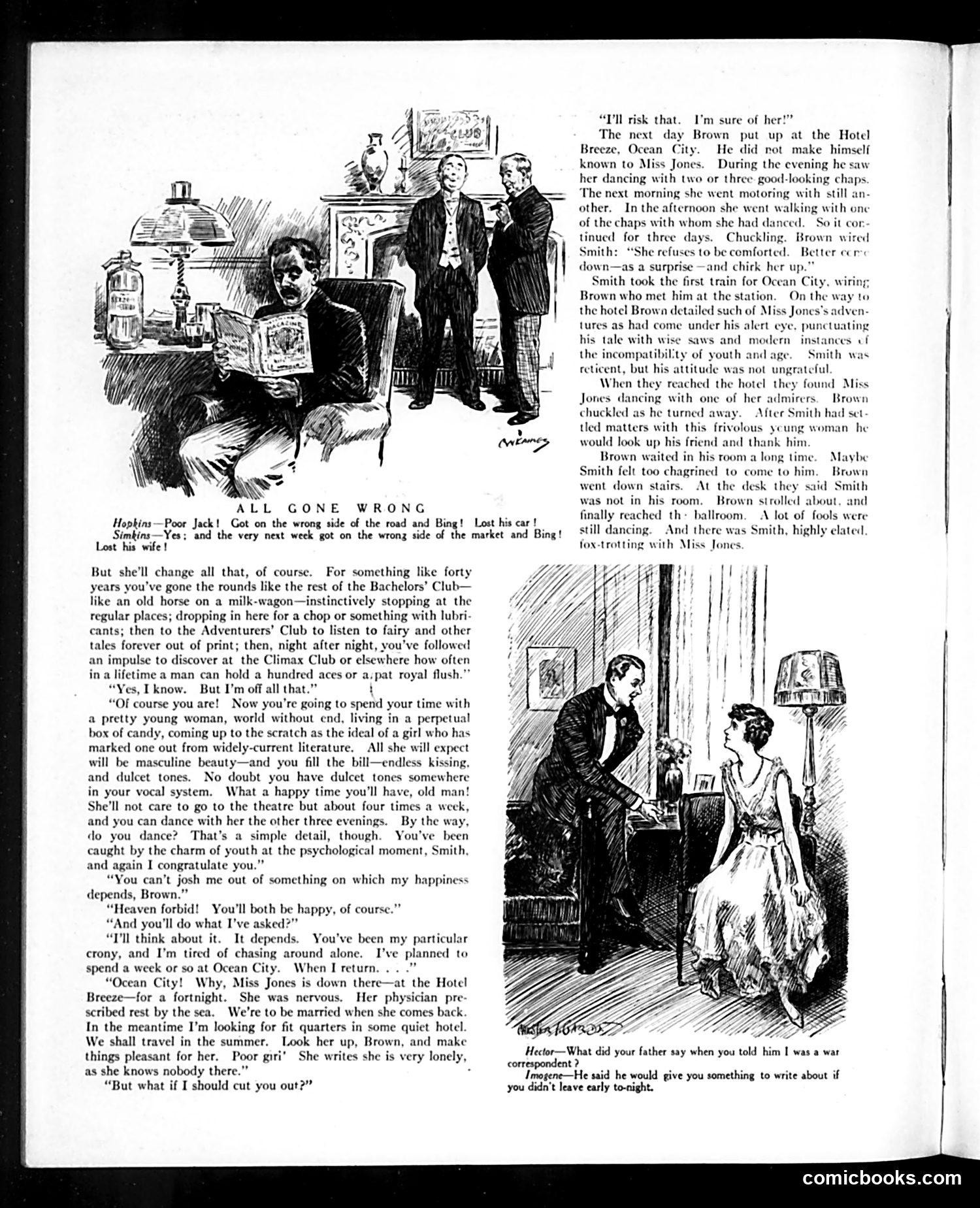
This page satirizes the foolishness of a bachelor named Smith who abandons decades of carefree bachelor club life to marry Miss Jones. His friend Brown warns him that marriage means endless domestic obligations—theater trips, dancing, candy boxes—replacing the freedom of gambling and leisure clubs. The satire deepens when Smith asks Brown to check on his fiancée at Ocean City's Hotel Breeze while she convalesces. Brown discovers Miss Jones is actually enjoying herself immensely, flirting and dancing with multiple admirers rather than being lonely and faithful as Smith imagines. The cartoon mocks Smith's naïveté about both women and marriage. It suggests that Smith, trading his independent bachelor life for domestic servitude, has ironically chosen a woman who may not be as devoted to him as he assumes. The humor lies in his misjudgment and the gap between romantic idealization and reality—a common Judge magazine theme critiquing both marriage and male gullibility.
📄 Transcribed text from this page (OCR, searchable)
Machine-transcribed from the original scan — historical spelling and the odd misread are preserved.
ALL GONE WRONG Poor Jack! Got on the wrong side of the road and Bing! Lost his car! imkins—Yes; and the very next week got on the wrong side of the market and Bing! Lost his wife! But she'll change all that, of course. For something like forty years you've gone the rounds like the rest of the Bachelors’ Club— like an old horse on a milk-wagon—instinctively stopping at the regular places; dropping in here for a chop or something with lubri- cants; then to the Adventurers’ Club to listen to fairy and other tales forever out of print; then, night after night, you've followed an impulse to discover at the Climax Club or elsewhere how often in a lifetime a man can hold a hundred aces or a;pat royal flush.” ves, know. But I’m off all that.” { “Of course you are! Now you're going to spend your time with a pretty young woman, world without end, living in a perpetual box of candy, coming up to the scratch as the ideal of a girl who has marked one out from widely-current literature, All she will expect will be masculine beauty—and you fill the bill—endless kissing, and dulcet tones. No doubt you have dulcet tones somewhere in your vocal system. What a happy time you'll have, old man! She'll not care to go to the theatre but about four times a week, and you can dance with her the other three evenings. By the w: do you dance? That’s a simple detail, though. You've been caught by the charm of youth at the psychological moment, Smith, and again I congratulate you.” “You can’t josh me out of something on which my happiness depends, Brown.” “Heaven forbid! You'll both be happy, of course.” “And you'll do what I've asked?” “T'll think about it. It depends. crony, and I’m tired of chasing around alone. spend a week or so at Ocean City. When I return. “Ocean City! Why, Miss Jones is down there—at the Hotel Breeze—for a fortnight. She was nervous. Her physician pre- scribed rest by the sea. We're to be married when she comes back. In the meantime I’m looking for fit quarters in some quict hotel. We shall travel in the summer. Look her up, Brown, and make things pleasant for her. Poor giri’ She writes she is very lonely, as she knows nobody there.” . “But what if I should cut you out?” You've been my particular I've planned to Hector—What did your father say when you told him I was a war corre lent ? Imogene—He said he would give you something to write about if you didn’t leave early to-night. “T'll risk that The next di I'm sure of her!” Brown put up at the Hotel Breeze, Ocean C He did rot ¢ himself known to Miss Jones. During the evening he saw her dancing with two or three good-looking chaps. The next morning she went motoring with still an- other. In the afternoon she went walking with one of the chaps with whom she had danced. So it cor tinued for three days. Chuckling. Brown wi Smith: “She refuses to be comforted. Better cere down—as a surprise —and chirk her up. Smith took the first train for Ocean City, wiring Brown who met him at the station. On the way to the hotel Brown detailed such of Miss Jones's advet tures as had come under his alert eye. punctuating his tale with wise saws and modern instances cf the incompatibility of youth and age. Smith was reticent, but his attitude was not ungrateful. When they rhed the hotel they found Miss Jones dancing with one of her admirers. Brown chuckled as he turned away. After Smith had set tled matters with this frivolous yeung woman he 1 would look up his friend and thank him. Brown waited in his room a long time. Maybe Smith felt too chagrined to come to him. Brown went down stairs. At the desk they said Smith was not in his room. Brown strolled about, and finally reached th» ballroom, A lot of fools were still dancing. And there was Smith, highly elated fox-trotting with Miss Jones. ed comicbooks.com