
Judge, 1916-03-25 · page 16 of 28
Judge — March 25, 1916 — page 16: what you’re looking at
What you’re looking at
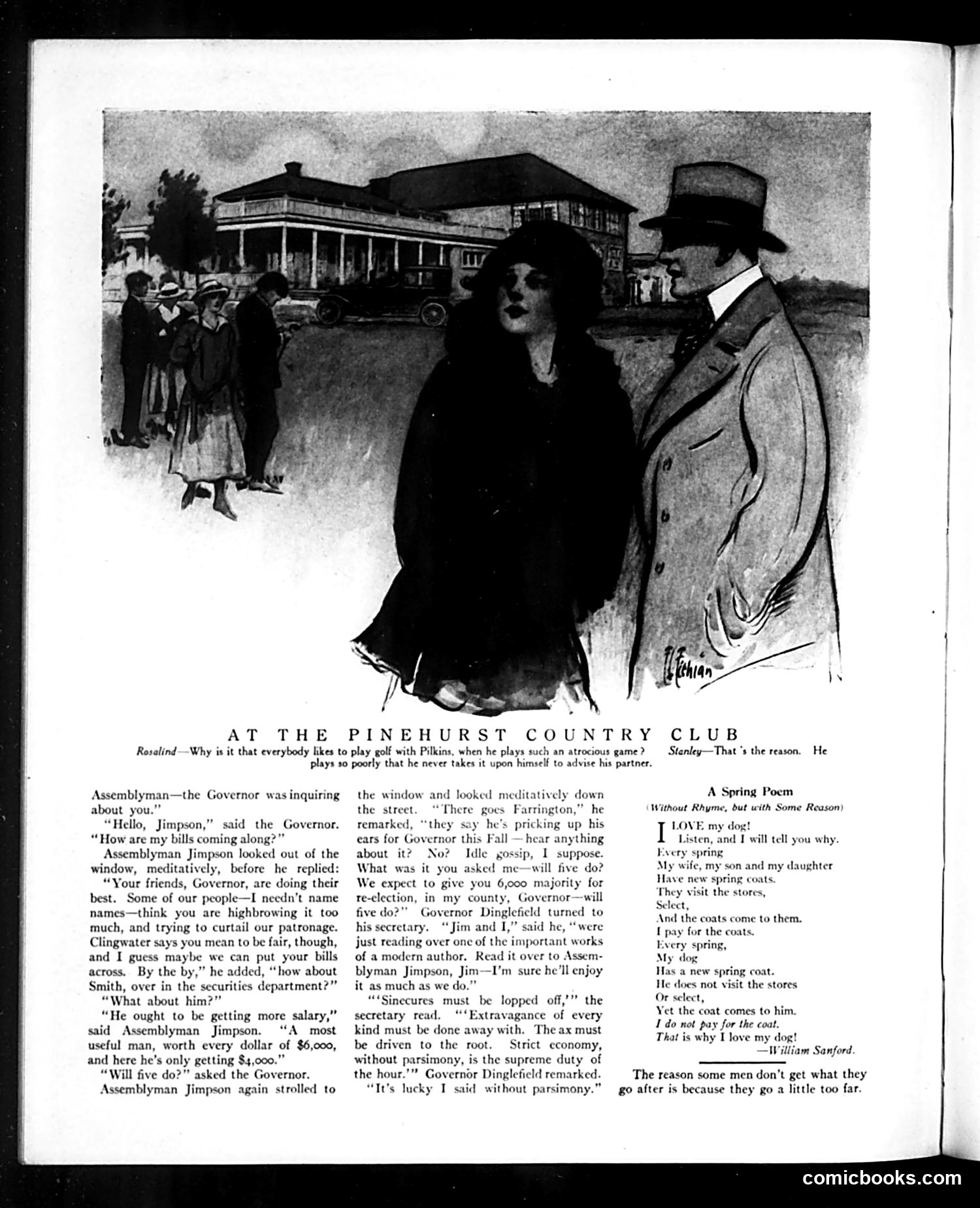
This cartoon satirizes political corruption and quid pro quo dealings among elected officials. **The Setup:** An Assemblyman named Jimpson approaches Governor Dinglefield at a country club. While ostensibly discussing legislative business, Jimpson subtly pressures the Governor: he mentions needing patronage appointments ("Smith, over in the securities department"), hints at delivering votes ("6,000 majority for re-election"), and implies a rival (Farrington) seeks the governorship. **The Satire:** The Governor and his secretary respond by reading aloud passages about eliminating "sinecures" and enforcing "strict economy"—high-minded reform rhetoric that contrasts sharply with their actual practice of dispensing favors. When Jimpson requests a $2,000 raise for Smith, the Governor immediately agrees ("Will five do?"), revealing that principles dissolve when political debts are called in. **The Point:** Judge mocks the hypocrisy of progressive-era politicians who publicly championed good government while privately trading favors, pay raises, and appointments for electoral support—business conducted casually over golf.
📄 Transcribed text from this page (OCR, searchable)
Machine-transcribed from the original scan — historical spelling and the odd misread are preserved.
AT THE PINEHURST COUNTRY CLUB Rosalind —Why is it that everybody likes to play golf with Pilkins, when he plays plays so poorly that he never takes it upon himself to advise his partner. Assemblyman—the Governor was inquiring about you “Hello, Jimpson,” said the “ How are my bills coming along? Assemblyman Jimpson looked out of the window, meditatively, before he replied: “Your friends, Governor, are doing their best. Some of our people—I needn’t name names—think you are highbrowing it too much, and trying to curtail our patronage. Clingwater says you mean to be fair, though, and I guess maybe we can put your bills across. By the by,” he added, “how about Smith, over in the securities department?” What about him?” “He ought to be getting more salary,” said Assemblyman Jimpson. ‘A most useful man, worth every dollar of $6,000, and here he’s only getting $4,000.” “Will five do?” asked the Governor. Assemblyman Jimpson again strolled to Governor. the window and looked meditatively down the street There goes Farrington,” he remarked, “they say he’s pricking up his ears for Governor this Fall —hear anything about it? No? Idle gossip, I suppose. What was it you asked me—will five do? We expect to give you 6,000 majority for re-election, in my county, Governor—will five do?" Governor Dingleficld turned to his secretary. “Jim and I,” said he, “were just reading over onc of the important works of a modern author. Read it over to Assem- blyman Jimpson, Jim—I’m sure he'll enjoy it as much as we do.” ““Sinecures must be lopped off,” the secretary read. “‘Extravagance of every kind must be done away with. The ax must be driven to the root. Strict economy, without parsimony, is the supreme duty of the hour.’”” Governor Dinglefield remarked. “It’s lucky I said without parsimony.” an atrocious game ? Stenley—That ‘s the reason. He A Spring Poem Without Rhyme, but with Some Reason) LOVE my di Listen, and I will tell you why. Every spring My wife, my son and my daughter Have new spring coats. They visit the stores, Select, And the coats come to them. I pay for the coats. a new spring coat. loes not visit the stores Or select, Yet the coat comes to him. I do not pay for the coat. That is why I love my dog! —William Sanford. The reason some men don’t get what they go after is because they go a little too far. comicbooks.com