
A complete issue · 28 pages · 1916
Judge — February 19, 1916
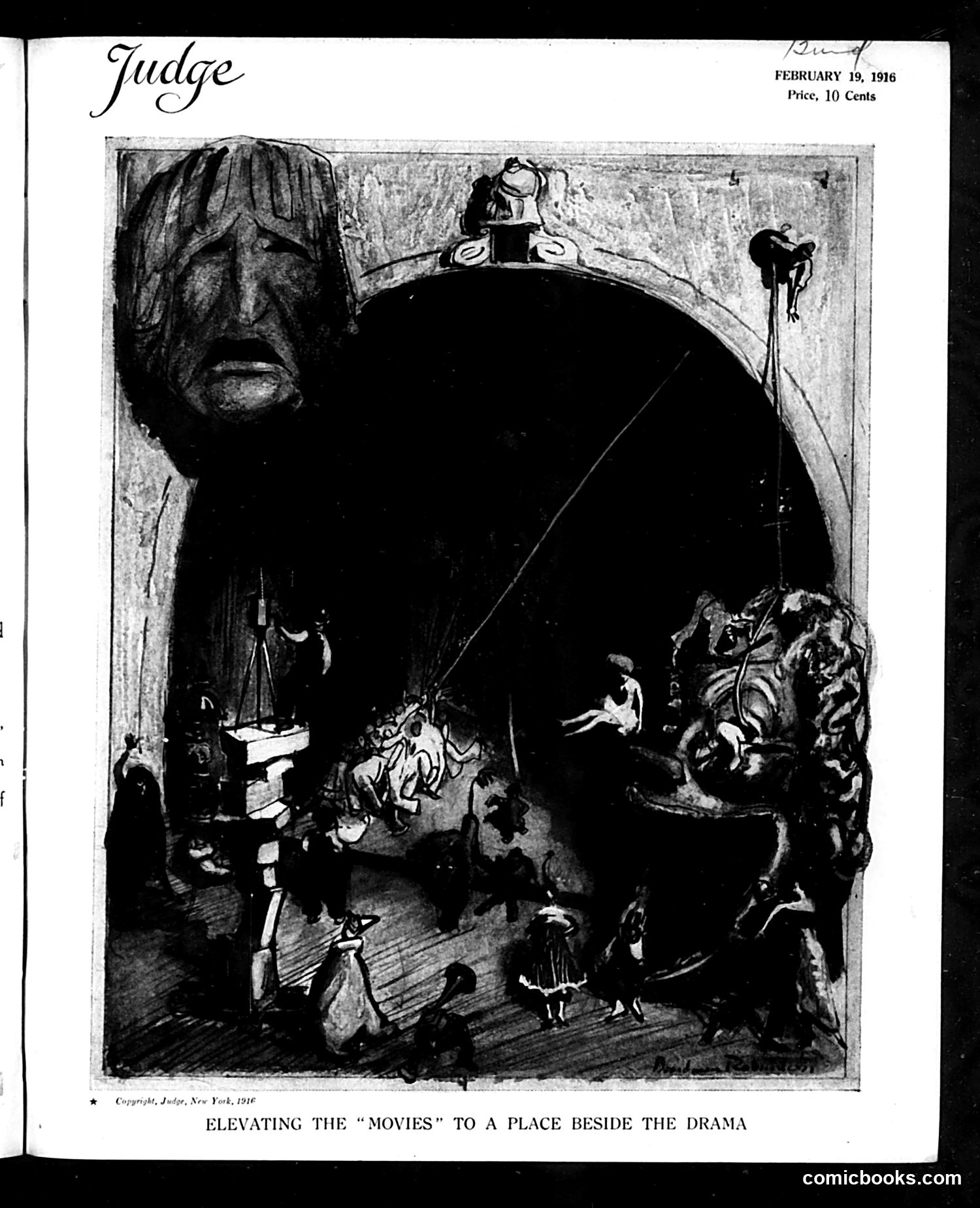
This 1916 Judge cartoon satirizes efforts to legitimize cinema as serious art comparable to theatrical drama. The image depicts a monumental classical structure—resembling a temple or grand theater—being constructed to elevate "movies" to cultural parity with traditional stage drama. The composition shows workers and figures laboring to build this architectural monument, with a stern face looming large above, possibly representing critical gatekeepers or industry figures. The satire suggests skepticism about whether cinema could truly achieve the cultural prestige of established theater, or mocks the pretentiousness of those attempting such elevation. This reflects early 20th-century tensions between emerging film as mass entertainment versus theater as established high art—a debate that persisted for decades before cinema gained full cultural legitimacy.
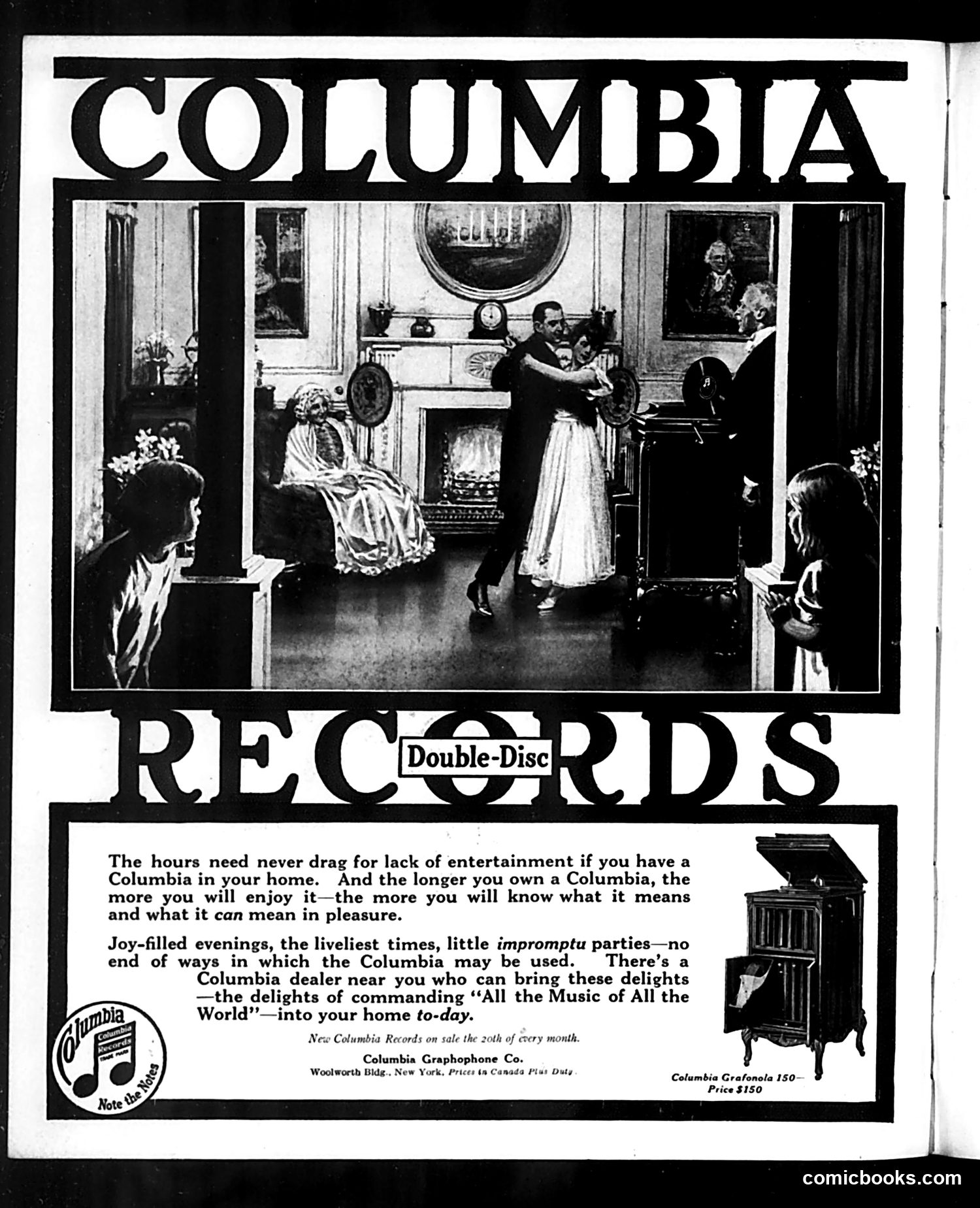
This page is primarily **advertising, not satire or editorial content**. It's a Columbia Records advertisement featuring a scene of well-dressed people in an elegant interior, apparently enjoying music together. The ad copy emphasizes how owning a Columbia graphophone (record player) provides endless home entertainment and enables spontaneous social gatherings ("impromptu parties"). The messaging suggests that owning this technology elevates one's social life and leisure time. The product shown—Columbia Grafanola 150—is priced at $150, positioning it as a luxury good for affluent households. The "Double-Disc" format allowed longer playing time. No political figures or satirical commentary appear present. This represents early 20th-century consumer marketing emphasizing technology as a status symbol and social facilitator.
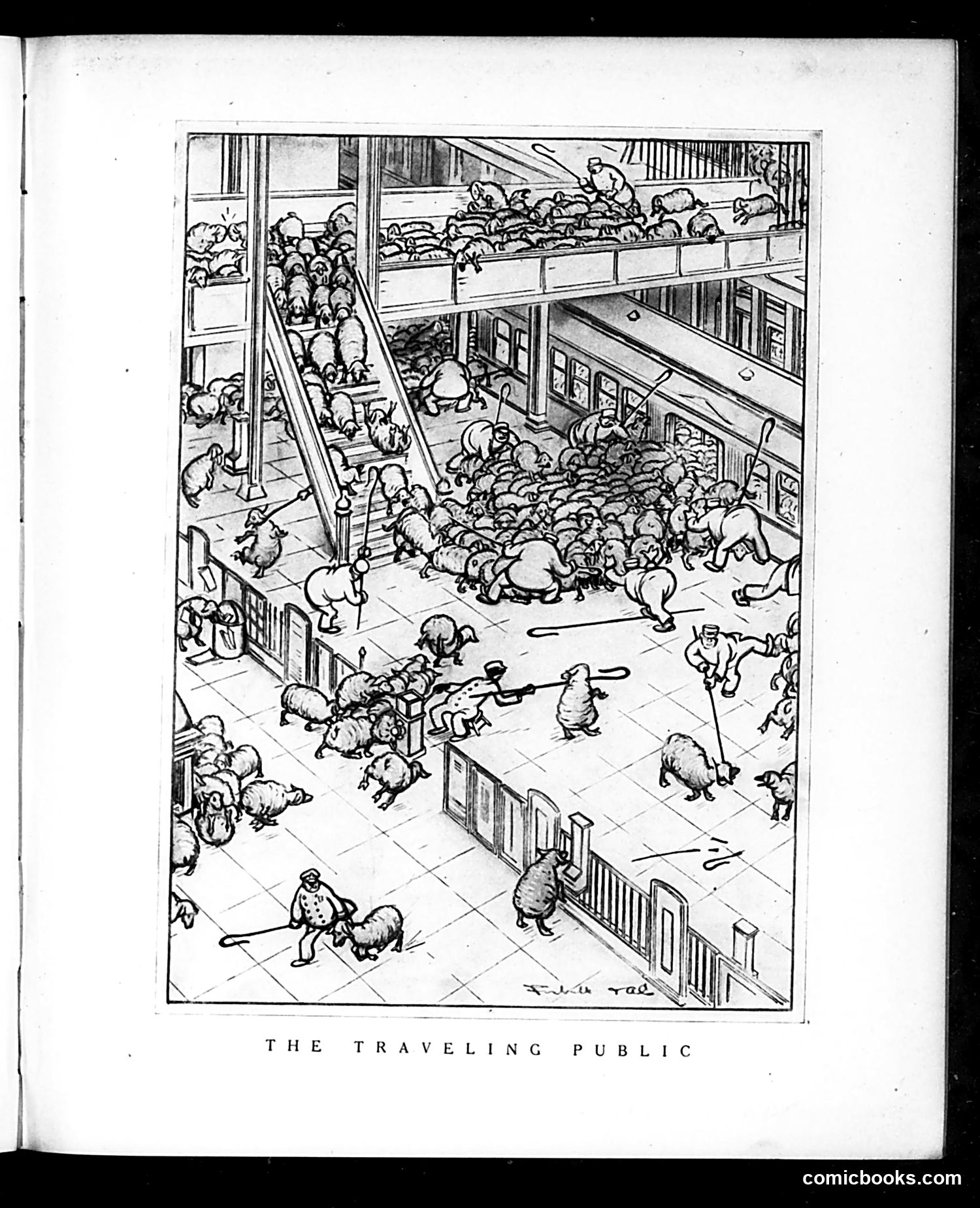
This cartoon satirizes crowded conditions in early 20th-century public transportation, likely depicting a train station or depot. The image shows masses of people and luggage packed into multiple levels—stairways, platforms, and cars—in chaotic disarray. The satire targets the experience of ordinary travelers during peak travel season. The exaggerated overcrowding—people literally stacked on top of each other, spilling across every surface—mocks both the inadequate infrastructure of transportation systems and the undignified conditions passengers endured. The title suggests this depicts a common, relatable problem for "the traveling public": a contemporary complaint about poor service, insufficient capacity, and the indignity of mass transit. Judge magazine frequently used such social commentary to criticize modernization's failures to serve ordinary Americans comfortably.
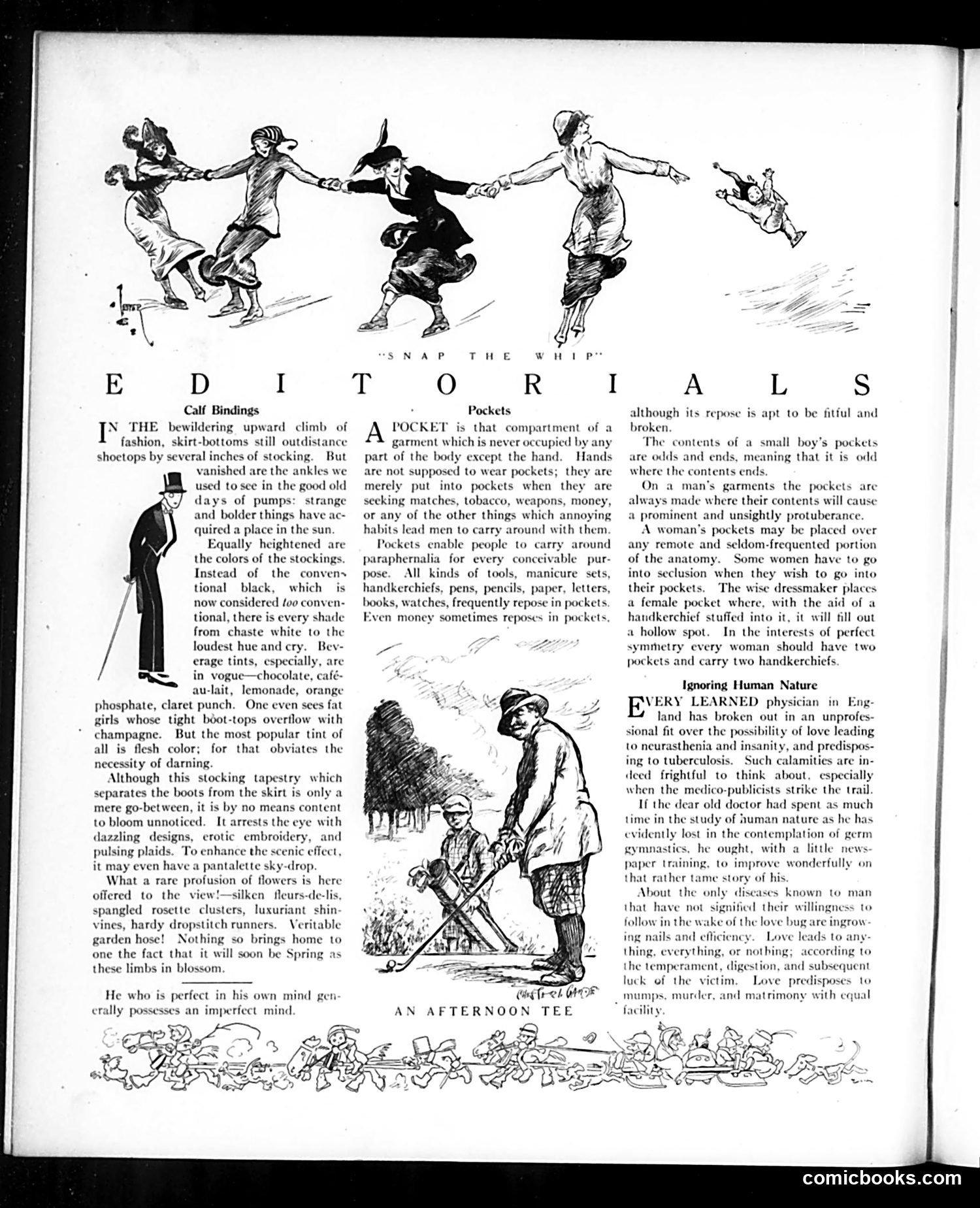
This page from *Judge* magazine contains three distinct pieces: 1. **"Snap the Whip"** (top): An illustrated sequence showing figures in a children's game, likely referencing the famous painting by Winslow Homer. 2. **"Editorials"** (left column): Discusses proper etiquette for men's clothing, specifically stockings and calf bindings—a fashion concern of the era. Includes a gentleman figure illustration. 3. **"Pockets"** and **"Ignoring Human Nature"** (right columns): Essays on practical clothing design and social behavior. The pocket discussion addresses gender differences in garment functionality. The second essay critiques physicians' dismissal of love's effects on health. 4. **"An Afternoon Tee"** (bottom): A sketch showing what appears to be a golf or leisure scene with two figures. The content reflects early 20th-century social commentary on fashion, gender roles, and medical attitudes rather than explicit political satire.
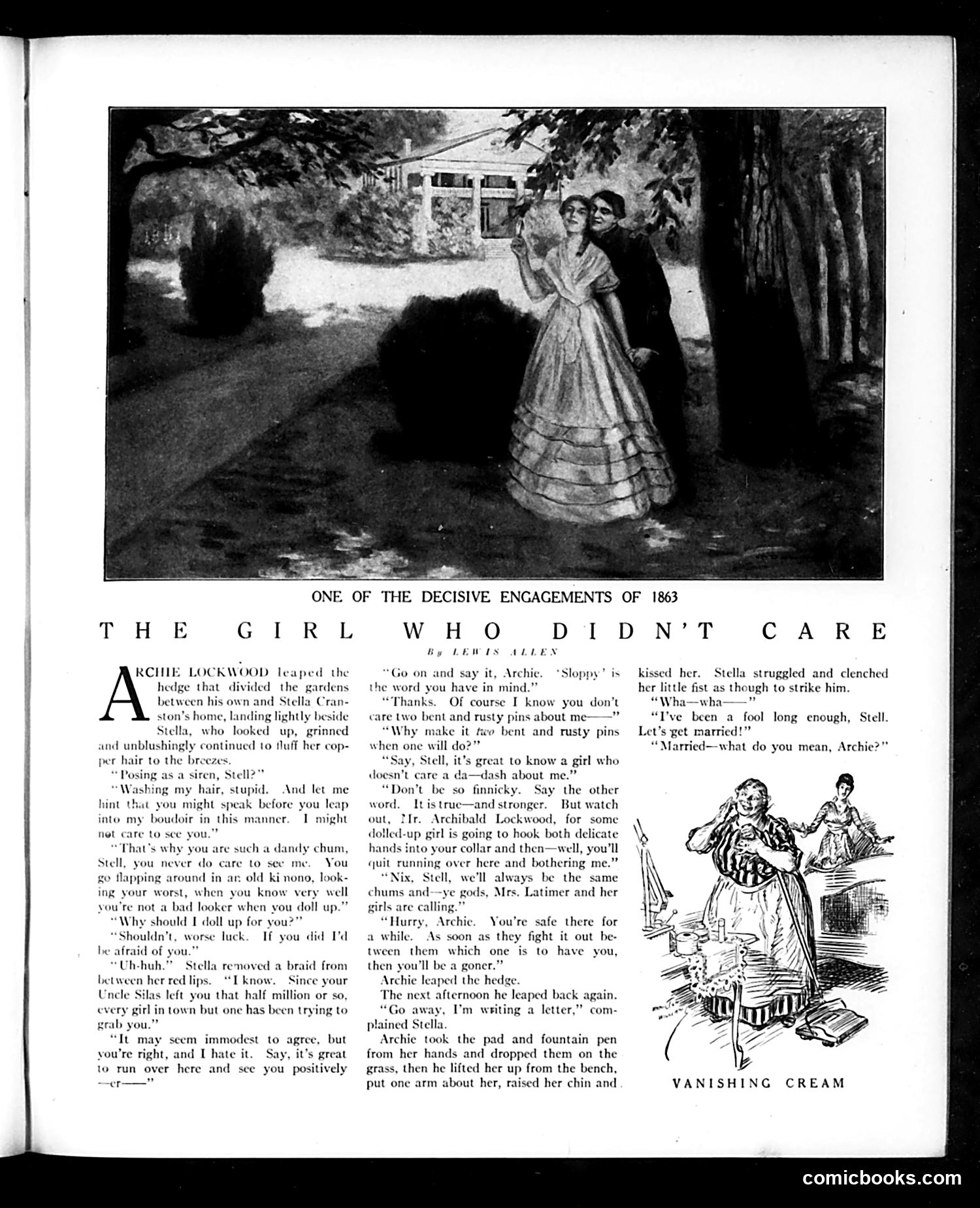
This page presents a romantic short story by Lewis Allen rather than political satire. The narrative concerns Stella Canton, who rejects suitor Archie Lockwood's advances, claiming indifference to marriage. The story plays on early 1860s courtship conventions—Archie attempts various persuasive tactics to win her affection, referencing "One of the Decisive Engagements of 1863" (likely the American Civil War), while Stella maintains her independence and emotional detachment. The accompanying illustration shows a woman in period dress confronting a man, depicting their romantic tension. The small advertisement for "Vanishing Cream" occupies the lower right. The piece appears aimed at Judge's audience through gentle humor about gender relations and marriage prospects during the Civil War era, when such domestic narratives provided escapist entertainment.
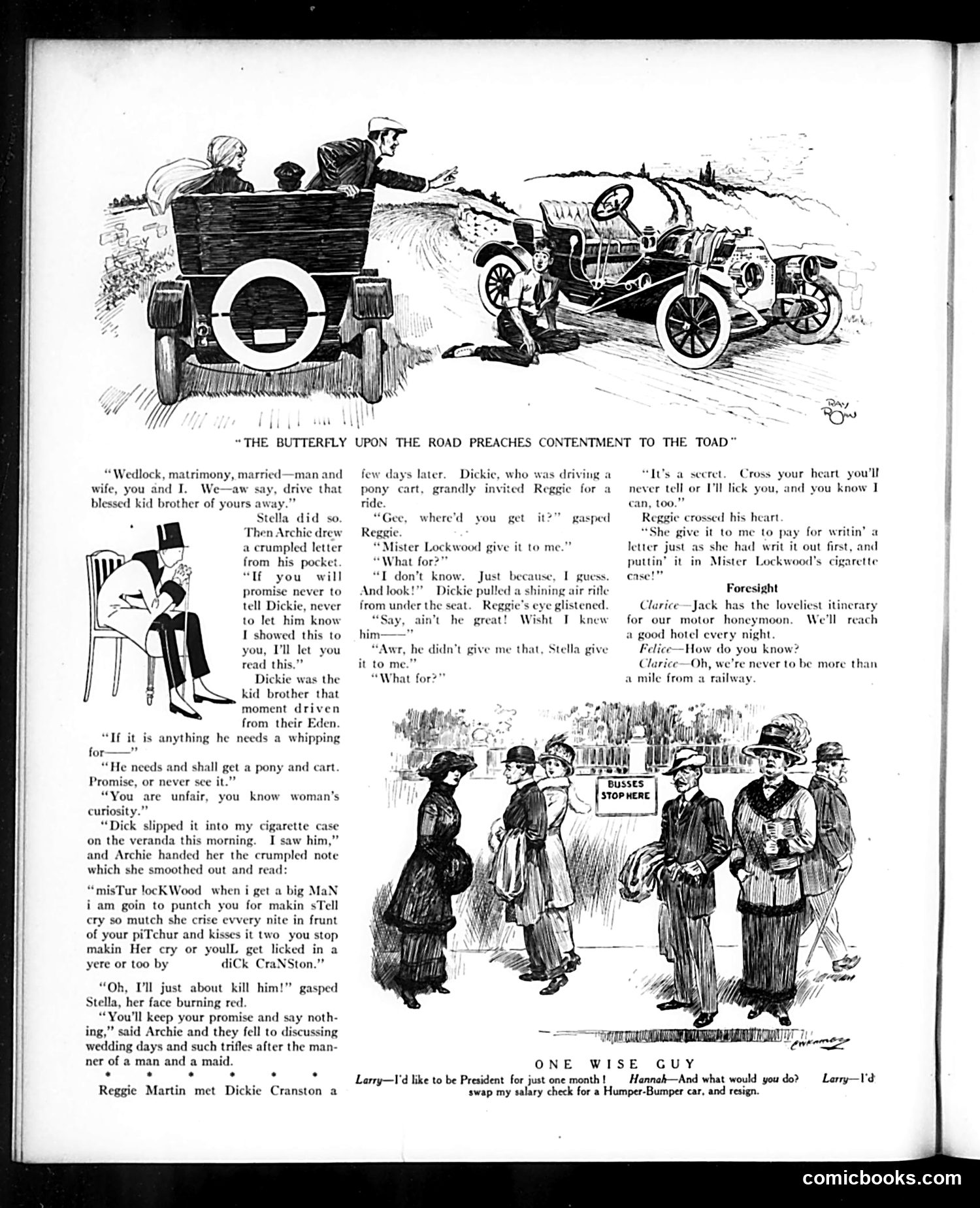
This page contains satirical commentary on early automobile culture and courtship customs in the early 1900s. **Main cartoon**: "The Butterfly Upon the Road Preaches Contentment to the Toad" depicts the tension between old and new transportation—a horse-drawn cart versus modern motorcars. The imagery suggests nostalgia for simpler times versus enthusiasm for new technology. **Story narrative**: The plot involves young Dickie Cranston receiving a pony cart from Mr. Lockwood as payment for writing a love letter. The humor plays on themes of youthful mischief, bribery through gifts, and the earnest (misspelled) threatening letter Dickie wrote to protect his sister's honor. The satire mocks Victorian propriety and parental concern about courtship. **Bottom panel ("One Wise Guy")**: A brief joke about aspirational materialism—a man would trade a presidential salary for a luxury automobile ("Humper-Bumper car"), reflecting society's obsession with status symbols and new consumer goods during the automobile boom. The overall tone satirizes early-20th-century social anxieties about changing courtship, technology, and class aspirations.
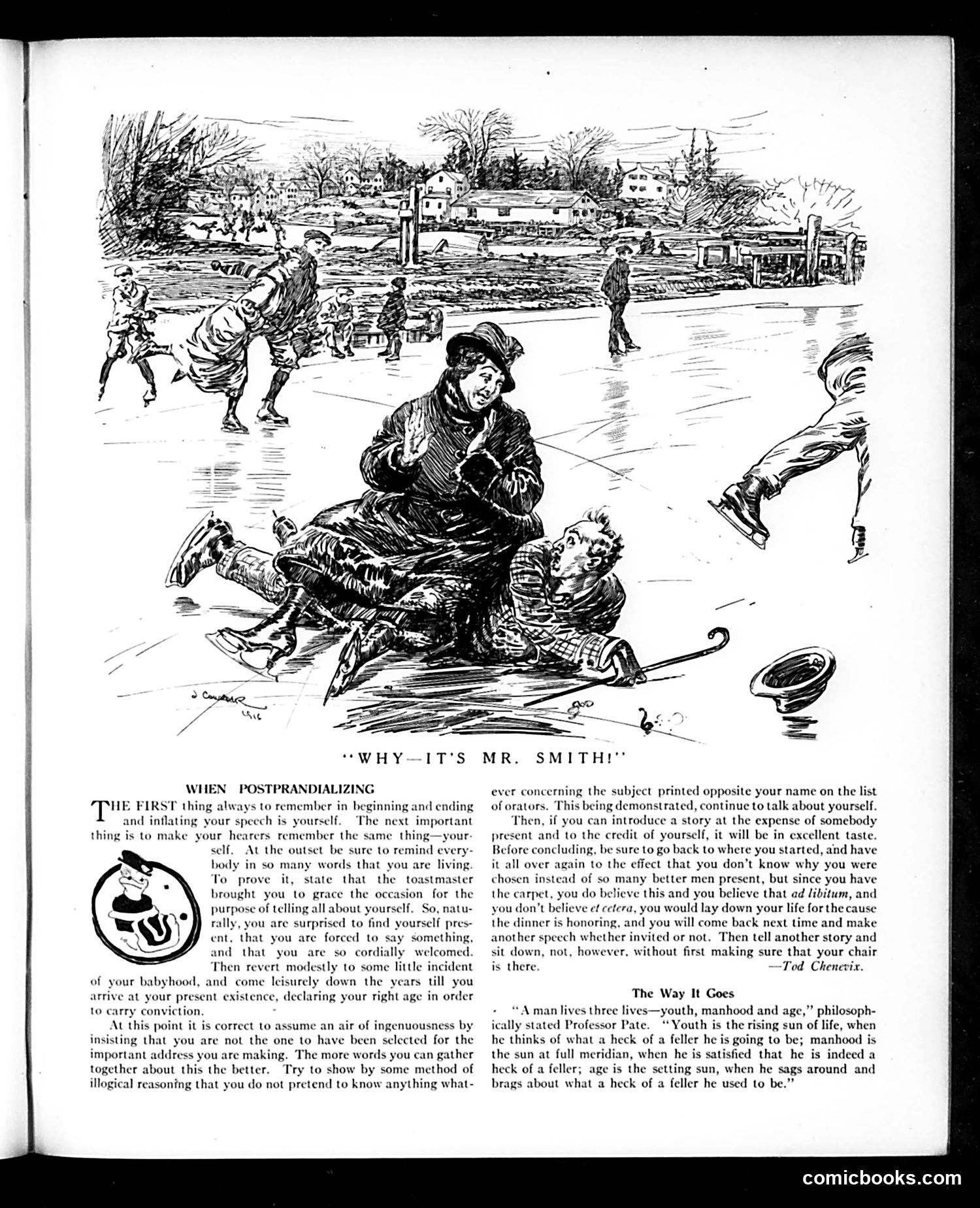
This page satirizes self-centered after-dinner speeches, a common social ritual of the era. The cartoon depicts a pompous speaker (identifiable only as "Mr. Smith") dominating a frozen pond gathering, seemingly oblivious to the actual activity around him—ice skating. The accompanying text mockingly instructs speakers to make themselves the speech's focus: begin by announcing your own importance, recount your entire life history, falsely claim unworthiness for the honor, and conclude by reiterating how central you are to everything. The humor lies in the explicit absurdity of the advice, exposing how genuinely self-absorbed public speakers actually behave. The small illustration of "Professor Pate" below adds a secondary joke: even philosophy becomes pretext for bragging about one's past achievements. Judge targets the tedious social conventions of banquet culture, where speakers predictably prioritize self-promotion over their actual subject matter.
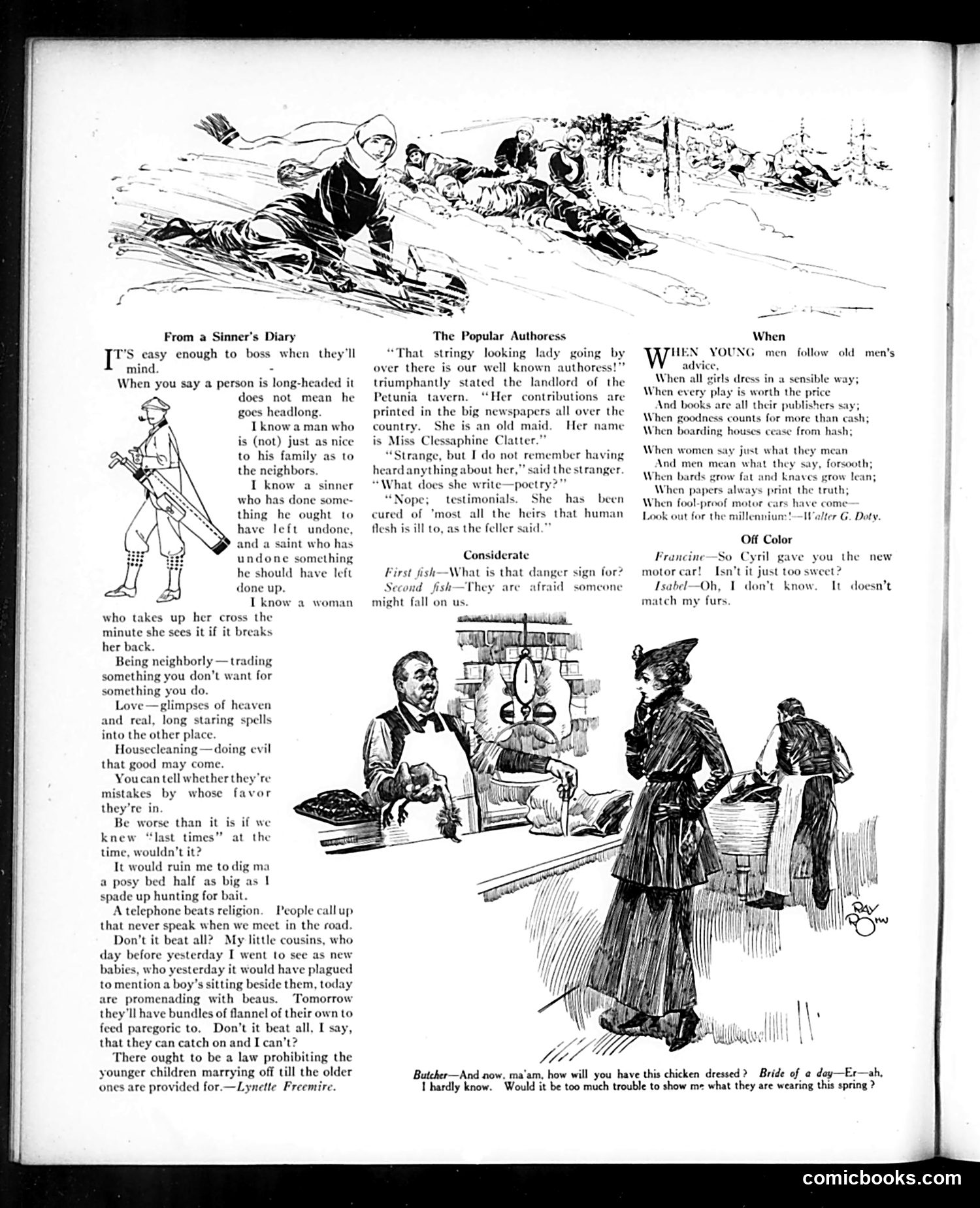
This page contains three distinct satirical pieces: **"From a Sinner's Diary"** presents cynical observations on human nature and hypocrisy—the writer notes contradictions like people who "take up her cross" only when it breaks her back, or the irony of housecleaning as "doing evil that good may come." The closing lament about young female cousins marrying off while the writer cannot is bitter social commentary on women's limited life options. **"The Popular Authoress"** satirizes patent medicine testimonials masquerading as literature. Miss Clessaphine Clatter's "contributions" aren't poetry but fake health testimonials—the joke being these fraudulent ads flooded newspapers and were mistaken for real writing. **Minor cartoons** mock women's vanity ("Off Color": Isabel complains a motorcar doesn't match her furs) and female ignorance (a new bride doesn't know how to dress chicken, asking the butcher what's "wearing this spring"). The overall tone reflects early 20th-century satirical magazine humor: cynicism about marriage, women's limited intellect, and widespread consumer fraud.
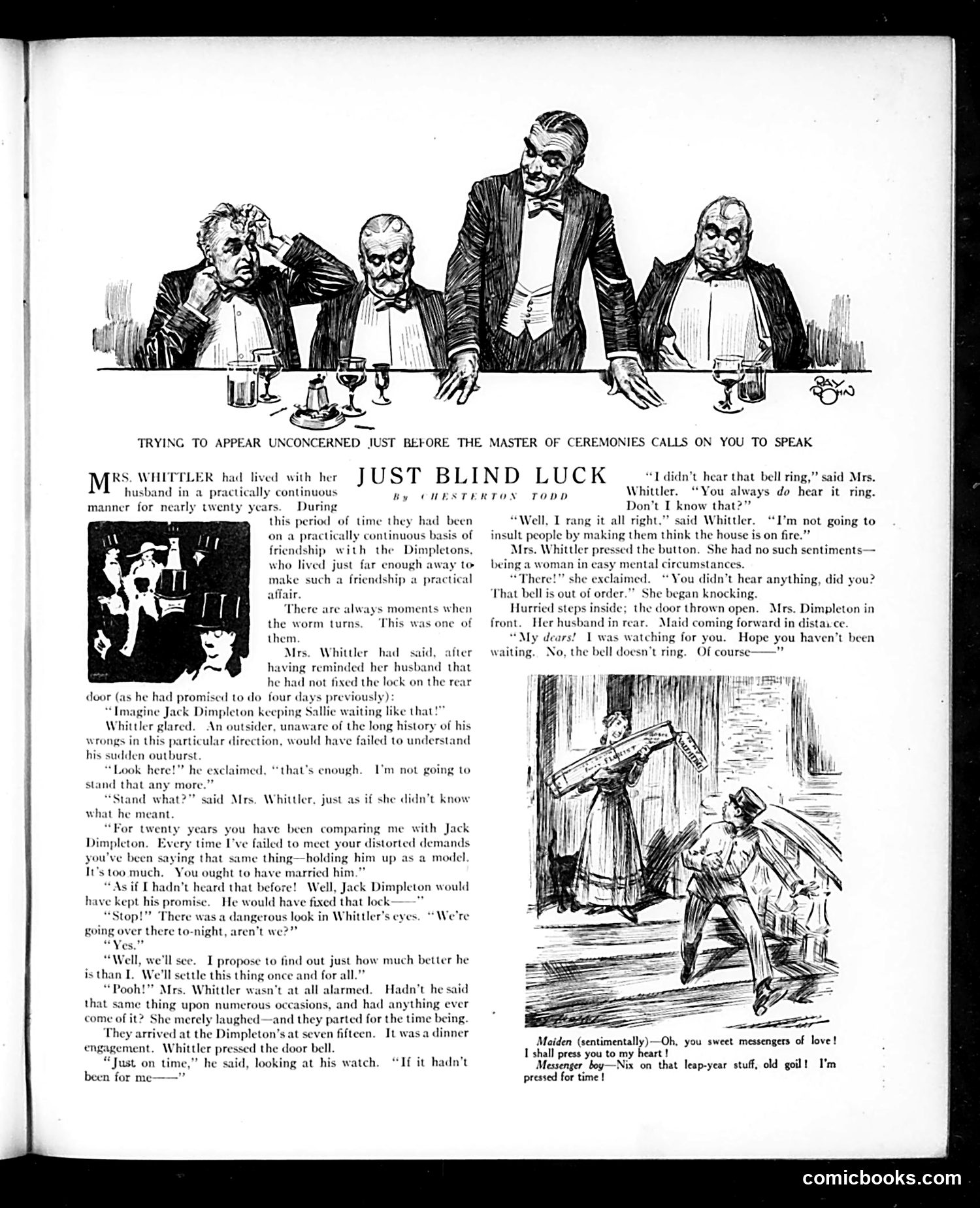
This page satirizes marital tension and male pride through a domestic comedy. Mrs. Whittler repeatedly compares her husband unfavorably to their neighbor Jack Dimpleton, praising Dimpleton's reliability while her husband fails at basic tasks (fixing a door lock). Frustrated by twenty years of this comparison, Mr. Whittler declares he'll prove himself superior by visiting the Dimpleton home that evening. The irony—the satire's point—becomes clear when they arrive: the Dimpleton's doorbell is broken, undermining Mrs. Whittler's complaint that her husband didn't ring it properly. Mr. Whittler's vindication appears to be "just blind luck" rather than actual superiority. The bottom cartoon about the messenger boy provides light comedic relief unrelated to the main story. The page satirizes how couples weaponize comparisons and how small domestic disputes escalate through pride and stubbornness.
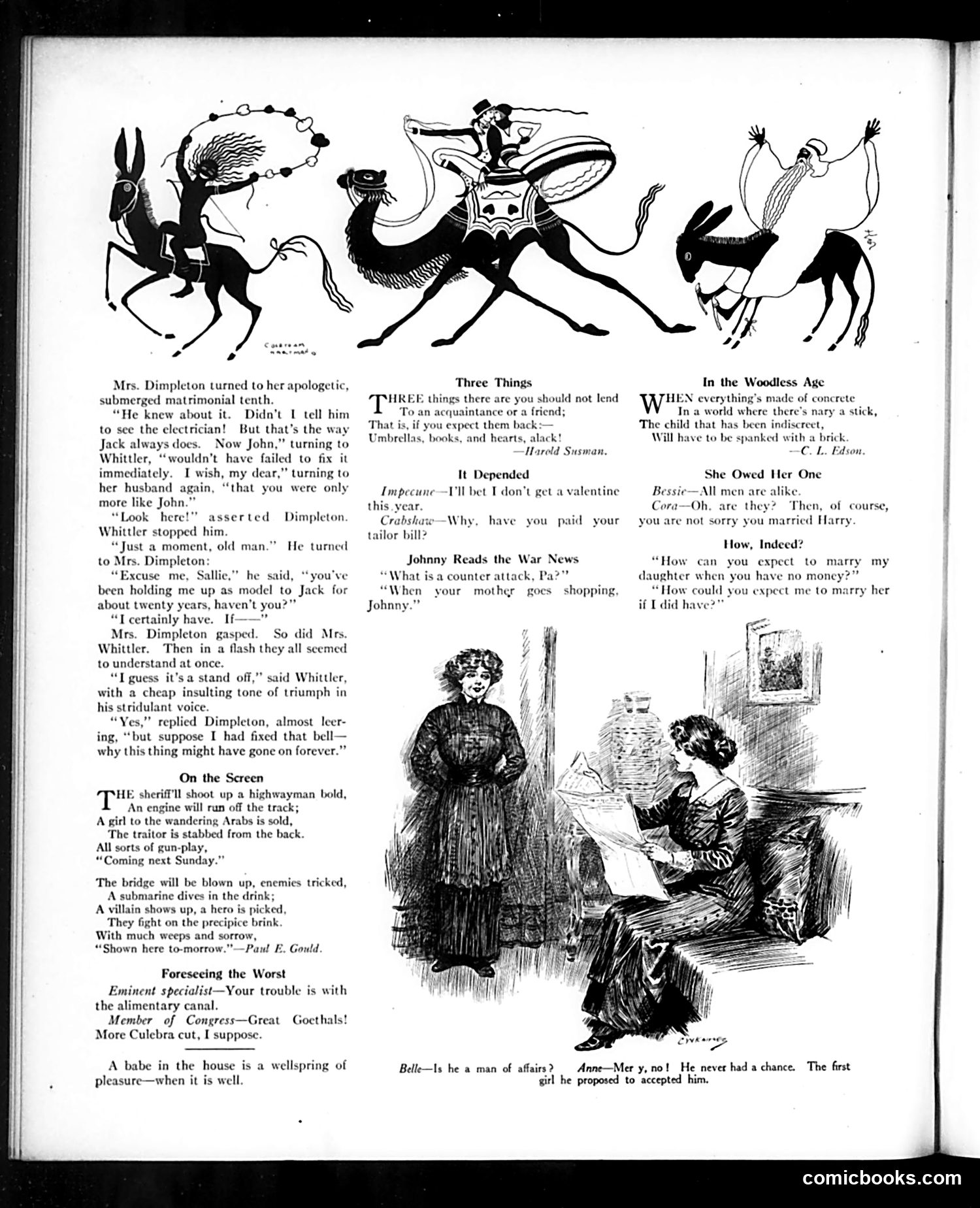
This page contains satirical humor typical of early 20th-century American magazines. The main cartoons mock domestic life and social pretensions: **"Three Things"** features a husband (Dimpleton) confronting a guest (Whittler) who has been held up as a superior model to him for twenty years. The joke hinges on mutual humiliation—both men's marriages are revealed as flawed, creating a "stand off." **"On the Screen"** parodies melodramatic silent film plots with exaggerated action sequences and dramatic cliffhangers, satirizing the predictable formulas of early cinema. The comic snippets target various social anxieties: a congressman's digestive problems (possibly alluding to the Panama Canal's Culebra Cut), marital discord, a futuristic world without wood requiring brick spankings, and courtship mishaps. The tone throughout is cynical about marriage, masculinity, and modern life—typical Judge material mocking middle-class pretensions and domestic arrangements.
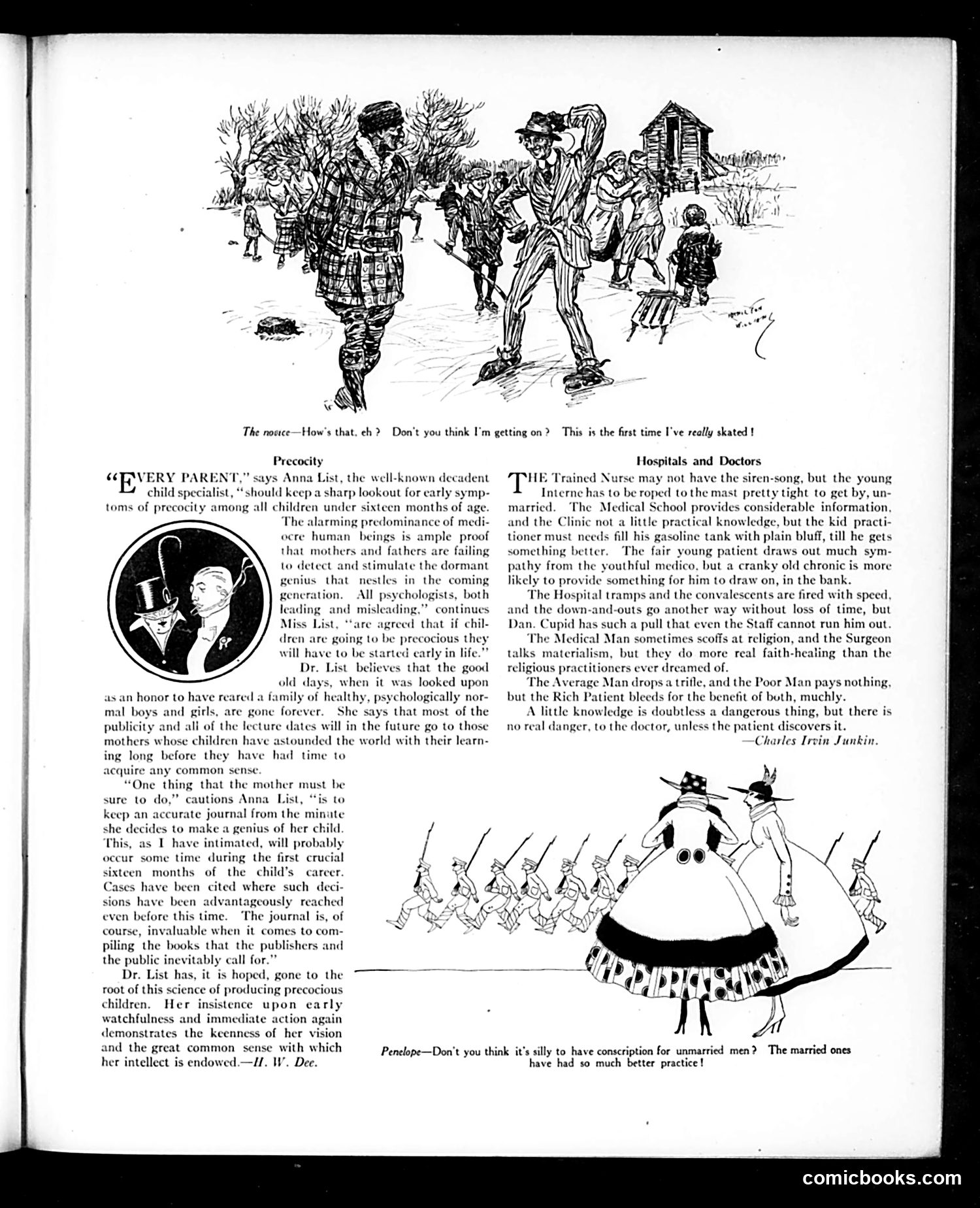
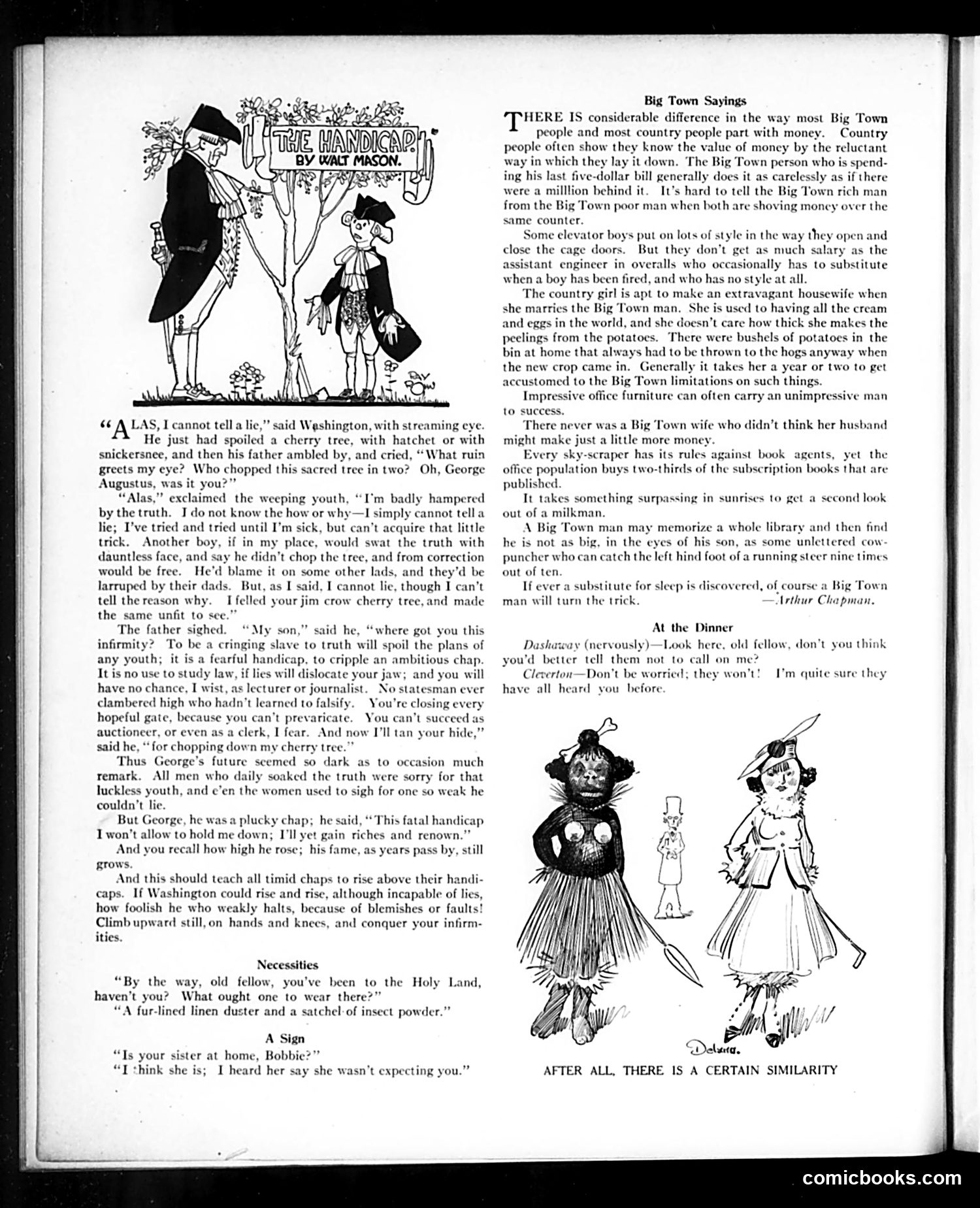
The main cartoon retells the George Washington cherry tree legend—a famous American myth about young Washington's honesty. Here, the satire inverts the moral: Washington's *inability* to lie is presented as a crippling handicap that would ruin his life prospects. His father warns that dishonesty is essential for success as a lawyer, journalist, auctioneer, or clerk. The irony is sharp: the cartoon mocks contemporary American society by suggesting that success *requires* lying, turning the venerated Washington legend upside down. The moral lesson flips from "honesty is virtue" to "honesty is foolish." The "Big Town Sayings" section offers unrelated social commentary contrasting urban and rural attitudes toward money, class markers (elevator boys vs. engineers), and household management—typical Judge magazine observations about American class and regional differences.
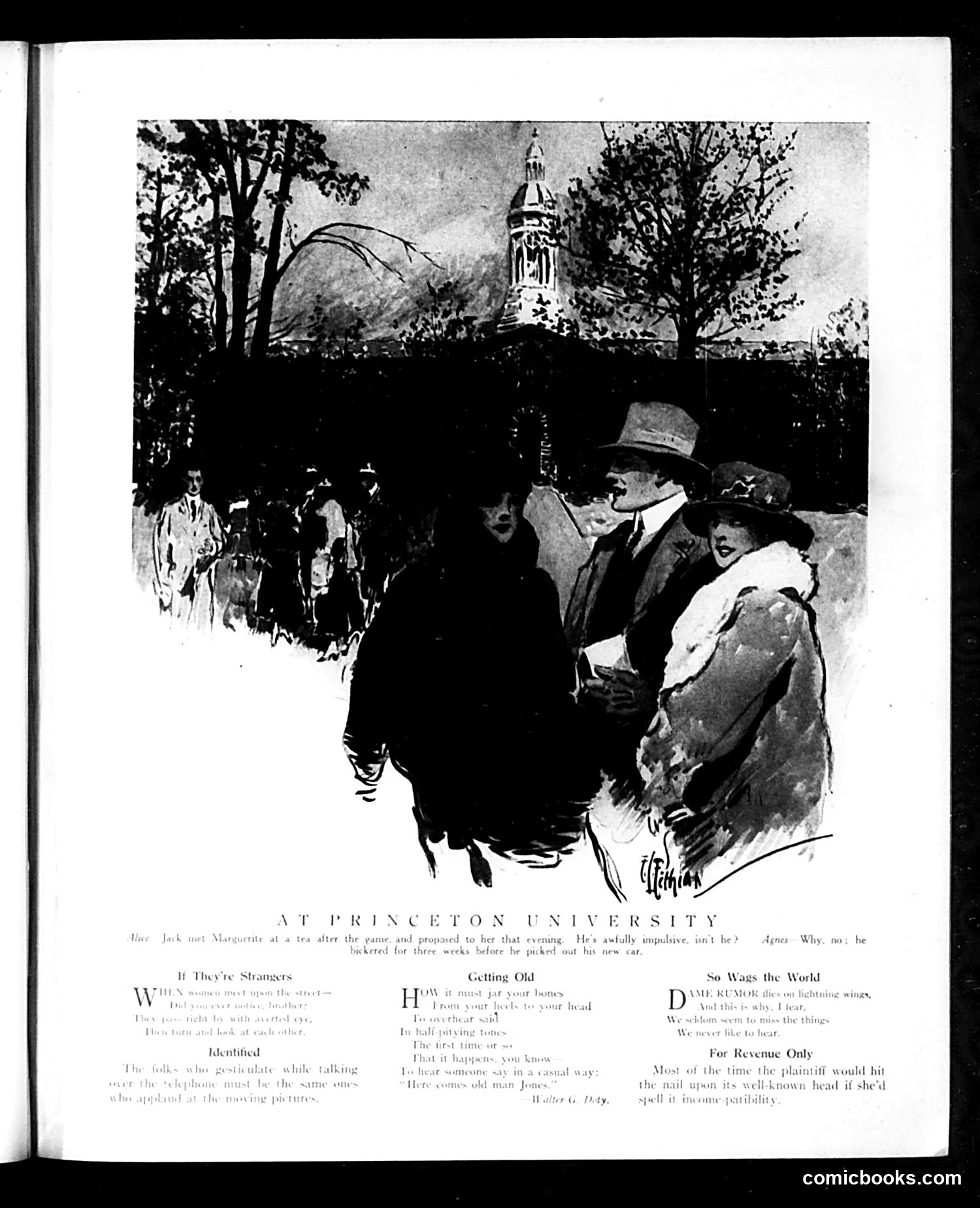
This page from *Judge* magazine presents a satirical illustration set at Princeton University. The main cartoon depicts well-dressed men and women in early 20th-century attire gathered outdoors, with a building and church spire visible in the background. The accompanying text snippets ("If They're Strangers," "Getting Old," "So Wags the World," "For Revenue Only") appear to be humorous observations about social behavior and courtship, likely poking fun at Princeton students and their romantic entanglements. The illustration's title references Jack and Marguerite, suggesting a specific narrative about university romance or scandal. The cartoon satirizes upper-class social pretension and the romantic dramas of Princeton's privileged student body—a common *Judge* target during this era when such magazines mocked wealthy institutions and their inhabitants' affectations.
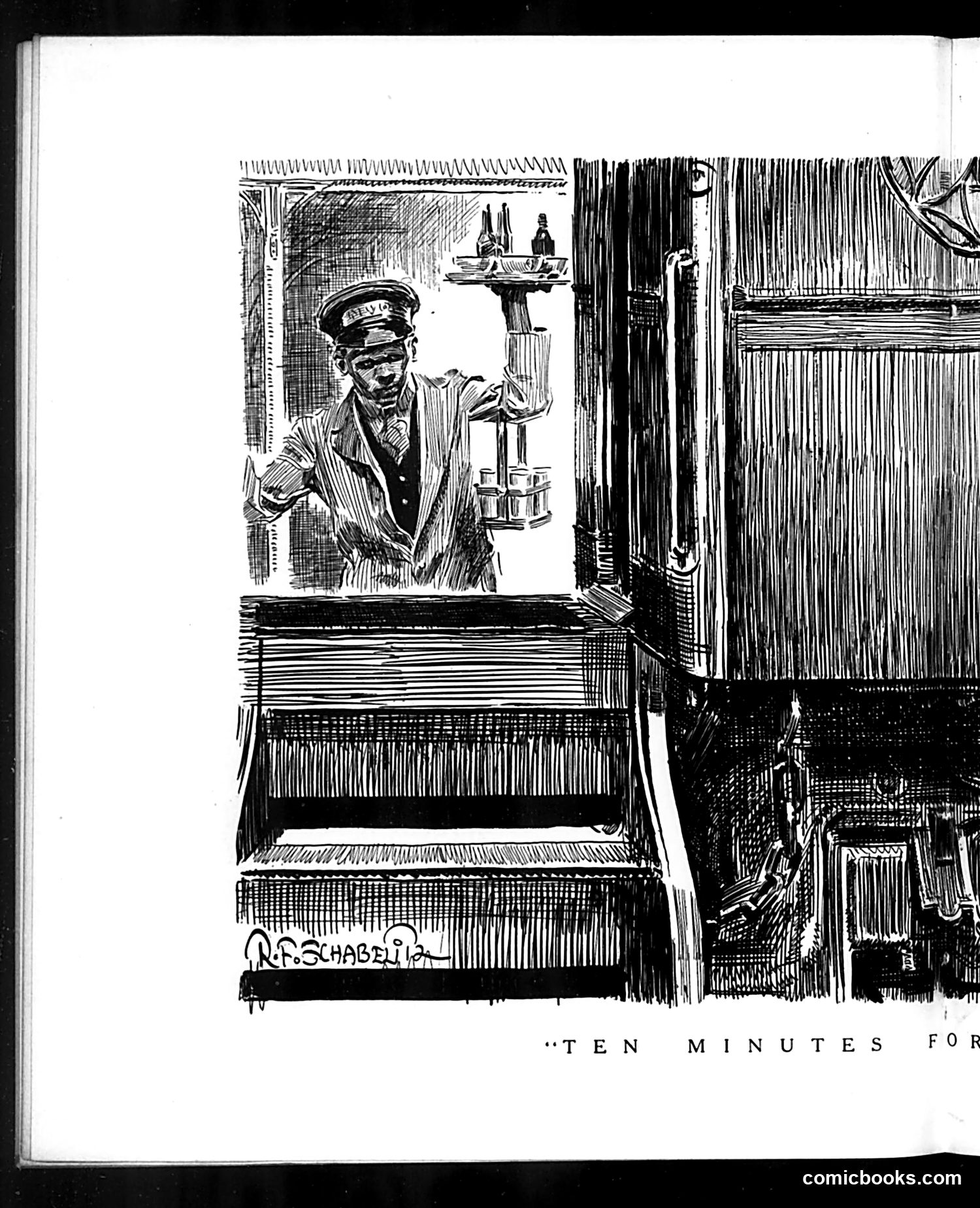
This is a black and white cartoon signed by Schabel showing a uniformed bellhop or porter standing at a doorway holding serving trays. The figure wears a cap and formal service attire. He appears to be at the entrance to a room or building, with stairs visible in the foreground. The visible text reads "TEN MINUTES FOR" (the rest is cut off). Without the complete caption, the specific satirical point is unclear. The cartoon likely comments on service industry labor or hospitality, possibly mocking inefficiency, class dynamics, or social expectations around servants and servants' quarters. The formal uniform and positioning suggest commentary on service sector hierarchies common to early-20th-century American satirical humor. More context would be needed for precise interpretation.
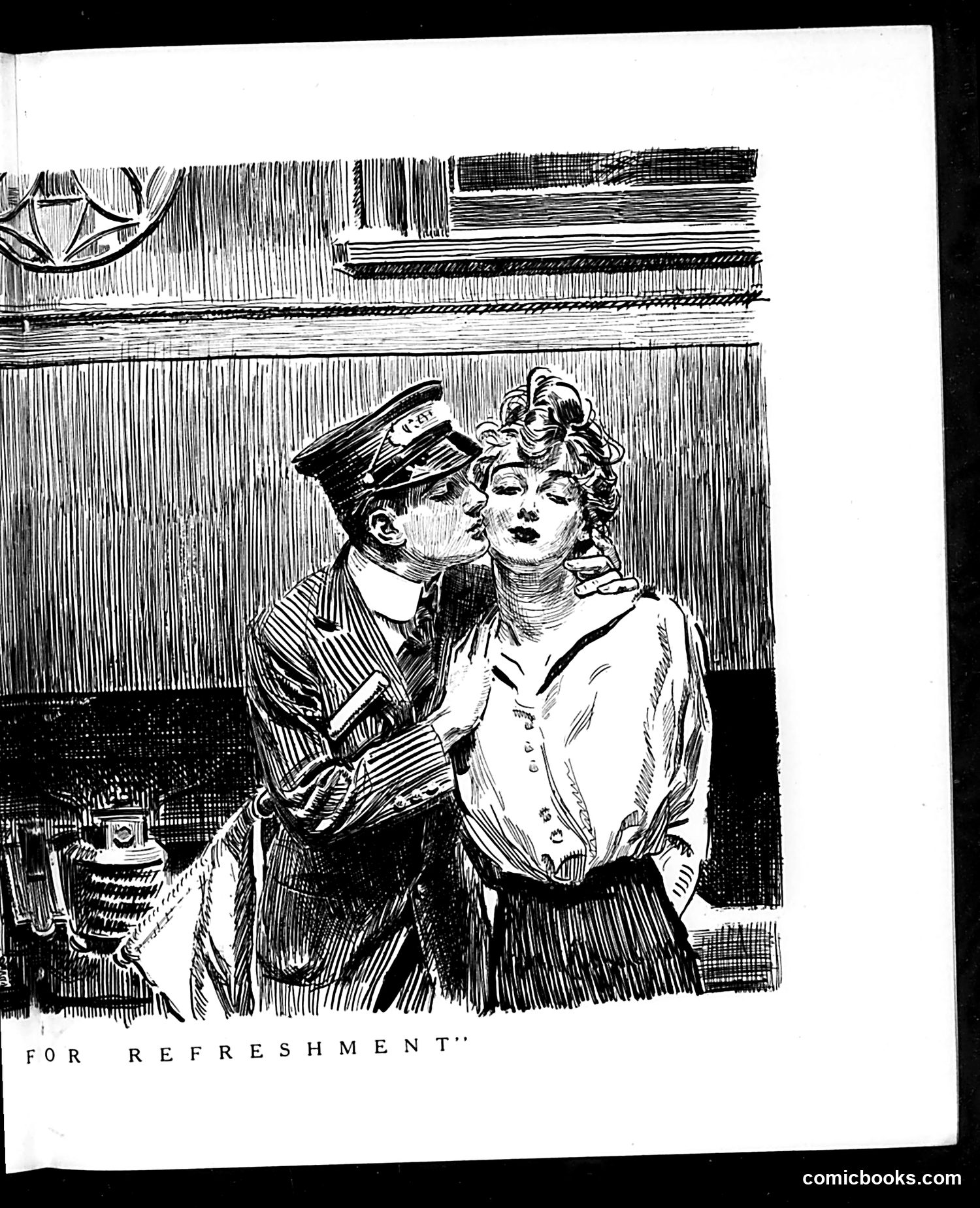
This appears to be a vintage advertisement or illustration from *Judge* magazine showing two figures in an intimate moment—a man in a military or bellhop uniform leaning toward a woman in fashionable dress. The partial caption reads "FOR REFRESHMENT," suggesting this is advertising beverages or a social establishment. The satirical point likely mocks either: - Romantic or flirtatious encounters in public spaces - The use of "refreshment" (alcohol) as a social lubricant for romance - Class dynamics between service workers and patrons The illustration style is characteristic of early-20th-century American humor magazines, which frequently satirized courtship customs and social conventions. Without the full caption or context, the specific target of satire remains unclear.
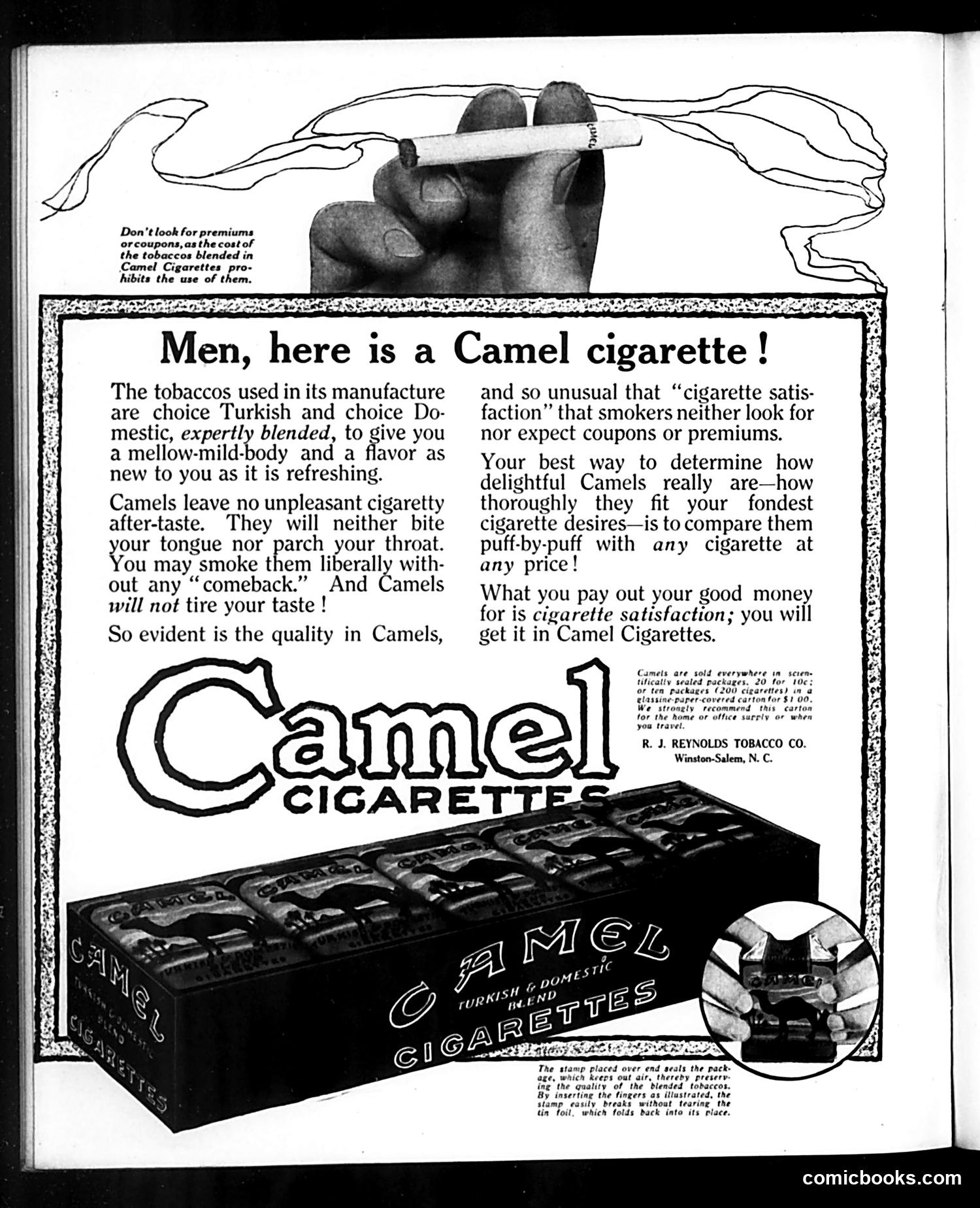
This page is primarily a **Camel cigarette advertisement**, not satire. The top illustration shows a hand holding a cigarette, while the text below comprises marketing copy from R.J. Reynolds Tobacco Company. The ad's key message targets male smokers by emphasizing quality over gimmicks: Camel cigarettes are supposedly so superior that they don't need to offer premiums or coupons (common marketing tactics of competing brands). The copy stresses the product's "mellow-mild" Turkish and domestic tobacco blend, lack of aftertaste, and smooth smoking experience. The circular detail photo demonstrates the package's stamped seal, a practical feature meant to convey freshness and quality. For a modern reader: this represents pre-regulation tobacco advertising, when companies could make health and satisfaction claims freely without warning labels. The premium-free positioning was itself a marketing strategy implying premium quality.
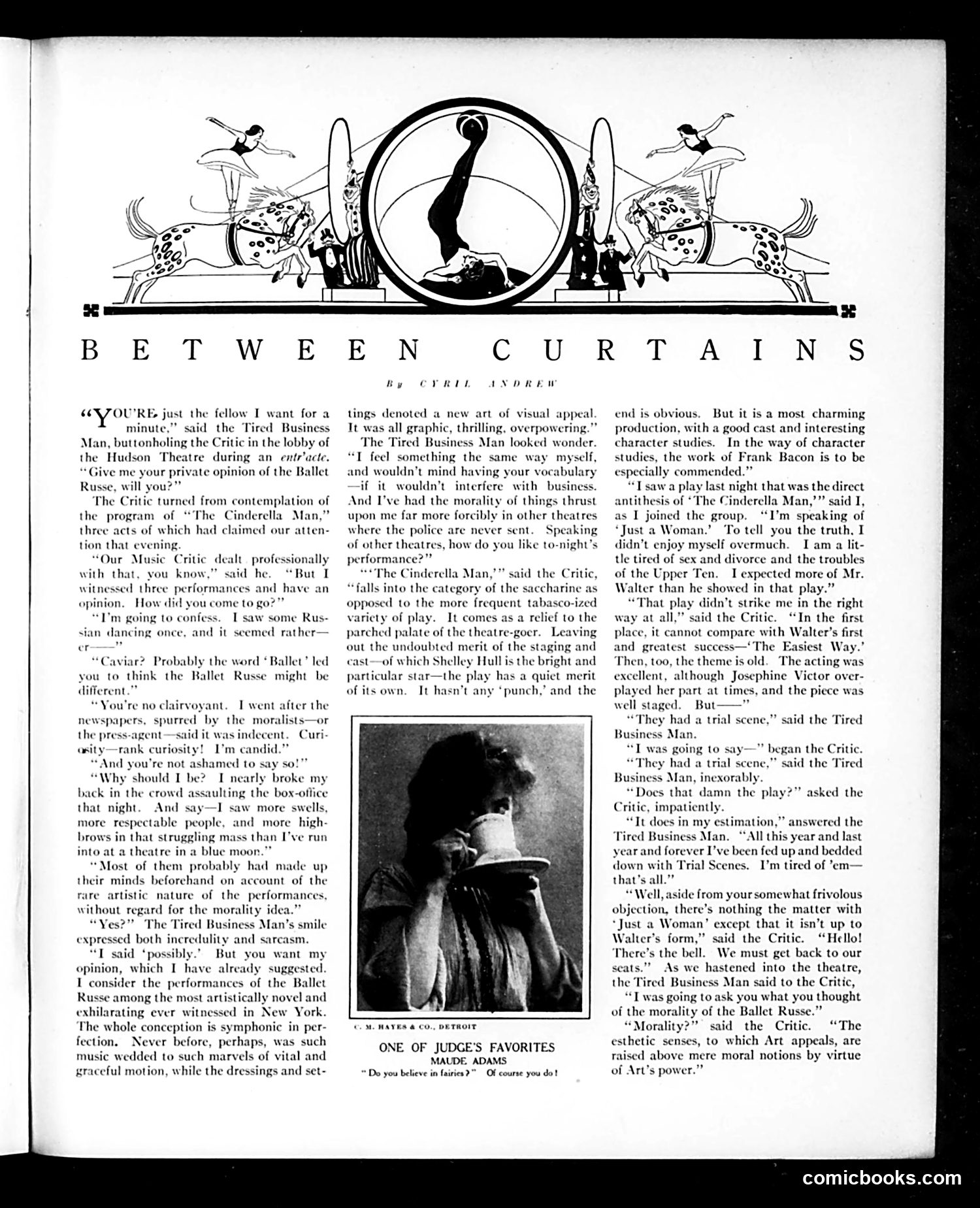
This page presents a dialogue between a "Tired Business Man" and a theater Critic, discussing three Broadway productions: the Ballet Russe, "The Cinderella Man," and "Just a Woman." The satire targets **moral hypocrisy** about the Ballet Russe. Newspapers and moralists condemned it as "indecent," yet this publicity drew respectable crowds of "swells" and "high-brows" to the box office—people ostensibly motivated by artistic merit, though the Critic skeptically suggests they came for the scandal. The joke is that moral outrage actually promoted the show. The accompanying photograph of **Maude Adams** (visible caption) represents the established theatrical establishment—a contrast to the modern, controversial Ballet Russe. The dialogue mocks both pretentious critical language (the Critic's flowery descriptions) and audience self-deception: people claim artistic appreciation while actually driven by controversy and curiosity about the forbidden.
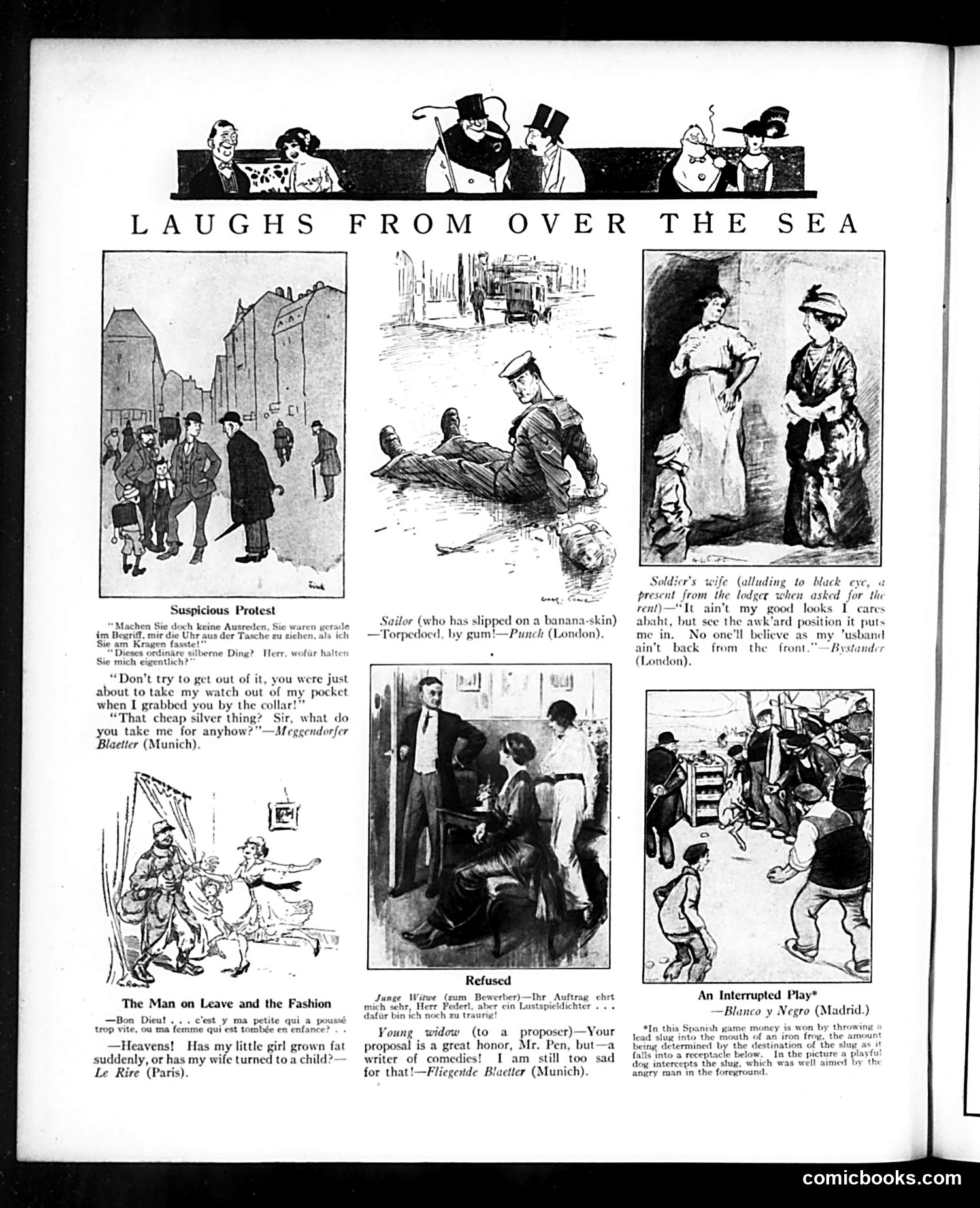
This page compiles humorous cartoons and jokes from European satirical publications, presenting them to American Judge readers as amusing foreign perspectives. The cartoons mock everyday social situations across cultures: a German scene of mistaken accusation during a pickpocketing attempt; a French joke about a man's wife aging poorly or their child growing fat; a British sailor slipping on a banana peel (a classic slapstick trope); a German scene mocking a would-be suitor who claims he's "too sad" for comedy writing; a London landlord's wife with a black eye making excuses to the tenant; and a Spanish street scene of children disrupting a theatrical performance. The humor relies on universal predicaments—theft, aging, physical mishaps, courtship failures, domestic violence, and misbehavior—suggesting these were recognized as funny across national borders during this era. The page essentially anthologizes "what makes Europeans laugh," positioning American readers as amused observers of international comedy.
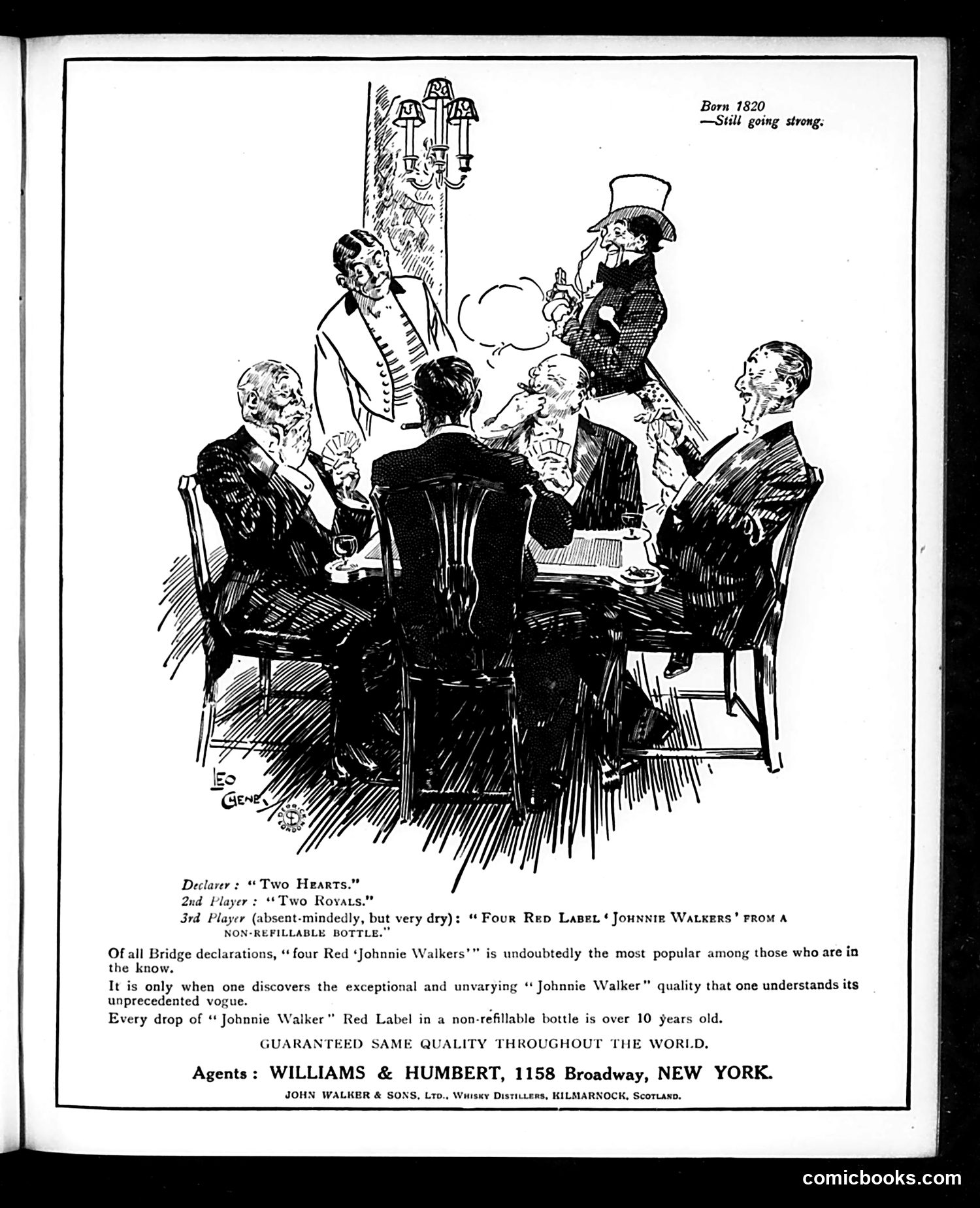
This is primarily a **Johnnie Walker whisky advertisement** disguised as humorous editorial content in Judge magazine. The cartoon depicts gentlemen playing bridge (a popular card game), with one player making a joke about declaring "Four Red Label Johnnie Walkers" instead of a legitimate bridge bid. The humor relies on: 1. **The pun**: Conflating bridge card declarations with drinking whisky 2. **The implicit satire**: Suggesting that among the sophisticated set ("those who are in the know"), ordering whisky during card games is as natural as making bridge bids 3. **The product placement**: The ad emphasizes Johnnie Walker's age ("over 10 years old") and quality as a selling point The header "Born 1820—Still going strong" anthropomorphizes the whisky brand itself as enduring and vital. This represents early 20th-century advertising that masked commercial promotion within entertainment content—blurring the line between editorial and advertisement in ways modern readers would find deceptive.
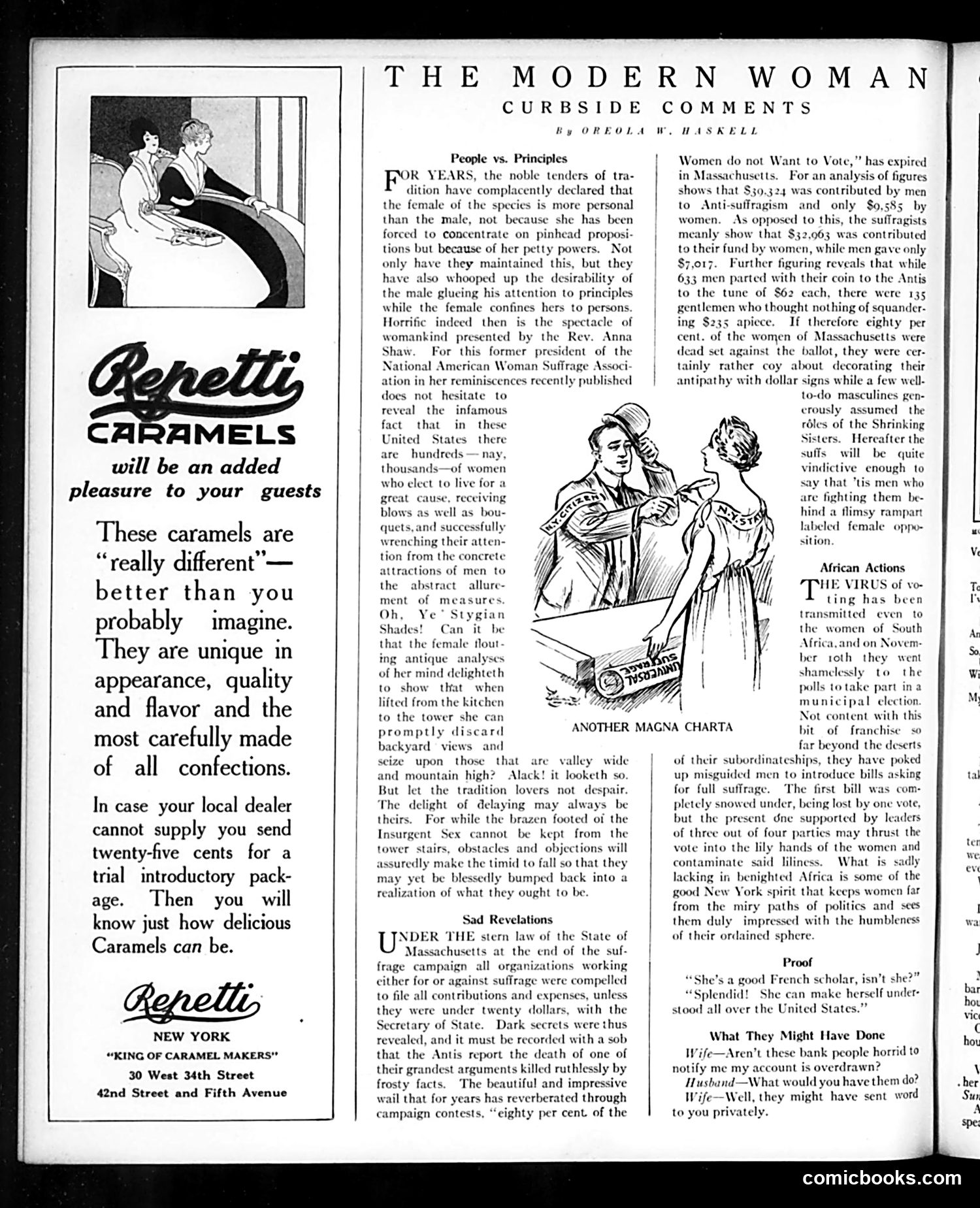
This page satirizes anti-suffrage arguments in the context of Massachusetts's 1915 suffrage campaign. The author (Oreola Haskell) uses two main points: **"People vs. Principles"**: Mocks the traditional claim that women are inherently focused on personal matters rather than abstract principles. She cites Rev. Anna Shaw (former president of the National American Woman Suffrage Association) as evidence that women *can* and *do* commit to causes beyond domestic concerns. **"Sad Revelations"**: Attacks the anti-suffrage slogan "eighty per cent of women do not want to vote" by exposing financial records. The data shows men—not women—funded the anti-suffrage campaign ($30,324 from men vs. $9,585 from women), while women overwhelmingly funded pro-suffrage efforts ($32,963 vs. $7,017 from men). This proves women *wanted* the vote; anti-suffrage was actually a male-led effort disguised as protecting women's wishes. The satire's bite: anti-suffragists claimed to represent women's preferences while actually silencing women's actual voices and spending.
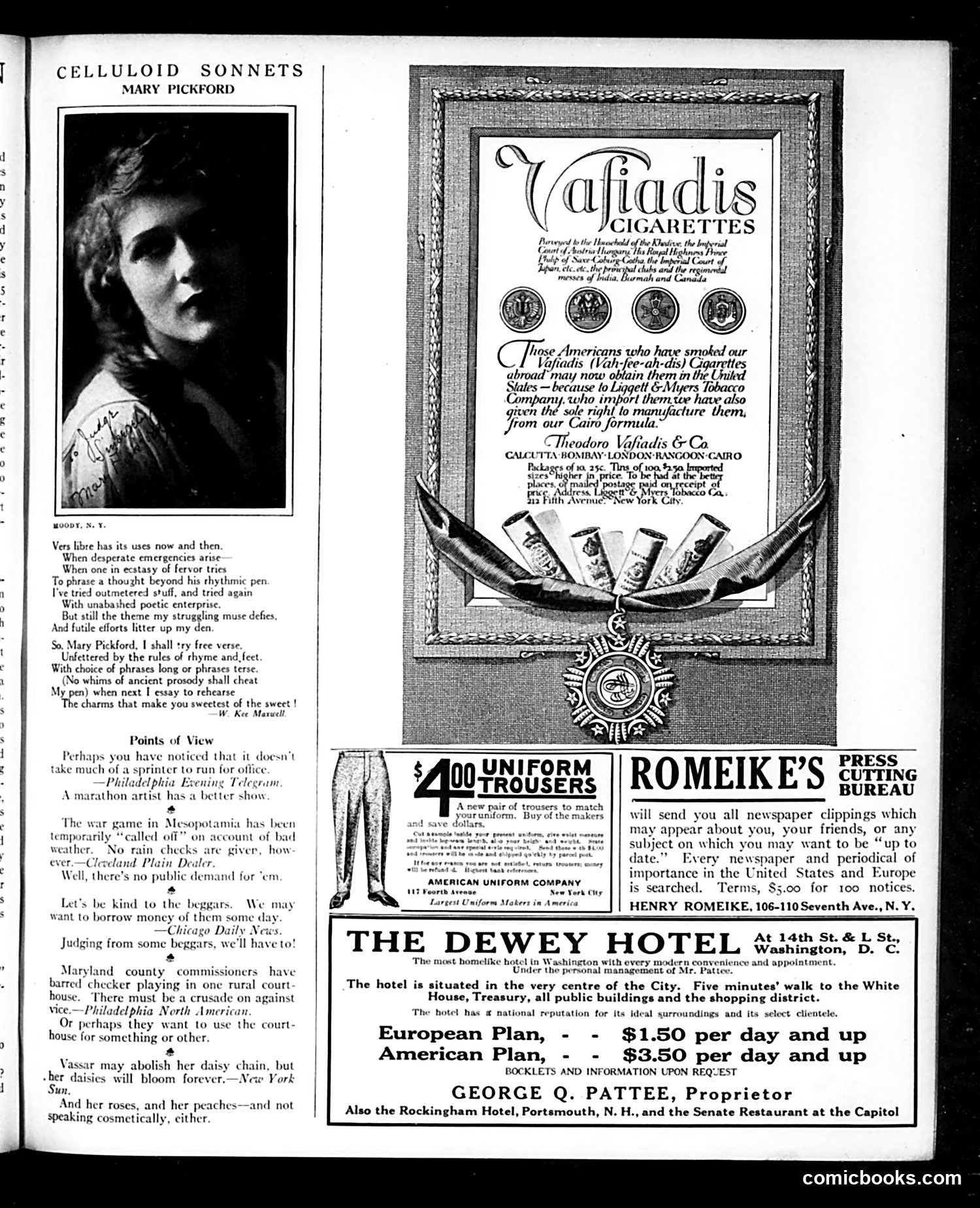
This page celebrates **Mary Pickford**, the silent film star, through a poem praising her beauty. The unnamed poet humorously struggles to compose verse worthy of her charms, ultimately deciding to abandon traditional meter ("free verse") to express her appeal. The accompanying "Points of View" section offers satirical observations on contemporary issues: political candidates who lack substance ("sprinters"), the Mesopotamian conflict (WWI-era), Maryland's ban on checkers in courtrooms, and Vassar College's traditions. The advertisements reflect the era's commerce: cigarettes, uniform trousers, press clipping services, and Washington D.C. hotels—typical Judge magazine fare mixing cultural commentary with commercial pitches to the magazine's educated, urban readership.
This lengthy satirical article uses the "buzz-saw" as a metaphor for dangerous human temptations and vices. The piece argues that humanity has an inborn tendency toward self-destructive behavior, comparing it to Adam's original sin. The main example is Bill Murdock, a horse trader who habitually cheats others in deals—a "buzz-saw" he expertly wields. Despite warnings, men repeatedly attempt to best him, losing money in the process. Murdock becomes wealthy and moves to town, having successfully exploited human nature's competitive weakness. The satirist suggests that risky activities—gambling, swimming in dangerous waters, playing poker—appeal to us like the purr of a kitten, though they're actually lethal. The piece criticizes humanity's inability to resist temptation despite knowing better, and notes that even scientific progress merely creates new "buzz-saws" for us to foolishly approach. The accompanying whiskey advertisements offer an ironic counterpoint: promoting "moderate" drinking as the path to happiness and success.
This page from *Judge* magazine contains two distinct sections: college humor and period advertising. **The College Humor Section ("With the College Wits"):** These are brief satirical jokes reprinted from various college publications (Stanford Chaparral, Princeton Tiger, etc.). They mock student life, professors, and romantic encounters with light wordplay. The opening poem jokes about a French soldier entering a cannon—likely a World War I reference, given the mention of "the war far away." **The Advertisement Section:** The dominant content is a full-page ad for **Nujol**, a mineral oil laxative made by Standard Oil Company. The ad uses shame-based marketing, claiming constipation causes "the blues" (depression) and affecting every bodily function. It emphasizes Nujol as a "mechanical lubricant" superior to harsh laxatives—a common early 20th-century patent medicine sales pitch. Below this is a smaller ad for **Foot Remedy Co.**, using similar testimonial-based marketing. **Context for Modern Readers:** The page reflects 1910s-1920s advertising culture, when patent medicines made extraordinary health claims and frank discussions of bowel function were standard marketing tactics in mainstream publications.
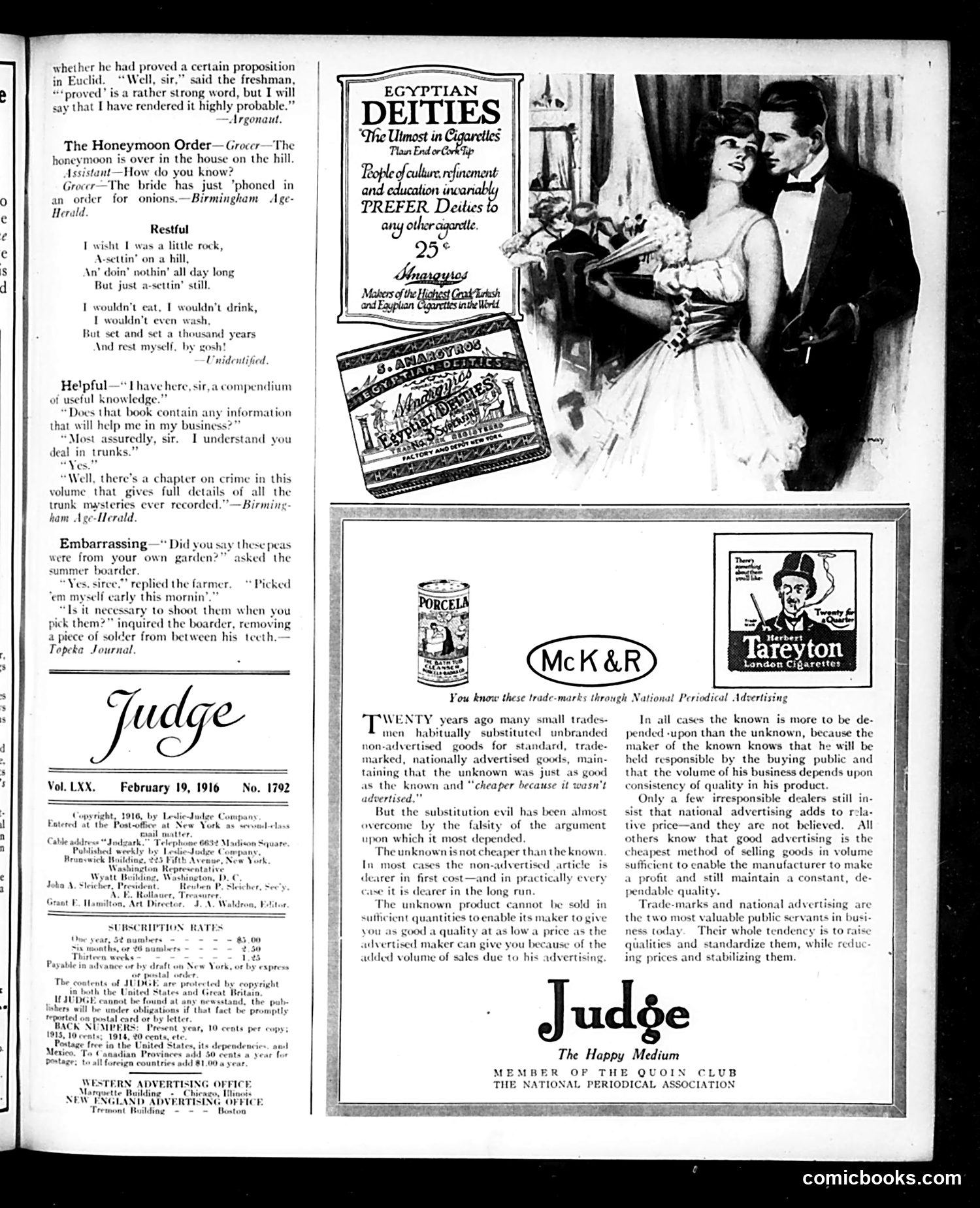
This page contains mostly humorous short jokes and advertisements rather than political cartoons. The humor pieces include: **Short Jokes:** - A freshman's weak math proof - A newlywed ordering onions (implying marital discord) - A farmer's peas requiring bullets to harvest (suggesting they're spoiled/dangerous) **Main Content:** A lengthy advertisement essay arguing that branded, nationally-advertised products are superior to unbranded alternatives—counter to the common belief that unknown brands are cheaper. The ad uses Egyptian Deities cigarettes and other products as examples, claiming advertising actually *lowers* prices through increased volume. The Egyptian Deities cigarette advertisement (top right) depicts a well-dressed couple at what appears to be a formal event, marketing cigarettes as refined products preferred by educated people. This page reflects pre-WWI consumer culture debates about branding and advertising's role in standardizing quality and prices—concerns still relevant today.
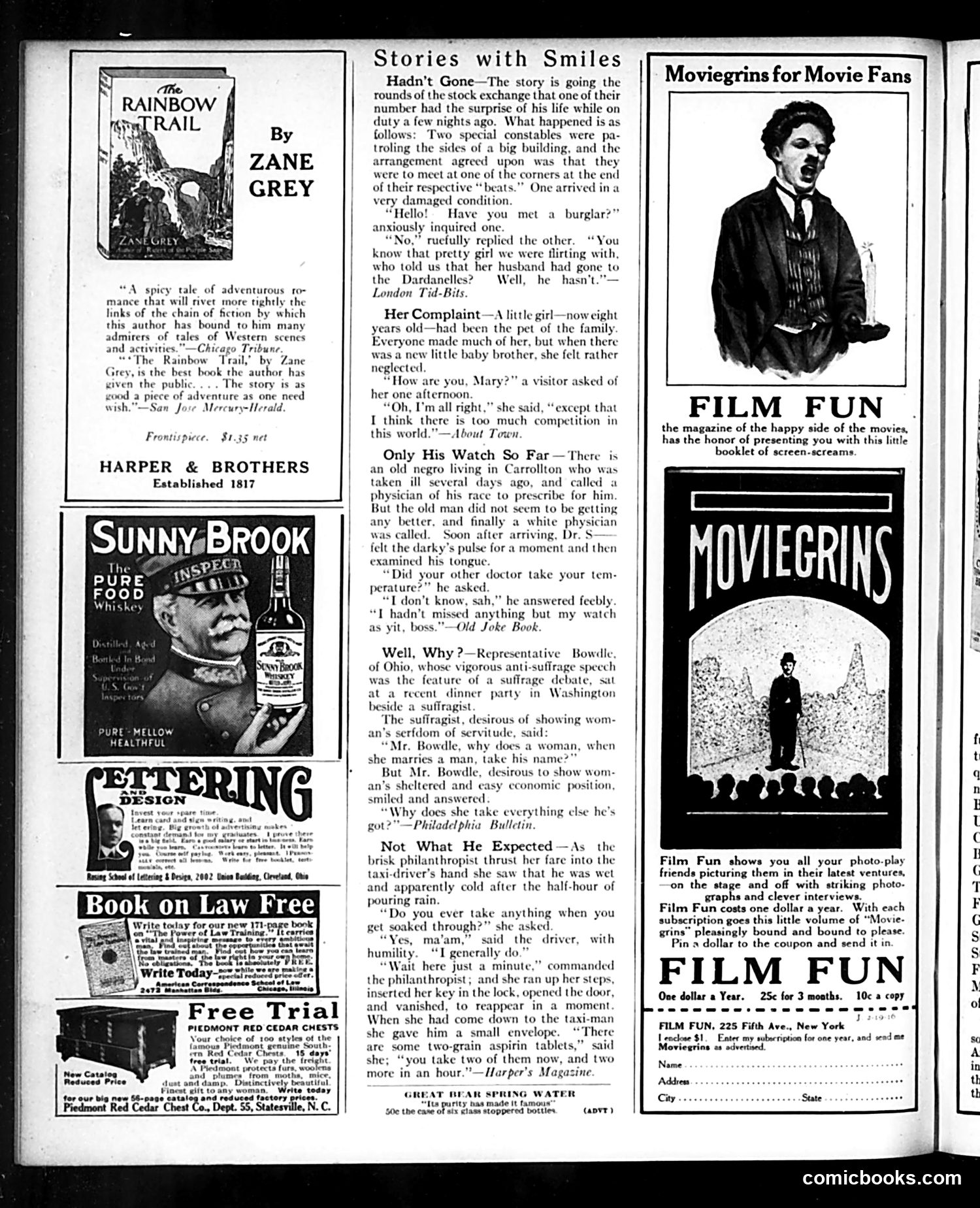
This page is primarily **advertising and light humor content**, not political satire. The main elements are: **"Stories with Smiles"** section contains three brief anecdotes: - Stock exchange joke about a constable encountering an unexpected husband (not a burglar) - A child complaining about sibling "competition" - A Black patient in Carrollton mentioning only missing his watch after a doctor's visit - Anti-suffrage humor featuring Ohio Representative Bowdle, who opposes women's voting rights, being challenged by a suffragist at dinner about why women take husbands' names - A final joke about a philanthropist giving aspirin tablets to a wet taxi driver The page also advertises **Zane Grey's western novel "The Rainbow Trail,"** Sunny Brook whiskey (marketed as "pure" and "healthful"), correspondence schools, and cedar chests. The suffrage joke reflects **contemporary 1910s-era resistance to women's voting rights**, presenting anti-suffrage arguments as witty rather than serious opposition.
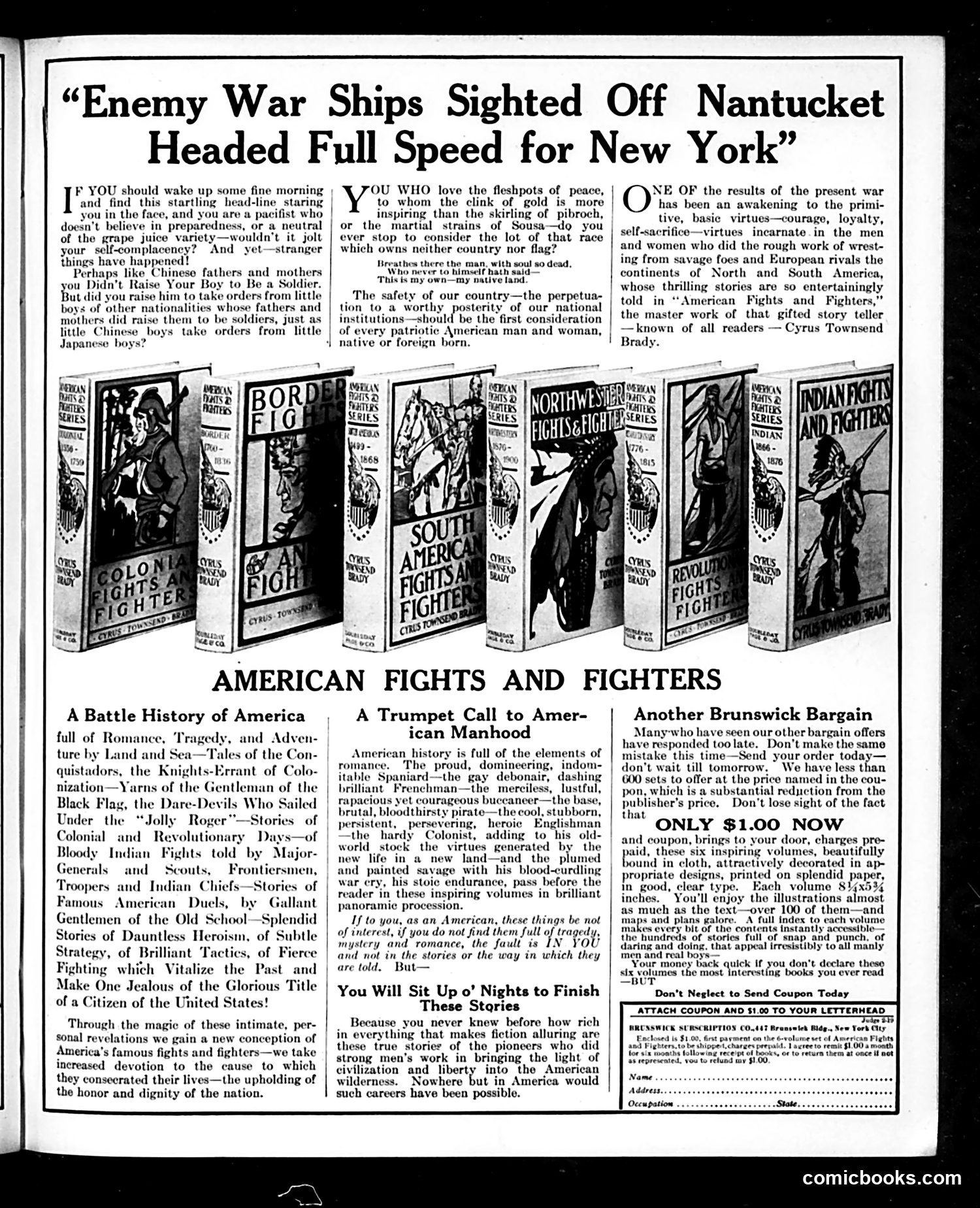
This page is primarily **advertising** for a book series called "American Fights and Fighters" by Cyrus Townsend Brady, disguised as editorial content in Judge magazine. The headline about enemy warships is sensationalist clickbait typical of WWI-era American media (the U.S. entered WWI in 1917). It's used to frame the surrounding text, which argues that Americans—particularly young men and pacifists—should embrace martial values and military preparedness. The editorial copy contrasts "pacifists" and "grape juice variety" neutrals unfavorably with patriotic ideals of courage and self-sacrifice. It appeals to nationalism and immigrant assimilation ("native or foreign born"), suggesting that reading tales of American frontier conquests and military heroes will inspire proper citizenship. The book covers displayed show typical adventure-pulp imagery: colonial fighters, border conflicts, and "Indian Fights"—celebrating America's imperial expansion as heroic narrative. The "$1.00 NOW" offer at bottom-right confirms this is primarily a sales pitch wrapped in patriotic rhetoric aimed at male readers during wartime anxiety.
This is a cigarette advertisement from *Judge* magazine. The image shows an elegantly manicured hand holding a cigarette package, accompanied by text claiming that at "good places you don't need to mention the name / Just ask for the best cigarette." The ad's appeal relies on aspirational snobbery—suggesting the product is so prestigious and universally recognized among the wealthy and sophisticated that merely requesting "the best cigarette" suffices. No brand name appears in the visible text, making this either deliberately mysterious marketing or an incomplete OCR capture. This reflects early 20th-century advertising strategies targeting affluent consumers who valued exclusivity and assumed social superiority. The luxurious hand imagery and sophisticated typography reinforce class-based messaging common in vintage cigarette advertising.