
Judge, 1916-02-19 · page 7 of 28
Judge — February 19, 1916 — page 7: what you’re looking at
What you’re looking at
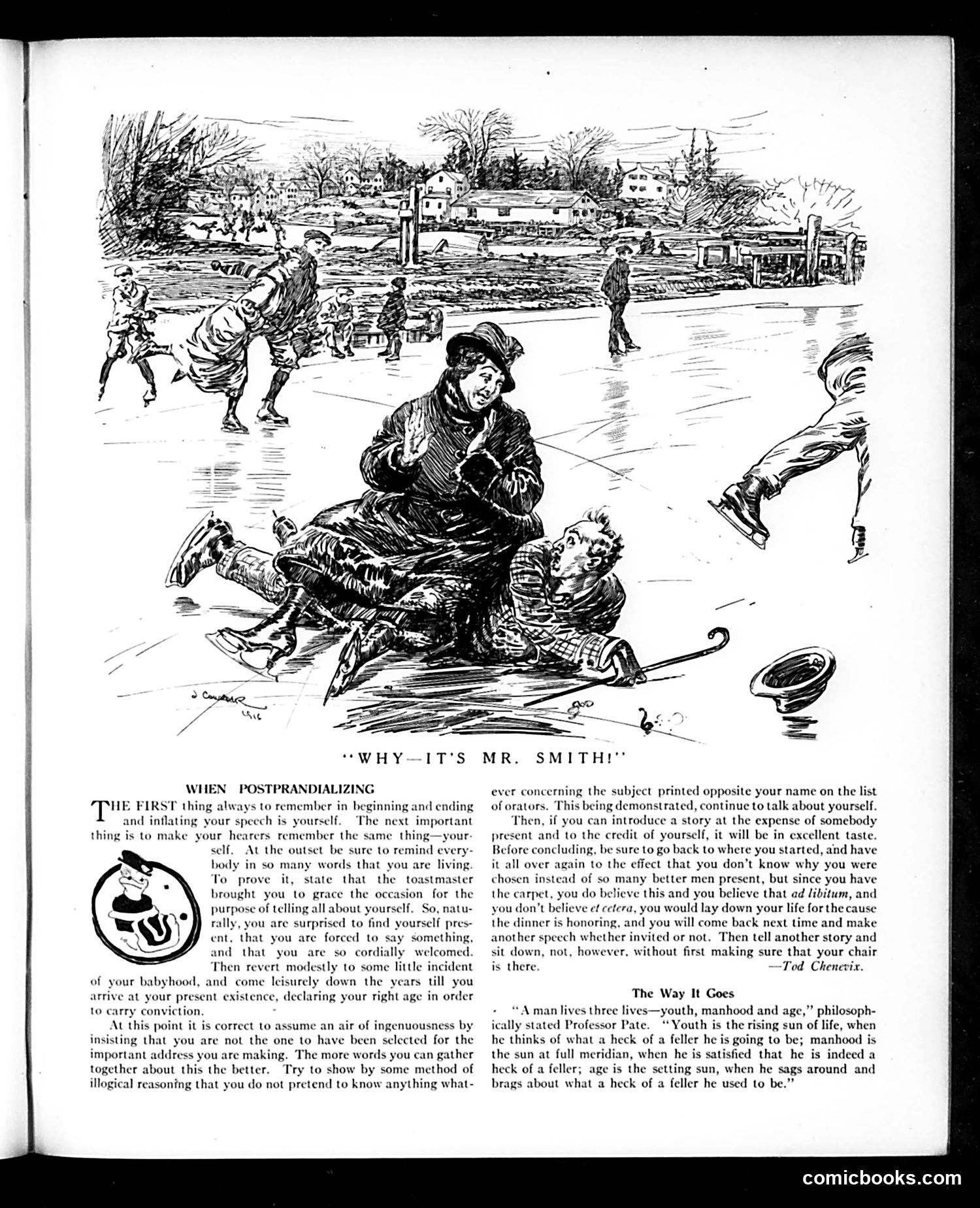
This page satirizes self-centered after-dinner speeches, a common social ritual of the era. The cartoon depicts a pompous speaker (identifiable only as "Mr. Smith") dominating a frozen pond gathering, seemingly oblivious to the actual activity around him—ice skating. The accompanying text mockingly instructs speakers to make themselves the speech's focus: begin by announcing your own importance, recount your entire life history, falsely claim unworthiness for the honor, and conclude by reiterating how central you are to everything. The humor lies in the explicit absurdity of the advice, exposing how genuinely self-absorbed public speakers actually behave. The small illustration of "Professor Pate" below adds a secondary joke: even philosophy becomes pretext for bragging about one's past achievements. Judge targets the tedious social conventions of banquet culture, where speakers predictably prioritize self-promotion over their actual subject matter.
📄 Transcribed text from this page (OCR, searchable)
Machine-transcribed from the original scan — historical spelling and the odd misread are preserved.
Zp “Uf, “WHY WHEN POSTPRANDIALIZING HE FIRST thing always to remember in beginning and ending and inflating your speech is yourself. The next important thing is to make your hearers remember the same thing—your- self. At the outset be sure to remind every- body in so many words that you are living. To prove it, state that the toastmaster brought you to grace the occasion for the purpose of telling all about yourself. So, natu- rally, you are surprised to find yourself pres- ent, that you are forced te something, and that you are so cordially eleomed. Then revert modestly to some little incident of your babyhood, and come leisurely down the years till you arrive at your present existence, declaring your right age in order to carry conviction. At this point it is correct to assume an air of ingenuousness by insisting that you are not the one to have been selected for the important address you are making. The more words you can gather together about this the better. Try to show by some method of illogical reasoning that you do not pretend to know anything what- -IT'S MR. SMITH!" ever concerning the subject printed opposite your name on the list of orators. This being demonstrated, continue to talk about yourself. Then, if you can introduce a story at the expense of somebody present and to the credit of yourself, it will be in excellent taste. Before concluding, be sure to go back to where you started, and have it all over again to the effect that you don’t know why you were chosen instead of so many better men present, but since you have the carpet, you do believe this and you believe that ad libitum, and you don’t believe ef cetera, you would lay down your life for the cause the dinner is honoring, and you will come back next time and make another speech whether invited or not. Then tell another story and sit down, not, however, without first making sure that your chair is there —Tod Chenevix. The Way It Goes * A man lives three lives—youth, manhood and age,” philosoph- ically stated Professor Pate. ‘Youth is the rising sun of life, when he thinks of what a heck of a feller he is going to be; manhood is the sun at full meridian, when he is satisfied that he is indeed a heck of a feller; age is the setting sun, when he sags around and brags about what a heck of a feller he used to be.” comicbooks.com