
Judge, 1916-02-19 · page 12 of 28
Judge — February 19, 1916 — page 12: what you’re looking at
What you’re looking at
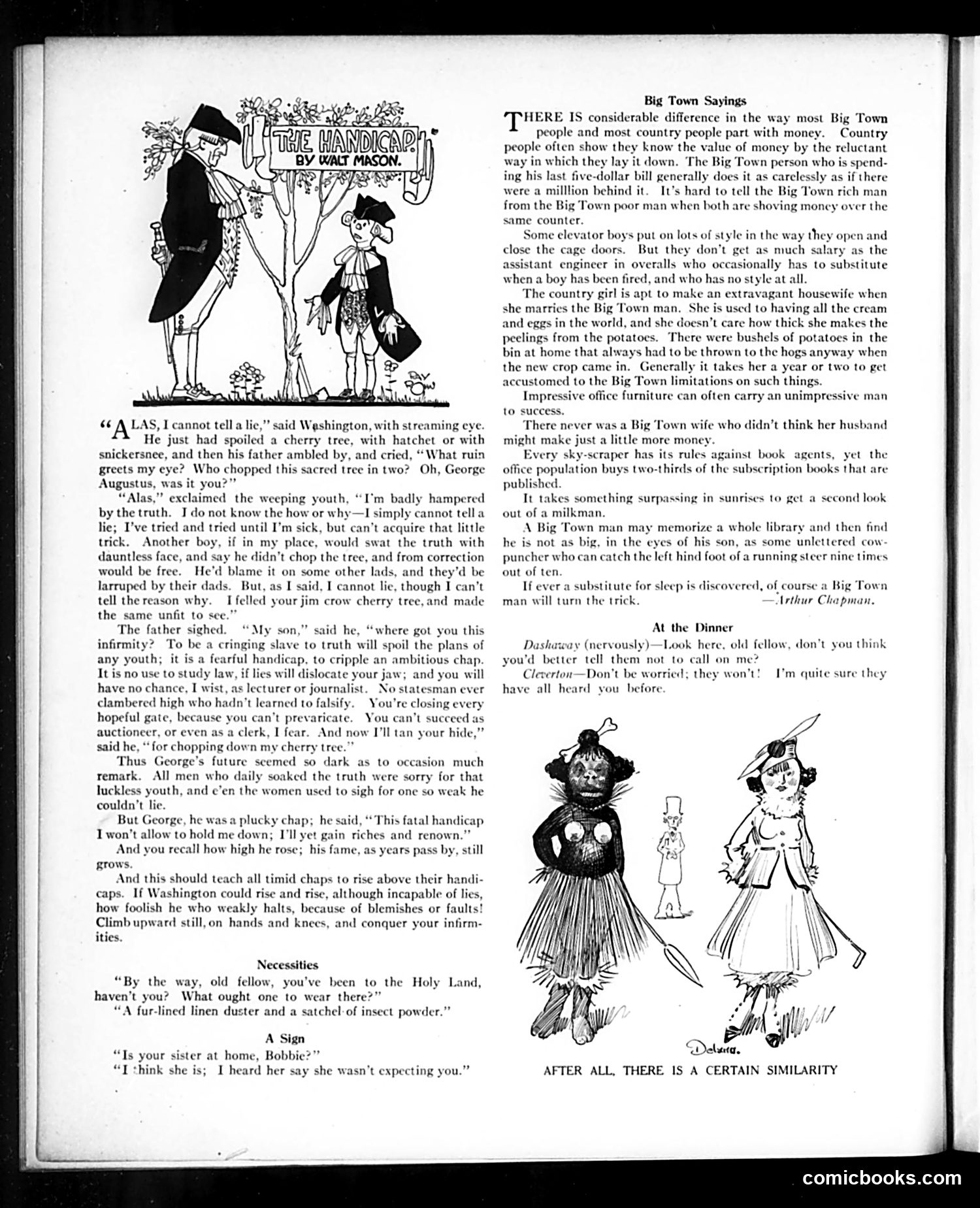
The main cartoon retells the George Washington cherry tree legend—a famous American myth about young Washington's honesty. Here, the satire inverts the moral: Washington's *inability* to lie is presented as a crippling handicap that would ruin his life prospects. His father warns that dishonesty is essential for success as a lawyer, journalist, auctioneer, or clerk. The irony is sharp: the cartoon mocks contemporary American society by suggesting that success *requires* lying, turning the venerated Washington legend upside down. The moral lesson flips from "honesty is virtue" to "honesty is foolish." The "Big Town Sayings" section offers unrelated social commentary contrasting urban and rural attitudes toward money, class markers (elevator boys vs. engineers), and household management—typical Judge magazine observations about American class and regional differences.
📄 Transcribed text from this page (OCR, searchable)
Machine-transcribed from the original scan — historical spelling and the odd misread are preserved.
LF Yashington, with streaming ¢ He just had spoiled a cherry tree, with hatchet or with snickersnee, and then his father ambled by, and cried, “What ruin greets my eye? Who chopped this sacred tree in two? Oh, George Augustus, was it you?” “Alas,” exclaimed the weeping youth, “I'm badly hampered by the truth. I do not know the how or why—I simply cannot tell a lie; I’ve tried and tried until I’m sick, but can’t acquire that little trick. Another boy, if in my place, would swat the truth with dauntless face, and say he didn’t chop the tree, and from correction would be free. He'd blame it on some other lads, and they'd be larruped by their dads. But, as I said, I cannot lie, though I can’t tell the reason why. [felled your jim crow cherry tree,and made the same unfit to see.” The father sighed. ‘My son,” said he, “where got you this infirmity? To be a cringing slave to truth will spoil the plans of any youth; it is a fearful handicap, to cripple an ambitious chap. It is no use to study law, if lies will dislocate your jaw; and you will have no chance, I wist, as lecturer or journalist. No statesman ever clambered high who hadn't learned to falsify. You're closing every hopeful gate, because you can't prevaricate. You can’t succeed as auctioneer, or even as a clerk, I fear. And now I'll tan your hide,” said he, “for chopping down my cherry tree.” Thus George’s future scemed so dark as to occasion much remark. All men who daily soaked the truth were sorry for that luckless youth, and e’en the women used to sigh for one so weak he couldn't li But George, he was a plucky chap; he said, “This fatal handicap I won't allow to hold me down; I'll in riches and renown.” And you recall how high he rose; his fame, as years pass by, still grows, And this should teach all timid chaps to rise above their handi- caps. If Washington could rise and rise, although incapable of lies how foolish he who weakly halts, because of blemishes or faults Climb upward still,on hands and knees, and conquer your infirm- ities. Necessities “By the way, old fellow, you've been to the Holy Land, haven’t you? What ought one to wear there?” “A fur-lined linen duster and a satchel-of insect powder.” A Sign “Ts your sister at home, Bobbie?” “I think she is; I heard her say she wasn't expecting you.” Big Town Sayings HERE IS considerable difference in the way most Big Town people and most country people part with money. Country people often show they know the value of money by the reluctant way in which they lay it down. The Big Town person who is spend- ing his last five-dollar bill generally does it as carelessly as if there were a milllion behind it. It’s hard to tell the Big Town rich man from the Big Town poor man when both are shoving moncy over the same counter. Some elevator boys put on lots of style in the way they open and close the cage doors. But they don’t get as much salary as the assistant engineer in overalls who occasionally has to substitute when a boy has been fired, and who has no style at all. The country girl is apt to make an extravagant housewife when she marries the Big Town man, She I the cream and eggs in the world, and she doesn’t care how thick she makes the peelings from the potatoes. There were bushels of potatoes in the bin at home that always had to be thrown to the hogs anyway when the new crop came in. Generally it takes her a year or two to get accustomed to the Big Town limitations on such things. Impressive office furniture can often carry an unimpressive man to success There never was a Big Town wife who didn’t think her husband might make just a little more money. ery sky-scraper has its rules against book agents, yet the office population buys two-thirds of the subscription books that are published. It takes something surpassing in sunrises to get a second look out of a milkman. \ Big Town man may memorize a whole library and then find he is not as big, in the eyes of his son, as some unlettered cow- puncher who can catch the left hind foot of a running steer nine times out of ten. If ever a substitute for sleep is discovered man will turn the trick. f course a Big Town Irthur Chapman, At the Dinner Dashaway (nervously)—Look here. old fellow, don't you think you'd better tell them not to call on me? “ Cleverton—Don't be worried; they won't! have all heard I’m quite sure they you before AFTER ALL, THERE IS A CERTAIN SIMILARITY comicbooks.com