
Judge, 1916-02-19 · page 25 of 28
Judge — February 19, 1916 — page 25: what you’re looking at
What you’re looking at
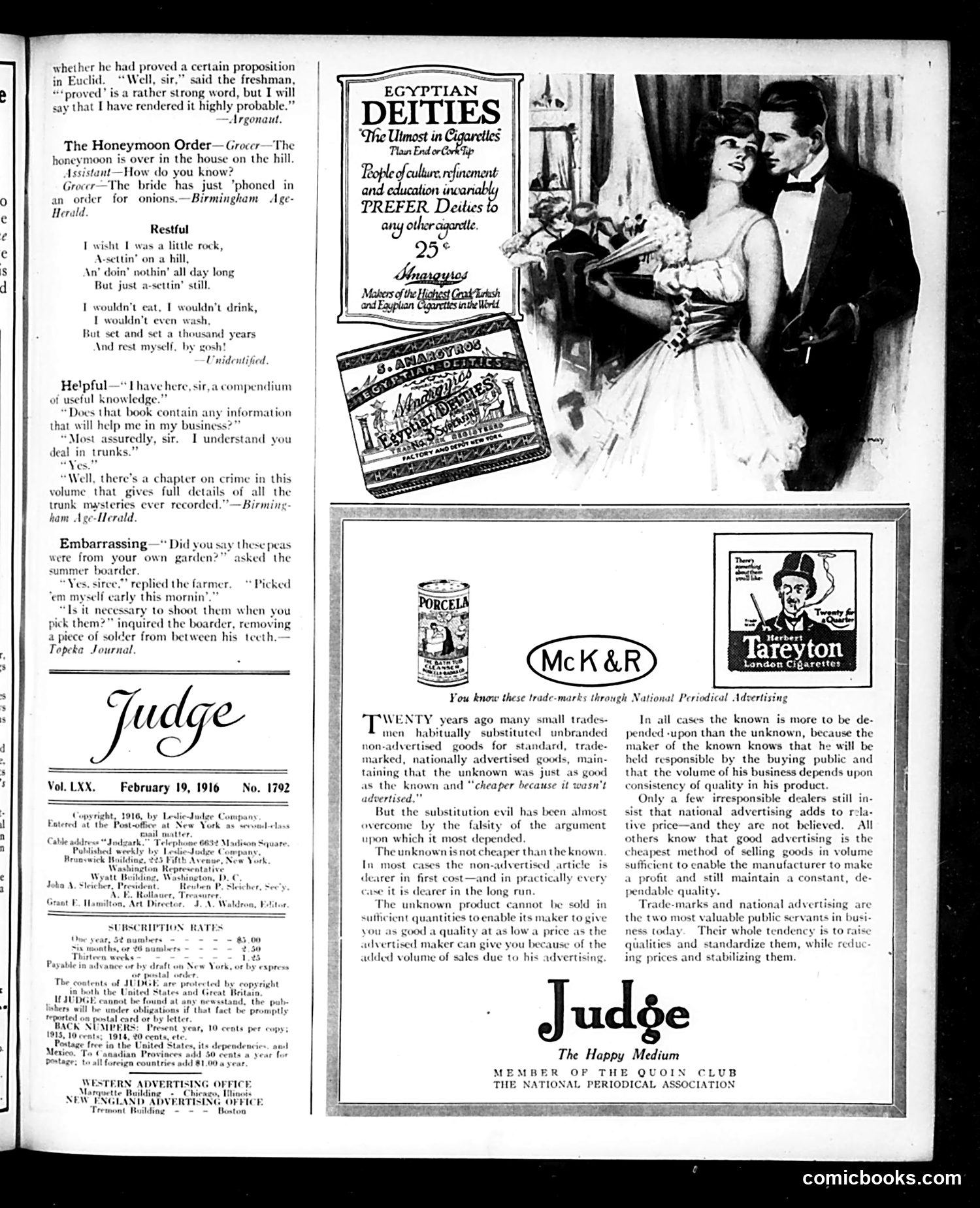
This page contains mostly humorous short jokes and advertisements rather than political cartoons. The humor pieces include: **Short Jokes:** - A freshman's weak math proof - A newlywed ordering onions (implying marital discord) - A farmer's peas requiring bullets to harvest (suggesting they're spoiled/dangerous) **Main Content:** A lengthy advertisement essay arguing that branded, nationally-advertised products are superior to unbranded alternatives—counter to the common belief that unknown brands are cheaper. The ad uses Egyptian Deities cigarettes and other products as examples, claiming advertising actually *lowers* prices through increased volume. The Egyptian Deities cigarette advertisement (top right) depicts a well-dressed couple at what appears to be a formal event, marketing cigarettes as refined products preferred by educated people. This page reflects pre-WWI consumer culture debates about branding and advertising's role in standardizing quality and prices—concerns still relevant today.
📄 Transcribed text from this page (OCR, searchable)
Machine-transcribed from the original scan — historical spelling and the odd misread are preserved.
whether he had proved a certain proposition in Euclid. “Well, sir,” said the freshman, proved’ is a rather strong word, but I will cay that L have rendered it highly probable.” : “Argonaut. The Honeymoon Order—Grocer—The honeymoon is over in the house on the hill. {ssistant—How do you know? Grocer—The bride ‘has just. "phoned in an order for onions.—Birmingham Age- Herald. Restful I wisht I was a little rock, A-settin’ on a hill, An’ doin’ nothin’ all day long But just a-settin’ still. I wouldn't eat, T wouldn't drink, I wouldn't even wash, But set and set a thousand years And rest myself, by gosh! Unidentified. He!pful—" I have here, sir,a compendium of useful knowledge.” “Does that book contain any informatic that will help me in my business?” “Most assuredly, sir. I understand you deal in trunks.”” “Yes.” Well, there’s a chapter on crime in this volume that gives full details of all the trunk mysteries ever recorded.” —Birming ham Age-Herald. Embarrassing —* Did you say these peas were from your own garden?’” asked the summer boarder. “Yes. sirce.”' replied the farmer.“ Picked ‘em myself carly this mornin’.” sit necessary to shoot them when you pick them?” inquired the boarder, removing a piece of solder from between his teeth.— Topeka Journal. “LUudaAgGe February 19, 1916 216, by Lestied) ison Square pany ew York, Joba A. Sleicher, \ er, T y Grant E. Hamilton, Att Direc JON, Waldron, Kelitor SUBSCRIPTION RATES postal notents of JUDGE 9 ted by right in both the United States and 9. der obligations if that fact be promptly prrtal eed o by letter BACK NUMPERS: Present year, 10 cents pee copy: 5 cents, ete #1.00 a year, anadian Provi all foreign count WESTERN ADVERTISING OFFICE Marquette Building = Chic < NEW ENGLAND ADVERTISING OFFICE Tremont Building - ~~ Bo —— EGYPTIAN DEITIES “The Utmost in § Plain End or Cok Tp and education invariably PREFER Deities b iy Tareyton London Cigarettes Fou know these trade-marks through National Periodical Advertising men habitually substituted unbranded dvertised goods for standard, trade- tionally advertised goods, main- t the unknown was just as good as the known and “cheaper because it wasn't advertised, But the substitution evil has been almost overcome by the falsity of the argument upon which it most depended The unknown is not cheaper than the know In most cases the non-advertised article is dearer in first cost—and in practically every case it is dearer in the long run The unknown product cannot be sold in sufficient quantities to enable its maker to give TWENTY years ago many small trades. ' you as good a quality at as low a price as the advertised maker can give you because of the added volume of sales due to his advertising. In all cases the known is more to be de- pended -upon than the unknown, because the maker of the known knows that he will be held responsible by the buying public and that the volume of his business depends upon consistency of quality in his product Only a few irresponsible dealers still in- sist that national advertising adds to rela- tive price—and they are not believed. All others know that good advertising is the cheapest method of selling goods in volume sufficient to enable the manufacturer to make a profit and still maintain a constant, de- pendable quality. Trade-marks and national advert the two most valuable public servants in busi- ness today. Their whole tendency is to ra qualities and standardize them, while redu ing prices and stabilizing them. : Judge The Happy Medium 1BER OP THE QUOIN CLUB ATIONAL PERIODICAL ASSOCIATION comicbooks.com