
A complete issue · 28 pages · 1916
Judge — January 1, 1916
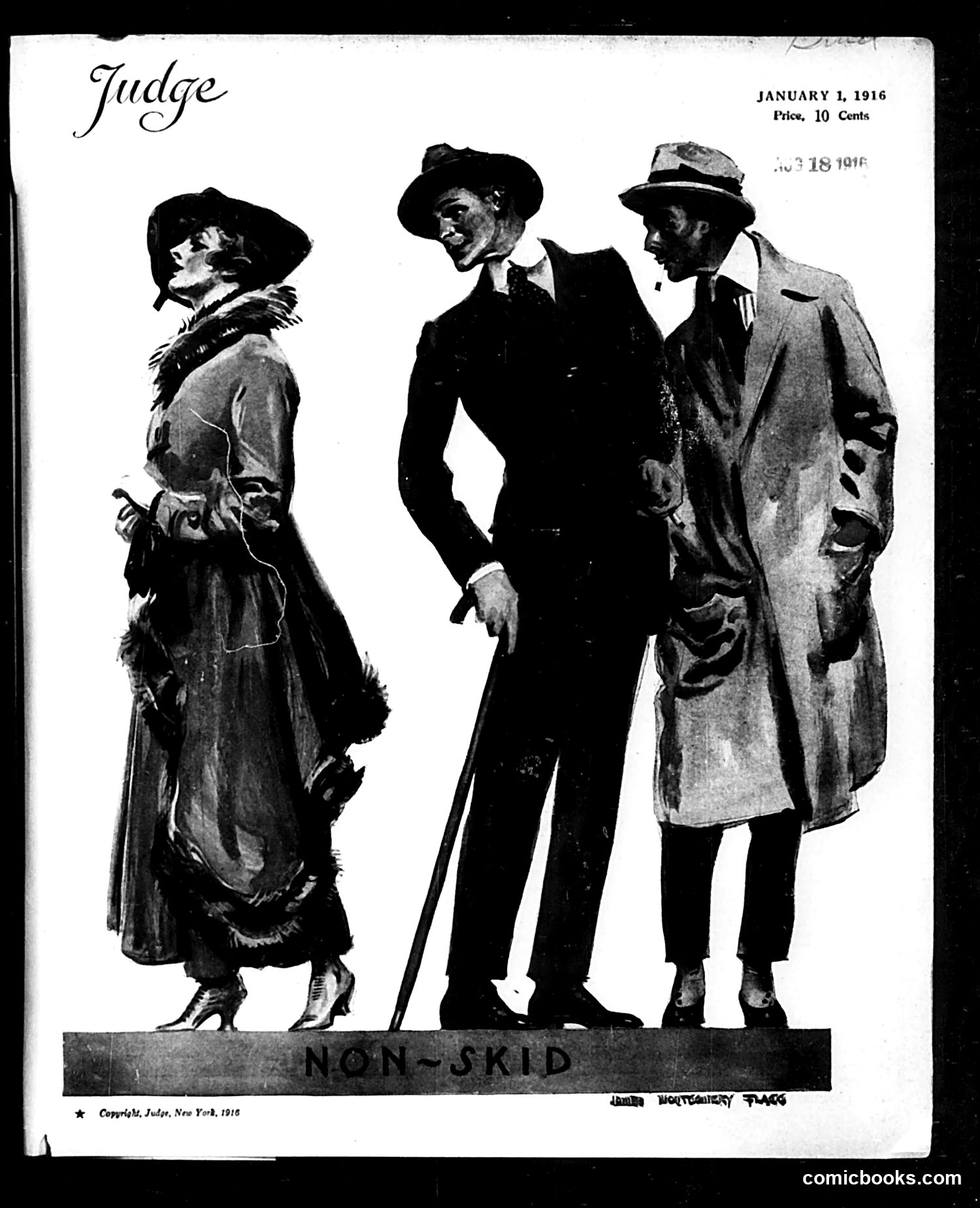
This cartoon satirizes fashion and winter safety. The caption "NON-SKID" references tire technology gaining popularity around 1916 for better traction on icy roads. The joke depicts three fashionably dressed people in winter coats and hats. The woman on the left wears an elaborate outfit with a large decorative fur collar and feathered hat—expensive, impractical winter wear. The two men appear equally well-dressed but somewhat awkwardly posed. The satire likely mocks wealthy urbanites who prioritize fashionable appearance over practical winter footwear. Their fancy clothing wouldn't prevent slipping on ice, unlike actual "non-skid" tire technology. The cartoon suggests these socialites need the modern safety innovation more than anyone, given their precarious fashion choices on snowy streets.
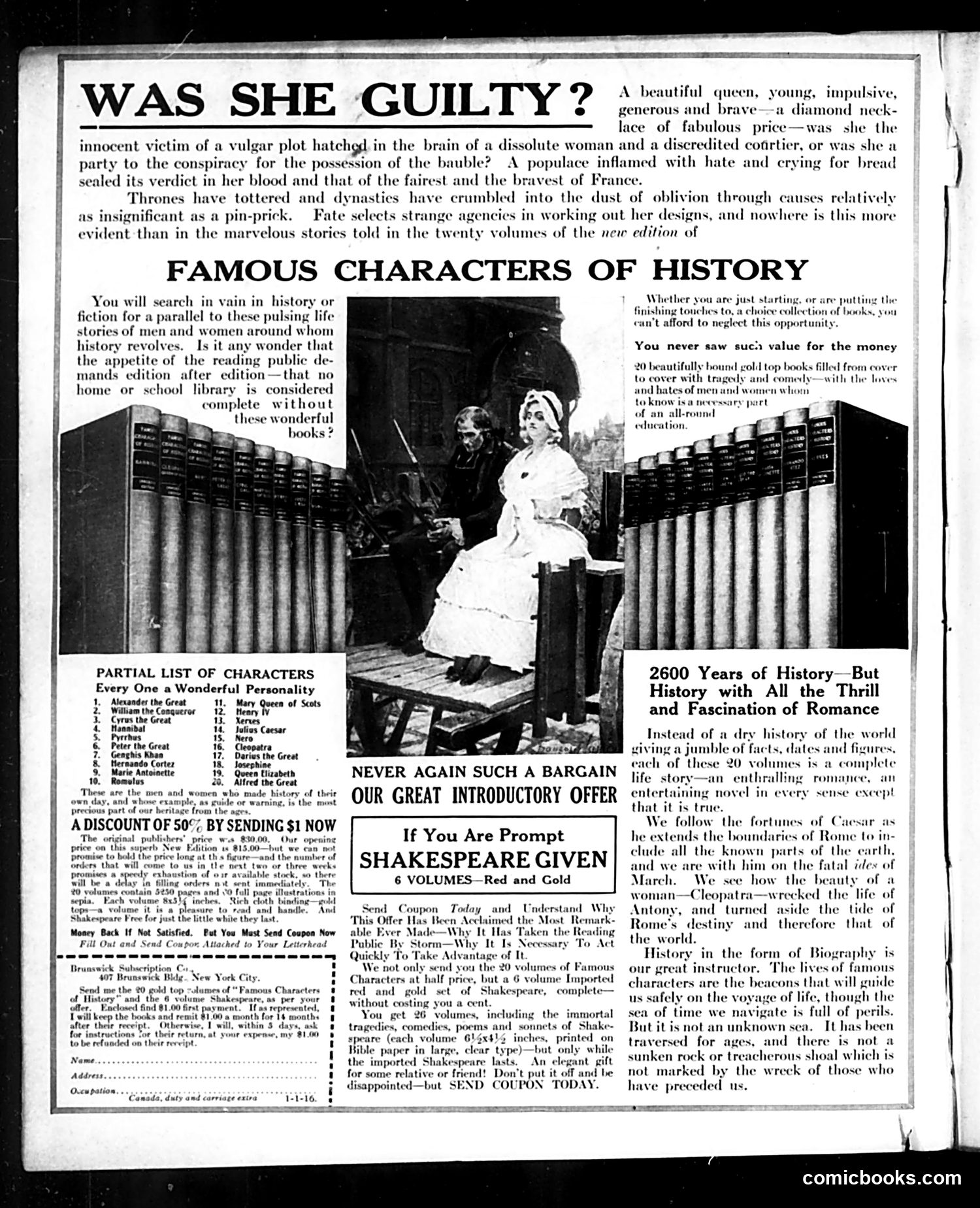
This page is primarily **advertising, not satire**. The headline "Was She Guilty?" refers to a book series called "Famous Characters of History" — a 20-volume encyclopedia offering dramatized historical narratives. The question appears designed to intrigue readers about figures like Cleopatra, whose story is mentioned in the ad copy. The central image shows a period scene, likely depicting one of these famous historical characters to illustrate the entertainment value of the volumes. The "introductory offer" promotes a 50% discount on a Shakespeare collection. This is a straightforward commercial pitch targeting educated readers interested in literature and history — typical Judge magazine content mixing satire with lucrative advertisements. No political cartoon is present here.
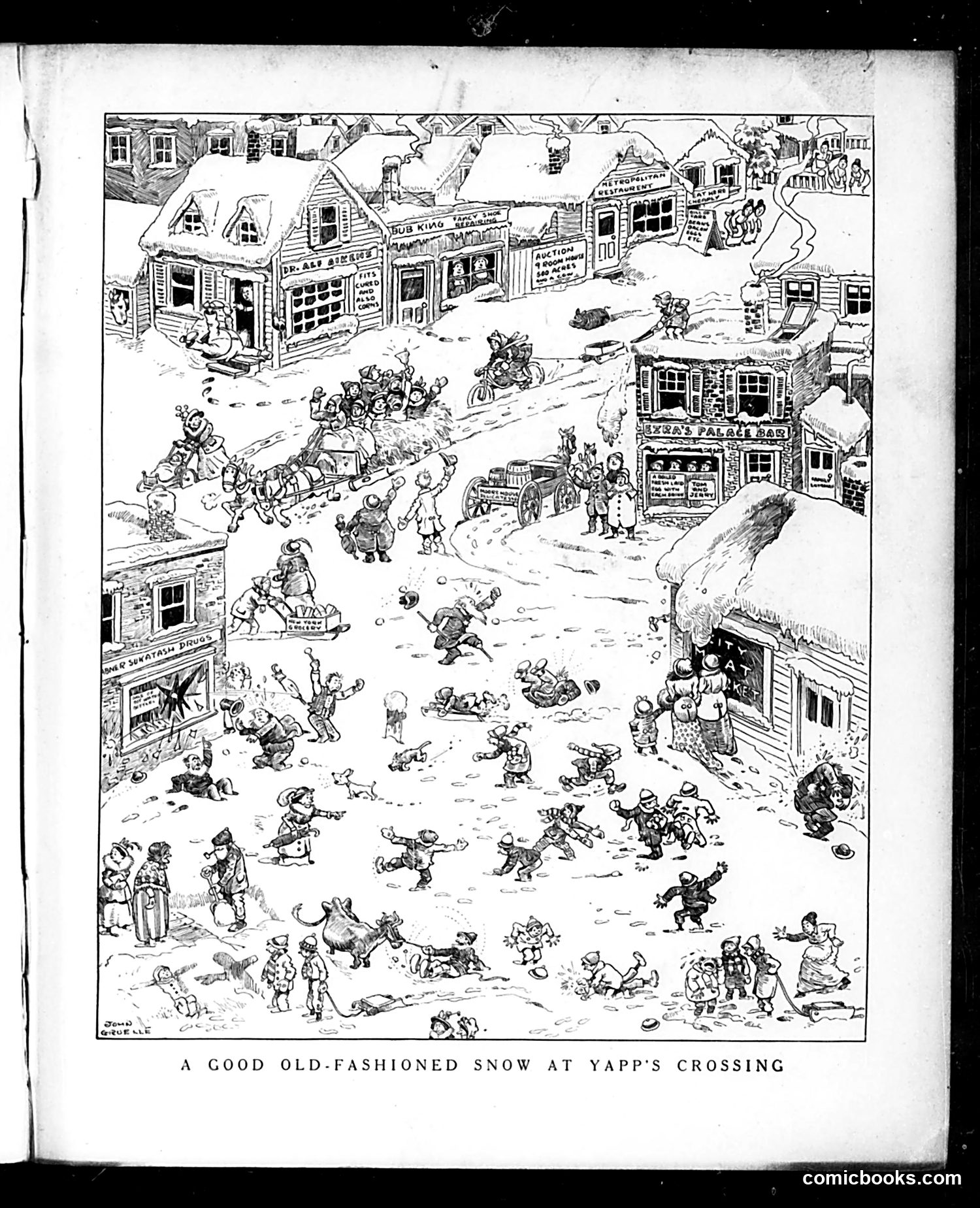
This illustration depicts a chaotic winter snow day at what appears to be a commercial crossroads or small town center. The scene shows dozens of children and adults engaged in various snow activities—sledding, building snowmen, playing, and general merriment in the snow. The visible business signs include "Rub King," "Dr. Art Simkins," "Metropolitan," and "Texas Palace Bar," suggesting this is a commercial district. The cartoon satirizes small-town American winter life, celebrating nostalgic snow-day chaos and unbridled outdoor recreation. The title references "Yapp's Crossing," likely a specific location, though the exact reference is unclear without additional historical context. The overall tone is warmly humorous rather than sharply political.
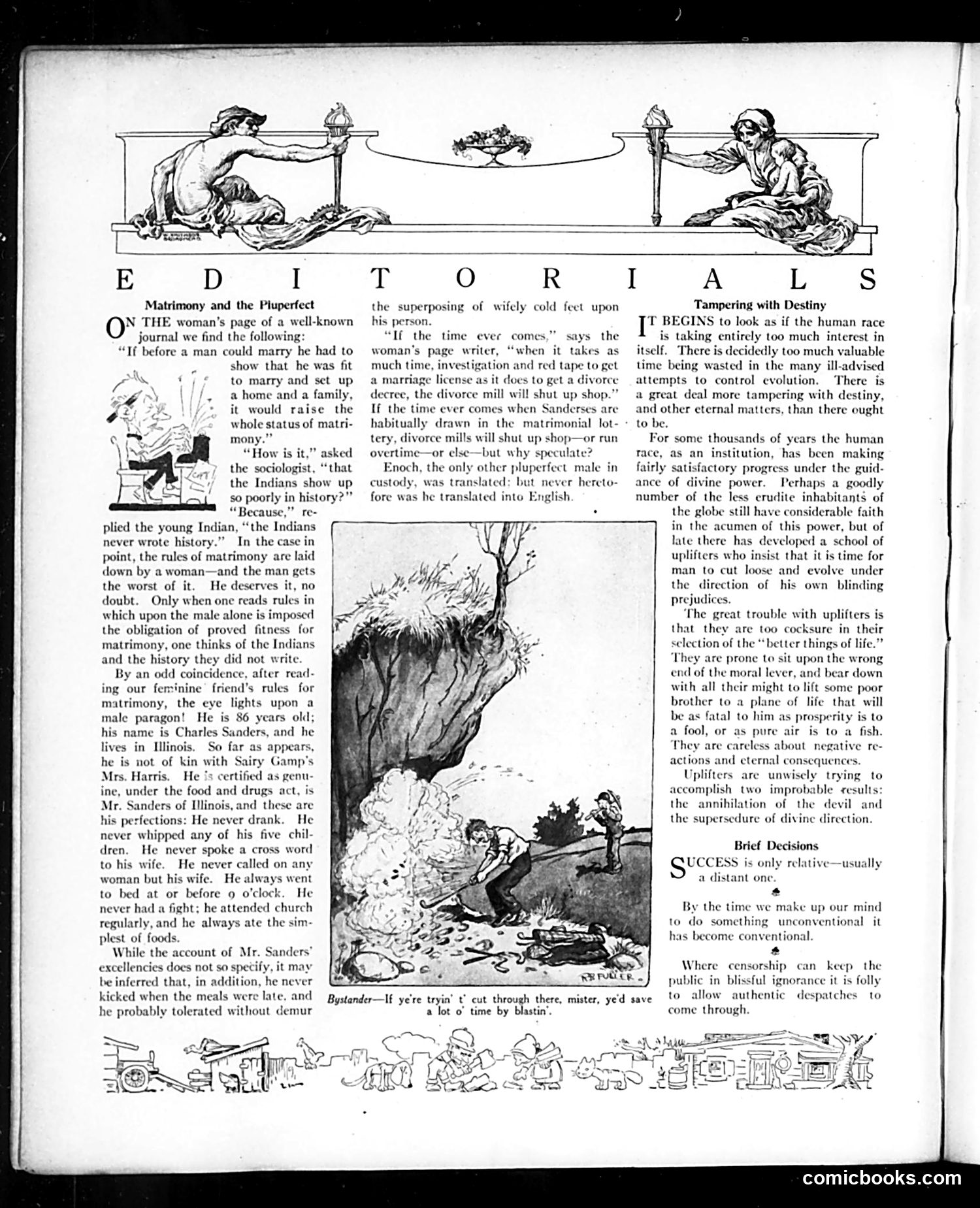
This page contains three satirical articles under the header "EDITORIALS": "Matrimony and the Pluriperfect," "Tampering with Destiny," and "Brief Decisions." The main cartoon illustrates the first piece, which critiques matrimonial rules. It references a historical figure named Charles Sanders from Illinois—described as a man of exemplary moral character who never drank, fought, or spoke harshly. The text sarcastically notes that despite these virtues, he lived under "food and drugs act" restrictions, suggesting government overreach. The second article mocks "uplifters"—reformers attempting to improve society—arguing they carelessly promote change without considering consequences. The cartoons are illustrative rather than depicting specific political figures. The satire targets institutional absurdities: marriage law complexities, overzealous moral reformers, and governmental regulation of personal conduct.
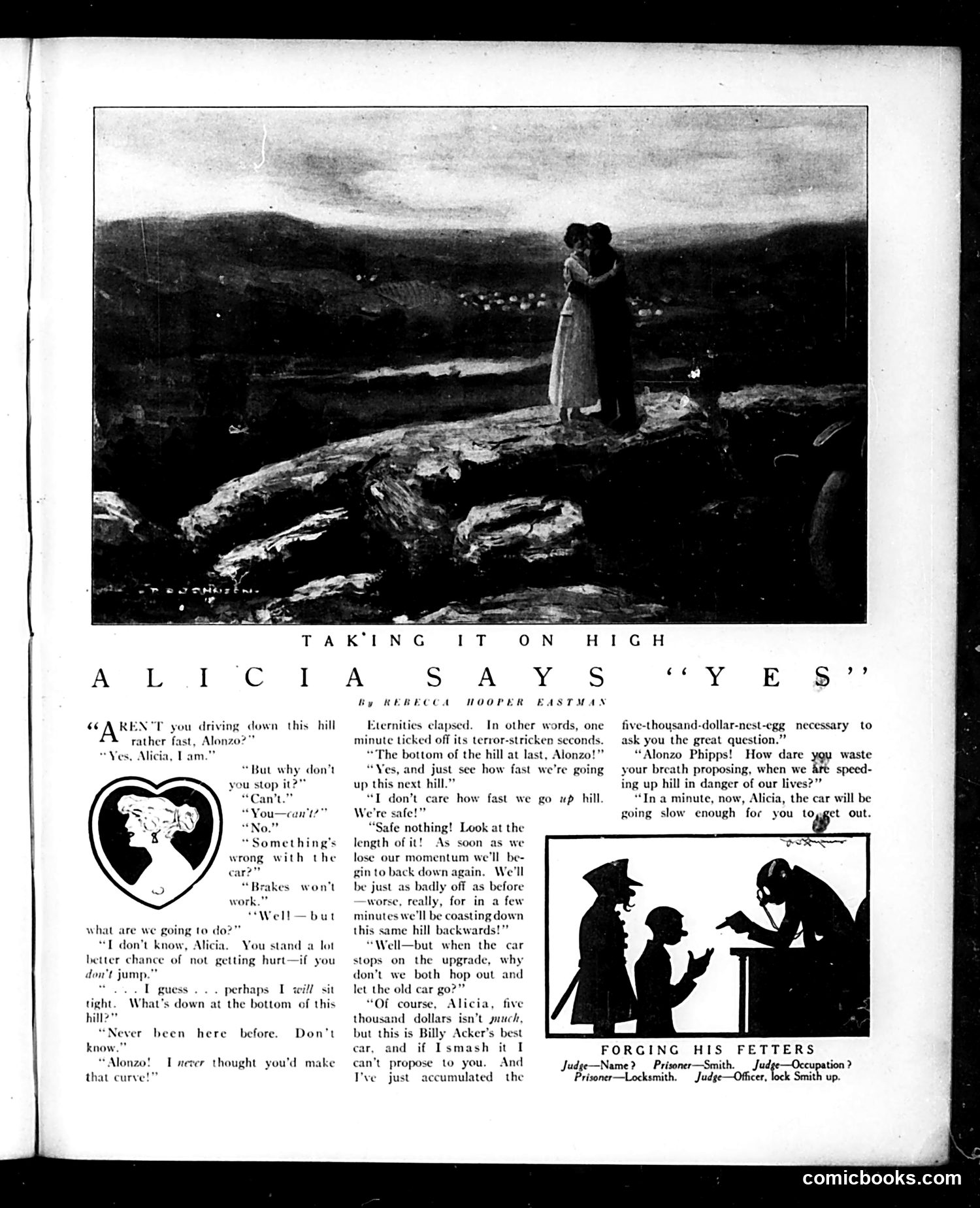
This is a humorous story about a couple debating whether to drive recklessly down a hill in what appears to be an early automobile. The male character (Alonzo) wants speed; Alicia urges caution, noting the brakes won't work properly and they risk injury or death. The satire targets reckless automotive behavior—a contemporary concern as automobiles were still relatively new and dangerous. The subplot involves a competing suitor (Billy Acker) who has accumulated five thousand dollars to propose to Alicia, but Alonzo threatens to wreck the car to prevent the proposal. The lower cartoon, "Forcing His Fetters," depicts a legal proceeding, likely showing prisoner interrogation or sentencing. The humor relies on automotive peril and romantic rivalry as comedic devices.
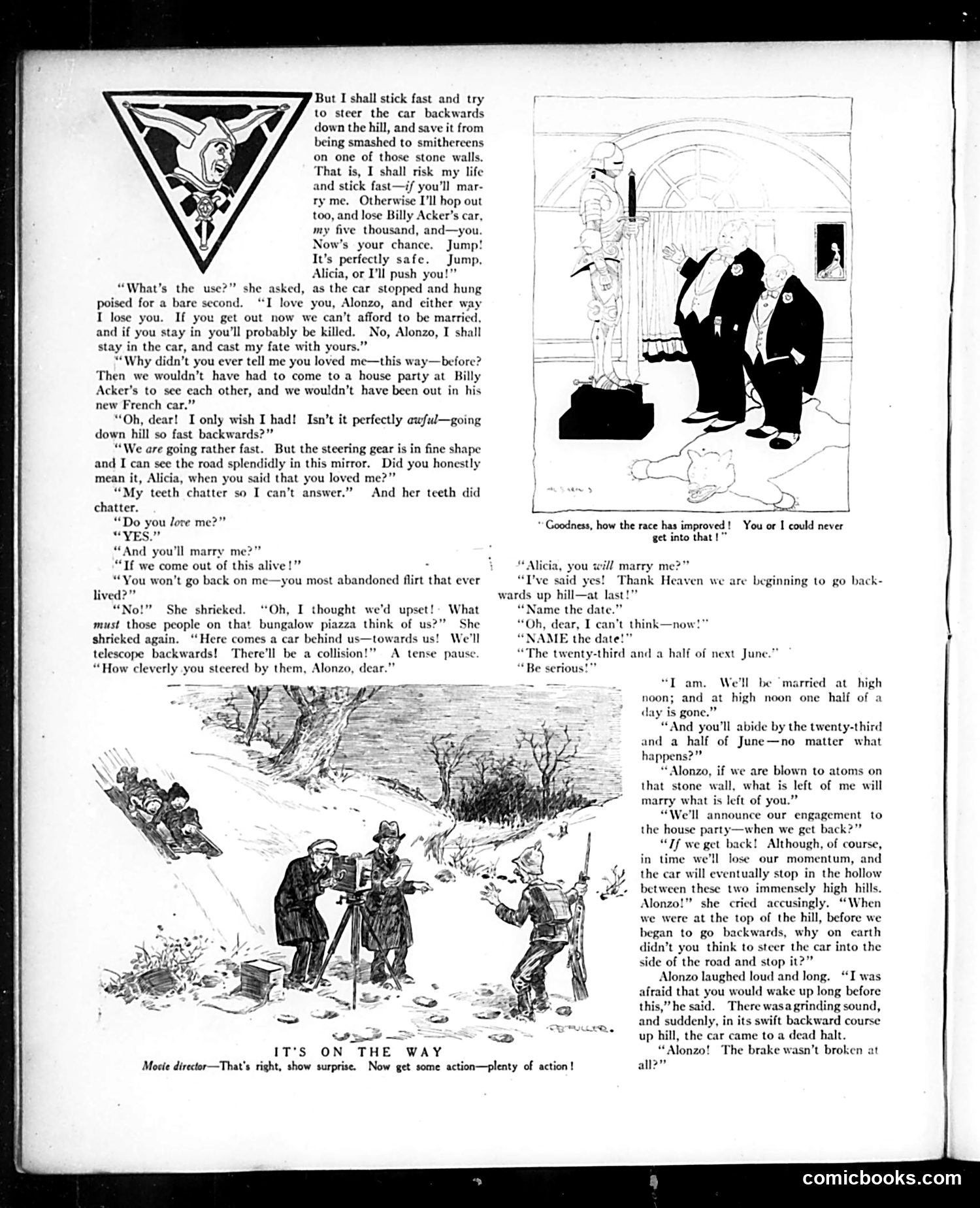
This page presents a serialized romantic melodrama titled "It's On the Way," likely from an early 20th-century *Judge* magazine. The narrative depicts a couple, Alicia and Alonzo, in a runaway automobile careening backwards down a hill—a scenario designed to generate maximum dramatic tension and comedic suspense. The satire targets several contemporary concerns: the dangers of early automobiles, the recklessness of wealthy socialites (attending "Billy Acker's" house party in a "new French car"), and the overwrought emotionalism of romantic fiction. The dialogue parodies breathless love confessions amid peril. The final reveal—that Alonzo deliberately engineered the crisis to extract a marriage proposal—mocks both masculine manipulation and feminine gullibility in courtship narratives. The bottom caption, addressing a "movie director" demanding "action," suggests *Judge* is satirizing both silent film melodrama conventions and the magazine's own serialized entertainment format.
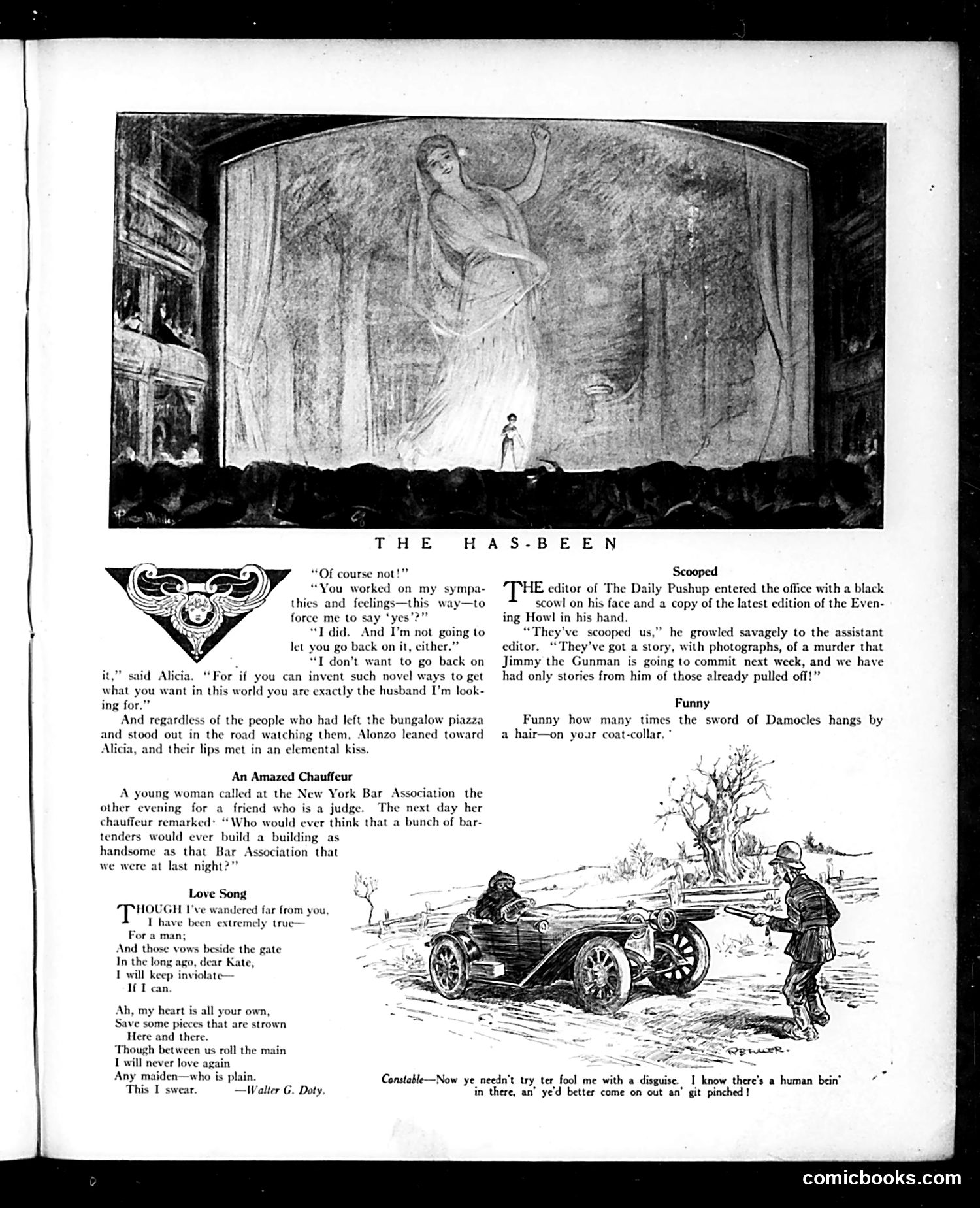
This Judge magazine page contains several satirical pieces mocking early 20th-century social pretensions and journalism: **"Scooped"** ridicules sensationalist newspapers competing for crime stories. The joke: a newspaper editor is furious that a rival has "scooped" them on covering a murder Jimmy the Gunman will allegedly commit—implying newspapers don't report news but manufacture it, essentially collaborating with criminals for exclusive stories. **"An Amazed Chauffeur"** mocks class confusion: a chauffeur mistakes the Bar Association building for a bartenders' social club, confusing "bar" (legal profession) with "bar" (drinking establishment)—satire on working-class misunderstanding of elite institutions. **"Love Song"** parodies sentimental romantic poetry with crude honesty about male infidelity ("save some pieces that are strewn / Here and there"). **The bottom illustration** shows a constable confronting someone in disguise, likely another joke about deception or crime. Overall, the page satirizes journalism sensationalism, class pretension, and romantic hypocrisy—typical Judge magazine targets of the era.
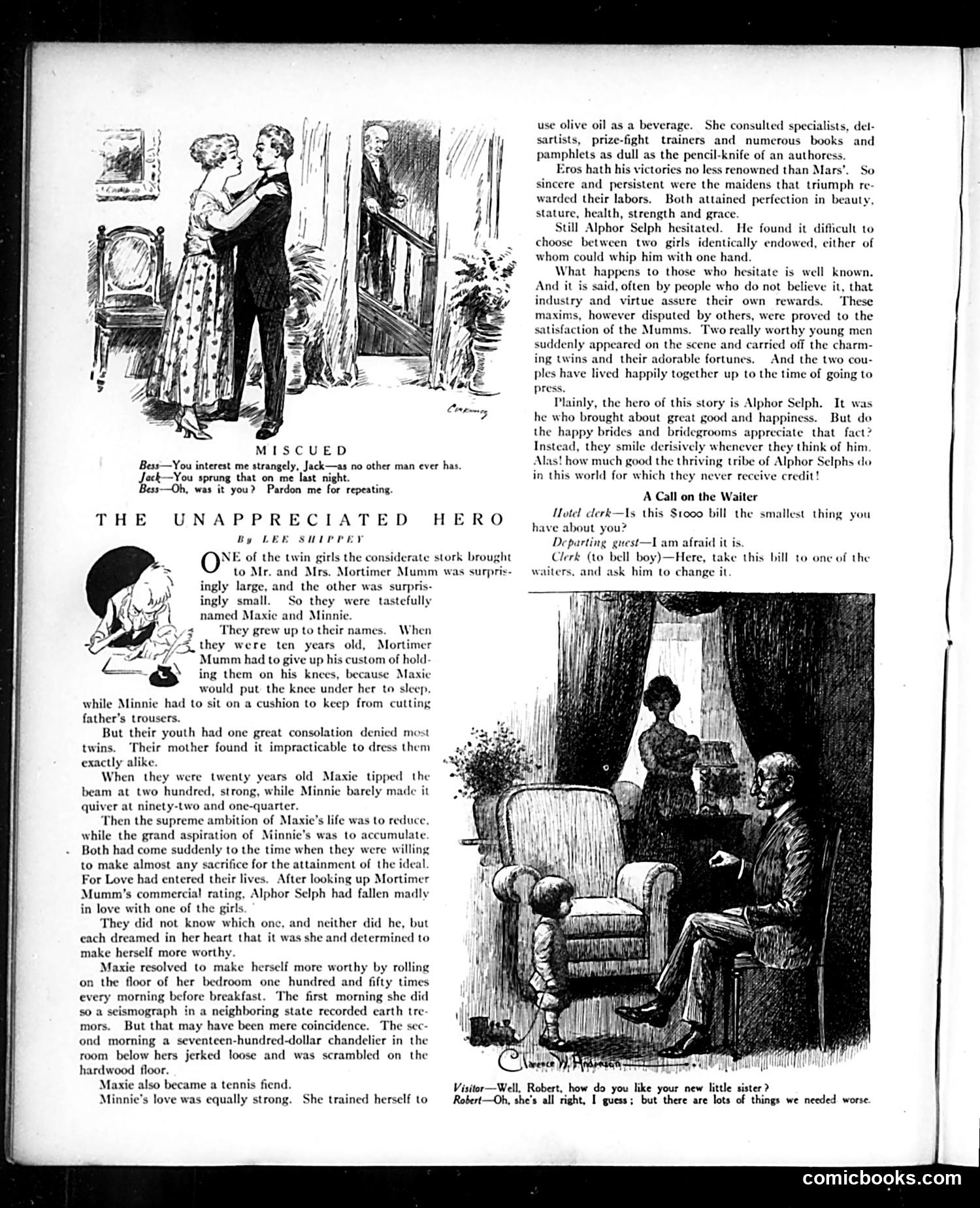
This story satirizes male entitlement and romantic indecision. Alphor Selph falls in love with one of twin sisters—Maxie (large) and Minnie (small)—but cannot decide between them. Rather than choose, he hesitates. Meanwhile, both sisters work desperately to improve themselves: Maxie exercises obsessively to lose weight (causing earthquakes and destroying property), while Minnie gains weight by consuming olive oil and training with prize-fighters. The satire's point: both sisters transform themselves completely through "industry and virtue," yet Selph's indecision costs him. Two *other* worthy men appear and marry the twins instead. The story's ironic title mocks Selph as "unappreciated"—suggesting he deserves credit for the good outcomes he *accidentally* caused through his own passivity and cowardice, while the twins who actually earned their happiness through hard work receive no credit from him. The joke critiques male selfishness and the expectation that women should compete for male approval.
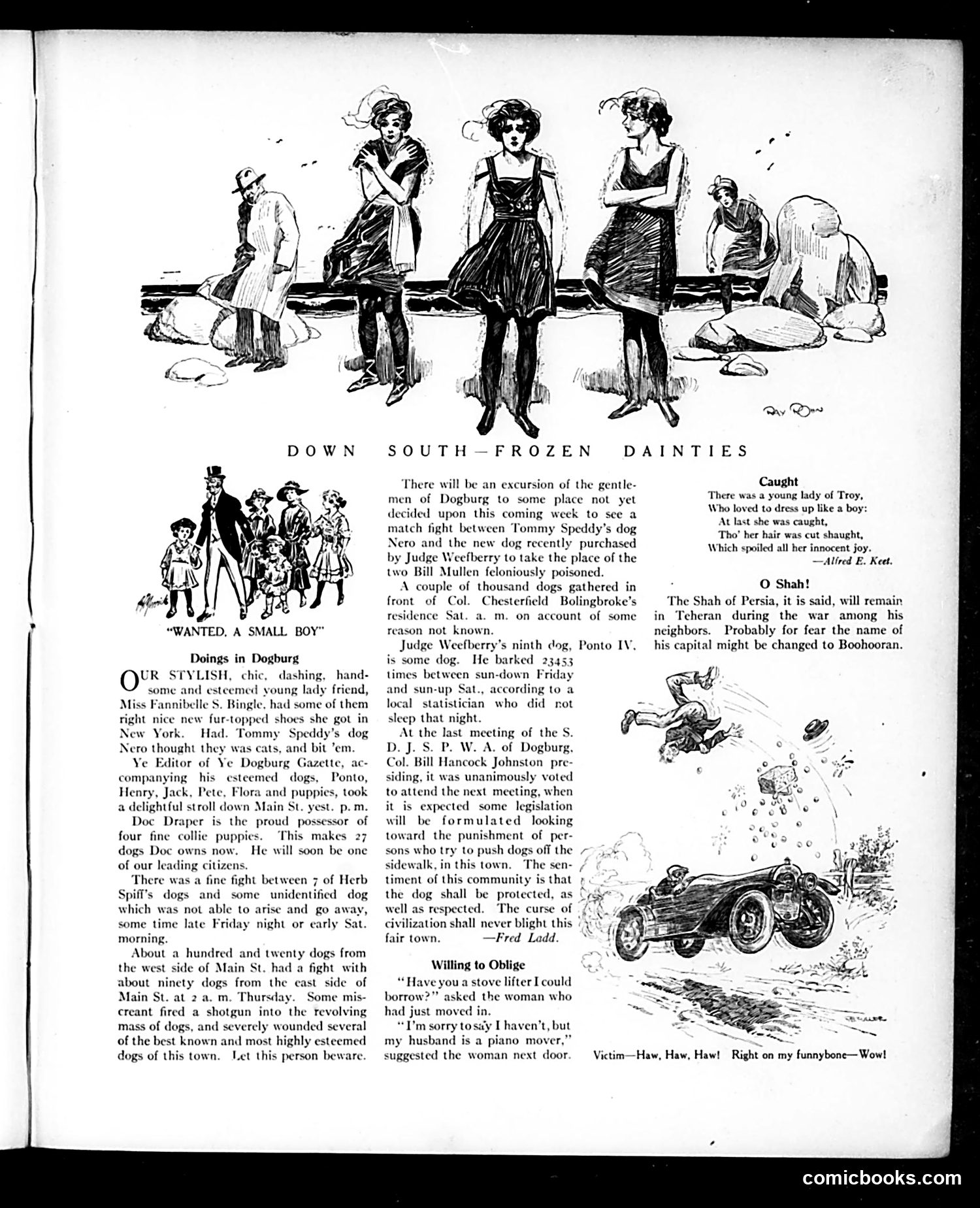
This page from *Judge* magazine contains humor centered on a fictional town called "Dogburg" where dogs dominate civic life. The main satire mocks small-town America's obsession with trivial local affairs. **Key Content:** The "Doings in Dogburg" section parodies local newspaper reporting, chronicling absurd dog-related incidents: a dog eating shoes, massive street fights between rival packs, and citizens debating dog protection laws. The humor lies in treating canine squabbles with the gravity of serious municipal politics. **Social Commentary:** This satirizes how provincial communities obsess over minor local scandals and dramatics—elevating petty disputes to matters of civic importance. The mockery extends to small-town journalism itself, which breathlessly covers inconsequential happenings. **Other Elements:** The page includes light poetry and jokes (the "lady of Troy" limerick, the "piano mover" gag) typical of *Judge*'s variety-magazine format. **Context:** Without a visible date, the precise historical moment remains unclear, though the style suggests early-to-mid 20th century American humor.
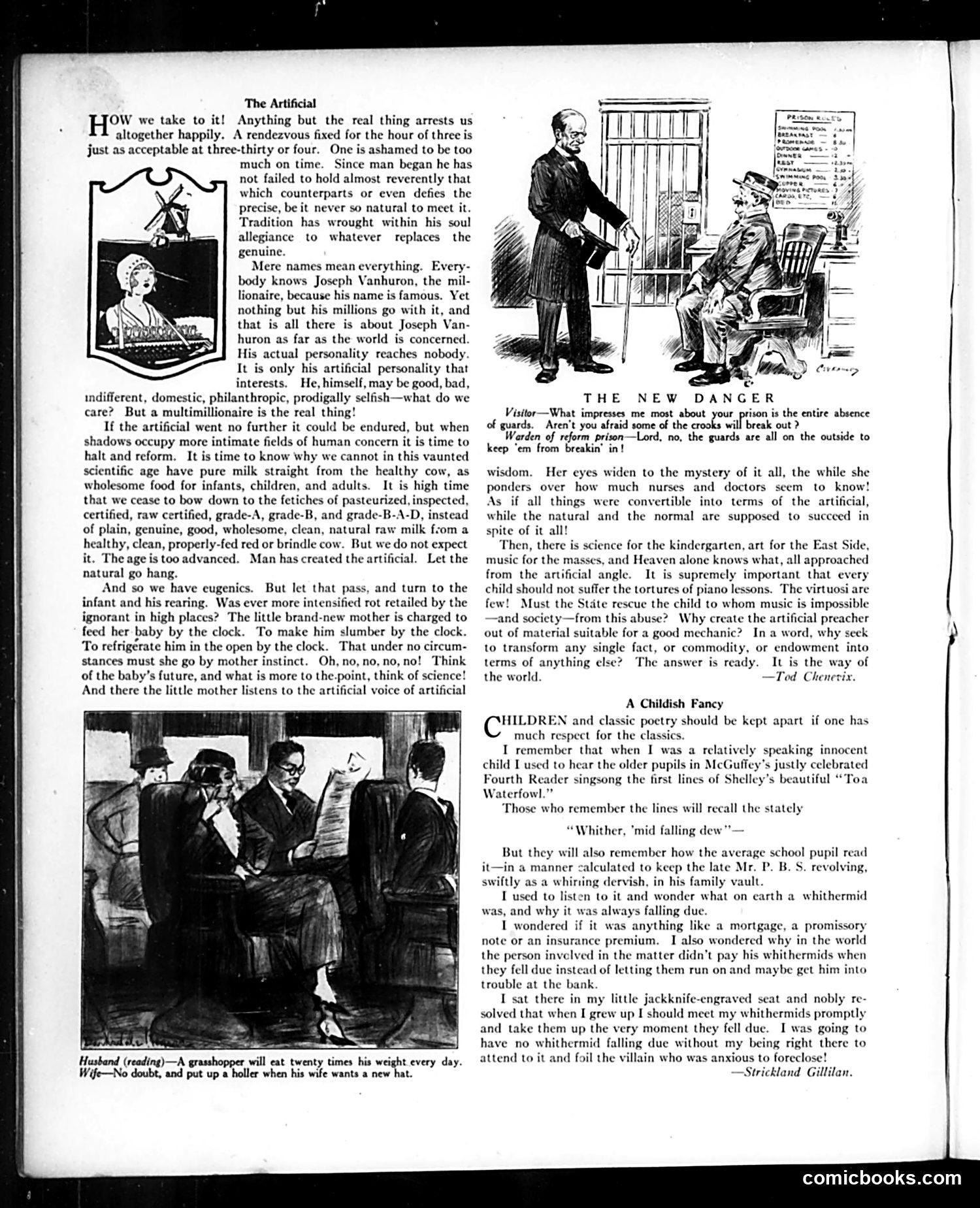
This page critiques American society's obsession with the artificial over the genuine. The main essay "The Artificial" argues that people value reputation and appearances (using Joseph Vanhuron, a wealthy industrialist, as an example) rather than actual character. It attacks modern practices like pasteurized milk, strict clock-based baby-feeding schedules dictated by "science," and the artificial creation of professionals unsuited to their vocations. The page includes two cartoons: "The New Danger" jokes that prison guards keep *inmates in* rather than out, satirizing prison reform efforts. A second cartoon depicts a husband's sarcastic response to his wife's complaint about expenses, suggesting wives are materialistic. The article's tone is reactionary—opposing modernization, scientific management, and social reform in favor of "natural" methods and tradition. The author credits are "Ted Chenevix" and "Strickland Gillilan."
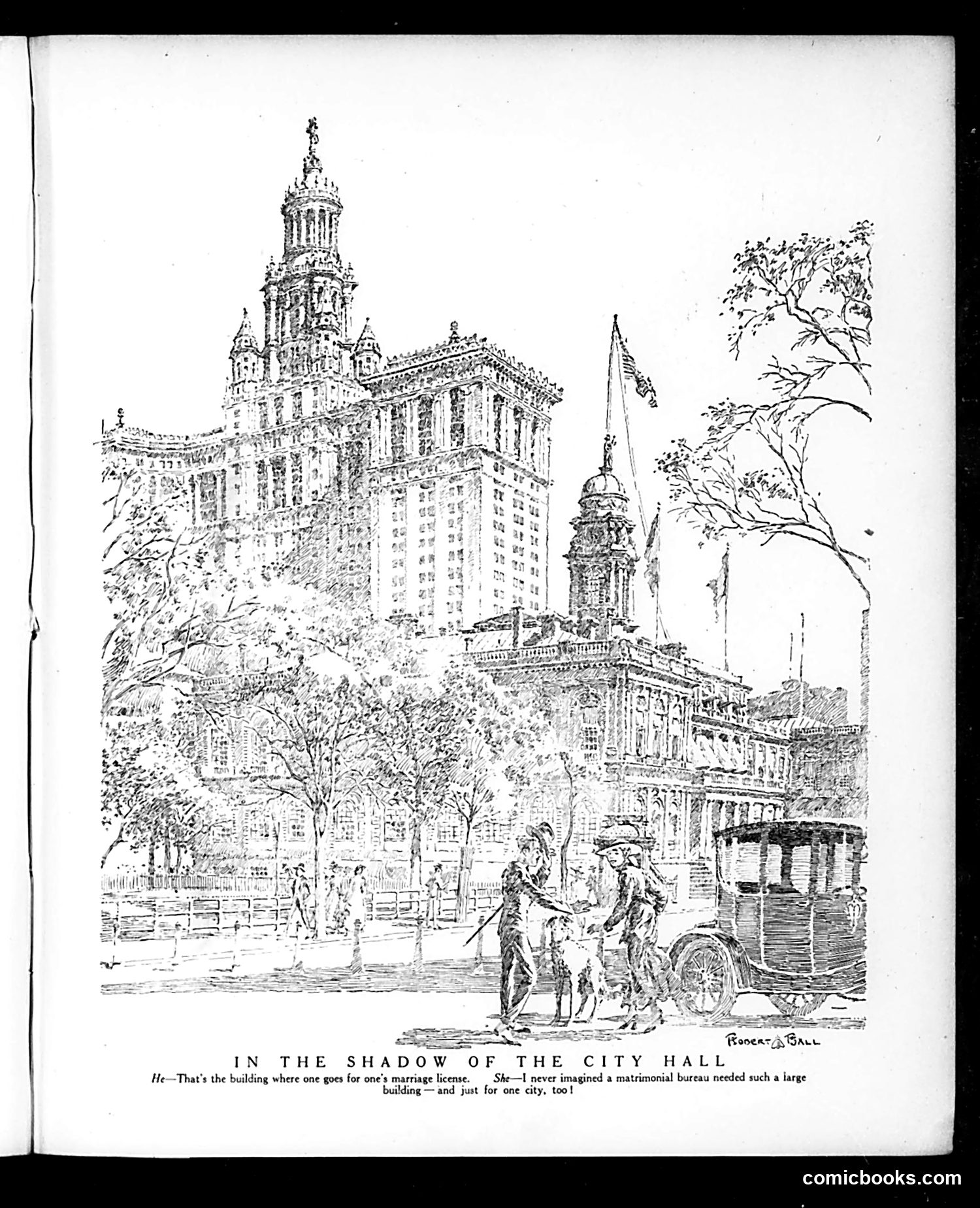
This cartoon satirizes the size and importance of municipal marriage-licensing bureaucracy. A couple stands before an imposing City Hall, with the woman remarking that she never expected such a large building would be needed just to obtain a marriage license. The man responds that it's "the building where one goes for one's marriage license," suggesting the bureaucracy has become absurdly extensive. The joke critiques early 20th-century urban administrative bloat—the irony that what should be a simple civil procedure requires an enormous institutional structure. The grand architecture of City Hall (with its prominent tower and flags) contrasts comedically with the mundane task of getting married, mocking government inefficiency and over-bureaucratization.
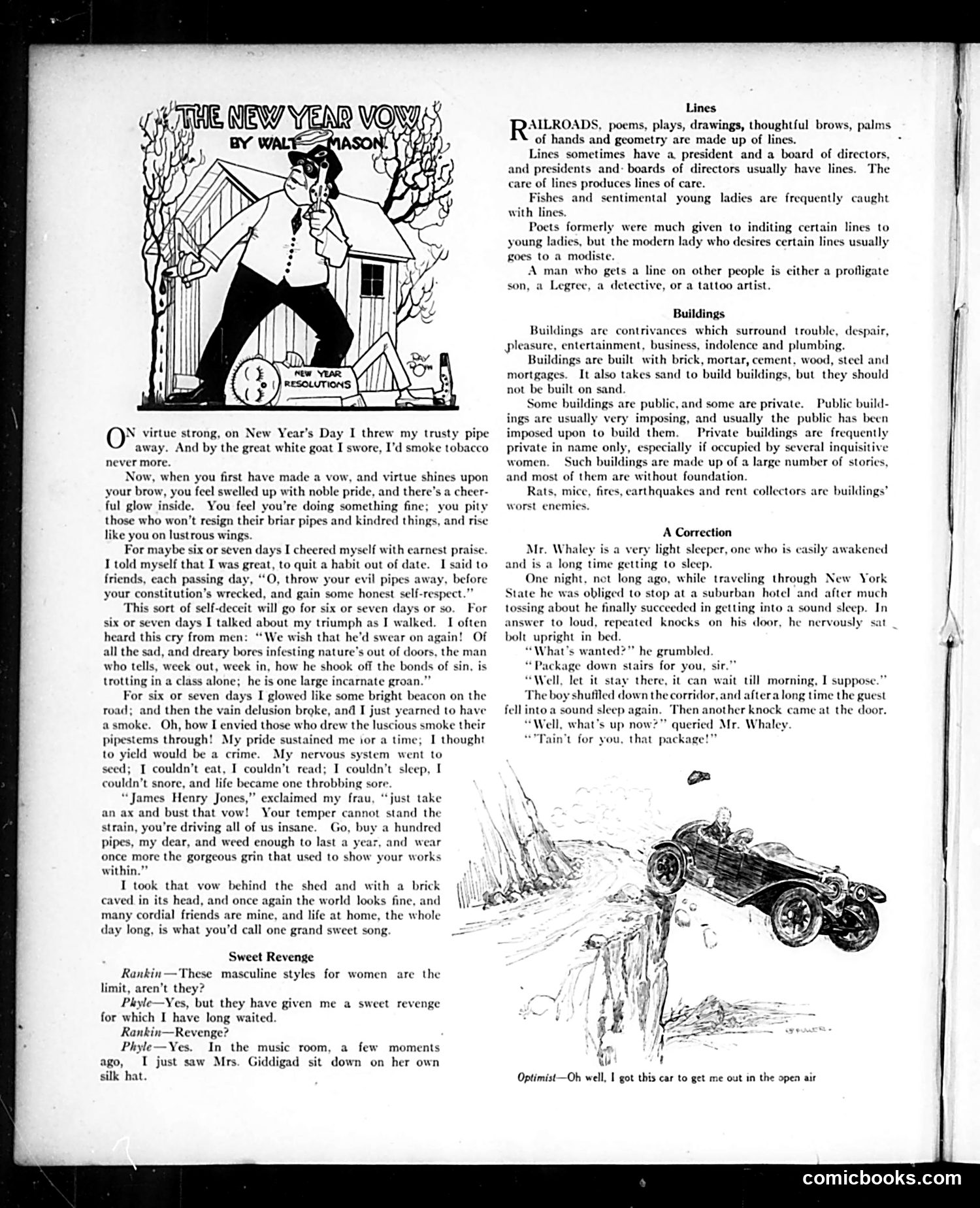
This Judge magazine page contains two distinct pieces: **"The New Year Vow" (left):** A humorous poem by Walt Mason about a man who quits smoking on New Year's Day, boasts about his virtue for a week, then suffers withdrawal so badly his wife tells him to resume smoking. It satirizes the common failure of New Year's resolutions and the annoying self-righteousness of people who brag about self-improvement. **"Lines" and "Buildings" (right):** Brief satirical essays defining abstract concepts through cynical observations. "Buildings" mocks private buildings occupied by "inquisitive women" lacking "foundation"—wordplay suggesting both structural and moral instability. These appear to be general social commentary rather than specific political satire. **The cartoon illustration** shows a car accident, captioned "Optimist—Oh well, I got this car to get me out in the open air," mocking optimists who rationalize misfortune. The page represents typical Judge content: lighthearted social satire rather than hard political commentary.
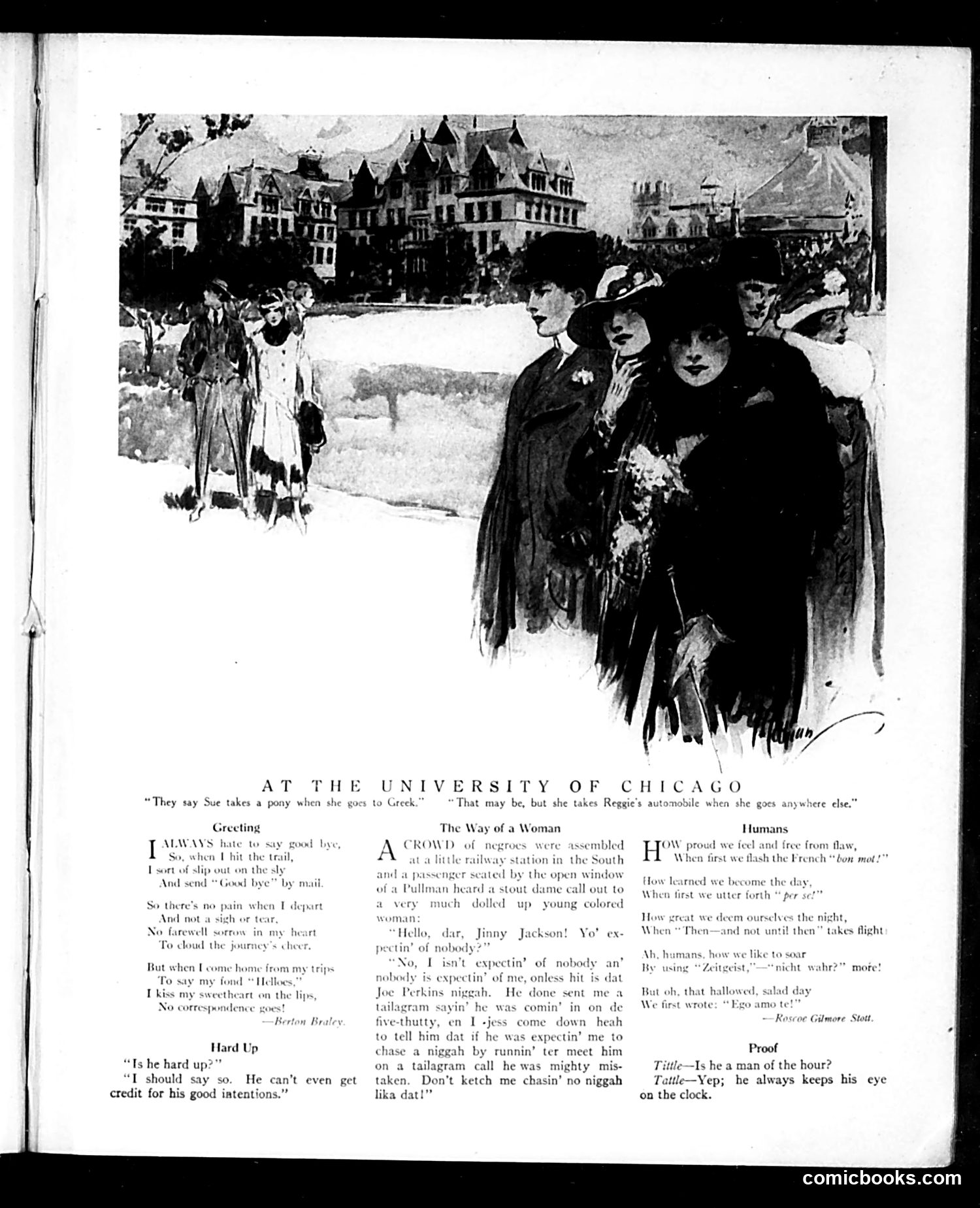
This page contains several brief satirical pieces and jokes typical of early 20th-century American humor magazines. **Main cartoon** (top): "At the University of Chicago" depicts wealthy students displaying pretentious behavior—the caption jokes that one woman takes an automobile to Greek class while another takes merely a pony elsewhere, mocking the conspicuous consumption and affectation of the university set. **Text pieces below** include: - "Greeting" and "Hard Up"—light romantic and financial humor - "The Way of a Woman"—appears to feature dialect humor (using period vernacular) about a woman's romantic expectations - "Humans"—philosophical doggerel mocking pretentiousness about French phrases and intellectual posturing - "Proof"—a brief joke about punctuality The overall theme satirizes social pretension, wealth display, and affected intellectualism among the affluent classes, particularly university students. The humor reflects period attitudes toward class distinctions and aspirational behavior among the well-to-do.
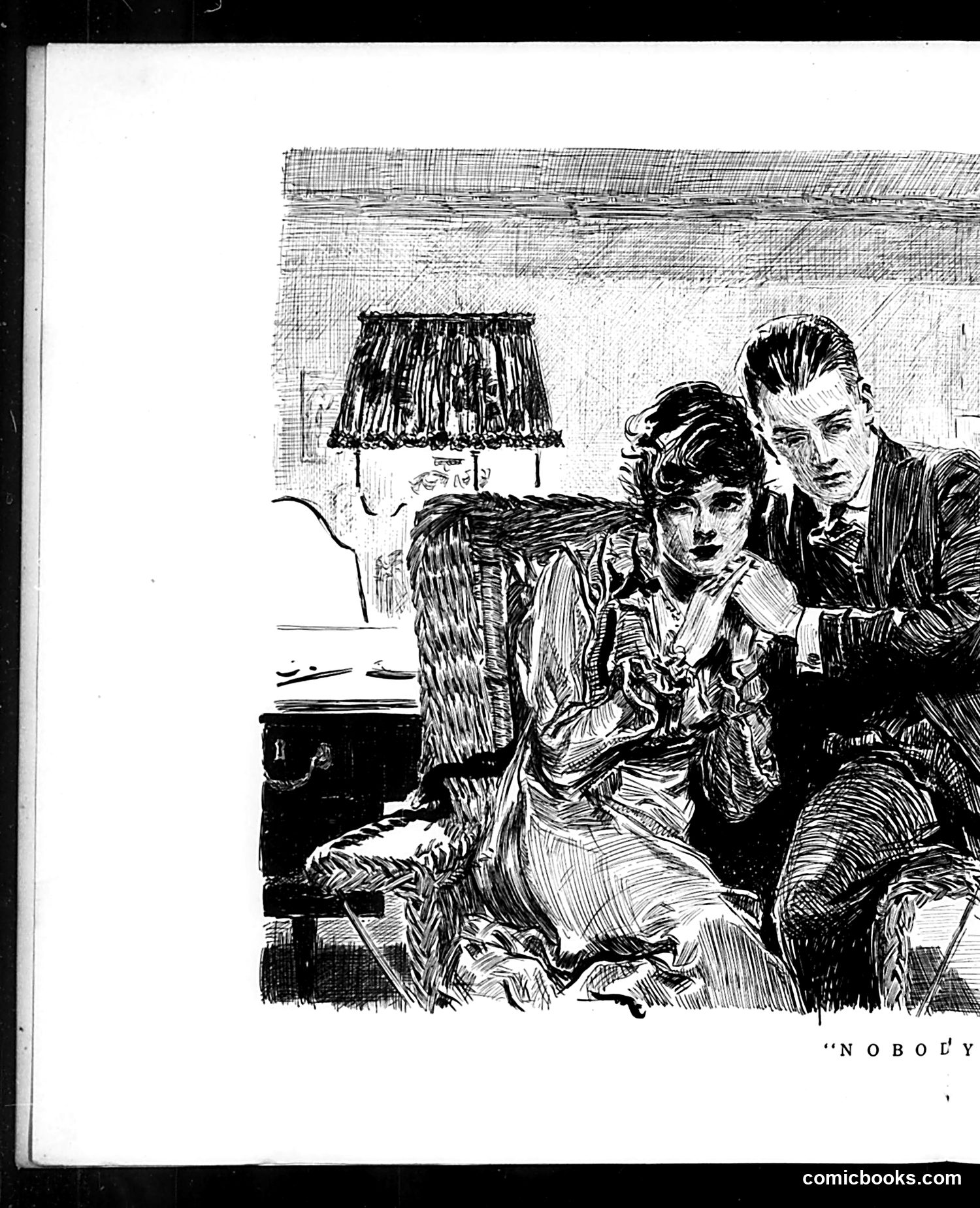
This appears to be a sketch illustration from *Judge* magazine captioned "NOBODY" (possibly incomplete OCR). The image shows three figures in an interior setting with a lamp—a woman in the center wearing a dress and two men in suits flanking her, one behind and one beside. The style and composition suggest this is likely a social satire about romantic or relationship dynamics, possibly depicting a love triangle or commenting on gender relations. However, without the complete text or additional context from the article this illustration accompanied, I cannot definitively identify the specific figures, the satirical point being made, or what social/political issue is being critiqued. The fragmentary caption "NOBODY" is insufficient to establish clear meaning.
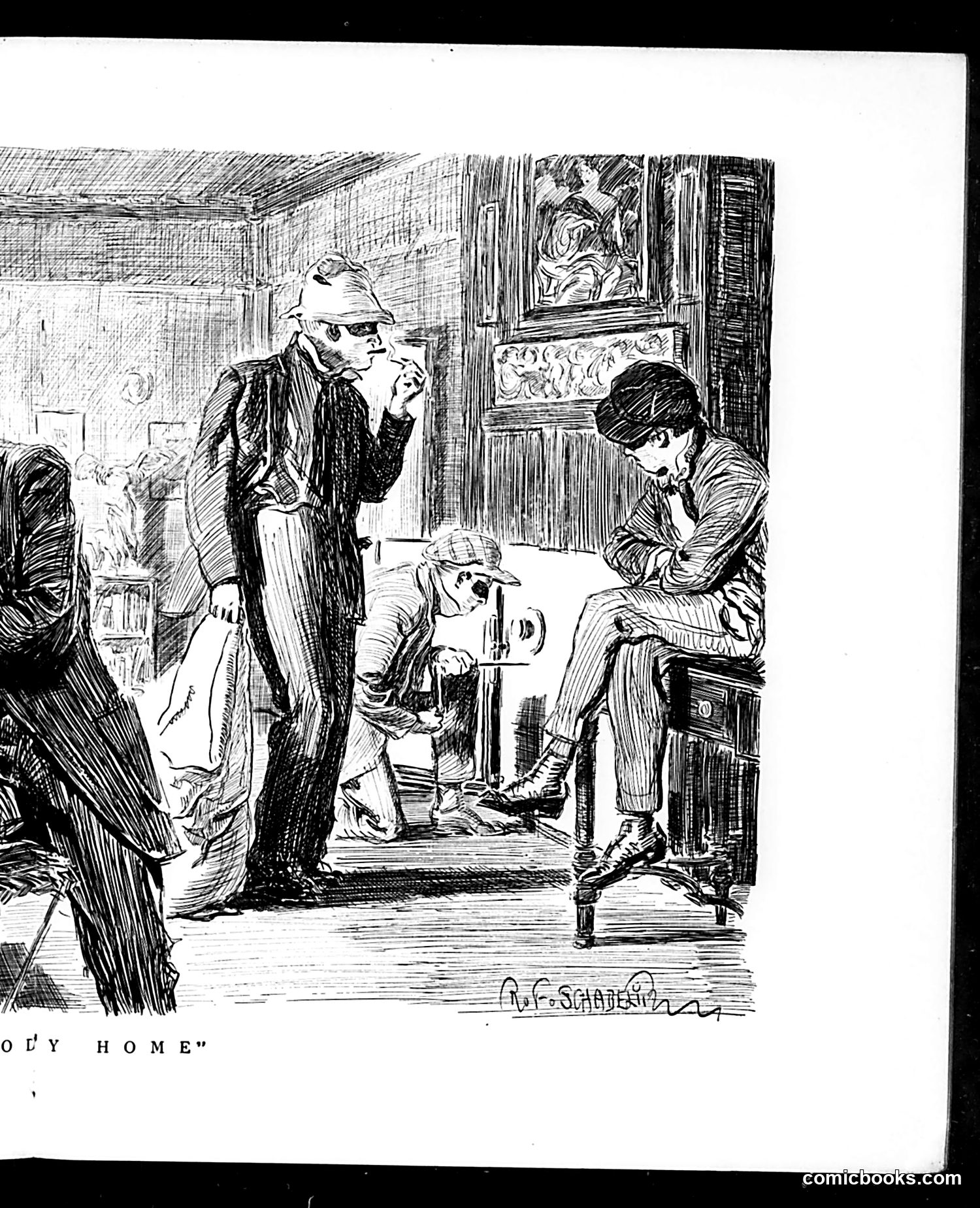
This appears to be a satirical illustration from *Judge* magazine showing a domestic scene. The cartoon depicts what seems to be a well-dressed man (possibly a politician or authority figure, given his formal attire and prominent placement) observing or commenting on a scene involving a woman seated and a child. The setting appears to be an interior room with artwork on the walls. The partial text visible reads "ory HOME," suggesting the cartoon's title references domesticity or home life. Without the complete caption or date, the specific political or social satire remains unclear. The artist's signature appears to read "Schaeffer." The cartoon likely comments on class relations, domestic authority, or social hypocrisy of the era, but the exact target requires additional context.
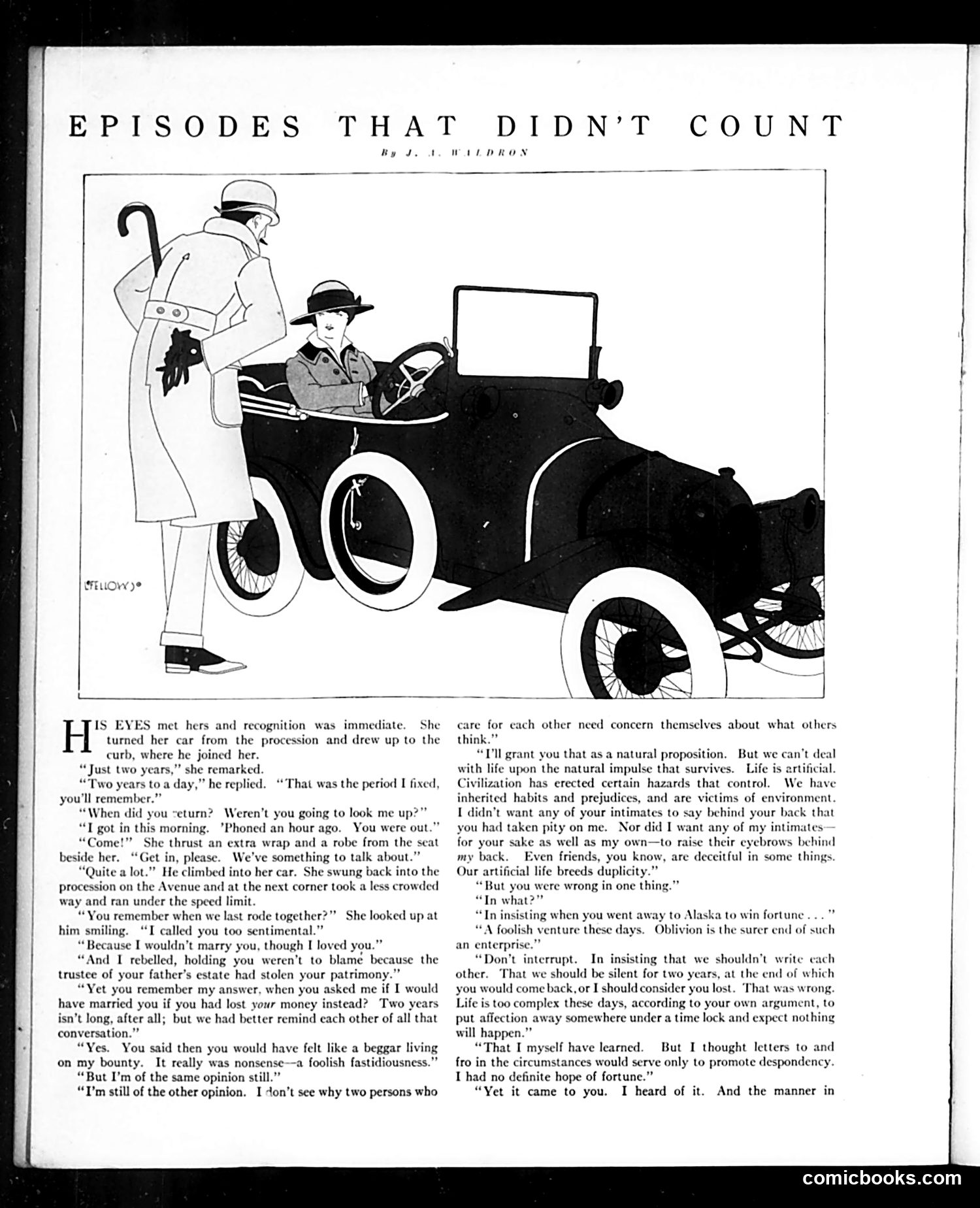
This page presents a serialized romance story rather than political satire. The narrative depicts a reunion between two former lovers: a woman of apparent wealth and a man who left years earlier (to Alaska, seeking fortune) after refusing to marry her because of pride—he wouldn't accept being seen as a "beggar" living on her money. The story explores early 20th-century social anxieties about courtship and class. The man's insistence on financial independence before marriage, and their mutual concern about what "intimates" would say about an unequal match, reflects period attitudes toward propriety and social standing. Their debate over whether he should have written during his absence—weighing romantic connection against avoiding "despondency"—captures contemporary tensions between emotion and rational Victorian restraint. This appears to be serialized fiction typical of *Judge* magazine's entertainment content, not political commentary.
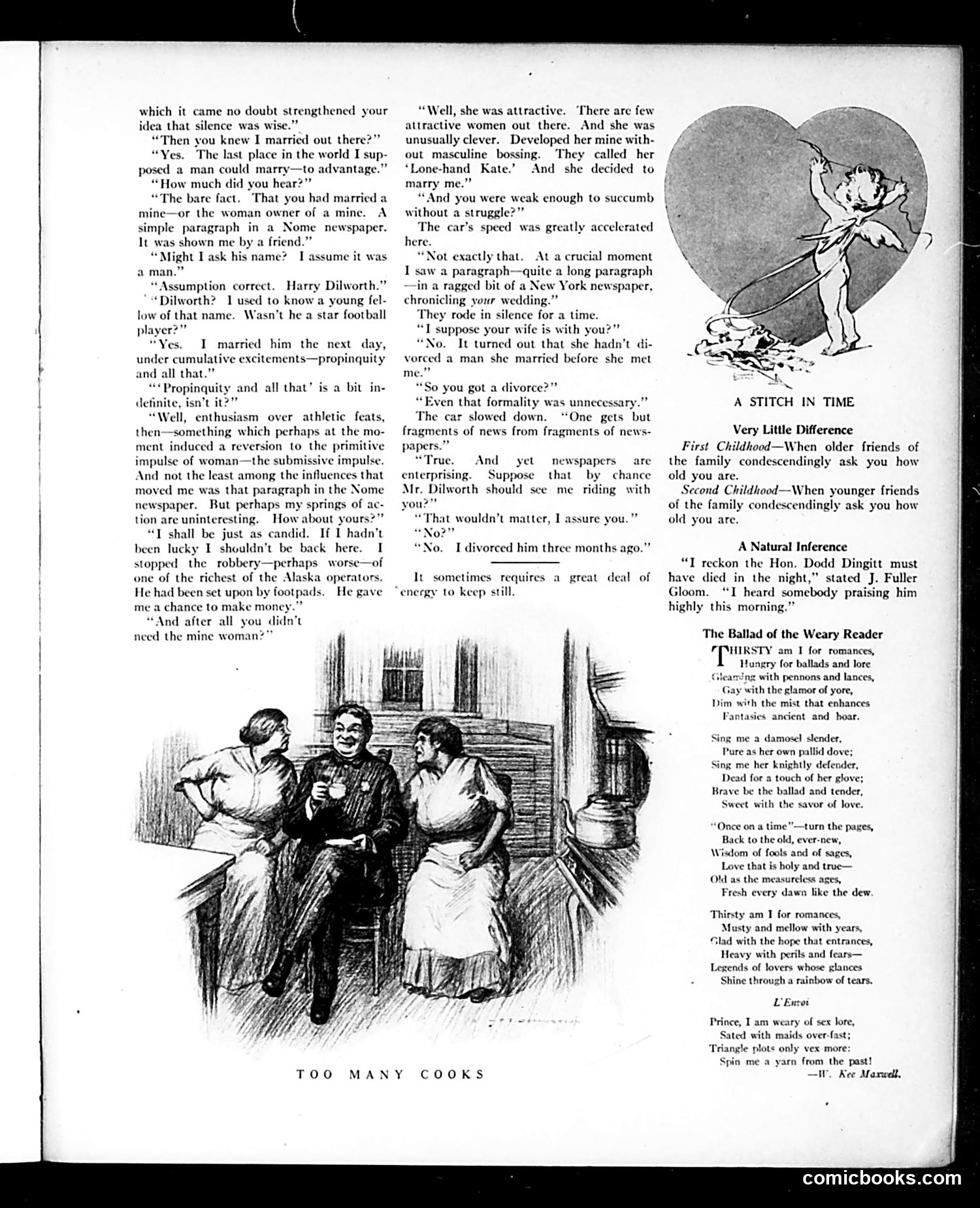
This page from the satirical magazine *Judge* contains a serial narrative dialogue ("Too Many Cooks") about marriage and infidelity among the wealthy, illustrated with a sketch of three figures in conversation. The story depicts a cynical exchange between two former acquaintances who each married for convenience rather than love. One married "Lone-hand Kate," a mine-owning woman in Alaska, after seeing a newspaper announcement of the other's wedding. The irony: his wife had never actually divorced her previous husband. When asked if he obtained a divorce, he replies it was "unnecessary"—implying casual disregard for legal formality. The satire targets **turn-of-the-century upper-class attitudes toward marriage as transactional** rather than moral or binding. Newspapers serve as plot devices, spreading fragments of information that drive these mercenary unions. The title "Too Many Cooks" suggests multiple parties spoiling the institution of marriage itself. The accompanying short pieces offer light social humor about aging and hypocrisy, while "The Ballad of the Weary Reader" parodies romantic literature fatigue.
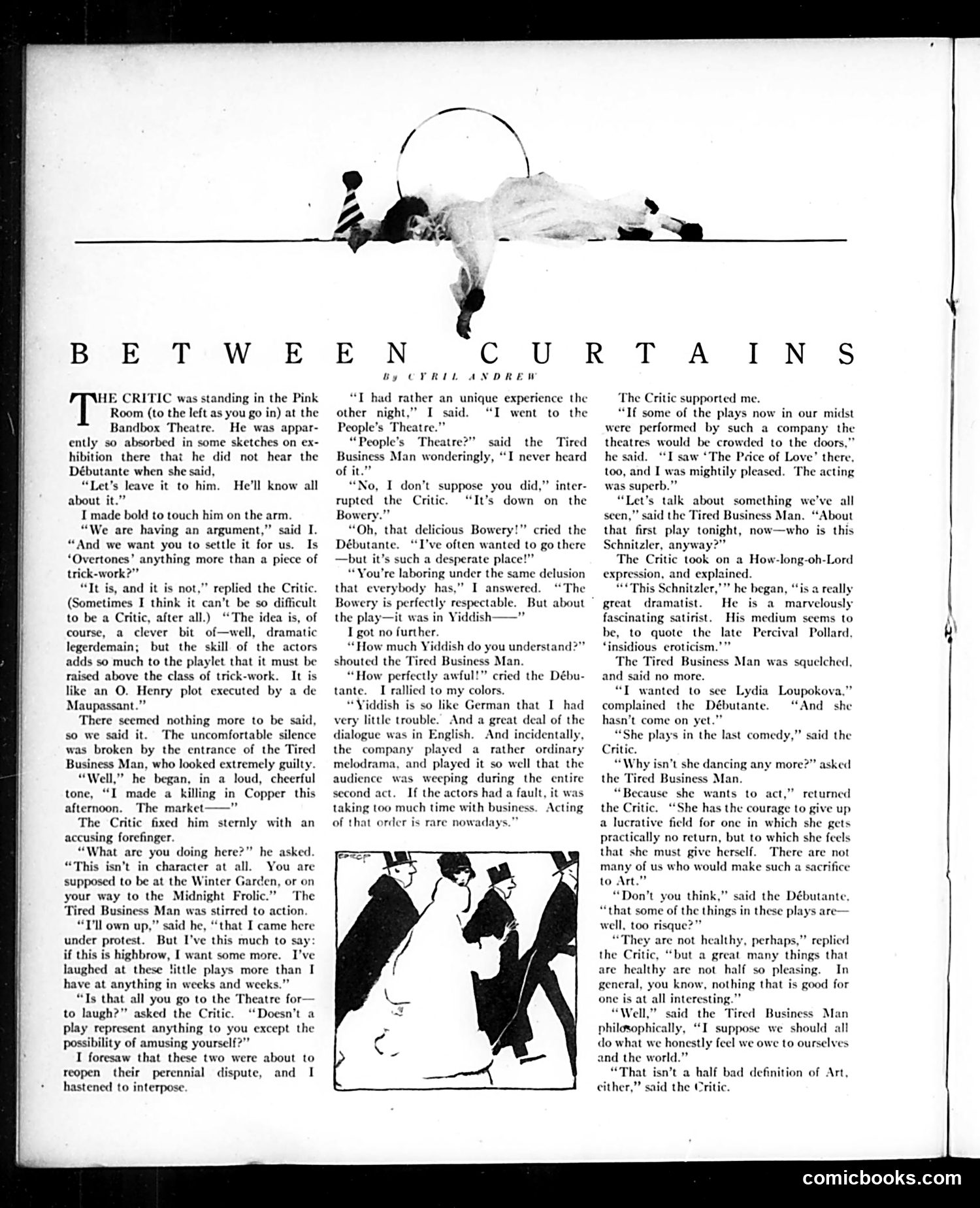
This is a theater-focused satirical piece from Judge magazine, depicting a debate among four archetypal characters about theatrical merit and taste. The figures represent stock types: **the Critic** (pretentious, gatekeeping intellectual), **the Débutante** (frivolous society woman), **the Tired Business Man** (practical everyman), and the unnamed narrator (mediator). The satire mocks the Critic's pompous aestheticism—he speaks in paradoxes ("It is, and it is not") and dismisses popular theater while praising obscure works. He's scandalized when the Tired Business Man admits he goes to theater merely to laugh, and when the narrator describes attending a Yiddish-language melodrama on the Bowery, the Critic dismisses this "lowbrow" entertainment until reminded that excellent acting transcends venue or language. The joke: the Critic's snobbery is deflated when forced to admit that skillfully-performed "common" theater rivals prestigious productions. The Tired Business Man's unpretentious pleasure in theater proves more honest than the Critic's affected sophistication.
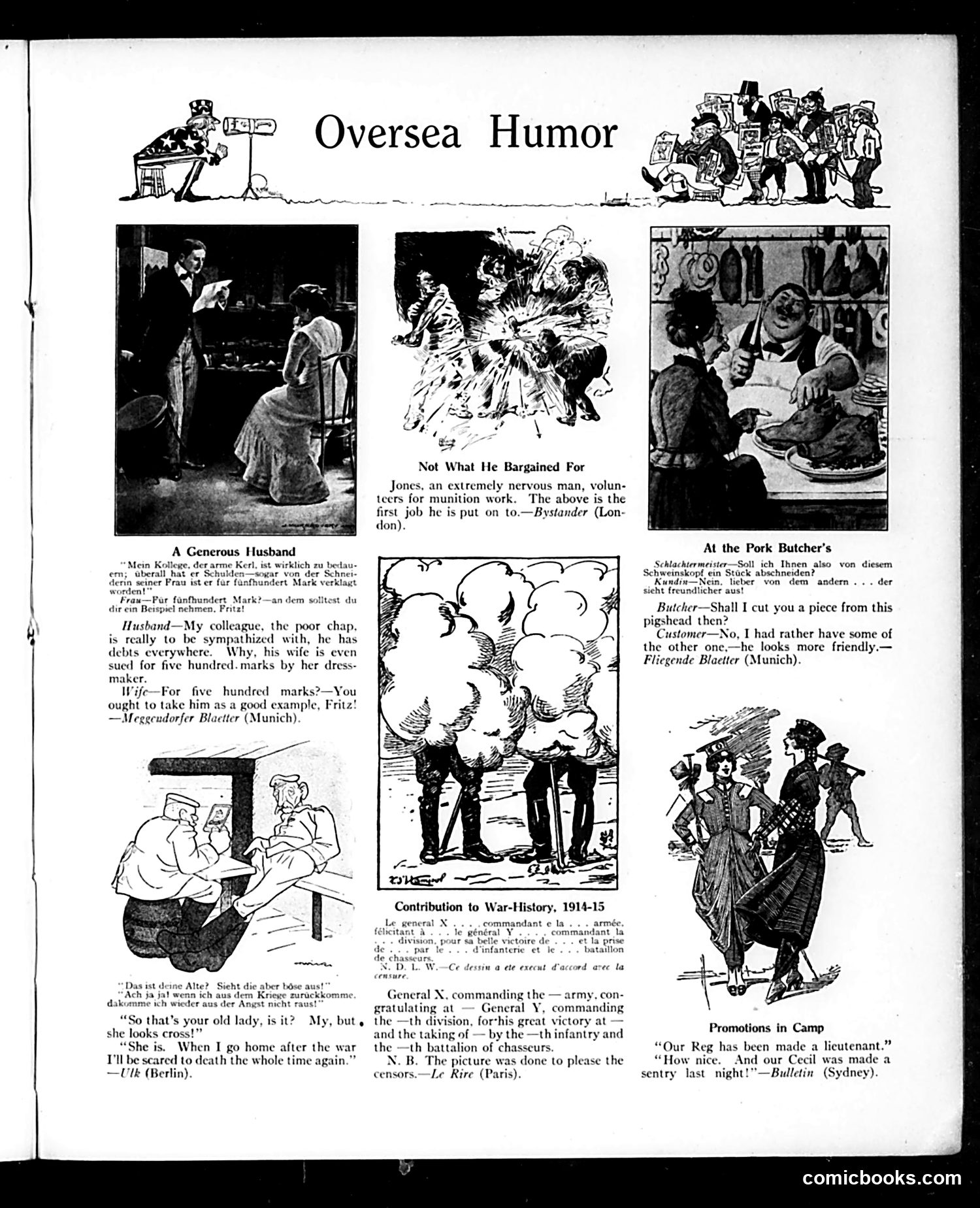
This page collects humorous cartoons from European and Allied publications during World War I (1914-15), mocking both military life and home-front absurdities. **"Not What He Bargained For"** (from London's *Bystander*): A nervous civilian volunteer for munitions work receives an unexpectedly dangerous first assignment—the joke being his naïveté about wartime industrial hazards. **"A Generous Husband"** (German *Meggendorfer Blätter*): A husband suggests his debt-ridden colleague should emulate a man sued for 500 marks by his dressmaker—dark humor about financial ruin. **"At the Pork Butcher's"** (Munich's *Fliegende Blätter*): A customer asks for the "friendlier-looking" pig's head, anthropomorphizing meat in gallows humor. **"Contribution to War-History"** and **"Promotions in Camp"** satirize military bureaucracy and censorship—generals congratulating each other for victories, and soldiers promoted to absurdly low ranks (sentry). The page represents how Allied nations used humor to process wartime anxiety and military incompetence.
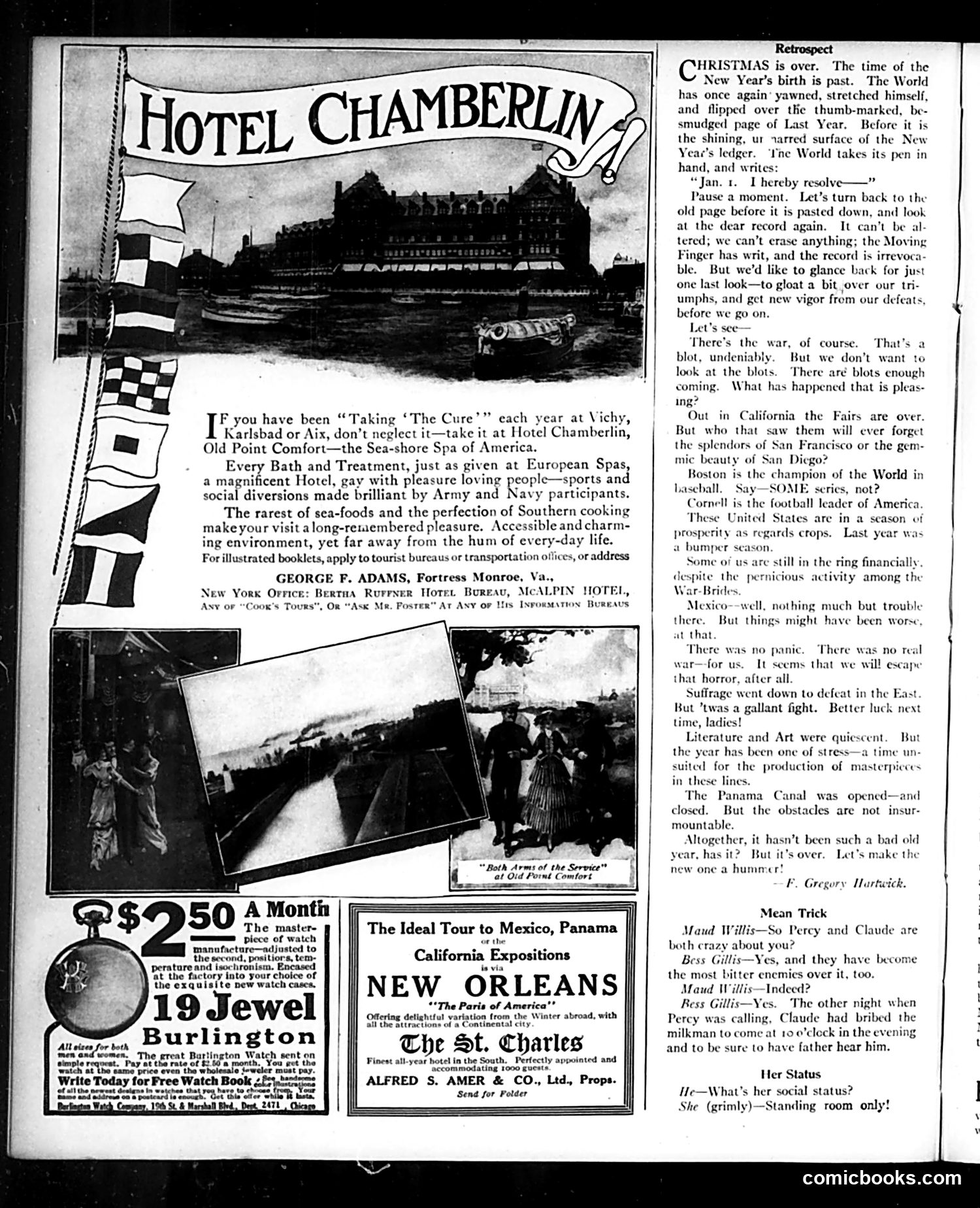
This page is primarily **not a political cartoon** but rather a retrospective essay by F. Gregory Hartwick reviewing 1915's major events for American readers. The "Retrospect" column reflects on the outgoing year with deliberate ambivalence—acknowledging both triumphs and failures. Key references include: - **World War I**: Called "a blot, undeniably" but glossed over; America wasn't directly involved yet - **California Expositions**: San Francisco and San Diego fairs celebrated as cultural highlights - **Baseball**: Boston's World Series victory - **Suffrage defeat in the East**: Women's voting rights lost ballot measures - **Panama Canal**: Recently opened but facing obstacles - **Mexico**: Ongoing instability dismissed as manageable trouble - **No panic, no war for us**: Relief that America escaped economic collapse and direct conflict The tone is optimistic resignation—the year wasn't great, but could've been worse. The surrounding advertisements (Hotel Chamberlin, Burlington Watch, New Orleans tours) are unrelated commercial content typical of period magazines.
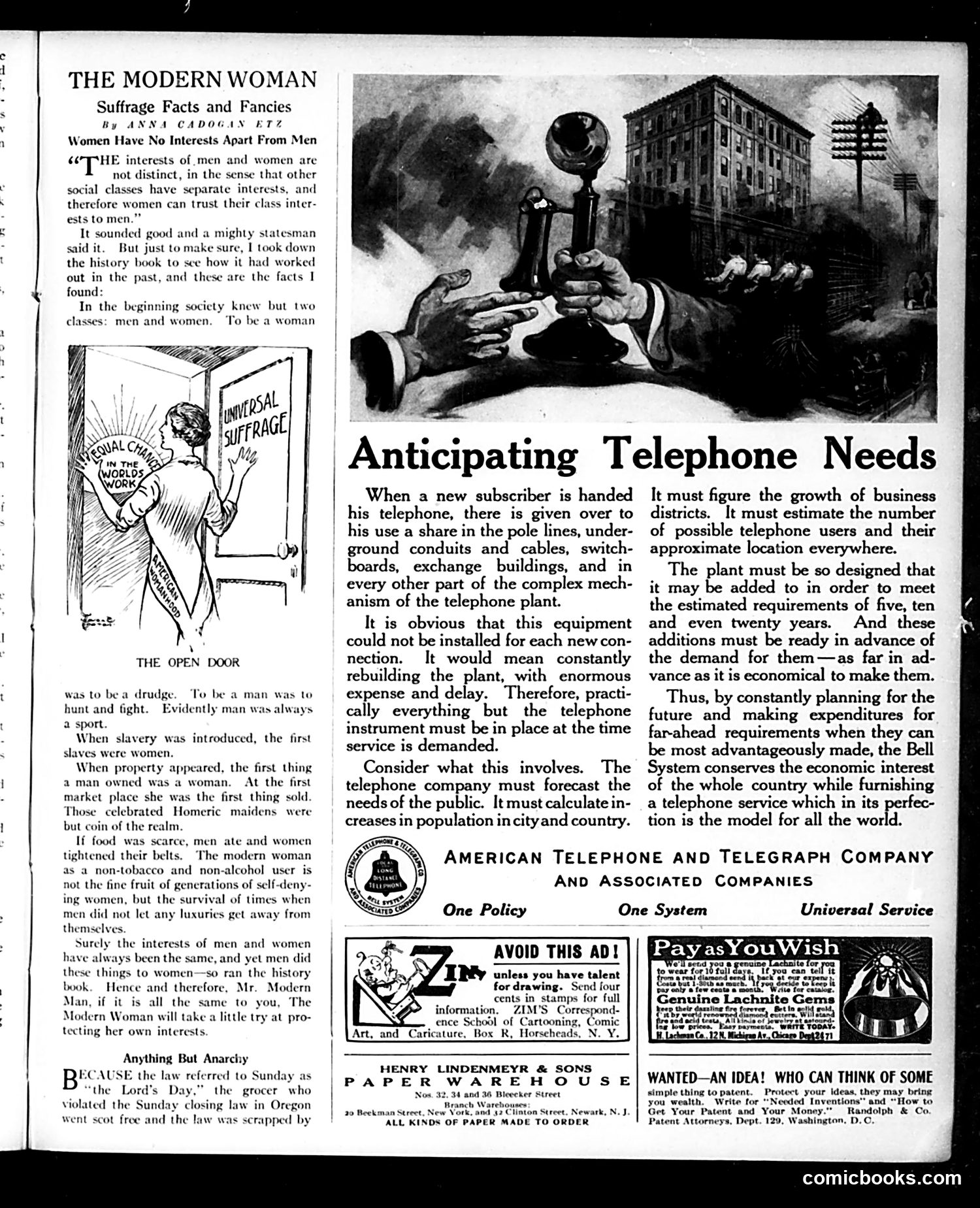
This page presents **pro-suffrage advocacy** disguised as satirical humor. Anna Cadogan Etz's article argues that women's interests are distinctly *separate* from men's, contradicting anti-suffrage claims that women need not vote because men represent their interests equally. The argument proceeds historically: women were treated as property and drudges while men enjoyed leisure and power—yet anti-suffragists claim shared interests. The cartoon "The Open Door" (left) visualizes this: a woman escaping bonds labeled "Universal Suffrage Work," suggesting suffrage represents liberation from male-imposed restrictions. The piece sarcastically demolishes the premise that men naturally protect women's welfare, using history to show systematic exploitation. By 1910s standards, this was **genuinely radical feminist rhetoric**, framed as common-sense observation rather than revolutionary demand. The page includes unrelated telephone company advertising, typical of magazine layout.
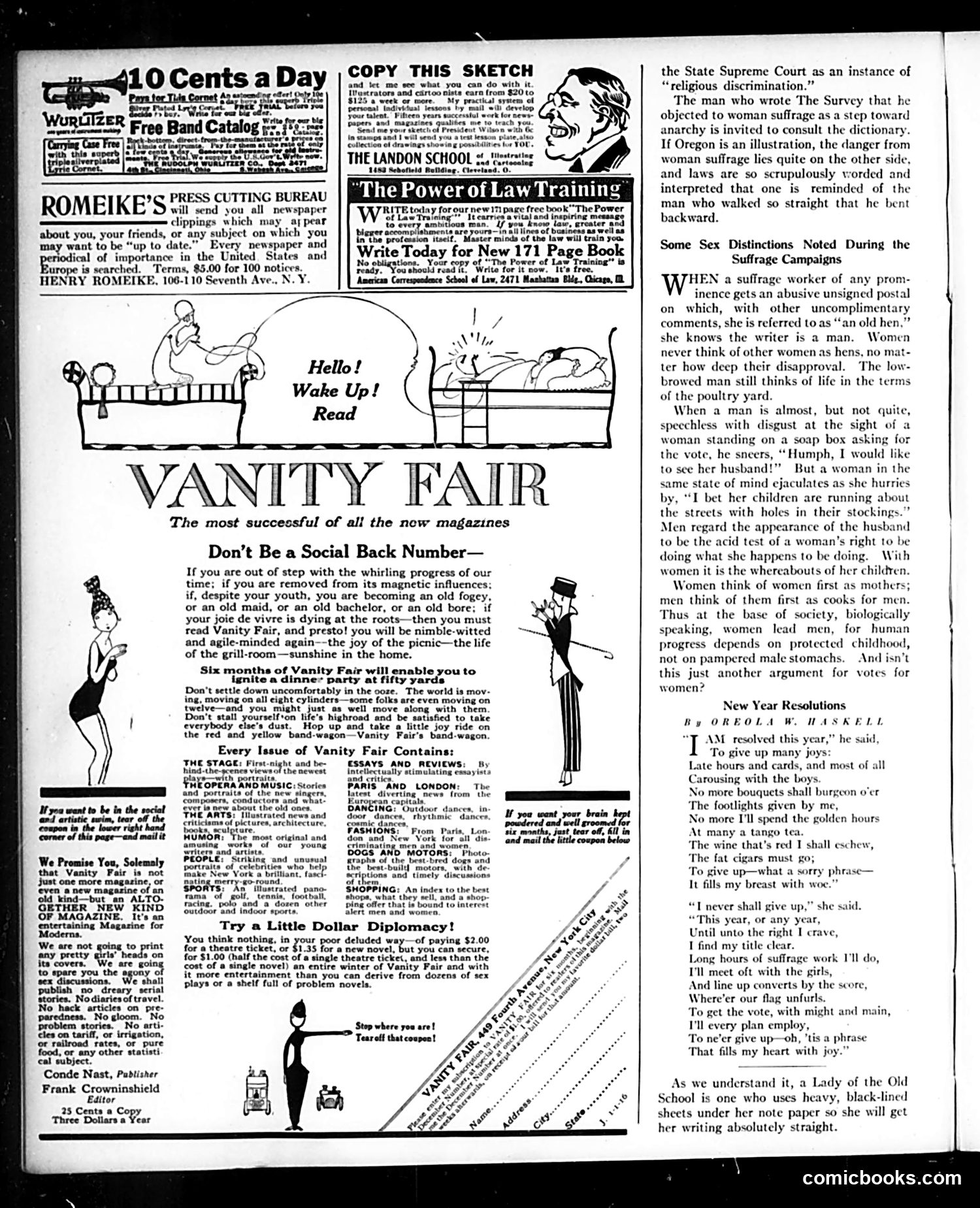
This page from *Judge*, a satirical weekly, is primarily **advertising and promotional content** rather than political cartoons, though it includes period commentary on women's suffrage. ## Key Content: **Main Advertisement**: *Vanity Fair* magazine dominates the page, promoting itself as essential reading for staying socially current. The pitch warns readers against becoming "old fogey" or "old maid" if they don't read it—a social anxiety sales tactic typical of the era. **Suffrage Commentary**: The right column discusses women's suffrage campaigns, noting how suffragists were dismissed by men (called "old hen," mocked for standing on soapboxes). The text argues that women's fitness to vote should be measured by their competence in life—including motherhood and household management—though it questions whether these domestic roles qualify them for political participation. **Cartoons**: Small illustrations include a man in bed being awakened and figures promoting *Vanity Fair*'s content (stage, sports, fashion). The page reflects early 20th-century gender politics and advertising aimed at affluent, urban readers concerned with social status and modernity.
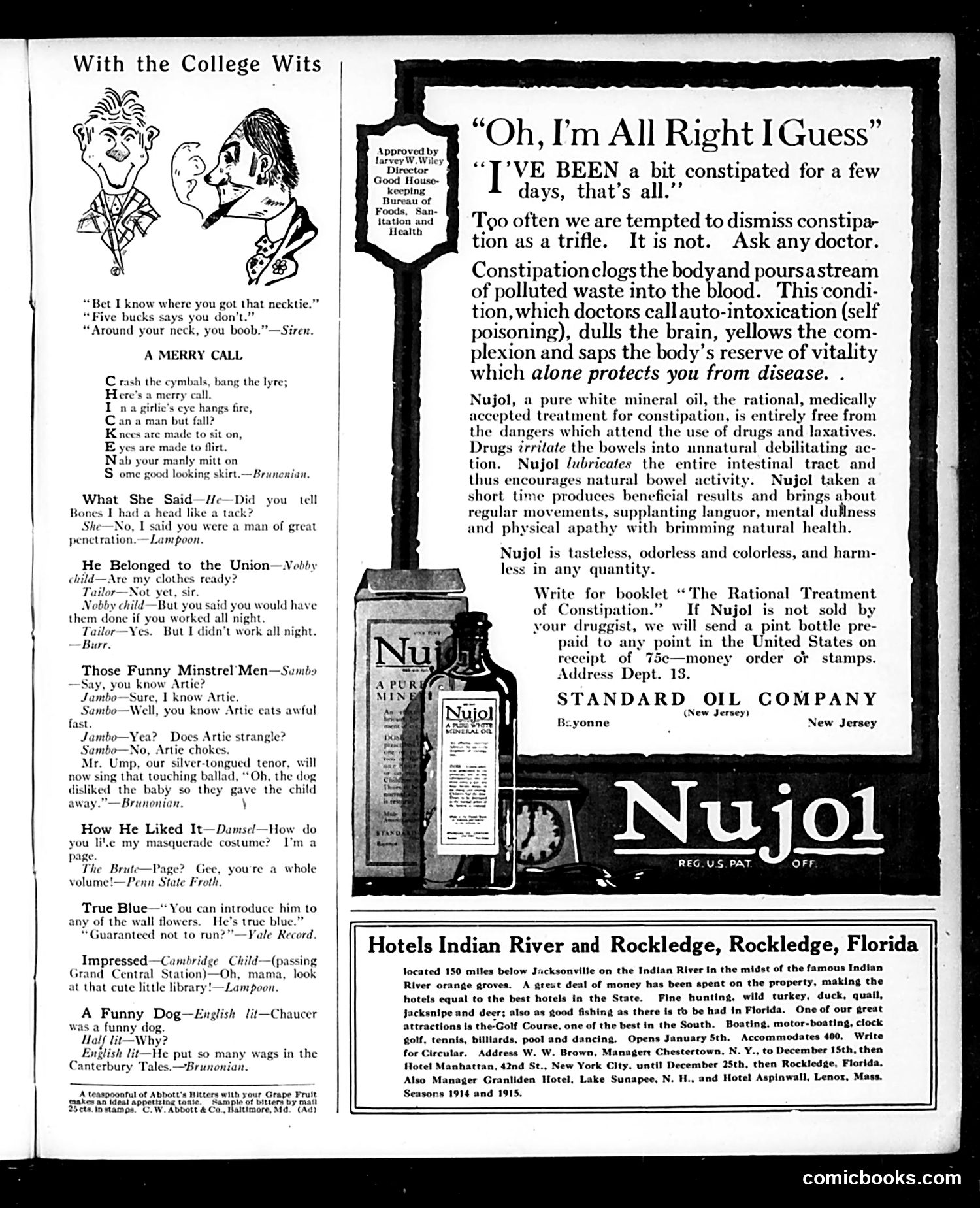
This page from *Judge* magazine contains two distinct sections: **Left side:** "With the College Wits" presents brief, punchy jokes sourced from college humor publications (identified by bylines like "Siren," "Lampoon," "Brunonian"). These are light social humor—mostly quips about dating, flirtation, tailors, and wordplay. The cartoons show caricatured college men making wisecracks. **Right side:** A Nujol laxative advertisement disguised as health advice. It invokes Dr. Harvey W. Wiley (the famous Food and Drug Administration chemist) to give medical credibility. The ad warns that constipation causes "auto-intoxication"—a pseudo-scientific term popular in this era suggesting toxins from the bowels poison the bloodstream. Nujol promises gentle relief without drugs' harsh effects, positioning itself as scientific and rational medicine. The page reflects early 20th-century anxieties about bodily health and the era's fascination with "scientific" remedies marketed through authority figures and pseudo-medical terminology.
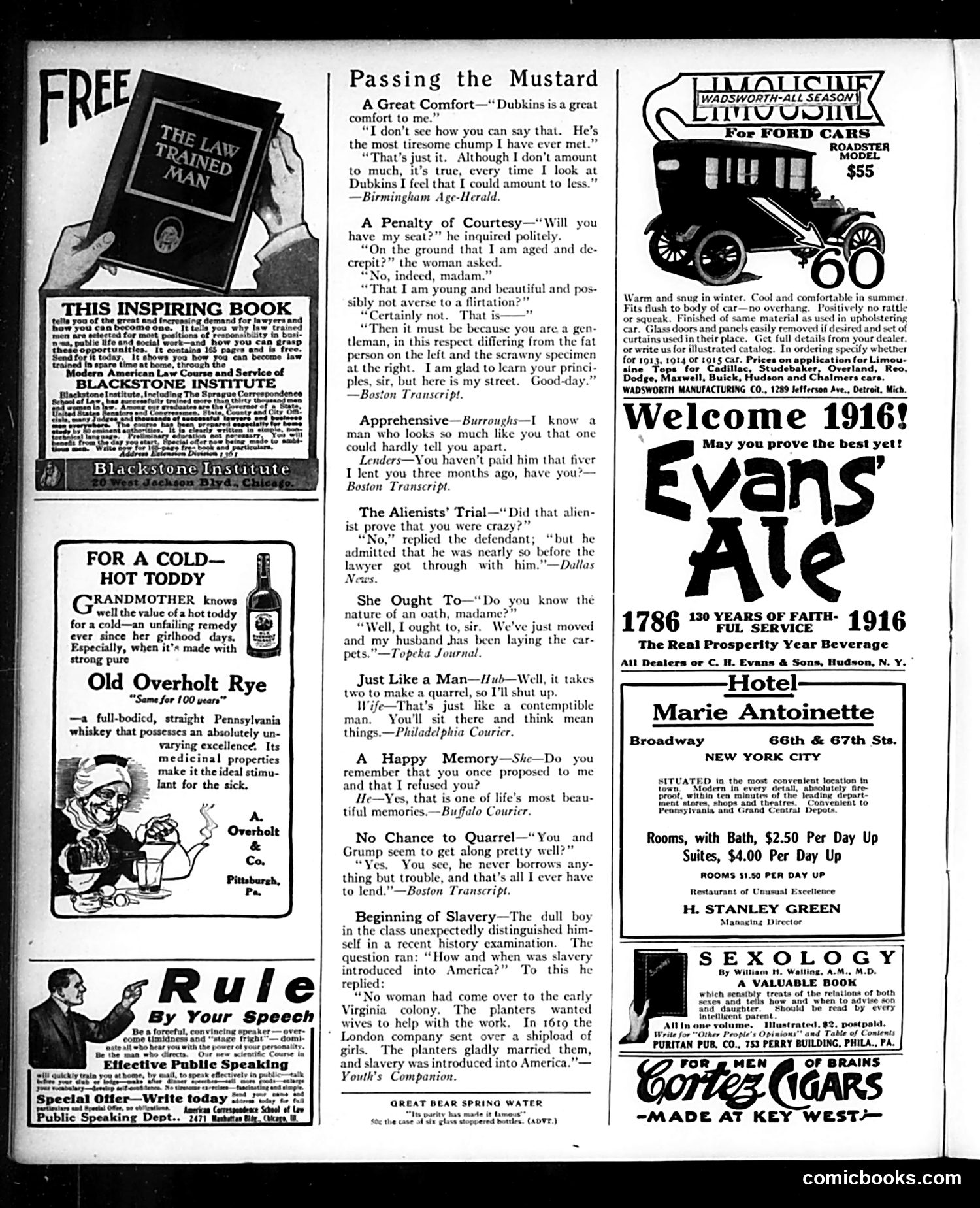
This page is primarily **advertising and humor anecdotes**, not political satire. The content consists of: **Advertisements:** Product pitches for educational courses (Blackstone Institute law school), Old Overholt Rye whiskey (marketed as medicinal for colds), Evans Ale (130th anniversary celebration), the Mousicke automobile roaster, Hotel Marie Antoinette in NYC, and Cortez cigars. **Humor Section ("Passing the Mustard"):** A collection of brief comic anecdotes about everyday social situations—an annoying friend, courtesy between strangers, mistaken identity, marriage quarrels, and historical ignorance. These jokes illustrate genteel middle-class anxieties: politeness, flirtation, debt, and domestic friction. The only potentially satirical element appears in "Beginning of Slavery," which uses crude historical humor (blaming women's arrival for America's slavery system) that reflects the era's casual racism and sexism. Overall, this is a **commercial/entertainment page** rather than political commentary.
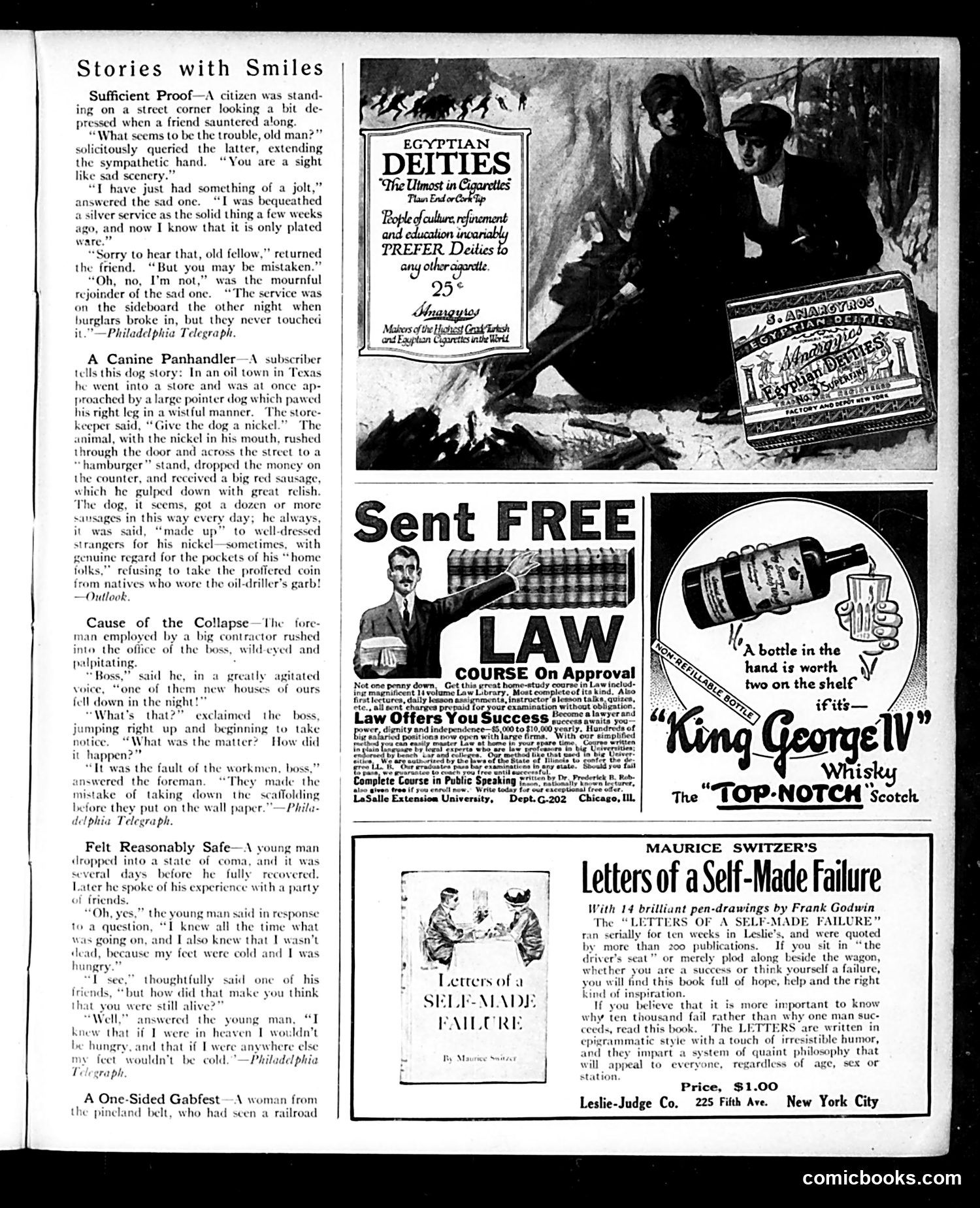
This page from *Judge* magazine contains humorous anecdotal stories (left column) and period advertisements (right side). ## "Stories with Smiles" (Left Column) These are brief comic anecdotes, typical of early 20th-century humor magazines: - **"Sufficient Proof"**: A man receives an inheritance of "silver service" (flatware), only to discover from a burglary that it's plated, not solid. The joke plays on ironic "proof" of worthlessness. - **"A Canine Panhandler"**: A dog in a Texas oil town learns to panhandle—accepting nickels from well-dressed strangers to buy sausages, but refusing coins from oilfield workers. Light humor about animal intelligence and social class. - **"Cause of the Collapse"**: A contractor's worker causes a building collapse by removing scaffolding before hanging wallpaper—a joke about incompetence and priorities. - **"Felt Reasonably Safe"**: A man in a coma deduces he's alive because he's hungry and cold—dark humor contrasting heavenly comfort with earthly discomfort. ## Advertisements (Right Side) Includes Egyptian Deities cigarettes, a correspondence law course, and King George IV Scotch whisky—typical period advertisements.
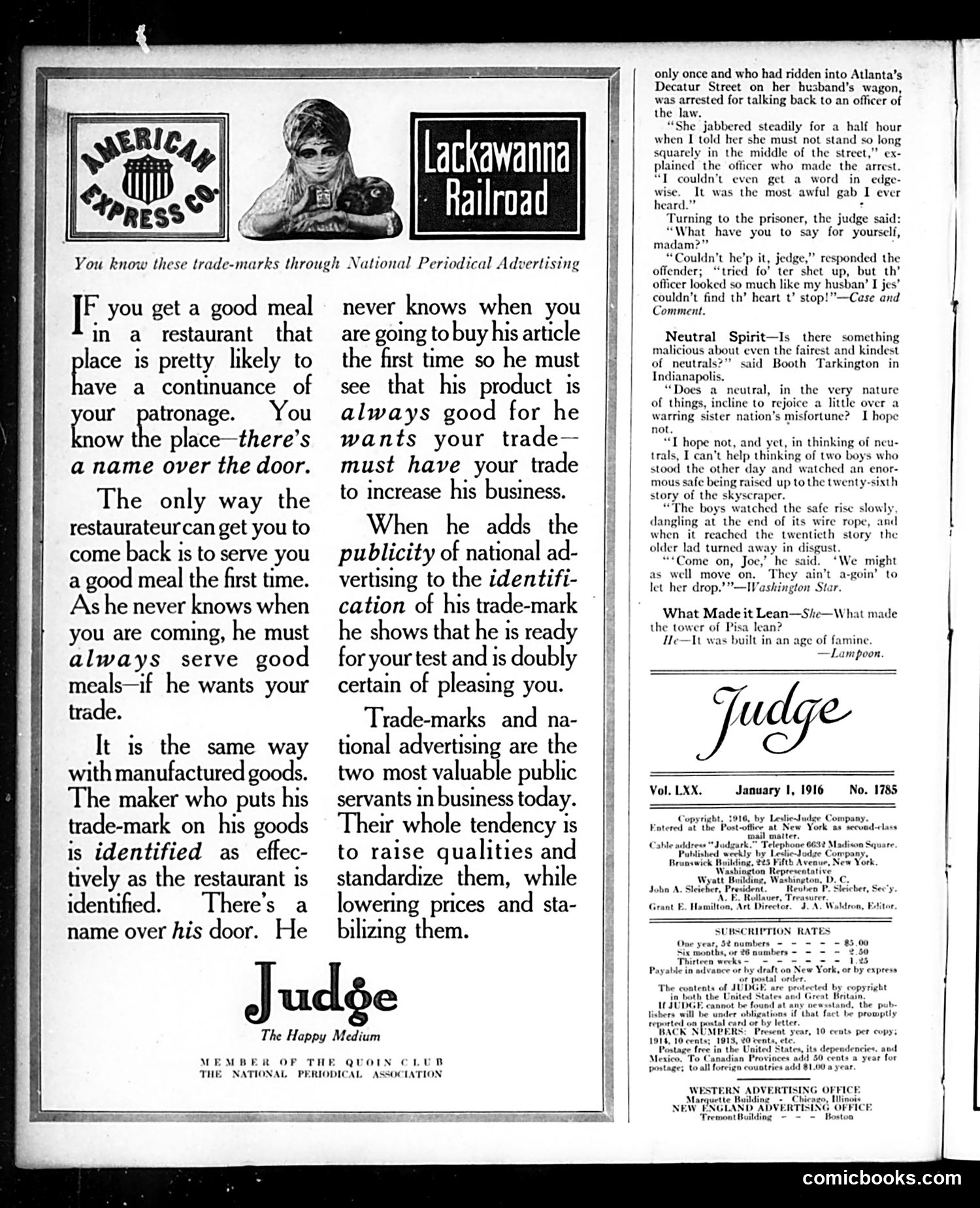
This page is primarily **advertising and editorial content**, not satirical cartoons. The main advertisement compares trade-marks and national advertising to restaurant reputation: just as diners return to restaurants with good names over the door, consumers buy branded manufactured goods repeatedly. The ad features logos for American Express Co. and Lackawanna Railroad, arguing that brand identification and national publicity raise quality standards while lowering prices. The right column contains three brief humorous anecdotes unrelated to the advertisement: 1. **"Case and Comment"**: A racist joke about a Black woman arrested in Atlanta for talking back to a police officer, who compares her chattiness to her husband. 2. **"Neutral Spirit"**: A commentary on WWI-era neutrality, using an anecdote about boys watching a safe drop from a building—implying neutrals enjoy others' misfortunes. 3. **"What Made It Lean"**: A pun about the Tower of Pisa, suggesting it leans because it was built during a famine. The page reflects 1916 advertising philosophy and period attitudes, including racial stereotyping typical of the era.
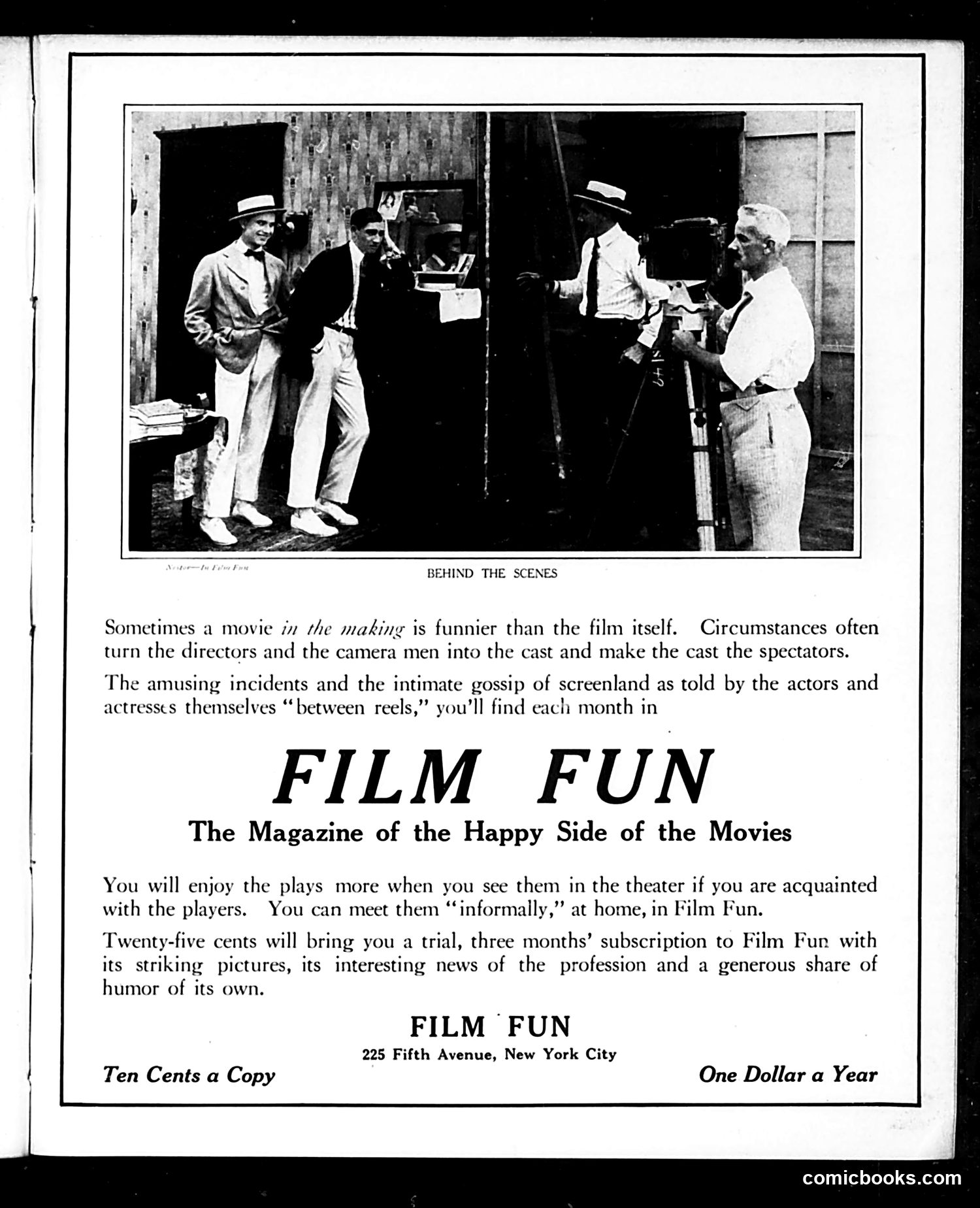
This is primarily a **magazine advertisement**, not political satire. The "Behind the Scenes" photograph shows film crew and actors during movie production—depicting directors, cameramen, and performers in 1920s silent-film era clothing and straw hats. The ad promotes **Film Fun**, a publication marketed as "the magazine of the happy side of the movies." It capitalizes on early Hollywood's public fascination with film production and celebrity gossip by promising readers intimate "between reels" anecdotes from actors and actresses. The pitch emphasizes that knowing performers personally makes theatrical experiences more enjoyable—a marketing strategy leveraging the emerging star system. The pricing (ten cents per copy, one dollar yearly) targets middle-class readers interested in entertainment industry insider content. This reflects the 1920s-30s period when movie culture was becoming central to American popular entertainment.
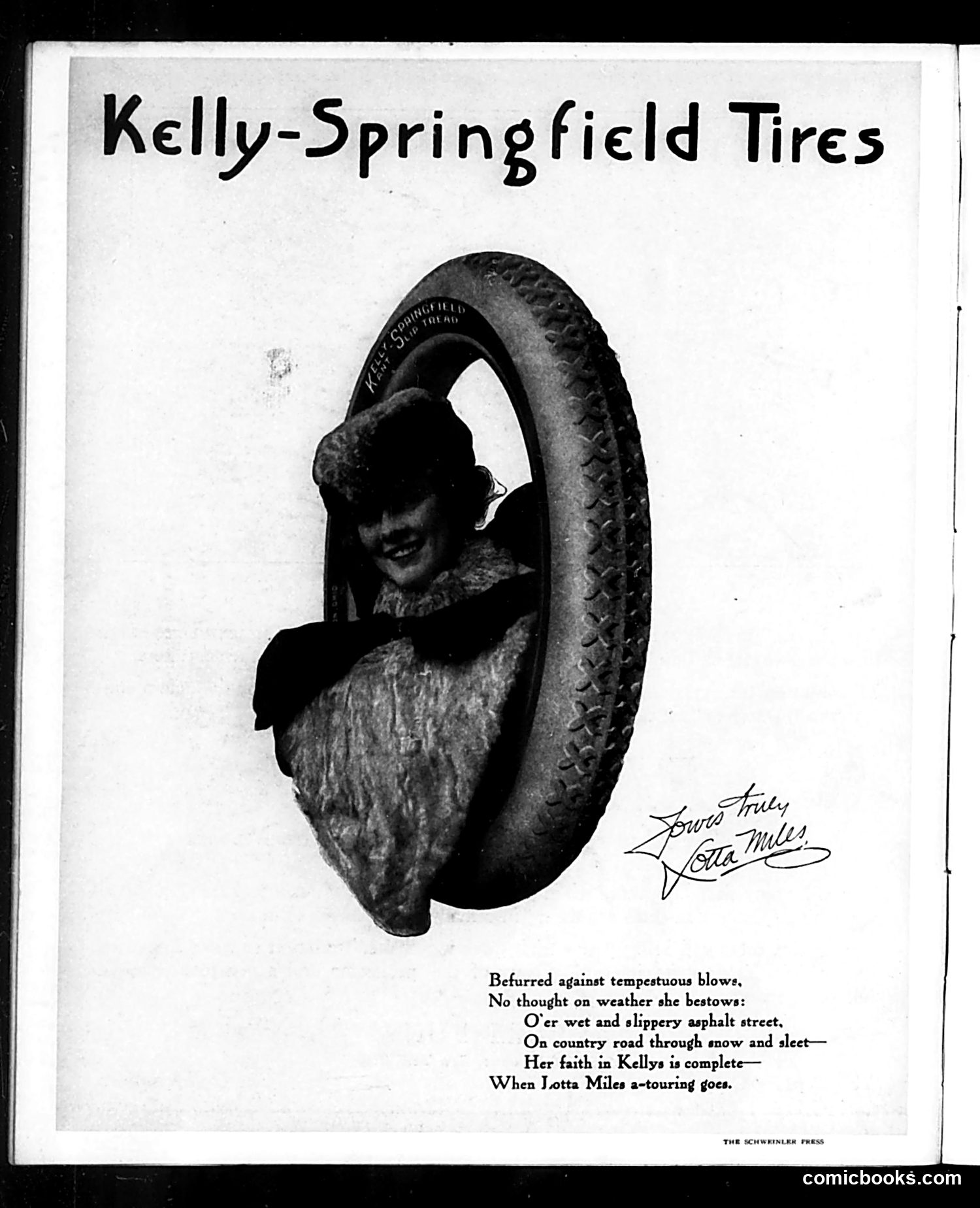
This is a product advertisement rather than political satire. It features a woman (identified as "Jotta Miles") posed inside a large tire, dressed in fashionable winter clothing including a fur stole and hat. The accompanying verse promotes Kelly-Springfield tires by claiming they provide reliable protection ("Her faith in Kellys is complete") across various weather conditions—wet streets, snow, and sleet. The ad uses the common early 20th-century marketing approach of pairing products with attractive women and poetic language to appeal to automobile owners, likely emphasizing that the tires are dependable enough for confident touring regardless of season or road conditions.