
Judge, 1916-01-01 · page 4 of 28
Judge — January 1, 1916 — page 4: what you’re looking at
What you’re looking at
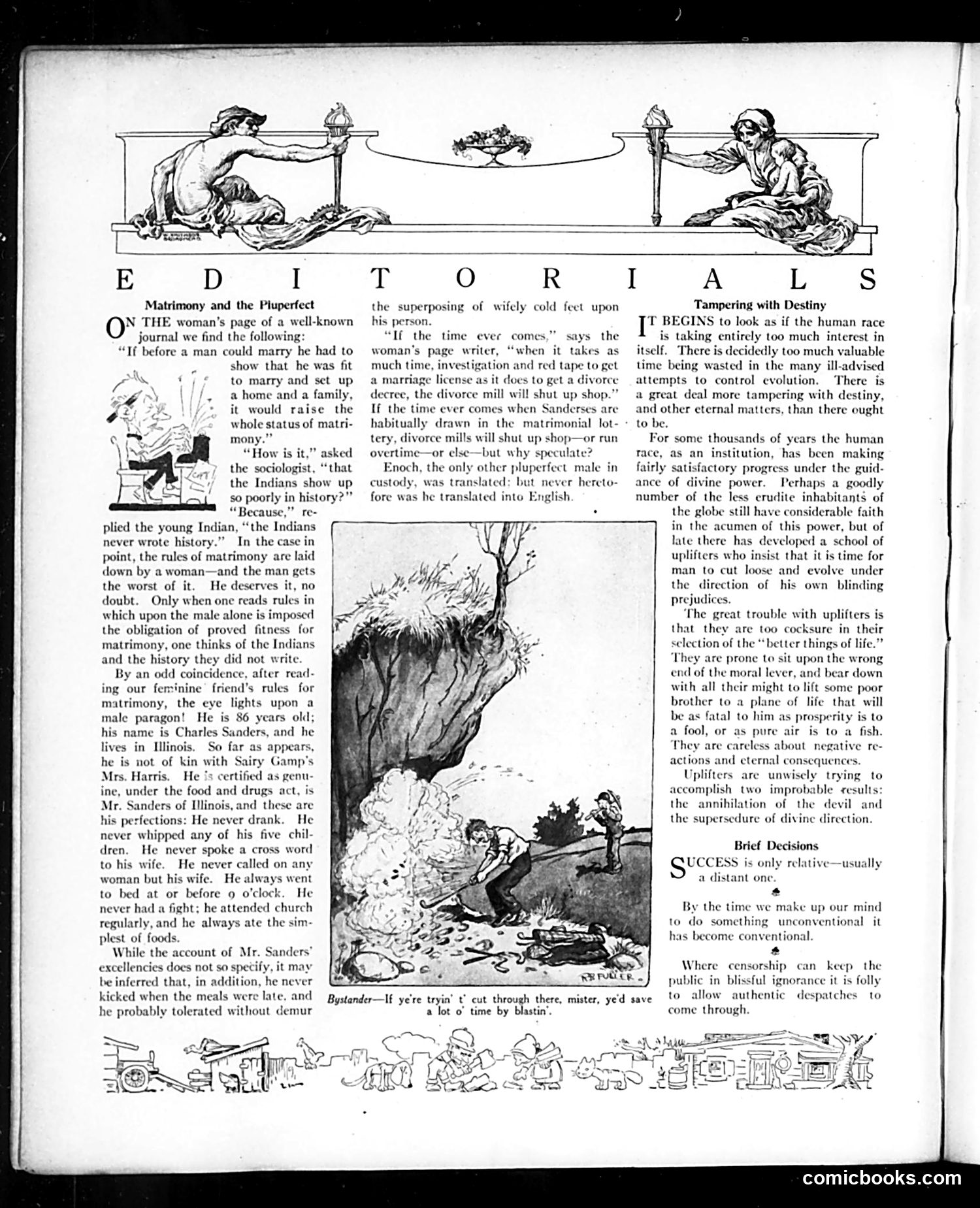
This page contains three satirical articles under the header "EDITORIALS": "Matrimony and the Pluriperfect," "Tampering with Destiny," and "Brief Decisions." The main cartoon illustrates the first piece, which critiques matrimonial rules. It references a historical figure named Charles Sanders from Illinois—described as a man of exemplary moral character who never drank, fought, or spoke harshly. The text sarcastically notes that despite these virtues, he lived under "food and drugs act" restrictions, suggesting government overreach. The second article mocks "uplifters"—reformers attempting to improve society—arguing they carelessly promote change without considering consequences. The cartoons are illustrative rather than depicting specific political figures. The satire targets institutional absurdities: marriage law complexities, overzealous moral reformers, and governmental regulation of personal conduct.
📄 Transcribed text from this page (OCR, searchable)
Machine-transcribed from the original scan — historical spelling and the odd misread are preserved.
Matrimony and the Piuperfect O*’ THE woman's page of a well-known journal we find the following: “If before a man could marty he had to show that he was fit to marry and set up a home and a family, it would raise the whole status of matri- mony.” “How is it,” asked the sociologist, “that the Indians show up so poorly in history?” “Because,” re- R the superposing of wifely cold fect upon his person. “If the time ever comes,” says the woman's page writer, “when it takes as much time, investigation and red tape to get a marriage license as it does to get a divorce decree, the divorce mill will shut up shop.” If the time ever comes when Sanderses are habitually drawn in the tery, divorce mills will shut up shop—or run overtime—or else—but why speculate? Enoch, the only other pluperfect_ male in custody, was translated: but never hereto- fore was he translated into English matrimonial lot- - plied the young Indian, “the Indians never wrote history In the case in point, the rules of matrimony are laid down by a woman—and the man gets the worst of it. He deserves it, no doubt. Only when one reads rules in which upon the male alone is imposed the obligation of proved fitness for matrimony, one thinks of the Indians and the history they did not write. By an odd coincidence, after read- ing our ferinine friend’s rules for matrimony, the eye lights upon a male paragon! He is 86 ycars old; his name is Charles Sanders, and he lives in Illinois, So far as appears, he is not of kin with Sairy Gamp’s Mrs. Harris. He 's certified as genu- ine, under the food and drugs act, is and these are his perfections: He never drank. He never whipped any of his five chil- dren. He never spoke a cross word to his wife. He never called on any woman but his wife. He always went to bed at or before 9 o'clock. He never had a fight; he attended church regularly, and he always ate the sim- plest of foods. While the account of Mr. S: excellencies does not so specify, it may be inferred that, in addition, he never kicked when the meals were late, and he probably tolerated without demur Bystander—If ye're tryin’ t' cut through there, mister, ye'd save a lot o' time by blastin’. Tampering with Destiny T BEGINS to look as if the human race is taking entirely too much interest in itself. There is decidedly too much valuable time being wasted in the many ill-advised attempts to control evolution. There is a great deal more tampering with destiny, and other eternal matters, than there ought to be. For some thousands of years the human race, as an institution, has been making fairly satisfactory progress under the guid- ance of divine power. Perhaps a goodly number of the less erudite inhabitants of the globe still have considerable faith in the acumen of this power, but of late there has developed a school of uplifters who insist that it is time for man to cut loose and evolve under the direction of his own blinding prejudices. ‘The great trouble with uplifters is that they are too cocksure in their selection of the “better things of life.” ‘They are prone to sit upon the wrong end of the moral le’ and bear down with all their might to lift some poor brother to a plane of life that will be as fatal to him as prosperity is to a fool, or as pure air is to a fish. They are careless about negative re- actions and eternal consequences. Uplifters are unwisely trying to accomplish two improbable sesults: the annihilation of the devil and the supersedure of divine direction. Brief Decisions UCCESS is only relative—usually a distant one. + By the time we make up our mind to do something unconventional it has become conventional. 2 Where censorship can keep the public in blissful ignorance it is folly to allow authentic despatches to come through. comicbooks.com