
Judge, 1916-01-01 · page 17 of 28
Judge — January 1, 1916 — page 17: what you’re looking at
What you’re looking at
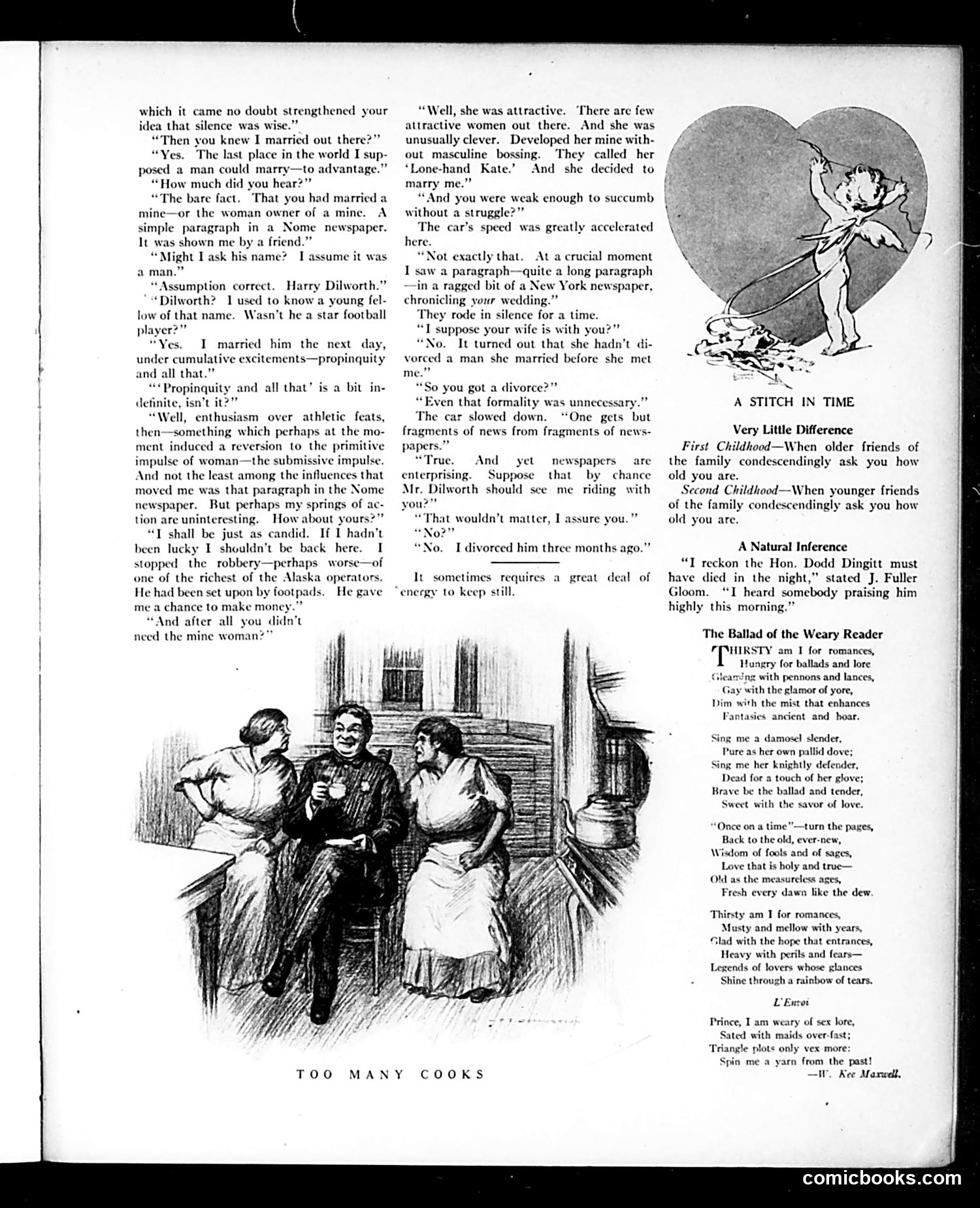
This page from the satirical magazine *Judge* contains a serial narrative dialogue ("Too Many Cooks") about marriage and infidelity among the wealthy, illustrated with a sketch of three figures in conversation. The story depicts a cynical exchange between two former acquaintances who each married for convenience rather than love. One married "Lone-hand Kate," a mine-owning woman in Alaska, after seeing a newspaper announcement of the other's wedding. The irony: his wife had never actually divorced her previous husband. When asked if he obtained a divorce, he replies it was "unnecessary"—implying casual disregard for legal formality. The satire targets **turn-of-the-century upper-class attitudes toward marriage as transactional** rather than moral or binding. Newspapers serve as plot devices, spreading fragments of information that drive these mercenary unions. The title "Too Many Cooks" suggests multiple parties spoiling the institution of marriage itself. The accompanying short pieces offer light social humor about aging and hypocrisy, while "The Ballad of the Weary Reader" parodies romantic literature fatigue.
📄 Transcribed text from this page (OCR, searchable)
Machine-transcribed from the original scan — historical spelling and the odd misread are preserved.
which it came no doubt engthened your idea that silence was “Then you knew I married out there?” ay The last place in the world I sup- posed a man could marry—to advantage.” “How much did you hear?” “The bare fact. That you had married a mine—or the woman owner of a mine. A simple paragraph in a Nome newspaper. It was shown me by a friend.” “Might Lask his name? I assume it was a man.” Assumption correct. Harry Dilworth.” ‘Dilworth? I used to know a young fel- low of that name. Wasn't he a star football pl ? I married him the next day, under cumulative excitements—propinquity and all that.”” “*Propinquity and all that’ is a bit in- definite, isn’t it?” “Well, enthusiasm over athletic feats, then—something which perhaps at the mo- ment induced a reversion to the primitive impulse of woman—the submissive impulse. And not the least among the influences that moved me was that paragraph in the Nome newspaper. But perhaps my springs of a tion are uninteresting. How about yours? “T shall be just as candid. If I hadn't been lucky I shouldn't be back here. I stopped the robbery—perhaps worse—of one of the richest of the Alaska operators. He had been set upon by footpads. He gav me a chance to make money And after all you didn’t need the mine woman?” “Well, she was attractive. ‘There are few attractive women out there. And she was unusually clever. Developed her mine with- out masculine bossing. They called her ‘Lone-hand Kate.’ And she decided to marry me.” “And you were weak enough to succumb | without a struggle?” The car's speed was greatly accelerated here. “Not exactly that. At a crucial moment I saw a paragraph—quite a long paragraph in a ragged bit of a New York newspaper, chronicling your wedding.” They rode in silence for a time. “I suppose your wife is with you? “No. It turned out that she hadn't di- vorced a man she married before she met me.” 0 you got a divorce?” Sven that formality was unnecessary.” The car slowed down. “One gets but fragments of news from fragments of news- papers.” Truc. And yet newspapers are enterprising. Suppose that by chance Mr. Dilworth should see me riding with you?” Phat wouldn't matter, Ia No?” “No. I divorced him three months ago.”” sure you.” It sometimes requires great deal of “energy to keep still. TOO MANY COOKS Los A STITCH IN TIME Very Little Difference First Childhood—When older friends of the family condescendingly ask you how old you are. Second Childhood—When younger friends of the family condescendingly ask you how old you are. A Natural Inference “I reckon the Hon. Dodd Dingitt must have died in the night,” stated J. Fuller Gloom. “I heard somebody praising him highly this morning.” The Ballad of the Weary Reader FP HIRSTY am I for romances, Mungry for ballads and lore Jng with pennons and lances, Gay with the glamor of yore, Dim with the mist that enhances Fantasies ancient and hoar. Sing me a damosel slender, Pure as her own pallid dove; Sing me her knightly defender, Dead for a touch of her glov Brave be the ballad and tender, Sweet with the savor of love. “Once on a time”—turn the pages, Back to the old, ever-new, Wisdom of fools and of sages, Love that is holy and true— Old as the measureless ages, Fresh every dawn like the dew Thirsty am T for romances, Musty and mellow with years, Glad with the hope that entrances, Heavy with perils and fears— Legends of lovers whose glances Shine through a rainbow of tears. L'Enrot Prince, I am weary of sex lore, Sated with maids over-fast; Triangle plots only vex more: he past! —W. Kee Maxwell. Spin me a yarn f comicbooks.com