
Judge, 1916-01-01 · page 8 of 28
Judge — January 1, 1916 — page 8: what you’re looking at
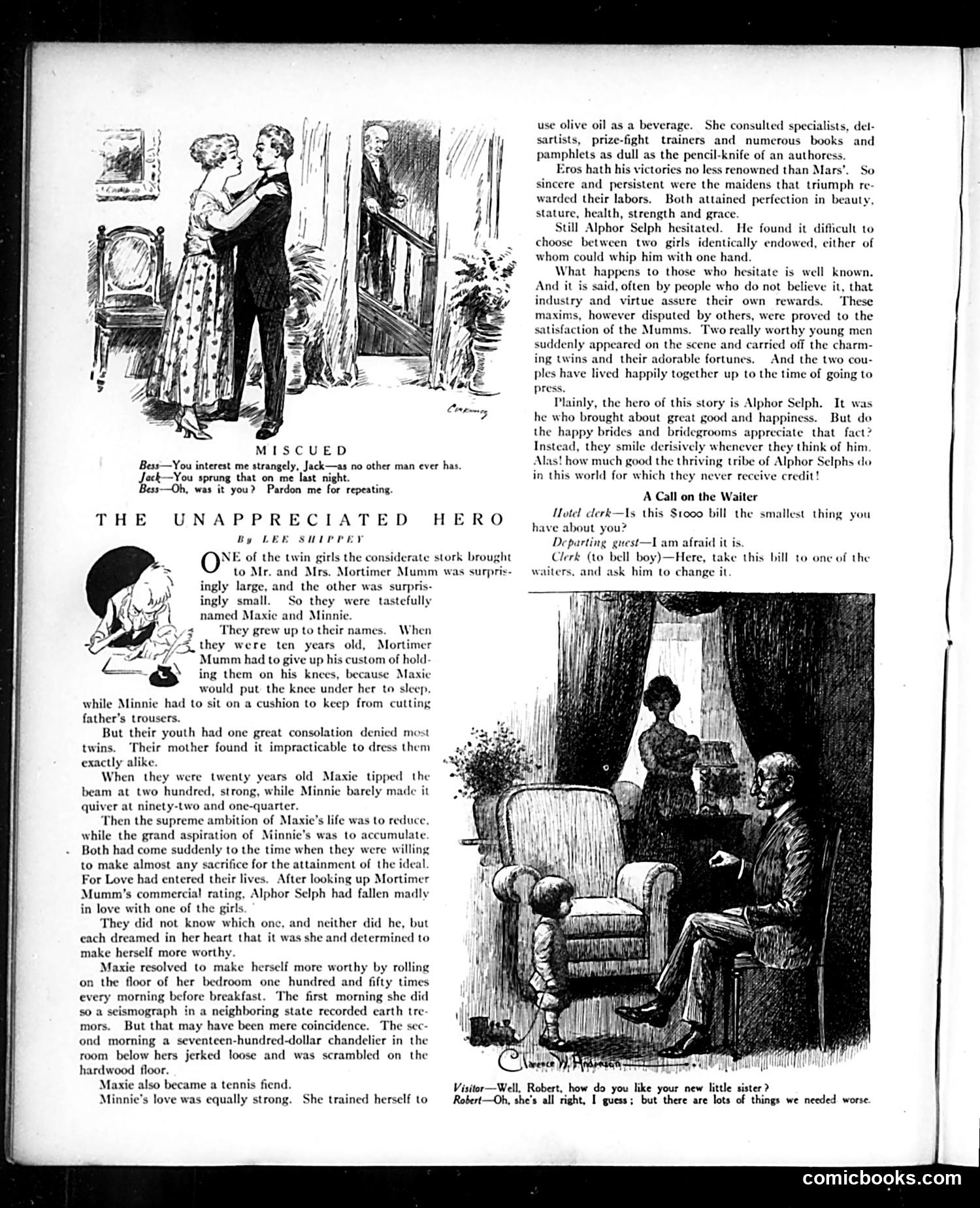
What you’re looking at
This story satirizes male entitlement and romantic indecision. Alphor Selph falls in love with one of twin sisters—Maxie (large) and Minnie (small)—but cannot decide between them. Rather than choose, he hesitates. Meanwhile, both sisters work desperately to improve themselves: Maxie exercises obsessively to lose weight (causing earthquakes and destroying property), while Minnie gains weight by consuming olive oil and training with prize-fighters. The satire's point: both sisters transform themselves completely through "industry and virtue," yet Selph's indecision costs him. Two *other* worthy men appear and marry the twins instead. The story's ironic title mocks Selph as "unappreciated"—suggesting he deserves credit for the good outcomes he *accidentally* caused through his own passivity and cowardice, while the twins who actually earned their happiness through hard work receive no credit from him. The joke critiques male selfishness and the expectation that women should compete for male approval.
📄 Transcribed text from this page (OCR, searchable)
Machine-transcribed from the original scan — historical spelling and the odd misread are preserved.
MISCUED Bess—You interest me strangely, Jack—as no other man ever has. Jack—You sprung that on me last night. Bess—Oh, was it you? Pardon me for repeating. THE UNAPPRECIATED By LEE SHIPPEY ingly large, and the other was surpris- ingly small. So they were tastefully named Maxie and Minnie. They grew up to their names. When they were ten years old, Mortimer Mumm had to give up his custom of hold ing them on his knees, because Maxic would put the knee under her to sleep. while Minnie had to sit on a cushion to keep from cutting father’s trousers. But their youth had one great consolation denied most twins. Their mother found it impracticable to dress them exactly alike. When they were twenty y beam at two hundred, strong, while quiver at ninety-two and one-quarter. ‘Then the supreme ambition of Maxie’s life was to reduce, while the grand aspiration of Minnie’s was to accumulate. Both had come suddenly to the time when they were willing to make almost any for the attainment of the ideal. For Love had entered their lives. After looking up Mortimer Mumm’s commercial rating, Alphor Selph had fallen madly in love with one of the girls. They did not know which onc, and neither did he, but each dreamed in her heart that it was she and determined to make herself more worthy. Maxie resolved to make herself more worthy by rolling on the floor of her bedroom one hundred and fifty times every morning before breakfast. The first morning she did so a seismograph in a neighboring state recorded earth tre- mors. But that may have been mere coincidence. The sec- ond morning a seventeen-hundred-dollar chandelier in the room below hers jerked loose and was scrambled on the hardwood floor. Maxie also became a tennis fiend. Minnie’s love was equally strong. She trained herself to old Maxie tipped the Minnie barely made it HERO * of the twin girls the considerate stork brought to Mr. and Mrs. Mortimer Mumm was surpris- ists, del- and use olive oil as a beverage. She consulted speci: sartists, prize-fight trainers and numerous books pamphlets as dull as the pencil-knife of an authores: s hath his victories no less renowned than Mars’. So sincere and persistent were the maidens that triumph re- warded their labors. Both attained perfection in beauty, stature, health, strength and grace. Still Alphor Selph hesitated. He found it difficult to choose between two girls identically endowed, either of whom could whip him with one hand. What happens to those who hesitate is well known. And it is said, often by people who do not believe it, that industry and virtue assure their own rewards. These maxims, however disputed by others, were proved to the satisfaction of the Mumms. Two really worthy young men suddenly appeared on the scene and carried off the charm- ing twins and their adorable fortunes. And the two cou- ples hi lived happily together up to the time of going to pres Plainly, the hero of this story is Alphor Selph. It was he who brought about great good and happin But do the happy brides and bridegrooms appreciate that fact? Instead, they smile derisively whenever they think of him how much good the thriving tribe of Alphor Selphs do in this world for which they never receive credit! A Call on the Waiter Motel clerk—1s this Stooo bill the smallest thing you have about you? Departing guest—L am afraid it is. Clerk (to bell boy)—Here, take this bill to one of the waiters, and ask him to change it. "4 = = neainiititt arence V FYnsresen ST cnet OUD Visitor—Well, Robert, how do you like your new little sister? Robert—Oh, she's all right, I guess; but there are lots of things we needed worse. comicbooks.com