
Judge, 1916-01-01 · page 26 of 28
Judge — January 1, 1916 — page 26: what you’re looking at
What you’re looking at
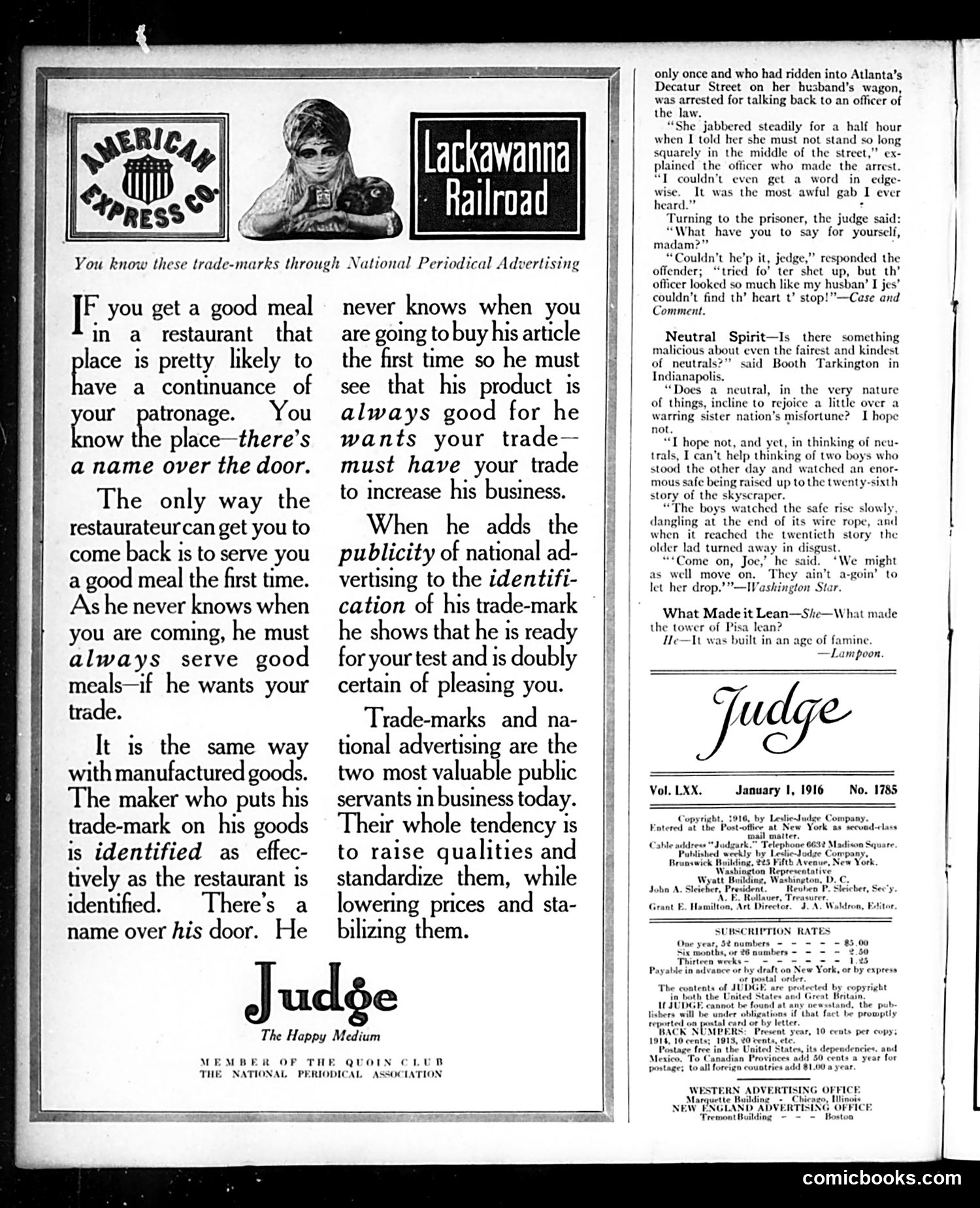
This page is primarily **advertising and editorial content**, not satirical cartoons. The main advertisement compares trade-marks and national advertising to restaurant reputation: just as diners return to restaurants with good names over the door, consumers buy branded manufactured goods repeatedly. The ad features logos for American Express Co. and Lackawanna Railroad, arguing that brand identification and national publicity raise quality standards while lowering prices. The right column contains three brief humorous anecdotes unrelated to the advertisement: 1. **"Case and Comment"**: A racist joke about a Black woman arrested in Atlanta for talking back to a police officer, who compares her chattiness to her husband. 2. **"Neutral Spirit"**: A commentary on WWI-era neutrality, using an anecdote about boys watching a safe drop from a building—implying neutrals enjoy others' misfortunes. 3. **"What Made It Lean"**: A pun about the Tower of Pisa, suggesting it leans because it was built during a famine. The page reflects 1916 advertising philosophy and period attitudes, including racial stereotyping typical of the era.
📄 Transcribed text from this page (OCR, searchable)
Machine-transcribed from the original scan — historical spelling and the odd misread are preserved.
F you get a good meal in a restaurant that pee is pretty likely to ave a continuance of ex atronage. You ow the place—there’s a name over the door. The only way the restaurateur can get you to come back is to serve you a good meal the first time. As he never knows when you are coming, he must always serve good meals—if he wants your trade. It is the same way with manufactured goods. The maker who puts his trade-mark on his goods is identified as effec- tively as the restaurant is identified. There's a name over his door. He Lackawanna - Railroad You know these trade-marks through National Periodical Advertising never knows when you are going to buy his article the first time so he must see that his product is always good for he wants your trade— must have your trade to increase his business. When he adds the publicity of national ad- vertising to the identifi- cation of his trade-mark he shows that he is ready for your test and is doubly certain of pleasing you. Trade-marks and na- tional advertising are the two most valuable public servants in business today. Their whole tendency is to raise qualities and standardize them, while lowering prices and sta- bilizing them. J udge The Happy Medium MEMBER OP THE QUOIN CLUB THE NATIONAL PERIODICAL ASSOCIATION only once and who had ridden into Atlanta’s. Decatur Street on her husband’s wagon, was arrested for talking back to an officer of the law. “She jabbered steadily for a half hour when I told her she must not stand so long squarely in the middle of the street,” ex- plained the officer who made the arrest. “T couldn’t even get a word in edge- wise. It was the most awful gab I ever heard.” : Turning to the prisoner, the judge said: “What have you to say for yourseli, madam?” “Couldn't he’p it, jedge,” responded the offender; “tried fo’ ter shet up, but th’ officer looked so much like my husban’ I jes’ couldn’t find th’ heart t’ stop!”—Case and Comment. Neutral Spirit—Is there something t and kindest kington in malicious about even the fai of neutrals?” Indianapolis. “Does a neutral, in the very nature of things, incline to rejoice a little over a warring sister nation’s misfortune? I hope not. “T hope not, and yet, in thinking of neu- trals, I can’t help thinking of two boys who stood the other day and watched an enor- mous safe being J up to the twenty-sixth story of the skyscraper. “The boys watched the safe rise slowly, dangling at the end of its wire rope, and when it reached the twentieth story the 1 lad turned a in di Come on, Joe,’ he as well move on. Th let her drop.’”—IWashi: said Booth ve might ein’ to What Made it Lean—Sse—What made the tower of Pisa lean? He—It was built in an age of famine. —Lampoon. No. 1785 Vol. LXX. January 1, 1916 Grant BE, How Waldron, Editor, SUBSCRIPTION RATES iat fact be promptly 10 cents per . Ulinois ICE, comicbooks.com