
Judge, 1916-01-01 · page 10 of 28
Judge — January 1, 1916 — page 10: what you’re looking at
What you’re looking at
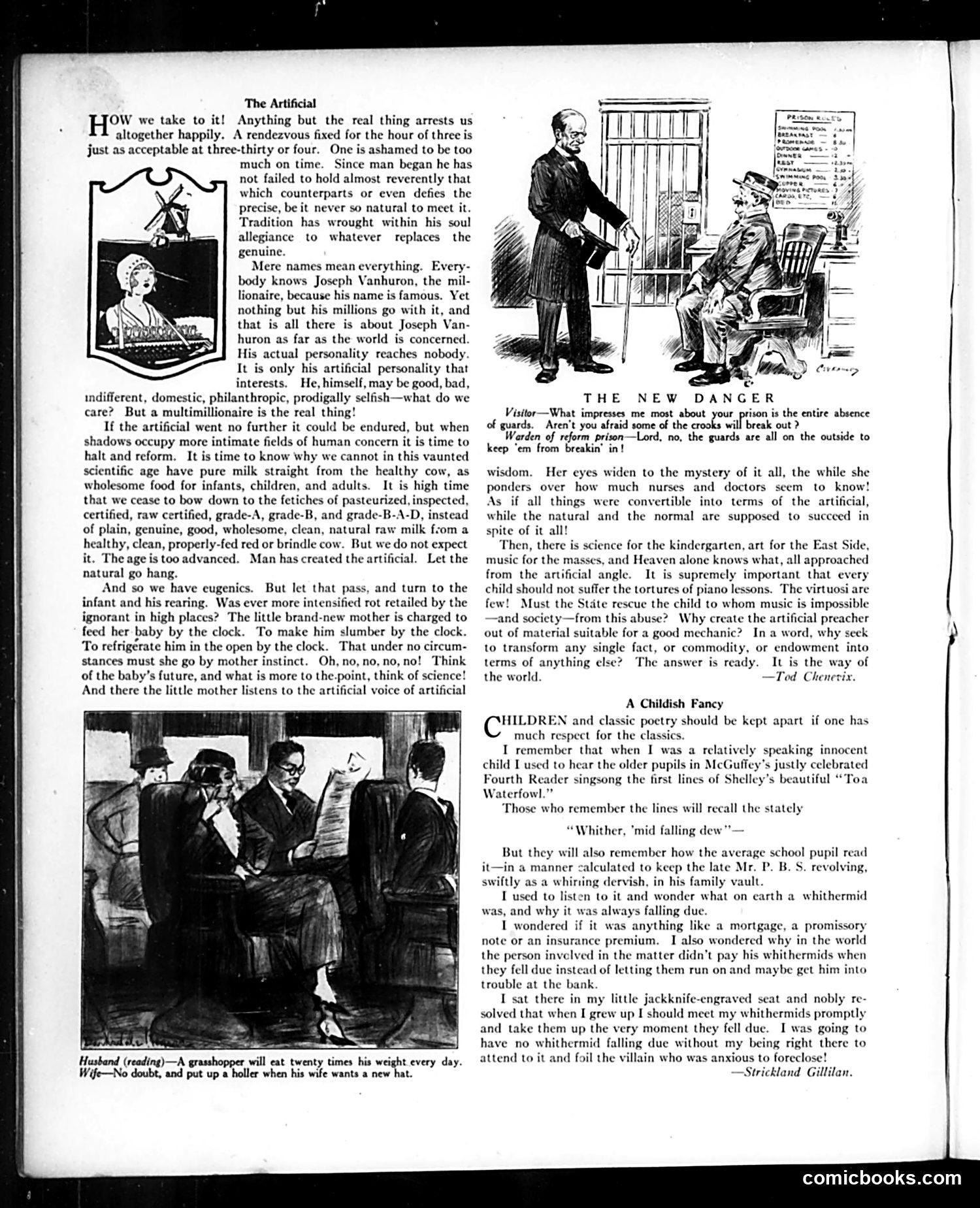
This page critiques American society's obsession with the artificial over the genuine. The main essay "The Artificial" argues that people value reputation and appearances (using Joseph Vanhuron, a wealthy industrialist, as an example) rather than actual character. It attacks modern practices like pasteurized milk, strict clock-based baby-feeding schedules dictated by "science," and the artificial creation of professionals unsuited to their vocations. The page includes two cartoons: "The New Danger" jokes that prison guards keep *inmates in* rather than out, satirizing prison reform efforts. A second cartoon depicts a husband's sarcastic response to his wife's complaint about expenses, suggesting wives are materialistic. The article's tone is reactionary—opposing modernization, scientific management, and social reform in favor of "natural" methods and tradition. The author credits are "Ted Chenevix" and "Strickland Gillilan."
📄 Transcribed text from this page (OCR, searchable)
Machine-transcribed from the original scan — historical spelling and the odd misread are preserved.
The Artificial OW we take to it! Anything but the real thing arrests us altogether happily. A rendezvous fixed for the hour of three is just as acceptable at three-thirty or four. One is ashamed to be too much on time. Since man began he has not failed to hold almost reverently that which counterparts or even defies the precise, be it never so natural to meet it. Tradition has wrought within his soul allegiance to whatever replaces the genuine. Mere names mean everything. Every- body knows Joseph Vanhuron, the mil- lionaire, because his name is famous. Yet nothing but his millions go with it, and that is all there about Joseph Van- huron as far as the world is concerned. His actual personality reaches nobody. It is only his artificial personality that interests. He, himself, may be good, bad, indifferent, domestic, philanthropic, prodigally selfish—what do we care? But a multimillionaire is the real thing! If the artificial went no further it could be endured, but when shadows occupy more intimate fields of human concern it is time to halt and reform. It is time to know why we cannot in this vaunted scientific age have pure milk straight from the healthy cow, as wholesome food for infants, children, and adults. It is high time that we cease to bow down to the fetiches of pasteurized, inspected, certified, raw certified, grade-A, grade-B, and grade-B-A-D, instead of plain, genuine, good, wholesome, clean, natural raw milk feom a healthy, clean, properly-fed red or brindle cow. But we do not expect it. The age is too advanced. Man has created the artificial. Let the natural go hang. And so we have cugenics. But let that pass, and turn to the infant and his rearing. Was ever more intensified rot retailed by the ignorant in high places? The little brand-new mother is charged to feed her baby by the clock. To make him slumber by the clock. To refrigérate him in the open by the clock. That under no circum- stances must she go by mother instinct. Oh, no,no,no,no! Think of the baby’s future, and what is more to the.point, think of science! And there the little mother listens to the art Husband (reading)—A grasshopper wil eat twenty times his weight every day. Wife—No doubt, and put up a holler when his wife wants a new hat. THE NEW DANGER Visitor—What impresses me most about your prison is the entire absence of guards. Aren't you afraid some of the crooks will break out ? Warden of reform prison—Lord, no, the guards are all on the outside to keep ‘em from breakin’ in! wisdom. Her eyes widen to the mystery of it all, the while she ponders over how much nurses and doctors seem to know! As if all things were convertible into terms of the artificial, while the natural and the normal are supposed to succeed in spite of it all! Then, there is science for the kindergarten, art for the East Side, music for the es, and Heaven alone knows what, all approached from the artificial angle. It is supremely important that every child should not suffer the tortures of piano lessons. The virtuosi are few! Must the Stdte rescue the child to whom music is impossible —and society—from this abuse? Why create the artificial preacher out of material suitable for a good mechanic? In a word, why seck to transform any single fact, or commodity, or endowment into terms of anything else? The answer is ready. It is the way of the world. —Tod Chenevix. A Childish Fancy HILDREN and classic poetry should be kept apart if one has much respect for the classics. I remember that when I was a relative child I used to hear the older pupils in McGuffe Fourth Reader singsong the first lines of Shelley’s beautiful Waterfowl Those who remember the lines will recall the stately “Whither, y speaking innocent "s justly celebrated “Toa ‘mid falling dew" — But they will also remember how the average school pupil read it—in a manner calculated to keep the late Mr. P. B. S. revolving, swiftly as a whining dervish, in his family vault. I used to listen to it and wonder what on earth a whithermid was, and why it was always falling due. I wondered if it was anything like a mortgage note or an insurance premium. I also wondered wh: the person invelved in the matter didn’t pay his whithermids when they fell due instead of letting them run on and maybe get him into trouble at the bank. I sat there in my little jackknife-engraved seat and nobly re- solved that when I grew up I should meet my whithermids promptly and take them up the very moment they fell due. I was going to have no whithermid falling due without my being right there to attend to it and foil the villain who was anxious to foreclo: Strickland Gillilan. promissory in the world comicbooks.com