
A complete issue · 28 pages · 1915
Judge — November 20, 1915
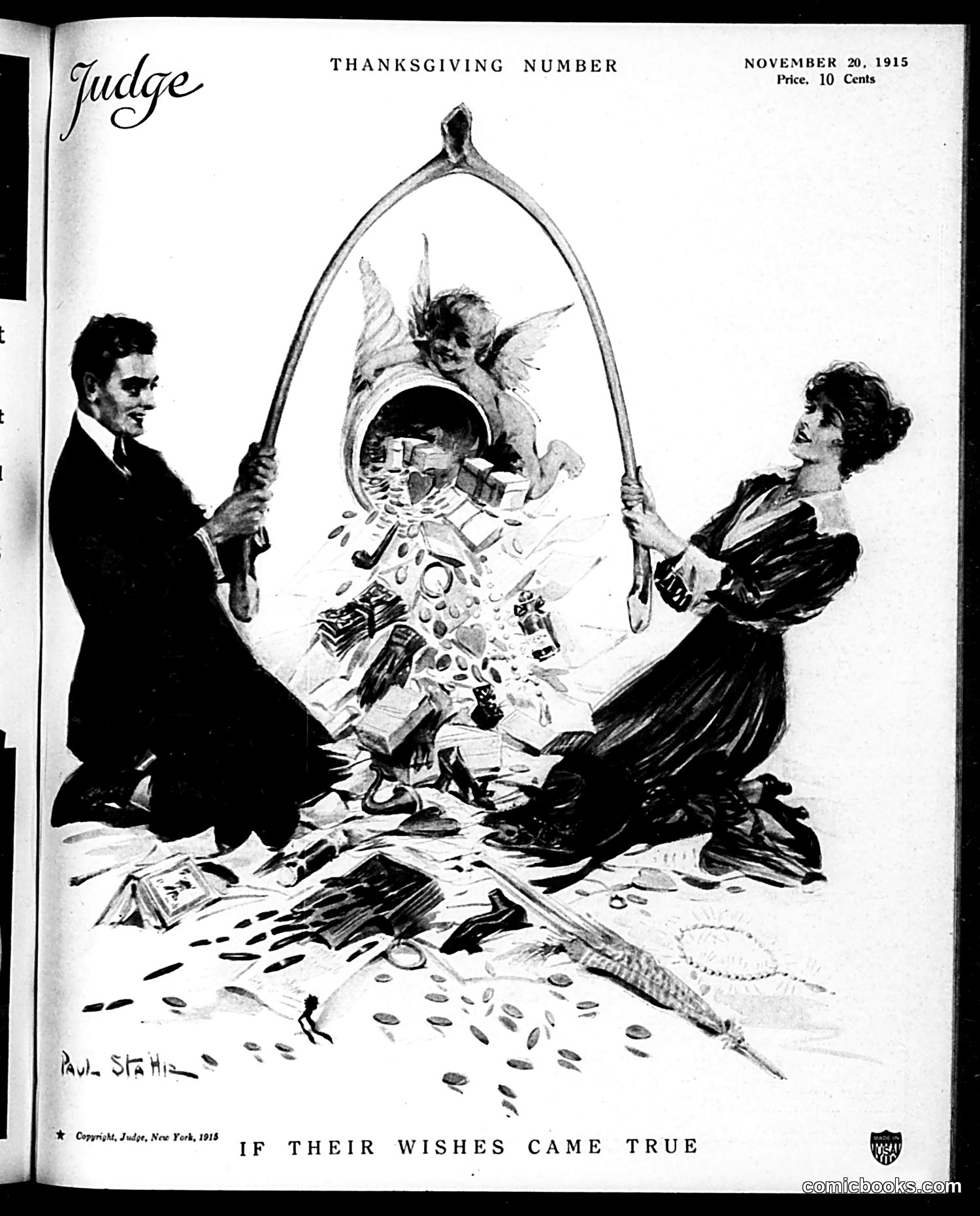
This Thanksgiving-themed cartoon satirizes wealth inequality during World War I. A man and woman (appearing to represent working-class Americans) hold open a giant wishbone while an angel presides over it. Inside the wishbone's shell, money spills abundantly—coins, bills, and financial symbols overflow. The satire's point: the couple wishes for wealth and prosperity, but the cartoon's title suggests this remains merely a fantasy. The contrast between their modest clothing and the overflowing riches inside the wishbone critiques the gap between ordinary citizens' aspirations and economic reality during the war years when profits concentrated among industrialists while workers struggled. The angel overhead adds ironic commentary—heavenly blessing on material desires rather than spiritual thanksgiving.
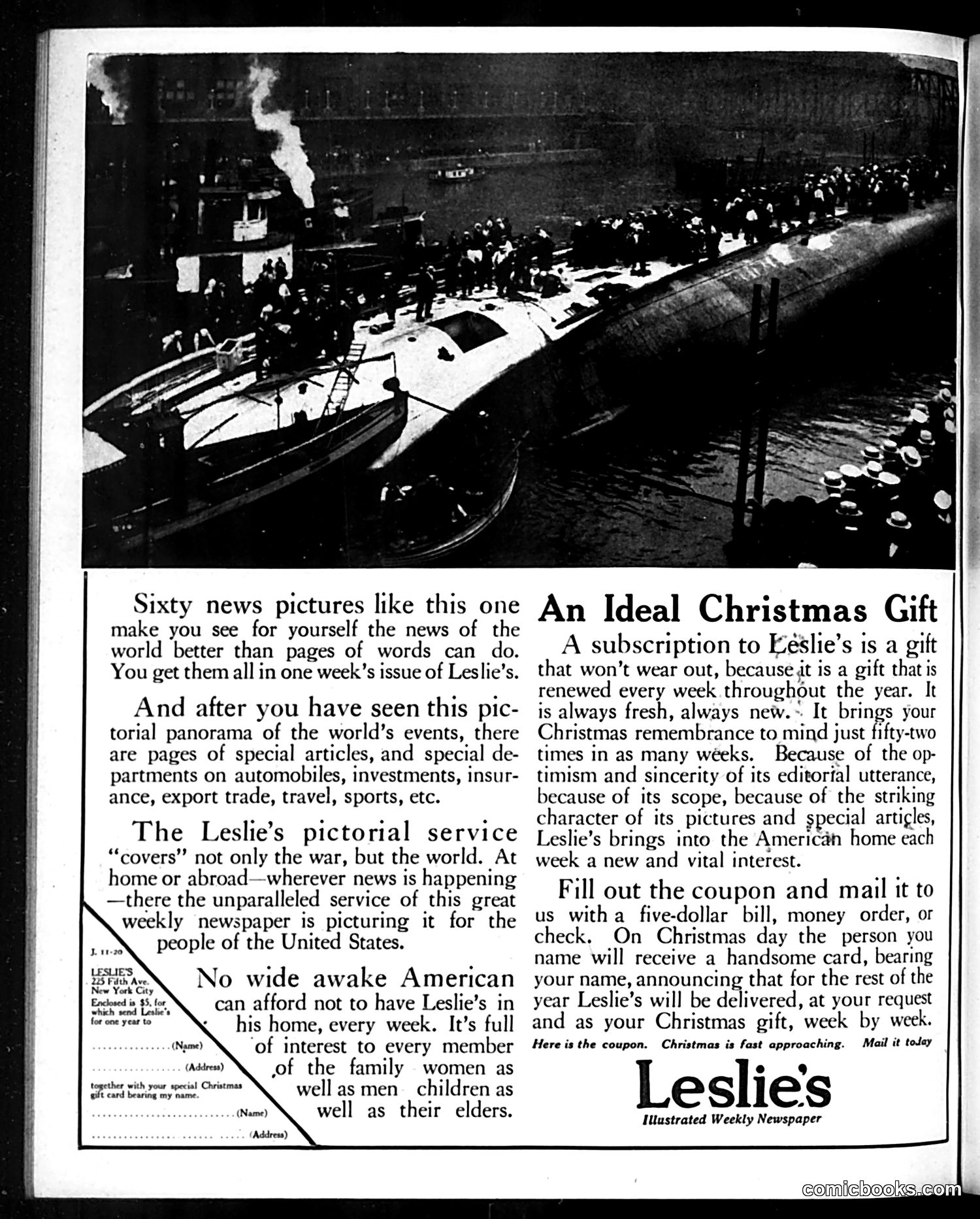
This page is **primarily advertising, not editorial content**. It's an advertisement for Leslie's Illustrated Weekly Newspaper, promoting gift subscriptions for Christmas. The image shows a crowded dock scene with a large ship, likely depicting a newsworthy event of the era (possibly a ship arrival or departure), though the specific event is unclear from the advertisement alone. The ad emphasizes Leslie's value proposition: 60 news pictures weekly plus articles covering war, world events, trade, and sports. The marketing angle positions a subscription as an ideal Christmas gift because it provides year-round remembrance—52 issues delivering "new" content weekly to the entire family. The page includes a coupon for readers to mail in with payment, a common early-20th-century subscription method.
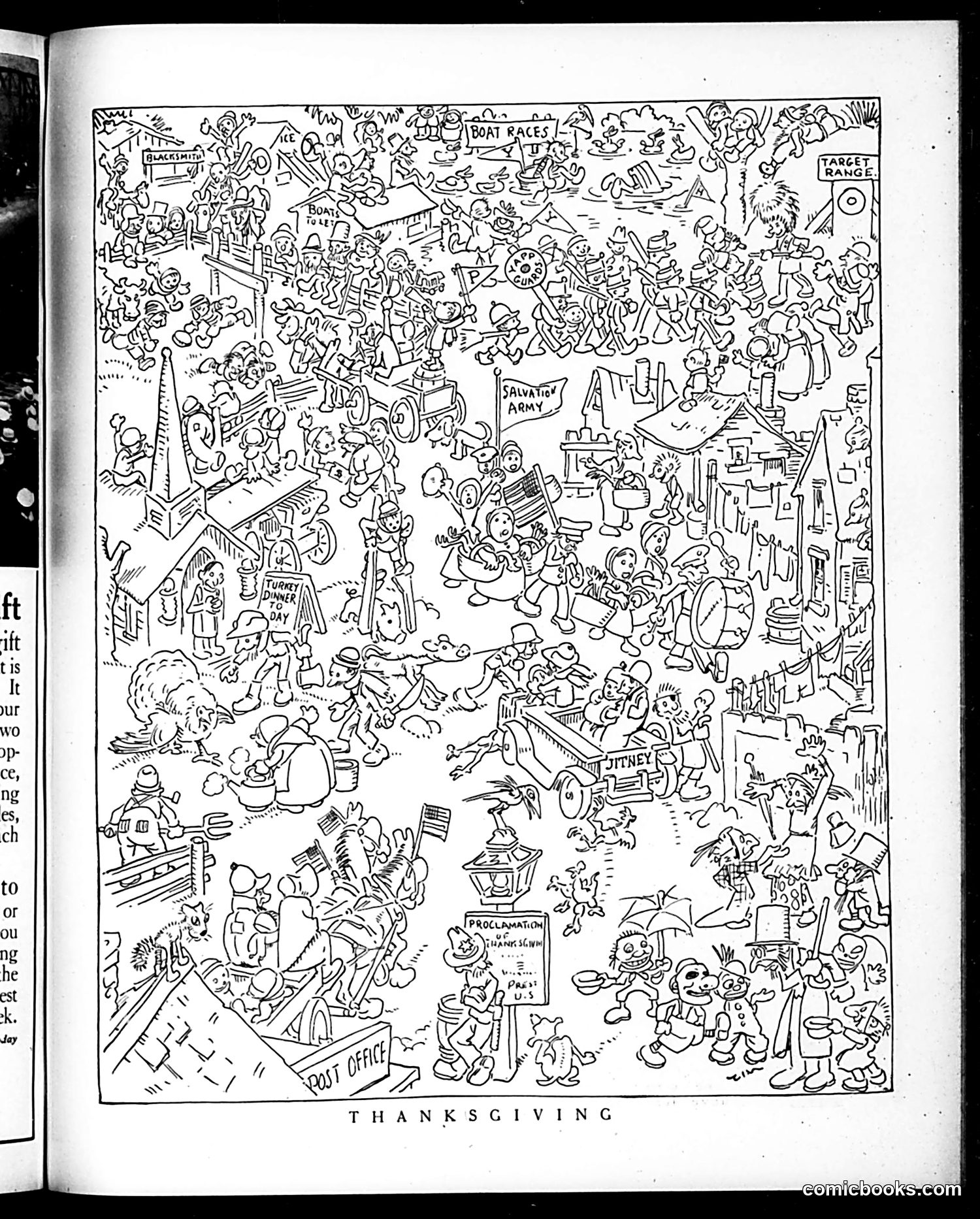
This is a crowded, "Where's Waldo?"-style illustration titled "Thanksgiving" depicting a chaotic holiday celebration. The scene includes numerous labeled elements: "Boat Races," "Salvation Army," "Post Office," "Proclamation," and "Target Range" visible among the dense activity. The cartoon satirizes the commercialization and complexity of American Thanksgiving—transforming what should be a simple family holiday into a bewildering array of competing activities and institutions. The jumble of figures engaged in racing, military recruiting, postal business, and target practice suggests Judge magazine's critique that Thanksgiving had become overly complicated and fragmented, pulled in many directions by commerce, government, and public spectacle rather than remaining a focused moment of gratitude and family togetherness.
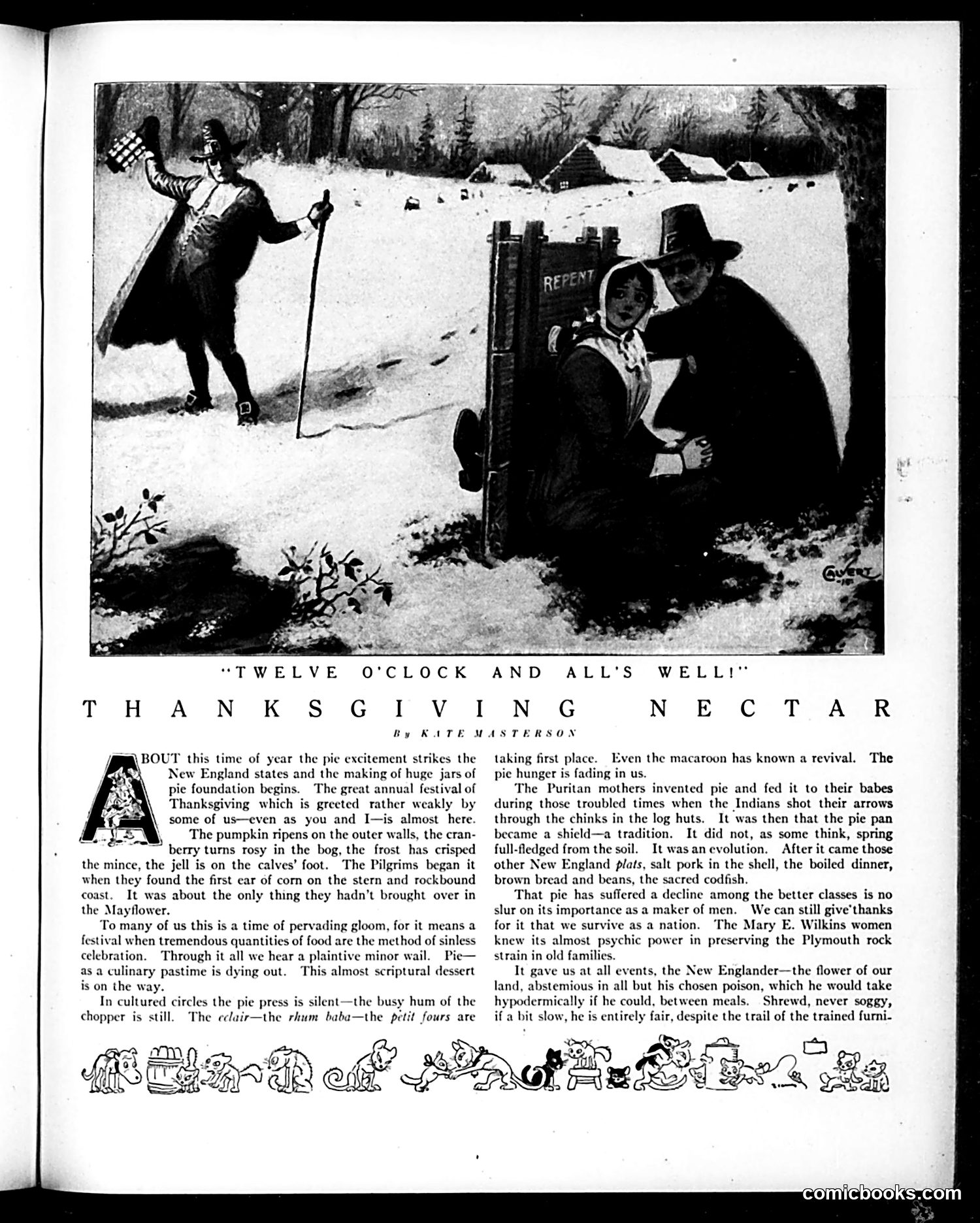
This satirical piece celebrates Thanksgiving pie traditions while lamenting its decline among "better classes." The image shows a winter scene where two well-dressed figures examine what appears to be a pie labeled "REGENT" — likely a commercial brand. The text humorously traces pie's cultural journey: from Pilgrim necessity to upper-class rejection. Masterson argues that despite attempts by "New Englanders" and society figures to poison pie's reputation through snobbery, it survives among working people. The "Mary E. Wilkins women" (likely referencing the regional writer) preserved Plymouth Rock traditions through humble pies. The satire criticizes class pretension—how the wealthy abandoned homely foods once deemed essential, only to have them survive through working-class loyalty.
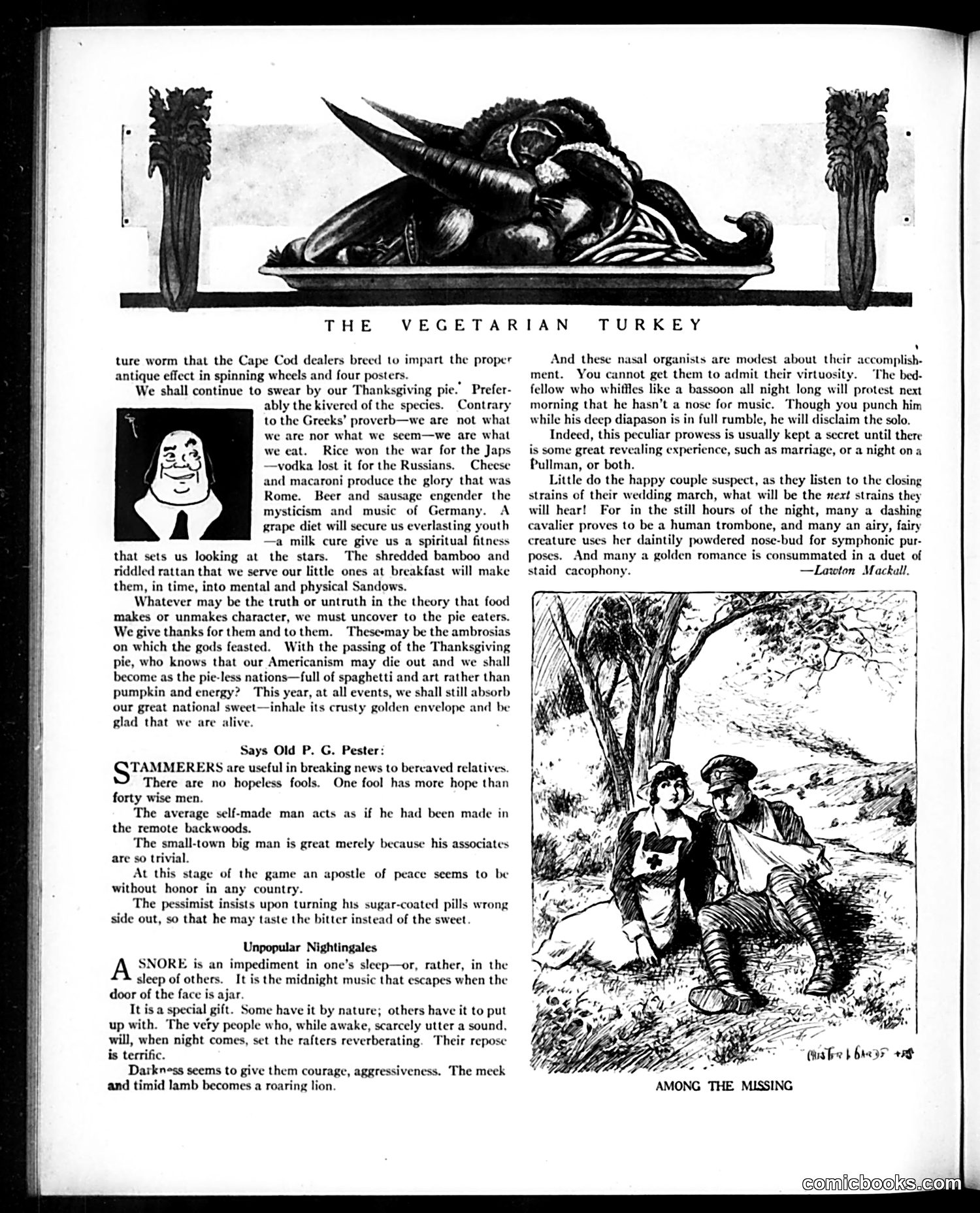
**The Main Cartoon:** The illustration depicts a reclining turkey—ironic given the title. This is satirizing vegetarian substitutes for traditional Thanksgiving turkey, mocking the growing vegetarian movement of the era. **The Text's Satire:** The opening essay humorously defends the Thanksgiving pie as an essential American institution, arguing that food shapes national character. It jokes that abandoning pumpkin pie would turn Americans into spaghetti-eating aesthetes like Europeans—implying vegetarianism and foreign foods threaten American identity. **P.G. Pester's Aphorisms:** These are cynical observations on human nature (fools, self-made men, pacifists), typical of Judge's sardonic humor column. **"Unpopular Nightingales":** This satirizes people who snore, personifying snoring as a hidden talent that respectable people deny—the humor lies in treating an annoying bodily function as a shameful secret exposed on wedding nights and train journeys. The page reflects early 20th-century anxieties about immigration, changing food culture, and genteel social pretense.
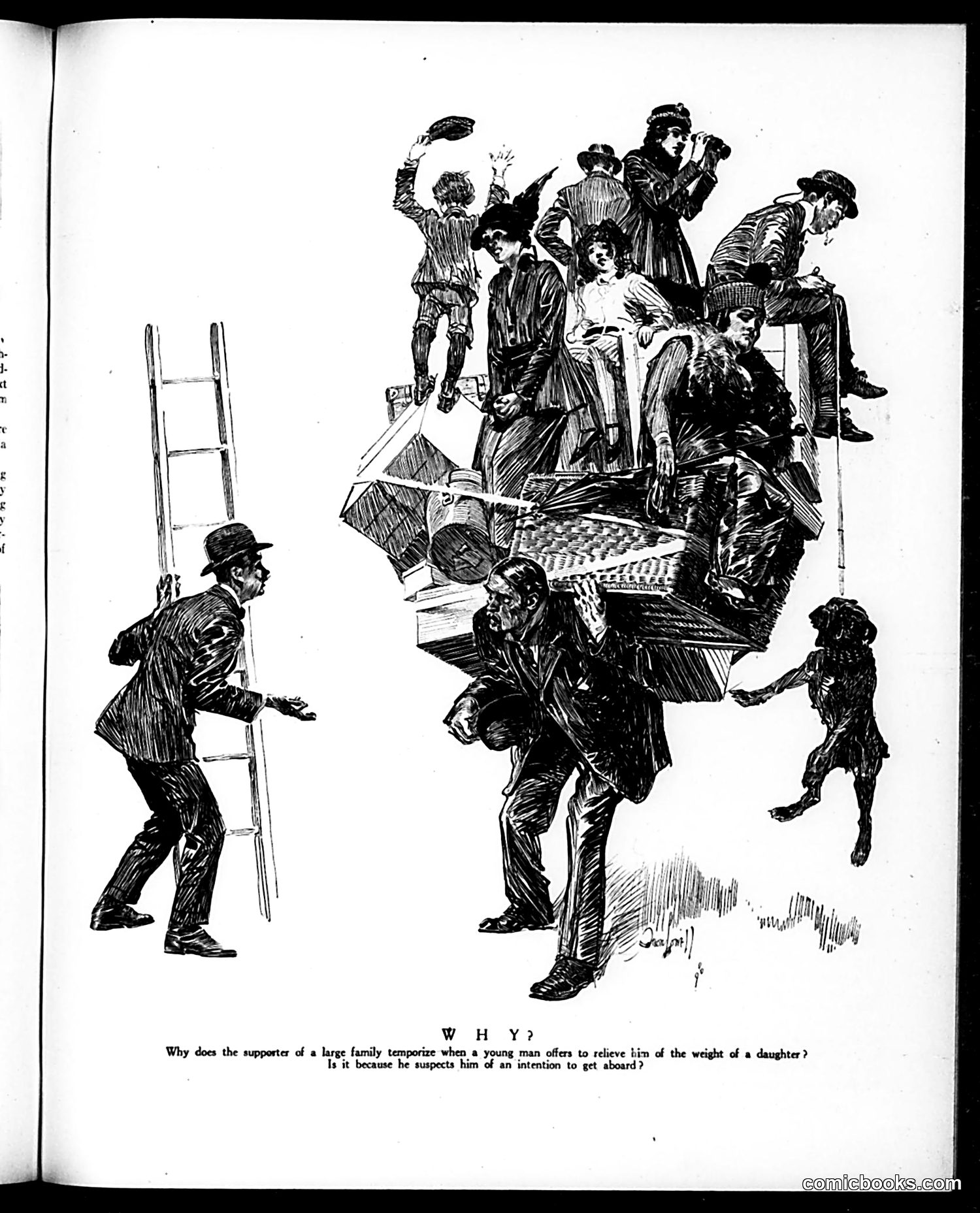
This cartoon satirizes marriage proposals and family dynamics of the era. The scene depicts a suitor (left, climbing a ladder) approaching a large family group (right, positioned elevated on furniture). The caption's rhetorical question suggests dark humor: when a young man offers to "relieve" a father of his daughter's burden through marriage, does the father suspect the suitor's true intentions—specifically, that he plans to "get aboard" (board with the family, becoming a financial dependent rather than a genuine suitor)? The joke mocks both mercenary marriages and economic desperation among young men who might marry primarily for room and board rather than genuine affection. The ladder suggests the suitor must literally climb to reach this family's social position.
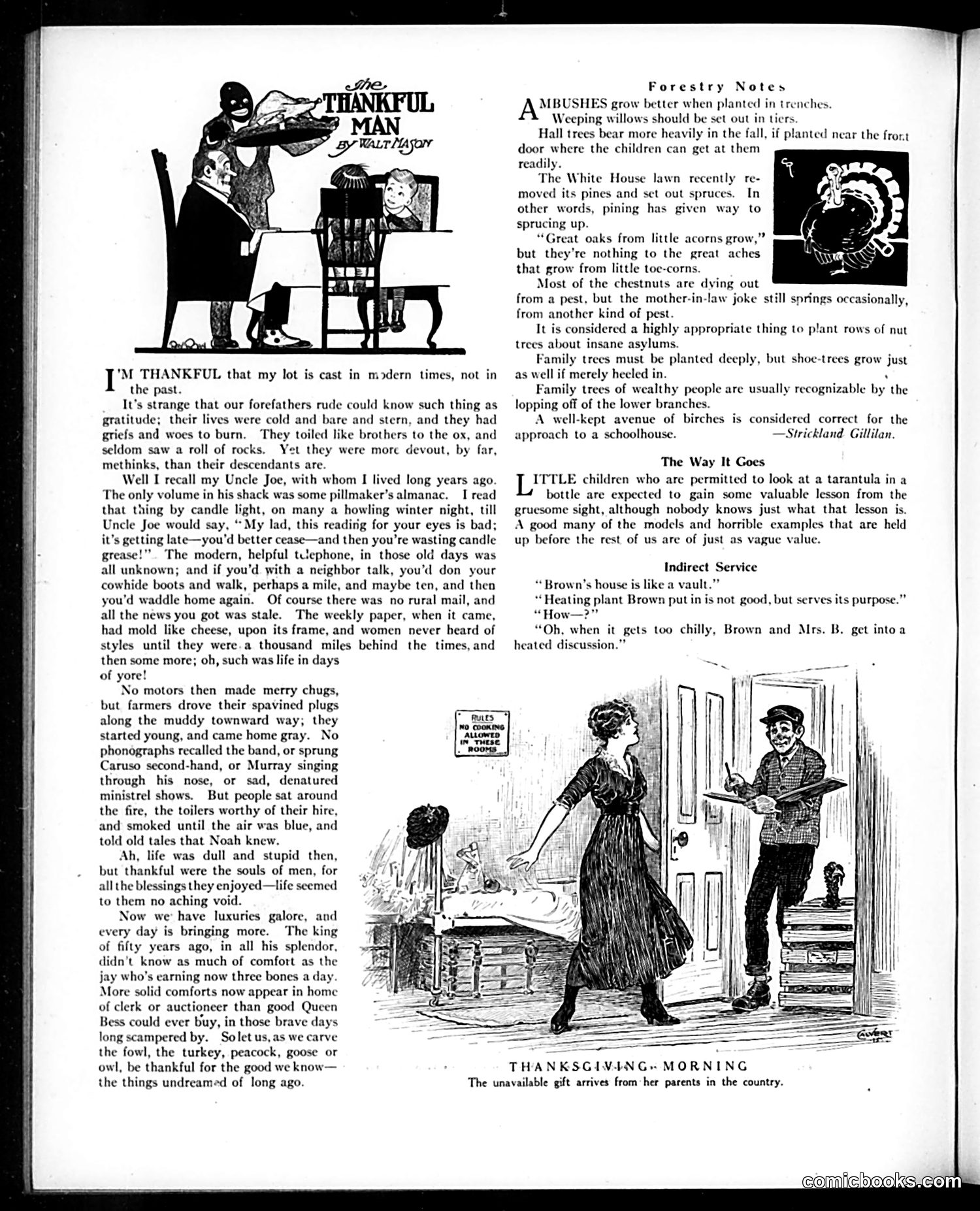
This page presents a nostalgic essay contrasting past and present American life. The main text, titled "The Thankful Man" by Walt Mason, argues that despite modern luxuries (automobiles, telephones, phonographs), past generations possessed greater spiritual gratitude and contentment. The narrator recalls Uncle Joe's sparse frontier existence—reading by candlelight, walking miles for neighborly visits, receiving stale weekly newspapers. Yet Mason suggests these hardships bred humility and devotion absent in modern times, when comfort breeds entitlement. The accompanying satirical "Forestry Notes" section mocks self-help advice columns through absurd planting tips (e.g., "Great oaks from little acorns grow, but they're nothing to the great aches that grow from little toe-corns"). The bottom illustration depicts "Thanksgiving Morning," showing a visitor arriving with the "unavailable gift" from country parents—likely implying urban/rural cultural disconnect. The overall message: progress and comfort may have cost us moral grounding.
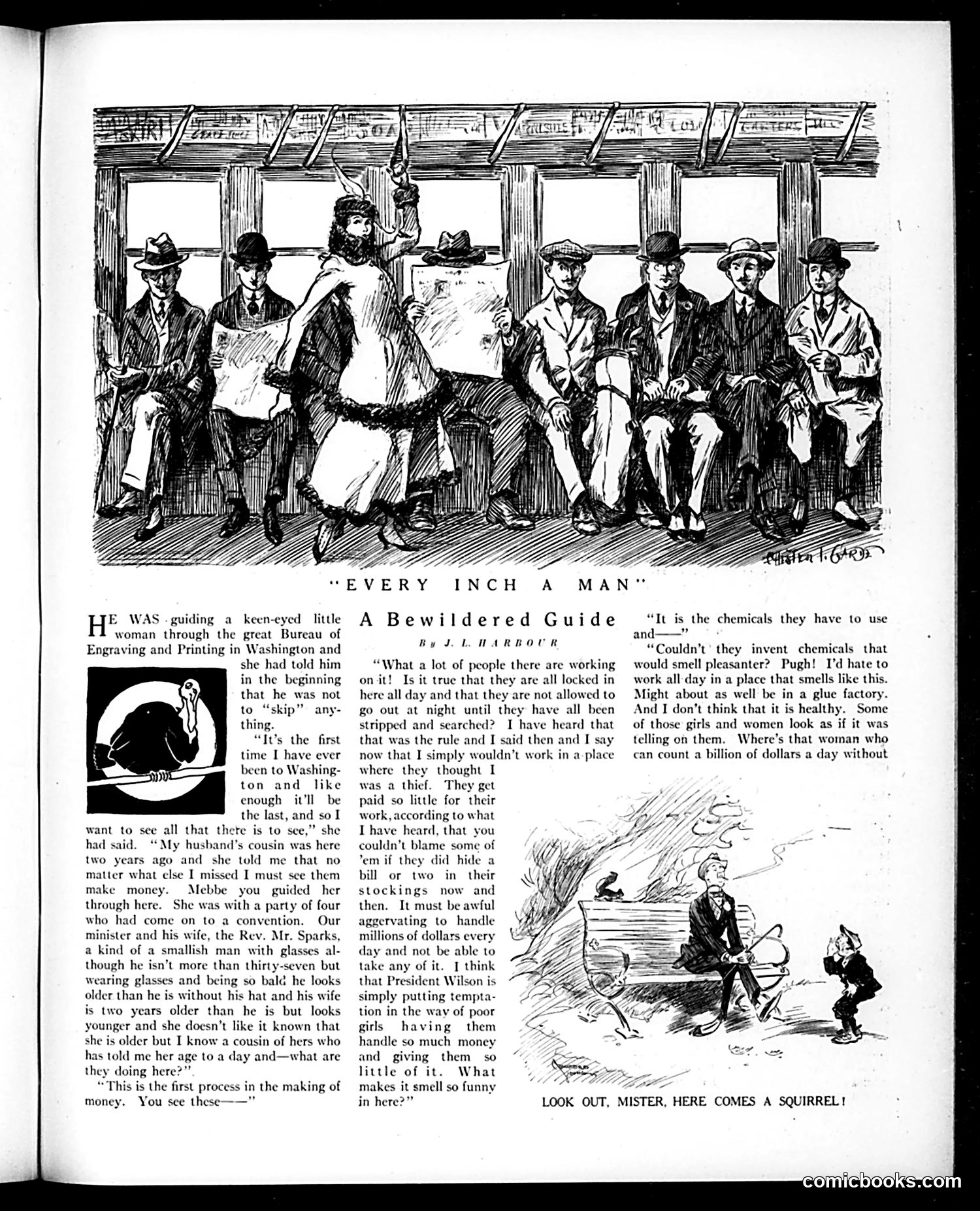
This humor piece satirizes a garrulous tourist woman touring the Bureau of Engraving and Printing in Washington, D.C. The joke is her breathless, meandering complaints about working conditions: she frets that workers are underpaid and tempted to steal money, worries the chemical smell is unhealthy, and sympathetically notes that President Wilson is "putting temptation in the way of poor girls" by having them handle millions while earning pittance. The satire targets both her naive moralizing and her obliviousness—she rambles endlessly about tangential gossip (the minister's wife's age) while badgering her patient guide. The caption "Every Inch a Man" (likely ironic) frames the guide's weary professionalism amid her relentless questioning. The final cartoon punchline—"Look Out, Mister, Here Comes a Squirrel!"—suggests her attention has wandered entirely, mocking her scattered, unfocused mind.
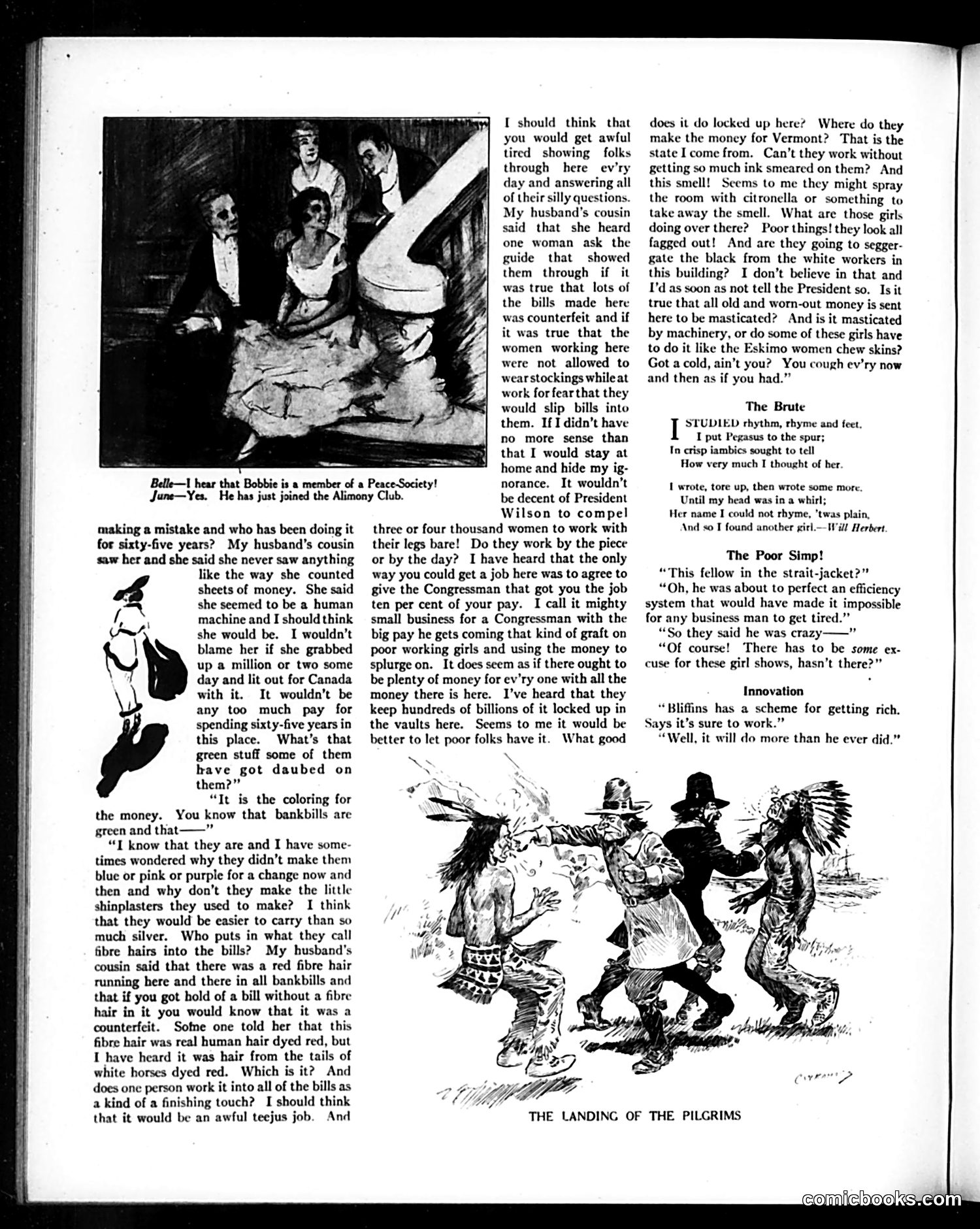
This Judge magazine page satirizes **tour groups visiting the U.S. Bureau of Engraving and Printing** (likely in Washington, D.C.). The main humor comes from a gossipy woman asking absurdly naive questions about money production to a tour guide. The satire targets: 1. **Public ignorance**: Questions about fiber in bills, whether counterfeit money is made there, and whether workers are paid per bill reflect comical misconceptions. 2. **Labor exploitation**: References to congressmen demanding 10% of workers' wages as graft, and women forbidden to wear stockings (to prevent theft) critique poor working conditions. 3. **Wealth inequality**: The woman questions why billions sit locked in vaults while poor people struggle. The small joke at top ("Alimony Club" = "Peace Society") puns on divorce settlements. The page demonstrates Judge's populist satirical approach—mocking both tourist ignorance and genuine workplace abuses in federal facilities.
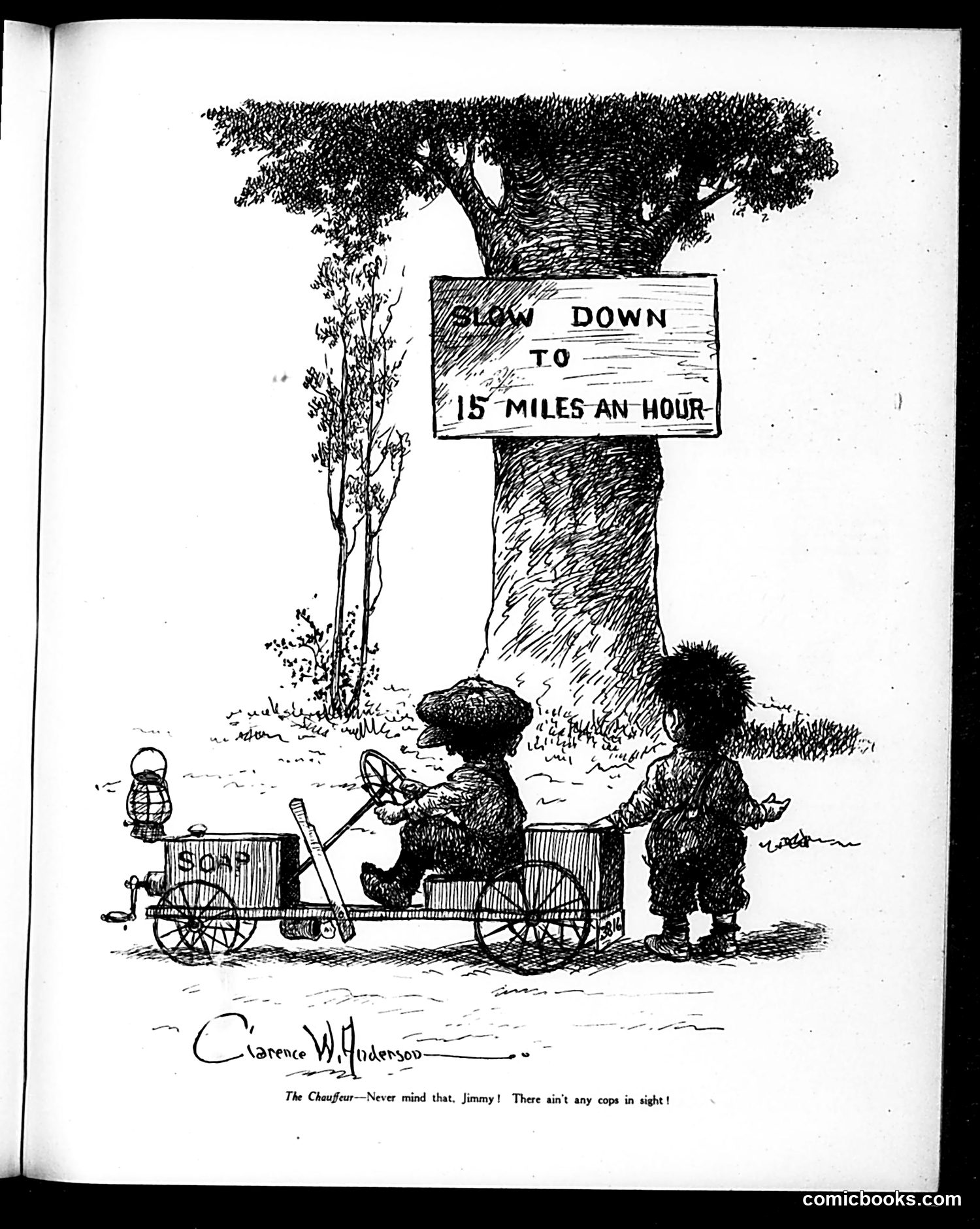
This Clarence Underwood cartoon satirizes speeding automobiles and traffic safety. Two figures in an early motorcar pass beneath a tree displaying a speed-limit sign reading "SLOW DOWN TO 15 MILES AN HOUR." The chauffeur (driver) tells his passenger "Jimmy" to ignore the limit, boasting "There ain't any cops in sight!" The joke targets both reckless drivers and the enforcement gap of early automobile regulations. The cartoon mocks the attitude that traffic laws exist only when police are present—suggesting drivers routinely violated speed limits when unobserved. This reflects early 20th-century concerns about dangerous driving in rapidly motorizing America, where speed limits were novel and often ignored by the wealthy driving their own vehicles.
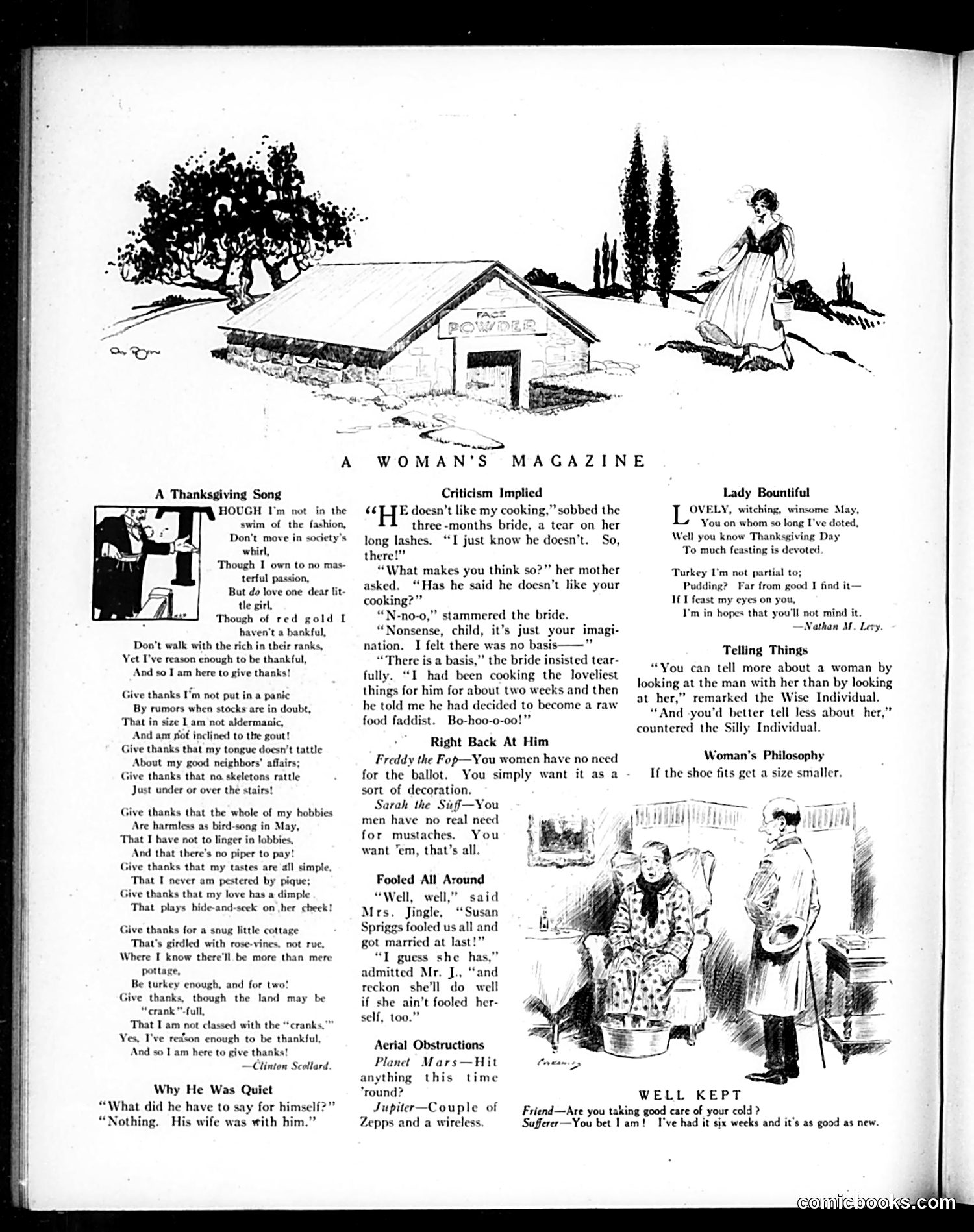
This Thanksgiving-themed page from Judge magazine satirizes early 20th-century gender roles and social attitudes. The **main cartoons** mock contemporary anxieties: "Why He Was Quiet" jokes that wives silence husbands; "Criticism Implied" ridicules a newlywed's insecurity about her cooking and her mother's gaslighting; "Fooled All Around" suggests marriage is mutual deception. **"Right Back At Him"** presents proto-feminist humor—when a man dismisses women's suffrage as decorative, "Sarah the Siff" counters that men's mustaches serve no real purpose either, inverting his condescension. The **Thanksgiving poem** celebrates modest domesticity—a working man content with his "dear little girl" and "snug little cottage," explicitly rejecting wealth and high society. **"Woman's Philosophy"** offers sardonic advice about self-improvement through denial. Overall, the page reflects anxieties about marriage, women's expanding social roles (suffrage), and class anxiety in the pre-WWI era, using humor to reinforce traditional gender hierarchies while acknowledging women's growing assertiveness.
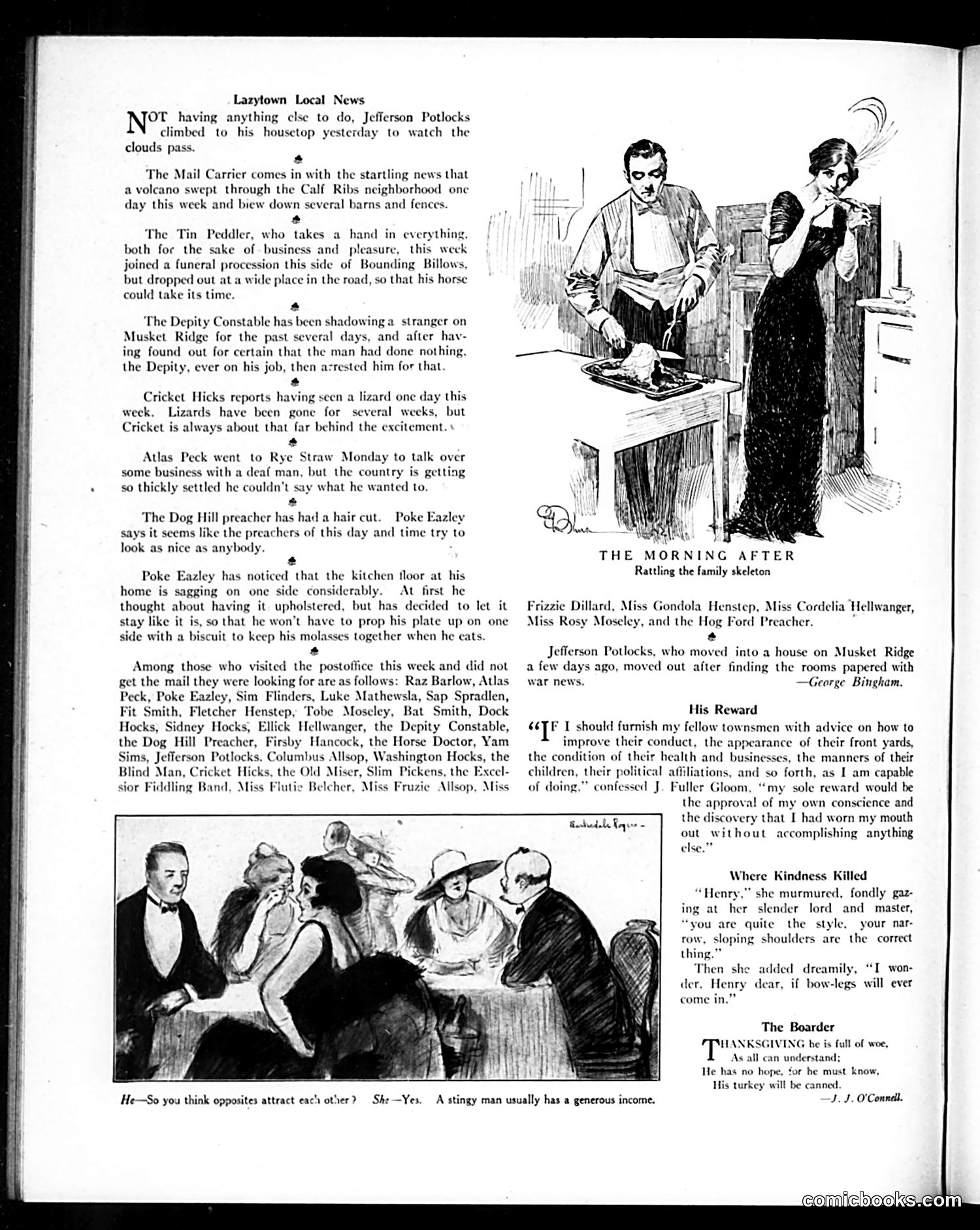
This page from *Judge* magazine presents "Lazytown Local News"—a humorous column satirizing rural American life through absurdist vignettes about fictional townspeople. The humor relies on exaggeration and deadpan delivery: a deputy arrests a stranger for doing nothing; a man notices his kitchen floor sagging and considers upholstering it instead of fixing it; Cricket Hicks perpetually reports events weeks after they've passed. The accompanying illustrations depict domestic scenes: "The Morning After" shows a family confronting embarrassing truths (the caption mentions "rattling the family skeleton"). Additional sketches include romantic irony and social observation—a woman compliments her husband's fashionable narrow shoulders while wondering if his bow-legs will improve. The satire targets rural incompetence, vanity, and the absurdities of small-town gossip and social pretension. The fake advice columns ("His Reward," "Where Kindness Killed") parody self-help literature with cynical twists about human nature.
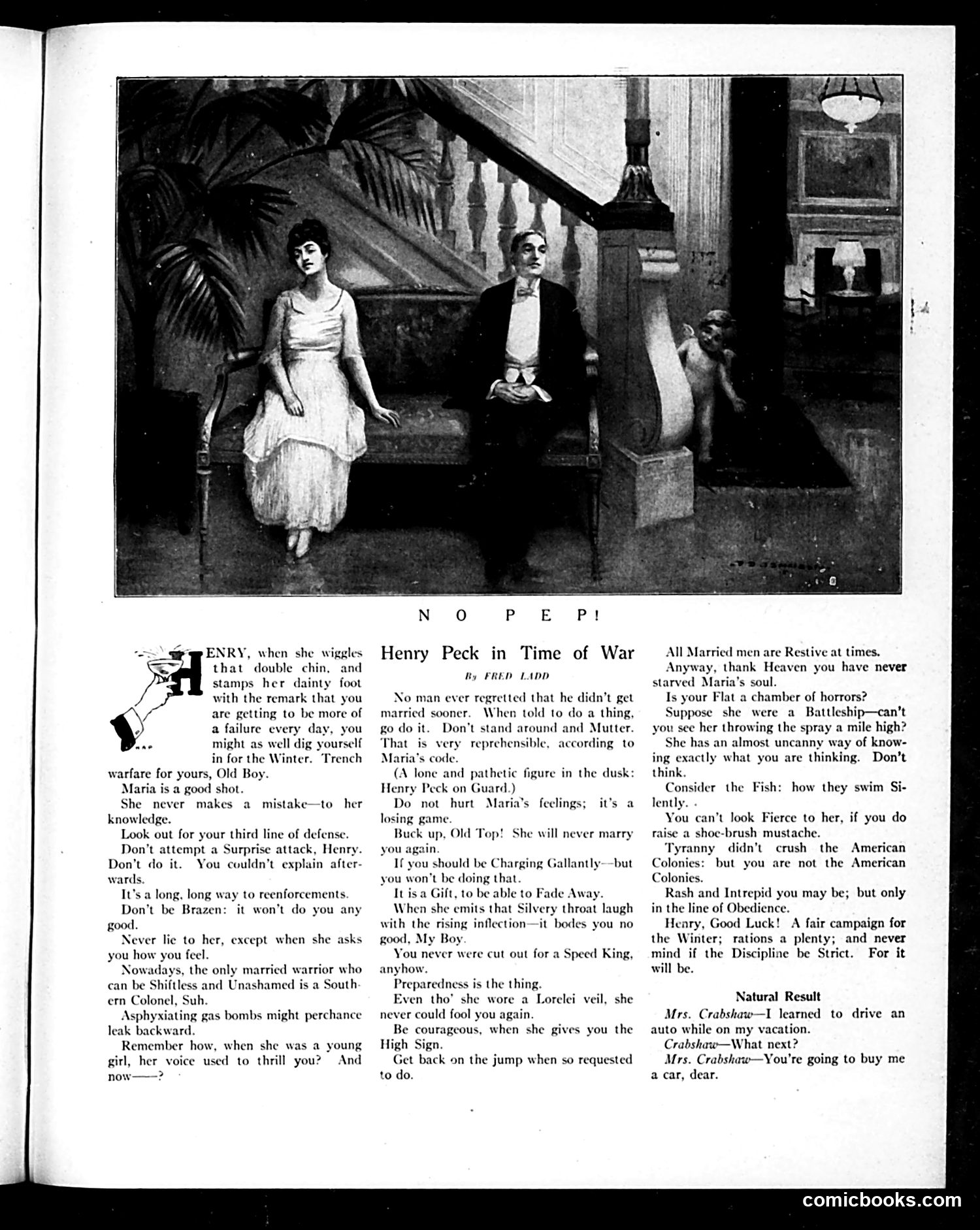
This is a satirical piece about married life during WWI, using military terminology as metaphor. The cartoon shows a husband (Henry Peck) and wife (Maria) in their home, with the accompanying text offering absurdist "advice" for navigating marriage like trench warfare. The satire contrasts two things: soldiers literally fighting in WWI trenches, and husbands managing domineering wives at home. Key points include warnings against contradicting Maria, avoiding surprise attacks, maintaining preparedness, and accepting that wives always win ("you won't be doing that" if you charge gallantly). The final joke ("Natural Result") shows a wife who learned to drive on vacation now demanding her husband buy her a car—illustrating how wives extract concessions through small requests. The humor relies on the era's assumption that wives are tyrants in the home and marriage is inherently combative. It's period-typical gender satire reflecting 1910s-20s attitudes about spousal dynamics.
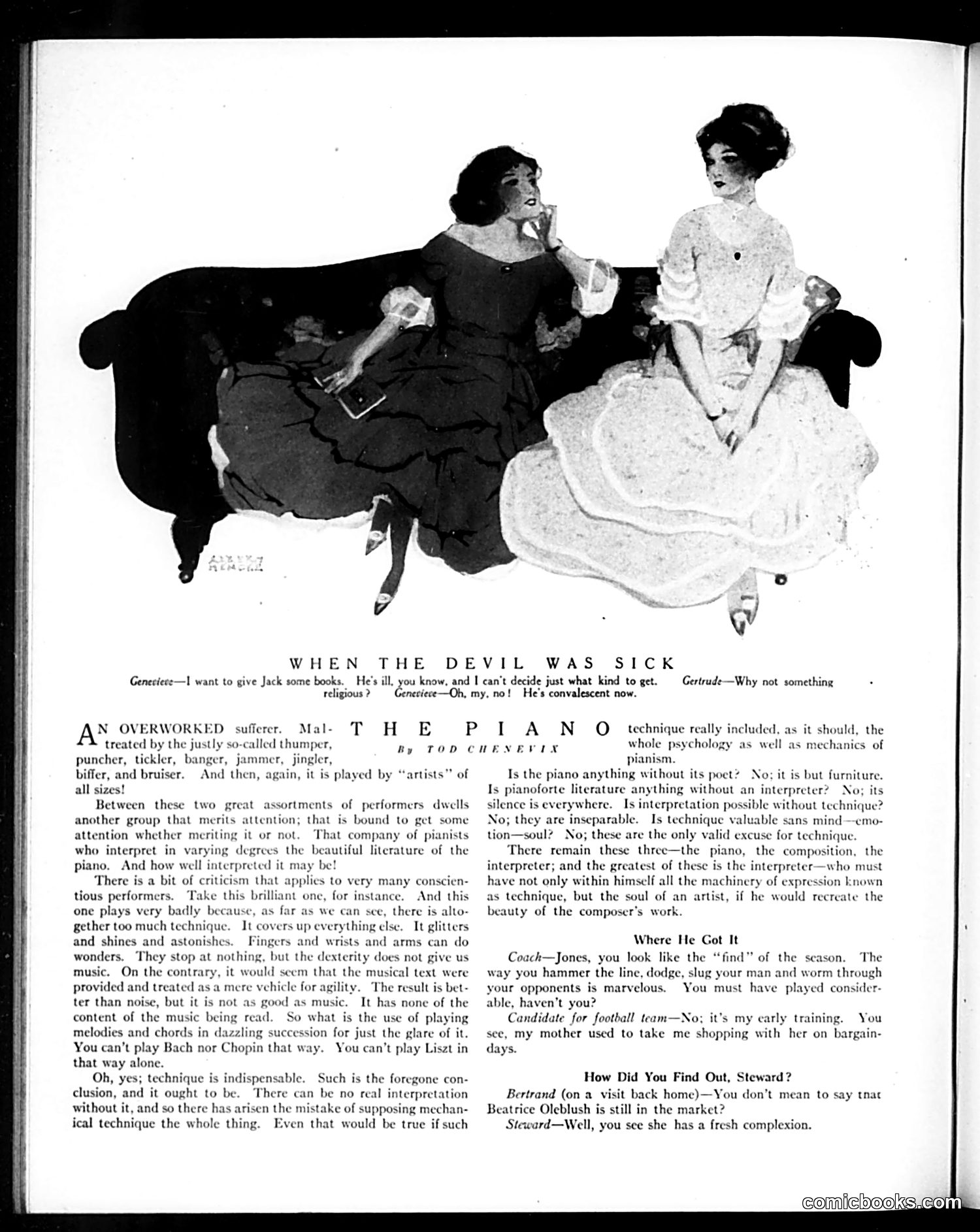
This page contains three satirical pieces typical of early 20th-century American humor: **"When the Devil Was Sick"** (illustrated): Two women on a sofa discuss gift books for an ill man named Jack. The satire plays on the proverb "When the Devil was sick, the Devil a monk would be"—suggesting people reform temporarily during illness. The joke implies Jack's convalescence won't last; his reformation is temporary. **"The Piano" (center article)**: A serious critique of piano technique vs. artistry. The author argues that mere technical dexterity without emotional depth and musical understanding produces "glitters and shines" but not true music. This wasn't political satire but cultural commentary on performance standards valued by Judge's educated readership. **Two brief comedic dialogues** at bottom: "Where He Got It" jokes that a football player's aggressive style comes from accompanying his mother shopping on bargain days. "How Did You Find Out, Steward?" implies a woman is "still in the market" (unmarried) because of her fresh complexion—a backhanded compliment suggesting appearance alone won't secure marriage.
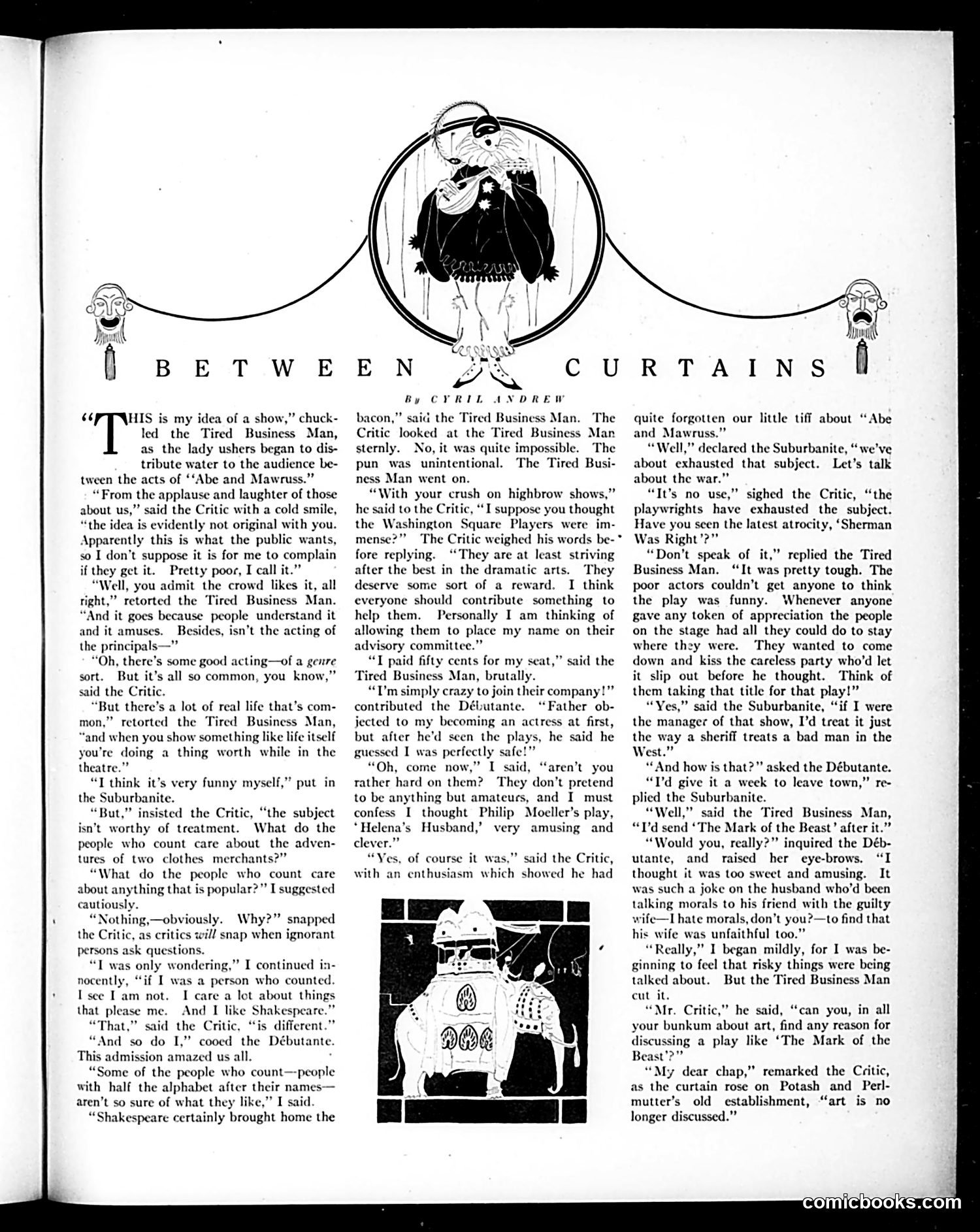
This satirical dialogue depicts a clash between cultural elites and ordinary theatergoers. The **Critic** represents snobbish intellectuals who dismiss popular entertainment as unworthy—here, the play "Abe and Mawruss" (a comedy about two Jewish garment merchants). He champions the **Washington Square Players**, an experimental avant-garde theater company, and dismisses commercial plays as artistically beneath consideration. The **Tired Business Man** and **Suburbanite** represent average audiences who actually *enjoy* accessible entertainment reflecting real life. The satire ridicules the Critic's pretentious gatekeeping: he condescends to ordinary people's tastes while ironically admitting he secretly liked the very play he publicly scorned. The underlying joke attacks cultural snobbism—the assumption that "people who count" possess superior taste. The page suggests that popular theater serving general audiences has genuine value, despite critical dismissal.
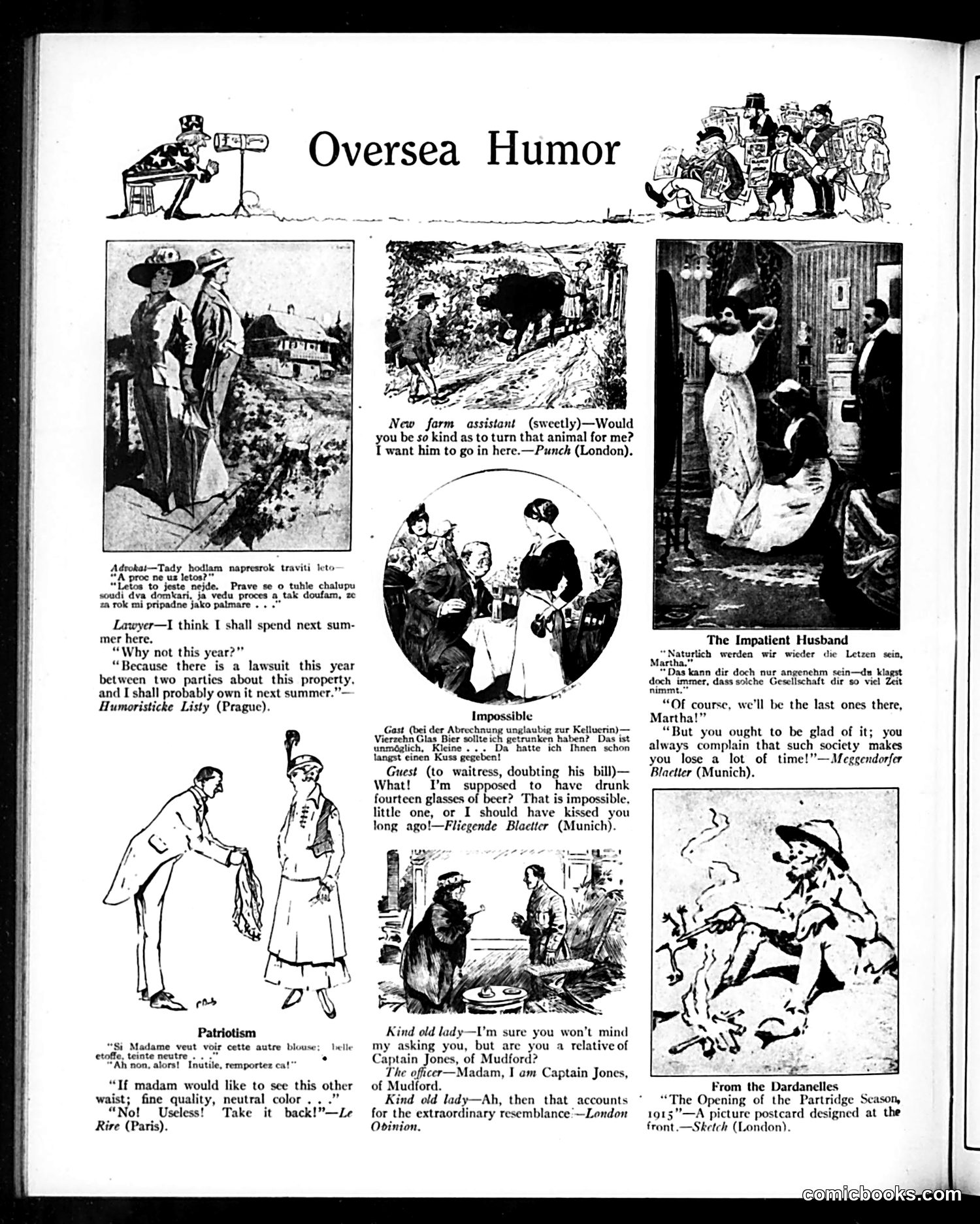
This page collects satirical cartoons from European humor magazines, showcasing international comedy circa 1913. The jokes target universal human follies: **"Patriotism"** (Paris): A woman refuses a neutral-colored blouse, demanding patriotic colors instead—satirizing nationalist fervor during pre-WWI tension. **"Impossible"** (Munich): A drunk guest disputes his beer bill, claiming he'd have kissed the waitress if he'd actually drunk that much—crude humor about intoxication and loose morals. **"The Impatient Husband"** (Munich): A husband complains social events waste his time, though his wife notes he always complains about them anyway—domestic comedy about contradiction. **"Lawyer's Summer"** (Prague): A lawyer plans to vacation where a property lawsuit occurs, hoping to inherit it—dark humor about legal corruption. The "Dardanelles" postcard references the 1915 WWI campaign, making dark jokes about partridge hunting near a military front. These represent Judge magazine's international satirical exchange showing European perspectives on nationalism, class, marriage, and wartime attitudes.
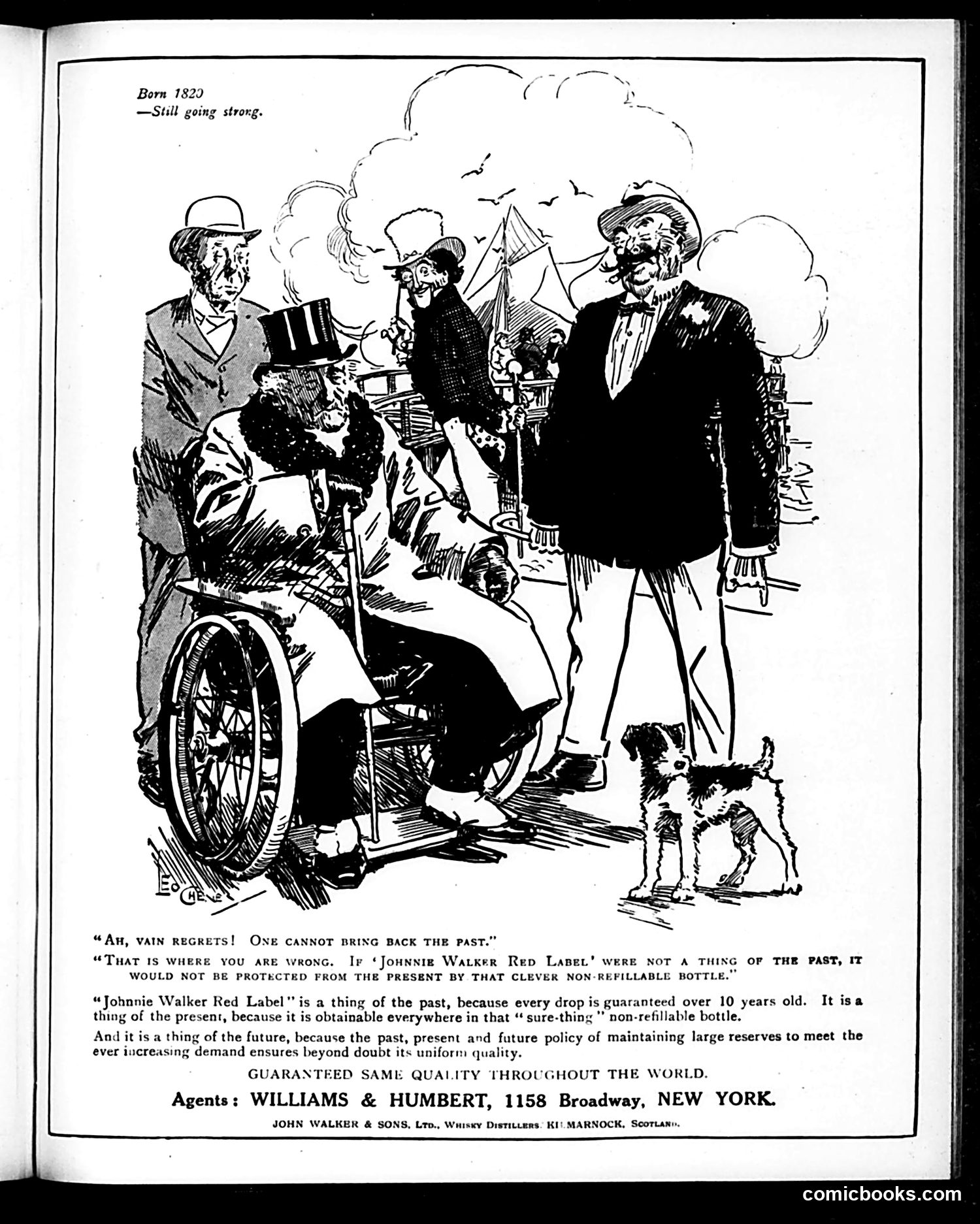
This page is primarily an **advertisement for Johnnie Walker whisky**, not political satire. The cartoon depicts well-dressed gentlemen discussing an aging bottle, with the caption playing on the phrase "one cannot bring back the past." The ad's clever conceit: Johnnie Walker Red Label is simultaneously a "thing of the past" (aged 10+ years), present (widely available in non-refillable bottles), and future (large reserves guarantee consistent quality). The "Born 1829" reference indicates the brand's founding date, emphasizing longevity and tradition. The non-refillable bottle detail was a marketing point—it prevented dilution or refilling with inferior product, a common fraud concern of the era. The small dog and nautical imagery evoke leisure and respectability. This represents **early 20th-century advertising** in a satirical magazine, using wit and wordplay rather than hard sell to promote premium Scottish whisky to an American audience.
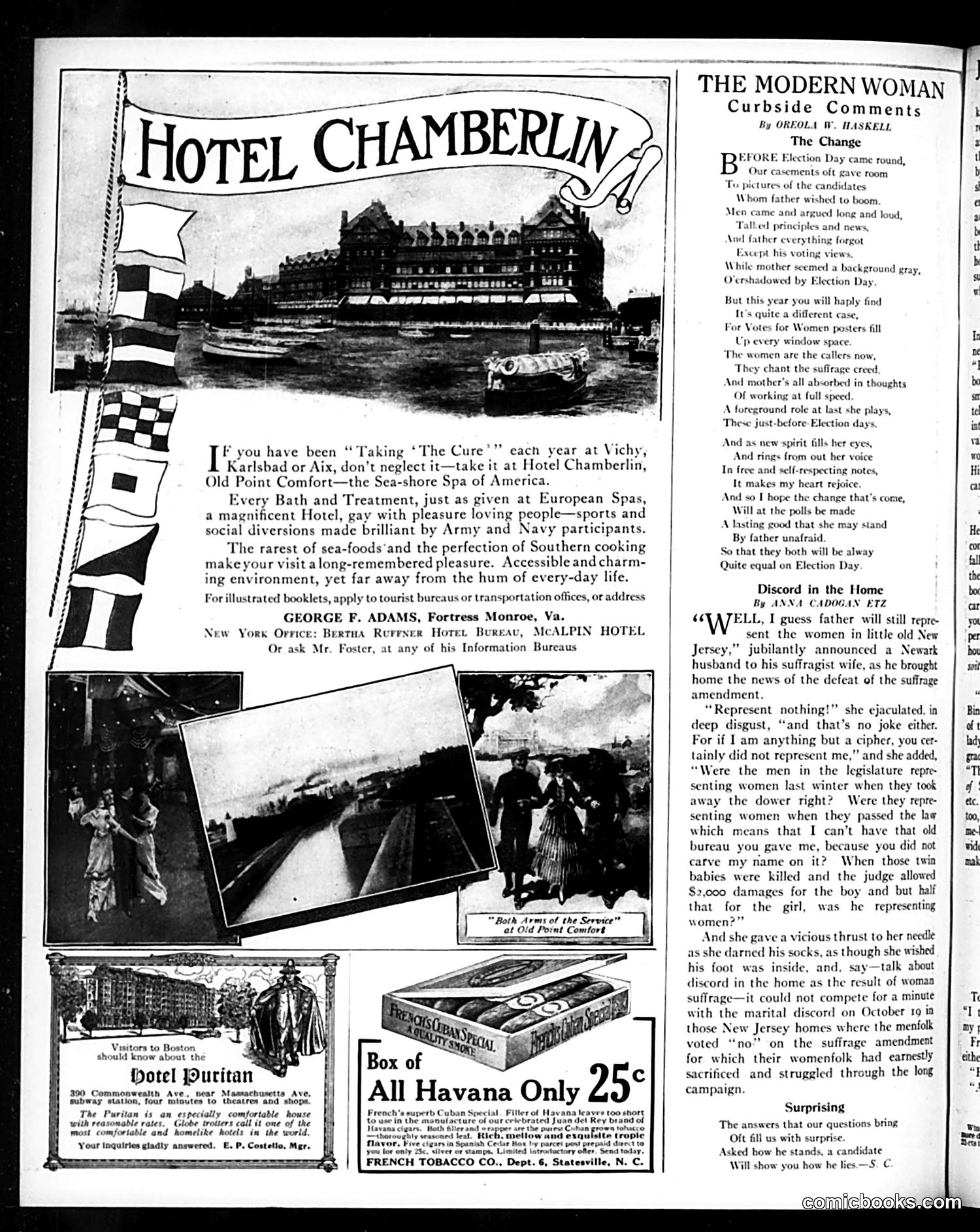
This page from *Judge* magazine contains two distinct pieces reflecting early 1900s women's suffrage debates: **"The Modern Woman" section** presents contrasting poems about how women's roles shifted during election campaigns. "The Change" celebrates how suffrage activism elevated women from passive background figures to engaged political participants, energizing their voices. "Discord in the Home" satirizes the opposite: a husband who claims to "represent" his wife politically while she points out he never actually voted for her interests—citing concrete examples like property rights and unequal legal damages for their children. The satire's target is **anti-suffrage men** who argued women didn't need voting rights because husbands represented family interests. The wife's angry needle-work and catalog of legal inequities expose this logic as absurd. The left side contains **hotel advertisements**, unrelated to the political content—typical of magazine layout from this era. The page reflects heated debates surrounding women's suffrage in the early 20th century, likely around state-level voting amendments.
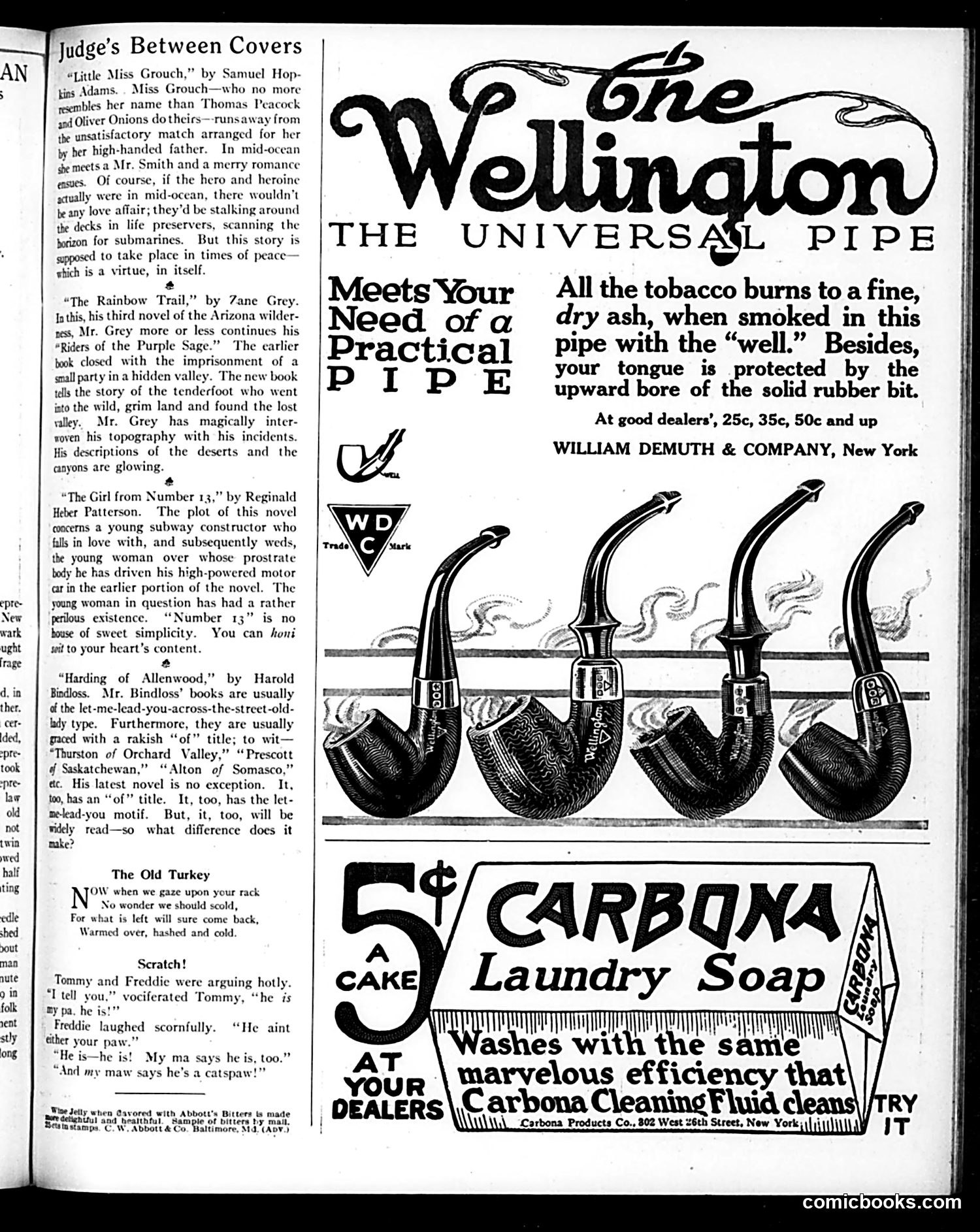
This page from Judge magazine is primarily **advertising and book reviews**, not political satire. The left column contains book reviews of contemporary novels: Samuel Hopkins Adams's "Little Miss Grouch" (romance disrupted by ocean setting), Zane Grey's "The Rainbow Trail" (Arizona wilderness adventure), and others. The reviews use lighthearted mockery typical of literary criticism—poking fun at plot contrivances and formulaic storytelling. The right side features **product advertisements**: The Wellington pipe (claiming superior ash and tongue protection), Carbona laundry soap (5¢ cakes), and Abbott's Bitters. These ads use typical early-20th-century marketing language emphasizing practical benefits and affordability. The bottom includes two brief humorous pieces: "The Old Turkey" (a joke about Thanksgiving leftovers) and "Scratch!" (children's wordplay about "catspaw"). There is **no political cartoon or social satire** on this page—it's a standard magazine spread mixing editorial content with paid advertisements.
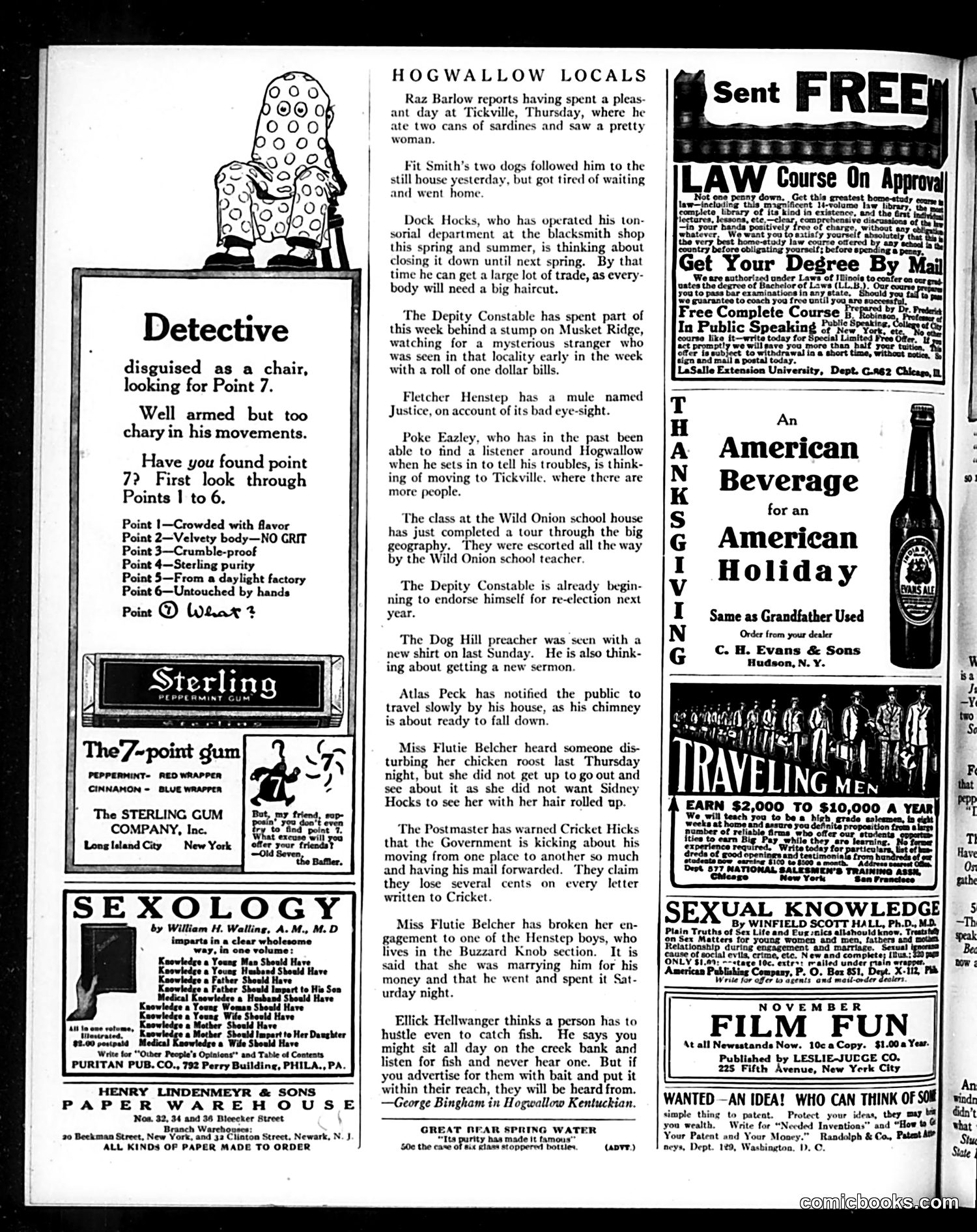
This is a typical Judge magazine page mixing advertising with humor content. **The Main Cartoon**: A detective disguised as a chair searches for "Point 7," a visual pun for Sterling Gum's advertising campaign. The joke is straightforward product placement dressed as a puzzle—readers must identify six qualities of Sterling gum before finding the hidden detective/chair. **"Hogwallow Locals"**: A rural humor column (common in early 1900s magazines) satirizing small-town life through exaggerated anecdotes. The jokes target provincial characters: a preacher getting new clothes, a postmaster moving frequently, a woman concerned about her hair-rolling being seen. The humor relies on gentle mockery of rural simplicity and small-town gossip. **Surrounding Advertisements**: Mail-order degrees, self-help books on sexuality (marketed as "knowledge"), gum, paper supplies, and beverages fill the margins—typical period advertising targeting middle-class readers. The page reflects early 20th-century American mass media: commercial satire blended with nostalgic rural humor and dubious correspondence-course ads.
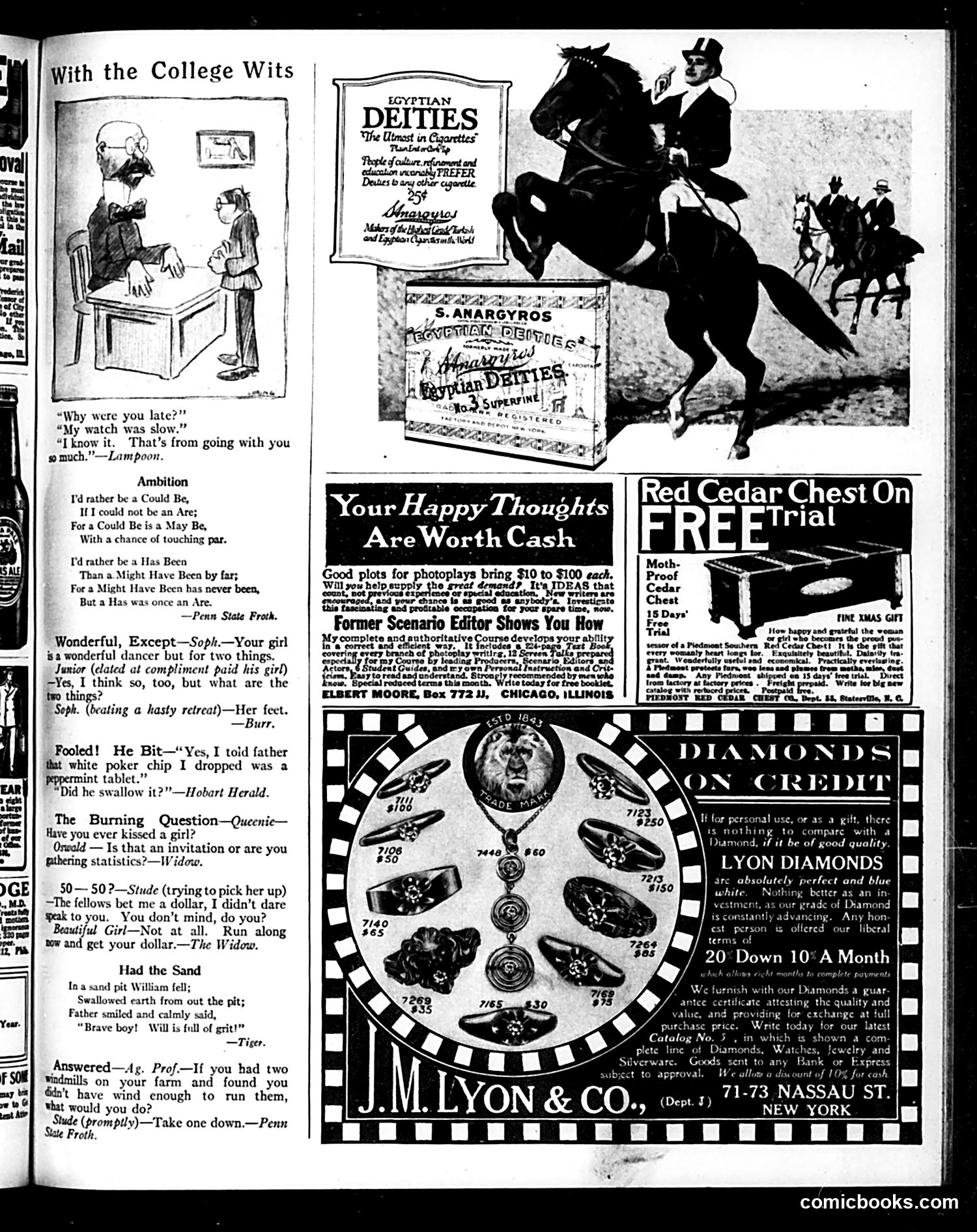
This page consists primarily of **college humor** and **advertisements** rather than political satire. The "College Wits" section features jokes sourced from various college humor publications (Penn State Froth, Hobart Herald, etc.). These are lightweight, pun-based gags about dating, watches, and farm life—typical of 1920s collegiate comedy. The humor relies on wordplay ("Could Be," "Has Been") and physical comedy premises (rejecting a dancer for her feet). The advertisements occupy significant space: Egyptian Deities cigarettes with an equestrian image, a Red Cedar chest trial offer, and J.M. Lyon & Co. diamond jewelry sold on installment ("20 Down 10° A Month"). A notable section promotes **paid story ideas for photoplay scripts**—appealing to readers to submit plot ideas for films at $10-$100 each, suggesting early Hollywood's hunger for content. This appears to be a typical Judge issue mixing light collegiate satire with commercial advertising, rather than the magazine's more pointed political commentary.
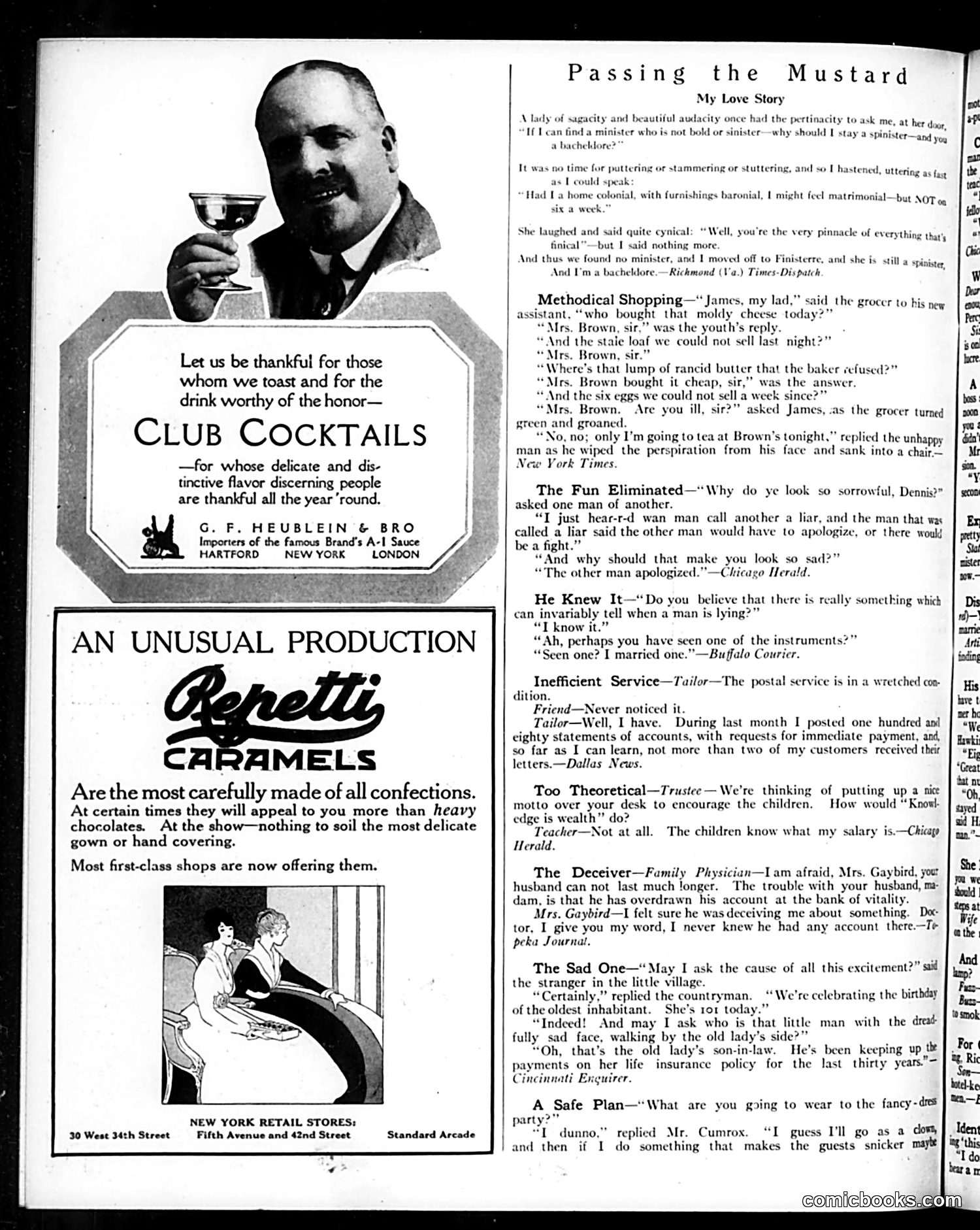
This page is primarily **advertisements and humor columns**, not political cartoons. The **left side** contains two ads: Club Cocktails (promoting a branded cocktail mixer) and Benetti Caramels (emphasizing their quality and cleanliness—notably that they won't soil a woman's delicate gloves, reflecting 1910s-20s gender norms). The **right side** features short humorous anecdotes typical of Judge magazine's "funny stories" format. These include: - A romantic mishap about a bachelor seeking a minister - A grocer's ironic complaint about selling spoiled goods to Mrs. Brown, then being invited to her house - Brief jokes about lying, postal service inefficiency, school mottos, and marital deception The humor relies on **wordplay, situational irony, and class observations** rather than political satire. "Passing the Mustard" (the column header) appears to be the magazine's humor section title. The content reflects early 20th-century concerns: courtship customs, domestic service, and bureaucratic inefficiency—accessible to contemporary middle-class readers but now requiring historical context.
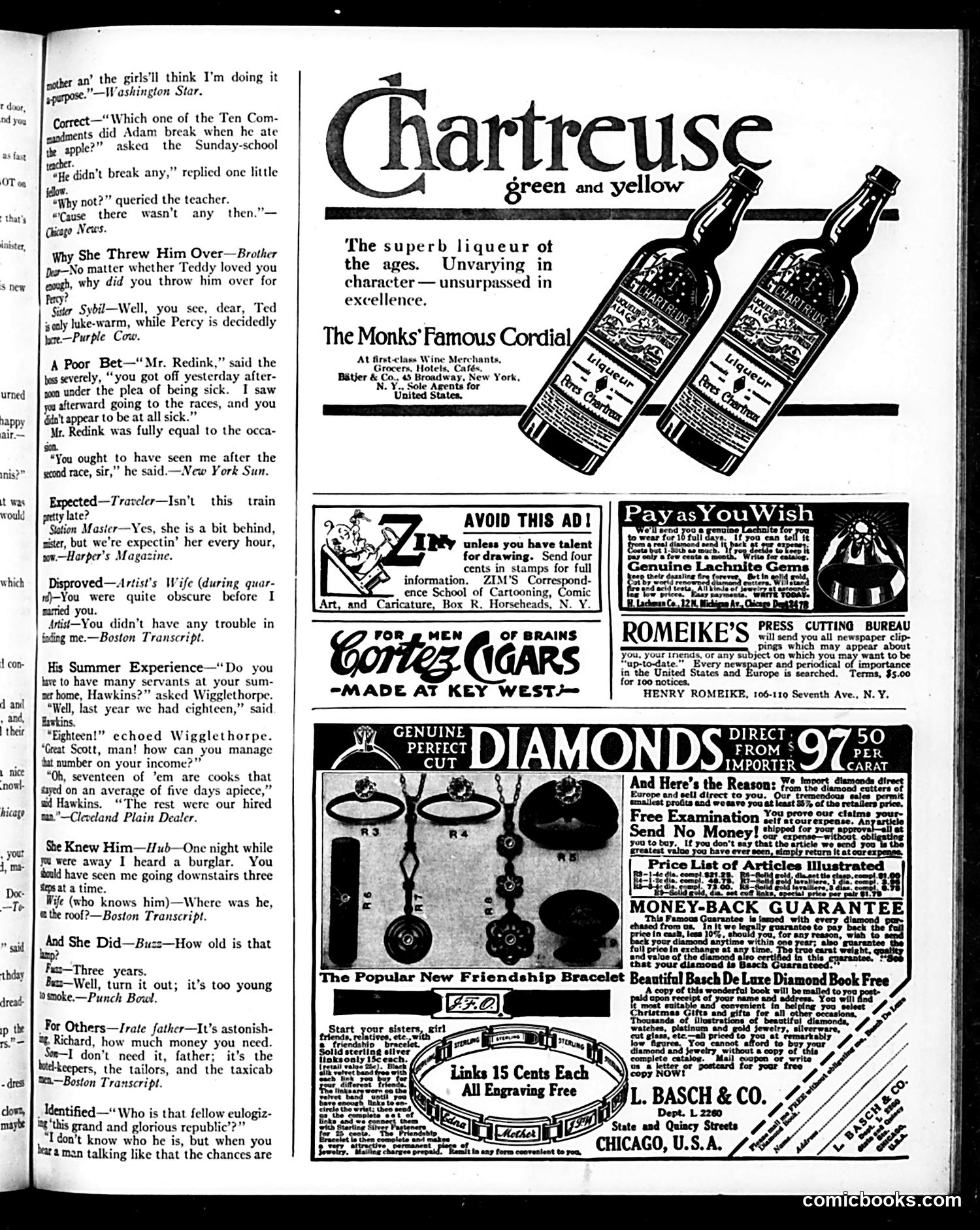
This page from *Judge* magazine is primarily **advertising**, with brief satirical jokes interspersed. The jokes are mild workplace and domestic humor typical of early 20th-century American satire. They include: a teacher's riddle about Adam and the Ten Commandments; a woman choosing one suitor over another based on temperature preferences; an employee caught playing hooky at the races; and marital banter about a wife's knowledge of her husband's cowardice. The advertisements dominate the page, hawking products like Chartreuse liqueur, diamonds, correspondence schools for cartooning, and a newspaper clipping service (Romeike's). One ad explicitly warns readers against responding to similar ads without cartooning talent. The satire is gentle, reflecting middle-class anxieties about work, courtship, and domestic life—nothing explicitly political. The page represents *Judge*'s primary function: selling advertising space to affluent readers while providing light entertainment.
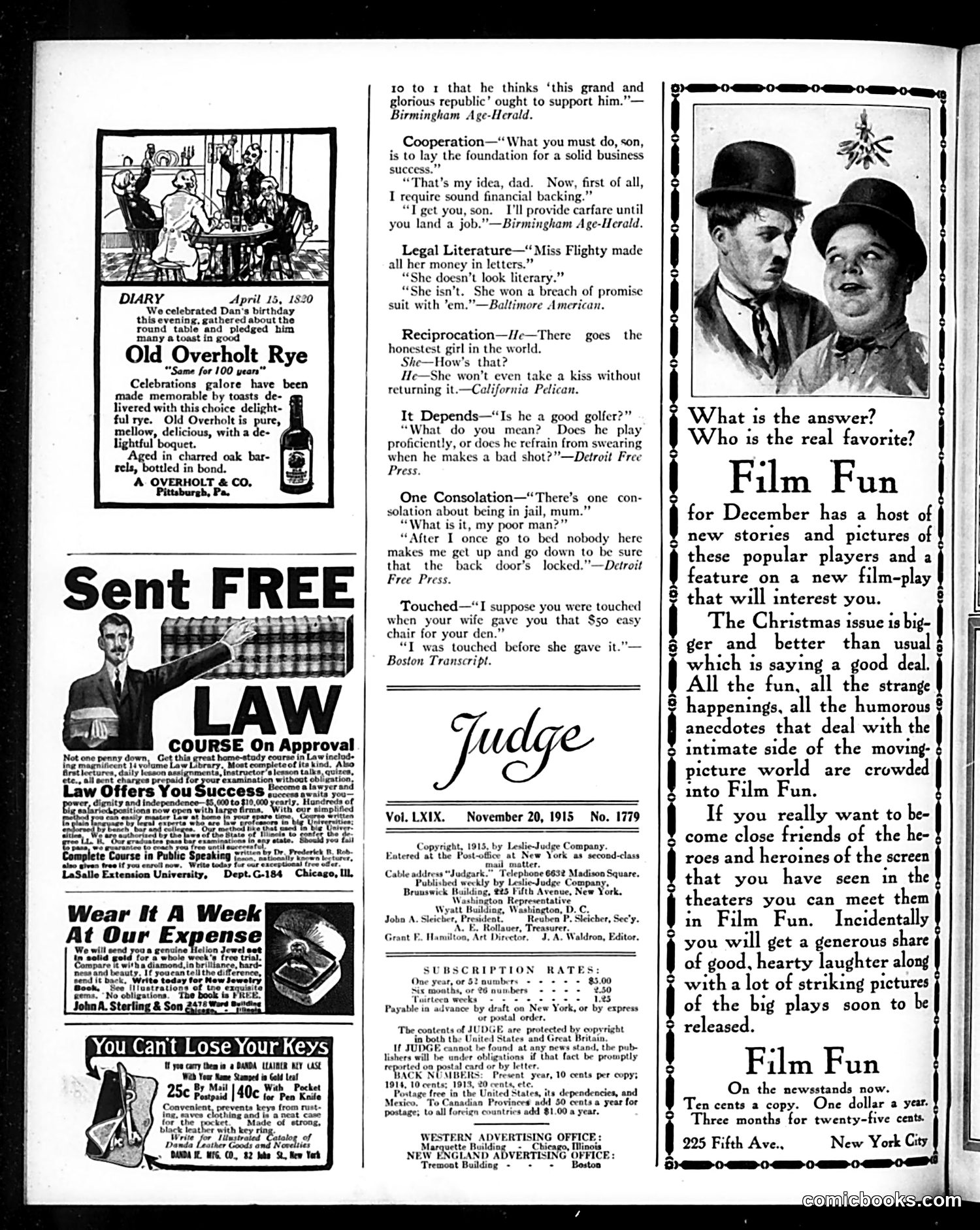
This is primarily a **title/contents page** from Judge magazine (November 20, 1915) with scattered period advertisements and humor snippets rather than coherent political cartoons. The page includes small jokes on social topics of 1915: a "Cooperation" joke mocking a father's stingy job-hunting advice; legal humor about a woman winning a breach-of-promise suit; and workplace/relationship quips. These are generic observations about business, romance, and human nature rather than specific political satire. The extensive advertisements dominate—for whiskey (Overholt Rye), correspondence law courses, costume jewelry, and leather goods—targeting early-1900s readers. A "Film Fun" magazine advertisement promotes movie star gossip and theatrical humor. **The satirical content is minimal and topical only to 1915 middle-class American life**: anxiety about financial backing, dating conventions, and the emerging film industry's celebrity culture. No specific political figures or events are referenced or caricatured.

This page is primarily **advertising and editorial content**, not political satire. It features: **Main Advertisement**: White Rock Mineral Springs water from Waukesha, Wisconsin, with an ornamental illustration of a classical female figure near water—a common branding approach for mineral waters of this era. **The Editorial Section** ("You know these trade-marks through National Periodical Advertising") is an **advertisement for advertising itself**. It argues that national brand advertising and trademarks benefit consumers by: - Standardizing quality - Reducing prices through economies of scale - Holding manufacturers accountable (their reputation depends on product quality) **The Irony**: Judge magazine runs this pro-advertising piece while displaying three major brand logos (Diaco, Postum Cereal, Santa Fe railroad)—proving the article's own point. There is no political cartoon or satire here. This is a straightforward advocacy page promoting national advertising as economically beneficial, likely reflecting Judge's business model as an advertising-supported publication. The tone is earnest rather than humorous.
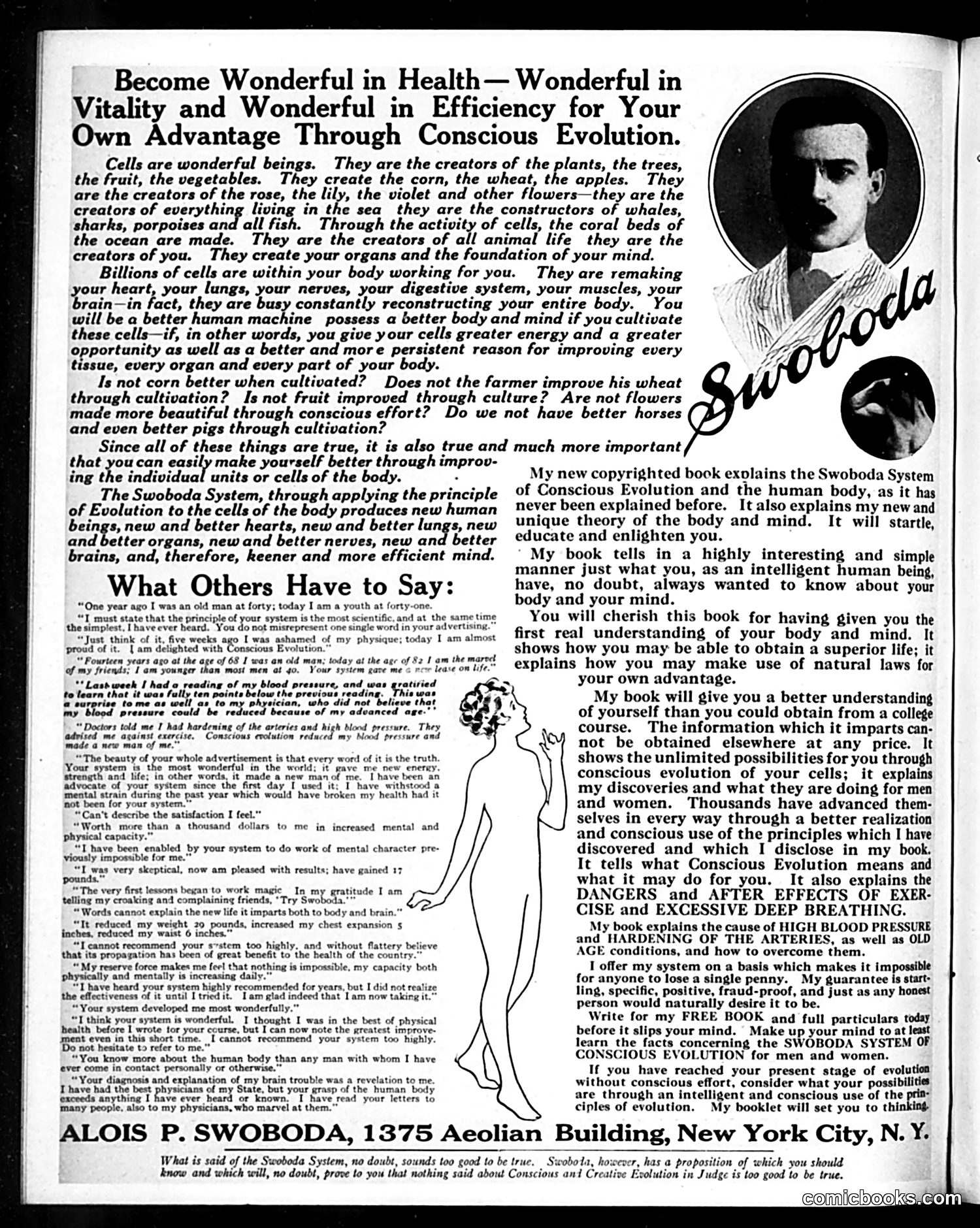
This page is primarily a **health advertisement**, not satirical content. It promotes the "Swoboda System of Conscious Evolution"—a pseudo-scientific self-improvement scheme claiming that by consciously cultivating bodily cells through unnamed methods, people could achieve better health, vigor, and mental capacity. The advertisement uses **social Darwinism** rhetoric (cultivation improving organisms) to market what appears to be a mail-order health course. The testimonials from supposed satisfied customers claim dramatic rejuvenation—a 40-year-old becoming youthful, an 82-year-old feeling younger than 60-year-olds. The small illustration shows a simplified female figure, likely meant to represent the "improved" human result. **Judge magazine context**: While Judge was satirical, it also carried paid advertising. This page may appear in Judge either as genuine advertising or as **implicit satire**—presenting an obvious health scam to readers who would recognize its dubious claims. Without confirmation of Judge's editorial stance on this particular advertiser, the intent remains unclear.