
Judge, 1915-11-20 · page 4 of 28
Judge — November 20, 1915 — page 4: what you’re looking at
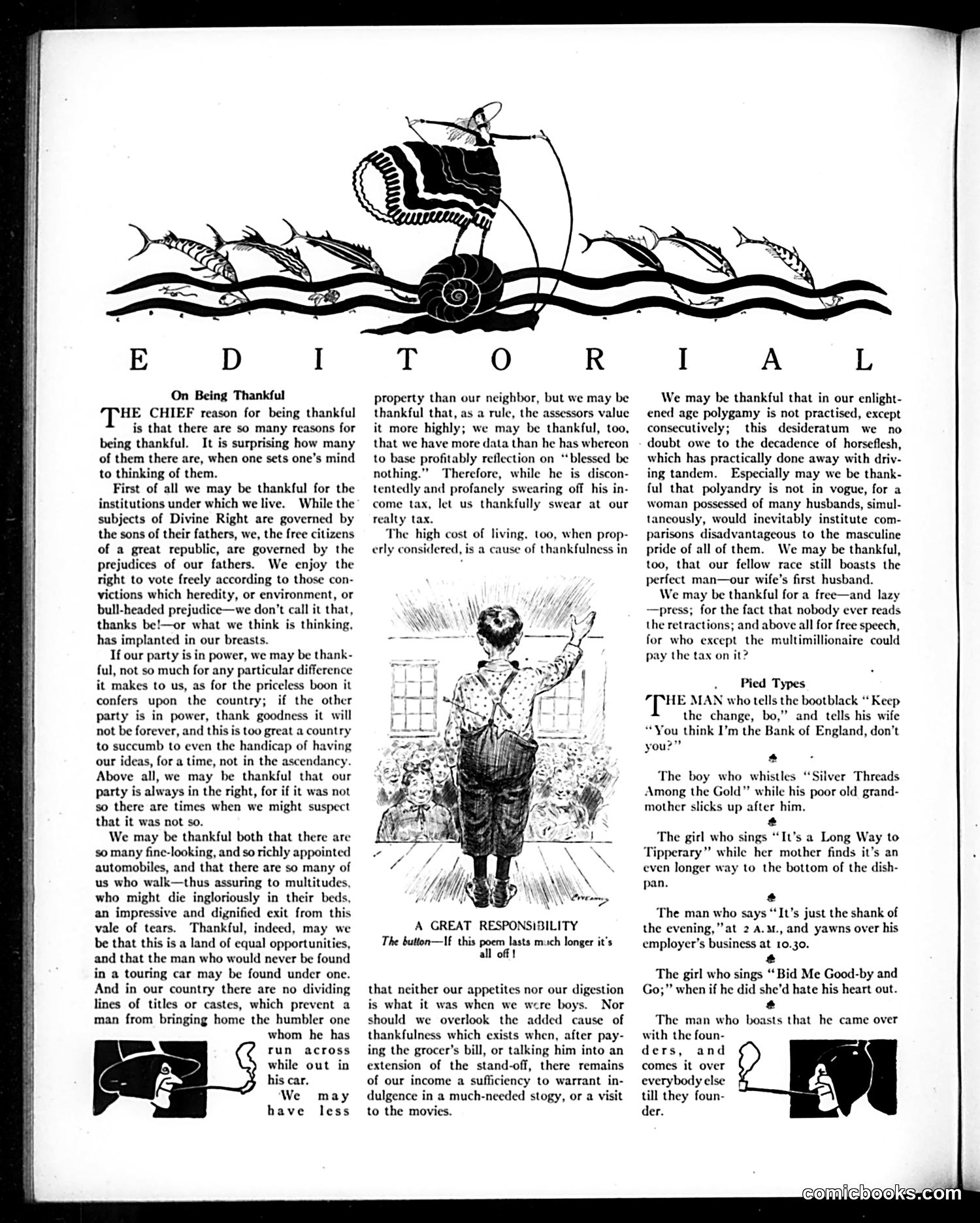
A restored page from Judge, 1915-11-20. Page through the whole issue in the reader above.
📄 Transcribed text from this page (OCR, searchable)
Machine-transcribed from the original scan — historical spelling and the odd misread are preserved.
On Being Thankful THE CHIEF reason for being thankful is that there are so many reasons for being thankful. It is surprising how many of them there are, when one sets one’s mind to thinking of them. First of all we may be thankful for the institutions under which we live. While the subjects of Divine Right are governed by the sons of their fathers, we, the free citizens of a great republic, are governed by the prejudices of our fathers. We enjoy the right to vote freely according to those con- victions which heredity, or environment, or bull-headed prejudice—we don’t call it that, thanks be!—or what we think is thinking, has implanted in our breasts. If our party is in power, we may be thank- ful, not so much for any particular difference it makes to us, as for the priceless boon it confers upon the country; if the other party is in power, thank goodness it will not be forever, and this is too great a country to succumb to even the handicap of having our ideas, for a time, not in the ascendancy. Above all, we may be thankful that our party is always in the right, for if it was not so there are times when we might suspect that it was not so. We may be thankful both that there are so many fine-looking, and so richly appointed automobiles, and that there are so many of us who walk—thus assuring to multitudes, who might die ingloriously in their beds, an impressive and dignified exit from this vale of tears. Thankful, indeed, may we be that this is a land of equal opportunities, and that the man who would never be found in a touring car may be found under one. And in our country there are no dividing lines of titles or castes, which prevent a man from bringing home the humbler one whom he has run across while out in his car. We have may less property than our neighbor, but we may be thankful that, as a rule, the assessors value it more highly; we may be thankful, too, that we have more data than he has whereon to base profitably reflection on “blessed be nothing.” Therefore, while he is discon- tentedly and profancly swearing off his in- come tax, let us thankfully swear at our realty tax. The high cost of | erly considered, is a c ing. too, when prop- se of thankfulness in A GREAT RESPONSIBILITY The button—If this poem lasts much longer it's all off ! that neither our appetites nor our digestion is what it was when we were boys. Nor should we overlook the added cause of thankfulness which exists when, after pay- ing the grocer’s bill, or talking him into an extension of the stand-off, there remains of our income a sufficiency to warrant in- dulgence in a much-needed stogy, or a visit to the movies. We may be thankful that in our enlight- ened age polygamy is not practised, except consecutively; this desideratum we no doubt owe to the decadence of horseflesh, which has practically done away with driv- ing tandem. Especially may we be thank- ful that polyandry is not in vogue, for a woman possessed of many husbands, simul- tancously, would inevitably institute com- parisons disadvantageous to the masculine pride of all of them. We may be thankful, too, that our fellow race still boasts the perfect man—our wife’s first husband. We may be thankful for a free—and lazy —press; for the fact that nobody ever reads the retractions; and above all for free speech, for who except the multimillionaire could pay the tax on it? Pied Types THe MAN who tells the bootblack “Keep the change, bo,” and tells his wife “You think I’m the Bank of England, don’t you?” 2 The boy who whistles ‘Silver Threads Among the Gold” while his poor old grand- mother slicks up after him. ¢ The girl who sings “It's a Long Way to Tipperary” while her mother finds it’s an even longer way to the bottom of the dish- pan. ¢ The man who says “‘It’s just the shank of the evening,” at 2 A.a., and yawns over his employer’s business at 10.30. & The girl who sings “‘ Bid Me Good-by and Go;”’ when if he did she'd hate his heart out. & The man who boasts that he came over with the foun- ders, and comes it over everybody else till they foun- der.