
Judge, 1915-11-20 · page 16 of 28
Judge — November 20, 1915 — page 16: what you’re looking at
What you’re looking at
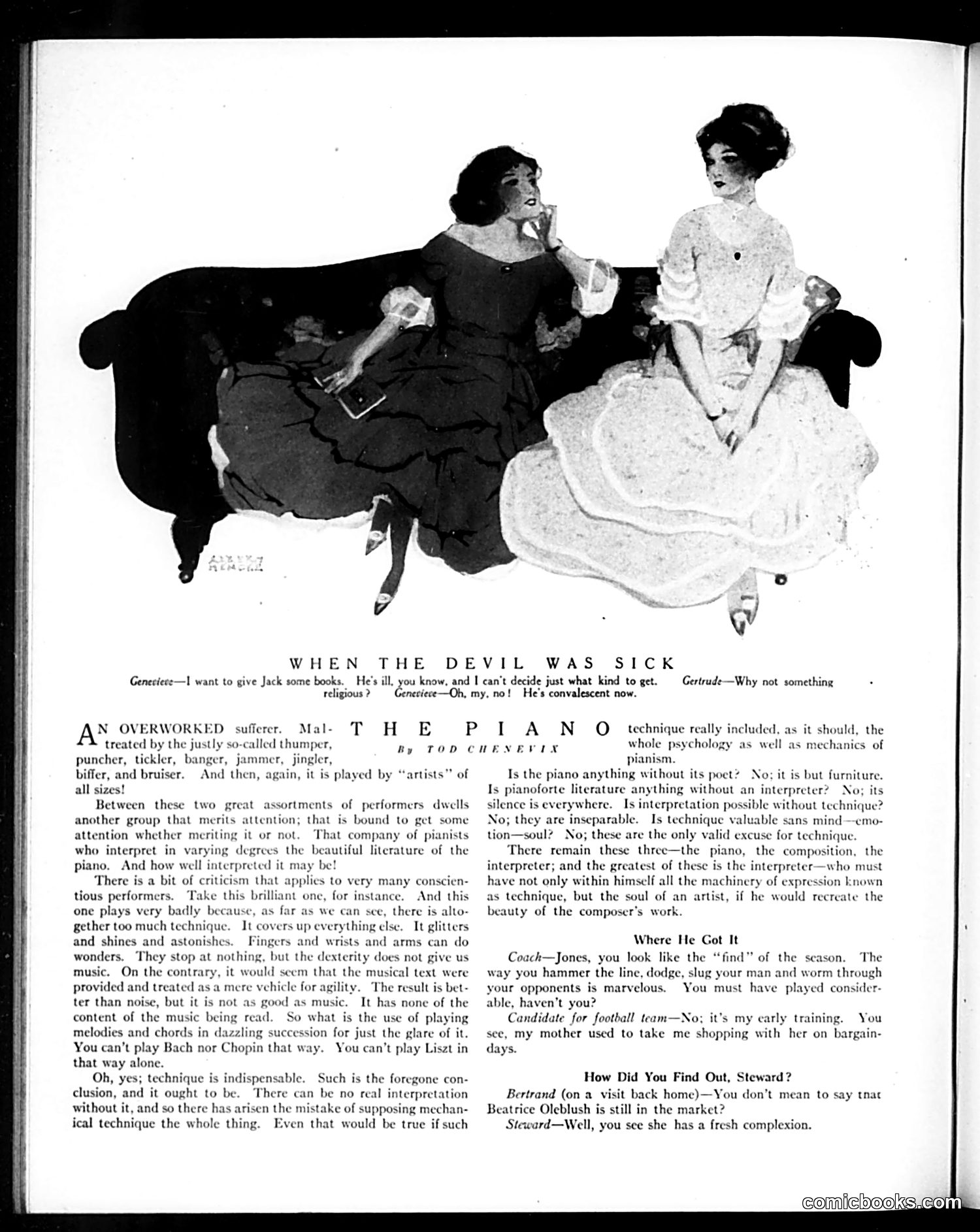
This page contains three satirical pieces typical of early 20th-century American humor: **"When the Devil Was Sick"** (illustrated): Two women on a sofa discuss gift books for an ill man named Jack. The satire plays on the proverb "When the Devil was sick, the Devil a monk would be"—suggesting people reform temporarily during illness. The joke implies Jack's convalescence won't last; his reformation is temporary. **"The Piano" (center article)**: A serious critique of piano technique vs. artistry. The author argues that mere technical dexterity without emotional depth and musical understanding produces "glitters and shines" but not true music. This wasn't political satire but cultural commentary on performance standards valued by Judge's educated readership. **Two brief comedic dialogues** at bottom: "Where He Got It" jokes that a football player's aggressive style comes from accompanying his mother shopping on bargain days. "How Did You Find Out, Steward?" implies a woman is "still in the market" (unmarried) because of her fresh complexion—a backhanded compliment suggesting appearance alone won't secure marriage.
📄 Transcribed text from this page (OCR, searchable)
Machine-transcribed from the original scan — historical spelling and the odd misread are preserved.
WHEN THE DEVIL WAS SICK He's ill, you know, and I can’t decide just what kind to get. Geneviete—1 want to give Jack some books. religious ? N OVERWORKED sufferer. Mal- treated by the justly so-called thumper, iy puncher, tickler, banger, jammer, jingler, biffer, and bruiser. And then, again, it is played by “artists” of all sizes! Between these two great assortments of performers dwells another group that merits attention; that is bound to get some attention whether meriting it or not. That company of pianists who interpret in varying degrees the beautiful literature of the piano. And how well interpreted it may be! There is a bit of criticism that applies to very many conscien- tious performers. Take this brilliant one, for instance. And this one plays very badly because, as far as we can sce, there is alto- gether too much technique. It covers up everything else. It glitters and shines and astonishes. Fingers and wrists and arms can do wonders. They stop at nothing, but the dexterity does not give us On the contrary, it would seem that the musical text were provided and treated as a mere vehicle for agility. The result is bet- ter than noise, but it is not as good as music. It has none of the content of the music being read. So what is the use of playing melodies and chords in dazzling succession for just the glare of it. You can’t play Bach nor Chopin that way. You can’t play Liszt in that way alone. Oh, yes; technique is indispensable. Such is the foregone con- clusion, and it ought to be. There can be no real interpretation without it, and so there has arisen the mistake of supposing mechan- ical technique the whole thing. Even that would be true if such TOD neciece—Oh, my, no! T H E P CHENEVIX Gertrude—Why not something He's convalescent now. I A N O technique really included, as it should, the whole psychology as well as mechanics of pianism. Is the piano anything without its poet? No; it is but furniture. Is pianoforte literature anything without an interpreter? ; its silence is everywhere. Is interpretation possible without technique? No; they are inseparable. Is technique valuable sans mind—-cmo- tion—soul? No; these are the only valid excuse for technique. There remain these three—the piano, the composition, the interpreter; and the greatest of these is the interpreter—who must have not only within himself all the machinery of expression known as technique, but the soul of an artist, if he would recreate the beauty of the composer's work Where He Got It Coach—Jones, you look like the “find” of the season. The way you hammer the line, dodge, slug your man and worm through your opponents is marvelous. You must have played consider- able, haven't you? Candidate for football team—No; it’s my carly training. You see, my mother used to take me shopping with her on bargain- days. How Did You Find Out, Steward? Bertrand (on a visit back home)—You don’t mean to say tnat Beatrice Oleblush is still in the market? Steward—Well, you see she has a fresh complexion.