
A complete issue · 28 pages · 1915
Judge — October 16, 1915
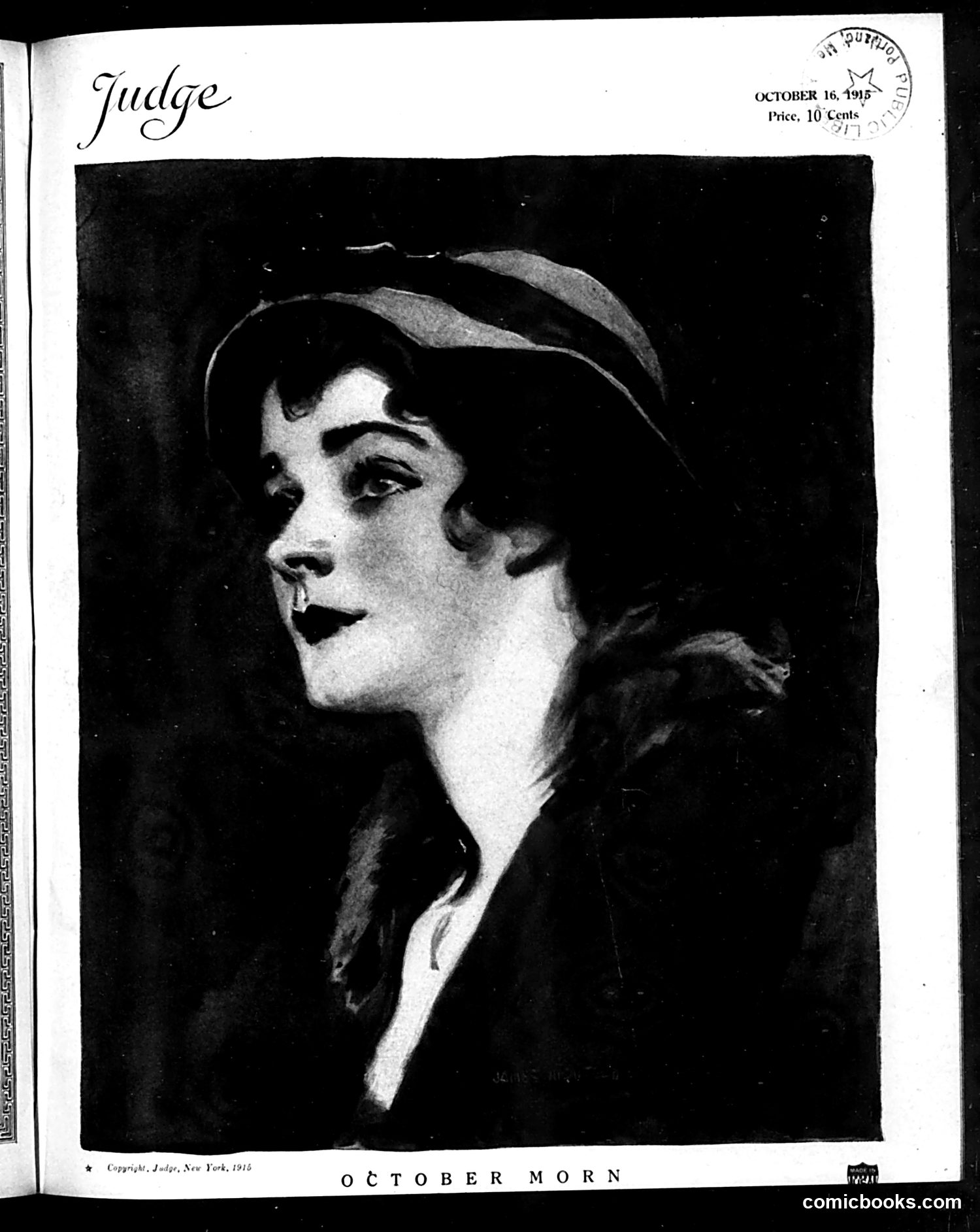
This appears to be a portrait cover rather than a satirical cartoon. The image shows a woman in profile wearing a dark coat and decorative hat with feathers, looking upward with an expression of contemplation or concern. The caption "OCTOBER MORN" likely references a specific cultural moment, possibly a well-known artwork, photograph, or public figure from 1915. Without additional context identifying the specific person or artwork being referenced, I cannot definitively explain the satirical intent. Judge typically used visual parody and social commentary on its covers. The melancholic expression and season title suggest commentary on a contemporary event, public figure, or cultural phenomenon, but the exact reference remains unclear from the image alone.
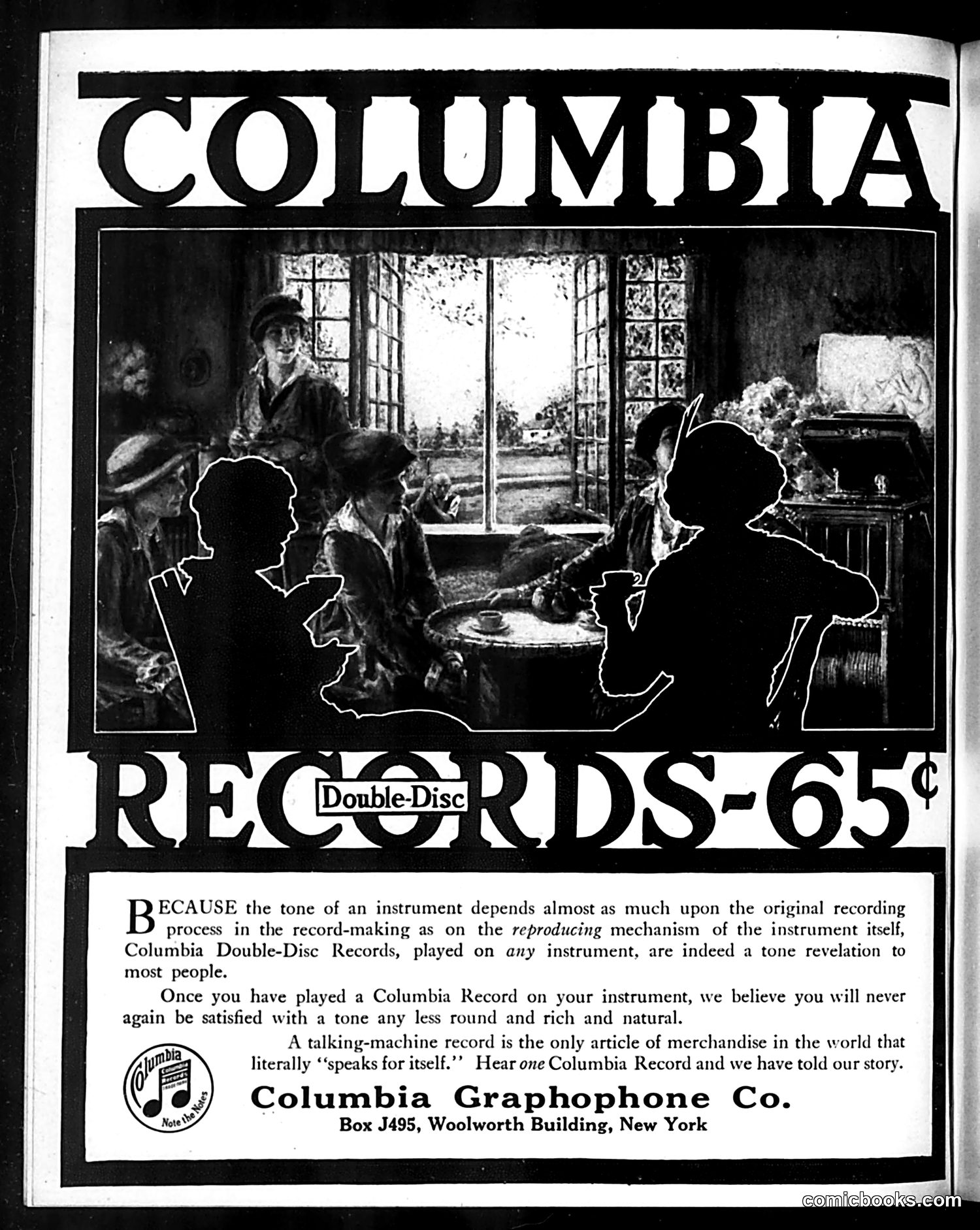
This page is primarily a **Columbia Records advertisement**, not political satire. It advertises Columbia Double-Disc Records at 65 cents, emphasizing superior sound quality achieved through their recording process. The image shows silhouetted figures in an elegant interior setting with a piano and large windows, apparently enjoying music together—a lifestyle marketing appeal. The advertisement claims Columbia Records deliver "tone revelation" superior to competitors and promises that hearing one record will convince listeners of its quality. The company address (Box J495, Woolworth Building, New York) and musical note logo are provided for ordering. This represents early 20th-century consumer advertising using aspirational imagery rather than satire or political commentary.
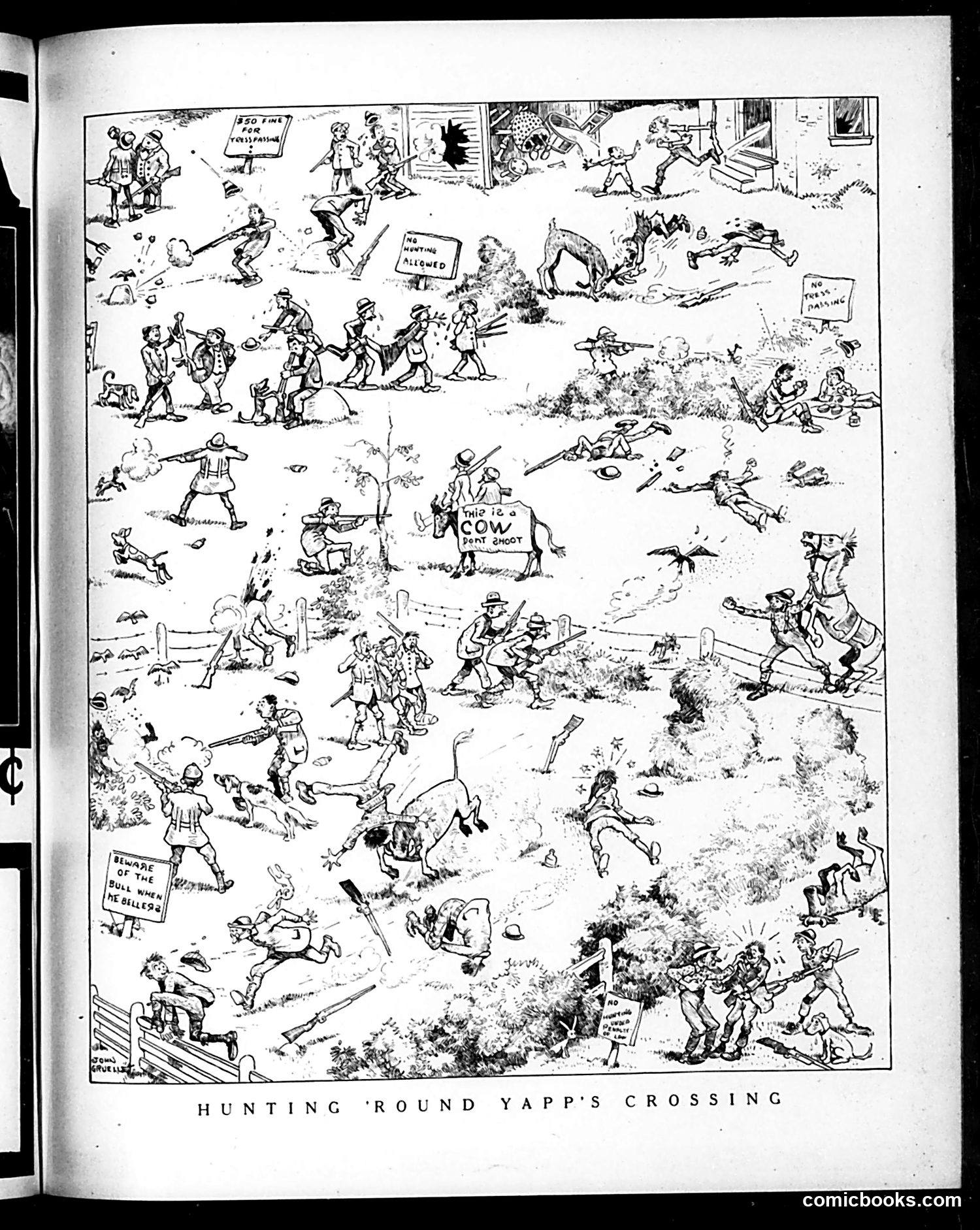
This political cartoon depicts a chaotic scene at what appears to be a rural crossing or border area. The title references "Yapp's Crossing," though the specific historical location isn't immediately clear from the image alone. The cartoon shows numerous figures engaged in various activities—some appear to be hunting, others fighting or fleeing. Signs visible in the illustration include references to rules or regulations being "allowed" or "not allowed," suggesting the satire concerns enforcement (or lack thereof) of rules at this location. The densely-packed composition with multiple simultaneous actions is typical of Judge magazine's style, creating visual chaos that likely comments on disorder, rule-breaking, or lawlessness. Without additional historical context, the specific political target remains unclear, though it appears to satirize either enforcement problems or jurisdictional confusion at this crossing.
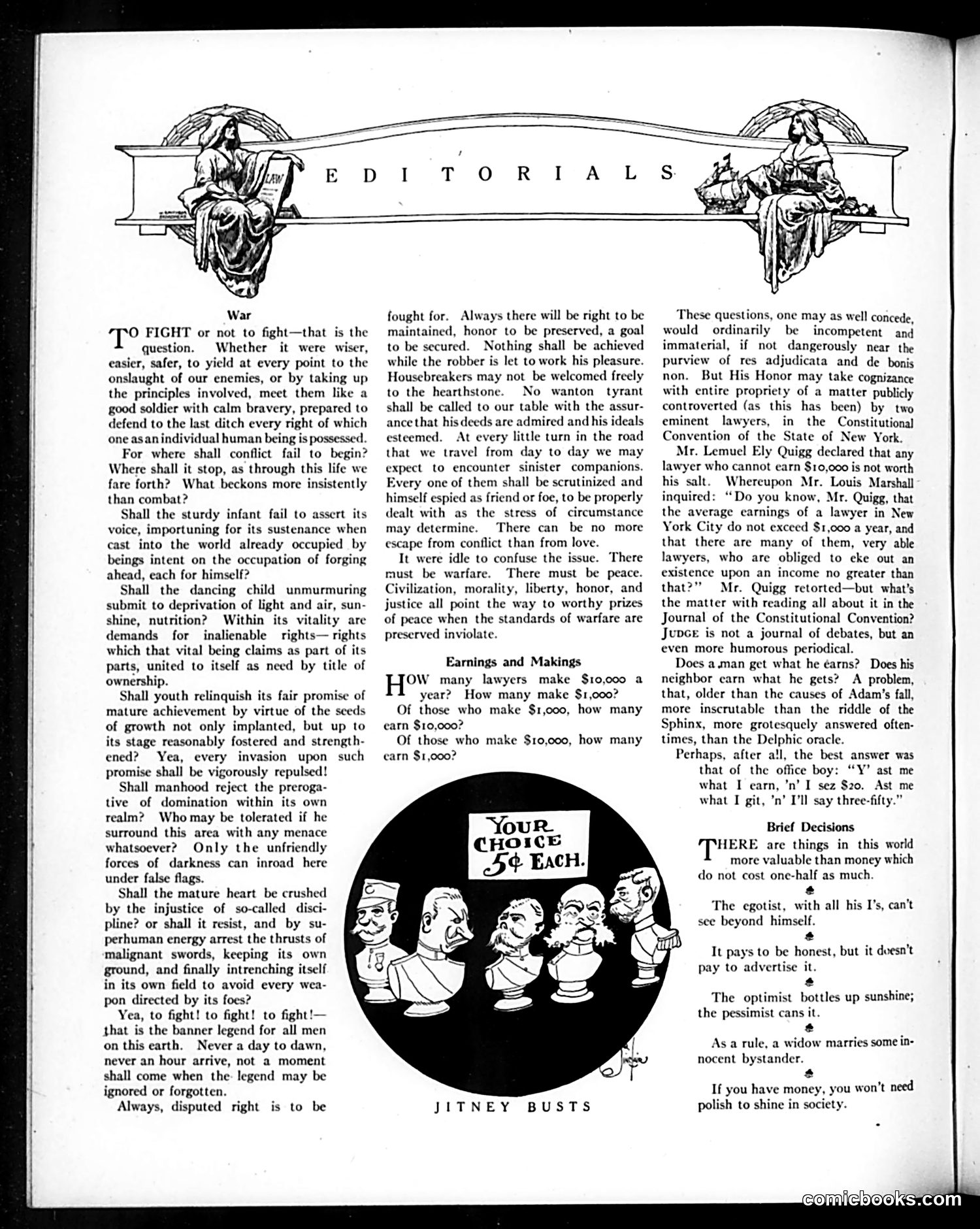
The central cartoon depicts four caricatured men's busts labeled "Jitney Busts," priced at 5¢ each. This appears to mock the "jitney" phenomenon—informal, unlicensed small buses or shared taxis that undercut established transportation monopolies in the early 1900s. The satire targets jitney operators themselves, likely portraying them as worthless or contemptible figures deserving mockery. By presenting their busts as cheap novelties, Judge ridicules both the service and the entrepreneurs behind it. The surrounding editorial content discusses war, morality, and legal/financial questions—suggesting the magazine positioned jitneys as emblematic of broader social disruptions and ethical decline in early 20th-century America. The jitney controversy represented tensions between small operators and established transit companies.
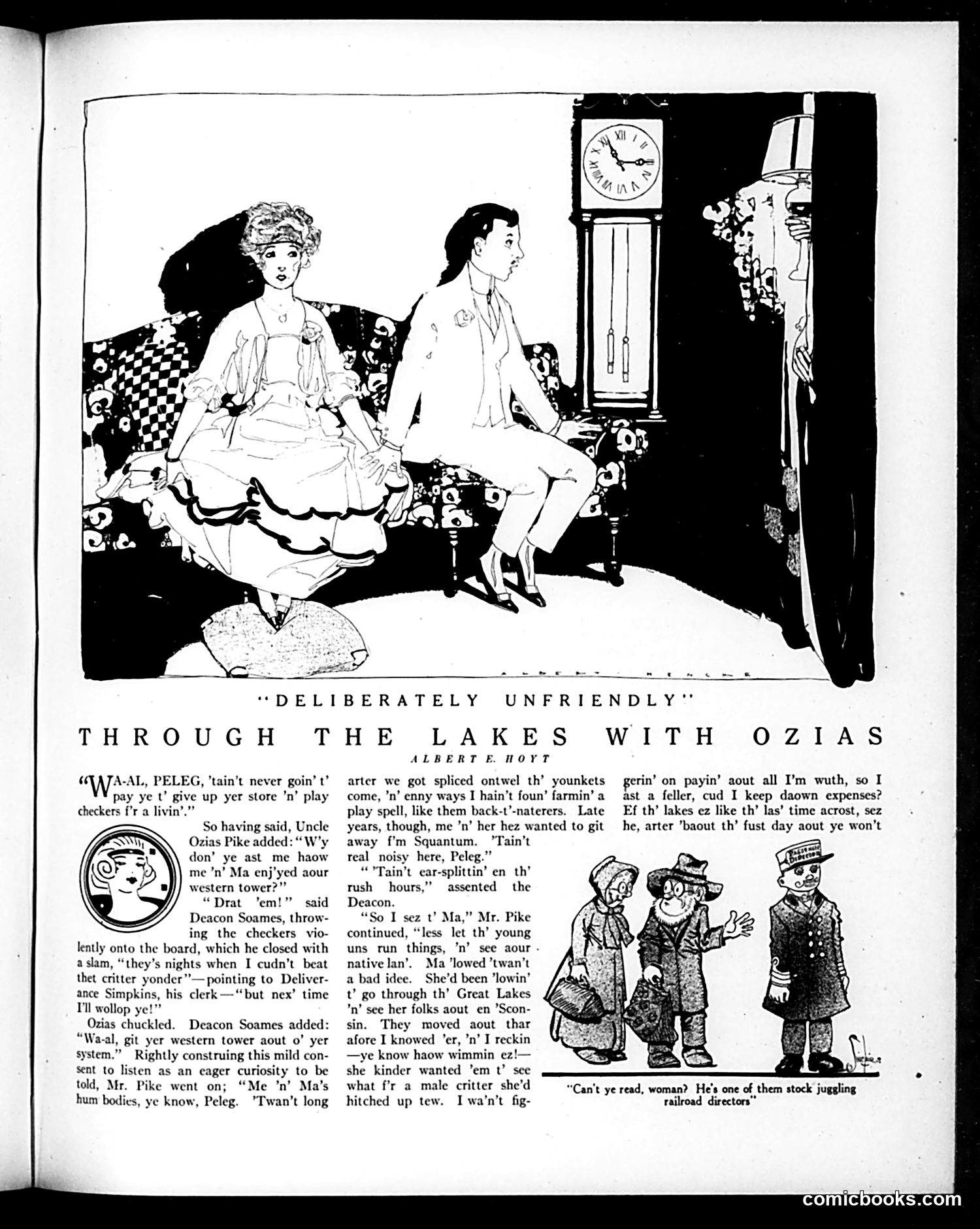
This is a humorous short story titled "Through the Lakes with Ozias," illustrated with a decorative header cartoon and small character sketches. The narrative, by Albert E. Hott, depicts rural American characters discussing a trip through the Great Lakes region. The main illustration shows two fashionably dressed women sitting on a patterned sofa, appearing deliberately unfriendly to each other—this matches the caption "Deliberately Unfriendly." The story features dialect-heavy dialogue between characters named Uncle Ozias Pike, Peleg, and Deacon Soames, employing rural Midwestern speech patterns typical of early 20th-century Judge magazine humor. The bottom illustration shows three characters in period dress. The humor relies on regional stereotypes and colloquial language rather than political commentary. This appears to be lighthearted fiction entertainment rather than political satire.
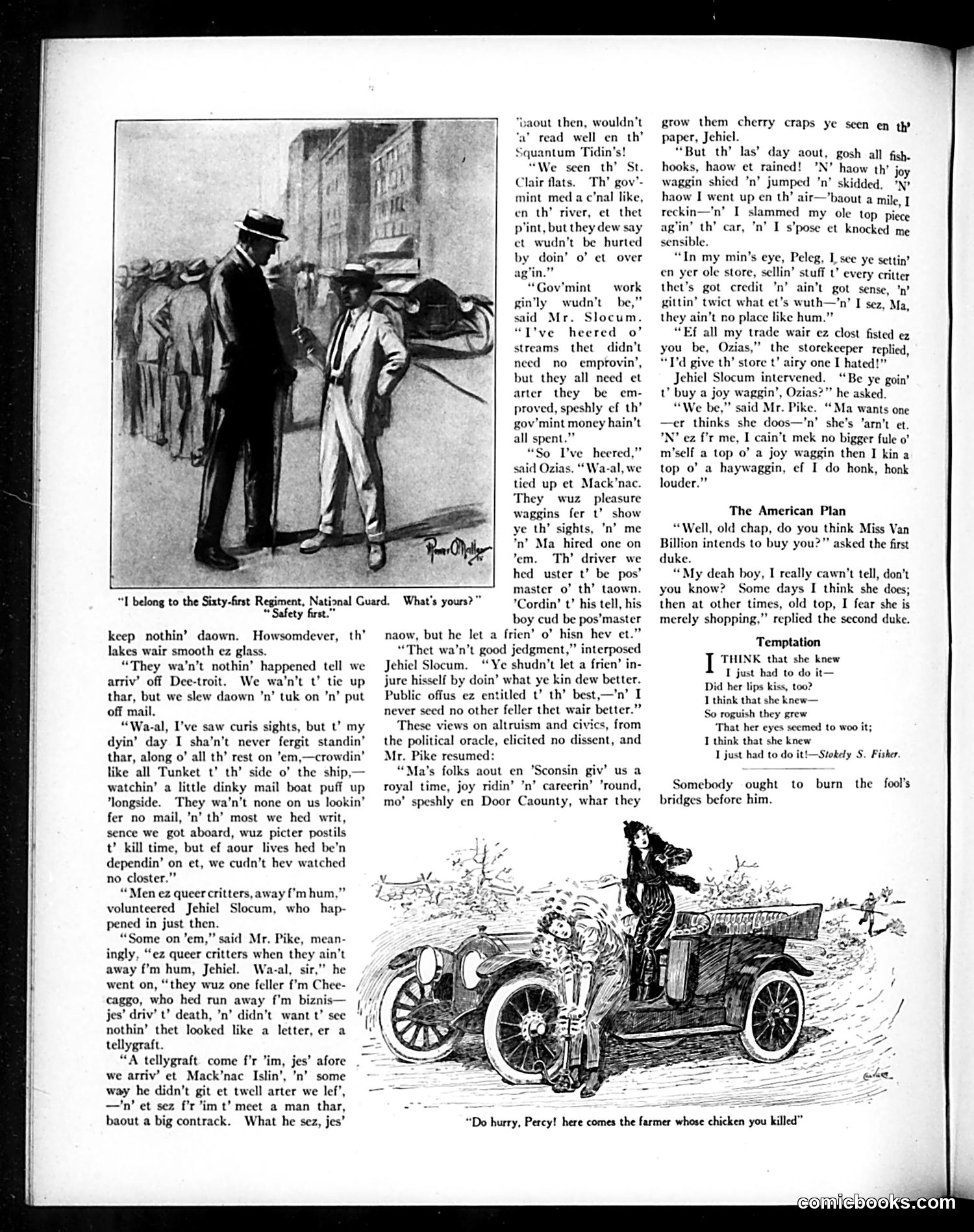
This page presents rural American dialect humor popular in early 20th-century satirical magazines. The main content features two conversational pieces: **Left side**: A dialogue between Mr. Pike and others discussing a mail delivery incident and government infrastructure projects (St. Clair flats canal work), with commentary on civic responsibility and public office. The satire targets corruption—a politician's son receiving a postmaster position through favoritism rather than merit. **Right side**: Two brief satirical sketches. "The American Plan" mocks wealthy American heiresses' marriages to foreign nobility, portraying a duke's uncertainty about marrying "Miss Van Billion" for her money rather than love. Above it, "Temptation" is a sentimental poem excerpt. **Visual elements**: Period photographs/illustrations accompany the text—one showing what appears to be a National Guard member, another depicting an early automobile. The overall tone exemplifies Judge's class-conscious humor, targeting both rural gullibility and urban aristocratic pretension through exaggerated dialect and romantic clichés.
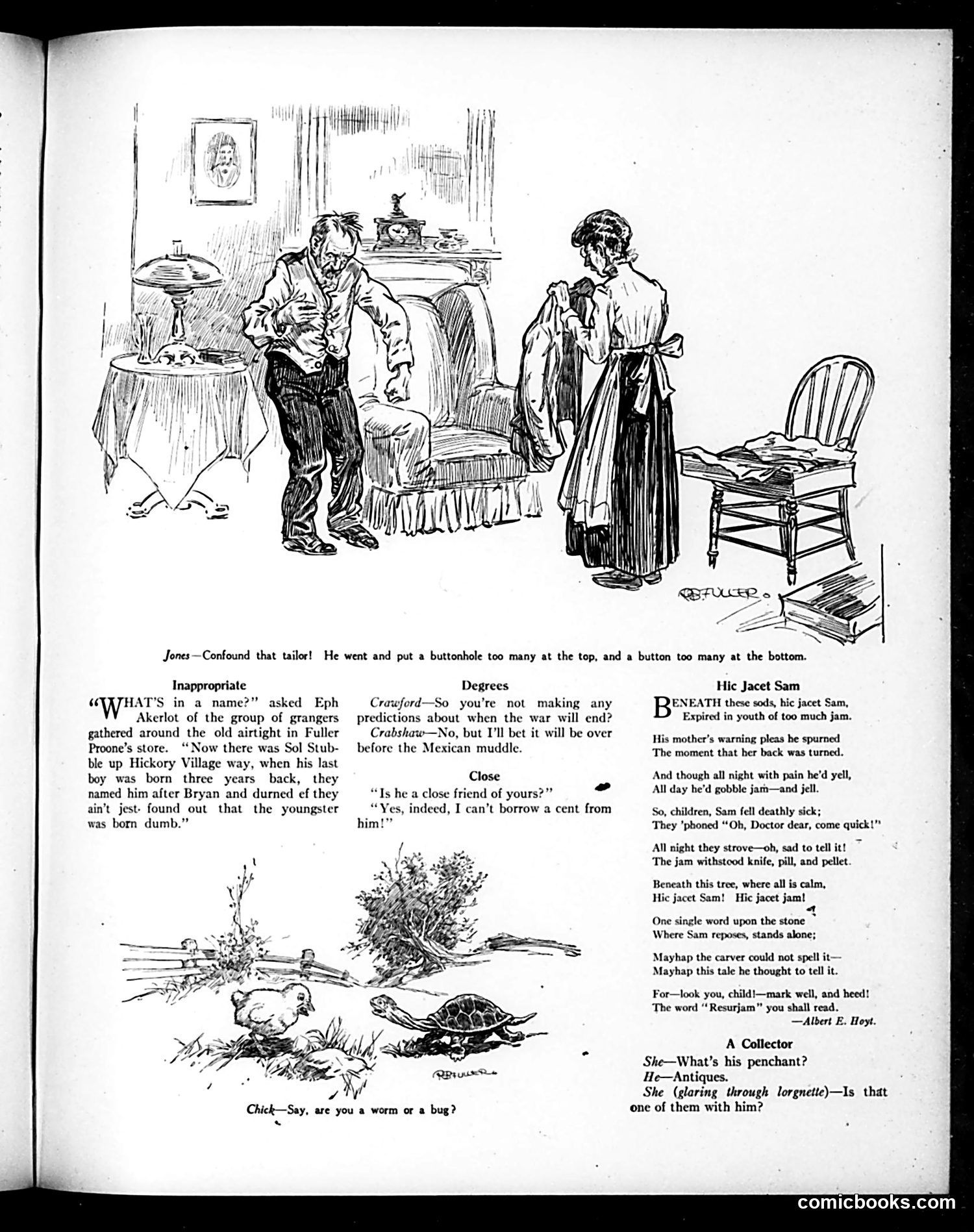
This page contains several unrelated humorous pieces typical of early 20th-century American satirical magazines. **Top cartoon**: A tailor has made an ill-fitting garment with buttonholes misaligned—too many at top, too few at bottom. A domestic comedy about incompetence. **"Inappropriate"**: Rural grangers discuss naming a child "Bryan" (likely William Jennings Bryan, the populist politician). The joke: the child turned out "dumb," implying mockery of Bryan or his supporters. **"Degrees"**: Two men discuss predicting when World War I will end. One quips it'll conclude before the "Mexican muddle" (U.S. border tensions/interventions in Mexico)—suggesting American involvement in Mexico was more intractable than the European war. **"Close"**: A one-liner about a supposed close friend one cannot borrow money from—ironic definition of friendship. **"Hic Jacet Sam"**: A Latin-titled poem (mock-serious, "Here lies Sam") about a boy who died from eating too much jam/jelly, despite his mother's warnings. The punchline: his epitaph reads "Resurjam" (Latin: "I shall rise"), unintentionally punning on resurrection and the jam. **"A Collector"**: A woman, viewing a man through a lorgnette, asks if he collects antiques—then insults him by suggesting *he* is one.
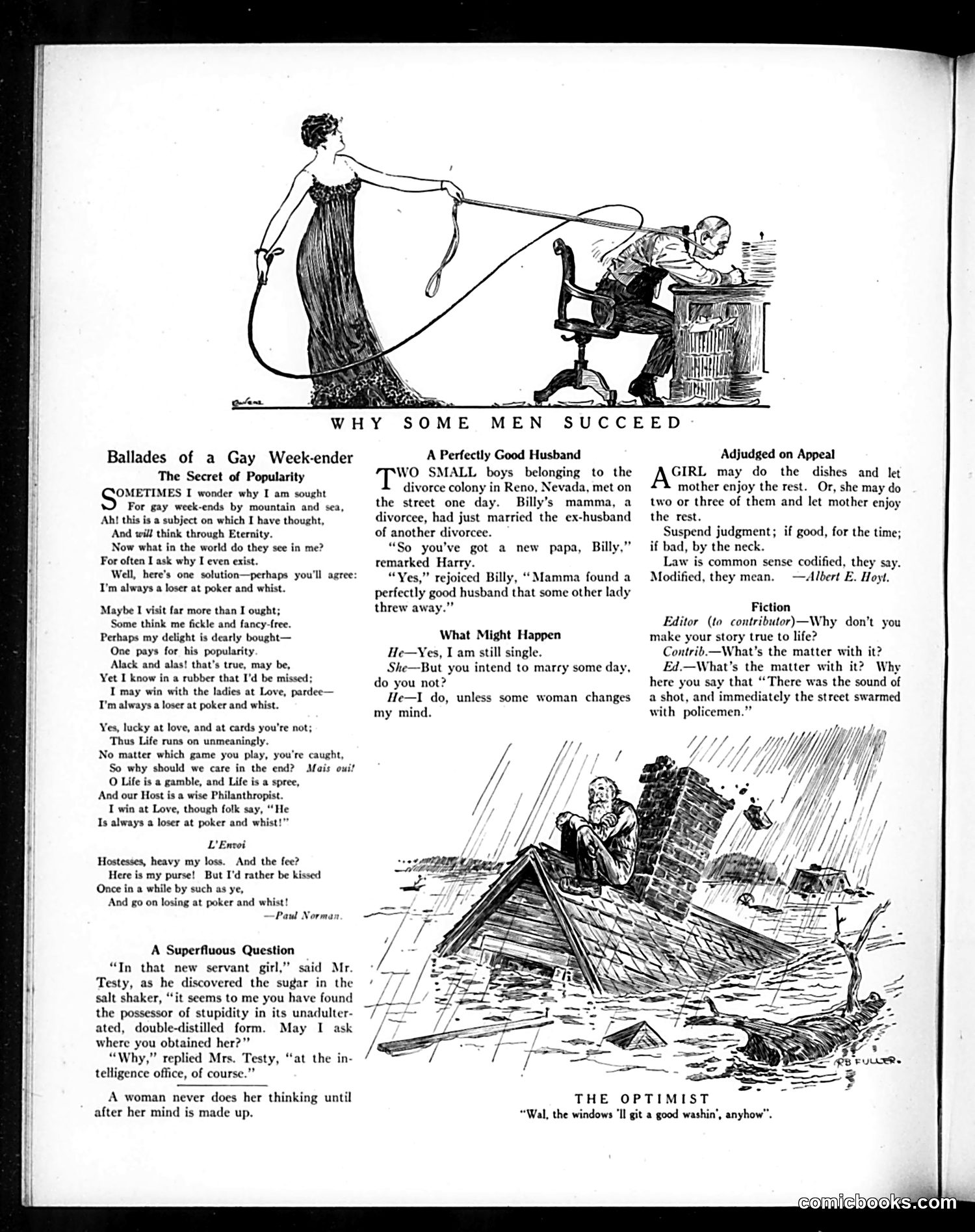
This page presents satirical commentary on early 20th-century American social life and gender relations. **Top cartoon**: A woman literally whips a man at his desk, captioned "Why Some Men Succeed." The joke inverts conventional wisdom—success comes not from merit but from submitting to female control. This reflects contemporary anxieties about women's growing social power. **Text sections** mock various social situations: a poem about a man popular at parties because he loses at cards (thus non-threatening); a "perfectly good husband" joke about Reno's notorious divorce colony (Nevada's loose divorce laws made it a destination); and editorial humor about servant incompetence, legal absurdity, and fictional implausibility. **Bottom illustration**: "The Optimist" shows a man in a capsized boat during a storm, cheerfully noting the windows will get washed anyway—commentary on blind optimism or darkly humorous acceptance of disaster. The overall tone mocks marriage, divorce culture, female authority, class pretensions, and human foolishness.
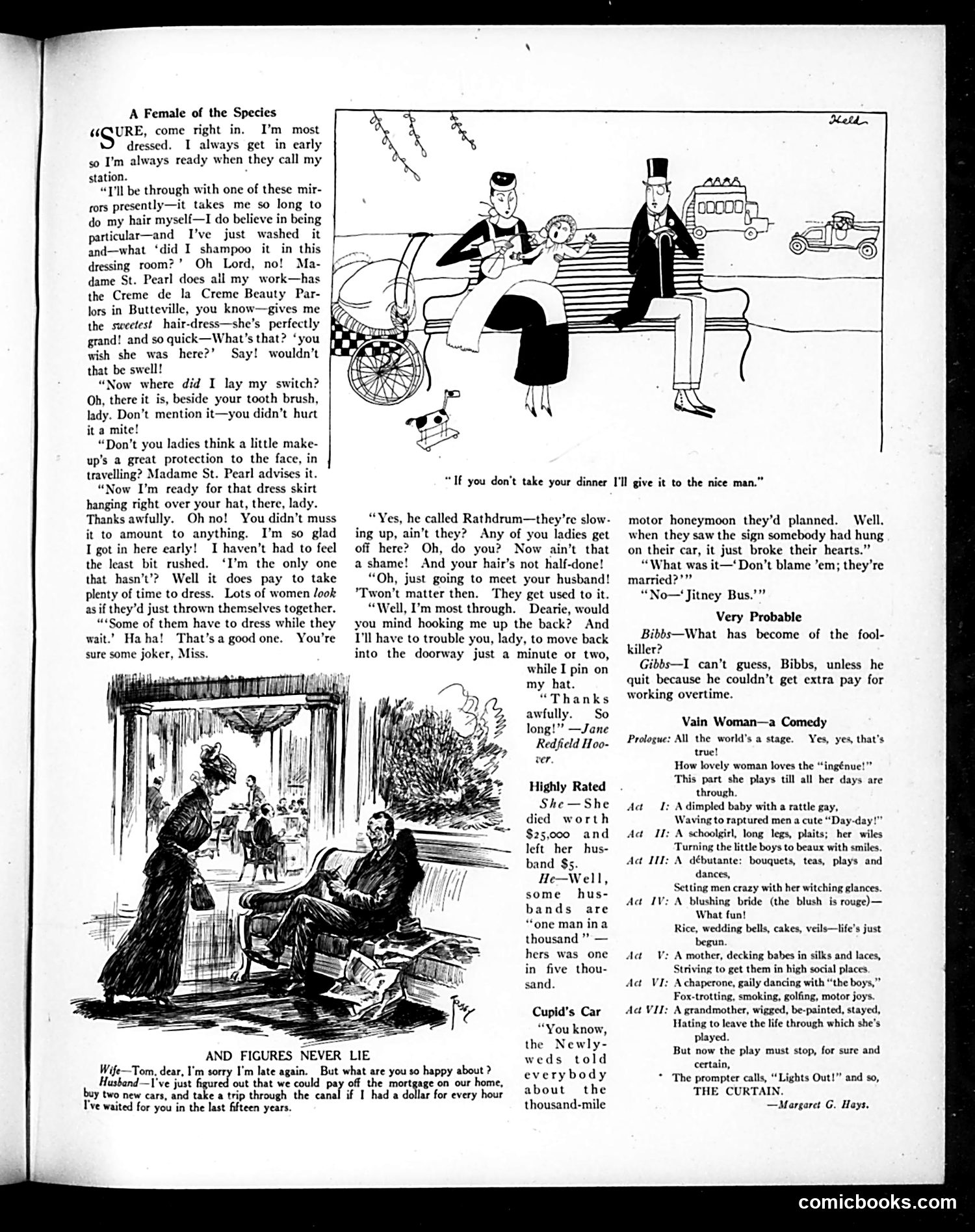
This page contains several satirical pieces mocking early 20th-century gender dynamics and vanity: **"A Female of the Species"** (main cartoon): A vain woman monopolizes a railway car's dressing room, endlessly discussing her elaborate grooming routine—her hairdresser "Madame St. Pearl," her "switch" (hairpiece), makeup, and dress. The satire targets women's obsession with appearance and their obliviousness to inconveniencing others. The cartoon presents her self-absorption as ridiculous and time-wasting. **"And Figures Never Lie"**: A husband justifies buying two cars and taking a canal trip by noting his wife has kept him waiting for fifteen years—suggesting women's frivolous use of time. **"Vain Woman—a Comedy"**: A theatrical piece mocking women's lifelong performance of youth and femininity across all life stages—from babies to grandmothers—always seeking male admiration through artifice. The page's consistent theme: women are vain, self-absorbed, and use manipulative femininity. These pieces reflect period attitudes toward women as frivolous consumers of beauty products and male attention.
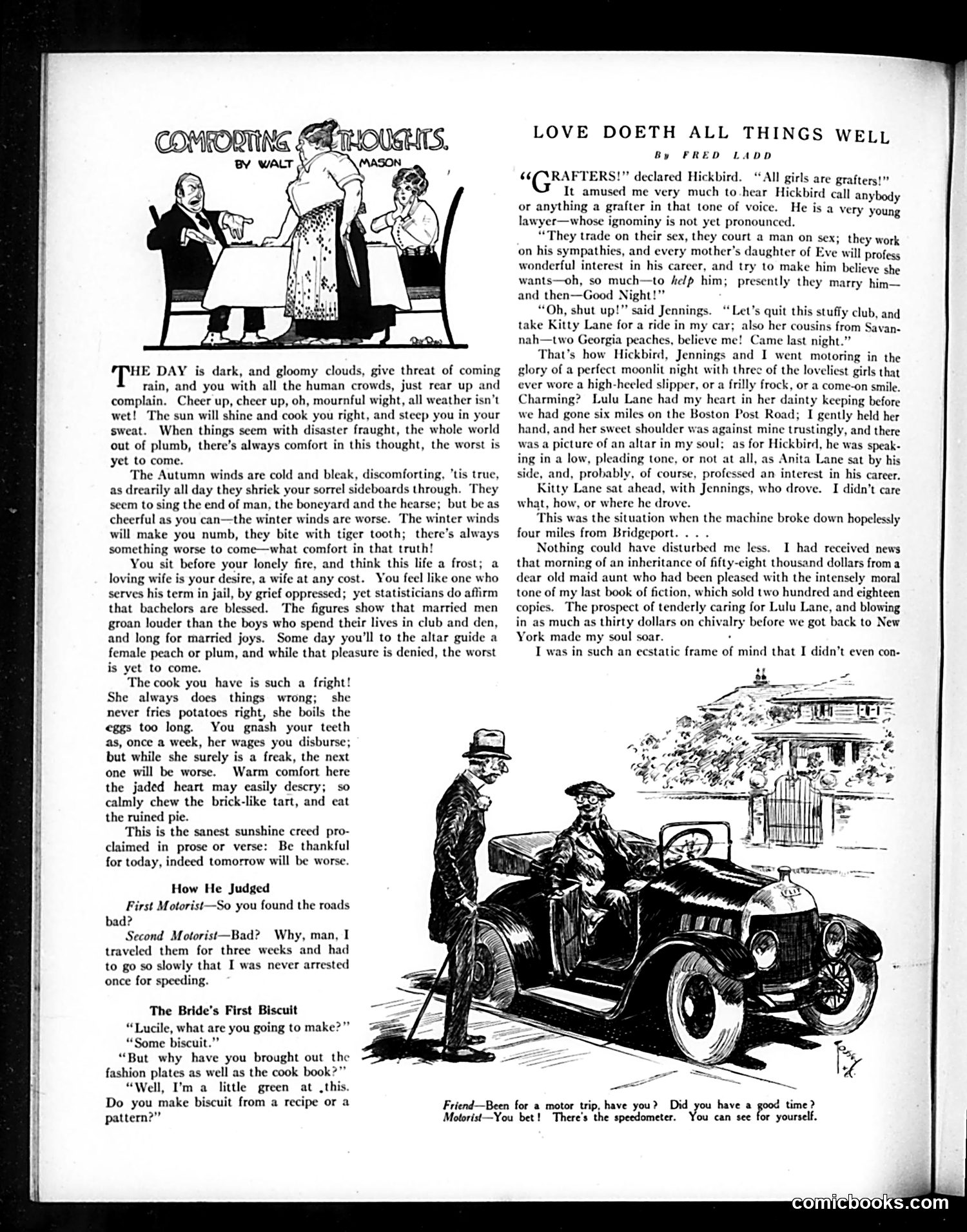
This page contains three distinct satirical pieces typical of early 20th-century humor: **"Comforting Thoughts"** (top left): A philosophical essay arguing that life's hardships are actually reassuring—because things could always be worse. The joke inverts typical complaint-culture by suggesting pessimism itself is comforting. **"How He Judged"** (bottom): A brief joke about motorists, where the humor relies on speeding culture. The "Second Motorist" brags he drove so slowly he wasn't arrested for speeding—mocking the common traffic violation of the era and suggesting the roads were so bad that safety was ironically enforced. **"The Bride's First Biscuit"** & **"Love Doeth All Things Well"**: Domestic humor. The biscuit joke mocks newlyweds' incompetence in cooking (a "pattern" rather than recipe suggests fashion-plate confusion). The longer story satirizes a young cynic's views on women as "grafters" who manipulate men—a period-typical skepticism about female motives that the narrative appears to challenge through romantic experience. The cartoons reinforce gender stereotypes common to the era.
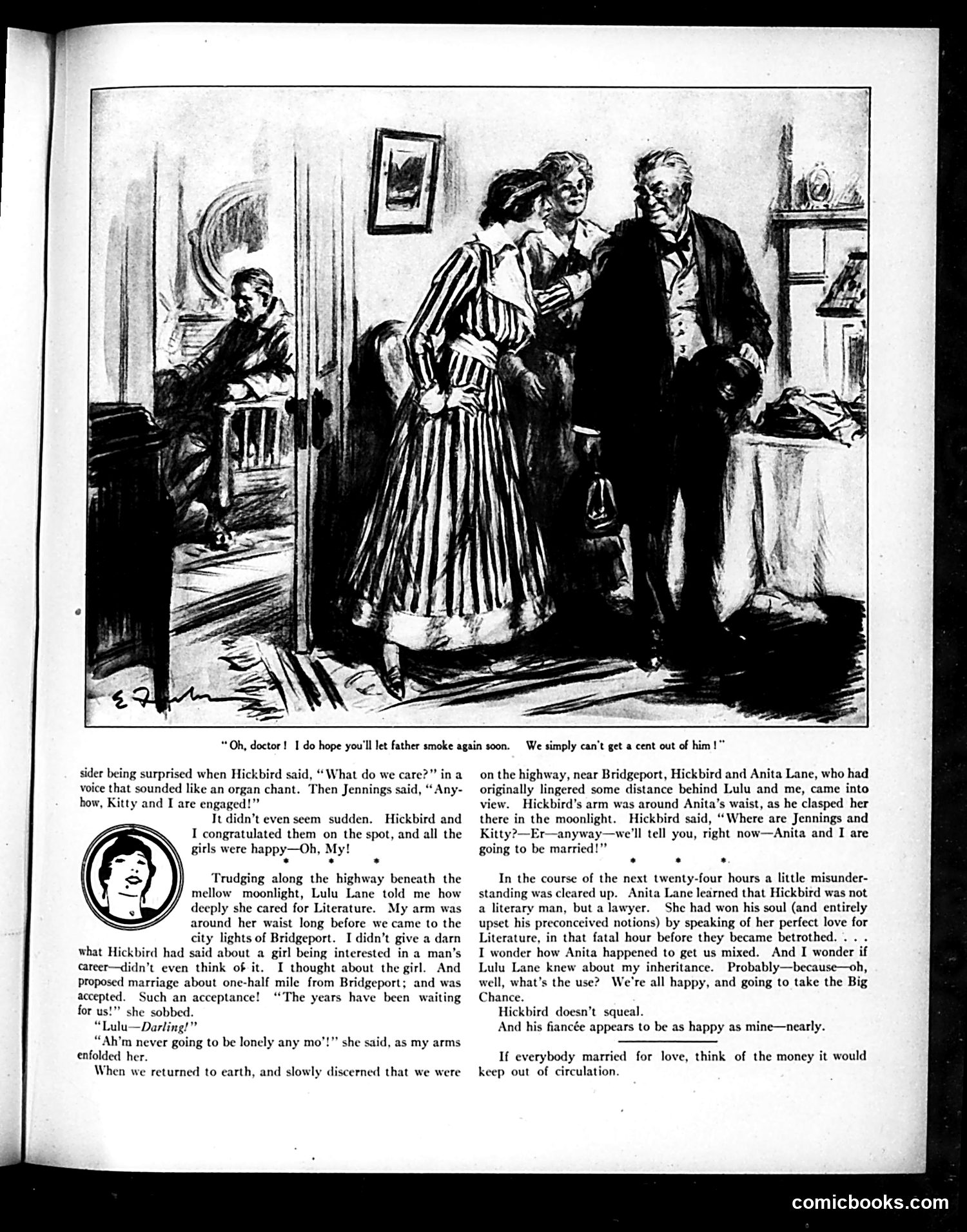
This page contains a romantic comedy narrative (not a political cartoon) satirizing early 20th-century courtship and marriage motives. The story involves multiple couples—Hickbird and Anita Lane, Jennings and Kitty, and the narrator with Lulu Lane—who become engaged in rapid succession near Bridgeport. The satire's point: each person misjudges their partner's true character. Anita falls for Hickbird believing he's a literary intellectual when he's actually a lawyer. The narrator implies Lulu may have married him for his inheritance rather than love. The final caption's joke—"If everybody married for love, think of the money it would keep out of circulation"—suggests marriages are typically financial transactions disguised as romance. The caption at top shows a doctor being asked about a patient's smoking, likely the father of one character, adding domestic comedy.
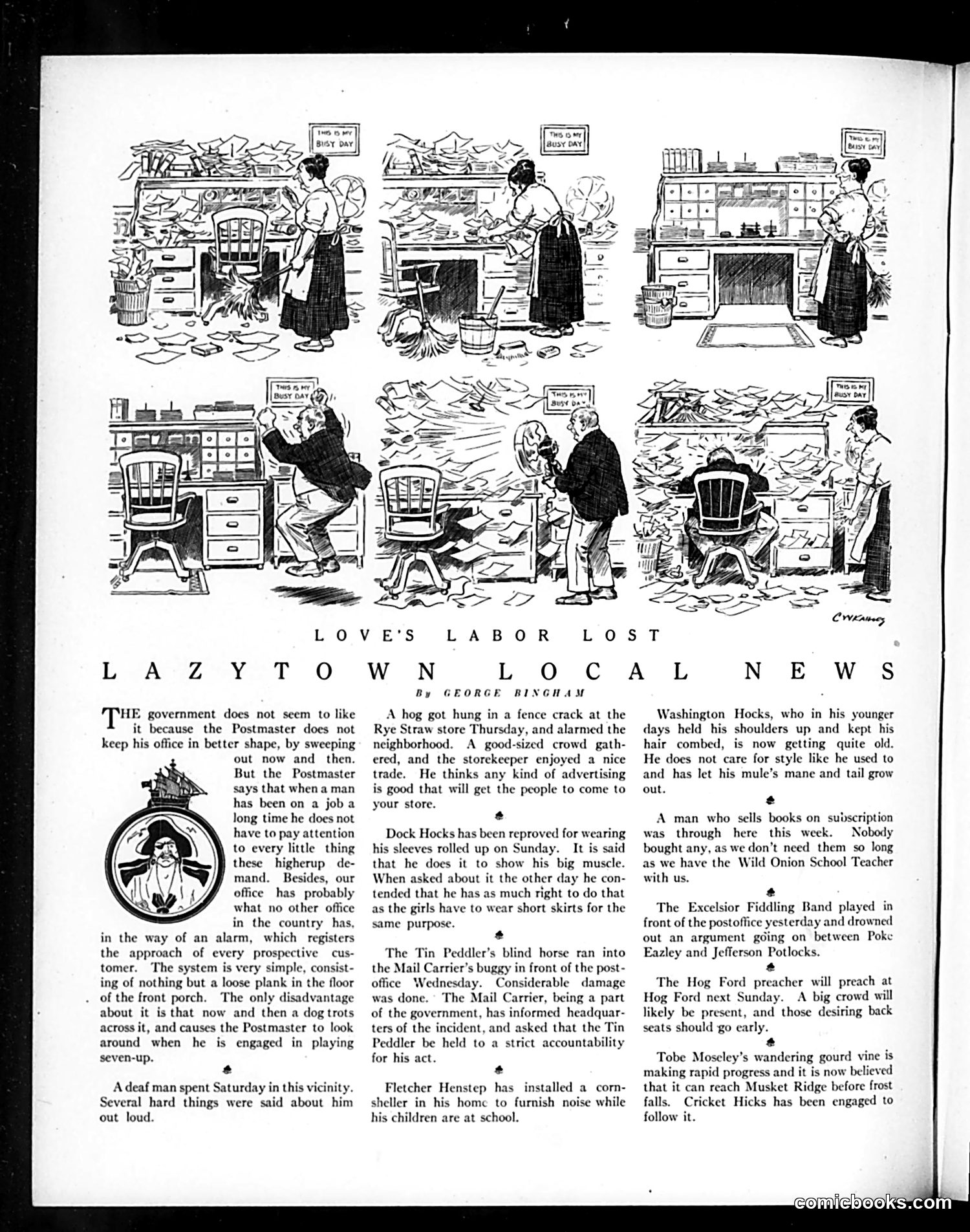
This Judge page satirizes rural American small-town life through fictional "local news" from a backwater community. The six cartoon panels at top (titled "This is My Busy Day") depict a woman's chaotic housekeeping, showing her surrounded by clutter and disorder—contrasting her frenetic activity with the column's ironic title. The text column by George Bingham presents absurdist humor about Lazytown's incompetent postmaster, who uses a loose floorboard as an alarm system and plays card games while neglecting his duties. Other items mock rural peculiarities: a storekeeper celebrating a hog stuck in a fence for the advertising crowds it draws; townsfolk concerned about a man's muscular display on Sunday; and trivial local events treated with mock-seriousness. The satire targets rural inefficiency, indolence, and the gap between official duty and actual practice—the postmaster's casual neglect of federal responsibility being the central joke. It's genteel mockery of American backwoods life for urban magazine readers.
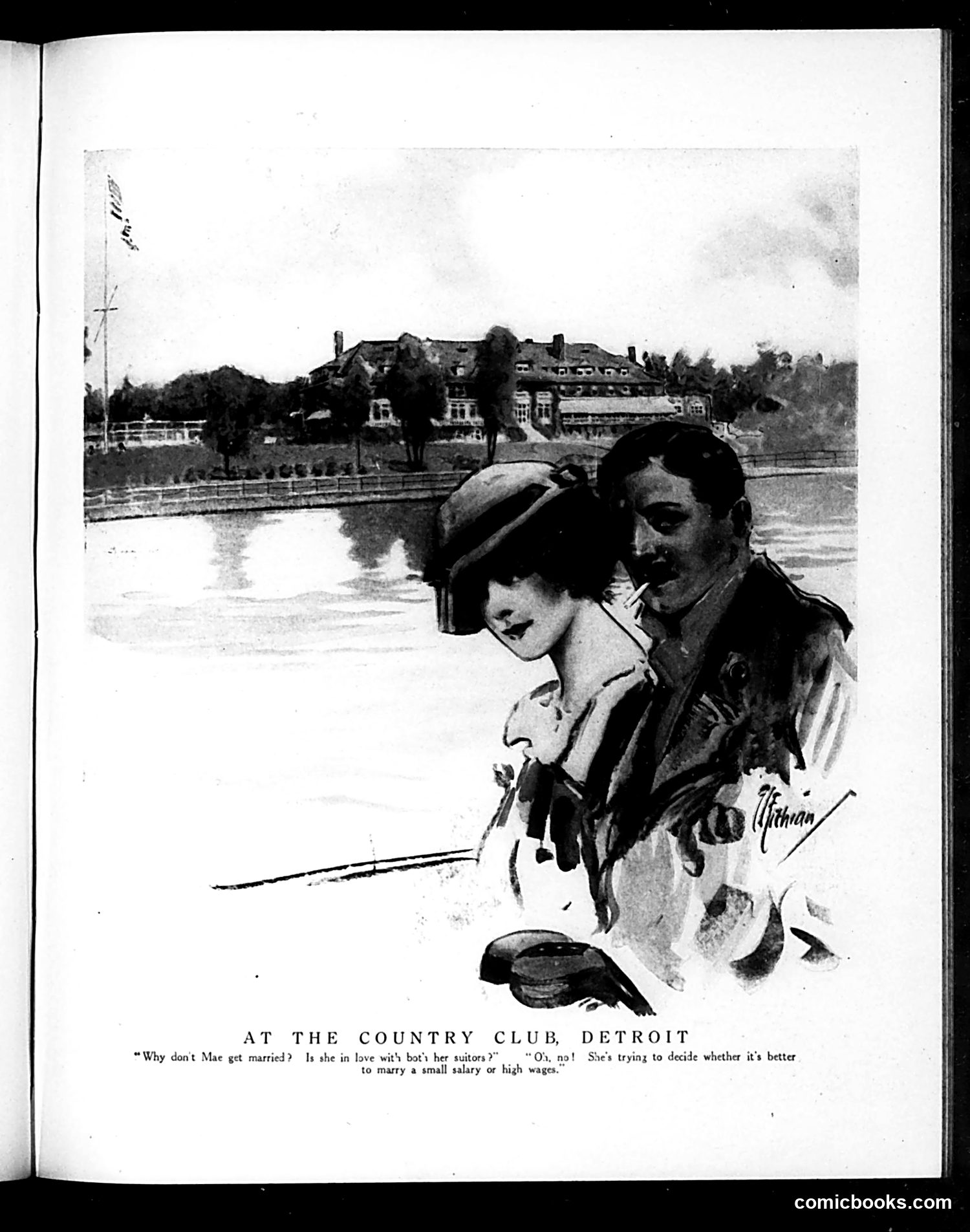
This is a satirical illustration titled "At the Country Club, Detroit" depicting a woman named Mae with two male suitors by a lakeside country club setting. The joke critiques women's materialism by presenting Mae as unable to choose between two men based on love—only on their earning potential. One suitor represents "small salary," the other "high wages." The humor reflects early-20th-century anxieties about women's independence and financial motivations in marriage, satirizing the notion that women calculated matrimonial decisions purely on economic grounds rather than affection. The signature appears to be "Tilman." The illustration style and setting suggest this likely dates to the 1910s-1920s era of Judge magazine.
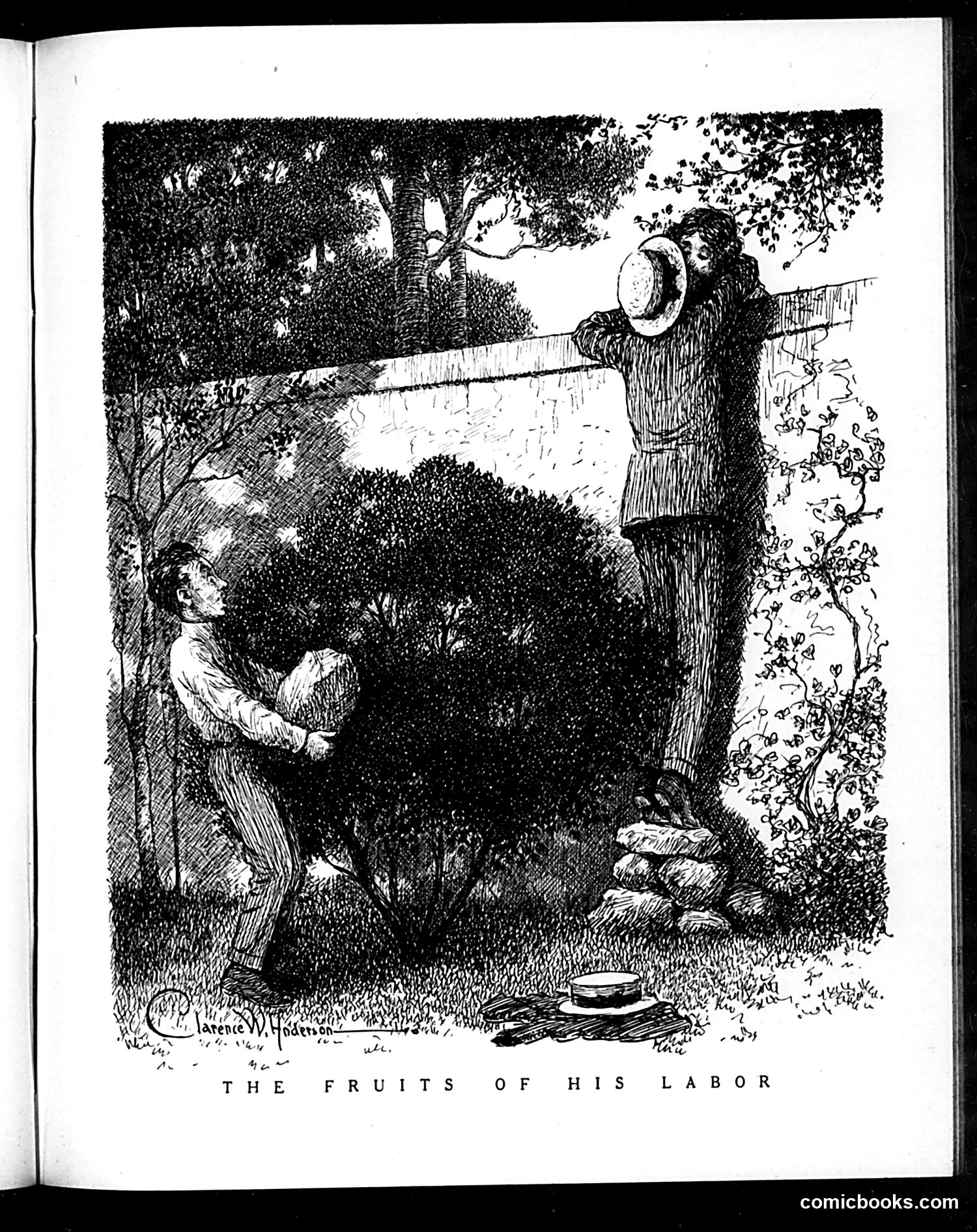
This satirical illustration depicts two figures in a woodland setting. One man, positioned below, appears exhausted or struggling beneath a large, dark bush or shrub. Another man stands elevated on a tree stump or platform above, holding what appears to be a drum or circular object, seemingly detached from the labor below. The caption "THE FRUITS OF HIS LABOR" suggests ironic commentary on economic disparity or labor exploitation—specifically, that the worker (below) toils strenuously while someone else (above) reaps the rewards or benefits. This appears to be *Judge* magazine's critique of unequal wealth distribution or workplace injustice, a common satirical theme in early American periodicals addressing labor disputes and class tensions.
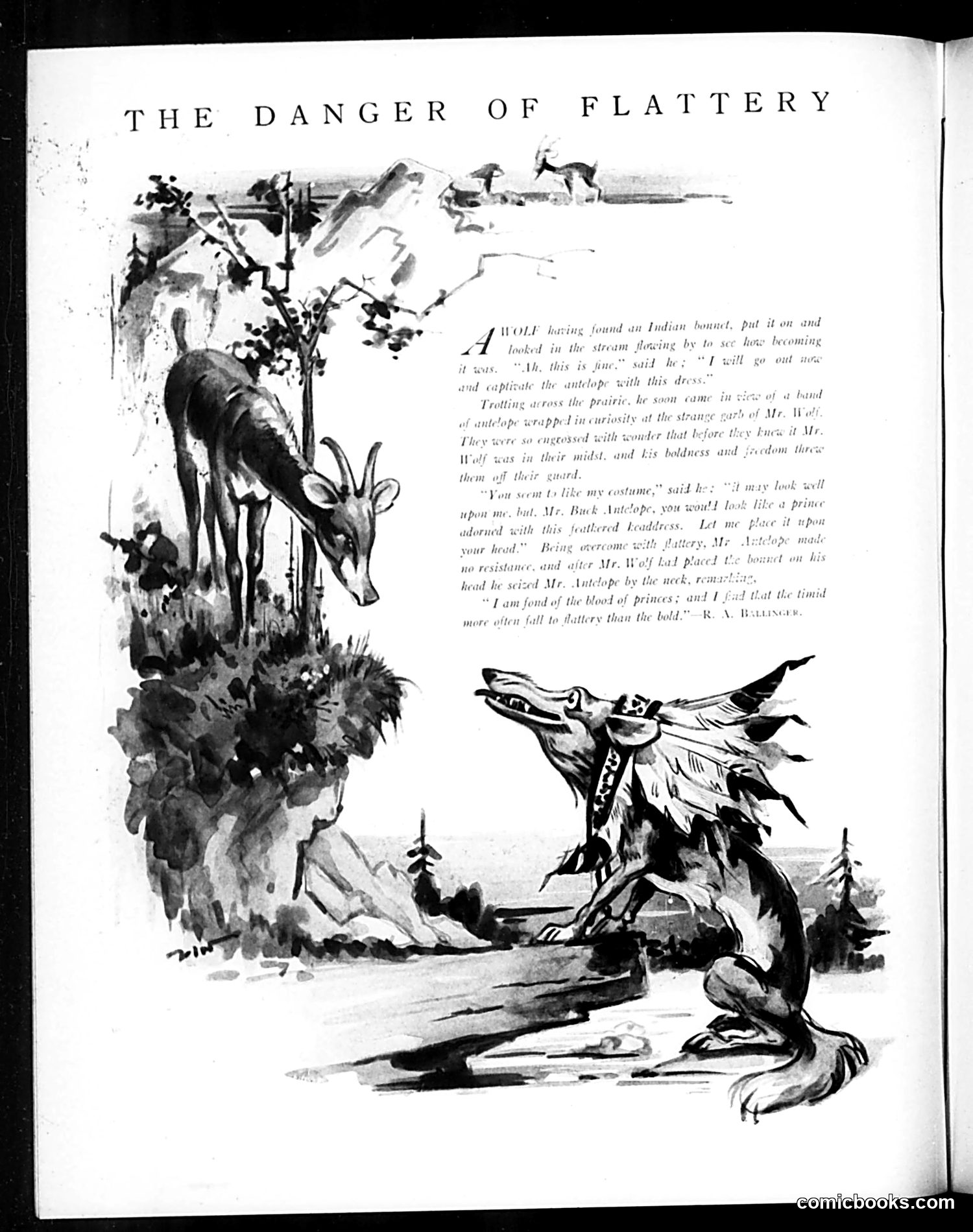
This Judge page satirizes susceptibility to flattery through two illustrated vignettes. The top image shows a wolf wearing an antelope's coat while conversing with a man—depicting how disguise and deceptive flattery can mask true nature. The accompanying text (a dialogue) warns that flattery can cloud judgment, illustrated by the wolf's claim that the man would "look like a prince adorned with this featherhead." The bottom illustration shows an anthropomorphic donkey or ass-like creature in formal dress, emphasizing the absurdity of flattery making someone accept an unflattering truth about themselves. The satire suggests that people—particularly perhaps politicians or the wealthy—accept ridiculous praise without recognizing their actual character, much as the man might accept the wolf's compliments while failing to see the danger. The moral: flattery blinds us to reality, making us vulnerable to manipulation by those with hidden, harmful intentions.
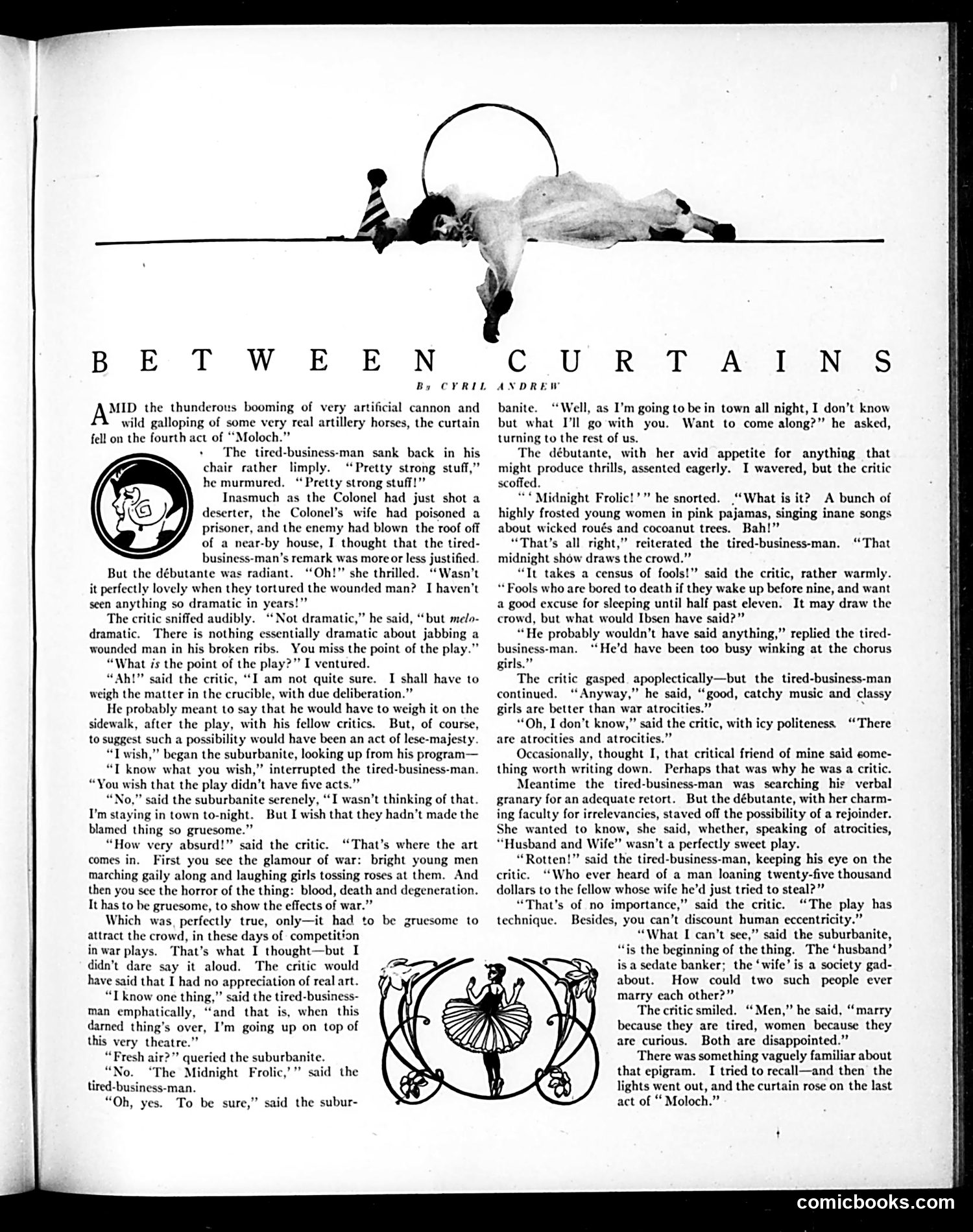
This piece satirizes early 20th-century theater culture and conflicting tastes in entertainment. The dialogue contrasts four archetypal characters attending a war play called "Moloch": 1. **The tired-business-man** - represents ordinary audiences seeking escapist entertainment 2. **The débutante** - a wealthy young woman who enjoys sensational violence for thrills 3. **The suburbanite** - a middle-class attendee seeking reasonable entertainment 4. **The critic** - a self-important arts snob defending "serious" dramatic art The satire mocks the critic's pretentious reverence for gruesome realism in war plays, while the tired-business-man pragmatically notes such scenes exist merely to "draw the crowd." The humor peaks when the businessman prefers the "Midnight Frolic" (apparently a Ziegfeld Follies-style revue) over serious drama—precisely what the critic scorns. The piece gently ridicules both artistic pretension and the commercialization of entertainment, with the businessman's common sense winning out over the critic's self-importance.
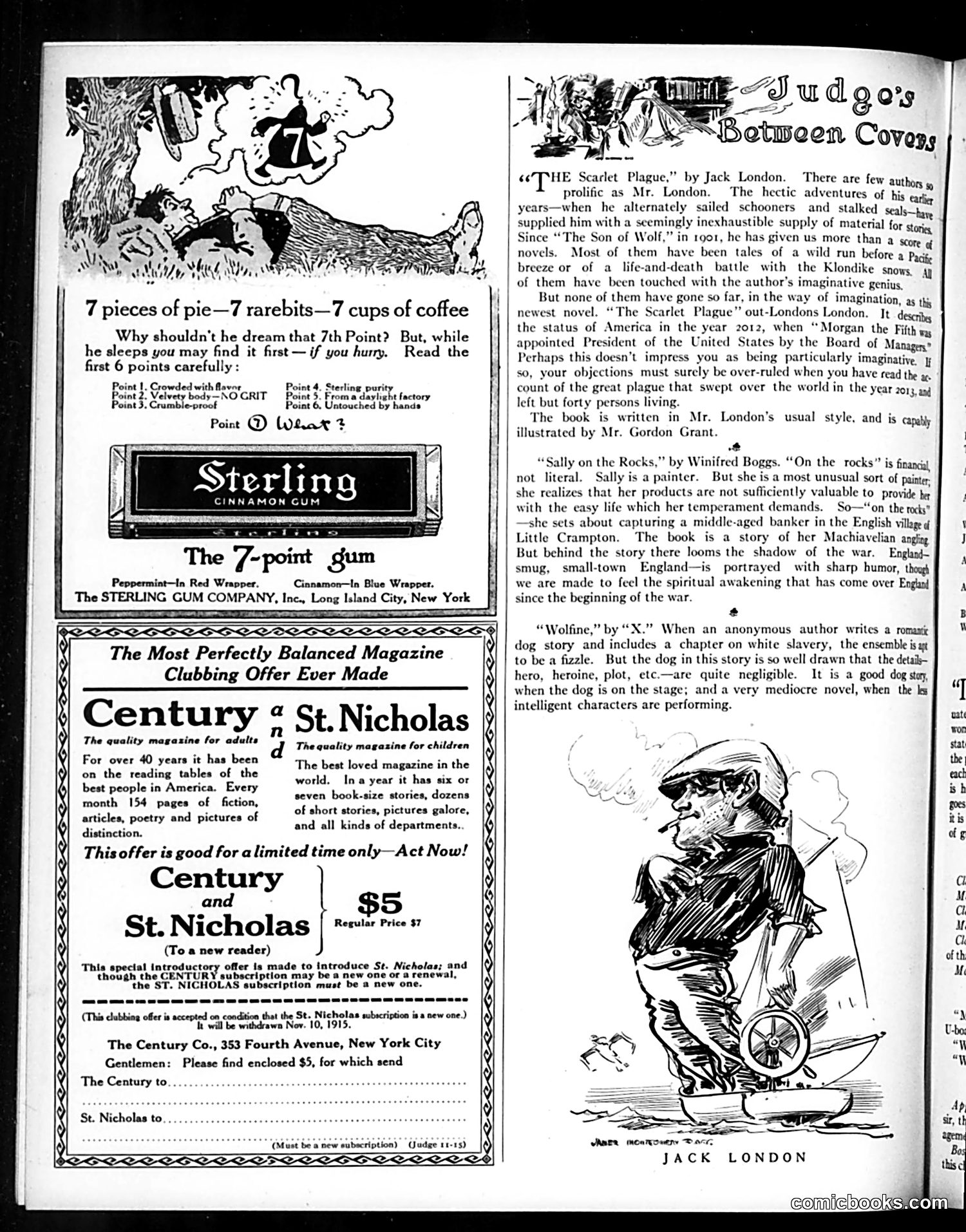
This page is primarily **advertising and book reviews** rather than political satire. The main content includes: **Left side:** A Sterling Cinnamon Gum advertisement disguised as a puzzle ("7 pieces of pie—7 rarebits—7 cups of coffee"), asking readers to identify a hidden "7th Point" in the gum's qualities. Below is a magazine subscription offer bundling *Century* and *St. Nicholas* magazines for $5. **Right side:** Book reviews under "Judges Between Covers," discussing recent publications by Jack London (*The Scarlet Plague*—set in a future 2012 America), Winifred Boggs (*Sally on the Rocks*), and an anonymous author's dog story (*Wolfine*). The only illustration is a sketch of Jack London himself at page bottom. There is **no political cartoon or satire** visible. This appears to be a standard magazine page mixing advertisements with literary criticism.
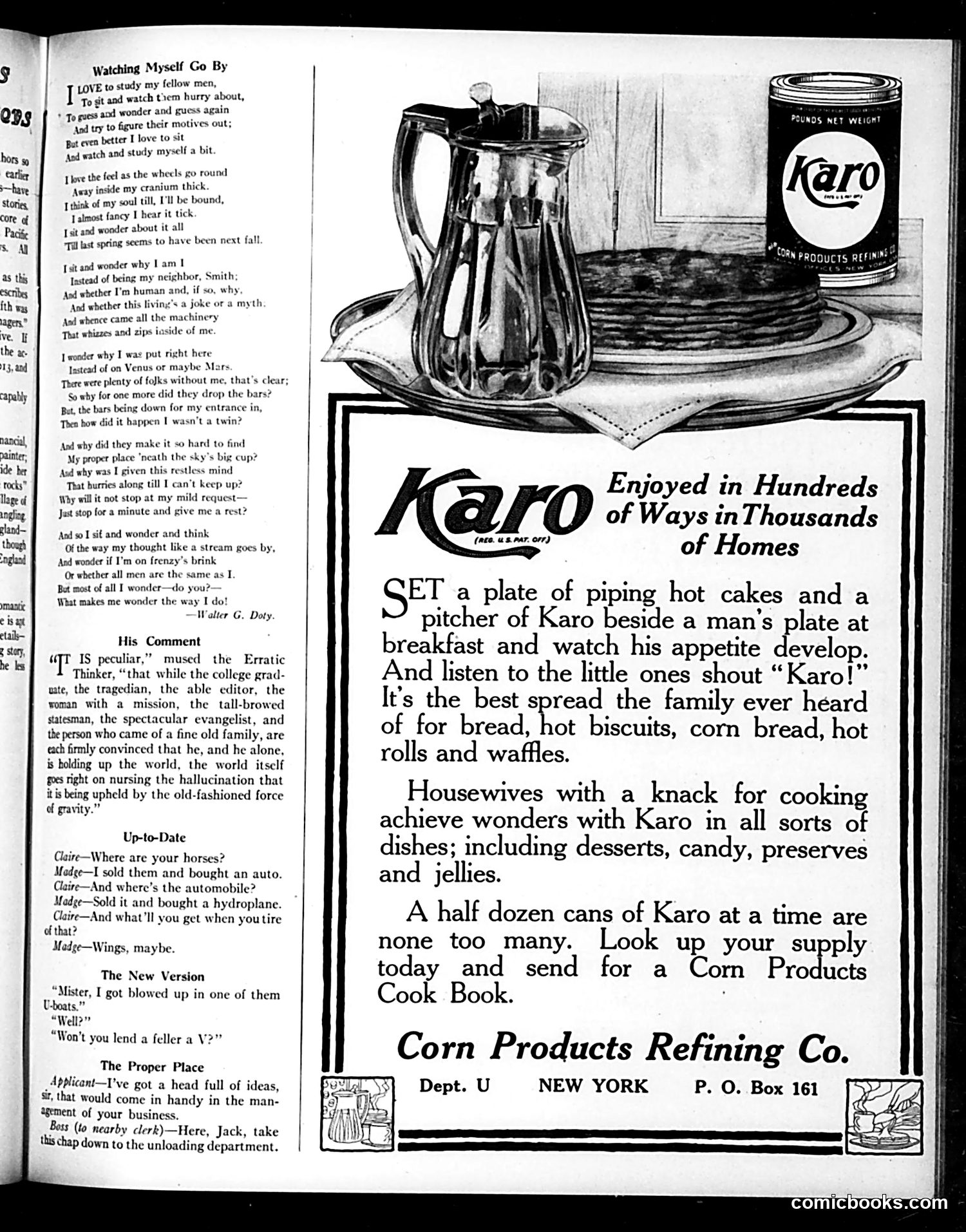
This page contains primarily **literary and humorous content** with one advertisement, rather than political cartoons. The main feature is "Watching Myself Go By," a contemplative poem by Walter G. Doty about existential self-reflection—a man observing himself and pondering his existence, identity, and place in the universe. The accompanying "His Comment" section satirizes intellectuals (college graduates, editors, evangelists, and aristocrats) who each believe *they* alone are holding up the world, while the world indifferently continues under gravity's force—a gentle mockery of human ego and self-importance. The page also includes brief humorous pieces: "Up-to-Date" jokes about technological obsolescence (cars replaced by hydroplanes by "wings"), and "The Proper Place," where an applicant with "ideas" is sent to the unloading department—corporate satire on impractical idealism. The **Karo syrup advertisement** occupies the right side, promoting the corn syrup product for breakfast foods and cooking, typical of early-20th-century domestic product marketing.
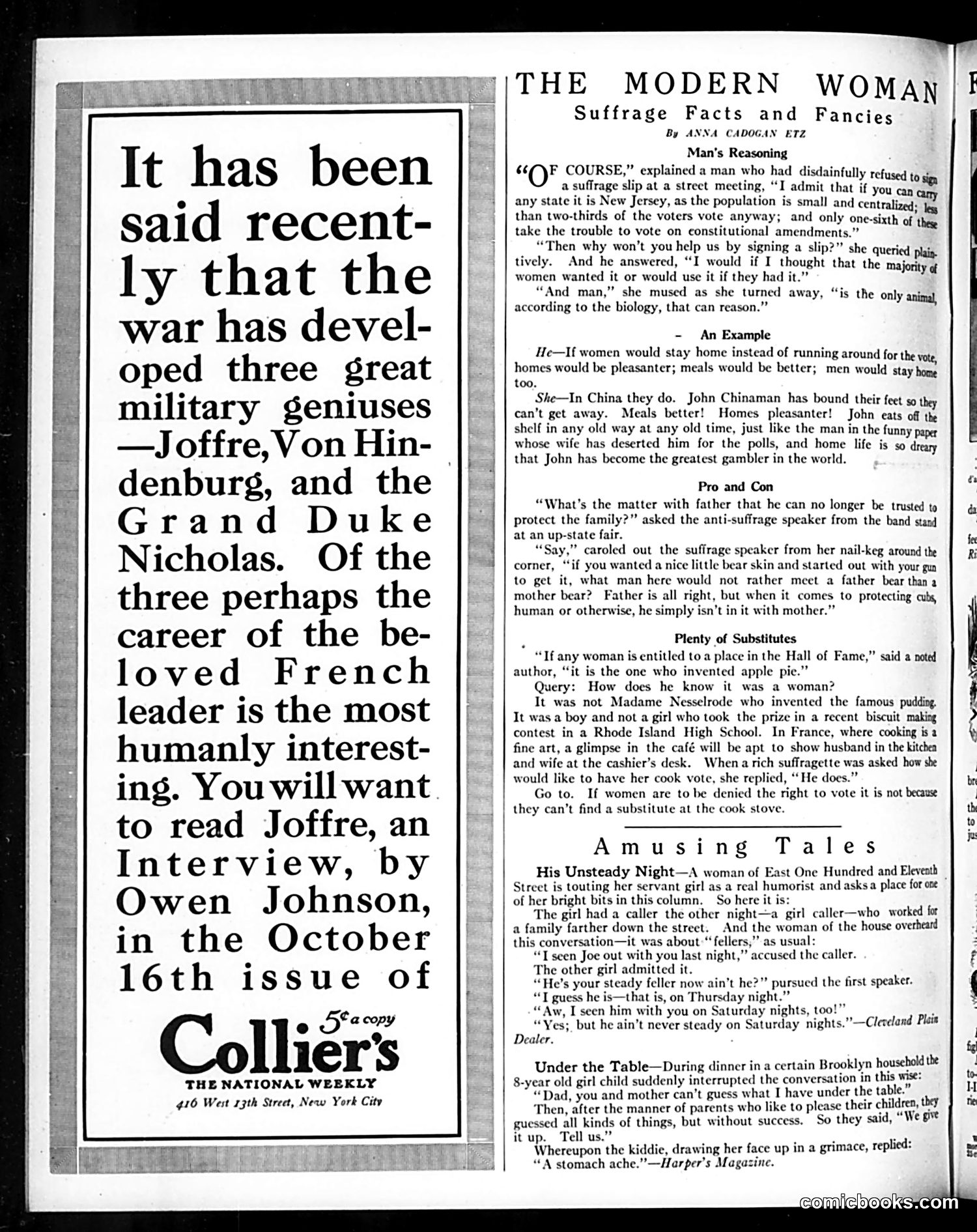
The left advertisement promotes an upcoming Collier's feature on Marshal Joffre, the French WWI general, positioning him as one of three great military geniuses developed by the war (alongside Von Hindenburg and Grand Duke Nicholas). The ad appeals to readers' interest in his "humanly interesting" career during the ongoing conflict. The right page contains anti-suffrage satire by Anna Cadogan Etz titled "Suffrage Facts and Fancies." It mocks women's suffrage arguments through dialogues. The satire ridicules pro-suffrage positions: a man's claim women lack voting incentive; comparisons to Chinese foot-binding; and sarcastic rebuttals suggesting women excel at domestic duties, so denying them votes seems pointless. The underlying argument attacks suffragists as neglecting home and family. The "Amusing Tales" section provides unrelated humor about working-class relationships. This reflects Judge's typically conservative stance opposing women's suffrage during the Progressive Era.
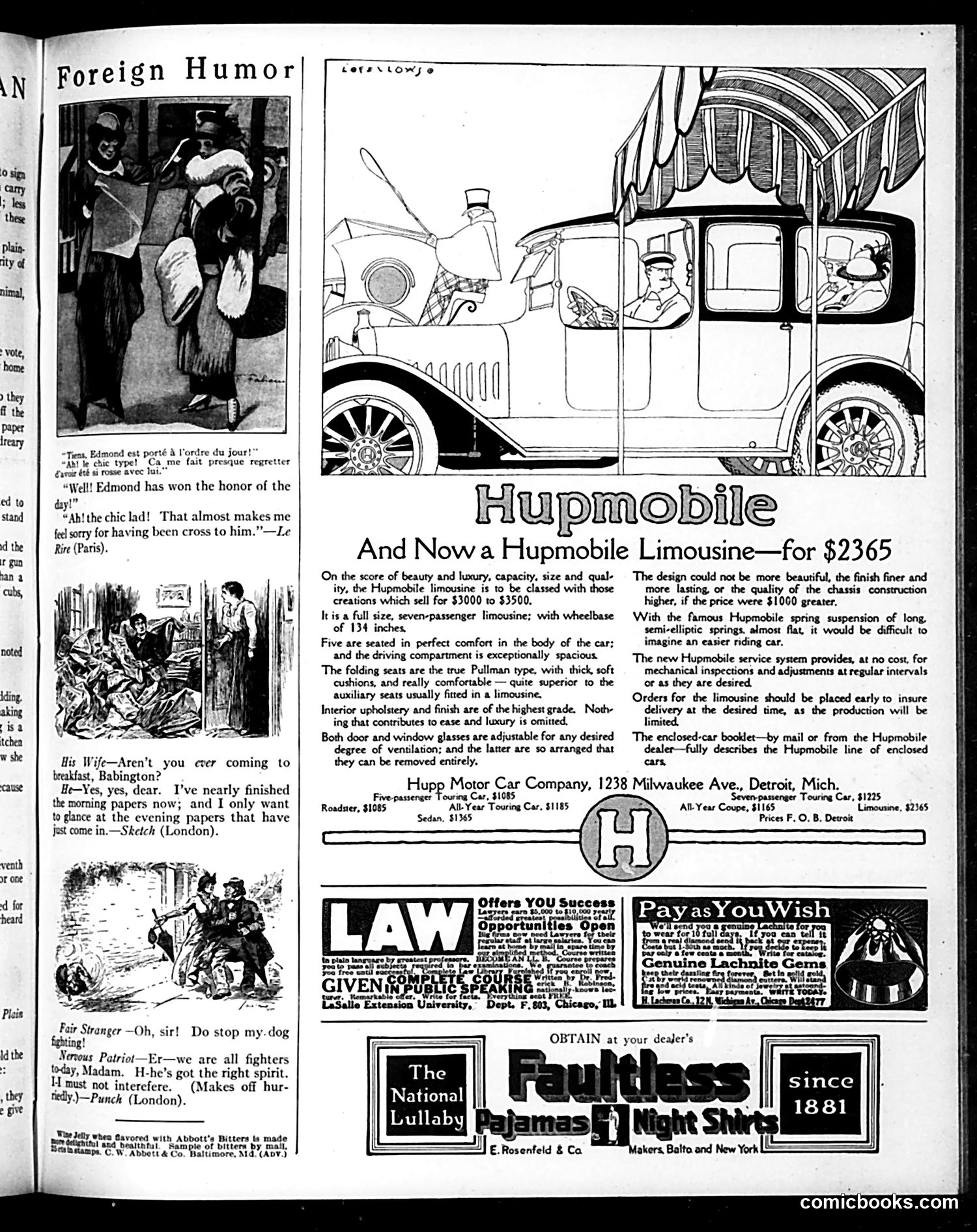
This Judge magazine page consists primarily of **short humorous anecdotes** from European publications (French *Le Rire* and British *Sketch* and *Punch*), not political cartoons. The jokes illustrate wartime sentiment: one French anecdote shows a woman almost regretting quarreling with her husband after learning he's earned military honors. A British joke depicts a man reading endless newspapers while his wife waits for breakfast. A third shows men romanticizing combat as noble "fighting." The page is otherwise dominated by **automobile and consumer advertisements**, including a substantial Hupmobile limousine ad ($2,365), a LAW correspondence school ad, and Piddless pajama advertisements. These ads represent typical early-20th-century marketing to middle and upper-class readers. The "Foreign Humor" section reflects *Judge*'s practice of reprinting European satirical content—a common feature demonstrating transatlantic cultural exchange during the World War I era.
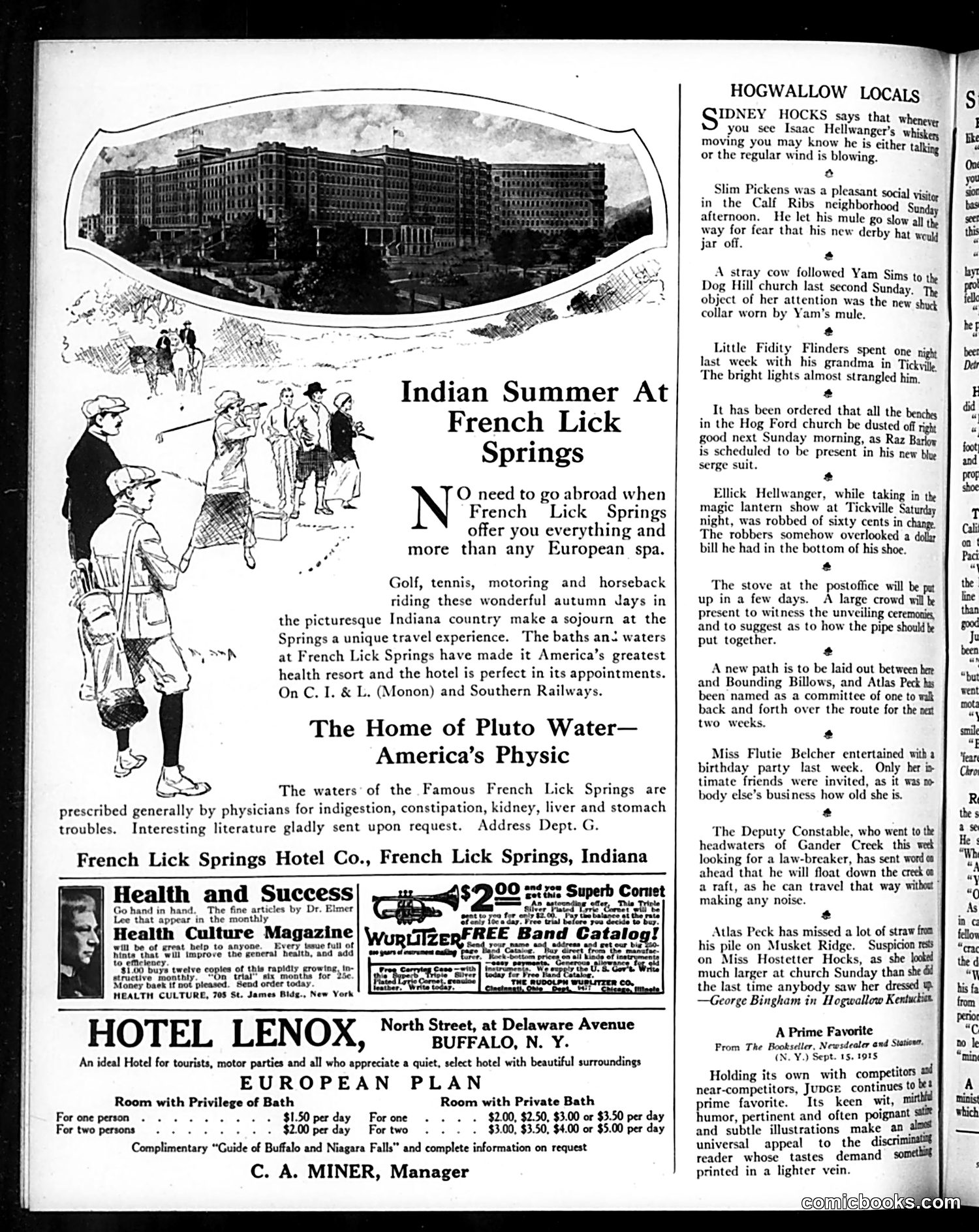
This page is primarily **advertising and filler content** rather than political satire. The main feature advertises French Lick Springs, a famous Indiana spa resort, promoting its mineral waters ("Pluto Water") as a cure for digestive and kidney ailments—a common health-tourism pitch of the era. The illustration shows tourists enjoying leisure activities (golf, horseback riding) at the resort, contrasting European spas with American alternatives. The "**Hogwallow Locals**" section on the right is humorous rural gossip in the style of early-20th-century American comic columns. It mocks small-town life through absurdist vignettes: a man worried his new derby hat will "jar off," a preacher's mule wearing a fancy collar, a stove unveiling ceremony drawing crowds. These aren't political—they're gentle satire of rural provincialism and simple-minded concerns. The remaining content comprises hotel advertisements (Hotel Lenox, Buffalo) and health magazine promotions. No clear political figures or topical satire are evident here.
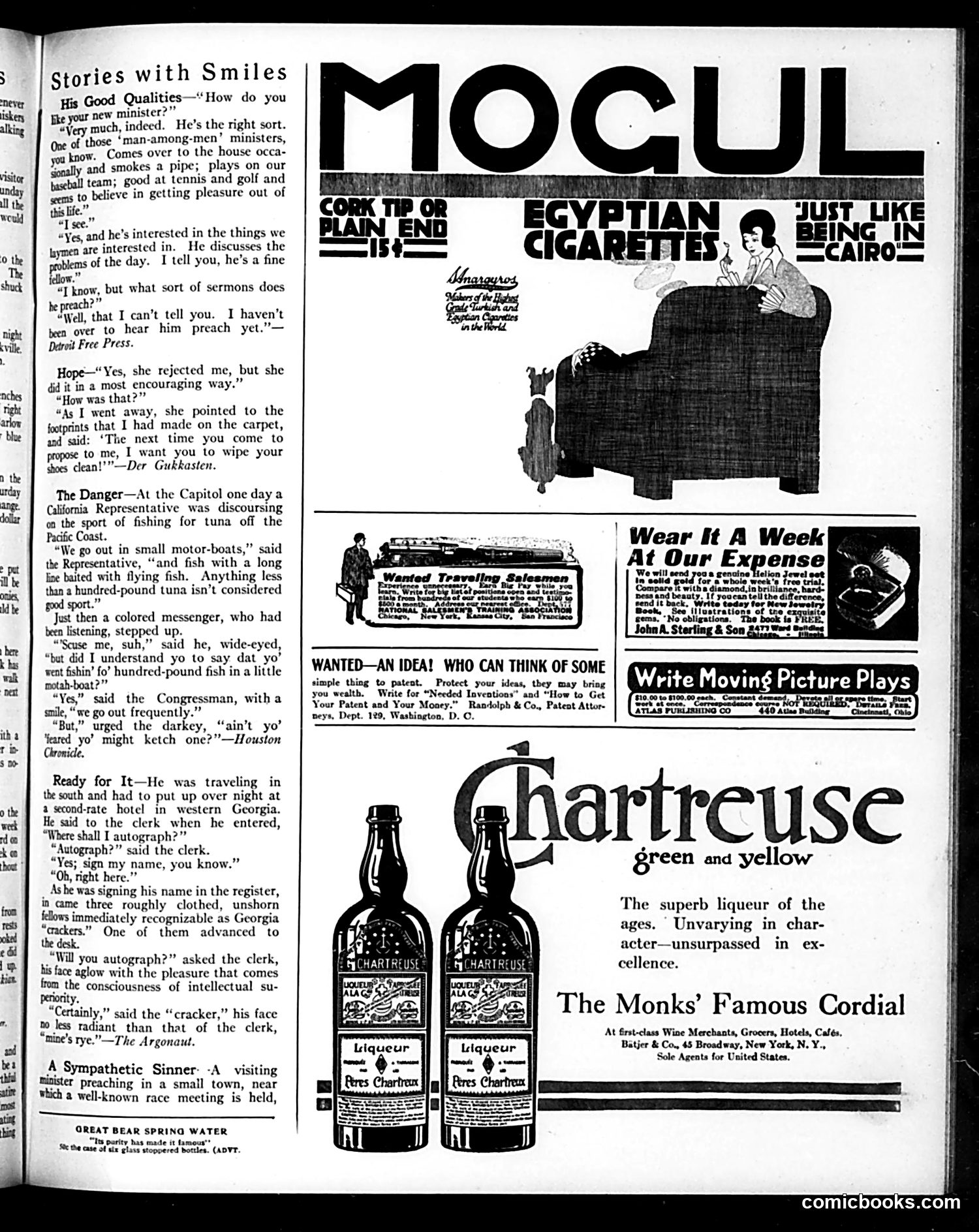
This page from *Judge* combines humor columns with advertisements. The main content consists of brief satirical anecdotes mocking various American social types: **"His Good Qualities"** jokes about a minister valued for socializing (golf, tennis, pipe-smoking) rather than preaching—satirizing shallow religiosity. **"The Danger"** ridicules a California Representative's tall fishing tale; a Black messenger deflates his exaggeration by questioning the premise, offering subtle commentary on bombastic politicians. **"Ready for It"** plays on regional stereotypes: an educated traveler expects Georgia "crackers" (poor whites) to be illiterate, but one surprises him by requesting an autograph, reversing expectations about who possesses sophistication. The page is primarily **advertising**—featuring cigarettes, cordial liqueur, traveling salesman positions, and patent services. The cartoons serve as filler content between commercial appeals typical of early 20th-century magazine design.
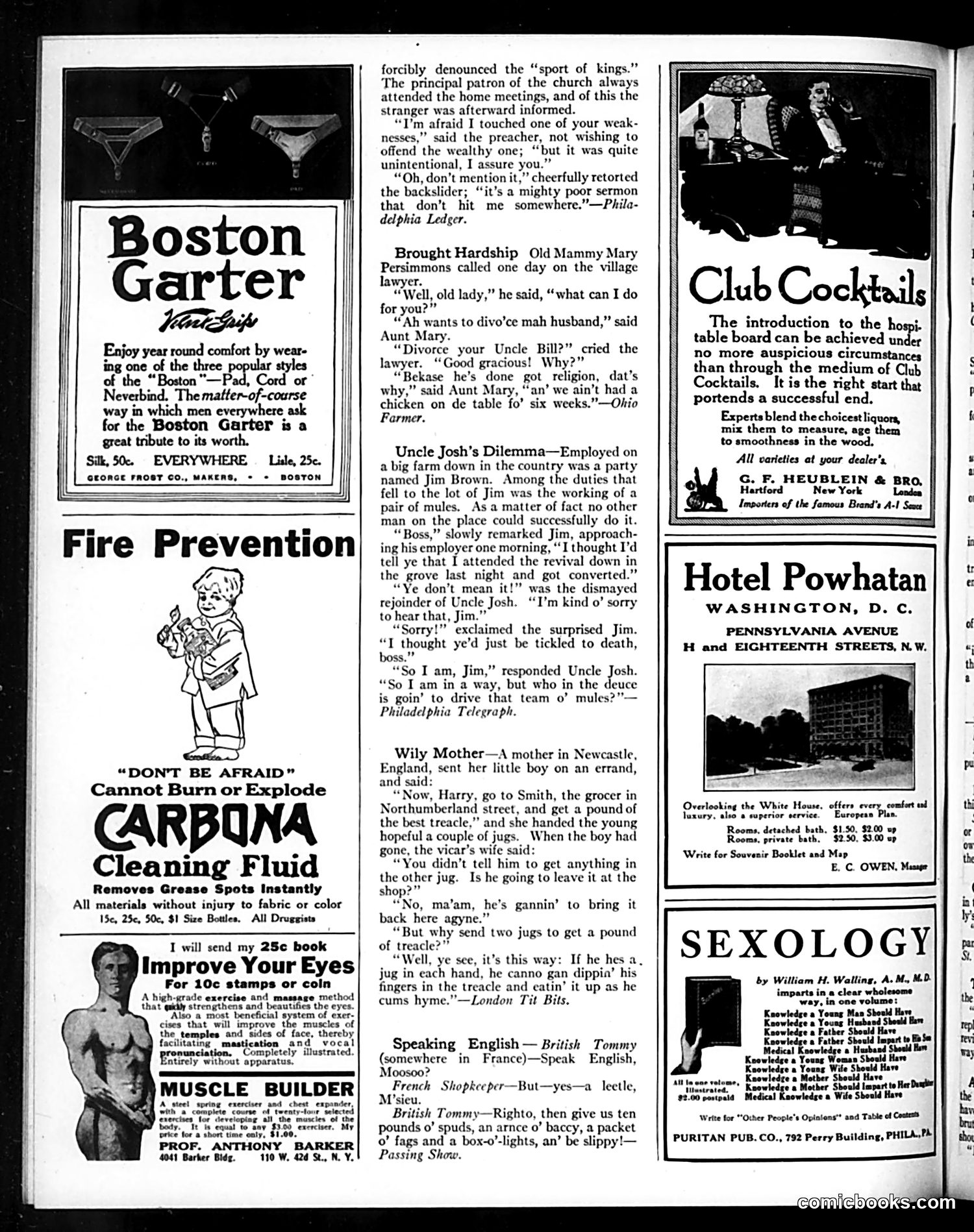
This page is primarily **advertising with humorous filler content**, typical of early 20th-century magazines. The main advertisements are for Boston Garters (men's hosiery), Carbona cleaning fluid, eye exercises, and muscle-building courses. The text consists of **brief comic anecdotes** rather than political satire: rural humor about a converted farmhand whose religious conversion inconveniences his employer; a dialect joke about an African American woman divorcing her husband after his conversion stops him from stealing chickens; British soldier slang for ordering supplies in French; and English working-class humor about a mother's trick to prevent her son eating treacle while running an errand. These stories reflect **period attitudes**: stereotypical Black dialect humor, gentle mockery of religious hypocrisy, and Anglo-American cultural differences. None appears to target specific political figures or events. The page demonstrates how early 20th-century humor magazines mixed advertising revenue with genteel, often offensive ethnic and regional comedy.
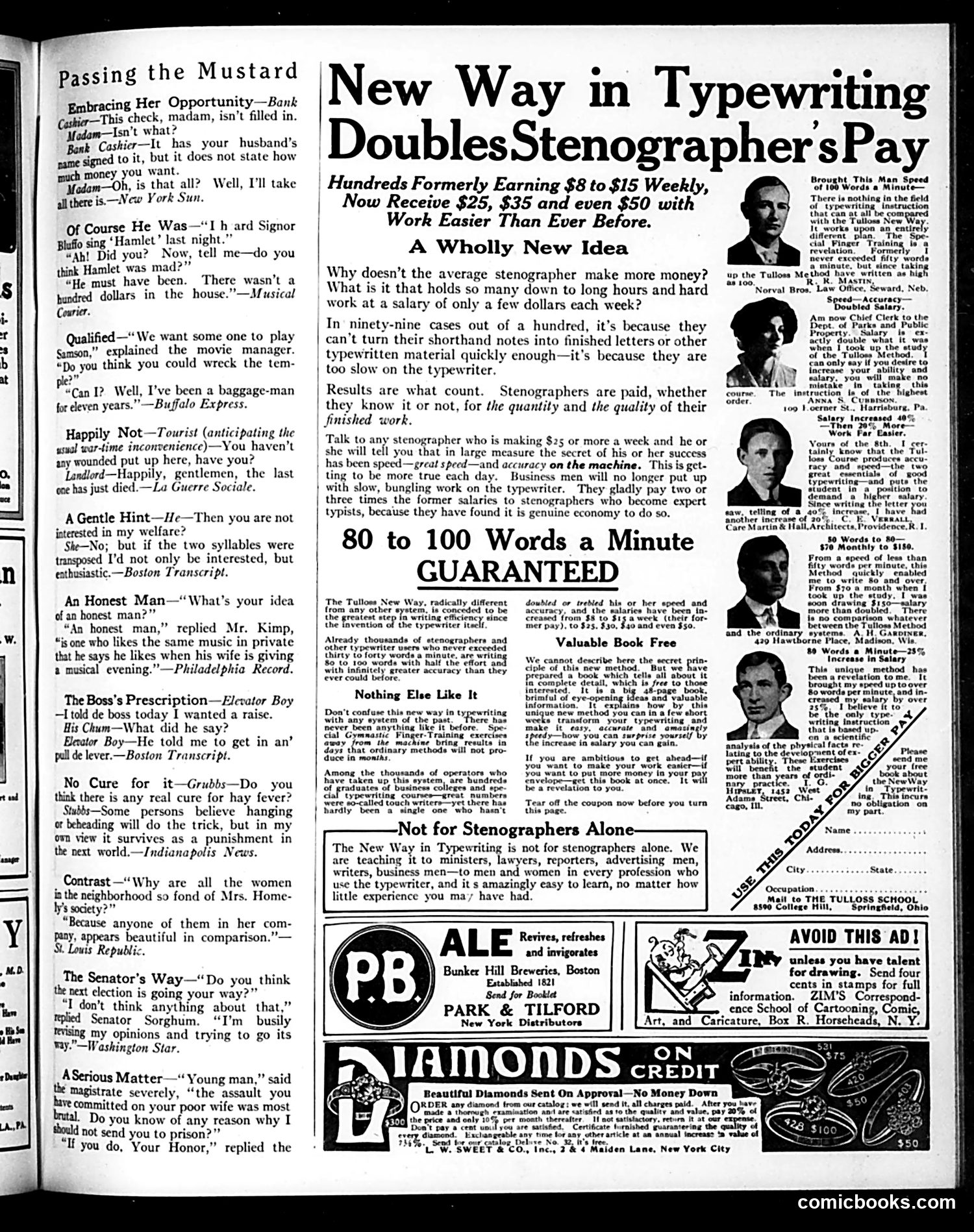
This page from *Judge* magazine contains **short humorous anecdotes** (left column) rather than political cartoons. The jokes target early 20th-century social conventions and gender dynamics: a wife casually asking to spend a husband's entire bank account; an actor's poverty being mistaken for madness; a wife-beater who received his "just desserts." These rely on period stereotypes about marriage, theater, and domestic violence treated as comedy. The **dominant content** is the "New Way in Typewriting" advertisement promoting the Tullos Method stenography course. It advertises "$8 to $15 weekly" stenographers earning "$25, $35 and even $50"—likely exaggerated claims—through improved typing speed. Testimonials from apparent office workers claim the method is revelatory. The ad targets stenographers and office workers, positioning faster typewriter skills as a path to significantly higher wages, which would have appealed to early 20th-century working-class readers.
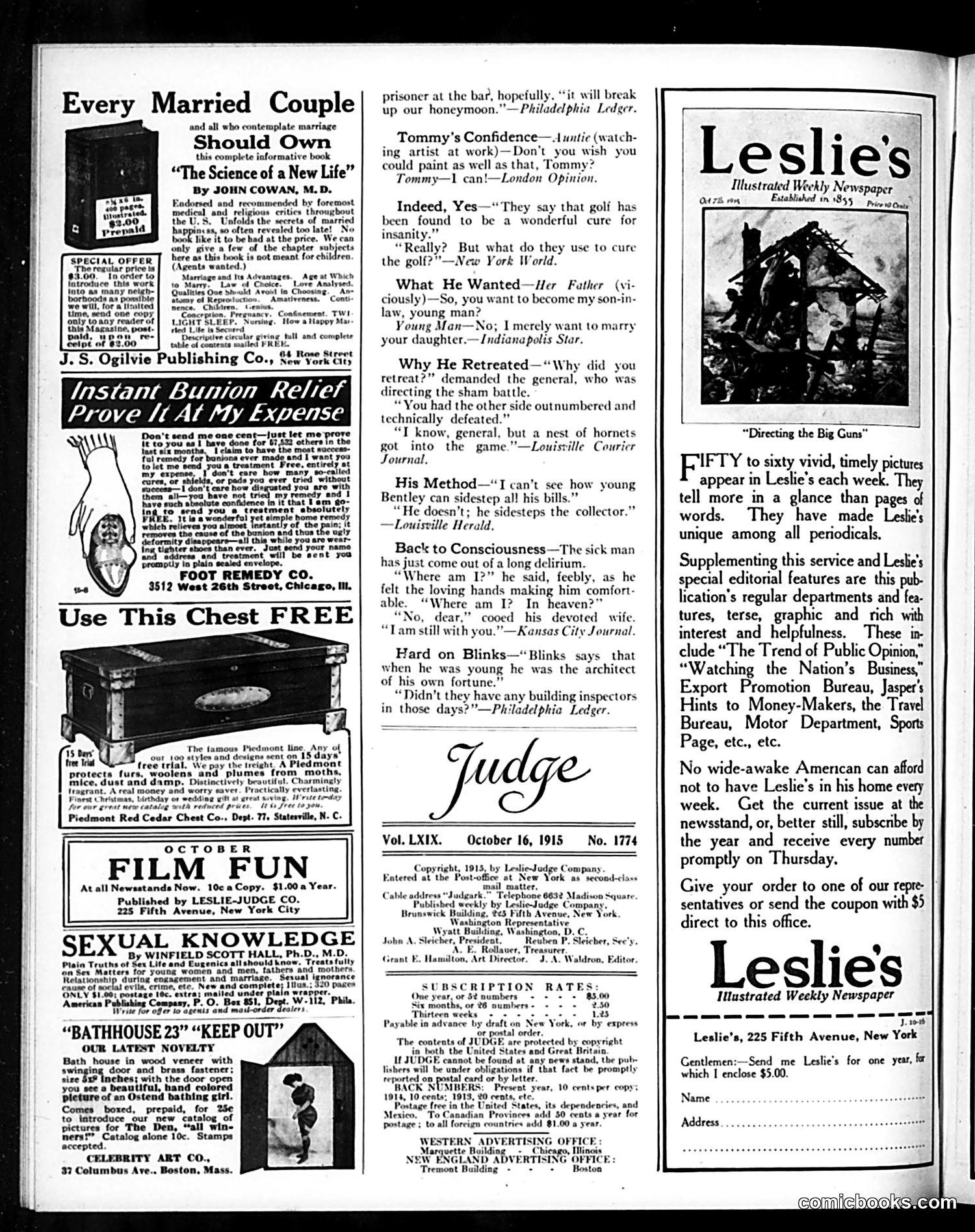
This page is primarily **advertisements and a collection of brief humor pieces**—no political cartoons requiring historical context. The humor pieces are lightweight observations about everyday life: jokes about golf curing insanity, a suitor clarifying he wants to marry the daughter (not become family), a soldier retreating from actual hornets during a war game, and a patient relieved to discover he's still alive (not in heaven). The advertisements promote marriage advice books, bunion relief, cedar chests for storing furs, and novelty items like a "bathhouse" peepshow toy—typical commercial fare for the era. **No significant political or social satire** appears here. The content reflects standard early-20th-century middlebrow magazine humor: mild domestic comedy and personal misadventures. The page serves primarily as a revenue vehicle through advertisements rather than editorial commentary.
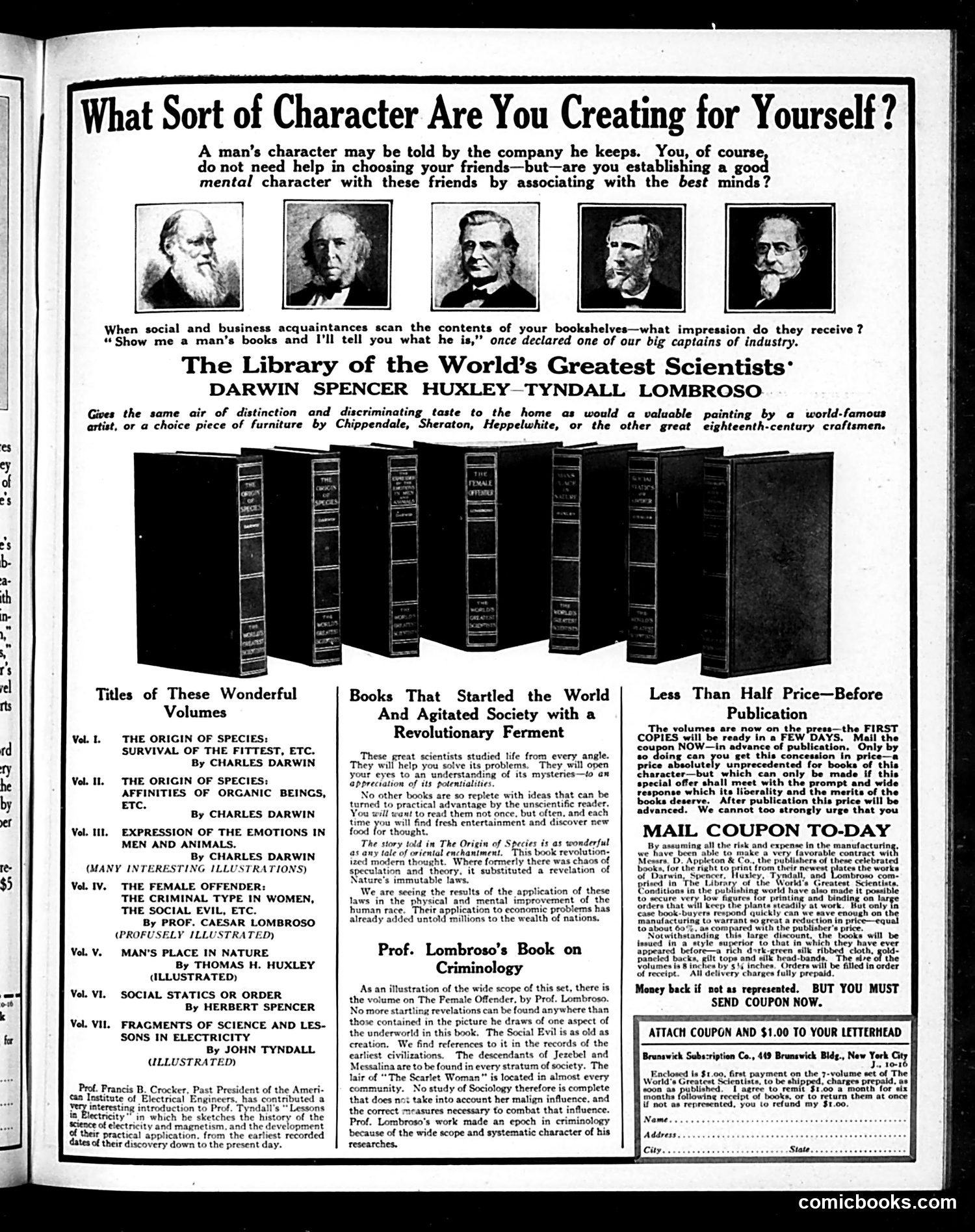
This is a **product advertisement** disguised as educational content, promoting "The Library of the World's Greatest Scientists"—a book set featuring Darwin, Spencer, Huxley, Tyndall, and Lombroso. The satire targets **social pretension**: the ad exploits Victorian anxieties about respectability by suggesting that owning these particular books signals intellectual sophistication and good character. The opening quote—"Show me a man's books and I'll tell you what he is"—implies that bookshelves function as status symbols that socially ambitious people use to impress visitors. The five portraits represent late 19th-century scientific authorities. However, the inclusion of **Lombroso** (an Italian criminologist known for pseudoscientific theories linking crime to heredity and physical characteristics) reveals the ad's irony: these weren't uniformly respected thinkers even then. The advertisement cynically exploits **evolutionary theory and social Darwinism**—popular but controversial ideas—to legitimize the set as "revolutionary." By framing book ownership as character-building, the ad satirizes how consumers manufacture respectability through consumption rather than genuine intellectual engagement.
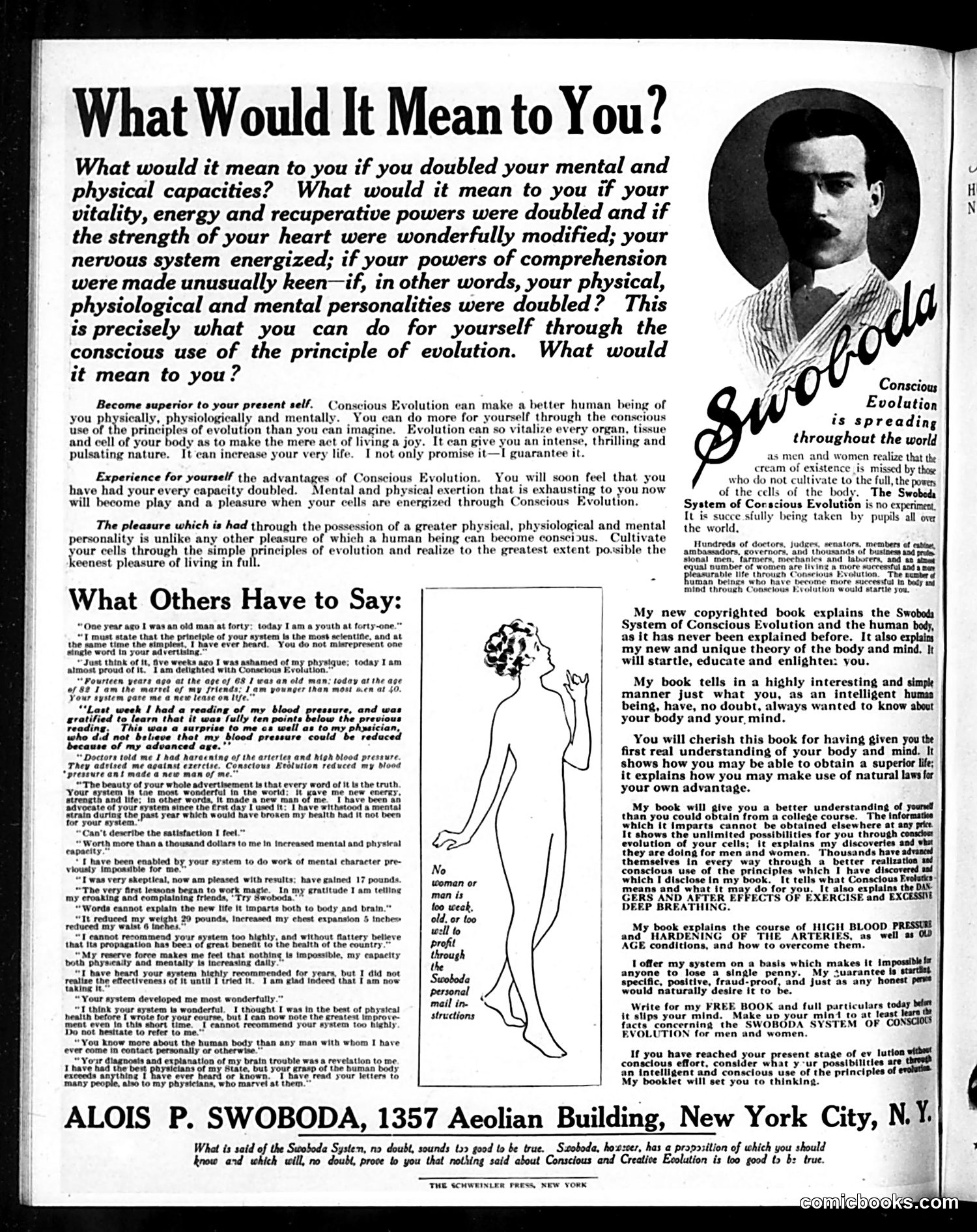
This page is primarily **advertising, not satire**—it promotes Alois P. Swoboda's "Conscious Evolution" system, a self-improvement program claiming to double one's physical and mental capacities through unnamed evolutionary principles. The content targets early 20th-century anxieties about vitality and success. The accompanying illustration of a nude female figure represents idealized physical perfection achievable through the system. The testimonials (presented as authentic endorsements) feature common advertising tropes: a 40-year-old claiming renewed youth, reports of increased strength and blood pressure reduction, and emphasis on business/professional benefits. **The satire**, if Judge magazine included any, likely mocked such pseudoscientific self-help claims that exploited widespread fears of aging and inadequacy. However, this particular page reads as straightforward paid promotion rather than satirical commentary—typical of early 20th-century magazines blending editorial content with substantial advertising.