
Judge, 1915-10-16 · page 6 of 28
Judge — October 16, 1915 — page 6: what you’re looking at
What you’re looking at
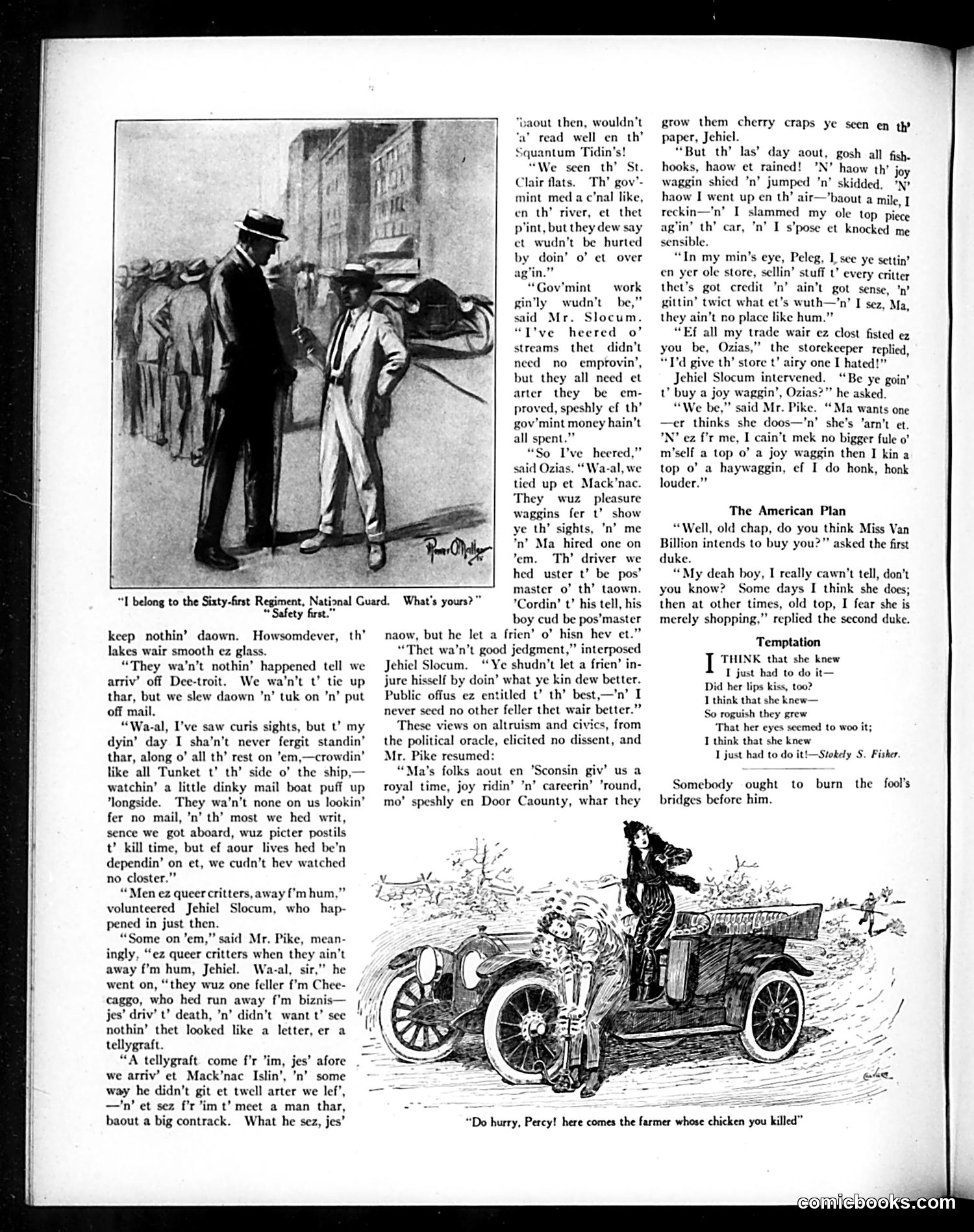
This page presents rural American dialect humor popular in early 20th-century satirical magazines. The main content features two conversational pieces: **Left side**: A dialogue between Mr. Pike and others discussing a mail delivery incident and government infrastructure projects (St. Clair flats canal work), with commentary on civic responsibility and public office. The satire targets corruption—a politician's son receiving a postmaster position through favoritism rather than merit. **Right side**: Two brief satirical sketches. "The American Plan" mocks wealthy American heiresses' marriages to foreign nobility, portraying a duke's uncertainty about marrying "Miss Van Billion" for her money rather than love. Above it, "Temptation" is a sentimental poem excerpt. **Visual elements**: Period photographs/illustrations accompany the text—one showing what appears to be a National Guard member, another depicting an early automobile. The overall tone exemplifies Judge's class-conscious humor, targeting both rural gullibility and urban aristocratic pretension through exaggerated dialect and romantic clichés.
📄 Transcribed text from this page (OCR, searchable)
Machine-transcribed from the original scan — historical spelling and the odd misread are preserved.
“paout then, wouldn't ‘a’ read well en th’ Squantum Tidin’s! “We seen th’ St. Clair flats. Th’ gov’ mint med a c’nal like, en th’ river, et thet p'int, but they dew say et wudn’t be hurted by doin’ o’ et over ag’in.” “Gov'mint — work gin'ly wudn’t be,” said Mr. Slocum. “I've heered 0’ streams thet didn’t need no emprovin’, but they all need et arter they be em- proved, speshly ef th’ gov’mint money hain’t all spent.” “So I’ve heered,” said Ozias. “Wa-al, we tied up et Mack’nac. They wuz pleasure waggins fer t’ show ye th’ sights, 'n’ me ’n’ Ma hired one on ’em. Th’ driver we hed uster t’ be po: anal Guard. What's yours?" keep nothin’ daown. Howsomdever, th’ lakes wair smooth ez glass. “They wa'n’t nothin’ happened tell we arriv’ off Dee-troit. We wa'n’t t’ tic up thar, but we slew daown 'n’ tuk on ’n’ put off mail. “Wa-al, I’ve saw curis sights, but t’ my dyin’ day I sha’n’t never fergit standin’ thar, along o’ all th’ rest on ’em,—crowdin’ like all Tunket t’ th’ side 0’ the ship,— watchin’ a little dinky mail boat puff up "longside. They wa'n’t none on us lookin’ fer no mail, ’n’ th’ most we hed writ, sence we got aboard, wuz picter postils t’ kill time, but ef aour lives hed be’n dependin’ on et, we cudn’t hev watched no closter.”” “Men ez queer critters, away f’m hum,” volunteered Jehiel Slocum, who hap- pened in just then. “Some on’em,” said Mr. Pike, mean- ingly, “ez queer critters when they ain’t away f’m hum, Jehiel. Wa-al, sir,” he went on, “they wuz one feller f’m Chee- caggo, who hed run away f'm biznis— jes’ driv’ U death, ’n’ didn’t want t’ see nothin’ thet looked like a letter, er a tellygraft. “A tellygraft. come f'r ‘im, jes’ afore we arriv’ et Mack’nac Islin’, ’n’ some way he didn’t git et twell arter we lef’, —'n’ et sez f'r’im t’ meet a man thar, baout a big contrack. What he sez, jes’ master o’ th’ taow ’Cordin’ t’ his tell, his boy cud be pos’master naow, but he let a frien’ 0’ hisn hev et.” “Thet wa’n’t good jedgment,” interposed Jehiel Slocum. “Ye shudn’t let a frien’ in- jure hisself by doin’ what ye kin dew better. Public offus ez entitled t’ th’ best,—'n’ I never seed no other feller thet wair better.” These views on altruism and civics, from the political oracle, elicited no dissent, and Mr. Pike resumed: “Ma's folks aout en 'Sconsin giv’ us a royal time, joy ridin’ ’n’ careerin’ ‘round, mo’ speshly en Door Caounty, whar they grow them cherry craps ye seen en th’ paper, Jehiel. “But th’ las’ day aout, gosh all fish. hooks, haow et rained! ’N’ haow th’ jo; waggin shied ’n’ jumped ’n’ skidded, y? haow I went up en th’ air—'baout a mile, | reckin—'n’ I slammed my ole top piece ag’in’ th’ car, ‘n’ I s’pose et knocked me sensible. “In my min’s eye, Peleg, 1 see ye settin’ en yer ole store, sellin’ stuff U every critter thet’s got credit ’n’ ‘t got sense, 'n’ gittin’ twict what et’s wuth—'n’ I sez, Ma, they ain’t no place like hum.” “Ef all my trade wair ez clost fisted ez you be, Ozias,” the storekeeper replied, “I'd give th’ store t’ airy one I hated!” Jehiel Slocum intervened. “Be ye goin’ buy a joy waggin’, Ozias?” he asked. * said Mr. Pike. “Ma wants one s she doos she’s ’arn’t et. * ez f'r me, I cain’t mek no bigger fule o” m'self a top o’ a joy waggin then I kin a top o’ a haywaggin, ef I do honk, honk louder. The American Plan “Well, old chap, do you think Miss Van Billion intends to buy you?” asked the first duke. “My deah boy, I really cawn’t tell, don't you know? Some days I think she does; then at other times, old top, I fear she is merely shopping,” replied the second duke. Temptation THINK that she knew I just had to do it— Did her lips kiss, too? I think that she knew— So roguish they grew ‘That her eyes seemed to woo it; I think that she knew I just had to do it!—Stokely S. Fisker. Somebody ought to burn the fool's bridges before him.