
Judge, 1915-10-16 · page 10 of 28
Judge — October 16, 1915 — page 10: what you’re looking at
What you’re looking at
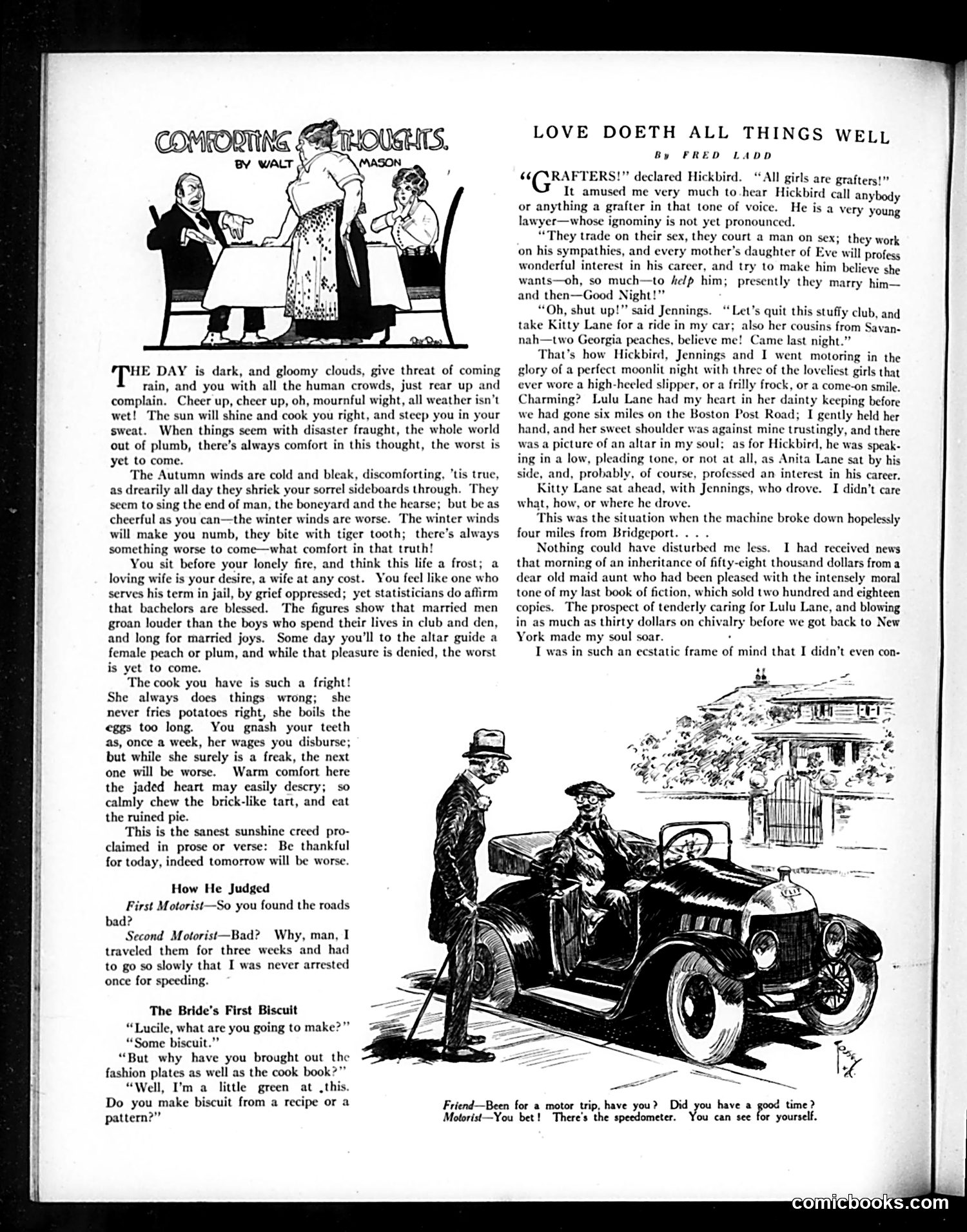
This page contains three distinct satirical pieces typical of early 20th-century humor: **"Comforting Thoughts"** (top left): A philosophical essay arguing that life's hardships are actually reassuring—because things could always be worse. The joke inverts typical complaint-culture by suggesting pessimism itself is comforting. **"How He Judged"** (bottom): A brief joke about motorists, where the humor relies on speeding culture. The "Second Motorist" brags he drove so slowly he wasn't arrested for speeding—mocking the common traffic violation of the era and suggesting the roads were so bad that safety was ironically enforced. **"The Bride's First Biscuit"** & **"Love Doeth All Things Well"**: Domestic humor. The biscuit joke mocks newlyweds' incompetence in cooking (a "pattern" rather than recipe suggests fashion-plate confusion). The longer story satirizes a young cynic's views on women as "grafters" who manipulate men—a period-typical skepticism about female motives that the narrative appears to challenge through romantic experience. The cartoons reinforce gender stereotypes common to the era.
📄 Transcribed text from this page (OCR, searchable)
Machine-transcribed from the original scan — historical spelling and the odd misread are preserved.
HE DAY is dark, and gloomy clouds, give threat of coming rain, and you with all the human crowds, just rear up and complain. Cheer up, cheer up, oh, mournful wight, all weather isn’t wet! The sun will shine and cook you right, and steep you in your sweat. When things seem with disaster fraught, the whole world out of plumb, there’s always comfort in this thought, the worst is yet to come, The Autumn winds are cold and bleak, discomforting, ‘tis true, as drearily all day they shriek your sorrel sideboards through. They seem to sing the end of man, the boneyard and the hearse; but be as cheerful as you can—the winter winds are worse. The winter winds will make you numb, they bite with tiger tooth; there’s always something worse to come—what comfort in that truth! You sit before your lonely fire, and think this life a frost; a loving wife is your desire, a wife at any cost. You feel like one who serves his term in jail, by grief oppressed; yet statisticians do affirm that bachelors are blessed. The figures show that married men groan louder than the boys who spend their lives in club and den, and long for married joys. Some day you'll to the altar guide a female peach or plum, and while that pleasure is denied, the worst is yet to come. The cook you have is such a fright! She always does things wrong; she never fries potatoes right, she boils the eggs too long. You gnash your teeth as, once a week, her wages you disburse; but while she surely is a freak, the next one will be worse. Warm comfort here the jaded heart may easily descry; so calmly chew the brick-like tart, and eat the ruined pie. This is the sanest sunshine creed pro- claimed in prose or verse: Be thankful for today, indeed tomorrow will be worse. How He Judged First Motorist—So you found the roads bad? Second Motorist—Bad? Why, man, I traveled them for three weeks and had to go so slowly that I was never arrested once for speeding. The Bride's First Biscuit “Lucile, what are you going to make? “Some biscuit.”” “But why have you brought out the fashion plates as well as the cook book?” “Well, I'm a little green at ,this. Do you make biscuit from a recipe or a pattern?” Motorist—You bet! There's the speedometer. LOVE DOETH ALL THINGS WELL By FRED LADD 66(XRAFTERS!” declared Hickbird. “All girls are grafters!” It amused me very much to-hear Hickbird call anybody or anything a grafter in that tone of voice. He is a very young lawyer—whose ignominy is not yet pronounced. . “They trade on their sex, they court a man on sex; they work on his sympathies, and every mother’s daughter of Eve will profess wonderful interest in his career, and try to make him believe she wants—oh, so much—to help him; presently they marry him— and then—Good Night!” “Oh, shut up!” said Jennings. “Let's quit this stuffy club, and take Kitty Lane for a ride in my car; also her cousins from Savan- nah—two Georgia peaches, believe me! Came last night.” That’s how Hickbird, Jennings and I went motoring in the glory of a perfect moonlit night with three of the loveliest girls that ever wore a high-heeled slipper, or a frilly frock, or a come-on smile. Charming? Lulu Lane had my heart in her dainty keeping before we had gone six miles on the Boston Post Road; I gently held her hand, and her sweet shoulder was nst mine trustingly, and there a picture of an altar in my soul: as for Hickbird, he was speak- a low, pleading tone, or not at all, as Anita Lane sat by his side, and, probably, of course, professed an interest in his career. Kitty Lane sat ahead, with Jennings, who drove. I didn’t care what, how, or where he drove. This was the situation when the machine broke down hopelessly four miles from Bridgeport. . . . Nothing could have disturbed me less. I had received news that morning of an inheritance of fifty-eight thousand dollars from a dear old maid aunt who had been pleased with the intensely moral tone of my last book of fiction, which sold two hundred and eighteen copies. The prospect of tenderly caring for Lulu Lane, and blowing in as much as thirty dollars on chivalry before we got back to New York made my soul soar. . I was in such an ecstatic frame of mind that I didn’t even con- Friend—Been for a motor trip, have you? Did you have a good time? ‘ou can see for yourself.